Last week, the Tehran Times noted that the Iranian oil bourse will start trading oil in currencies other than the dollar from March 20. This long-planned move is part of President Mahmoud Ahmadinejad’s vision of economic war with the west.
“The dispute over Iran’s nuclear programme is nothing more than a convenient excuse for the US to use threats to protect the 'reserve currency’ status of the dollar,” the newspaper, which calls itself the voice of the Islamic Revolution, said.
“Recall that Saddam [Hussein] announced Iraq would no longer accept dollars for oil purchases in November 2000 and the US-Anglo invasion occurred in March 2003,” the Times continued. “Similarly, Iran opened its oil bourse in 2008, so it is a credit to Iranian negotiating ability that the 'crisis’ has not come to a head long before now.”
Iran has the third-largest oil reserves in the world and pricing oil in currencies other than dollars is a provocative move aimed at Washington. If Iran switches to the non-dollar terms for its oil payments, there could be a new oil price that would be denominated in euro, yen or even the yuan or rupee.
India is already in talks with Iran over how it can pay for its oil in rupees.
Even more surprisingly, reports have suggested that India is even considering paying for its oil in gold bullion. However, it is more likely that the country will pay in rupees, a currency that is not freely convertible.
Last week, Indian state-owned group Hindustan Petroleum said that Indian businesses could not pay for Iranian crude imports in rupees unless the federal finance ministry exempted such payments from crippling withholding tax. This issue remains unresolved.
India and Iran have agreed – but not yet started – to settle 45pc of payments for Iranian oil in rupees. Iran will then use the currency to buy imports from India.
New Delhi currently spends about $12bn (£7.6bn) on Iranian oil each year, importing 12pc of the country’s needs from the country.
India pays for its oil in dollars, routed through a bank in Turkey after a previous mechanism was shut down in 2010. The Indian government has been resisting calls to stop importing oil from the pariah state.
“There have been problems with regard to Iran’s nuclear programme,” Manmohan Singh, India’s prime minister, said on Friday. “We sincerely believe that this issue can be and should be resolved by giving maximum scope to diplomacy.”
All of this means that the EU ban on Iranian oil imports, which comes into force on July 1, could hit Europe harder than it does Iran.
The country currently supplies 500,000 barrels of oil per day to the EU and there is a potential oil price spike in the offing should Iran pre-emptively stop the flow of oil to Europe, which it has threatened to do.
This could be disastrous to businesses that are already finding the economic climate tough.
“While Iran may be able to find markets for much of its oil output in Asia, the alternative sources of supply to Europe are still unclear,” Caroline Bain, a commodities analyst at the Economist Intelligence Unit, said.
“Until the supply outlook stabilises, the oil price is expected to continue to reflect this uncertainty rather than the likelihood of lower growth in global oil consumption in 2012.”
The worries are already sending ripples of concern around the world.
“While we have been listing the Iranian situation as a source of upside risk for a decade, there are some new factors that can make for a far more dangerous outcome, as the current drift of policy on both sides is creating the risk of a significant escalation,” Sudakshina Unnikrishnan, an analyst at Barclays Capital, said.
“Iran may close the Strait of Hormuz, causing an anticipated 50pc rise in crude oil prices, resulting in widespread economic havoc,” the Tehran Times columnist noted.
So the EU ban could be counter productive, as it keeps the oil price high. However, as long as President Ahmadinejad’s economic war doesn’t escalate into an actual war, we may manage to avoid a crippling oil spike

DAILY BUSINESS REPORT - Financial Updates, International Markets and Business News
February 13, 2012


February 12, 2012
Mortgage Settlement as Attorney General Sellout: Deal is Not Done, and Final Version Guaranteed to be Worse Than Advertised
You know it’s bad when banks are the most truthful guys in the room.
Remember that historical mortgage settlement deal that was the lead news story on Thursday? It has been widely depicted as a done deal. The various AGs who had been holdouts said their concerns had been satisfied.
But in fact, Bank of America’s press release said that the deal was “agreements in principle” as opposed to a final agreement. The Charlotte bank had to be more precise than politicians because it is subject to SEC regulations about the accuracy of its disclosures. And if you read the template for the AG press release carefully, you can see how it finesses where the pact stands. And today, American Banker confirmed that the settlement pact is far from done, and the details will be kept from the public as long as possible, until it is filed in Federal court (because it includes injunctive relief, a judge must bless the agreement).
This may not sound all that important to laypeople, but most negotiators and attorneys will react viscerally to how negligent the behavior of the AGs has been. The most common reaction among lawyers I know who been with white shoe firms (including former partners) is “shocking”. Let me explain why.
Negotiating of large, complex deals (or even little deals) does not happen in one fell swoop. Even when the two sides have outlined the major terms, and in sone cases hammered out the really important ones in some detail, there is still a great deal of negotiating that takes place in finalizing the text of the contract. The negotiation over the definitive agreement makes a great deal of difference on how fair the pact turns out to be. For instance, one of the sayings of transaction lawyers is “He who controls the document controls the deal.” The party that writes up the initial version of the contract has undue influence because that becomes the default and the other side has to negotiate back from that language.
As attorney Max Gardner said via e-mail (boldface ours):
I would never tell a client that I had settled a case or claim against a creditor until the ink was on the final written settlement agreement. I would of course advise the client of the verbal offer and secure the client’s acceptance but would always say something like “don’t spend any of the money because as Yogi might say it ain’t over until we have the signed agreement and their check has cleared my trust account.” An attorney would be guilty of serious ethical violations if he or she told a client we have a settlement with BoA and it is final before the deal was closed out by written agreement and in my bankruptcy practice the agreement was approved by the court. The AGs have said this agreement must be approved by a Federal District Court Judge so really why would you make such public announcements before at the least a written agreement signed and inked by ALL of the parties.
Why is it deeply troubling that the attorneys general have gone along with the Administration’s messaging and have all fallen in line with the “biggest Federal-state settlement ever” when no such settlement in fact exists? This isn’t just acceding to the Administration’s pet wish to build on its State of the Union PR. They’ve completely abandoned their negotiating leverage at a critical stage.
Let’s look at this equation. The Administration and the banks both want a pro-bank deal (the only minor point of difference is how much in populist gestures the banks have to submit to in order to get the much more valuable bennies they want). The only parties that cared to any degree about ordinary citizens were the dissident AGs. But they now have now given up any bargaining leverage over how this deal turns out.
The only power any party has in a negotiation is his threat to leave the bargaining table. The AGs can no longer do that. They’ve taken star turns, made ringing pronouncements of how great this pact is. They can’t possibly reverse themselves mere weeks down the road and say, whoops, this deal isn’t go great after all.
The AGs had to have known what they were doing in capitulating. Delaware’s Beau Biden was one of the most outspoken AGs after the Schneiderman destabilized the opposition by putting himself on the sidelines, making it clear he had not signed on when most other AGs remained silent. Yet in an interview with Dylan Ratigan early last week, he sounded as if the fight had been beaten out of him, that he was resigned to signing on to the agreement if he could preserve the MERS suit he had filed and add bank names to it later if the facts warranted. What sort of veiled or not so veiled threats did the Democratic party operatives make to get him to fall into line?
I hate using Biden as an example because he resisted down to the end. I don’t see how any seasoned attorney could possibly have misunderstood what he was giving up. Maybe the last holdouts felt even en bloc that they had no sway and even if they all stood aside, it would hurt them with little upside for their constituents. But agreeing to a pig in the poke would never be acceptable in the private sector, and the AGs can’t pretend not to know how outside the pale their conduct was.
We’ve seen an analogous process at work in the Dodd Frank bill. It was widely described as a “bill to come up with a bill,” with a lot of provisions either subjected to studies or kicked over to regulatory rulemaking to come up with a final version of the provision. The result has been that it has given the banks another go at the bill, and various media reports indicate that they’ve done a very good job in blunting the impact of many provisions.
Now some readers might argue that this analogy is unfair, that the mortgage settlement is much further along that Dodd Frank was. That might seem to be true. However, the attorneys general are not experts in securitization, and benign-sounding language can have implication that they don’t appreciate. And some of the responses from AG offices to simple questions suggest they are over their heads on this deal.
And the American Banker article indicates that the deal has a lot more points still open that the Administration’s victory lap would lead you to believe:
…a fully authorized, legally binding deal has not been inked yet….A representative for the North Carolina attorney general downplayed the significance of the document’s non-final status, saying that the terms were already fixed…
Other sources who spoke with American Banker raised doubts that everything is yet in place. A person familiar with the mortgage servicing pact says that a settlement term sheet does not yet exist. Instead, there are a series of nearly-complete documents that will be attached to a consent judgment eventually filed with the court. That truly final version will include things such as servicing standards, consumer relief options, legal releases, and enforcement terms. There will likely be separate state and a federal versions of the release…
Whatever the reason for the document’s continued non-appearance, the lack of a public final settlement is already the cause for disgruntlement among those who closely follow the banking industry. Quite simply, the actual terms of a settlement matter.
“The devil’s in the details,” says Ron Glancz, chairman of law firm Venable LLP’s Financial Services Group. “Until you see the document you’re never quite sure what your rights are.”…
And there is plenty more still to be worked out under all circumstances.
“Even once we get to the final terms, the servicers we’re told are going to be allowed to develop their own plans,” says NCLC’s Thompson. “They’re going to have three months to develop those from when the settlement is approved by the court. We are a long way in lots of ways from being able to kick the tires.
Now why the rush to get a photo op? I don’t buy that this was driven by election timing. A lot of studies show undecided voters make up their minds in the last month or at most two before the election. Big news is more effective closer to the election.
Maybe the Administration believes its own PR and thinks this measley program will help the housing market, or more important, secure the fealty of banks. But my guess is that the fact that 15 AGs concerned about the negotiations had met is what pushed the Administration into high gear. They did not want a meaningful, cohesive opposition forming. In addition, I am certain some evil genius in the Administration understood full well the value of destroying the AGs’ bargaining leverage before the final phase of negotiations.
Oh, and what about the other bombshell in the American Banker story:
American Banker asked The Department of Justice, the Department of Housing and Urban Development, and the offices of Attorneys General in Iowa, North Carolina and Colorado for a copy of the settlement last night. Only Iowa, North Carolina and the Department of Justice have responded, saying that the document would not be available until it is filed with the court on a yet-undetermined date.
Diane Thompson, an attorney with the National Consumer Law Center, said it was “unusual” that a settlement agreement had not been released. But the officialdom has gone further than that, and has said they won’t release the document until it has to be made public, via a Federal court filing.
Why would they choose to delay publicizing such important information? The most logical reason is they want it to be public the bare minimum amount of time possible prior to court approval, so as to give opponents (read aggrieved investors) the tightest window possible for filing motions opposing the pact. This deal was done within a very small group, and the two parties most affected, homeowners and investors, were and continue to be kept as far away from the process as possible.
And there are signs that AGs were really over their heads on this one, independent of the Administration’s gamesmanship. This was from reader LucyLulu:
Spoke yesterday with an associate of my attorney general yesterday and had a most frustrating conversation….
One of the many interesting tidbits she did share however (and I am unsure how reliable her info was) was that no investor owned modifications of loans would occur without first obtaining consent of the investors…I tried to nail down how this consent would be obtained, she was reluctant to provide details, just to say how consents from shareholders are normally obtained.
Now this may simply be an out-of-the loop staffer making things up, but another correspondent heard pretty much the same “we’ll get approvals” palaver from another AG’s office. I have to tell you, they most certainly WON’T obtain consents as they do in shareholder land (as in preparing and sending out proxies and soliciting votes on contested matters). Moreover, the standards for what level of approval is required varies by deal: some it’s a simple majority (presumably by par value), some require majority approval of each tranche, some require a supermajority (2/3 or even 75%). The Administration is likely to be taking the position that they don’t need consent in most deals if the mod is NPV positive. And given that they can pick the parameters that are most flattering (loan level v. portfolio level, discretion over time horizon chosen for measurement), I’d suspect that investor consent will not be obtained (unless investors start making serious noises, which seems less likely than it did last weekend).
Reader Mikent was correct when he called this deal a robosettlement. Just like its namesake, it’s more about getting it done than doing it right.
Remember that historical mortgage settlement deal that was the lead news story on Thursday? It has been widely depicted as a done deal. The various AGs who had been holdouts said their concerns had been satisfied.
But in fact, Bank of America’s press release said that the deal was “agreements in principle” as opposed to a final agreement. The Charlotte bank had to be more precise than politicians because it is subject to SEC regulations about the accuracy of its disclosures. And if you read the template for the AG press release carefully, you can see how it finesses where the pact stands. And today, American Banker confirmed that the settlement pact is far from done, and the details will be kept from the public as long as possible, until it is filed in Federal court (because it includes injunctive relief, a judge must bless the agreement).
This may not sound all that important to laypeople, but most negotiators and attorneys will react viscerally to how negligent the behavior of the AGs has been. The most common reaction among lawyers I know who been with white shoe firms (including former partners) is “shocking”. Let me explain why.
Negotiating of large, complex deals (or even little deals) does not happen in one fell swoop. Even when the two sides have outlined the major terms, and in sone cases hammered out the really important ones in some detail, there is still a great deal of negotiating that takes place in finalizing the text of the contract. The negotiation over the definitive agreement makes a great deal of difference on how fair the pact turns out to be. For instance, one of the sayings of transaction lawyers is “He who controls the document controls the deal.” The party that writes up the initial version of the contract has undue influence because that becomes the default and the other side has to negotiate back from that language.
As attorney Max Gardner said via e-mail (boldface ours):
I would never tell a client that I had settled a case or claim against a creditor until the ink was on the final written settlement agreement. I would of course advise the client of the verbal offer and secure the client’s acceptance but would always say something like “don’t spend any of the money because as Yogi might say it ain’t over until we have the signed agreement and their check has cleared my trust account.” An attorney would be guilty of serious ethical violations if he or she told a client we have a settlement with BoA and it is final before the deal was closed out by written agreement and in my bankruptcy practice the agreement was approved by the court. The AGs have said this agreement must be approved by a Federal District Court Judge so really why would you make such public announcements before at the least a written agreement signed and inked by ALL of the parties.
Why is it deeply troubling that the attorneys general have gone along with the Administration’s messaging and have all fallen in line with the “biggest Federal-state settlement ever” when no such settlement in fact exists? This isn’t just acceding to the Administration’s pet wish to build on its State of the Union PR. They’ve completely abandoned their negotiating leverage at a critical stage.
Let’s look at this equation. The Administration and the banks both want a pro-bank deal (the only minor point of difference is how much in populist gestures the banks have to submit to in order to get the much more valuable bennies they want). The only parties that cared to any degree about ordinary citizens were the dissident AGs. But they now have now given up any bargaining leverage over how this deal turns out.
The only power any party has in a negotiation is his threat to leave the bargaining table. The AGs can no longer do that. They’ve taken star turns, made ringing pronouncements of how great this pact is. They can’t possibly reverse themselves mere weeks down the road and say, whoops, this deal isn’t go great after all.
The AGs had to have known what they were doing in capitulating. Delaware’s Beau Biden was one of the most outspoken AGs after the Schneiderman destabilized the opposition by putting himself on the sidelines, making it clear he had not signed on when most other AGs remained silent. Yet in an interview with Dylan Ratigan early last week, he sounded as if the fight had been beaten out of him, that he was resigned to signing on to the agreement if he could preserve the MERS suit he had filed and add bank names to it later if the facts warranted. What sort of veiled or not so veiled threats did the Democratic party operatives make to get him to fall into line?
I hate using Biden as an example because he resisted down to the end. I don’t see how any seasoned attorney could possibly have misunderstood what he was giving up. Maybe the last holdouts felt even en bloc that they had no sway and even if they all stood aside, it would hurt them with little upside for their constituents. But agreeing to a pig in the poke would never be acceptable in the private sector, and the AGs can’t pretend not to know how outside the pale their conduct was.
We’ve seen an analogous process at work in the Dodd Frank bill. It was widely described as a “bill to come up with a bill,” with a lot of provisions either subjected to studies or kicked over to regulatory rulemaking to come up with a final version of the provision. The result has been that it has given the banks another go at the bill, and various media reports indicate that they’ve done a very good job in blunting the impact of many provisions.
Now some readers might argue that this analogy is unfair, that the mortgage settlement is much further along that Dodd Frank was. That might seem to be true. However, the attorneys general are not experts in securitization, and benign-sounding language can have implication that they don’t appreciate. And some of the responses from AG offices to simple questions suggest they are over their heads on this deal.
And the American Banker article indicates that the deal has a lot more points still open that the Administration’s victory lap would lead you to believe:
…a fully authorized, legally binding deal has not been inked yet….A representative for the North Carolina attorney general downplayed the significance of the document’s non-final status, saying that the terms were already fixed…
Other sources who spoke with American Banker raised doubts that everything is yet in place. A person familiar with the mortgage servicing pact says that a settlement term sheet does not yet exist. Instead, there are a series of nearly-complete documents that will be attached to a consent judgment eventually filed with the court. That truly final version will include things such as servicing standards, consumer relief options, legal releases, and enforcement terms. There will likely be separate state and a federal versions of the release…
Whatever the reason for the document’s continued non-appearance, the lack of a public final settlement is already the cause for disgruntlement among those who closely follow the banking industry. Quite simply, the actual terms of a settlement matter.
“The devil’s in the details,” says Ron Glancz, chairman of law firm Venable LLP’s Financial Services Group. “Until you see the document you’re never quite sure what your rights are.”…
And there is plenty more still to be worked out under all circumstances.
“Even once we get to the final terms, the servicers we’re told are going to be allowed to develop their own plans,” says NCLC’s Thompson. “They’re going to have three months to develop those from when the settlement is approved by the court. We are a long way in lots of ways from being able to kick the tires.
Now why the rush to get a photo op? I don’t buy that this was driven by election timing. A lot of studies show undecided voters make up their minds in the last month or at most two before the election. Big news is more effective closer to the election.
Maybe the Administration believes its own PR and thinks this measley program will help the housing market, or more important, secure the fealty of banks. But my guess is that the fact that 15 AGs concerned about the negotiations had met is what pushed the Administration into high gear. They did not want a meaningful, cohesive opposition forming. In addition, I am certain some evil genius in the Administration understood full well the value of destroying the AGs’ bargaining leverage before the final phase of negotiations.
Oh, and what about the other bombshell in the American Banker story:
American Banker asked The Department of Justice, the Department of Housing and Urban Development, and the offices of Attorneys General in Iowa, North Carolina and Colorado for a copy of the settlement last night. Only Iowa, North Carolina and the Department of Justice have responded, saying that the document would not be available until it is filed with the court on a yet-undetermined date.
Diane Thompson, an attorney with the National Consumer Law Center, said it was “unusual” that a settlement agreement had not been released. But the officialdom has gone further than that, and has said they won’t release the document until it has to be made public, via a Federal court filing.
Why would they choose to delay publicizing such important information? The most logical reason is they want it to be public the bare minimum amount of time possible prior to court approval, so as to give opponents (read aggrieved investors) the tightest window possible for filing motions opposing the pact. This deal was done within a very small group, and the two parties most affected, homeowners and investors, were and continue to be kept as far away from the process as possible.
And there are signs that AGs were really over their heads on this one, independent of the Administration’s gamesmanship. This was from reader LucyLulu:
Spoke yesterday with an associate of my attorney general yesterday and had a most frustrating conversation….
One of the many interesting tidbits she did share however (and I am unsure how reliable her info was) was that no investor owned modifications of loans would occur without first obtaining consent of the investors…I tried to nail down how this consent would be obtained, she was reluctant to provide details, just to say how consents from shareholders are normally obtained.
Now this may simply be an out-of-the loop staffer making things up, but another correspondent heard pretty much the same “we’ll get approvals” palaver from another AG’s office. I have to tell you, they most certainly WON’T obtain consents as they do in shareholder land (as in preparing and sending out proxies and soliciting votes on contested matters). Moreover, the standards for what level of approval is required varies by deal: some it’s a simple majority (presumably by par value), some require majority approval of each tranche, some require a supermajority (2/3 or even 75%). The Administration is likely to be taking the position that they don’t need consent in most deals if the mod is NPV positive. And given that they can pick the parameters that are most flattering (loan level v. portfolio level, discretion over time horizon chosen for measurement), I’d suspect that investor consent will not be obtained (unless investors start making serious noises, which seems less likely than it did last weekend).
Reader Mikent was correct when he called this deal a robosettlement. Just like its namesake, it’s more about getting it done than doing it right.
February 11, 2012
This Is What An Economic Depression Looks Like In The 21st Century
Do you want to see what a 21st century economic depression looks like? Just look at Greece. Once upon a time, the Greek economy was thriving, the Greek government was borrowing money like there was no tomorrow and Greek citizens were thoroughly enjoying the bubble of false prosperity that all that debt created. Those that warned that Greece was headed for a financial collapse were laughed at and were called "doom and gloomers". Well, nobody is laughing now. You see, the truth is that debt is a very cruel master. Greeks were able to live way beyond their means for many, many years but eventually a day of reckoning arrived. At this point, the Greek economy has been in a recession for five years in a row, and the economic crisis in that country is rapidly getting even worse. It was just recently announced that the overall rate of unemployment in Greece has soared above 20 percent and the youth unemployment rate has risen to an astounding 48 percent. One out of every five retail stores has been shut down and parents are literally abandoning children in the streets. The frightening thing is that this is just the beginning. Things are going to get a lot worse in Greece. And in case you haven't been paying attention, these kinds of conditions are coming to the United States as well. We are heading down the exact same road as Greece went down, and the economic pain that this country is eventually going to suffer is going to be beyond anything that most Americans would dare to imagine.
All debt spirals eventually come to an end. For years, Greece borrowed huge amounts of very cheap money, but there came a point when the debt became absolutely strangling and the rest of the world refused to lend the Greek government money at such cheap rates anymore.
Greece would have defaulted long before now if the EU and the IMF had not stepped in to bail them out. But along with those bailouts came strings. The EU and the IMF insisted that the Greek government cut spending and raise taxes.
Well, those spending cuts and tax increases caused the economy to slow down. Tax revenues decreased and deficit reduction targets were missed. So the EU and the IMF insisted on even more spending cuts and tax increases.
Even after all of the spending cuts and all of the tax increases that we have seen, the debt to GDP ratio in Greece is still higher than it was before the crisis began. Today, the Greek national debt is sitting at 142 percent of GDP.
Now the EU and the IMF are demanding even more austerity measures before they will release any more bailout money.
Needless to say, the Greek people are pretty much exasperated by all of this. They created this mess by going into so much debt, but they certainly don't like the solutions that are being imposed upon them.
Protesters in Greece are absolutely outraged that the EU and the IMF are now demanding a 22 percent reduction in the minimum wage.
Most families in Greece are just barely surviving at this point. Unfortunately, Greece is probably looking at depression conditions for many years to come.
Over the past three years, the size of the Greek economy has shrunk by 16 percent.
In 2012, it is being projected that the Greek economy will shrink by another 5 percent.
Sadly, that projection is probably way too optimistic.
Over the past couple of months, it has been like someone has pulled the rug out from under the Greek economy. Just check out the following numbers from an article in the Telegraph by Ambrose Evans-Pritchard....
Another normal day at the Hellenic Statistical Authority.
We learn that:
Greece's manufacturing output contracted by 15.5pc in December from a year earlier.
Industrial output fell 11.3pc, compared to minus 7.8pc in November.
Unemployment jumped to 20.9pc in November, up from 18.2pc a month earlier.
I have little further to add. This is what a death spiral looks like.
Can you imagine unemployment going up by 2.7 percent in one month?
This is what a 21st century economic depression looks like.
And needless to say, civil unrest is rampant in Greece.
The following is how a USA Today article described some of the protests that we saw in Greece this week....
Scores of youths, in hoods and gas masks, used sledge hammers to smash up marble paving stones in Athens' main Syntagma Square before hurling the rubble at riot police.
The country's two biggest labor unions stopped railway, ferry and public transport schedules, and hospitals worked on skeleton staff while most public services were disrupted. Unions were planning protests in Athens and other cities around midday.
Greek citizens are exasperated by the endless rounds of austerity that are being imposed upon them. They wonder how far all of this is going to go.
How much higher can taxes go in Greece? Greece already has tax rates that are among the highest in Europe....
Greece has the third highest rate of VAT in Europe, second highest gas/petrol tax, third highest tax on social insurance contributions, fifth highest VAT on alcohol, highest property tax and one of the worst corporate tax rates, without the quality of living or competitiveness to match.
How much farther can government pay be cut? Greek civil servants have had their incomes slashed by about 40 percent since 2010.
How would you feel if your pay was reduced by 40 percent?
Large numbers of Greeks are rapidly reaching the end of their ropes. The following is from a recent article in the Independent....
"People are scared and haven't really realised what's happening yet," George Pantsios, an electrician for the country's public power corporation, said. He has only been receiving half of his €850 monthly wage since August. "But once we all lose our jobs and can't feed our kids, that's when it'll go boom and we'll turn into Tahrir Square."
Instead of turning violent, others are simply giving in to despair. According to the Daily Mail, large numbers of Greek children are being abandoned because their parents simply cannot afford to take care of them anymore. The note that one mother left with her little toddler was absolutely heartbreaking....
One mother, it said, ran away after handing over her two-year-old daughter Natasha.
Four-year-old Anna was found by a teacher clutching a note that read: 'I will not be coming to pick up Anna today because I cannot afford to look after her. Please take good care of her. Sorry.'
Sadly, there are an increasing number of Greeks that are giving up on life entirely. The number of suicides in Greece rose by 40 percent during just one recent 12 month time period.
But we haven't even seen the worst in Greece yet. The worst is still yet to come.
And the people of Greece are going to get angrier and angrier and angrier.
According to one recent poll, about 90 percent all of Greeks are unhappy with the interim government led by Prime Minister Lucas Papademos.
This week, that government has started to fall apart. Over just the past few days, 6 members of the 48-member government cabinet have resigned. Not only is there real doubt if the new austerity measures will be approved, there is very real doubt if this government will be able to hold together much longer.
Frustration with the EU and the IMF has reached a fever pitch in Greece. Just check out what Reuters is reporting....
In a letter obtained by Reuters on Friday, the Federation of Greek Police accused the officials of "...blackmail, covertly abolishing or eroding democracy and national sovereignty" and said one target of its warrants would be the IMF's top official for Greece, Poul Thomsen.
So what is going to happen next in Greece?
The truth is that nobody knows.
But whatever kind of "deals" are reached, the reality is that nothing is going to keep Greece from continuing to experience depression-like conditions for quite some time.
Unfortunately, Greece is not an isolated case.
Portugal, Ireland, Italy and Spain are all going down the same path and Europe does not have enough money to bail all of them out.
To get an idea of how much money it would take to bail out the financially troubled nations of Europe, just check out this infographic that was recently posted on ZeroHedge.
A day of reckoning is coming for the United States as well. As CNBC recently noted, the U.S. debt problem is far worse than the European debt problem is.
That is why I have written over and over about the U.S. national debt and about how the U.S. government is spending too much money.
Right now, the U.S. government is still able to borrow gigantic mountains of very cheap money and is spending money as if tomorrow will never come.
Well, just like we saw in Greece, when debt gets out of control a day of great pain eventually arrives.
What we are watching unfold in Greece right now is coming to America.
You better get ready.
All debt spirals eventually come to an end. For years, Greece borrowed huge amounts of very cheap money, but there came a point when the debt became absolutely strangling and the rest of the world refused to lend the Greek government money at such cheap rates anymore.
Greece would have defaulted long before now if the EU and the IMF had not stepped in to bail them out. But along with those bailouts came strings. The EU and the IMF insisted that the Greek government cut spending and raise taxes.
Well, those spending cuts and tax increases caused the economy to slow down. Tax revenues decreased and deficit reduction targets were missed. So the EU and the IMF insisted on even more spending cuts and tax increases.
Even after all of the spending cuts and all of the tax increases that we have seen, the debt to GDP ratio in Greece is still higher than it was before the crisis began. Today, the Greek national debt is sitting at 142 percent of GDP.
Now the EU and the IMF are demanding even more austerity measures before they will release any more bailout money.
Needless to say, the Greek people are pretty much exasperated by all of this. They created this mess by going into so much debt, but they certainly don't like the solutions that are being imposed upon them.
Protesters in Greece are absolutely outraged that the EU and the IMF are now demanding a 22 percent reduction in the minimum wage.
Most families in Greece are just barely surviving at this point. Unfortunately, Greece is probably looking at depression conditions for many years to come.
Over the past three years, the size of the Greek economy has shrunk by 16 percent.
In 2012, it is being projected that the Greek economy will shrink by another 5 percent.
Sadly, that projection is probably way too optimistic.
Over the past couple of months, it has been like someone has pulled the rug out from under the Greek economy. Just check out the following numbers from an article in the Telegraph by Ambrose Evans-Pritchard....
Another normal day at the Hellenic Statistical Authority.
We learn that:
Greece's manufacturing output contracted by 15.5pc in December from a year earlier.
Industrial output fell 11.3pc, compared to minus 7.8pc in November.
Unemployment jumped to 20.9pc in November, up from 18.2pc a month earlier.
I have little further to add. This is what a death spiral looks like.
Can you imagine unemployment going up by 2.7 percent in one month?
This is what a 21st century economic depression looks like.
And needless to say, civil unrest is rampant in Greece.
The following is how a USA Today article described some of the protests that we saw in Greece this week....
Scores of youths, in hoods and gas masks, used sledge hammers to smash up marble paving stones in Athens' main Syntagma Square before hurling the rubble at riot police.
The country's two biggest labor unions stopped railway, ferry and public transport schedules, and hospitals worked on skeleton staff while most public services were disrupted. Unions were planning protests in Athens and other cities around midday.
Greek citizens are exasperated by the endless rounds of austerity that are being imposed upon them. They wonder how far all of this is going to go.
How much higher can taxes go in Greece? Greece already has tax rates that are among the highest in Europe....
Greece has the third highest rate of VAT in Europe, second highest gas/petrol tax, third highest tax on social insurance contributions, fifth highest VAT on alcohol, highest property tax and one of the worst corporate tax rates, without the quality of living or competitiveness to match.
How much farther can government pay be cut? Greek civil servants have had their incomes slashed by about 40 percent since 2010.
How would you feel if your pay was reduced by 40 percent?
Large numbers of Greeks are rapidly reaching the end of their ropes. The following is from a recent article in the Independent....
"People are scared and haven't really realised what's happening yet," George Pantsios, an electrician for the country's public power corporation, said. He has only been receiving half of his €850 monthly wage since August. "But once we all lose our jobs and can't feed our kids, that's when it'll go boom and we'll turn into Tahrir Square."
Instead of turning violent, others are simply giving in to despair. According to the Daily Mail, large numbers of Greek children are being abandoned because their parents simply cannot afford to take care of them anymore. The note that one mother left with her little toddler was absolutely heartbreaking....
One mother, it said, ran away after handing over her two-year-old daughter Natasha.
Four-year-old Anna was found by a teacher clutching a note that read: 'I will not be coming to pick up Anna today because I cannot afford to look after her. Please take good care of her. Sorry.'
Sadly, there are an increasing number of Greeks that are giving up on life entirely. The number of suicides in Greece rose by 40 percent during just one recent 12 month time period.
But we haven't even seen the worst in Greece yet. The worst is still yet to come.
And the people of Greece are going to get angrier and angrier and angrier.
According to one recent poll, about 90 percent all of Greeks are unhappy with the interim government led by Prime Minister Lucas Papademos.
This week, that government has started to fall apart. Over just the past few days, 6 members of the 48-member government cabinet have resigned. Not only is there real doubt if the new austerity measures will be approved, there is very real doubt if this government will be able to hold together much longer.
Frustration with the EU and the IMF has reached a fever pitch in Greece. Just check out what Reuters is reporting....
In a letter obtained by Reuters on Friday, the Federation of Greek Police accused the officials of "...blackmail, covertly abolishing or eroding democracy and national sovereignty" and said one target of its warrants would be the IMF's top official for Greece, Poul Thomsen.
So what is going to happen next in Greece?
The truth is that nobody knows.
But whatever kind of "deals" are reached, the reality is that nothing is going to keep Greece from continuing to experience depression-like conditions for quite some time.
Unfortunately, Greece is not an isolated case.
Portugal, Ireland, Italy and Spain are all going down the same path and Europe does not have enough money to bail all of them out.
To get an idea of how much money it would take to bail out the financially troubled nations of Europe, just check out this infographic that was recently posted on ZeroHedge.
A day of reckoning is coming for the United States as well. As CNBC recently noted, the U.S. debt problem is far worse than the European debt problem is.
That is why I have written over and over about the U.S. national debt and about how the U.S. government is spending too much money.
Right now, the U.S. government is still able to borrow gigantic mountains of very cheap money and is spending money as if tomorrow will never come.
Well, just like we saw in Greece, when debt gets out of control a day of great pain eventually arrives.
What we are watching unfold in Greece right now is coming to America.
You better get ready.
February 10, 2012
Is A Greek Uncontrollable Default Inevitable?
It seems our discussions on sovereign litigation 'arbitrage' and blocking stakes among foreign-law Greek bondholders is gathering some consensus among the smarter sell-side research shops. In a note today, recognizing the differences between Greek international-law bonds, Credit Suisse applies their rigorous game theory perspective to the EUR18bn of foreign-law bond holders and the implications on the PSI negotiations. As we have pointed out, and has been successfully traded in the last few weeks, they expect foreign-law bonds to trade at a premium to Greek-law government bonds (just as we also noted we see increasingly in Portuguese bond dispersion) not just for blocking stake possibilities but also as better hedge-protected CDS positions. CS points out that if CACs were introduced into Greek law bonds, this blocking stake in foreign-law bonds will create a much higher chance of a hard default credit event and while UK law bonds won't be protected from a hard default they will at least have CDS trigger protection. Finally, the hope of creating a true Prisoner's Dilemma (where standing alone/holding-out singularly is a sub-optimal strategy) fails dismally as each participant is aware that others (blocking stake foreign-law bond holders) will for sure not participate. Adding to this threat is the current low stress environment, set up by the ECB and its LTRO, which could encourage more 'aggressive' behavior by any player in the game creating higher chances of a hard default by Greece as Troika-deal confidence increases the bargaining power for heavier haircuts and thus - fewer willing participants. What a mess!

Credit Suisse: Greek International-Law Bonds
Based on our analysis, we expect Greek international law bonds to trade at a premium to Greek law government bonds. We think there is a higher chance that, at the single bond level, some of the holders of the former would not participate in a restructuring that could be enforced by the retroactive introduction of CACs into the latter since minority blocking stakes by the private sector might already be in place.
Furthermore, due to their higher CAC threshold it is probably easier for a private investor to build a blocking stake in one of the newer vintage type bonds, which we thus find more attractive.
In addition, if CACs were introduced retroactively for Greek law bonds, we believe there is a good chance that the threshold would need to be set at 66% (or lower) rather than 75%, since the banks have probably sold a large share of their holdings to either the public sector or to investors who do not need to participate in a voluntary PSI. The international law bonds with the 75% threshold should thus benefit on a relative basis.
However, if CACs were introduced into Greek law bonds and minority blocking stakes in international law bonds prevented a full participation by all holders, we would expect that the higher the proportion of private sector hold-outs, the higher the chance of a hard credit event would become.
Furthermore, if the Greek authorities decided to take the route of a hard default, for example, a failure to pay, we believe there is a good chance that the international law bonds would be subject to that as well. We suspect that English law may in the end not prove much recourse given Greece’s financial condition. A minority blocking stake is hence no hedge against a hard credit event, in our view – it merely minimizes the risk of taking a loss in a bond without the CDS triggering.
We do not know if the ECB holding of circa EUR45bn of GGBs includes international law bonds. Given the ECB’s unwillingness to participate in the PSI, we would expect it to sell its stake to participating (private or public) parties if there were a chance of preventing a minority blocking stake.
There is an interesting additional conclusion with regards to the tactic that we highlighted in our latest Flash, which could be designed to ensure a nearly universal take-up in a bond exchange as described by Mitu Gulati and Jeromin Zettelmeyer. In our opinion, this tactic only works if it turns out to be a true prisoners’ dilemma, in the sense that the parties that can decide to participate or not know that they will lose if the other parties choose to participate and one stands more or less alone as a single hold-out. However, the potential existence of blocking stakes and, importantly, the fact that the respective players might be aware of them, reduces the likelihood of anyone choosing to participate out of pure fear that the other players might do so. As a consequence, we believe a voluntary take up can only work if the result from participating becomes more lucrative – in other words, if what the private sector could receive in exchange for its bonds was somehow enhanced in value. Among other things, that could include seniority, legal and jurisdictional considerations. We also think that, as the private sector involvement becomes increasingly punitive, the risk of a non-cooperative strategy decreases, reducing the chance of a voluntary outcome.
Finally, we would like to point out that our Game Theory would suggest that the environment we currently observe, namely a low stress environment, is exactly the type where one would expect “aggressive” behaviour by any player. Therefore, we would not be surprised if a hard default by Greece (i.e., a default where relations with the core break down, endangering the ECB’s considerable additional exposure) is being contemplated a lot more than it was just a few months ago.

Credit Suisse: Greek International-Law Bonds
Based on our analysis, we expect Greek international law bonds to trade at a premium to Greek law government bonds. We think there is a higher chance that, at the single bond level, some of the holders of the former would not participate in a restructuring that could be enforced by the retroactive introduction of CACs into the latter since minority blocking stakes by the private sector might already be in place.
Furthermore, due to their higher CAC threshold it is probably easier for a private investor to build a blocking stake in one of the newer vintage type bonds, which we thus find more attractive.
In addition, if CACs were introduced retroactively for Greek law bonds, we believe there is a good chance that the threshold would need to be set at 66% (or lower) rather than 75%, since the banks have probably sold a large share of their holdings to either the public sector or to investors who do not need to participate in a voluntary PSI. The international law bonds with the 75% threshold should thus benefit on a relative basis.
However, if CACs were introduced into Greek law bonds and minority blocking stakes in international law bonds prevented a full participation by all holders, we would expect that the higher the proportion of private sector hold-outs, the higher the chance of a hard credit event would become.
Furthermore, if the Greek authorities decided to take the route of a hard default, for example, a failure to pay, we believe there is a good chance that the international law bonds would be subject to that as well. We suspect that English law may in the end not prove much recourse given Greece’s financial condition. A minority blocking stake is hence no hedge against a hard credit event, in our view – it merely minimizes the risk of taking a loss in a bond without the CDS triggering.
We do not know if the ECB holding of circa EUR45bn of GGBs includes international law bonds. Given the ECB’s unwillingness to participate in the PSI, we would expect it to sell its stake to participating (private or public) parties if there were a chance of preventing a minority blocking stake.
There is an interesting additional conclusion with regards to the tactic that we highlighted in our latest Flash, which could be designed to ensure a nearly universal take-up in a bond exchange as described by Mitu Gulati and Jeromin Zettelmeyer. In our opinion, this tactic only works if it turns out to be a true prisoners’ dilemma, in the sense that the parties that can decide to participate or not know that they will lose if the other parties choose to participate and one stands more or less alone as a single hold-out. However, the potential existence of blocking stakes and, importantly, the fact that the respective players might be aware of them, reduces the likelihood of anyone choosing to participate out of pure fear that the other players might do so. As a consequence, we believe a voluntary take up can only work if the result from participating becomes more lucrative – in other words, if what the private sector could receive in exchange for its bonds was somehow enhanced in value. Among other things, that could include seniority, legal and jurisdictional considerations. We also think that, as the private sector involvement becomes increasingly punitive, the risk of a non-cooperative strategy decreases, reducing the chance of a voluntary outcome.
Finally, we would like to point out that our Game Theory would suggest that the environment we currently observe, namely a low stress environment, is exactly the type where one would expect “aggressive” behaviour by any player. Therefore, we would not be surprised if a hard default by Greece (i.e., a default where relations with the core break down, endangering the ECB’s considerable additional exposure) is being contemplated a lot more than it was just a few months ago.
February 9, 2012
On 'Bleak' Street, Bosses in Cross Hairs
Wall Street's bleak bonus season just got bleaker at Goldman Sachs Group Inc. and Morgan Stanley, where it is becoming clear that traders aren't the only ones at risk of having their pay taken back. Their bosses are on the hook, too.
The Wall Street securities firms said they would seek to recover pay from any employee whose actions expose the firms to substantial financial or legal repercussions. The firms said the policy isn't new, but the disclosure shows the companies won't just go after the excessive risk-takers if bad trades hurt the firms' profits. The latest disclosures clarify for the first time that managers are on the line.
The companies disclosed the clawback policies separately in Securities and Exchange Commission filings in late January and early February, in connection with agreements they reached to end proxy fights being waged by the office that runs New York City's pension funds.
New York City Comptroller John Liu filed papers last year seeking to force the firms to strengthen their clawback policies.
The move comes at a touchy time on Wall Street, where pay is in decline after a year of mixed financial performance and stock-price declines. At Goldman Sachs, compensation and benefits dropped 21% from a year ago to $12.22 billion, taking per capita pay and perks down to $367,000, a level last seen in the financial crisis. The firm cut 2,400 jobs last year, joining roughly two dozen firms around the globe that plan to shed more than 100,000 positions.
"These two firms have set the standard for clawback policies in the banking industry," said Mr. Liu in a statement Tuesday. "We appreciate the dialogue we've had on this issue and will continue to call for them to disclose the amount of clawbacks if forthcoming regulation does not require it."
Goldman Sachs and Morgan Stanley declined to comment.
Though soft economic growth, volatile markets and tighter rules rank as bigger worries for most on Wall Street than clawbacks triggered by the actions of traders, it is hard to ignore the risk completely. UBS AG, Switzerland's largest bank by assets, said Tuesday that it will cut investment-bank bonuses 60% following a retrenchment that started after a London-based employee made unauthorized trades that cost the bank $2.3 billion.
Regulators have pressured banks to detail clawbacks in compensation agreements since the financial crisis, when, they contend, incentives encouraged Wall Street workers to overlook risk in pursuit of profit.
The banks said they adopted clawback policies but said little beyond that.
It is unclear how effective clawback policies have been in reining in risky behavior. Michael Deutsch, an employment lawyer who specializes in Wall Street pay, said that despite their prevalence, "the actual implementation of a clawback has been pretty rare."
Now, under pressure from shareholders such as the New York comptroller's office,
Goldman Sachs and Morgan Stanley are clarifying their stance. The shareholder group also made these demands on J.P. Morgan Chase & Co. The firm hasn't addressed the proposal.
Goldman Sachs and Morgan Stanley separately said they anticipate a new global regulation from the Basel Committee on Banking Supervision that requires they disclose aggregate dollar amounts clawed back in a given year.
"We believe clawbacks are a focus for our regulators," Goldman Sachs said in correspondence with the comptroller's office disclosed in an SEC filing.
In exchange for the clarifications, the shareholder group withdrew proxy proposals that called on the banks to broaden the scope of their policies, hold managers and supervisors accountable to clawbacks, and publicly disclose clawbacks.
In its proxy last year, Goldman said its clawback policy allowed for forfeiture of stock awards "in the event that conduct or judgment results in a restatement of the firm's financial statements or other significant harm to the firm's business." The firm also can claw back pay for misconduct that results in legal or reputational harm.
Morgan Stanley's proxy last year said clawbacks can be triggered for conduct leading to a restatement, a significant financial loss or other reputational harm.
It explicitly covers "a substantial loss on a trading position or other holding or any loss on a trading position or other holding where an employee operated outside the risk parameters" or where the employee was motivated by pay.
The Wall Street securities firms said they would seek to recover pay from any employee whose actions expose the firms to substantial financial or legal repercussions. The firms said the policy isn't new, but the disclosure shows the companies won't just go after the excessive risk-takers if bad trades hurt the firms' profits. The latest disclosures clarify for the first time that managers are on the line.
The companies disclosed the clawback policies separately in Securities and Exchange Commission filings in late January and early February, in connection with agreements they reached to end proxy fights being waged by the office that runs New York City's pension funds.
New York City Comptroller John Liu filed papers last year seeking to force the firms to strengthen their clawback policies.
The move comes at a touchy time on Wall Street, where pay is in decline after a year of mixed financial performance and stock-price declines. At Goldman Sachs, compensation and benefits dropped 21% from a year ago to $12.22 billion, taking per capita pay and perks down to $367,000, a level last seen in the financial crisis. The firm cut 2,400 jobs last year, joining roughly two dozen firms around the globe that plan to shed more than 100,000 positions.
"These two firms have set the standard for clawback policies in the banking industry," said Mr. Liu in a statement Tuesday. "We appreciate the dialogue we've had on this issue and will continue to call for them to disclose the amount of clawbacks if forthcoming regulation does not require it."
Goldman Sachs and Morgan Stanley declined to comment.
Though soft economic growth, volatile markets and tighter rules rank as bigger worries for most on Wall Street than clawbacks triggered by the actions of traders, it is hard to ignore the risk completely. UBS AG, Switzerland's largest bank by assets, said Tuesday that it will cut investment-bank bonuses 60% following a retrenchment that started after a London-based employee made unauthorized trades that cost the bank $2.3 billion.
Regulators have pressured banks to detail clawbacks in compensation agreements since the financial crisis, when, they contend, incentives encouraged Wall Street workers to overlook risk in pursuit of profit.
The banks said they adopted clawback policies but said little beyond that.
It is unclear how effective clawback policies have been in reining in risky behavior. Michael Deutsch, an employment lawyer who specializes in Wall Street pay, said that despite their prevalence, "the actual implementation of a clawback has been pretty rare."
Now, under pressure from shareholders such as the New York comptroller's office,
Goldman Sachs and Morgan Stanley are clarifying their stance. The shareholder group also made these demands on J.P. Morgan Chase & Co. The firm hasn't addressed the proposal.
Goldman Sachs and Morgan Stanley separately said they anticipate a new global regulation from the Basel Committee on Banking Supervision that requires they disclose aggregate dollar amounts clawed back in a given year.
"We believe clawbacks are a focus for our regulators," Goldman Sachs said in correspondence with the comptroller's office disclosed in an SEC filing.
In exchange for the clarifications, the shareholder group withdrew proxy proposals that called on the banks to broaden the scope of their policies, hold managers and supervisors accountable to clawbacks, and publicly disclose clawbacks.
In its proxy last year, Goldman said its clawback policy allowed for forfeiture of stock awards "in the event that conduct or judgment results in a restatement of the firm's financial statements or other significant harm to the firm's business." The firm also can claw back pay for misconduct that results in legal or reputational harm.
Morgan Stanley's proxy last year said clawbacks can be triggered for conduct leading to a restatement, a significant financial loss or other reputational harm.
It explicitly covers "a substantial loss on a trading position or other holding or any loss on a trading position or other holding where an employee operated outside the risk parameters" or where the employee was motivated by pay.
February 8, 2012
Perhaps Derivatives Deleveraging Is Fueling The Stock Market Rally
A mad scramble to avoid insolvency as Greek default becomes likely may be driving the rally in equities.
Deleveraging typically means selling assets to raise cash to meet margin calls or pay debts coming due. But there may be another twist to deleveraging that has fueled the manic market rally since late December. I am indebted to Peter C. of M3 Financial Sense for explaining this dynamic.
To understand this non-intuitive dynamic, let's start with a simple example of how options work. If this is new to you, please stay with me, your head will not explode.... at least for awhile.
An option is a financial instrument which grants you the right to buy X number of shares of a company at Y price (the strike price). One option controls 100 shares. An option is either a put (a bet the price will decline in the future) or a call (a bet the price will rise in the future).
An option is "in the money" when the stock price is above the call strike price or below the put strike price. For example, if you own one call option on Netflix (NFLX) at a strike price of $100, then your option is worth $2,900 ($29 per share) as of today because Netflix is trading for $129 per share. (There is also a time value in options, but let's leave that aside in this example.)
So if you bought 10,000 options on Netflix (NFLX), whomever sold you the options is obligated to deliver 1,000,000 shares of Netflix to you (at the strike price of the option) upon expiration of the option. If your option is "in the money" as in the above example, the specialist who sold you the options will hedge his position so he can meet the obligation.
If your options are just barely in the money, he might buy 250,000 shares of Netflix to cover his future obligation. As your option becomes ever more valuable, i.e. becomes deeper in the money, the specialist has to increase his hedge up to the full 1,000,000 shares that he is obligated to deliver to you upon expiration. That purchase of 750,000 shares to cover his bet will drive the price of Netflix up.
Here is an important point about options and derivatives. In theory, the number of options should equal the number of outstanding shares. If there are 1,000,000 shares of a stock outstanding, then there shouldn't be more than 10,000 options contracts written and sold.
In the parlance of options, these puts and calls are "covered," meaning there are enough shares available to "cover" the options, i.e. when the option expires, there are enough shares to meet the delivery obligations of actual shares. If a specialist sells options without holding the requisite number of actual shares to cover the options, then he will have to buy those shares as the delivery date looms. If the number of option contracts exceeds the number of available shares, then the rush to acquire those shares for delivery will spark a massive rally.
This is somewhat akin to the infamous "short-covering rallies" triggered when those who sold shares short have to buy shares to close their short positions.
Options and futures contracts are all marked to market at the close of every trading day. The price is thus transparent for all to see. Derivatives are not marked to market. That sort of requirement is evil, evil, evil and anti-capitalist--or so we are told by the financial cartels who profit from selling derivatives.
Derivatives can be sold in whatever quantity can be fobbed off to credulous buyers. This is how the world ends up with 700 gazillion dollars in notional derivatives.
Consider the debt of a sovereign state--for example, Greece. Just to keep things simple, let's say there are $100 billion of outstanding Greek bonds. Back in the good old days around 2009, the risk of Geece defaulting on that debt was considered low. Nonetheless, prudent owners of the debt bought insurance against default. The insurance is a derivative called a credit default swap (CDS).
The contract works somewhat like an option, in the sense that if a default occurs, the seller of the CDS must cover their contract by delivering the value promised in the CDS to its owner. If no default ever occurs, the financial institution that originated and sold the CDS gets to keep the hefty premium.
Nice. Since there are no limits on how many CDs I can write on Greek debt, why not sell more CDS? In fact, why not sell more CDS than there are Greek bonds?
As in our options example, in the normal course of things the number of CDS equals the outstanding bonds. In other words, the owners of the $100 billion in bonds would buy $100 billion in notional CDS insurance against default.
If Greece defaulted and the value of the bonds fell in half to $50 billion, the sellers of the CDS would owe the owners of the CDS $50 billion. (This is simplified, but you get the picture.) That was, after all, the bet: in exchange for this hefty premium, if Greece defaults then we will make good your horrendous losses.
But a funny thing happened on the way to the derivatives market: wise guys realized they weren't limited to selling CDS to the owners of Greek bonds--anyone could buy a CDS on Greek debt. So why not sell $1 trillion in CDS against Greek bonds? That's ten times the premium.
Some issuers hedged their bet by buying CDS issued by other institutions. These other institutions are the "counterparty", that is, the party who pays off the CDS I bought from them so I can pay off the owner of my CDS. Thus the derivatives market for Greek debt is a daisy-chain of counterparties, all planning to use the proceeds from the CDS they own to pay off the CDS they sold. It was a license to print money--until Greece defaults.
Yikes, now what? Just as in the classic film The Producers, where 100% of the proceeds of the Broadway play were promised to ten different investors, the CDS schemers reckoned the odds of a Greek default were effectively zero--"the E.U. will never let a member state default."
Ahem. Until they do. In The Producers, the schemers devised a play so odious, so bad and so repellent that they felt extremely confident it would close after one night for a tremendous loss--and they would get to keep the 10X oversubscribed investors' money. This was the same bet made by sellers of CDS on Greek debt--and on Italian, Portuguese, Spanish, Irish et al. debt as well.
Now that leaves the canny financiers in a pickle, as they owe various parties $1 trillion when $100 billion in Greek debt goes up in smoke.
Now we get to the deleveraging part. As I understand it, some of these CDS are written against various swaps or stock indices, meaning that the asset to be delivered upon default is ultimately a claim against stock indices, currencies, etc.
That means that those holding the CDS obligations have to acquire these assets so they can pay off their obligation when Greece defaults.
There is one more wrinkle. Many sellers of CDS protected themselves against any potential loss by buying a CDS originated by someone else. As noted in When Greece Defaults, the Credit Default Swap Dominoes Fall (February 4, 2012), this "can be likened to a pool of $100 bets leveraged off $5 in cash. If every bet is covered perfectly, then it's somewhat like $95 in bets being paid by passing $5 around--much like the famous email that depicts all debts in a small town being paid by the same $5."
But some players have issued more CDS than they bought as insurance, meaning that they will be unable to meet all their obligations. Everyone is depending on a host of counterparties to deliver, and now there is a growing fear that some counterparties will be unable to make good on their obligations.
That's how the dominoes topple. Prudent institutions aren't waiting around until the dominoes fall--they're buying the underlying assets so they can meet their CDS obligations. That's the only way not to topple into insolvency when the default causes CDS to be recognized as due and payable.
In this light, it's no wonder stocks have been rising. If even a modest percentage of CDS are tied to stock indices, then those deleveraging their derivatives positions must acquire the underlying assets. They can no longer count on all counterparties paying off as promised, and so they are raising cash and buying the underlying assets needed to make good their obligations.
The whole thing is a farce, just like The Producers. The moment the default is recognized, then all the CDS become due and payable, and it will only take handful of failed counterparties to bring the entire system down.
No wonder the Eurocrats and central bankers are twisting everyone's arms to accept a 70% loss--the alternative is a Greek default and the collapse of the banking cartel's profitable scheme. It is beyond absurd--what is a 70% loss but default? When banana republics default, their bondholders don't necessarily absorb a 70% loss. yet now, to "save" the despicably parastic shadow banking system and the "too big to fail" financial institutions, a default cannot be called a default: it is a "voluntary haircut."
Greece, please do the world a favor and openly default--right now, today. Declare a default and pay nothing. Force the shadow banking system to recognize a default and bring down the entire rotten heap of worm-eaten corruption.
At that point, there will be no reason to buy equities.
Deleveraging typically means selling assets to raise cash to meet margin calls or pay debts coming due. But there may be another twist to deleveraging that has fueled the manic market rally since late December. I am indebted to Peter C. of M3 Financial Sense for explaining this dynamic.
To understand this non-intuitive dynamic, let's start with a simple example of how options work. If this is new to you, please stay with me, your head will not explode.... at least for awhile.
An option is a financial instrument which grants you the right to buy X number of shares of a company at Y price (the strike price). One option controls 100 shares. An option is either a put (a bet the price will decline in the future) or a call (a bet the price will rise in the future).
An option is "in the money" when the stock price is above the call strike price or below the put strike price. For example, if you own one call option on Netflix (NFLX) at a strike price of $100, then your option is worth $2,900 ($29 per share) as of today because Netflix is trading for $129 per share. (There is also a time value in options, but let's leave that aside in this example.)
So if you bought 10,000 options on Netflix (NFLX), whomever sold you the options is obligated to deliver 1,000,000 shares of Netflix to you (at the strike price of the option) upon expiration of the option. If your option is "in the money" as in the above example, the specialist who sold you the options will hedge his position so he can meet the obligation.
If your options are just barely in the money, he might buy 250,000 shares of Netflix to cover his future obligation. As your option becomes ever more valuable, i.e. becomes deeper in the money, the specialist has to increase his hedge up to the full 1,000,000 shares that he is obligated to deliver to you upon expiration. That purchase of 750,000 shares to cover his bet will drive the price of Netflix up.
Here is an important point about options and derivatives. In theory, the number of options should equal the number of outstanding shares. If there are 1,000,000 shares of a stock outstanding, then there shouldn't be more than 10,000 options contracts written and sold.
In the parlance of options, these puts and calls are "covered," meaning there are enough shares available to "cover" the options, i.e. when the option expires, there are enough shares to meet the delivery obligations of actual shares. If a specialist sells options without holding the requisite number of actual shares to cover the options, then he will have to buy those shares as the delivery date looms. If the number of option contracts exceeds the number of available shares, then the rush to acquire those shares for delivery will spark a massive rally.
This is somewhat akin to the infamous "short-covering rallies" triggered when those who sold shares short have to buy shares to close their short positions.
Options and futures contracts are all marked to market at the close of every trading day. The price is thus transparent for all to see. Derivatives are not marked to market. That sort of requirement is evil, evil, evil and anti-capitalist--or so we are told by the financial cartels who profit from selling derivatives.
Derivatives can be sold in whatever quantity can be fobbed off to credulous buyers. This is how the world ends up with 700 gazillion dollars in notional derivatives.
Consider the debt of a sovereign state--for example, Greece. Just to keep things simple, let's say there are $100 billion of outstanding Greek bonds. Back in the good old days around 2009, the risk of Geece defaulting on that debt was considered low. Nonetheless, prudent owners of the debt bought insurance against default. The insurance is a derivative called a credit default swap (CDS).
The contract works somewhat like an option, in the sense that if a default occurs, the seller of the CDS must cover their contract by delivering the value promised in the CDS to its owner. If no default ever occurs, the financial institution that originated and sold the CDS gets to keep the hefty premium.
Nice. Since there are no limits on how many CDs I can write on Greek debt, why not sell more CDS? In fact, why not sell more CDS than there are Greek bonds?
As in our options example, in the normal course of things the number of CDS equals the outstanding bonds. In other words, the owners of the $100 billion in bonds would buy $100 billion in notional CDS insurance against default.
If Greece defaulted and the value of the bonds fell in half to $50 billion, the sellers of the CDS would owe the owners of the CDS $50 billion. (This is simplified, but you get the picture.) That was, after all, the bet: in exchange for this hefty premium, if Greece defaults then we will make good your horrendous losses.
But a funny thing happened on the way to the derivatives market: wise guys realized they weren't limited to selling CDS to the owners of Greek bonds--anyone could buy a CDS on Greek debt. So why not sell $1 trillion in CDS against Greek bonds? That's ten times the premium.
Some issuers hedged their bet by buying CDS issued by other institutions. These other institutions are the "counterparty", that is, the party who pays off the CDS I bought from them so I can pay off the owner of my CDS. Thus the derivatives market for Greek debt is a daisy-chain of counterparties, all planning to use the proceeds from the CDS they own to pay off the CDS they sold. It was a license to print money--until Greece defaults.
Yikes, now what? Just as in the classic film The Producers, where 100% of the proceeds of the Broadway play were promised to ten different investors, the CDS schemers reckoned the odds of a Greek default were effectively zero--"the E.U. will never let a member state default."
Ahem. Until they do. In The Producers, the schemers devised a play so odious, so bad and so repellent that they felt extremely confident it would close after one night for a tremendous loss--and they would get to keep the 10X oversubscribed investors' money. This was the same bet made by sellers of CDS on Greek debt--and on Italian, Portuguese, Spanish, Irish et al. debt as well.
Now that leaves the canny financiers in a pickle, as they owe various parties $1 trillion when $100 billion in Greek debt goes up in smoke.
Now we get to the deleveraging part. As I understand it, some of these CDS are written against various swaps or stock indices, meaning that the asset to be delivered upon default is ultimately a claim against stock indices, currencies, etc.
That means that those holding the CDS obligations have to acquire these assets so they can pay off their obligation when Greece defaults.
There is one more wrinkle. Many sellers of CDS protected themselves against any potential loss by buying a CDS originated by someone else. As noted in When Greece Defaults, the Credit Default Swap Dominoes Fall (February 4, 2012), this "can be likened to a pool of $100 bets leveraged off $5 in cash. If every bet is covered perfectly, then it's somewhat like $95 in bets being paid by passing $5 around--much like the famous email that depicts all debts in a small town being paid by the same $5."
But some players have issued more CDS than they bought as insurance, meaning that they will be unable to meet all their obligations. Everyone is depending on a host of counterparties to deliver, and now there is a growing fear that some counterparties will be unable to make good on their obligations.
That's how the dominoes topple. Prudent institutions aren't waiting around until the dominoes fall--they're buying the underlying assets so they can meet their CDS obligations. That's the only way not to topple into insolvency when the default causes CDS to be recognized as due and payable.
In this light, it's no wonder stocks have been rising. If even a modest percentage of CDS are tied to stock indices, then those deleveraging their derivatives positions must acquire the underlying assets. They can no longer count on all counterparties paying off as promised, and so they are raising cash and buying the underlying assets needed to make good their obligations.
The whole thing is a farce, just like The Producers. The moment the default is recognized, then all the CDS become due and payable, and it will only take handful of failed counterparties to bring the entire system down.
No wonder the Eurocrats and central bankers are twisting everyone's arms to accept a 70% loss--the alternative is a Greek default and the collapse of the banking cartel's profitable scheme. It is beyond absurd--what is a 70% loss but default? When banana republics default, their bondholders don't necessarily absorb a 70% loss. yet now, to "save" the despicably parastic shadow banking system and the "too big to fail" financial institutions, a default cannot be called a default: it is a "voluntary haircut."
Greece, please do the world a favor and openly default--right now, today. Declare a default and pay nothing. Force the shadow banking system to recognize a default and bring down the entire rotten heap of worm-eaten corruption.
At that point, there will be no reason to buy equities.
February 7, 2012
1 Million Households Could See Mortgage Reduced By Average Of $20,000 In Foreclosure Settlement
California and New York, the key holdouts in a long-awaited settlement over foreclosure abuses, moved closer Monday to backing a deal that would force the five largest mortgage lenders to reduce loans for about 1 million households. More than 40 U.S. states have agreed to a nationwide settlement.
California still has "significant sticking points," but they may be settled in the coming days, said officials with direct knowledge of the negotiations. That represents progress from a few weeks ago, when California Attorney General Kamala Harris called the proposed settlement "inadequate."
The officials spoke on condition of anonymity because they weren't authorized to discuss the settlement publicly.
"I'm less concerned with the timeline than the details," Harris said in a statement Monday.
Negotiators worked well into Monday night to see if they could persuade more states to join the settlement, an official said. There is growing optimism that California, New York, Delaware, Nevada and a few others will eventually sign on.
"Federal and state officials, as well as representatives from the banks, continue to address matters that they must complete before finalizing any settlement," said Iowa Attorney General Tom Miller, who is leading the 50-state talks.
Homeowners in states that opt out of the deal wouldn't share in the settlement money. The money available to homeowners could run as high as $25 billion if all states approve the deal.
The reduced loans would benefit homeowners who are behind on their payments and owe more than their homes are worth. The lenders would also send checks for about $2,000 to hundreds of thousands of people who lost homes to foreclosure.
The five lenders — Bank of America, JPMorgan Chase, Wells Fargo, Citigroup and Ally Financial — have already agreed to the settlement. In settling the charges, the states would agree not to pursue further investigations against the banks in civil court. The deal would not protect the banks from criminal investigations.
The few states that have resisted the deal have expressed concern that it would limit their ability to take action against the banks for any past wrongdoing that turns up later.
California's backing is particularly crucial. It was among the states hardest hit by the foreclosure crisis. And it has the most residents "underwater": They owe more on their loan than their home is worth. Without California's participation, the money available to homeowners nationally would be about $19 billion rather than $25 billion.
The settlement has been toughened in recent days to allow states to pursue lenders who mistreat borrowers in the future. Fines could run as high as $5 million per violation.
Under the deal, the mortgage principal for about 1 million homeowners would be written down by an average of $20,000. An additional 750,000 Americans — about half the households eligible for aid under the deal — would receive about $2,000.
David Stevens, CEO of the Mortgage Bankers Association and a former Obama administration housing official, said the deal would ease lending restrictions for new loans and aid homeowners at risk of foreclosure.
"This will have a role in providing certainty to the (financial) markets about credit being eased and homeowners getting some money back," Stevens said.
Still, several housing and community organizations have complained that the settlement wouldn't go far enough.
George Goehl of the National People's Action, a collection of community housing groups, said $25 billion for homeowners would be a "paltry down payment," considering that roughly 11 million homes are underwater by a combined $750 billion.
"Anything less than $300 billion is a win for the 1 percent that lets the banks off too easily and falls short of helping both middle-class families and communities targeted most by big bank fraud," Goehl said.
But if California and New York agree to the deal, other holdouts, including Arizona and Nevada, would likely follow suit.
"My office is continuing to review the intricate draft settlement terms and advocating for improvements to address Nevada's needs," Nevada Attorney General Catherine Cortez Masto said in a statement.
Delaware might not. Attorney General Beau Biden has said he still has concerns about the settlement "as currently constructed," he said in a statement.
"We are continuing to review the complicated documents that we received a week ago, and are continuing to advocate for improvements to address our concerns," Biden said.
The settlement would end a painful chapter that emerged from the 2008 financial crisis, when home values sank and millions edged toward foreclosure. Many companies that process foreclosures failed to verify documents. Some employees signed papers they hadn't read or used fake signatures to speed foreclosures — an action known as robo-signing.
The agreement also promises to reshape long-standing mortgage lending guidelines. It would make it easier for those at risk of foreclosure to make their payments and keep their homes.
Those who lost their homes to foreclosure are unlikely to get their homes back or benefit much financially from the settlement.
The settlement would apply only to privately held mortgages issued from 2008 through 2011. Banks own about half of all U.S. mortgages — roughly 31 million loans.
The deal is subject to approval by a federal judge.
California still has "significant sticking points," but they may be settled in the coming days, said officials with direct knowledge of the negotiations. That represents progress from a few weeks ago, when California Attorney General Kamala Harris called the proposed settlement "inadequate."
The officials spoke on condition of anonymity because they weren't authorized to discuss the settlement publicly.
"I'm less concerned with the timeline than the details," Harris said in a statement Monday.
Negotiators worked well into Monday night to see if they could persuade more states to join the settlement, an official said. There is growing optimism that California, New York, Delaware, Nevada and a few others will eventually sign on.
"Federal and state officials, as well as representatives from the banks, continue to address matters that they must complete before finalizing any settlement," said Iowa Attorney General Tom Miller, who is leading the 50-state talks.
Homeowners in states that opt out of the deal wouldn't share in the settlement money. The money available to homeowners could run as high as $25 billion if all states approve the deal.
The reduced loans would benefit homeowners who are behind on their payments and owe more than their homes are worth. The lenders would also send checks for about $2,000 to hundreds of thousands of people who lost homes to foreclosure.
The five lenders — Bank of America, JPMorgan Chase, Wells Fargo, Citigroup and Ally Financial — have already agreed to the settlement. In settling the charges, the states would agree not to pursue further investigations against the banks in civil court. The deal would not protect the banks from criminal investigations.
The few states that have resisted the deal have expressed concern that it would limit their ability to take action against the banks for any past wrongdoing that turns up later.
California's backing is particularly crucial. It was among the states hardest hit by the foreclosure crisis. And it has the most residents "underwater": They owe more on their loan than their home is worth. Without California's participation, the money available to homeowners nationally would be about $19 billion rather than $25 billion.
The settlement has been toughened in recent days to allow states to pursue lenders who mistreat borrowers in the future. Fines could run as high as $5 million per violation.
Under the deal, the mortgage principal for about 1 million homeowners would be written down by an average of $20,000. An additional 750,000 Americans — about half the households eligible for aid under the deal — would receive about $2,000.
David Stevens, CEO of the Mortgage Bankers Association and a former Obama administration housing official, said the deal would ease lending restrictions for new loans and aid homeowners at risk of foreclosure.
"This will have a role in providing certainty to the (financial) markets about credit being eased and homeowners getting some money back," Stevens said.
Still, several housing and community organizations have complained that the settlement wouldn't go far enough.
George Goehl of the National People's Action, a collection of community housing groups, said $25 billion for homeowners would be a "paltry down payment," considering that roughly 11 million homes are underwater by a combined $750 billion.
"Anything less than $300 billion is a win for the 1 percent that lets the banks off too easily and falls short of helping both middle-class families and communities targeted most by big bank fraud," Goehl said.
But if California and New York agree to the deal, other holdouts, including Arizona and Nevada, would likely follow suit.
"My office is continuing to review the intricate draft settlement terms and advocating for improvements to address Nevada's needs," Nevada Attorney General Catherine Cortez Masto said in a statement.
Delaware might not. Attorney General Beau Biden has said he still has concerns about the settlement "as currently constructed," he said in a statement.
"We are continuing to review the complicated documents that we received a week ago, and are continuing to advocate for improvements to address our concerns," Biden said.
The settlement would end a painful chapter that emerged from the 2008 financial crisis, when home values sank and millions edged toward foreclosure. Many companies that process foreclosures failed to verify documents. Some employees signed papers they hadn't read or used fake signatures to speed foreclosures — an action known as robo-signing.
The agreement also promises to reshape long-standing mortgage lending guidelines. It would make it easier for those at risk of foreclosure to make their payments and keep their homes.
Those who lost their homes to foreclosure are unlikely to get their homes back or benefit much financially from the settlement.
The settlement would apply only to privately held mortgages issued from 2008 through 2011. Banks own about half of all U.S. mortgages — roughly 31 million loans.
The deal is subject to approval by a federal judge.
February 6, 2012
More on the Role of Second Liens and the Mortgage Settlement as Stealth Bank Bailout
Readers who missed the post over the weekend entitled, “Schneiderman MERS Suit and HUD’s Donovan Remarks Confirm That Mortgage “Settlement” is a Stealth Bank Bailout,” since it provides important background and context for this piece, which clarifies some issues I skipped over.
To give a brief recap of the post: both a small group discussion with Shaun Donovan (reported by Dave Dayen of Firedoglake and separately by Shahien Nasirpour of the Financial Times) and the Schneiderman MERS lawsuit on Friday confirm our previously-stated hypothesis that the settlement is really a transfer from mortgage investors to banks. That is why the banks remain willing to participate as the release has been whittled down to appease the formerly dissenting attorneys general (remember, the old reason for the banks to go along was that it was a cash for release deal: the banks were willing to pay hard money to get a significant waiver of liability).
The reason this settlement amounts to a transfer is the banks will be given credit towards the total reported value of the settlement for modifying mortgages that they do not own, meaning that economic loss will be borne by investors. Servicers have an obvious incentive to shift losses onto other parties whenever possible, and so the only principal mods they are likely to do of loans they own are one they would have done anyhow.
In addition, default rates are higher among borrowers with second liens, and second liens are almost entirely held on bank balance sheets. Which banks? Oh, the ones that happen to be the four biggest servicers: Bank of America, Citigroup, JP Morgan, and Wells. And those second lien holdings are collectively in the hundreds of billions. Were they written down to the degree that some mortgage investors argue is warranted, it would reveal that these banks were seriously undercapitalized.
As we stressed, this plan is a serious violation of property rights (not that that should be any surprise at this point). The creditor hierarchy is clear: second liens should be written off in their entirety before first liens are touched. Yet we also linked to evidence in the post from top mortgage analyst Laurie Goodman that servicers were already doing everything they could to favor their second liens over firsts. This settlement would give official sanction to this practice.
I also want to flag, a second time, an appalling throwaway comment in a New York Times update tonight:
The settlement, if all states participate, will also include $3 billion to lower the rates of mortgage holders who are current.
Huh? The banks have an explicit obligation to service the loans for the benefit of the certificate holders, meaning the investors. There is NO economic rationale, none, for reducing interest charges to borrowers who are current (unless they are under financial duress and at risk of delinquency/default). This is a bribe to prevent complaints by borrowers who pay on time and are in “beggar thy neighbor” mode.
I did want to clarify a possible misimpression I suspect I created in my Sunday post. By inveighing against a transfer from first lienholders (investors in mortgage bonds not owned by banks) I may have left reader thinking the Powers That Be will not touch second liens at all in the agreement. That isn’t true. We highlighted in an earlier post on Nevada attorney general Catherine Cortez Masto’s letter which raised questions about the pact that there were some provisions about second liens. I didn’t discuss them in detail because it is a bit of a Plato’s cave exercise. But as we indicated, anything short of wiping out the seconds before the firsts is simply not defensible (the second liens, which are overwhelmingly home equity lines of credit, got higher interest rates precisely because they were higher risk). And from what we can infer, the provisions in the agreement, at least at the time of the Masto letter, are smokescreens to cover the goring of investor oxen.
Let’s look at the questions Masto asked related to second liens:
This suggests that there is a requirement to modify (note modify rather than extinguish) a second lien when a first is modified. Given the desire to assist banks while trying to maintain a fiction of “fairness,” I’d expect this provision to set forth some sort of parallel treatment, for instance, that a 10% principal mod on a first mortgage must be accompanied by a 10% reduction on a second. Since the dollar amounts involved in first mortgages considerably exceed those in seconds, the first lienholder would still take the bigger writedown in dollar terms, and the second lienholder will benefit by the borrower having greater ability to pay.
I’d assume the answer to be “yes” unless the provisions regarding second liens meant to be a joke. Virtually all of the bank-owned second liens are home equity lines of credit.
I can’t infer the implications of 34.2, so if you have any good guesses, please pipe up in comments.
On 33.2, the point in the settlement, of writing off second liens more than 180 days delinquent, is largely meaningless. As we indicated, banks keep insisting that their seconds are current, and that’s because they can make them so.
First, as we have recounted, these liens actually have a lot in common with credit cards, in that banks will allow stressed borrowers to pay only the interest due and amortize the loan. We’ve even been told banks will reduced the payment on a loan about to go delinquent, take a token payment, and deem the loan to be current. Banks can also increase the home equity credit line, which means borrowers can simply borrow more to make their payments.
The result is that the banks report a much larger portion of their second liens are current than would actually be categorized as current if they were required to define current on a fully amortized basis. Moreover, they are not required to write down these loans, which are mostly held in their “held to maturity” books even when the first lien is defaulted or in a significant negative equity condition (remember, unless there is equity in the house, an uncured default on the first means foreclosure, which means the second is wiped out. One of the reasons bank foreclosure timelines have become so attenuated is to avoid taking losses on seconds). Not surprisingly, the supine OCC contends there is nothing it can should do, to force the banks to behave otherwise.
Before you say, “Gee, is all this so unreasonable?” let’s contrast this conduct with how regulators treated small bank commercial second liens recently. Bank expert Josh Rosner tells us that during the height of the crisis, certain primary prudential regulators forced the other regulators to make sure that the community banks with large commercial exposures had to have those loans reappraised and written down those exposures to fair value. This took place even when the loans were held in the held to maturity books of the banks. Keep in mind that the accounting rules were that loans in these books did not have to be revalued unless there was a credit event (such as a delinquency). Even then, they would normally be required to test the loans to see if the impairment was temporary or whether a writedown was warranted. Yet even in cases when these loans were paying on a fully amortized basis, the regulators forced these small banks to write them down.
A final point: some readers questioned my comment that the current version amounted to a transfer from retirement accounts to banks. That was overly broad, but more refinement (I hope to get to when I can get my hands on market share and expected loss data) does not make the picture much prettier.
I focused on private label securities, since they have and still continue to experience a much level of defaults than prime (Fannie and Freddie) mortgages. The latest data I have seen (which was a while ago) was 40% expected defaults, which would produce losses of 30% (as in you’d get 25% recovery form the foreclosure). The 75% loss on foreclosure is a valid number historically, but I expect loss severities to rise to much closer to 100%, between servicer delays, greater scrutiny by some judges in judicial foreclosure states, and more borrowers fighting foreclosures.
While not all deals were total turkeys, on most deals, the lower tranches are already wiped out, and the top 3 AAA tranches are also gone due to refis. So what is left are the fourth and 5th once-rated AAA tranches and some of the lower tranches. While foreclosures distribute losses to the lowest-credit-rated borrowers first, mods are distributed pro rata across all tranches, and with the bulk of the value of the deal originally and still in what were originally AAA tranches, they will take a hit. Mind you, most investors are not opposed to mods IF any second liens were wiped out first; they are still better off taking a 25% to 50% hit than a 80% loss.
So the investors that will be most affected are AAA investors, if nothing else because originally and now they represented the bulk of the value of the securitization. I’m not certain precisely who were the targets for AAA RMBS, but in general, AAA bond buyers are pension funds (particularly defined benefit funds, but bond funds that marketed themselves as “AAA” or high credit quality would also be targets, and those are often an option in 401 (k) plans, either offered directly as an investment option or bundled into a “balanced” fund) as well as insurers, who for regulatory reasons also tend to hold some of their portfolios in AAA rated assets. The appeal of private label MBS was investors got a better yield than for corporate or government bonds, supposedly in return for bearing some prepayment risk (no one thought they were eating credit risk too).
But….I managed to miss the biggest investors in the former AAA private label MBS: Fannie and Freddie, which hold large exposures to private label securities. So it is both taxpayers and investors that will pay for this stealth bailout.
So even with this hopefully helpful clarification, the overall picture remains the same: the deal as now constituted is a victory for the banks, shamelessly marketed as a win for repeatedly victimized ordinary citizens.
- the OCC has taken the position that there is nothing they can do, or should do, to force the banks to behave otherwise.
To give a brief recap of the post: both a small group discussion with Shaun Donovan (reported by Dave Dayen of Firedoglake and separately by Shahien Nasirpour of the Financial Times) and the Schneiderman MERS lawsuit on Friday confirm our previously-stated hypothesis that the settlement is really a transfer from mortgage investors to banks. That is why the banks remain willing to participate as the release has been whittled down to appease the formerly dissenting attorneys general (remember, the old reason for the banks to go along was that it was a cash for release deal: the banks were willing to pay hard money to get a significant waiver of liability).
The reason this settlement amounts to a transfer is the banks will be given credit towards the total reported value of the settlement for modifying mortgages that they do not own, meaning that economic loss will be borne by investors. Servicers have an obvious incentive to shift losses onto other parties whenever possible, and so the only principal mods they are likely to do of loans they own are one they would have done anyhow.
In addition, default rates are higher among borrowers with second liens, and second liens are almost entirely held on bank balance sheets. Which banks? Oh, the ones that happen to be the four biggest servicers: Bank of America, Citigroup, JP Morgan, and Wells. And those second lien holdings are collectively in the hundreds of billions. Were they written down to the degree that some mortgage investors argue is warranted, it would reveal that these banks were seriously undercapitalized.
As we stressed, this plan is a serious violation of property rights (not that that should be any surprise at this point). The creditor hierarchy is clear: second liens should be written off in their entirety before first liens are touched. Yet we also linked to evidence in the post from top mortgage analyst Laurie Goodman that servicers were already doing everything they could to favor their second liens over firsts. This settlement would give official sanction to this practice.
I also want to flag, a second time, an appalling throwaway comment in a New York Times update tonight:
The settlement, if all states participate, will also include $3 billion to lower the rates of mortgage holders who are current.
Huh? The banks have an explicit obligation to service the loans for the benefit of the certificate holders, meaning the investors. There is NO economic rationale, none, for reducing interest charges to borrowers who are current (unless they are under financial duress and at risk of delinquency/default). This is a bribe to prevent complaints by borrowers who pay on time and are in “beggar thy neighbor” mode.
I did want to clarify a possible misimpression I suspect I created in my Sunday post. By inveighing against a transfer from first lienholders (investors in mortgage bonds not owned by banks) I may have left reader thinking the Powers That Be will not touch second liens at all in the agreement. That isn’t true. We highlighted in an earlier post on Nevada attorney general Catherine Cortez Masto’s letter which raised questions about the pact that there were some provisions about second liens. I didn’t discuss them in detail because it is a bit of a Plato’s cave exercise. But as we indicated, anything short of wiping out the seconds before the firsts is simply not defensible (the second liens, which are overwhelmingly home equity lines of credit, got higher interest rates precisely because they were higher risk). And from what we can infer, the provisions in the agreement, at least at the time of the Masto letter, are smokescreens to cover the goring of investor oxen.
Let’s look at the questions Masto asked related to second liens:
This suggests that there is a requirement to modify (note modify rather than extinguish) a second lien when a first is modified. Given the desire to assist banks while trying to maintain a fiction of “fairness,” I’d expect this provision to set forth some sort of parallel treatment, for instance, that a 10% principal mod on a first mortgage must be accompanied by a 10% reduction on a second. Since the dollar amounts involved in first mortgages considerably exceed those in seconds, the first lienholder would still take the bigger writedown in dollar terms, and the second lienholder will benefit by the borrower having greater ability to pay.
I’d assume the answer to be “yes” unless the provisions regarding second liens meant to be a joke. Virtually all of the bank-owned second liens are home equity lines of credit.
I can’t infer the implications of 34.2, so if you have any good guesses, please pipe up in comments.
On 33.2, the point in the settlement, of writing off second liens more than 180 days delinquent, is largely meaningless. As we indicated, banks keep insisting that their seconds are current, and that’s because they can make them so.
First, as we have recounted, these liens actually have a lot in common with credit cards, in that banks will allow stressed borrowers to pay only the interest due and amortize the loan. We’ve even been told banks will reduced the payment on a loan about to go delinquent, take a token payment, and deem the loan to be current. Banks can also increase the home equity credit line, which means borrowers can simply borrow more to make their payments.
The result is that the banks report a much larger portion of their second liens are current than would actually be categorized as current if they were required to define current on a fully amortized basis. Moreover, they are not required to write down these loans, which are mostly held in their “held to maturity” books even when the first lien is defaulted or in a significant negative equity condition (remember, unless there is equity in the house, an uncured default on the first means foreclosure, which means the second is wiped out. One of the reasons bank foreclosure timelines have become so attenuated is to avoid taking losses on seconds). Not surprisingly, the supine OCC contends there is nothing it can should do, to force the banks to behave otherwise.
Before you say, “Gee, is all this so unreasonable?” let’s contrast this conduct with how regulators treated small bank commercial second liens recently. Bank expert Josh Rosner tells us that during the height of the crisis, certain primary prudential regulators forced the other regulators to make sure that the community banks with large commercial exposures had to have those loans reappraised and written down those exposures to fair value. This took place even when the loans were held in the held to maturity books of the banks. Keep in mind that the accounting rules were that loans in these books did not have to be revalued unless there was a credit event (such as a delinquency). Even then, they would normally be required to test the loans to see if the impairment was temporary or whether a writedown was warranted. Yet even in cases when these loans were paying on a fully amortized basis, the regulators forced these small banks to write them down.
A final point: some readers questioned my comment that the current version amounted to a transfer from retirement accounts to banks. That was overly broad, but more refinement (I hope to get to when I can get my hands on market share and expected loss data) does not make the picture much prettier.
I focused on private label securities, since they have and still continue to experience a much level of defaults than prime (Fannie and Freddie) mortgages. The latest data I have seen (which was a while ago) was 40% expected defaults, which would produce losses of 30% (as in you’d get 25% recovery form the foreclosure). The 75% loss on foreclosure is a valid number historically, but I expect loss severities to rise to much closer to 100%, between servicer delays, greater scrutiny by some judges in judicial foreclosure states, and more borrowers fighting foreclosures.
While not all deals were total turkeys, on most deals, the lower tranches are already wiped out, and the top 3 AAA tranches are also gone due to refis. So what is left are the fourth and 5th once-rated AAA tranches and some of the lower tranches. While foreclosures distribute losses to the lowest-credit-rated borrowers first, mods are distributed pro rata across all tranches, and with the bulk of the value of the deal originally and still in what were originally AAA tranches, they will take a hit. Mind you, most investors are not opposed to mods IF any second liens were wiped out first; they are still better off taking a 25% to 50% hit than a 80% loss.
So the investors that will be most affected are AAA investors, if nothing else because originally and now they represented the bulk of the value of the securitization. I’m not certain precisely who were the targets for AAA RMBS, but in general, AAA bond buyers are pension funds (particularly defined benefit funds, but bond funds that marketed themselves as “AAA” or high credit quality would also be targets, and those are often an option in 401 (k) plans, either offered directly as an investment option or bundled into a “balanced” fund) as well as insurers, who for regulatory reasons also tend to hold some of their portfolios in AAA rated assets. The appeal of private label MBS was investors got a better yield than for corporate or government bonds, supposedly in return for bearing some prepayment risk (no one thought they were eating credit risk too).
But….I managed to miss the biggest investors in the former AAA private label MBS: Fannie and Freddie, which hold large exposures to private label securities. So it is both taxpayers and investors that will pay for this stealth bailout.
So even with this hopefully helpful clarification, the overall picture remains the same: the deal as now constituted is a victory for the banks, shamelessly marketed as a win for repeatedly victimized ordinary citizens.
- the OCC has taken the position that there is nothing they can do, or should do, to force the banks to behave otherwise.
February 5, 2012
I Can’t Take It Anymore! When Will The Government Quit Putting Out Fraudulent Employment Statistics?
On Friday, the entire financial world celebrated when it was announced that the unemployment rate in the United States had fallen to 8.3 percent. That is the lowest it has been since February 2009, and it came as an unexpected surprise for financial markets that are hungry for some good news. According to the Bureau of Labor Statistics, nonfarm payrolls jumped by 243,000 during the month of January. You can read the full employment report right here. Based on this news, pundits all over the world were declaring that the U.S. economy is back. Stocks continued to rise on Friday and the Dow is hovering near a 4 year high. So does this mean that our economic problems are over? Of course not. A closer look at the numbers reveals just how fraudulent these employment statistics really are. Between December 2011 and January 2012, the number of Americans "not in the labor force" increased by a whopping 1.2 million. That was the largest increase ever in that category for a single month. That is how the federal government is getting the unemployment rate to go down. The government is simply pretending that huge numbers of unemployed Americans don't want to be part of the labor force anymore. As you will see below, the employment situation in America is not improving. Yet everyone in the mainstream media is dancing around as if the economic crisis has been cancelled. I can't take it anymore! It is beyond ridiculous that so many intelligent people continue to buy in to such fraudulent numbers.
The truth is that the labor force participation rate declined dramatically in January. For those unfamiliar with this statistic, the labor force participation rate is the percentage of working age Americans that are either employed or that are unemployed and considered to be looking for a job.
As you can see from the chart posted below, the labor force participation rate rose steadily between 1970 and 2000. That happened because large numbers of women were entering the labor force for the first time.
The labor force participation rate peaked at a little more then 67 percent in the late 90s. Between 2000 and the start of the recent recession, it declined slightly to about 66 percent.
Since then, it has been dropping like a rock. The chart below does not even include the latest data. In January, the labor force participation rate was only 63.7 percent. That is the lowest that is has been since May 1983. So keep that in mind as you view the chart.
In reality, the percentage of men and women in the United States that would like to have jobs is almost certainly about the same as it was back in 2007 or 2008. There has been no major social change that would cause large numbers of men or women to want to give up their careers. So there is something very, very fishy with this chart....

The federal government has been pretending that millions of unemployed Americans have decided that they simply do not want jobs anymore.
This does not make sense at all.
The truth is that unemployment is not really declining at all. The percentage of Americans that are working is not increasing. The civilian employment-population ratio dropped like a rock during 2008 and 2009 and it has held very steady since that time.
In January, the civilian employment-population ratio once again held steady at 58.5 percent. This is about where it has been for most of the last two years....

Does that chart look like an "economic recovery" to you?
Of course not.
If the percentage of people that are employed is about the same as it was two years ago, does that represent an improvement?
Of course not.
If the employment situation in America was getting better, the civilian employment-population ratio would be bouncing back.
We should be thankful that our economy is not free falling like it was during 2008 and 2009, but we also need to understand why things have stabilized.
The federal government is spending money like there is no tomorrow. During 2011, the Obama administration stole an average of about 150 million dollars an hour from our children and our grandchildren and pumped it into the economy. Even though the Obama administration spent that money on a lot of frivolous things, it still got into the pockets of average Americans who in turn went out and spent it on food, gas, clothes and other things.
Without all of this reckless government spending, we would not be able to continue to live way above our means and our economic problems would be a lot worse.
But even with the federal government borrowing and spending unprecedented amount of money, and even with interest rates at record lows, our economy is still deeply struggling. Just consider the following facts....
-New home sales in the United States hit a brand new all-time record low during 2011.
-The average duration of unemployment in America is close to an all-time record high.
-The percentage of Americans living in "extreme poverty" is at an all-time high.
-The number of Americans on food stamps recently hit a new all-time high.
-According to the Census Bureau, an all-time record 49 percent of all Americans live in a home that gets direct monetary benefits from the federal government. Back in 1983, less than a third of all Americans lived in a home that received direct monetary benefits from the federal government.
So let's not get too excited about the economy.
Yes, things have somewhat stabilized. The percentage of Americans that have jobs is about the same as it was two years ago. Considering how rapidly jobs are being shipped out of the United States, that is a good thing.
Enjoy this false bubble of hope while you can. Things are about to get a lot worse.
Do you remember how rapidly things fell apart after the financial crisis of 2008?
Well, another major financial crisis is on the way. This time it is going to be centered in Europe initially, but it is going to spread all around the globe just like the last one did.
As the charts above show, we have never even come close to recovering from the last recession, and another one is on the way.
So how bad are things going to get after the next wave of the financial crisis hits us?
That is something that we should all be thinking about.
The truth is that the labor force participation rate declined dramatically in January. For those unfamiliar with this statistic, the labor force participation rate is the percentage of working age Americans that are either employed or that are unemployed and considered to be looking for a job.
As you can see from the chart posted below, the labor force participation rate rose steadily between 1970 and 2000. That happened because large numbers of women were entering the labor force for the first time.
The labor force participation rate peaked at a little more then 67 percent in the late 90s. Between 2000 and the start of the recent recession, it declined slightly to about 66 percent.
Since then, it has been dropping like a rock. The chart below does not even include the latest data. In January, the labor force participation rate was only 63.7 percent. That is the lowest that is has been since May 1983. So keep that in mind as you view the chart.
In reality, the percentage of men and women in the United States that would like to have jobs is almost certainly about the same as it was back in 2007 or 2008. There has been no major social change that would cause large numbers of men or women to want to give up their careers. So there is something very, very fishy with this chart....
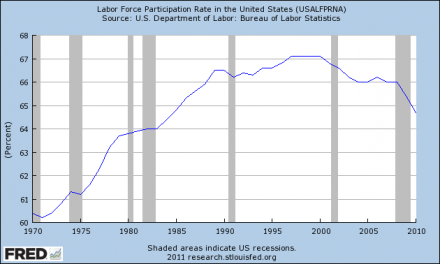
The federal government has been pretending that millions of unemployed Americans have decided that they simply do not want jobs anymore.
This does not make sense at all.
The truth is that unemployment is not really declining at all. The percentage of Americans that are working is not increasing. The civilian employment-population ratio dropped like a rock during 2008 and 2009 and it has held very steady since that time.
In January, the civilian employment-population ratio once again held steady at 58.5 percent. This is about where it has been for most of the last two years....
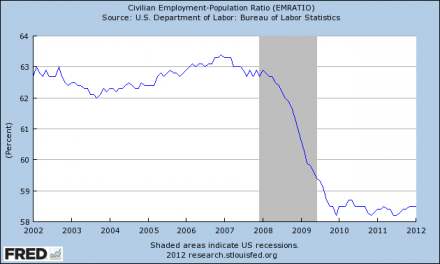
Does that chart look like an "economic recovery" to you?
Of course not.
If the percentage of people that are employed is about the same as it was two years ago, does that represent an improvement?
Of course not.
If the employment situation in America was getting better, the civilian employment-population ratio would be bouncing back.
We should be thankful that our economy is not free falling like it was during 2008 and 2009, but we also need to understand why things have stabilized.
The federal government is spending money like there is no tomorrow. During 2011, the Obama administration stole an average of about 150 million dollars an hour from our children and our grandchildren and pumped it into the economy. Even though the Obama administration spent that money on a lot of frivolous things, it still got into the pockets of average Americans who in turn went out and spent it on food, gas, clothes and other things.
Without all of this reckless government spending, we would not be able to continue to live way above our means and our economic problems would be a lot worse.
But even with the federal government borrowing and spending unprecedented amount of money, and even with interest rates at record lows, our economy is still deeply struggling. Just consider the following facts....
-New home sales in the United States hit a brand new all-time record low during 2011.
-The average duration of unemployment in America is close to an all-time record high.
-The percentage of Americans living in "extreme poverty" is at an all-time high.
-The number of Americans on food stamps recently hit a new all-time high.
-According to the Census Bureau, an all-time record 49 percent of all Americans live in a home that gets direct monetary benefits from the federal government. Back in 1983, less than a third of all Americans lived in a home that received direct monetary benefits from the federal government.
So let's not get too excited about the economy.
Yes, things have somewhat stabilized. The percentage of Americans that have jobs is about the same as it was two years ago. Considering how rapidly jobs are being shipped out of the United States, that is a good thing.
Enjoy this false bubble of hope while you can. Things are about to get a lot worse.
Do you remember how rapidly things fell apart after the financial crisis of 2008?
Well, another major financial crisis is on the way. This time it is going to be centered in Europe initially, but it is going to spread all around the globe just like the last one did.
As the charts above show, we have never even come close to recovering from the last recession, and another one is on the way.
So how bad are things going to get after the next wave of the financial crisis hits us?
That is something that we should all be thinking about.
February 4, 2012
HSBC Laundering Billions?
A former employee of one of the world's largest international banks has provided WND with more than 1,000 pages of documents, including customer account ledgers for dozens of companies through which the financial institution was laundering money each month, according to the whistleblower. "I found many accounts through which hundreds of thousands of dollars were being flowed as a conduit on a monthly basis," John Cruz, an account relationship manager who worked in the HSBC southern New York region, told WND. − WorldNetDaily
Dominant Social Theme: What a shock! This is perhaps the biggest bank in the world! Where were the regulators? What's going on? How could this happen? It's really impossible to believe ...
Free-Market Analysis: Jerome Corsi better hire pretty good security. In Georgia, a lawsuit that Corsi has helped promote seems close to knocking US President Barack Obama off the ballot due to questions about his parents and whether he is US "natural born" – and thus eligible to be president.
And now Corsi has apparently helped reveal the underbelly of the Western world's banking system by exposing "thousands of pages" of documents that, according to Corsi, seem to prove fairly conclusively that HSBC was involved in a massive money laundering scheme that involved people at the very top of the bank.
As of 2011, according to Wikipedia, British-based HSBC was the world's second-largest banking and financial services group and second-largest public company per a composite measure by Forbes magazine ... "In February 2008, HSBC was named the world's most valuable banking brand by The Banker magazine."
Given that HSBC is the most valuable banking brand in the world, systemic corruption at the top of HSBC is big news. What's funny in a sad way is that this probably has been going on for decades. It is only now, however − thanks to the Internet − that these sorts of things can be publicized. It seems like there is fairly significant evidence to back up these charges.
As WND reported, Cruz has a raft of customer account records he claims are evidence of an international money-laundering scheme involving hundreds of billions of dollars by London-based HSBC, which reportedly is under investigation by a US Senate committee.
We don't put too much faith in the US Senate when it comes to these sorts of money-laundering schemes. First of all, we don't think money laundering, for the most part. is a crime. We think drugs and gambling – two large generators of illicit funds – should be legalized.
But the reason they won't be, so far as we can tell, is because the Anglosphere elite that seeks to run the world has arranged these "crimes" so as to create large pools of black capital. It is this untrackable black capital that increasingly runs the West's mercenary military and the the West's top-level globalist, Intel-oriented operations.
The sums that slosh about in the recesses of Western government and its mercantilist banking facilities are almost impossible to comprehend. Just before 9/11 − on September 10, in fact − Donald Rumsfeld announced that US$2.3 trillion in Defense funds had gone missing and could not be accounted for.
Unfortunately, Mr. Rumsfeld was not able to follow up definitively as regards this staggering sum because the plane that hit the Pentagon on 9/11 apparently wiped out the records department that contained details on expenditures (along with 125 employees, mostly accountants, bookkeepers and budget analysts).
The elites have plenty of money for black-ops efforts, of course, but the power elite NEVER uses its own funds, from what we can tell. Also, money-washing at big banks creates large pools of "clean" capital that can be used for a variety of purposes.
This larger observation speaks to the heart of what is really going on in the early 21st century. There is a group of unfathomably wealthy Anglosphere elite families (deriving their funds from the control of central banking around the world) and their associates and enablers that are trying to create one-world government as rapidly as possible.
While many call these families Zionist, we have recently eschewed this term, thinking it confuses things. What the world is run by, basically, is a mafia that hires people of similar race and persuasion the way the Italian mafia has in the past.
It is a crime syndicate. It has created – at the top – a parallel global economic, military and political system that seems to be part of the world's larger demos but actually reports to the families not to voters or "democratic" facilities.
The Internet is a process, not an episode. As times goes on, we figure more and more anomalous revelations about the world's largest criminal syndicate will be revealed. These are not "incidents" of corruption. In fact, one oughtn't to call it "corruption," in our view.
There is an emergent world government that has been put in place and it is one that is supported by corporations and individuals that are above national law. The system will only collapse – and it will in our view – when people realize that what they believe is anomalous is in fact systemic.
Conclusion: The revelations about HSBC should not shock anyone who believes in the step-by-step – and ongoing – construction of a New World Order. What HSBC likely reveals is the Way the World Really Works.
Dominant Social Theme: What a shock! This is perhaps the biggest bank in the world! Where were the regulators? What's going on? How could this happen? It's really impossible to believe ...
Free-Market Analysis: Jerome Corsi better hire pretty good security. In Georgia, a lawsuit that Corsi has helped promote seems close to knocking US President Barack Obama off the ballot due to questions about his parents and whether he is US "natural born" – and thus eligible to be president.
And now Corsi has apparently helped reveal the underbelly of the Western world's banking system by exposing "thousands of pages" of documents that, according to Corsi, seem to prove fairly conclusively that HSBC was involved in a massive money laundering scheme that involved people at the very top of the bank.
As of 2011, according to Wikipedia, British-based HSBC was the world's second-largest banking and financial services group and second-largest public company per a composite measure by Forbes magazine ... "In February 2008, HSBC was named the world's most valuable banking brand by The Banker magazine."
Given that HSBC is the most valuable banking brand in the world, systemic corruption at the top of HSBC is big news. What's funny in a sad way is that this probably has been going on for decades. It is only now, however − thanks to the Internet − that these sorts of things can be publicized. It seems like there is fairly significant evidence to back up these charges.
As WND reported, Cruz has a raft of customer account records he claims are evidence of an international money-laundering scheme involving hundreds of billions of dollars by London-based HSBC, which reportedly is under investigation by a US Senate committee.
We don't put too much faith in the US Senate when it comes to these sorts of money-laundering schemes. First of all, we don't think money laundering, for the most part. is a crime. We think drugs and gambling – two large generators of illicit funds – should be legalized.
But the reason they won't be, so far as we can tell, is because the Anglosphere elite that seeks to run the world has arranged these "crimes" so as to create large pools of black capital. It is this untrackable black capital that increasingly runs the West's mercenary military and the the West's top-level globalist, Intel-oriented operations.
The sums that slosh about in the recesses of Western government and its mercantilist banking facilities are almost impossible to comprehend. Just before 9/11 − on September 10, in fact − Donald Rumsfeld announced that US$2.3 trillion in Defense funds had gone missing and could not be accounted for.
Unfortunately, Mr. Rumsfeld was not able to follow up definitively as regards this staggering sum because the plane that hit the Pentagon on 9/11 apparently wiped out the records department that contained details on expenditures (along with 125 employees, mostly accountants, bookkeepers and budget analysts).
The elites have plenty of money for black-ops efforts, of course, but the power elite NEVER uses its own funds, from what we can tell. Also, money-washing at big banks creates large pools of "clean" capital that can be used for a variety of purposes.
This larger observation speaks to the heart of what is really going on in the early 21st century. There is a group of unfathomably wealthy Anglosphere elite families (deriving their funds from the control of central banking around the world) and their associates and enablers that are trying to create one-world government as rapidly as possible.
While many call these families Zionist, we have recently eschewed this term, thinking it confuses things. What the world is run by, basically, is a mafia that hires people of similar race and persuasion the way the Italian mafia has in the past.
It is a crime syndicate. It has created – at the top – a parallel global economic, military and political system that seems to be part of the world's larger demos but actually reports to the families not to voters or "democratic" facilities.
The Internet is a process, not an episode. As times goes on, we figure more and more anomalous revelations about the world's largest criminal syndicate will be revealed. These are not "incidents" of corruption. In fact, one oughtn't to call it "corruption," in our view.
There is an emergent world government that has been put in place and it is one that is supported by corporations and individuals that are above national law. The system will only collapse – and it will in our view – when people realize that what they believe is anomalous is in fact systemic.
Conclusion: The revelations about HSBC should not shock anyone who believes in the step-by-step – and ongoing – construction of a New World Order. What HSBC likely reveals is the Way the World Really Works.
February 3, 2012
The Real Economic Picture
If you have any money and you want to understand the lies that “your” government tells you with statistics, subscribe to John Williams shadowstats.com.
John Williams is the best and utterly truthful statistician that we the people have.
The charts below come from John Williams Hyperinflation Report, January 25, 2012. The commentary is supplied by me.
Here is the chart of real average weekly earnings deflated by the US government’s own measure of inflation, which as I pointed out in my recent column, Economics Lesson 1, understates true inflation.

This chart (below) shows the behavior of inflation as measured by “our” government’s official measure, CPI-U (bottom line) and John Williams measure which uses the official methodology of when I was Assistant Secretary of the US Treasury. The gap between the top and bottom lines represents the amount of money that was due to Social Security recipients and others whose income was indexed to inflation that was diverted by the government to wars, police state, and bankers’ bailouts.

This next chart shows the gains that gold and the Swiss franc have made against the US dollar. The Swiss franc is the top line and gold is the bottom. When gold and the Swiss franc rise, the dollar is falling. Notice that during President Reagan’s first term, when I was in the Treasury, gold and the Swiss franc dropped, that is, the dollar rose in purchasing power. Obviously, the supply-side policy that Reagan implemented strengthened the US dollar. It was only with the advent of the Bush policy of endless trillion dollar wars, reaffirmed by Obama, that the US dollar and economy collapsed relative to gold and hard currencies.
The recent drop in the Swiss franc is due to the Swiss government announcing that the country’s exports could not tolerate any further run up in the franc’s value, and that the Swiss central bank would print new francs to accommodate future inflows of dollars and euros. In other words, Switzerland was forced to import US inflation in order to protect its exports.

Here is nonfarm payroll employment. As you can see, the US economy has been in recession for four years despite the easiest monetary policy and largest government deficits in US history.

Here is consumer confidence. Do you see a recovery despite all the recovery hype from politicians and the financial media?

Here is housing starts. Do you see a recovery?

Here is real GDP deflated according to the methodology used when I was in the US Treasury.

Here is real retail sales deflated by the traditional, as contrasted with the current, substitution-based, measure of inflation.

These graphs courtesy of John Williams make it completely clear that there is no economic recovery. In place of recovery, we have hype from politicians, Wall Street, and the presstitute media. The “recovery” is no more real than Iraqi “weapons of mass destruction” or Iranian “nukes” or the Obama regime’s phony story of assassinating last year an undefended Osama bin Laden, allegedly the mastermind of Islamic terrorism, left by al Qaeda to the mercy of a US Seal team, a man who was widely reported to have died from renal failure in December 2001, a man who denied any responsibility for 9/11.
A government and media that will deceive you about simple things such as inflation, unemployment, and GDP growth, will lie to you about everything.
John Williams is the best and utterly truthful statistician that we the people have.
The charts below come from John Williams Hyperinflation Report, January 25, 2012. The commentary is supplied by me.
Here is the chart of real average weekly earnings deflated by the US government’s own measure of inflation, which as I pointed out in my recent column, Economics Lesson 1, understates true inflation.
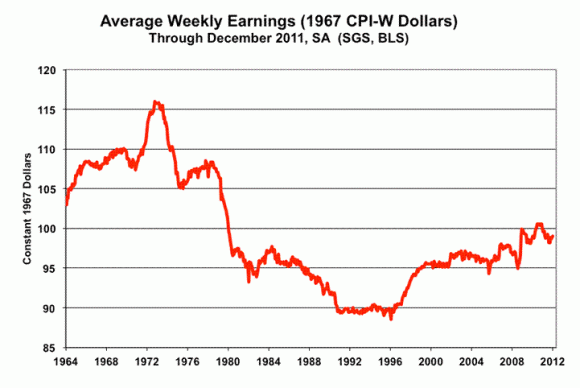
This chart (below) shows the behavior of inflation as measured by “our” government’s official measure, CPI-U (bottom line) and John Williams measure which uses the official methodology of when I was Assistant Secretary of the US Treasury. The gap between the top and bottom lines represents the amount of money that was due to Social Security recipients and others whose income was indexed to inflation that was diverted by the government to wars, police state, and bankers’ bailouts.
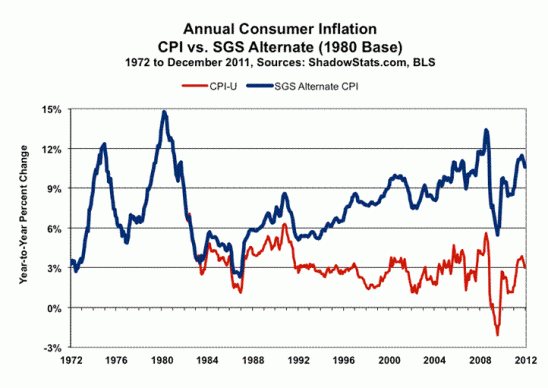
This next chart shows the gains that gold and the Swiss franc have made against the US dollar. The Swiss franc is the top line and gold is the bottom. When gold and the Swiss franc rise, the dollar is falling. Notice that during President Reagan’s first term, when I was in the Treasury, gold and the Swiss franc dropped, that is, the dollar rose in purchasing power. Obviously, the supply-side policy that Reagan implemented strengthened the US dollar. It was only with the advent of the Bush policy of endless trillion dollar wars, reaffirmed by Obama, that the US dollar and economy collapsed relative to gold and hard currencies.
The recent drop in the Swiss franc is due to the Swiss government announcing that the country’s exports could not tolerate any further run up in the franc’s value, and that the Swiss central bank would print new francs to accommodate future inflows of dollars and euros. In other words, Switzerland was forced to import US inflation in order to protect its exports.
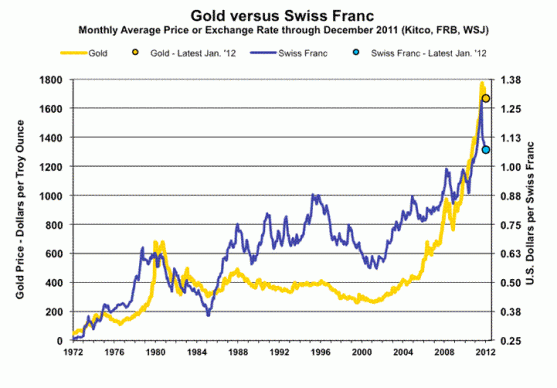
Here is nonfarm payroll employment. As you can see, the US economy has been in recession for four years despite the easiest monetary policy and largest government deficits in US history.
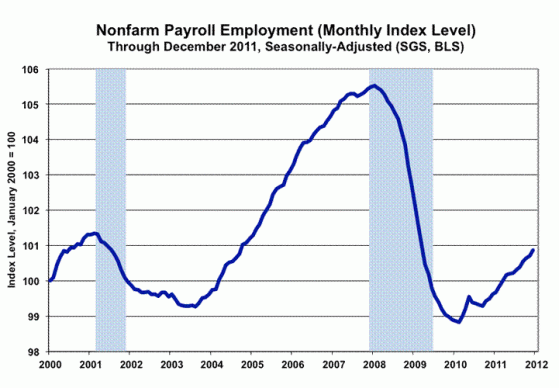
Here is consumer confidence. Do you see a recovery despite all the recovery hype from politicians and the financial media?
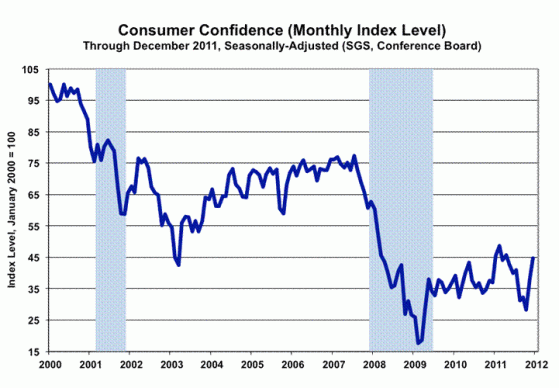
Here is housing starts. Do you see a recovery?
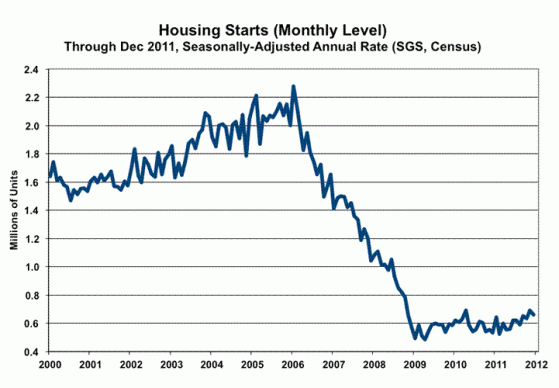
Here is real GDP deflated according to the methodology used when I was in the US Treasury.
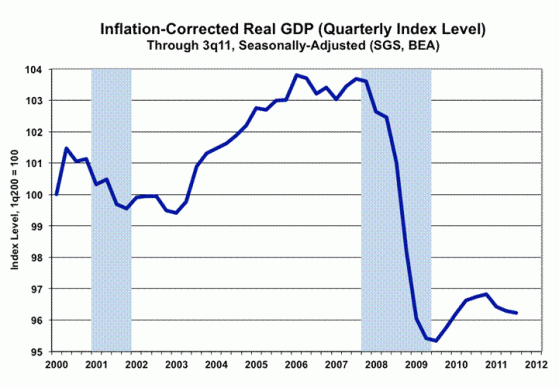
Here is real retail sales deflated by the traditional, as contrasted with the current, substitution-based, measure of inflation.
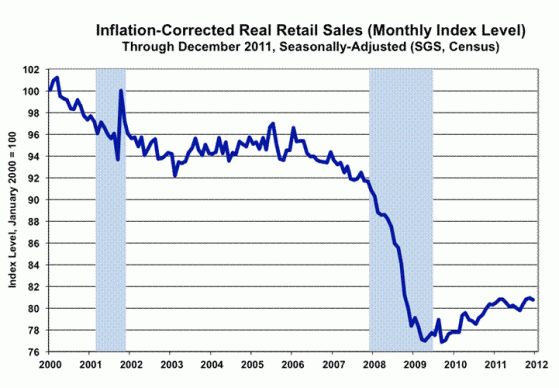
These graphs courtesy of John Williams make it completely clear that there is no economic recovery. In place of recovery, we have hype from politicians, Wall Street, and the presstitute media. The “recovery” is no more real than Iraqi “weapons of mass destruction” or Iranian “nukes” or the Obama regime’s phony story of assassinating last year an undefended Osama bin Laden, allegedly the mastermind of Islamic terrorism, left by al Qaeda to the mercy of a US Seal team, a man who was widely reported to have died from renal failure in December 2001, a man who denied any responsibility for 9/11.
A government and media that will deceive you about simple things such as inflation, unemployment, and GDP growth, will lie to you about everything.
February 2, 2012
Global Risks "Announced" for 2012 – Beware of What the Bigwigs Discussed in Davos!
The WEF's Global Risk Report warns of economic imbalances and social inequality, and how these risks could "revert the gains of globalization"...
The linked Global Risks 2012 Video presents the findings of a survey of 469 experts and industry leaders who worry that the world's institutions are ill-equipped to cope with today's interconnected, rapidly evolving risks [and rightfully so].
The findings of the survey fed into an analysis of three major risk cases: Seeds of Dystopia, Unsafe Safeguards and the Dark Side of Connectivity. Quite frankly, if the titles of these "risk cases" don't give you the shivers, possibly the video will.
By the way, a strange byline at the end of the video comes across as quite awkward: "This film is not authorized nor endorsed by the president, the First Lady or the White House." Now, why would it or should it be?! I leave any interpretations in your good hands / minds...
The Report – and its Top 10 Risks
In addition to the aforementioned "major risk cases", the actual Global Risks 2012 Report analyses the top risks in five categories – economic, environmental, geopolitical, societal and technological. Structured on a 10-year outlook, the survey captured the perceived impact, likelihood and interconnectedness of 50 prevalent global risks.
The figure I've included below lists the Report's Top 5 risks in terms of likelihood (Figure 4 of the Report). Then, next, take note of the Top 5 risks selected, in terms of likelihood, over the past 7 years.


A few things appear to stick out here: First of all, the Top 5 risks chosen in the Report, in terms of likelihood, have changed every year. It seems awkward that the risks elected as the most likely over the medium- to long-term future would change EVERY year.
Secondly, it is not noteworthy that the most likely risks elected by the report's "experts" are strongly influenced by the actual events and prominent media coverage in the preceding year. Possibly, the risks listed in the report are merely themes and topics that are popularly launched and discussed at the WEF and those that are most likely to find a political ear.
The Fundamental Risk, and the Cause, is nowhere to be found!
What I found most intriguing about the survey's results, which are supposedly based on the outlooks of 469 (??!) of the world's leading experts, is that although the Report recognizes the risk of a major systemic financial failure and of 'chronic' fiscal imbalances, both in terms of likelihood and impact (see Figure 5 of the report below), the fundamental risk and true cause is nowhere to be found!

What is the biggest risk today? What is the fundamental and true cause for the fiscal imbalances and for the risks of a major systemic financial failure today? It is the MONETARY IMBALANCES that governments and central banks around the world have created. They have continuously lowered interest rates over the past three decades. Financial risk and returns are now priced at zero. Cheap money has resulted in large-scale, unprecedented mis-allocation.
Likely Policy Responses – Ironically Contrarian to the Washington Consensus!
What do you think the political responses and economic policies to address these prominently published risks will be?
Severe income disparity: Will that be addressed with less bureaucracy, more freedom and better education? Or will it merely translate into more taxes for the wealthy and more (ineffective) state sponsored job creation and consumer confidence initiatives? Chronic fiscal imbalances: Do you think we will see a sincere tightening of belts? I don't think so.
The economic and financial issues, and yes, the risks of severe income disparity, are the result of government's intervention in the free markets and their politically driven lack of monetary discipline. The political response pattern to these "2012 risks," to the likes of income disparity (translate social unrest), chronic fiscal imbalances, extreme volatility in energy and agricultural prices, will be based on more quantitative easing and more government intervention. It will be more of what we need less of.
In this context, I am reminded of last week's excellent commentary by Sovereign Man's Simon Black, who is speaking at BFI's Inner Circle Briefing in the Bahamas:
"There is a delicious irony in the world of economic policy at the moment.
Back in 1997 and 1998 I had a ringside seat to the Asian financial crisis from my trading desk in Seoul. When everything collapsed, the policy prescriptions from the World Bank and IMF for Asia's sick economies were to:
1. HIKE interest rates,
2. CUT government spending,
3. Further deregulate, liberalize, and open their economies to foreign investment to attract capital;
4. And let their zombie banks FAIL.
Though they experienced brutal recessions after swallowing this tough medicine, the two countries which carried out these policies to the fullest extent, South Korea and Indonesia, are today among the most successful and dynamic economies in Asia, and the WORLD."
What you can expect in policy responses is the very contrary. Over the coming years, we will instead see more quantitative easing, more government spending and debt, more regulations, more protectionism, exchange controls and a lot of bailouts of banks.
These are precisely the ingredients needed to further increase the risks of severe income disparity, chronic financial imbalances, extreme volatility in energy and agricultural prices and yes, the risk of a major systemic financial crisis. So in the end, maybe those 469 experts really know what they are doing. Maybe their risk forecasts are not so bad after all.
When the Biggest Risk Is What "They" Will Call the Solution...
In the end, with all the uncertainties and risks discussed in Davos, it all comes down to one thing: Money. Paper Money. And we expect there will be plenty of that!
The linked Global Risks 2012 Video presents the findings of a survey of 469 experts and industry leaders who worry that the world's institutions are ill-equipped to cope with today's interconnected, rapidly evolving risks [and rightfully so].
The findings of the survey fed into an analysis of three major risk cases: Seeds of Dystopia, Unsafe Safeguards and the Dark Side of Connectivity. Quite frankly, if the titles of these "risk cases" don't give you the shivers, possibly the video will.
By the way, a strange byline at the end of the video comes across as quite awkward: "This film is not authorized nor endorsed by the president, the First Lady or the White House." Now, why would it or should it be?! I leave any interpretations in your good hands / minds...
The Report – and its Top 10 Risks
In addition to the aforementioned "major risk cases", the actual Global Risks 2012 Report analyses the top risks in five categories – economic, environmental, geopolitical, societal and technological. Structured on a 10-year outlook, the survey captured the perceived impact, likelihood and interconnectedness of 50 prevalent global risks.
The figure I've included below lists the Report's Top 5 risks in terms of likelihood (Figure 4 of the Report). Then, next, take note of the Top 5 risks selected, in terms of likelihood, over the past 7 years.


A few things appear to stick out here: First of all, the Top 5 risks chosen in the Report, in terms of likelihood, have changed every year. It seems awkward that the risks elected as the most likely over the medium- to long-term future would change EVERY year.
Secondly, it is not noteworthy that the most likely risks elected by the report's "experts" are strongly influenced by the actual events and prominent media coverage in the preceding year. Possibly, the risks listed in the report are merely themes and topics that are popularly launched and discussed at the WEF and those that are most likely to find a political ear.
The Fundamental Risk, and the Cause, is nowhere to be found!
What I found most intriguing about the survey's results, which are supposedly based on the outlooks of 469 (??!) of the world's leading experts, is that although the Report recognizes the risk of a major systemic financial failure and of 'chronic' fiscal imbalances, both in terms of likelihood and impact (see Figure 5 of the report below), the fundamental risk and true cause is nowhere to be found!

What is the biggest risk today? What is the fundamental and true cause for the fiscal imbalances and for the risks of a major systemic financial failure today? It is the MONETARY IMBALANCES that governments and central banks around the world have created. They have continuously lowered interest rates over the past three decades. Financial risk and returns are now priced at zero. Cheap money has resulted in large-scale, unprecedented mis-allocation.
Likely Policy Responses – Ironically Contrarian to the Washington Consensus!
What do you think the political responses and economic policies to address these prominently published risks will be?
Severe income disparity: Will that be addressed with less bureaucracy, more freedom and better education? Or will it merely translate into more taxes for the wealthy and more (ineffective) state sponsored job creation and consumer confidence initiatives? Chronic fiscal imbalances: Do you think we will see a sincere tightening of belts? I don't think so.
The economic and financial issues, and yes, the risks of severe income disparity, are the result of government's intervention in the free markets and their politically driven lack of monetary discipline. The political response pattern to these "2012 risks," to the likes of income disparity (translate social unrest), chronic fiscal imbalances, extreme volatility in energy and agricultural prices, will be based on more quantitative easing and more government intervention. It will be more of what we need less of.
In this context, I am reminded of last week's excellent commentary by Sovereign Man's Simon Black, who is speaking at BFI's Inner Circle Briefing in the Bahamas:
"There is a delicious irony in the world of economic policy at the moment.
Back in 1997 and 1998 I had a ringside seat to the Asian financial crisis from my trading desk in Seoul. When everything collapsed, the policy prescriptions from the World Bank and IMF for Asia's sick economies were to:
1. HIKE interest rates,
2. CUT government spending,
3. Further deregulate, liberalize, and open their economies to foreign investment to attract capital;
4. And let their zombie banks FAIL.
Though they experienced brutal recessions after swallowing this tough medicine, the two countries which carried out these policies to the fullest extent, South Korea and Indonesia, are today among the most successful and dynamic economies in Asia, and the WORLD."
What you can expect in policy responses is the very contrary. Over the coming years, we will instead see more quantitative easing, more government spending and debt, more regulations, more protectionism, exchange controls and a lot of bailouts of banks.
These are precisely the ingredients needed to further increase the risks of severe income disparity, chronic financial imbalances, extreme volatility in energy and agricultural prices and yes, the risk of a major systemic financial crisis. So in the end, maybe those 469 experts really know what they are doing. Maybe their risk forecasts are not so bad after all.
When the Biggest Risk Is What "They" Will Call the Solution...
In the end, with all the uncertainties and risks discussed in Davos, it all comes down to one thing: Money. Paper Money. And we expect there will be plenty of that!
February 1, 2012
47 Signs That China Is Absolutely Destroying America On The Global Economic Stage
Have you ever watched a football game or a basketball game where one team dominates the other team so badly that calling it a "blowout" would be a huge understatement? Well, that is what China is doing to the United States. China is absolutely destroying America on the global economic stage. Once upon a time, the Chinese economy was a joke and the U.S. economy was the most powerful the world had ever seen. But over the past couple of decades the U.S. economy has decayed and declined while the Chinese economy has skyrocketed. Today, China makes more steel, more automobiles, more beer, more cotton, more coal and more solar panels than we do. China has the fastest train in the world, the fastest computer in the world and they export twice as much high-tech equipment as we do. In 2011, our trade deficit with China was the largest trade deficit that one nation has had with another nation in the history of the world, and China has now accumulated more than 3 trillion dollars in foreign currency reserves. Every single day, we lose more jobs, more businesses and more of our national wealth to China. In technical economic terms, China has "taken us out behind the woodshed" and has beaten the living daylights out of us. Unfortunately, most Americans are so addicted to entertainment that they don't even realize what is happening.
If you do not believe that China is wiping the floor with America in front of the rest of the world, just keep reading. The following are 47 signs that China is absolutely destroying America on the global economic stage....
#1 Back in 1998, the United States had 25 percent of the world’s high-tech export market and China had just 10 percent. Today, China's high-tech exports are more than twice the size of U.S. high-tech exports.
#2 America has lost more than a quarter of all of its high-tech manufacturing jobs over the past ten years.
#3 The Chinese economy has grown 7 times faster than the U.S. economy has over the past decade.
#4 In 2010, China produced more than twice as many automobiles as the United States did.
#5 In 2010, China produced 627 million metric tons of steel. The United States only produced 80 million metric tons of steel.
#6 In 2010, China produced 7.3 million metric tons of cotton. The United States only produced 3.4 million metric tons of cotton.
#7 China produced 19.8 percent of all the goods consumed in the world during 2010. The United States only produced 19.4 percent.
#8 During 2010, we spent $365 billion on goods and services from China while they only spent $92 billion on goods and services from us.
#9 In 1985, the U.S. trade deficit with China was 6 million dollars for the entire year. The final U.S. trade deficit with China for 2011 will be very close to 300 billion dollars. That will be the largest trade deficit that one nation has had with another nation in the history of the world.
#10 The U.S. trade deficit with China is now 28 times larger than it was back in 1990.
#11 Since China entered the WTO in 2001, the U.S. trade deficit with China has grown by an average of 18% per year.
#12 According to the New York Times, a Jeep Grand Cherokee that costs $27,490 in the United States costs about $85,000 in China.
#13 According to the Economic Policy Institute, America is losing half a million jobs to China every single year.
#14 The United States has lost a staggering 32 percent of its manufacturing jobs since the year 2000.
#15 The United States had been the leading consumer of energy on the globe for about 100 years, but during the summer of 2010 China took over the number one spot.
#16 15 years ago, China was 14th in the world in published scientific research articles. But now, China is expected to pass the United States and become number one very shortly.
#17 China is also expected to soon become the global leader in patent filings.
#18 In 2009, the United States ranked dead last of the 40 nations examined by the Information Technology & Innovation Foundation when it came to "change" in "global innovation-based competitiveness" over the previous ten years.
#19 China now awards more doctoral degrees in engineering each year than the United States does.
#20 China now possesses the fastest supercomputer on the entire planet.
#21 China now has the world's fastest train and the world's most extensive high-speed rail network.
#22 The construction of the new $200 million African Union headquarters was funded by China.
#23 Today, China produces nearly twice as much beer as the United States does.
#24 85 percent of all artificial Christmas trees are made in China.
#25 Amazingly, China now consumes 53 percent of the world's cement.
#26 There are more pigs in China than in the next 43 pork producing nations combined.
#27 China is now the number one producer of wind and solar power on the entire globe.
#28 Chinese solar panel production was about 50 times larger in 2010 than it was in 2005.
#29 Right now, China is producing more than three times as much coal as the United States does.
#30 China controls over 90 percent of the total global supply of rare earth elements.
#31 China is now the number one supplier of components that are critical to the operation of U.S. defense systems.
#32 According to author Clyde Prestowitz, China's number one export to the U.S. is computer equipment. According to an article in U.S. News & World Report, during 2010 the number one U.S. export to China was "scrap and trash".
#33 The United States has lost an average of 50,000 manufacturing jobs a month since China joined the World Trade Organization in 2001.
#34 Back in the year 2000, more than 20 percent of all jobs in America were manufacturing jobs. Today, only about 5 percent of all jobs in America are manufacturing jobs.
#35 Between December 2000 and December 2010, 38 percent of the manufacturing jobs in Ohio were lost, 42 percent of the manufacturing jobs in North Carolina were lost and 48 percent of the manufacturing jobs in Michigan were lost.
#36 The average household debt load in the United States is 136% of average household income. In China, the average household debt load is 17% of average household income.
#37 The new World Trade Center tower is going to be made with imported glass from China.
#38 The new MLK memorial on the National Mall was made in China.
#39 A Washington Post/ABC News poll conducted a while back found that 61 percent of all Americans consider China to be a threat to our jobs and economic security.
#40 According to U.S. Representative Betty Sutton, an average of 23 manufacturing facilities a day closed down in the United States during 2010.
#41 Overall, more than 56,000 manufacturing facilities in the United States have shut down since 2001.
#42 According to Professor Alan Blinder of Princeton University, 40 million more U.S. jobs could be sent out of the country over the next two decades.
#43 Over the past several decades, China has been able to accumulate approximately 3 trillion dollars in foreign currency reserves, and the U.S. government now owes China close to 1.5 trillion dollars.
#44 According to the IMF, China will pass the United States and will become the largest economy in the world in 2016.
#45 According to one prominent economist, the Chinese economy already has roughly the same amount of purchasing power as the U.S. economy does.
#46 According to Stanford University economics professor Ed Lazear, if the U.S. economy and the Chinese economy continue to grow at current rates, the average Chinese citizen will be wealthier than the average American citizen in just 30 years.
#47 Nobel economist Robert W. Fogel of the University of Chicago is projecting that the Chinese economy will be three times larger than the U.S. economy by the year 2040 if current trends continue.
If the global economy was a game, America would be losing very badly and China would have all the momentum.
Unfortunately, the global economy is not a game. Very real businesses and very real jobs are affected by this every single day.
Barack Obama keeps talking about how "the economy is improving", but the reality is that we have never even gotten close to where we were back before the financial crisis of 2008.
The following chart (which I pulled off a Fed website today) shows the average duration of unemployment in America. Does this look like an economic recovery to you?....

The Obama administration tells us that the official unemployment rate is only 8.5 percent, but that is a joke. Even the Congressional Budget Office admits that the official unemployment rate should actually be somewhere up around 10 percent.
But the real story is the number of long-term unemployed workers we have in America today.
According to the Hamilton Project, approximately 53 percent of all unemployed workers in the state of Florida were out of work for more than six months during 2011.
But Barack Obama seems absolutely amazed that there are still so many unemployed people out there during his "economic recovery". Just check out the following interaction that took place between Obama and one concerned wife during a recent appearance by Obama on Google+....
"Can I ask you what kind of engineer your husband is?," Obama said to the wife of the unemployed engineer.
"He's a semiconductor engineer," she responded.
"It is interesting to me -- and I meant what I said if your send me your husband's resume, I'd be interested in finding out exactly what's happening right there because the word that we're getting is that somebody in that type of high-tech field, that kind of engineer, should be able to find something right away."
Obama does not realize that it is not so simple to "find something right away" in this economy.
We have been shipping high-tech jobs overseas at a blistering pace. The jobs simply are not there anymore.
In Europe, unemployment is even worse. Just check out this chart which shows what has been happening to youth unemployment in Europe recently.
In both the United States and Europe, a great disconnect has taken place. Just because big corporations in the U.S. and in Europe are doing well, that does not mean that they are going to provide good jobs for workers in the U.S. and in Europe.
These days, it is way too easy for big corporations to ship jobs over to places like China where it is perfectly legal to pay workers slave labor wages.
So unless something changes, that means that from now on there will be chronic structural unemployment problems in the United States.
That also means that the number of Americans dependent on the government is going to continue to increase.
And unfortunately, there are signs that the economy is about to experience another downturn. Consumer confidence in the U.S. is falling once again. The Baltic Dry Index, which is often used as a measure of the health of the world economy, has fallen more than 60 percent since October.
Perhaps most importantly of all, Europe is heading into a recession and several European nations are already experiencing depression-like conditions.
Considering the fact that half of all global trade involves Europe in some manner, that is not a good thing for us.
So if you have a job right now, you might want to hold on to it tightly. Jobs are precious commodities at the moment, and they are going to become even more scarce in the years ahead.
If you do not believe that China is wiping the floor with America in front of the rest of the world, just keep reading. The following are 47 signs that China is absolutely destroying America on the global economic stage....
#1 Back in 1998, the United States had 25 percent of the world’s high-tech export market and China had just 10 percent. Today, China's high-tech exports are more than twice the size of U.S. high-tech exports.
#2 America has lost more than a quarter of all of its high-tech manufacturing jobs over the past ten years.
#3 The Chinese economy has grown 7 times faster than the U.S. economy has over the past decade.
#4 In 2010, China produced more than twice as many automobiles as the United States did.
#5 In 2010, China produced 627 million metric tons of steel. The United States only produced 80 million metric tons of steel.
#6 In 2010, China produced 7.3 million metric tons of cotton. The United States only produced 3.4 million metric tons of cotton.
#7 China produced 19.8 percent of all the goods consumed in the world during 2010. The United States only produced 19.4 percent.
#8 During 2010, we spent $365 billion on goods and services from China while they only spent $92 billion on goods and services from us.
#9 In 1985, the U.S. trade deficit with China was 6 million dollars for the entire year. The final U.S. trade deficit with China for 2011 will be very close to 300 billion dollars. That will be the largest trade deficit that one nation has had with another nation in the history of the world.
#10 The U.S. trade deficit with China is now 28 times larger than it was back in 1990.
#11 Since China entered the WTO in 2001, the U.S. trade deficit with China has grown by an average of 18% per year.
#12 According to the New York Times, a Jeep Grand Cherokee that costs $27,490 in the United States costs about $85,000 in China.
#13 According to the Economic Policy Institute, America is losing half a million jobs to China every single year.
#14 The United States has lost a staggering 32 percent of its manufacturing jobs since the year 2000.
#15 The United States had been the leading consumer of energy on the globe for about 100 years, but during the summer of 2010 China took over the number one spot.
#16 15 years ago, China was 14th in the world in published scientific research articles. But now, China is expected to pass the United States and become number one very shortly.
#17 China is also expected to soon become the global leader in patent filings.
#18 In 2009, the United States ranked dead last of the 40 nations examined by the Information Technology & Innovation Foundation when it came to "change" in "global innovation-based competitiveness" over the previous ten years.
#19 China now awards more doctoral degrees in engineering each year than the United States does.
#20 China now possesses the fastest supercomputer on the entire planet.
#21 China now has the world's fastest train and the world's most extensive high-speed rail network.
#22 The construction of the new $200 million African Union headquarters was funded by China.
#23 Today, China produces nearly twice as much beer as the United States does.
#24 85 percent of all artificial Christmas trees are made in China.
#25 Amazingly, China now consumes 53 percent of the world's cement.
#26 There are more pigs in China than in the next 43 pork producing nations combined.
#27 China is now the number one producer of wind and solar power on the entire globe.
#28 Chinese solar panel production was about 50 times larger in 2010 than it was in 2005.
#29 Right now, China is producing more than three times as much coal as the United States does.
#30 China controls over 90 percent of the total global supply of rare earth elements.
#31 China is now the number one supplier of components that are critical to the operation of U.S. defense systems.
#32 According to author Clyde Prestowitz, China's number one export to the U.S. is computer equipment. According to an article in U.S. News & World Report, during 2010 the number one U.S. export to China was "scrap and trash".
#33 The United States has lost an average of 50,000 manufacturing jobs a month since China joined the World Trade Organization in 2001.
#34 Back in the year 2000, more than 20 percent of all jobs in America were manufacturing jobs. Today, only about 5 percent of all jobs in America are manufacturing jobs.
#35 Between December 2000 and December 2010, 38 percent of the manufacturing jobs in Ohio were lost, 42 percent of the manufacturing jobs in North Carolina were lost and 48 percent of the manufacturing jobs in Michigan were lost.
#36 The average household debt load in the United States is 136% of average household income. In China, the average household debt load is 17% of average household income.
#37 The new World Trade Center tower is going to be made with imported glass from China.
#38 The new MLK memorial on the National Mall was made in China.
#39 A Washington Post/ABC News poll conducted a while back found that 61 percent of all Americans consider China to be a threat to our jobs and economic security.
#40 According to U.S. Representative Betty Sutton, an average of 23 manufacturing facilities a day closed down in the United States during 2010.
#41 Overall, more than 56,000 manufacturing facilities in the United States have shut down since 2001.
#42 According to Professor Alan Blinder of Princeton University, 40 million more U.S. jobs could be sent out of the country over the next two decades.
#43 Over the past several decades, China has been able to accumulate approximately 3 trillion dollars in foreign currency reserves, and the U.S. government now owes China close to 1.5 trillion dollars.
#44 According to the IMF, China will pass the United States and will become the largest economy in the world in 2016.
#45 According to one prominent economist, the Chinese economy already has roughly the same amount of purchasing power as the U.S. economy does.
#46 According to Stanford University economics professor Ed Lazear, if the U.S. economy and the Chinese economy continue to grow at current rates, the average Chinese citizen will be wealthier than the average American citizen in just 30 years.
#47 Nobel economist Robert W. Fogel of the University of Chicago is projecting that the Chinese economy will be three times larger than the U.S. economy by the year 2040 if current trends continue.
If the global economy was a game, America would be losing very badly and China would have all the momentum.
Unfortunately, the global economy is not a game. Very real businesses and very real jobs are affected by this every single day.
Barack Obama keeps talking about how "the economy is improving", but the reality is that we have never even gotten close to where we were back before the financial crisis of 2008.
The following chart (which I pulled off a Fed website today) shows the average duration of unemployment in America. Does this look like an economic recovery to you?....
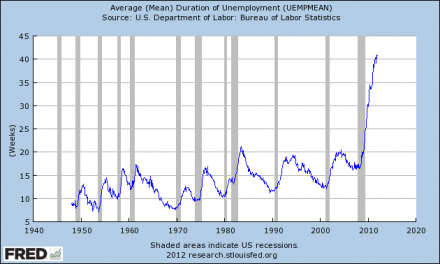
The Obama administration tells us that the official unemployment rate is only 8.5 percent, but that is a joke. Even the Congressional Budget Office admits that the official unemployment rate should actually be somewhere up around 10 percent.
But the real story is the number of long-term unemployed workers we have in America today.
According to the Hamilton Project, approximately 53 percent of all unemployed workers in the state of Florida were out of work for more than six months during 2011.
But Barack Obama seems absolutely amazed that there are still so many unemployed people out there during his "economic recovery". Just check out the following interaction that took place between Obama and one concerned wife during a recent appearance by Obama on Google+....
"Can I ask you what kind of engineer your husband is?," Obama said to the wife of the unemployed engineer.
"He's a semiconductor engineer," she responded.
"It is interesting to me -- and I meant what I said if your send me your husband's resume, I'd be interested in finding out exactly what's happening right there because the word that we're getting is that somebody in that type of high-tech field, that kind of engineer, should be able to find something right away."
Obama does not realize that it is not so simple to "find something right away" in this economy.
We have been shipping high-tech jobs overseas at a blistering pace. The jobs simply are not there anymore.
In Europe, unemployment is even worse. Just check out this chart which shows what has been happening to youth unemployment in Europe recently.
In both the United States and Europe, a great disconnect has taken place. Just because big corporations in the U.S. and in Europe are doing well, that does not mean that they are going to provide good jobs for workers in the U.S. and in Europe.
These days, it is way too easy for big corporations to ship jobs over to places like China where it is perfectly legal to pay workers slave labor wages.
So unless something changes, that means that from now on there will be chronic structural unemployment problems in the United States.
That also means that the number of Americans dependent on the government is going to continue to increase.
And unfortunately, there are signs that the economy is about to experience another downturn. Consumer confidence in the U.S. is falling once again. The Baltic Dry Index, which is often used as a measure of the health of the world economy, has fallen more than 60 percent since October.
Perhaps most importantly of all, Europe is heading into a recession and several European nations are already experiencing depression-like conditions.
Considering the fact that half of all global trade involves Europe in some manner, that is not a good thing for us.
So if you have a job right now, you might want to hold on to it tightly. Jobs are precious commodities at the moment, and they are going to become even more scarce in the years ahead.
Subscribe to:
Posts (Atom)