The scandal surrounding JP Morgan’s losses in its Chief Investment Office is not going away, and for good reason. Its trading book continues to lose money at an astounding rate. The most recent report estimates that the losses have increased by at least 50% more than the bank’s original loss estimates. The total damage is anyone’s guess at this point.
This fiasco is beginning to look a lot like accounting control fraud. The Justice Department and the FBI have begun criminal probes. The SEC is also investigating. So far, the objectives of these investigations are under wraps, but if I were an SEC or DOJ enforcement official I’d be laser-focused on bringing a Sarbanes-Oxley case against Jamie Dimon.
Sarbanes-Oxley emerged out of the Enron frauds. This law requires the CEO to certify that internal controls are operating effectively to give comfort to readers of the financial statements that the disclosures contained in the reporting are reliable. There are civil penalties for filing a false certification and criminal penalties, including jail time, for false filings found to be fraudulent. So far none of the obvious candidates like Dick Fuld at Lehman or Jon Corzine at MF Global have been prosecuted under the law.
Jamie Dimon looks like a very attractive candidate to investigate for SOX violations.
For starters, Dimon’s description of what happened rings SOX alarm bells:
First of all, there was one warning signal — if you look back from today, there were other red flags. That particular red flag — you know, we made a mistake, we got very defensive and people started justifying everything we did. You know, the benefit in life is to say, ‘Maybe you made a mistake, let’s dig deep.’ And the mistake had been brewing for a while, so it wasn’t just any one thing.
- Meet the Press, May 13, 2012
Warning signs and red flags were ignored. And they’ve apparently been ignored since 2007. Once again, echoing what happened at MF Global, risk managers who raised alarms about the riskiness of the positions in 2009 were replaced with more cooperative risk managers:
Several bankers said that risk controls were not sufficiently strengthened by Doug Braunstein, who took over as chief financial officer in 2010, another reason the bolder trades continued.
This indicates the firm was aware of deficiencies in the controls if other executives knew Braunstein had a mandate to improve them. These concerns are probably documented in the meeting minutes of the management committees responsible for risk, financial reporting and SOX compliance. It shouldn’t be difficult for the SEC to review these sources to determine who knew what and when about the state of the internal control environment.
JPM has issued quite a few financial statements since 2007 and 2009. If the controls and riskiness of the trades were as alarming and deficient as the managers indicate, then the reliability of the financial statements for the last 5 years are questionable. For a portfolio of this size and importance it’s inconceivable that the controls and risk issues were not reported up the management chain.
More damning is Dimon’s tacit admission that the controls designed to protect the firm from these sorts of blowups were ineffective, due to lack of intervention. Ignoring internal controls, or red flags as Dimon characterizes them, is a failure in the control environment. The failure to disclose inoperative key controls in the CEO certification is a violation the law.
That’s the big picture case. Recent reporting about the trade itself point to other areas that should be investigated for Sox violations.
When is a Hedge not a Hedge?
It appears that the JPM portfolio ‘hedge’ isn’t a hedge at all, at least according to current accounting standards. As Dina Dublon, CFO of JP Morgan Chase from 1998 to 2004, explained:
Dublon also pointed out that JP Morgan’s $200 billion mistake was not an accounting loss. “There is a difference between accounting and economic valuations,” she said. “You have a mark-to-market hedge against an accrual exposure that is not being marked to market. So you can have a gain or loss on the hedge, but you will not recognize the change in value of the loan portfolio, which is on an accrual accounting basis.
Translating this into non accountant language, JPM had a portfolio of assets which are available for sale. The change in the value of those securities is tracked, but since they aren’t considered to be trading assets, the change in value doesn’t hit the bottom line until they are sold. By contrast, positions held in trading books are “marked to market,” meaning they are revalued as market prices change and the resulting gains or losses are reported on an ongoing basis.
JPM reported that this portfolio contains significant unrealized gains. Indeed, it realized some of those gains to offset the losses on the portfolio ‘hedge’.
To hedge this portfolio JPM bought and sold credit default swaps. This portfolio ‘hedge’ is accounted for on a mark to market basis. This is odd since a true hedge should get the same accounting treatment as the asset it’s hedging. This indicates that the ‘hedge’ failed the hedge effectiveness test required by the accounting rules that would qualify it for hedge accounting treatment. More precisely the correlation between the hedge and the underlying isn’t strong enough to qualify it as a hedge.
Further confirmation that the ‘hedge’ wasn’t technically a hedge comes from Jamie Dimon himself.
In hindsight, the new strategy was flawed, complex, poorly reviewed, poorly executed and poorly monitored. The portfolio has proven to be riskier, more volatile and less effective an economic hedge than we thought.
As Dublon explained above, “There is a difference between accounting and economic valuations.” Dimon takes care to refer to the ‘economic hedge’, which is a term of art. It has no significance for financial disclosure purposes. It means whatever the user wants it to mean. If Dimon has not been vigilant in using the phrase ‘economic hedge’ in his disclosures and public comments about this portfolio then he’s made some false disclosures.
An “economic hedge’ is not a ‘hedge’ for financial disclosure purposes. ‘Economic hedge’ is a meaningless phrase. The abbreviated term ‘hedge’ when used to describe the trading portfolio embedded in the CIO book is a false characterization of the portfolio. He should not be permitted to describe this as a hedge in any of his comments about this book. At a minimum, he should be called on it every time he utters the phrase.
If It’s Not a Hedge Then What is It?
To recap, JPM owns a portfolio of securities it is ‘economically hedging” with a portfolio of credit default swaps. The purpose of a hedge is to reduce the risk of adverse price moves on the underlying portfolio.
The CDS portfolio consists of CDS purchased and CDS sold.
CDS purchased for the portfolio may have been put on as a hedge against the “available for sale” portfolio. But the CDS sold as a hedge doesn’t seem to make any sense. Selling CDS is equivalent to increasing the exposure to the underlying credits. The CDS sold don’t seem to have a risk mitigating role as part of a hedge, but to date JPM hasn’t provided the information to evaluate the overall portfolio.
It’s possible JPM was funding the CDS purchases by selling longer dated CDS and justifying the inclusion of the CDS sales as funding of the hedging purchases, but that would seem to be pretty expansive definition of a hedge. Perhaps ‘economic hedging’ as JPM defines it includes the funding sources of the combined ‘economic hedge’. That seems ridiculous but the term is open to any interpretation.
Since the combined CDS portfolio is accounted for on a mark to market basis, the position may not have raised any red flags with readers of the financial statements as long as it was in the money. That appears to have been the case for an extended period, as evidenced by the enormous pay packages (over $100 million for the chief trader, the infamous Whale, if reports are to be believed) for the CIO desk. You don’t pay that kind of money to hedgers.
But the position has cratered this year and JPM was forced to disclose the losses on the CDS portfolio. To offset those losses JPM sold off some of its AFS portfolio. We’re still waiting for a precise definition of economic hedge from JPM.
This characterization raises additional alarms, since it appears that JPM effectively viewed the AFS/CDS portfolio combination as a net trading position. Normally, you wouldn’t sell your AFS portfolio (or enjoy the beneficial accounting treatment) unless there was an extraordinary exogenous event that caused you to liquidate the portfolio. Trading losses on a portfolio jointly managed as part of the AFS portfolio wouldn’t qualify.
This raises the question of whether JPM has correctly classified the available for sale assets since they acquired them. That’s a serious issue. If JPM misclassified a $200B position for years, it should be investigated for a host of regulatory violations and fraud.
For all intents and purposes the hedge portfolio is a separate trading book, and the financial reporting reflects that fact. There should be no way JPM should be able to spin this as a hedge of anything and deny the proprietary trading characterization the accounting treatment signifies.
What’s up With the Value at Risk?
Another area the SEC needs to investigate is the curious restatement of the VaR, which is a measure of risk used in disclosures to investors and regulatory reviews.
As discussed above, the risk exposure of the marked to market positions (the hedge porfolio) must be disclosed in the financial statements. JPM recently replaced the VaR model for this portfolio. It appears that the new model significantly understated the risk exposure and the bank has hastily reverted to an “older” model. One benefit of a reduced risk exposure is a reduction in capital held against the portfolio. Under the new model JPM would only have been required to hold half as much capital on the portfolio, than it did under the original model
It is extremely unusual that a risk model for such a critical portfolio isn’t exhaustively vetted both internally and by the regulators before it was permitted to be installed. There was clearly a breakdown in the controls around that model replacement. This breakdown resulted in a significant and material underreporting of risk in the initial 1Q 2012 SEC reporting. The restatement validates that a material breakdown in internal controls existed before the model was implemented.
It also raises other questions. Blaming models for management failures has become a fairly standard first response during the financial crisis. When HSBC took their first big hit on their securitization business in the 2007 (for fiscal year 2006), and shut down their US securitization business, they attributed the losses to the discovery that their credit risk models were flawed. I have no doubt this was true, but the discovery of the flawed model also coincided with the beginning of the collapse of the RMBS market.
The revelation by JPM in the days immediately following the reports of the Whale’s trade, that the new VAR model seriously underestimated the riskiness of the portfolio, is more significant to a SOX investigation around adequacy of controls than an investigation into the adequacy of the model itself for risk management purposes.
This sort of “whoops our models understated risk” is a convenient way to shift blame off management to “model error” for a decision to take on additional risk. Given that easy profits in banking are vanishing, which are we to believe: that JPM, heretofore seen as a leader in the CDS marker, suddenly became grossly incompetent? Or did they decide to take on more risk and implement models that would mask from regulators and the public the scale of the wagers they were taking?
It also raises concerns about other models use for these portfolios. Many of the underlying assets in the portfolio are illiquid and complex securities. The models used for pricing these instruments and reporting valuations deserve additional scrutiny at this point as well.
It doesn’t look like JP Morgan made a bunch of egregious mistakes. It looks like they broke the law, at least the Sarbanes-Oxley law.

DAILY BUSINESS REPORT - Financial Updates, International Markets and Business News
May 17, 2012


May 16, 2012
Drop the Cash From Helicopters!
Narrow M1 data for April is the weakest since modern records began. Real M1 deposits – a leading indicator of economic growth six months or so ahead – have contracted since November. They are shrinking faster that at any time during the 2008-2009 crisis, and faster than in Spain right now, according to Simon Ward at Henderson Global Investors ... "China is in deflation," says Charles Dumas from Lombard Street Research. Yes, consumer price inflation is 3.4pc – though falling – but consumption is a third of GDP. Fixed investment is 46pc, and here prices have dropped 3.5pc in six months. Export prices have dropped 6.6pc ... All the BRICs need watching. India's industrial output fell 3.5pc in March. The country seems caught in a 1970s stagflation vice. Brazil has softened too, with car sales down 15pc and industrial production contracting in March. The bad loans of the banks have reached 10.3pc, higher than post-Lehman. The bubble has probably popped already, but hoteliers in Rio are hanging on. The European Parliament has pulled out of the UN's Rio forum on sustainable development in June because the rooms are exorbitant. "We are short the vastly over-vaunted and over-owned BRICs," says hedge fund contrarian Hugh Hendry. – UK Telegraph
Dominant Social Theme: If only we could print as much money as we want. That would make the banks happy, anyway ...
Free-Market Analysis: Ambrose Evans-Pritchard has gotten to the heart of the matter in a recent article on monetary contraction (see above). He rightly points out that less money is circulating but then comes quickly to a Keynesian conclusion that more money will provide the antidote.
Because of all of the conflicting information surrounding this subject, it takes a long time to figure it out. But one thing is for sure: "Printing" money is not the solution.
Unlike many, Evans-Pritchard has gotten the problem right in the past. For a variety of reasons, money is not circulating around the world.
But the solution is not to print more of it! What the power elite that controls central banking around the world simply doesn't want to explain is that trying to shove more money into the larger economy is a nonstarter.
The world is full to the gills of money that is not circulating already. If money sits in bank vaults uncirculated because people don't want to borrow, then the "economy" will not expand, locally, regionally or nationally.
The distortions of the current system need to be removed. The largest banks and financial facilities need to compete on an even playing field and rise or fall on their own merits. This STILL has not happened, some four years into the financial crisis.
Now, as well, there has been some suggestion in the past that central banks are in a sense discouraging the circulating of money by basically paying banks to let money sit on the shelf.
We would not count out this possibility. It's our contention that the powers-that-be are likely driving the world into a kind of planned depression, one that includes Europe, the US and the BRICs as well. Evans-Pritchard seems to see somewhat the same picture – regardless of the "planning" part:
The BRICS helped save us in 2008-2009. If we now face a global crisis on all fronts – and such an outcome can still be avoided – it will test the mettle of world leaders. Interest rates in the G10 are mostly zero already, and budgets are frighteningly stretched.
Sensing what is coming, Citigroup's chief economist Willem Buiter says global central banks have not yet exhausted their arsenal. They can "and should" crank up quantitative easing (QE), buy everything under the sun, and do "helicopter money drops".
I would go even further. Sovereign central banks have the means to defeat any depression thrown at them by launching mass purchases of assets outside the banking system, working through the classic Hawtrey-Cassel quantity of money mechanism until nominal GDP is restored to its trend line.
The problem is not scientific. A world slump is preventable if leaders act with enough panache. The hindrance is that the Euro Tower still haunted by Hayekians, and most G10 citizens – and Telegraph readers from my painful experience – view such notions as Weimar debauchery, or plain Devil worship. Economists cannot command a democratic consent for monetary stimulus any more easily today than in 1932.
Pritchard believes that central banks ought to print money and then buy up diseased assets – specifically financial ones. Presumably he must believe this because he writes for the UK Telegraph.
But we do not. And so we are free to point out that if an asset is diseased to begin with, merely buying it up with more money-from-nothing is not going to make the asset healthier.
This is merely a recipe for prolonging the pain until the larger economy gradually rights itself. But in truth this will never happen.
Gradually, as a result of intensive money printing, the powers-that-be will blow more bubbles and create what appears to be a recovery but shall not be.
And that is best case. Worst case, economies stagger on while central bankers continue to print money and further inflate the system. Inevitably, then, the system provides even fewer jobs while living expenses go up.
Conclusion: The problem is admirably stated in this article, but not the solution. The real solution is to let the larger economy unwind and let failing firms go out of business. Printing more money only prolongs the pain.
Dominant Social Theme: If only we could print as much money as we want. That would make the banks happy, anyway ...
Free-Market Analysis: Ambrose Evans-Pritchard has gotten to the heart of the matter in a recent article on monetary contraction (see above). He rightly points out that less money is circulating but then comes quickly to a Keynesian conclusion that more money will provide the antidote.
Because of all of the conflicting information surrounding this subject, it takes a long time to figure it out. But one thing is for sure: "Printing" money is not the solution.
Unlike many, Evans-Pritchard has gotten the problem right in the past. For a variety of reasons, money is not circulating around the world.
But the solution is not to print more of it! What the power elite that controls central banking around the world simply doesn't want to explain is that trying to shove more money into the larger economy is a nonstarter.
The world is full to the gills of money that is not circulating already. If money sits in bank vaults uncirculated because people don't want to borrow, then the "economy" will not expand, locally, regionally or nationally.
The distortions of the current system need to be removed. The largest banks and financial facilities need to compete on an even playing field and rise or fall on their own merits. This STILL has not happened, some four years into the financial crisis.
Now, as well, there has been some suggestion in the past that central banks are in a sense discouraging the circulating of money by basically paying banks to let money sit on the shelf.
We would not count out this possibility. It's our contention that the powers-that-be are likely driving the world into a kind of planned depression, one that includes Europe, the US and the BRICs as well. Evans-Pritchard seems to see somewhat the same picture – regardless of the "planning" part:
The BRICS helped save us in 2008-2009. If we now face a global crisis on all fronts – and such an outcome can still be avoided – it will test the mettle of world leaders. Interest rates in the G10 are mostly zero already, and budgets are frighteningly stretched.
Sensing what is coming, Citigroup's chief economist Willem Buiter says global central banks have not yet exhausted their arsenal. They can "and should" crank up quantitative easing (QE), buy everything under the sun, and do "helicopter money drops".
I would go even further. Sovereign central banks have the means to defeat any depression thrown at them by launching mass purchases of assets outside the banking system, working through the classic Hawtrey-Cassel quantity of money mechanism until nominal GDP is restored to its trend line.
The problem is not scientific. A world slump is preventable if leaders act with enough panache. The hindrance is that the Euro Tower still haunted by Hayekians, and most G10 citizens – and Telegraph readers from my painful experience – view such notions as Weimar debauchery, or plain Devil worship. Economists cannot command a democratic consent for monetary stimulus any more easily today than in 1932.
Pritchard believes that central banks ought to print money and then buy up diseased assets – specifically financial ones. Presumably he must believe this because he writes for the UK Telegraph.
But we do not. And so we are free to point out that if an asset is diseased to begin with, merely buying it up with more money-from-nothing is not going to make the asset healthier.
This is merely a recipe for prolonging the pain until the larger economy gradually rights itself. But in truth this will never happen.
Gradually, as a result of intensive money printing, the powers-that-be will blow more bubbles and create what appears to be a recovery but shall not be.
And that is best case. Worst case, economies stagger on while central bankers continue to print money and further inflate the system. Inevitably, then, the system provides even fewer jobs while living expenses go up.
Conclusion: The problem is admirably stated in this article, but not the solution. The real solution is to let the larger economy unwind and let failing firms go out of business. Printing more money only prolongs the pain.
May 15, 2012
The 2 Billion Dollar Loss By JP Morgan Is Just A Preview Of The Coming Collapse Of The Derivatives Market
When news broke of a 2 billion dollar trading loss by JP Morgan, much of the financial world was absolutely stunned. But the truth is that this is just the beginning. This is just a very small preview of what is going to happen when we see the collapse of the worldwide derivatives market. When most Americans think of Wall Street, they think of a bunch of stuffy bankers trading stocks and bonds. But over the past couple of decades it has evolved into much more than that. Today, Wall Street is the biggest casino in the entire world. When the "too big to fail" banks make good bets, they can make a lot of money. When they make bad bets, they can lose a lot of money, and that is exactly what just happened to JP Morgan. Their Chief Investment Office made a series of trades which turned out horribly, and it resulted in a loss of over 2 billion dollars over the past 40 days. But 2 billion dollars is small potatoes compared to the vast size of the global derivatives market. It has been estimated that the the notional value of all the derivatives in the world is somewhere between 600 trillion dollars and 1.5 quadrillion dollars. Nobody really knows the real amount, but when this derivatives bubble finally bursts there is not going to be nearly enough money on the entire planet to fix things.
Sadly, a lot of mainstream news reports are not even using the word "derivatives" when they discuss what just happened at JP Morgan. This morning I listened carefully as one reporter described the 2 billion dollar loss as simply a "bad bet".
And perhaps that is easier for the American people to understand. JP Morgan made a series of really bad bets and during a conference call last night CEO Jamie Dimon admitted that the strategy was "flawed, complex, poorly reviewed, poorly executed and poorly monitored".
The funny thing is that JP Morgan is considered to be much more "risk averse" than most other major Wall Street financial institutions are.
So if this kind of stuff is happening at JP Morgan, then what in the world is going on at some of these other places?
That is a really good question.
For those interested in the technical details of the 2 billion dollar loss, an article posted on CNBC described exactly how this loss happened....
The failed hedge likely involved a bet on the flattening of a credit derivative curve, part of the CDX family of investment grade credit indices, said two sources with knowledge of the industry, but not directly involved in the matter. JPMorgan was then caught by sharp moves at the long end of the bet, they said. The CDX index gives traders exposure to credit risk across a range of assets, and gets its value from a basket of individual credit derivatives.
In essence, JP Morgan made a series of bets which turned out very, very badly. This loss was so huge that it even caused members of Congress to take note. The following is from a statement that U.S. Senator Carl Levin issued a few hours after this news first broke....
"The enormous loss JPMorgan announced today is just the latest evidence that what banks call 'hedges' are often risky bets that so-called 'too big to fail' banks have no business making."
Unfortunately, the losses from this trade may not be over yet. In fact, if things go very, very badly the losses could end up being much larger as a recent Zero Hedge article detailed....
Simple: because it knew with 100% certainty that if things turn out very, very badly, that the taxpayer, via the Fed, would come to its rescue. Luckily, things turned out only 80% bad. Although it is not over yet: if credit spreads soar, assuming at $200 million DV01, and a 100 bps move, JPM could suffer a $20 billion loss when all is said and done. But hey: at least "net" is not "gross" and we know, just know, that the SEC will get involved and make sure something like this never happens again.
And yes, the SEC has announced an "investigation" into this 2 billion dollar loss. But we all know that the SEC is basically useless. In recent years SEC employees have become known more for watching pornography in their Washington D.C. offices than for regulating Wall Street.
But what has become abundantly clear is that Wall Street is completely incapable of policing itself. This point was underscored in a recent commentary by Henry Blodget of Business Insider....
Wall Street can't be trusted to manage—or even correctly assess—its own risks.
This is in part because, time and again, Wall Street has demonstrated that it doesn't even KNOW what risks it is taking.
In short, Wall Street bankers are just a bunch of kids playing with dynamite.
There are two reasons for this, neither of which boil down to "stupidity."
The first reason is that the gambling instruments the banks now use are mind-bogglingly complicated. Warren Buffett once described derivatives as "weapons of mass destruction." And those weapons have gotten a lot more complex in the past few years.
The second reason is that Wall Street's incentive structure is fundamentally flawed: Bankers get all of the upside for winning bets, and someone else—the government or shareholders—covers the downside.
The second reason is particularly insidious. The worst thing that can happen to a trader who blows a huge bet and demolishes his firm—literally the worst thing—is that he will get fired. Then he will immediately go get a job at a hedge fund and make more than he was making before he blew up the firm.
We never learned one of the basic lessons that we should have learned from the financial crisis of 2008.
Wall Street bankers take huge risks because the risk/reward ratio is all messed up.
If the bankers make huge bets and they win, then they win big.
If the bankers make huge bets and they lose, then the federal government uses taxpayer money to clean up the mess.
Under those kind of conditions, why not bet the farm?
Sadly, most Americans do not even know what derivatives are.
Most Americans have no idea that we are rapidly approaching a horrific derivatives crisis that is going to make 2008 look like a Sunday picnic.
According to the Comptroller of the Currency, the "too big to fail" banks have exposure to derivatives that is absolutely mind blowing. Just check out the following numbers from an official U.S. government report....
JPMorgan Chase - $70.1 Trillion
Citibank - $52.1 Trillion
Bank of America - $50.1 Trillion
Goldman Sachs - $44.2 Trillion
So a 2 billion dollar loss for JP Morgan is nothing compared to their total exposure of over 70 trillion dollars.
Overall, the 9 largest U.S. banks have a total of more than 200 trillion dollars of exposure to derivatives. That is approximately 3 times the size of the entire global economy.
It is hard for the average person on the street to begin to comprehend how immense this derivatives bubble is.
So let's not make too much out of this 2 billion dollar loss by JP Morgan.
This is just chicken feed.
This is just a preview of coming attractions.
Soon enough the real problems with derivatives will begin, and when that happens it will shake the entire global financial system to the core.
Sadly, a lot of mainstream news reports are not even using the word "derivatives" when they discuss what just happened at JP Morgan. This morning I listened carefully as one reporter described the 2 billion dollar loss as simply a "bad bet".
And perhaps that is easier for the American people to understand. JP Morgan made a series of really bad bets and during a conference call last night CEO Jamie Dimon admitted that the strategy was "flawed, complex, poorly reviewed, poorly executed and poorly monitored".
The funny thing is that JP Morgan is considered to be much more "risk averse" than most other major Wall Street financial institutions are.
So if this kind of stuff is happening at JP Morgan, then what in the world is going on at some of these other places?
That is a really good question.
For those interested in the technical details of the 2 billion dollar loss, an article posted on CNBC described exactly how this loss happened....
The failed hedge likely involved a bet on the flattening of a credit derivative curve, part of the CDX family of investment grade credit indices, said two sources with knowledge of the industry, but not directly involved in the matter. JPMorgan was then caught by sharp moves at the long end of the bet, they said. The CDX index gives traders exposure to credit risk across a range of assets, and gets its value from a basket of individual credit derivatives.
In essence, JP Morgan made a series of bets which turned out very, very badly. This loss was so huge that it even caused members of Congress to take note. The following is from a statement that U.S. Senator Carl Levin issued a few hours after this news first broke....
"The enormous loss JPMorgan announced today is just the latest evidence that what banks call 'hedges' are often risky bets that so-called 'too big to fail' banks have no business making."
Unfortunately, the losses from this trade may not be over yet. In fact, if things go very, very badly the losses could end up being much larger as a recent Zero Hedge article detailed....
Simple: because it knew with 100% certainty that if things turn out very, very badly, that the taxpayer, via the Fed, would come to its rescue. Luckily, things turned out only 80% bad. Although it is not over yet: if credit spreads soar, assuming at $200 million DV01, and a 100 bps move, JPM could suffer a $20 billion loss when all is said and done. But hey: at least "net" is not "gross" and we know, just know, that the SEC will get involved and make sure something like this never happens again.
And yes, the SEC has announced an "investigation" into this 2 billion dollar loss. But we all know that the SEC is basically useless. In recent years SEC employees have become known more for watching pornography in their Washington D.C. offices than for regulating Wall Street.
But what has become abundantly clear is that Wall Street is completely incapable of policing itself. This point was underscored in a recent commentary by Henry Blodget of Business Insider....
Wall Street can't be trusted to manage—or even correctly assess—its own risks.
This is in part because, time and again, Wall Street has demonstrated that it doesn't even KNOW what risks it is taking.
In short, Wall Street bankers are just a bunch of kids playing with dynamite.
There are two reasons for this, neither of which boil down to "stupidity."
The first reason is that the gambling instruments the banks now use are mind-bogglingly complicated. Warren Buffett once described derivatives as "weapons of mass destruction." And those weapons have gotten a lot more complex in the past few years.
The second reason is that Wall Street's incentive structure is fundamentally flawed: Bankers get all of the upside for winning bets, and someone else—the government or shareholders—covers the downside.
The second reason is particularly insidious. The worst thing that can happen to a trader who blows a huge bet and demolishes his firm—literally the worst thing—is that he will get fired. Then he will immediately go get a job at a hedge fund and make more than he was making before he blew up the firm.
We never learned one of the basic lessons that we should have learned from the financial crisis of 2008.
Wall Street bankers take huge risks because the risk/reward ratio is all messed up.
If the bankers make huge bets and they win, then they win big.
If the bankers make huge bets and they lose, then the federal government uses taxpayer money to clean up the mess.
Under those kind of conditions, why not bet the farm?
Sadly, most Americans do not even know what derivatives are.
Most Americans have no idea that we are rapidly approaching a horrific derivatives crisis that is going to make 2008 look like a Sunday picnic.
According to the Comptroller of the Currency, the "too big to fail" banks have exposure to derivatives that is absolutely mind blowing. Just check out the following numbers from an official U.S. government report....
JPMorgan Chase - $70.1 Trillion
Citibank - $52.1 Trillion
Bank of America - $50.1 Trillion
Goldman Sachs - $44.2 Trillion
So a 2 billion dollar loss for JP Morgan is nothing compared to their total exposure of over 70 trillion dollars.
Overall, the 9 largest U.S. banks have a total of more than 200 trillion dollars of exposure to derivatives. That is approximately 3 times the size of the entire global economy.
It is hard for the average person on the street to begin to comprehend how immense this derivatives bubble is.
So let's not make too much out of this 2 billion dollar loss by JP Morgan.
This is just chicken feed.
This is just a preview of coming attractions.
Soon enough the real problems with derivatives will begin, and when that happens it will shake the entire global financial system to the core.
May 14, 2012
What Was Not Said During Jamie Dimon's Media PR Campaign
Today's Meet The Press PR damage control campaign orchestrated on behalf of Jamie Dimon by the fawning press was just another attempt at redirection, in which a faux contrite Jamie Dimon promises that as a result of being '100% wrong' about his prior "Tempest in a Teapot" description of the Bruno Iksil debacle, he has learned his lesson, and in tried and true American fashion deserves a second chance. The rest was filler. What was not said is that the entire business model of the modern US banking edifice, where due to the Net Interest Margin limitations imposed by ZIRP, is one of prop trading as being a glorified hedge fund is the only way the banks can generate a rate of return above their cost of capital.
•What was also not said was the glaring lies by Blythe Masters from a month ago who swore up and down to CNBC that JPM does not engage in prop trading: "We have offsetting positions. We have no stake in whether prices rise or decline"
•What was also not said is that contrary to "conventional wisdom" where a few prop traders have been sacked (most likely due to not taking enough risk) prop trading is alive and well across Wall Street, even if it has been largely rebranded as 'flow trading' - just as the high freaks are scrambling to come up with a new name for HFT because that will make all the difference.
•What was also not said, nor discussed, is why anyone would trust or invest in these money center banks when their balance sheets are so opaque, even their apparently clueless CEOs flip-flop within a month on what is really happening, with accounting standards so poor, that nobody can figure out what they are investing in, and why Mark-to-Market is still halted (Aren't banks finally quote unquote healthy?).
•Finally, the most important thing not said, was Glass-Steagall, the one law whose overturning allowed the commingling of deposits and hedge fund activity courtesy of Gramm-Leach-Bliley, hilarious called the Financial Services Modernization Act of 1999.
If America is to have even a remote hope of returning to normalcy, Glass-Steagall has to be reinstated. Which is why nobody brought it up on MTP: neither the anchor who is accountable to an organization which needs the status quo for advertising revenues, nor the hungry for TV exposure senator, nor the DCF-expert access journalist. Nobody.
Luckily America's population - at least the part which realizes that nothing has changed for the better, and that fundamentally things have continued deteriorating, especially when removing the central planners' crutches - is becoming increasingly more educated and realizes just how much it is being lied to by prominent bankers, on prime time TV, in a process that further destroys any residual credibility of the status quo. And for those curious what happens when the last ounce of faith in a failing system disappears, we have one word: Europe.
•What was also not said was the glaring lies by Blythe Masters from a month ago who swore up and down to CNBC that JPM does not engage in prop trading: "We have offsetting positions. We have no stake in whether prices rise or decline"
•What was also not said is that contrary to "conventional wisdom" where a few prop traders have been sacked (most likely due to not taking enough risk) prop trading is alive and well across Wall Street, even if it has been largely rebranded as 'flow trading' - just as the high freaks are scrambling to come up with a new name for HFT because that will make all the difference.
•What was also not said, nor discussed, is why anyone would trust or invest in these money center banks when their balance sheets are so opaque, even their apparently clueless CEOs flip-flop within a month on what is really happening, with accounting standards so poor, that nobody can figure out what they are investing in, and why Mark-to-Market is still halted (Aren't banks finally quote unquote healthy?).
•Finally, the most important thing not said, was Glass-Steagall, the one law whose overturning allowed the commingling of deposits and hedge fund activity courtesy of Gramm-Leach-Bliley, hilarious called the Financial Services Modernization Act of 1999.
If America is to have even a remote hope of returning to normalcy, Glass-Steagall has to be reinstated. Which is why nobody brought it up on MTP: neither the anchor who is accountable to an organization which needs the status quo for advertising revenues, nor the hungry for TV exposure senator, nor the DCF-expert access journalist. Nobody.
Luckily America's population - at least the part which realizes that nothing has changed for the better, and that fundamentally things have continued deteriorating, especially when removing the central planners' crutches - is becoming increasingly more educated and realizes just how much it is being lied to by prominent bankers, on prime time TV, in a process that further destroys any residual credibility of the status quo. And for those curious what happens when the last ounce of faith in a failing system disappears, we have one word: Europe.
May 11, 2012
JP Morgan Loss Bomb Confirms That It’s Time to Kill VaR
One of the amusing bits of the hastily arranged JP Morgan conference call on its $2 billion and growing “hedge” losses and related first quarter earning release was the way the heretofore loud and proud bank was revealed to have feet of clay on the risk management front. Jamie Dimon said that the bank had determined that its value at risk model was “inadequate” and it would be using an older model. And no wonder. The Financial Times report contained this bombshell:
JPMorgan also restated its “value at risk”, a measure of maximum possible daily losses, of the CIO [the unit that executed the trading strategy that blew up] in the first quarter from $67m to $129m
“Restating” greatly underplays the significance of what happened. VaR is a prospective risk metric. From ECONNED:
…the objective was to come up with a single figure that captured all the risks in a simple statistical fashion: what was the risk that the bank would lose a certain amount of money, specified to a threshold level of probability, in, say, the next 24 hours? The model output would say something like: “We have 95% odds of losing no more than $300 million dollars in the next 24 hours.”
It took seven years of refinements to reach that goal, which should have been seen as a warning that it might not be such a good idea.
While firms look at VaR over a range of time frames, daily VaR (what is the most I can expect to lose in the next 24 hours) to a 99% threshold is widely used.
So get this: VaR’s real use is prospective. The VaR for a big risk taking unit was found to have been nearly double the level reported two weeks ago (hat tip Joe Costello). Remember, this was the risk incurred in the first quarter; this change has nothing to do with the losses incurred in the last six weeks. It means the risk originally reported by the folks in risk management (in real time, for use in management decisions) was grossly off.
The fact that VaR is a lousy metric should not come as a surprise. Anyone who has paid much attention to financial firm risk management should know that it is not what it is cracked up to be. There is a tremendous bias towards scientism, towards undue faith in quantification and statistics (see a longer form discussion in “Management’s Great Addiction“) which leads to overconfidence. And when people are paid bonuses annually, with no clawbacks for losses, and banks show profits a fair bit of the time, who is going to question bad metrics when the insiders come out big winners regardless?
But VaR is a particularly troubling example, more so because it is sufficiently, dangerously simple minded enough that regulators and managers a step or two removed from markets have become overly attached to its deceptive simplicity.
For newbies to this site, JP Morgan created the widely used risk management tool Value at Risk (note to Felix Salmon: JP Morgan did NOT invent risk management, investment banks were doin’ it in the stone ages of the 1970s and 1980s. And the pioneer among banks wasn’t JP Morgan, but Bankers Trust, with its RAROC, or Return on Risk Adjusted Capital model). VaR set out to create a single risk measure across an entire firm. As we wrote in ECONNED:
….the objective was to come up with a single figure that captured all the risks in a simple statistical fashion: what was the risk that the bank would lose a certain amount of money, specified to a threshold level of probability, in, say, the next 24 hours? The model output would say something like: “We have 95% odds of losing no more than $300 million dollars in the next 24 hours.”
It took seven years of refinements to reach that goal, which should have been seen as a warning that it might not be such a good idea….
Using a single metric to sum up the behavior of complex phenomena is a dangerously misleading proposition…
The output formulation was designed around statistical convention, that of probability distributions. But the part of the distribution that the analysis cut off is the very part that will kill a leveraged firm. It was almost as if the team that produced VaR had drawn a map that simply marked the edge of the world with the legend “Beyond here lie dragons,”when the treasure seekers will inevitably venture into those uncharted waters.
That discussion actually understates how misleading VaR is. As mathematician Benoit Mandelbrot discovered in the 1960s, and Nassim Nicholas Taleb popularized in his book Black Swan, risks in financial markets do not have normal (Gaussian) distributions. Taleb, in his article The Fourth Quadrant, pointed out there are many situations where statistics are at best questionable and at worst unreliable: where you have non-Gaussian risk distributions (as you have in financial markets) and complex payoffs. Even if you have comparatively simple businesses, aggregating risk across businesses creates complex payoffs. And the risks in these business aren’t simple. Taleb indicative list of “very complex payoffs” includes:
Calibration of nonlinear models
Leveraged portfolios (around the loss point)
Derivative payoffs
Dynamically hedged portfolios
Kurtosis-based positioning (“volatility trading”)
JP Morgan and every big dealer bank is stuffed to the gills with risks like that.
Now VaR isn’t the only risk model JP Morgan is using, but it has served to allow the inmates to run the asylum. The fact that Dimon dwelled on VaR was likely not just to assign blame; it’s guaranteed to be a major tool in communicating with senior management and the board.
The good news is the regulators seem to be a step ahead of Dimon in turning their backs on VaR. FT Alphaville last week reported on the latest missive from the Basel Committee on Banking Supervision on capital requirements for bank trading operations. They said they don’t like VaR and want to move to other metrics:
….the Committee has considered alternative risk metrics, in particular expected shortfall (ES). ES measures the riskiness of a position by considering both the size and the likelihood of losses above a certain confidence level. In other words, it is the expected value of those losses beyond a given confidence level. The Committee recognises that moving to ES could entail certain operational challenges; nonetheless it believes that these are outweighed by the benefits of replacing VaR with a measure that better captures tail risk.
Note that this change will not win with Taleb’s approval. He has also written about the difficulty of measuring tail risk. He has shown in many markets how tail risk estimates are often (statistically) based mainly on one or two data points, and how fraught that is. His main point still holds: the type of risks embodied in trading books aren’t suited to statistical measurements. The best approach is likely to be to use a variety of measures and models and (gasp) apply judgment. But the authorities, and Dimon along with them, have not given up their hunt for a philosopher’s stone to turn lead into gold.
JPMorgan also restated its “value at risk”, a measure of maximum possible daily losses, of the CIO [the unit that executed the trading strategy that blew up] in the first quarter from $67m to $129m
“Restating” greatly underplays the significance of what happened. VaR is a prospective risk metric. From ECONNED:
…the objective was to come up with a single figure that captured all the risks in a simple statistical fashion: what was the risk that the bank would lose a certain amount of money, specified to a threshold level of probability, in, say, the next 24 hours? The model output would say something like: “We have 95% odds of losing no more than $300 million dollars in the next 24 hours.”
It took seven years of refinements to reach that goal, which should have been seen as a warning that it might not be such a good idea.
While firms look at VaR over a range of time frames, daily VaR (what is the most I can expect to lose in the next 24 hours) to a 99% threshold is widely used.
So get this: VaR’s real use is prospective. The VaR for a big risk taking unit was found to have been nearly double the level reported two weeks ago (hat tip Joe Costello). Remember, this was the risk incurred in the first quarter; this change has nothing to do with the losses incurred in the last six weeks. It means the risk originally reported by the folks in risk management (in real time, for use in management decisions) was grossly off.
The fact that VaR is a lousy metric should not come as a surprise. Anyone who has paid much attention to financial firm risk management should know that it is not what it is cracked up to be. There is a tremendous bias towards scientism, towards undue faith in quantification and statistics (see a longer form discussion in “Management’s Great Addiction“) which leads to overconfidence. And when people are paid bonuses annually, with no clawbacks for losses, and banks show profits a fair bit of the time, who is going to question bad metrics when the insiders come out big winners regardless?
But VaR is a particularly troubling example, more so because it is sufficiently, dangerously simple minded enough that regulators and managers a step or two removed from markets have become overly attached to its deceptive simplicity.
For newbies to this site, JP Morgan created the widely used risk management tool Value at Risk (note to Felix Salmon: JP Morgan did NOT invent risk management, investment banks were doin’ it in the stone ages of the 1970s and 1980s. And the pioneer among banks wasn’t JP Morgan, but Bankers Trust, with its RAROC, or Return on Risk Adjusted Capital model). VaR set out to create a single risk measure across an entire firm. As we wrote in ECONNED:
….the objective was to come up with a single figure that captured all the risks in a simple statistical fashion: what was the risk that the bank would lose a certain amount of money, specified to a threshold level of probability, in, say, the next 24 hours? The model output would say something like: “We have 95% odds of losing no more than $300 million dollars in the next 24 hours.”
It took seven years of refinements to reach that goal, which should have been seen as a warning that it might not be such a good idea….
Using a single metric to sum up the behavior of complex phenomena is a dangerously misleading proposition…
The output formulation was designed around statistical convention, that of probability distributions. But the part of the distribution that the analysis cut off is the very part that will kill a leveraged firm. It was almost as if the team that produced VaR had drawn a map that simply marked the edge of the world with the legend “Beyond here lie dragons,”when the treasure seekers will inevitably venture into those uncharted waters.
That discussion actually understates how misleading VaR is. As mathematician Benoit Mandelbrot discovered in the 1960s, and Nassim Nicholas Taleb popularized in his book Black Swan, risks in financial markets do not have normal (Gaussian) distributions. Taleb, in his article The Fourth Quadrant, pointed out there are many situations where statistics are at best questionable and at worst unreliable: where you have non-Gaussian risk distributions (as you have in financial markets) and complex payoffs. Even if you have comparatively simple businesses, aggregating risk across businesses creates complex payoffs. And the risks in these business aren’t simple. Taleb indicative list of “very complex payoffs” includes:
Calibration of nonlinear models
Leveraged portfolios (around the loss point)
Derivative payoffs
Dynamically hedged portfolios
Kurtosis-based positioning (“volatility trading”)
JP Morgan and every big dealer bank is stuffed to the gills with risks like that.
Now VaR isn’t the only risk model JP Morgan is using, but it has served to allow the inmates to run the asylum. The fact that Dimon dwelled on VaR was likely not just to assign blame; it’s guaranteed to be a major tool in communicating with senior management and the board.
The good news is the regulators seem to be a step ahead of Dimon in turning their backs on VaR. FT Alphaville last week reported on the latest missive from the Basel Committee on Banking Supervision on capital requirements for bank trading operations. They said they don’t like VaR and want to move to other metrics:
….the Committee has considered alternative risk metrics, in particular expected shortfall (ES). ES measures the riskiness of a position by considering both the size and the likelihood of losses above a certain confidence level. In other words, it is the expected value of those losses beyond a given confidence level. The Committee recognises that moving to ES could entail certain operational challenges; nonetheless it believes that these are outweighed by the benefits of replacing VaR with a measure that better captures tail risk.
Note that this change will not win with Taleb’s approval. He has also written about the difficulty of measuring tail risk. He has shown in many markets how tail risk estimates are often (statistically) based mainly on one or two data points, and how fraught that is. His main point still holds: the type of risks embodied in trading books aren’t suited to statistical measurements. The best approach is likely to be to use a variety of measures and models and (gasp) apply judgment. But the authorities, and Dimon along with them, have not given up their hunt for a philosopher’s stone to turn lead into gold.
May 10, 2012
Europe’s Problems Multiply
Yves here. Notice how someone in the officialdom actually said “There is no alternative”. Nothing like being explicit.
By Delusional Economics, who is horrified at the state of economic commentary in Australia and is determined to cleanse the daily flow of vested interests propaganda to produce a balanced counterpoint. Cross posted from MacroBusiness.
Overnight, Greek Leftist leader, Alexis Tsipras, gave up on his attempts, or at least pretence of them, to form government. The gauntlet has now been handed to PASOK leader, Evangelos Venizelos, who again has 3 days to attempt the same.
Given that New Democracy, Venizelos’s potential coalition partner, has already failed to create a workable coalition it is doubtful PASOK will succeed. Neither Tsipras or Samaras used their fully allocated time suggesting there is little point dragging out talks as no comprises could be reached.
Greece appears to be heading back towards an interim technocrat government and new elections unless the Greek President is able to muster a workable coalition in the coming days. New elections may bring new alliances, but it is yet to be seen what the new political strategies will appear after the demolition of the centrist parties.
Overnight the EFSF board agreed to make an additional payment to Greece in order to keep it technically solvent for a few more weeks:
After a conference call, the board of the European Financial Stability Facility, the 700 billion euro bailout fund administered by the 17 countries that use the euro, agreed to make the scheduled payment, which will allow Greece to meet near-term bond redemptions and other obligations.
An initial 4.2 billion euros will be paid on Thursday, while the remaining 1 billion will be paid out later, “depending on the financing needs of Greece,” a statement said.
It said the remaining 1 billion was not needed before June.
This may appear as a back down but realistically it is just a payment in order for Greece to hand the money back again. Greece has approximately €3 billion worth of bonds held by the ECB maturing this month and also the non-greek law PSI bonds to sort out. This is very much a case of drip feeding money in order to protect greater Europe from the contagion of a default.
In the meantime the rhetoric from outside of Greece has ramped up a notch with European Central Bank Executive Board member Joerg Asmussen quoted as saying:
Greece has to be aware that there is no alternative to the agreed consolidation program if it wants to remain a member of the euro zone
The ECB currently holds €40 billion of Greek bonds and its banks have €140bn in repos. In that regard Mr Asmussen appears to be having an argument with a loaded gun, and this has very much turned into a game of chicken.
But members of the ECB aren’t alone in publicly announcing Greece’s choice. Until recently, speaking of a Greek departure from the Euro was completely out of bounds. But, as Bloomberg reports, the economic and political realities of the situation appear to have changed all of that:
From the monetary fortress of the European Central Bank to the pro-European duchy of Luxembourg, policy makers are beginning to air their doubts that Greece can stay in the euro.
Post-election tumult in Athens has put the once-taboo subject of an exit from the 17-country currency union on the agenda, lifting the veil on possible scenario planning afoot behind the scenes.
“If Greece decides not to stay in the euro zone, we cannot force Greece,” German Finance Minister Wolfgang Schaeuble said at a conference sponsored by German broadcaster WDR in Brussels today. “They will decide whether to stay in the euro zone or not.”
After 386 billion euros ($499 billion) in aid pledges for Greece, Ireland and Portugal, 214 billion euros in ECB bond purchases and another trillion euros in low-interest loans for banks, plus 17 high-level crisis summits, Greece’s political chaos thrust Europe into a perilous new phase.
The world is witnessing an “important moment in European Union history, a moment of crisis,” EU President Herman Van Rompuy said in Brussels on the 62nd anniversary of the declaration by Robert Schuman, then France’s foreign minister, that launched postwar European integration.
Let’s hope there is some form of compromise on both sides, but at this point in time it is very hard to say what is going to happen either way.
Greece, however, wasn’t the only problem overnight. Spain once again came to the fore as its 10 year bond yields rose 4.02% to reach 6.078%. Meanwhile the Spanish stock market indicator, the IBEX 35, closed down 2.77% overnight which took it back to levels not seen since October 2003 and it now sits lower than it did at the height of the GFC:
Overnight rumours of plans to attempt to bolster the banking system, including huge jumps in capital requirements, hit the news wires:
Spain plans to partly nationalize BFA- Bankia group as Prime Minister Mariano Rajoy tries to restore investor confidence with his second overhaul of lenders in three months, a government official said.
The government will become the largest shareholder in the bank that has the biggest Spanish asset base, said the official, who declined to be named because the plan hasn’t been announced.
It’s also working on a plan to force banks to set aside more provisions on real estate loans that are still healthy, said a person familiar with the situation, who also declined to be identified. The rules, to be approved on May 11, will increase provisions on the loans to about 30 percent from 7 percent, creating an additional buffer of about 30 billion euros ($39 billion), the person said.
Rajoy, who said for the first time this week he may use public money to shore up banks, is trying to restore trust in the financial system without overburdening public finances.
As I have explained previously, Spain’s major economic issue the loss of private sector wealth from over exposure to a deflating housing bubble which, in the absence of a major push in counter cyclical fiscal policy, is leading to a surge in bad debts in the banking system.
Spanish house prices accelerated downwards in April with the YoY falls hitting 12.5%. The accumulative falls since the peak are now 29.8%

With asset devaluations like that it is very difficult to see how the Spanish taxpayer is going to stay unencumbered under any new plan.
By Delusional Economics, who is horrified at the state of economic commentary in Australia and is determined to cleanse the daily flow of vested interests propaganda to produce a balanced counterpoint. Cross posted from MacroBusiness.
Overnight, Greek Leftist leader, Alexis Tsipras, gave up on his attempts, or at least pretence of them, to form government. The gauntlet has now been handed to PASOK leader, Evangelos Venizelos, who again has 3 days to attempt the same.
Given that New Democracy, Venizelos’s potential coalition partner, has already failed to create a workable coalition it is doubtful PASOK will succeed. Neither Tsipras or Samaras used their fully allocated time suggesting there is little point dragging out talks as no comprises could be reached.
Greece appears to be heading back towards an interim technocrat government and new elections unless the Greek President is able to muster a workable coalition in the coming days. New elections may bring new alliances, but it is yet to be seen what the new political strategies will appear after the demolition of the centrist parties.
Overnight the EFSF board agreed to make an additional payment to Greece in order to keep it technically solvent for a few more weeks:
After a conference call, the board of the European Financial Stability Facility, the 700 billion euro bailout fund administered by the 17 countries that use the euro, agreed to make the scheduled payment, which will allow Greece to meet near-term bond redemptions and other obligations.
An initial 4.2 billion euros will be paid on Thursday, while the remaining 1 billion will be paid out later, “depending on the financing needs of Greece,” a statement said.
It said the remaining 1 billion was not needed before June.
This may appear as a back down but realistically it is just a payment in order for Greece to hand the money back again. Greece has approximately €3 billion worth of bonds held by the ECB maturing this month and also the non-greek law PSI bonds to sort out. This is very much a case of drip feeding money in order to protect greater Europe from the contagion of a default.
In the meantime the rhetoric from outside of Greece has ramped up a notch with European Central Bank Executive Board member Joerg Asmussen quoted as saying:
Greece has to be aware that there is no alternative to the agreed consolidation program if it wants to remain a member of the euro zone
The ECB currently holds €40 billion of Greek bonds and its banks have €140bn in repos. In that regard Mr Asmussen appears to be having an argument with a loaded gun, and this has very much turned into a game of chicken.
But members of the ECB aren’t alone in publicly announcing Greece’s choice. Until recently, speaking of a Greek departure from the Euro was completely out of bounds. But, as Bloomberg reports, the economic and political realities of the situation appear to have changed all of that:
From the monetary fortress of the European Central Bank to the pro-European duchy of Luxembourg, policy makers are beginning to air their doubts that Greece can stay in the euro.
Post-election tumult in Athens has put the once-taboo subject of an exit from the 17-country currency union on the agenda, lifting the veil on possible scenario planning afoot behind the scenes.
“If Greece decides not to stay in the euro zone, we cannot force Greece,” German Finance Minister Wolfgang Schaeuble said at a conference sponsored by German broadcaster WDR in Brussels today. “They will decide whether to stay in the euro zone or not.”
After 386 billion euros ($499 billion) in aid pledges for Greece, Ireland and Portugal, 214 billion euros in ECB bond purchases and another trillion euros in low-interest loans for banks, plus 17 high-level crisis summits, Greece’s political chaos thrust Europe into a perilous new phase.
The world is witnessing an “important moment in European Union history, a moment of crisis,” EU President Herman Van Rompuy said in Brussels on the 62nd anniversary of the declaration by Robert Schuman, then France’s foreign minister, that launched postwar European integration.
Let’s hope there is some form of compromise on both sides, but at this point in time it is very hard to say what is going to happen either way.
Greece, however, wasn’t the only problem overnight. Spain once again came to the fore as its 10 year bond yields rose 4.02% to reach 6.078%. Meanwhile the Spanish stock market indicator, the IBEX 35, closed down 2.77% overnight which took it back to levels not seen since October 2003 and it now sits lower than it did at the height of the GFC:
Overnight rumours of plans to attempt to bolster the banking system, including huge jumps in capital requirements, hit the news wires:
Spain plans to partly nationalize BFA- Bankia group as Prime Minister Mariano Rajoy tries to restore investor confidence with his second overhaul of lenders in three months, a government official said.
The government will become the largest shareholder in the bank that has the biggest Spanish asset base, said the official, who declined to be named because the plan hasn’t been announced.
It’s also working on a plan to force banks to set aside more provisions on real estate loans that are still healthy, said a person familiar with the situation, who also declined to be identified. The rules, to be approved on May 11, will increase provisions on the loans to about 30 percent from 7 percent, creating an additional buffer of about 30 billion euros ($39 billion), the person said.
Rajoy, who said for the first time this week he may use public money to shore up banks, is trying to restore trust in the financial system without overburdening public finances.
As I have explained previously, Spain’s major economic issue the loss of private sector wealth from over exposure to a deflating housing bubble which, in the absence of a major push in counter cyclical fiscal policy, is leading to a surge in bad debts in the banking system.
Spanish house prices accelerated downwards in April with the YoY falls hitting 12.5%. The accumulative falls since the peak are now 29.8%
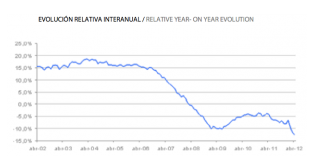
With asset devaluations like that it is very difficult to see how the Spanish taxpayer is going to stay unencumbered under any new plan.
May 9, 2012
The Emperor is Naked: David Stockman
A “paralyzed” Federal Reserve Bank, in its “final days,” held hostage by Wall Street “robots” trading in markets that are “artificially medicated” are just a few of the bleak observations shared by David Stockman, former Republican U.S. Congressman and director of the Office of Management and Budget. He is also a founding partner of Heartland Industrial Partners and the author of The Triumph of Politics: Why Reagan’s Revolution Failed and the soon-to-be released The Great Deformation: How Crony Capitalism Corrupts Free Markets and Democracy. The Gold Report caught up with Stockman for this exclusive interview at the recent Recovery Reality Check conference.
The Gold Report: David, you have talked and written about the effect of government-funded, debt-fueled spending on the stock market. What will be the real impact of quantitative easing?
David Stockman: We are in the last innings of a very bad ball game. We are coping with the crash of a 30-year–long debt super-cycle and the aftermath of an unsustainable bubble.
Quantitative easing is making it worse by facilitating more public-sector borrowing and preventing debt liquidation in the private sector—both erroneous steps in my view. The federal government is not getting its financial house in order. We are on the edge of a crisis in the bond markets. It has already happened in Europe and will be coming to our neighborhood soon.
TGR: What should the role of the Federal Reserve be?
DS: To get out of the way and not act like it is the central monetary planner of a $15 trillion economy. It cannot and should not be done.
The Fed is destroying the capital market by pegging and manipulating the price of money and debt capital. Interest rates signal nothing anymore because they are zero. The yield curve signals nothing anymore because it is totally manipulated by the Fed. The very idea of “Operation Twist” is an abomination.
Capital markets are at the heart of capitalism and they are not working. Savers are being crushed when we desperately need savings. The federal government is borrowing when it is broke. Wall Street is arbitraging the Fed’s monetary policy by borrowing overnight money at 10 basis points and investing it in 10-year treasuries at a yield of 200 basis points, capturing the profit and laughing all the way to the bank. The Fed has become a captive of the traders and robots on Wall Street.
TGR: If we are in the final innings of a debt super-cycle, what is the catalyst that will end the game?
DS: I think the likely catalyst is a breakdown of the U.S. government bond market. It is the heart of the fixed income market and, therefore, the world’s financial market.
Because of Fed management and interest-rate pegging, the market is artificially medicated. All of the rates and spreads are unreal. The yield curve is not market driven. Supply and demand for savings and investment, future inflation risk discounts by investors—none of these free market forces matter. The price of money is dictated by the Fed, and Wall Street merely attempts to front-run its next move.
As long as the hedge fund traders and fast-money boys believe the Fed can keep everything pegged, we may limp along. The minute they lose confidence, they will unwind their trades.
On the margin, nobody owns the Treasury bond; you rent it. Trillions of treasury paper is funded on repo: You buy $100 million (M) in Treasuries and immediately put them up as collateral for overnight borrowings of $98M. Traders can capture the spread as long as the price of the bond is stable or rising, as it has been for the last year or two. If the bond drops 2%, the spread has been wiped out.
If that happens, the massive repo structures—that is, debt owned by still more debt—will start to unwind and create a panic in the Treasury market. People will realize the emperor is naked.
TGR: Is that what happened in 2008?
DS: In 2008 it was the repo market for mortgage-back securities, credit default obligations and such. In 2008 we had a dry run of what happens when a class of assets owned on overnight money goes into a tailspin. There is a thunderous collapse.
Since then, the repo trade has remained in the Treasury and other high-grade markets because subprime and low-quality mortgage-backed securities are dead.
TGR: Walk us through a hypothetical. What happens when the fast-money traders lose confidence in the Fed’s ability to keep the spread?
DS: They are forced to start selling in order to liquidate their carry trades because repo lenders get nervous and want their cash back. However, when the crisis comes, there will be insufficient private bids—the market will gap down hard unless the central banks buy on an emergency basis: the Fed, the European Central Bank (ECB), the people’s printing press of China and all the rest of them.
The question is: Will the central banks be able to do that now, given that they have already expanded their balance sheets? The Fed balance sheet was $900 billion (B) when Lehman crashed in September 2008. It took 93 years to build it to that level from when the Fed opened for business in November 1914. Bernanke then added another $900B in seven weeks and then he took it to $2.4 trillion in an orgy of money printing during the initial 13 weeks after Lehman. Today it is nearly $3 trillion. Can it triple again? I do not think so. Worldwide it’s the same story: the top eight central banks had $5 trillion of footings shortly before the crisis; they have $15 trillion today. Overwhelmingly, this fantastic expansion of central bank footings has been used to buy or discount sovereign debt. This was the mother of all monetizations.
TGR: Following that path, what happens if there are no buyers? Do the governments go into default?
DS: The U.S. Treasury needs to be in the market for $20B in new issuances every week. When the day comes when there are all offers and no bids, the music will stop. Instead of being able to easily pawn off more borrowing on the markets—say 90 basis points for a 5-year note as at present—they may have to pay hundreds of basis points more. All of a sudden the politicians will run around with their hair on fire, asking, what happened to all the free money?
TGR: What do the politicians have to do next?
DS: They are going to have to eat 30 years worth of lies and by the time they are done eating, there will be a lot of mayhem.
TGR: Will the mayhem stretch into the private sector?
DS: It will be everywhere. Once the bond market starts unraveling, all the other risk assets will start selling off like mad, too.
TGR: Does every sector collapse?
DS: If the bond market goes into a dislocation, it will spread like a contagion to all of the other asset markets. There will be a massive selloff.
I think everything in the world is overvalued—stocks, bonds, commodities, currencies. Too much money printing and debt expansion drove the prices of all asset classes to artificial, non-economic levels. The danger to the world is not classic inflation or deflation of goods and services; it’s a drastic downward re-pricing of inflated financial assets.
TGR: Is there any way to unravel this without this massive dislocation?
DS: I do not think so. When you are so far out on the end of a limb, how do you walk it back?
The Fed is now at the end of a $3 trillion limb. It has been taken hostage by the markets the Federal Open Market Committee was trying to placate. People in the trading desks and hedge funds have been trained to front run the Fed. If they think the Fed’s next buy will be in the belly of the curve, they buy the belly of the curve. But how does the Fed ever unwind its current lunatic balance sheet? If the smart traders conclude the Fed’s next move will be to sell mortgage-backed securities, they will sell like mad in advance; soon there would be mayhem as all the boys and girls on Wall Street piled on. So the Fed is frozen; it is petrified by fear that if it begins contracting its balance sheet it will unleash the demons.
TGR: Was there some type of tipping that allowed certain banks to front run the Fed?
DS: There are two kinds of front-running. First is market-based front-running. You try to figure out what the Fed is doing by reading its smoke signals and looking at how it slices and dices its meeting statements. People invest or speculate against the Fed’s next incremental move.
Second, there is illicit front-running, where you have a friend who works for the Federal Reserve Board who tells you what happened in its meetings. This is obviously illegal.
But frankly, there is also just plain crony capitalism that is not that different in character and it’s what Wall Street does every day. Bill Dudley, who runs the New York Fed, was formerly chief economist for Goldman Sachs and he pretends to solicit an opinion about financial conditions from the current Goldman economist, who then pretends to opine as to what the economy and Fed might do next for the benefit of Goldman’s traders, and possibly its clients. So then it links in the ECB, Bank of Canada, etc. Is there any monetary post in the world not run by Goldman Sachs?
The point is, this is not the free market at work. This is central bank money printers and their Wall Street cronies perverting what used to be a capitalist market.
TGR: Does this unwinding of the Fed and the bond markets put the banking system back in peril, like in 2008?
DS: Not necessarily. That is one of the great myths that I address in my book. The banking system, especially the mainstream banking system, was not in peril at all. The toxic securitized mortgage assets were not in the Main Street banks and savings and loans; these institutions owned mostly prime quality whole loans and could have bled down the modest bad debt they did have over time from enhanced loan loss reserves. So the run on money was not at the retail teller window; it was in the canyons of Wall Street. The run was on wholesale money—that is, on repo and on unsecured commercial paper that had been issued in the hundreds of billions by financial institutions loaded down with securitized toxic garbage, including a lot of in-process inventory, on the asset side of their balance sheets.
The run was on investment banks that were really hedge funds in financial drag. The Goldmans and Morgan Stanleys did not really need trillion-dollar balance sheets to do mergers and acquisitions. Mergers and acquisitions do not require capital; they require a good Rolodex. They also did not need all that capital for the other part of investment banking—the underwriting business. Regulated stocks and bonds get underwritten through rigged cartels—they almost never under-price and really don’t need much capital. Their trillion dollar balance sheets, therefore, were just massive trading operations—whether they called it customer accommodation or proprietary is a distinction without a difference—which were funded on 30 to 1 leverage. Much of the debt was unstable hot money from the wholesale and repo market and that was the rub—the source of the panic.
Bernanke thought this was a retail run à la the 1930s. It was not; it was a wholesale money run in the canyons of Wall Street and it should have been allowed to burn out.
TGR: Let’s get back to our ballgame. What is to keep the U.S. population from saying, please Fed save us again?
DS: This time, I think the people will blame the Fed for lying. When the next crisis comes, I can see torches and pitch forks moving in the direction of the Eccles building where the Fed has its offices.
TGR: Let’s talk about timing. On Dec. 31, the tax cuts expire, defense cuts go into place and we hit the debt ceiling.
DS: That will be a clarifying moment; never before have three such powerful vectors come together at the same time— fiscal triple witching.
First, the debt ceiling will expire around election time, so the government will face another shutdown and it will be politically brutal to assemble a majority in a lame duck session to raise it by the trillions that will be needed. Second, the whole set of tax cuts and credits that have been enacted over the last 10 years total up to $400–500B annually will expire on Dec. 31, so they will hit the economy like a ton of bricks if not extended. Third, you have the sequester on defense spending that was put in last summer as a fallback, which cannot be changed without a majority vote in Congress.
It is a push-pull situation: If you defer the sequester, you need more debt ceiling. If you extend the tax expirations, you need a debt ceiling increase of $100B a month.
TGR: What will Congress do?
DS: Congress will extend the whole thing for 60 or 90 days to give the new president, if he hasn’t demanded a recount yet, an opportunity to come up with a plan.
To get the votes to extend the debt ceiling, the Democrats will insist on keeping the income and payroll tax cuts for the 99% and the Republicans will want to keep the capital gains rate at 15% so the Wall Street speculators will not be inconvenienced. It is utter madness.
TGR: It is like chasing your tail. How does it stop?
DS: I do not know how a functioning democracy in the ordinary course can deal with this. Maybe someone from Goldman Sachs can come and put in a fix, just like in Greece and Italy. The situation is really that pathetic.
TGR: Greece has come up with some creative ways to bring down its sovereign debt without actually defaulting.
DS: The Greek debt restructuring was a farce. More than $100B was held by the European bailout fund, the ECB or the International Monetary Fund. They got 100 cents on the dollar simply by issuing more debt to Greece. For private debt, I believe the net write-down was $30B after all the gimmicks, including the front-end payment. The rest was simply refinanced. The Greeks are still debt slaves, and will be until they tell Brussels to take a hike.
TGR: Going back to the triple-witching hour at year-end, if the debt ceiling is raised again, when do we start to see government layoffs and limitations on services?
DS: Defense purchases and non-defense purchases will be hit with brutal force by the sequester. As we go into 2013, there will be a shocking hit to the reported GDP numbers as discretionary government spending shrinks. People keep forgetting that most government spending is transfer payments, but it is only purchases of labor and goods that go directly into the GDP calculations, and it is these accounts that will get smacked by the sequester of discretionary defense and non-defense budgets.
TGR: I would think to unemployment numbers as well.
DS: They will go up.
Just take one example. According to the Bureau of Labor Statistics monthly report, there are 650,000 or so jobs in the U.S. Postal Service alone. That is 650,000 people who pretend to work at jobs that have more or less been made obsolete and redundant by the Internet and who are paid through borrowings from Uncle Sam because the post office is broke. Yet, the courageous ladies and gentlemen on Capitol Hill cannot even bring themselves to vote to discontinue Saturday mail delivery; they voted to study it! That is a measure of the loss of capacity to rationally cognate about our fiscal circumstance.
TGR: In the midst of this volatility, how can normal people preserve, much less expand their wealth?
DS: The only thing you can do is to stay out of harm’s way and try to preserve what you can in cash. All of the markets are rigged or impaired. A 4% yield on blue chip stocks is not worth it, because when the thing falls apart, your 4% will be gone in an hour.
TGR: But if the government keeps printing money, cash will not be worth as much, either, right?
DS: No, I do not think we will have hyperinflation. I think the financial system will break down before it can even get started. Then the economy will go into paralysis until we find the courage, focus and resolution to do something about it. Instead of hyperinflation or deflation there will be a major financial dislocation, which means painful re-pricing of financial assets.
How painful will the re-pricing be? I think the public already knows that it will be really terrible. A poll I saw the other day indicated that 25% of people on the verge of retirement think they are in such bad financial shape that they will have to work until age 80. Now, the average life expectancy is 78. People’s financial circumstances are so bad that they think they will be working two years after they are dead!
TGR: Finally, what is your investment model?
DS: My investing model is ABCD: Anything Bernanke Cannot Destroy: flashlight batteries, canned beans, bottled water, gold, a cabin in the mountains.
TGR: Thank you very much.
The Gold Report: David, you have talked and written about the effect of government-funded, debt-fueled spending on the stock market. What will be the real impact of quantitative easing?
David Stockman: We are in the last innings of a very bad ball game. We are coping with the crash of a 30-year–long debt super-cycle and the aftermath of an unsustainable bubble.
Quantitative easing is making it worse by facilitating more public-sector borrowing and preventing debt liquidation in the private sector—both erroneous steps in my view. The federal government is not getting its financial house in order. We are on the edge of a crisis in the bond markets. It has already happened in Europe and will be coming to our neighborhood soon.
TGR: What should the role of the Federal Reserve be?
DS: To get out of the way and not act like it is the central monetary planner of a $15 trillion economy. It cannot and should not be done.
The Fed is destroying the capital market by pegging and manipulating the price of money and debt capital. Interest rates signal nothing anymore because they are zero. The yield curve signals nothing anymore because it is totally manipulated by the Fed. The very idea of “Operation Twist” is an abomination.
Capital markets are at the heart of capitalism and they are not working. Savers are being crushed when we desperately need savings. The federal government is borrowing when it is broke. Wall Street is arbitraging the Fed’s monetary policy by borrowing overnight money at 10 basis points and investing it in 10-year treasuries at a yield of 200 basis points, capturing the profit and laughing all the way to the bank. The Fed has become a captive of the traders and robots on Wall Street.
TGR: If we are in the final innings of a debt super-cycle, what is the catalyst that will end the game?
DS: I think the likely catalyst is a breakdown of the U.S. government bond market. It is the heart of the fixed income market and, therefore, the world’s financial market.
Because of Fed management and interest-rate pegging, the market is artificially medicated. All of the rates and spreads are unreal. The yield curve is not market driven. Supply and demand for savings and investment, future inflation risk discounts by investors—none of these free market forces matter. The price of money is dictated by the Fed, and Wall Street merely attempts to front-run its next move.
As long as the hedge fund traders and fast-money boys believe the Fed can keep everything pegged, we may limp along. The minute they lose confidence, they will unwind their trades.
On the margin, nobody owns the Treasury bond; you rent it. Trillions of treasury paper is funded on repo: You buy $100 million (M) in Treasuries and immediately put them up as collateral for overnight borrowings of $98M. Traders can capture the spread as long as the price of the bond is stable or rising, as it has been for the last year or two. If the bond drops 2%, the spread has been wiped out.
If that happens, the massive repo structures—that is, debt owned by still more debt—will start to unwind and create a panic in the Treasury market. People will realize the emperor is naked.
TGR: Is that what happened in 2008?
DS: In 2008 it was the repo market for mortgage-back securities, credit default obligations and such. In 2008 we had a dry run of what happens when a class of assets owned on overnight money goes into a tailspin. There is a thunderous collapse.
Since then, the repo trade has remained in the Treasury and other high-grade markets because subprime and low-quality mortgage-backed securities are dead.
TGR: Walk us through a hypothetical. What happens when the fast-money traders lose confidence in the Fed’s ability to keep the spread?
DS: They are forced to start selling in order to liquidate their carry trades because repo lenders get nervous and want their cash back. However, when the crisis comes, there will be insufficient private bids—the market will gap down hard unless the central banks buy on an emergency basis: the Fed, the European Central Bank (ECB), the people’s printing press of China and all the rest of them.
The question is: Will the central banks be able to do that now, given that they have already expanded their balance sheets? The Fed balance sheet was $900 billion (B) when Lehman crashed in September 2008. It took 93 years to build it to that level from when the Fed opened for business in November 1914. Bernanke then added another $900B in seven weeks and then he took it to $2.4 trillion in an orgy of money printing during the initial 13 weeks after Lehman. Today it is nearly $3 trillion. Can it triple again? I do not think so. Worldwide it’s the same story: the top eight central banks had $5 trillion of footings shortly before the crisis; they have $15 trillion today. Overwhelmingly, this fantastic expansion of central bank footings has been used to buy or discount sovereign debt. This was the mother of all monetizations.
TGR: Following that path, what happens if there are no buyers? Do the governments go into default?
DS: The U.S. Treasury needs to be in the market for $20B in new issuances every week. When the day comes when there are all offers and no bids, the music will stop. Instead of being able to easily pawn off more borrowing on the markets—say 90 basis points for a 5-year note as at present—they may have to pay hundreds of basis points more. All of a sudden the politicians will run around with their hair on fire, asking, what happened to all the free money?
TGR: What do the politicians have to do next?
DS: They are going to have to eat 30 years worth of lies and by the time they are done eating, there will be a lot of mayhem.
TGR: Will the mayhem stretch into the private sector?
DS: It will be everywhere. Once the bond market starts unraveling, all the other risk assets will start selling off like mad, too.
TGR: Does every sector collapse?
DS: If the bond market goes into a dislocation, it will spread like a contagion to all of the other asset markets. There will be a massive selloff.
I think everything in the world is overvalued—stocks, bonds, commodities, currencies. Too much money printing and debt expansion drove the prices of all asset classes to artificial, non-economic levels. The danger to the world is not classic inflation or deflation of goods and services; it’s a drastic downward re-pricing of inflated financial assets.
TGR: Is there any way to unravel this without this massive dislocation?
DS: I do not think so. When you are so far out on the end of a limb, how do you walk it back?
The Fed is now at the end of a $3 trillion limb. It has been taken hostage by the markets the Federal Open Market Committee was trying to placate. People in the trading desks and hedge funds have been trained to front run the Fed. If they think the Fed’s next buy will be in the belly of the curve, they buy the belly of the curve. But how does the Fed ever unwind its current lunatic balance sheet? If the smart traders conclude the Fed’s next move will be to sell mortgage-backed securities, they will sell like mad in advance; soon there would be mayhem as all the boys and girls on Wall Street piled on. So the Fed is frozen; it is petrified by fear that if it begins contracting its balance sheet it will unleash the demons.
TGR: Was there some type of tipping that allowed certain banks to front run the Fed?
DS: There are two kinds of front-running. First is market-based front-running. You try to figure out what the Fed is doing by reading its smoke signals and looking at how it slices and dices its meeting statements. People invest or speculate against the Fed’s next incremental move.
Second, there is illicit front-running, where you have a friend who works for the Federal Reserve Board who tells you what happened in its meetings. This is obviously illegal.
But frankly, there is also just plain crony capitalism that is not that different in character and it’s what Wall Street does every day. Bill Dudley, who runs the New York Fed, was formerly chief economist for Goldman Sachs and he pretends to solicit an opinion about financial conditions from the current Goldman economist, who then pretends to opine as to what the economy and Fed might do next for the benefit of Goldman’s traders, and possibly its clients. So then it links in the ECB, Bank of Canada, etc. Is there any monetary post in the world not run by Goldman Sachs?
The point is, this is not the free market at work. This is central bank money printers and their Wall Street cronies perverting what used to be a capitalist market.
TGR: Does this unwinding of the Fed and the bond markets put the banking system back in peril, like in 2008?
DS: Not necessarily. That is one of the great myths that I address in my book. The banking system, especially the mainstream banking system, was not in peril at all. The toxic securitized mortgage assets were not in the Main Street banks and savings and loans; these institutions owned mostly prime quality whole loans and could have bled down the modest bad debt they did have over time from enhanced loan loss reserves. So the run on money was not at the retail teller window; it was in the canyons of Wall Street. The run was on wholesale money—that is, on repo and on unsecured commercial paper that had been issued in the hundreds of billions by financial institutions loaded down with securitized toxic garbage, including a lot of in-process inventory, on the asset side of their balance sheets.
The run was on investment banks that were really hedge funds in financial drag. The Goldmans and Morgan Stanleys did not really need trillion-dollar balance sheets to do mergers and acquisitions. Mergers and acquisitions do not require capital; they require a good Rolodex. They also did not need all that capital for the other part of investment banking—the underwriting business. Regulated stocks and bonds get underwritten through rigged cartels—they almost never under-price and really don’t need much capital. Their trillion dollar balance sheets, therefore, were just massive trading operations—whether they called it customer accommodation or proprietary is a distinction without a difference—which were funded on 30 to 1 leverage. Much of the debt was unstable hot money from the wholesale and repo market and that was the rub—the source of the panic.
Bernanke thought this was a retail run à la the 1930s. It was not; it was a wholesale money run in the canyons of Wall Street and it should have been allowed to burn out.
TGR: Let’s get back to our ballgame. What is to keep the U.S. population from saying, please Fed save us again?
DS: This time, I think the people will blame the Fed for lying. When the next crisis comes, I can see torches and pitch forks moving in the direction of the Eccles building where the Fed has its offices.
TGR: Let’s talk about timing. On Dec. 31, the tax cuts expire, defense cuts go into place and we hit the debt ceiling.
DS: That will be a clarifying moment; never before have three such powerful vectors come together at the same time— fiscal triple witching.
First, the debt ceiling will expire around election time, so the government will face another shutdown and it will be politically brutal to assemble a majority in a lame duck session to raise it by the trillions that will be needed. Second, the whole set of tax cuts and credits that have been enacted over the last 10 years total up to $400–500B annually will expire on Dec. 31, so they will hit the economy like a ton of bricks if not extended. Third, you have the sequester on defense spending that was put in last summer as a fallback, which cannot be changed without a majority vote in Congress.
It is a push-pull situation: If you defer the sequester, you need more debt ceiling. If you extend the tax expirations, you need a debt ceiling increase of $100B a month.
TGR: What will Congress do?
DS: Congress will extend the whole thing for 60 or 90 days to give the new president, if he hasn’t demanded a recount yet, an opportunity to come up with a plan.
To get the votes to extend the debt ceiling, the Democrats will insist on keeping the income and payroll tax cuts for the 99% and the Republicans will want to keep the capital gains rate at 15% so the Wall Street speculators will not be inconvenienced. It is utter madness.
TGR: It is like chasing your tail. How does it stop?
DS: I do not know how a functioning democracy in the ordinary course can deal with this. Maybe someone from Goldman Sachs can come and put in a fix, just like in Greece and Italy. The situation is really that pathetic.
TGR: Greece has come up with some creative ways to bring down its sovereign debt without actually defaulting.
DS: The Greek debt restructuring was a farce. More than $100B was held by the European bailout fund, the ECB or the International Monetary Fund. They got 100 cents on the dollar simply by issuing more debt to Greece. For private debt, I believe the net write-down was $30B after all the gimmicks, including the front-end payment. The rest was simply refinanced. The Greeks are still debt slaves, and will be until they tell Brussels to take a hike.
TGR: Going back to the triple-witching hour at year-end, if the debt ceiling is raised again, when do we start to see government layoffs and limitations on services?
DS: Defense purchases and non-defense purchases will be hit with brutal force by the sequester. As we go into 2013, there will be a shocking hit to the reported GDP numbers as discretionary government spending shrinks. People keep forgetting that most government spending is transfer payments, but it is only purchases of labor and goods that go directly into the GDP calculations, and it is these accounts that will get smacked by the sequester of discretionary defense and non-defense budgets.
TGR: I would think to unemployment numbers as well.
DS: They will go up.
Just take one example. According to the Bureau of Labor Statistics monthly report, there are 650,000 or so jobs in the U.S. Postal Service alone. That is 650,000 people who pretend to work at jobs that have more or less been made obsolete and redundant by the Internet and who are paid through borrowings from Uncle Sam because the post office is broke. Yet, the courageous ladies and gentlemen on Capitol Hill cannot even bring themselves to vote to discontinue Saturday mail delivery; they voted to study it! That is a measure of the loss of capacity to rationally cognate about our fiscal circumstance.
TGR: In the midst of this volatility, how can normal people preserve, much less expand their wealth?
DS: The only thing you can do is to stay out of harm’s way and try to preserve what you can in cash. All of the markets are rigged or impaired. A 4% yield on blue chip stocks is not worth it, because when the thing falls apart, your 4% will be gone in an hour.
TGR: But if the government keeps printing money, cash will not be worth as much, either, right?
DS: No, I do not think we will have hyperinflation. I think the financial system will break down before it can even get started. Then the economy will go into paralysis until we find the courage, focus and resolution to do something about it. Instead of hyperinflation or deflation there will be a major financial dislocation, which means painful re-pricing of financial assets.
How painful will the re-pricing be? I think the public already knows that it will be really terrible. A poll I saw the other day indicated that 25% of people on the verge of retirement think they are in such bad financial shape that they will have to work until age 80. Now, the average life expectancy is 78. People’s financial circumstances are so bad that they think they will be working two years after they are dead!
TGR: Finally, what is your investment model?
DS: My investing model is ABCD: Anything Bernanke Cannot Destroy: flashlight batteries, canned beans, bottled water, gold, a cabin in the mountains.
TGR: Thank you very much.
May 8, 2012
Lack of Trust – Caused by Institutional Corruption – Is Killing the Economy
People Are Losing Trust In All Institutions
The signs are everywhere: Americans have lost trust in our institutions.
The Chicago Booth/Kellogg School Financial Trust Index published yesterday shows that only 22% of Americans trust the nation’s financial system.
SmartMoney notes today that more and more Americans are keeping valuables at home because they have lost trust in banks.
Robert Shiller said Monday:
Our whole economy has been affected by variations in confidence. Central banks are sort of trusted, but the actions they have often affect people’s confidence by appearance rather than substance. We’re not in the most trusting mood now.”
The National Journal noted last week:

Seven in 10 Americans believe that the country is on the wrong track; eight in 10 are dissatisfied with the way the nation is being governed. Only 23 percent have confidence in banks, and just 19 percent have confidence in big business. Less than half the population expresses “a great deal” of confidence in the public-school system or organized religion. “We have lost our gods,” says Laura Hansen, an assistant professor of sociology at Western New England University in Springfield, Mass. “We lost [faith] in the media: Remember Walter Cronkite? We lost it in our culture: You can’t point to a movie star who might inspire us, because we know too much about them. We lost it in politics, because we know too much about politicians’ lives. We’ve lost it—that basic sense of trust and confidence—in everything.”
***
After a 50-year decline, just 14 percent of respondents in a 2011 Gallup Poll said that the federal government could be trusted “a great deal
Gallup reported last month that – for the second year in a row – Americans said that gold is the safest long-term investment. This shows that Americans don’t trust the government. Specifically, as Time Magazine points out:
Traditionally, gold has been a store of value when citizens do not trust their government politically or economically.
Indeed:
■A tiny percent of Americans believe that the U.S. government has the consent of the governed
■A higher percentage of Americans believed in King George of England during the Revolutionary War than believe in congress today
■Many Americans disbelieve the government’s rosy statements about the economy
■An NBC News/Wall Street Journal poll from November found that 76% of Americans believe that the country’s current financial and political structures favor the rich over the rest of the country
■The U.S. financial system is so corrupt and unregulated that many don’t believe the government and businesses’ promises to follow the rule of law … and simply won’t do business here anymore
It’s not just the U.S.
As the Economist reported in January, trust in institutions is plunging worldwide:
The latest annual “trust barometer” published by Edelman, a PR firm, on January 24th [finds that] overall trust has declined in the leaders of the four main categories of organization scrutinized—government, business, non-governmental organizations and the media. Of the 50 or so countries examined, 11, nearly twice as many as last year, are now judged “sceptical”, with less than 50% of those polled saying they trusted these institutions. Trust in Japanese institutions plunged to 34%, from 51% in 2011, not surprising given the handling by leaders of the Tsunami and its aftermath. But the collapse in trust was even more striking in Brazil, the country in which trust was greatest in 2011, at 80%, but now, following a series of corruption scandals, has slipped to 51% (admittedly, still above America and Britain, among others).
This headline slump in trust is due, above all, to the public losing faith in political leaders. In 2011, across all countries, Edelman found that 52% of those polled trusted government; this year, it was only 43%. Government is now trusted less even than the media …. Trust in business fell slightly, from 56% to 53%, as did trust in NGOs, which still remain the most trusted type of institution, at 58%, down from 61% in 2011. As in previous years, the barometer is based on a poll of what Edelman calls “informed people”, which typically means professional and well-educated, though this year for the first time the views of the informed were benchmarked against a poll of the public as a whole. For each institution, the broader public was even less trusting than the informed, with government trusted by 38%, business 47%, NGOs 50% and the media 46%.
Lack of Trust Is Killing the Economy
Top economists have been saying for well over a decade that trust is necessary for a stable economy, and that prosecuting the criminals is necessary to restore trust. Indeed, as we have repeatedly noted, loss of trust is arguably the main reason we are stuck in an economic crisis … notwithstanding unprecedented action by central banks worldwide.
Economist Daniel Hameresh writes:
A number of economists have shown recently that income levels and real growth depend upon trust—trust greases the wheels of exchange.
In 1998, Paul Zak (Professor of Economics and Department Chair, as well as the founding Director of the Center for Neuroeconomics Studies at Claremont Graduate University, Professor of Neurology at Loma Linda University Medical Center, and a senior researcher at UCLA) and Stephen Knack (a Lead Economist in the World Bank’s Research Department and Public Sector Governance Department) wrote a paper called Trust and Growth, arguing:
Adam Smith … observed notable differences across nations in the ‘probity’ and ‘punctuality’ of their populations. For example, the Dutch ‘are the most faithful to their word.’ John Stuart Mill wrote: ‘There are countries in Europe . . . where the most serious impediment to conducting business concerns on a large scale, is the rarity of persons who are supposed fit to be trusted with the receipt and expenditure of large sums of money’ (Mill, 1848, p. 132).
Enormous differences across countries in the propensity to trust others survive
today.
***
Trust is higher in ‘fair’ societies.
***
High trust societies produce more output than low trust societies. A fortiori, a sufficient amount of trust may be crucial to successful development. Douglass North (1990, p. 54) writes,
The inability of societies to develop effective, lowcost enforcement of contracts is the most important source of both historical stagnation and contemporary underdevelopment in the Third World.
***
If trust is too low in a society, savings will be insufficient to sustain positive output growth. Such a poverty trap is more likely when institutions -
both formal and informal – which punish cheaters are weak.
Heap, Tan and Zizzo and others have come to similar conclusions.
In 2001, Zak and Knack showed that “strengthening the rule of law, reducing inequality, and by facilitating interpersonal understanding” all increase trust. They conclude:
Our analysis shows that trust can be raised directly by increasing communication and education, and indirectly by strengthening formal institutions that enforce contracts and by reducing income inequality. Among the policies that impact these factors, only education, … and freedom satisfy the efficiency criterion which compares the cost of policies with the benefits citizens receive in terms of higher living standards. Further, our analysis suggests that good policy initiates a virtuous circle: policies that raise trust efficiently, improve living standards, raise civil liberties, enhance institutions, and reduce corruption, further raising trust. Trust, democracy, and the rule of law are thus the foundation of abiding prosperity.
A 2005 letter in premier scientific journal Nature reviewed the research on trust and economics:
Trust … plays a key role in economic exchange and politics. In the absence of trust among trading partners, market transactions break down. In the absence of trust in a country’s institutions and leaders, political legitimacy breaks down. Much recent evidence indicates that trust contributes to economic, political and social success.
Forbes wrote an article in 2006 entitled “The Economics of Trust”. The article summarizes the importance of trust in creating a healthy economy:
Imagine going to the corner store to buy a carton of milk, only to find that the refrigerator is locked. When you’ve persuaded the shopkeeper to retrieve the milk, you then end up arguing over whether you’re going to hand the money over first, or whether he is going to hand over the milk. Finally you manage to arrange an elaborate simultaneous exchange. A little taste of life in a world without trust–now imagine trying to arrange a mortgage.
Being able to trust people might seem like a pleasant luxury, but economists are starting to believe that it’s rather more important than that. Trust is about more than whether you can leave your house unlocked; it is responsible for the difference between the richest countries and the poorest.
“If you take a broad enough definition of trust, then it would explain basically all the difference between the per capita income of the United States and Somalia,” ventures Steve Knack, a senior economist at the World Bank who has been studying the economics of trust for over a decade. That suggests that trust is worth $12.4 trillion dollars a year to the U.S., which, in case you are wondering, is 99.5% of this country’s income.
***
Above all, trust enables people to do business with each other. Doing business is what creates wealth.
***
Economists distinguish between the personal, informal trust that comes from being friendly with your neighbors and the impersonal, institutionalized trust that lets you give your credit card number out over the Internet.
In 2007, Yann Algan (Professor of Economics at Paris School of Economics and University Paris East) and Pierre Cahuc (Professor of Economics at the Ecole Polytechnique (Paris)) reported:
We find a significant impact of trust on income per capita for 30 countries over the period 1949-2003.
Similarly, market psychologists Richard L. Peterson M.D. and Frank Murtha, PhD noted in 2008
Trust is the oil in the engine of capitalism, without it, the engine seizes up. Confidence is like the gasoline, without it the machine won’t move.
Trust is gone: there is no longer trust between counterparties in the financial system. Furthermore, confidence is at a low. Investors have lost their confidence in the ability of shares to provide decent returns (since they haven’t).
In 2009, Paola Sapienza (associate professor of finance and the Zell Center Faculty Fellow at Northwestern University) and Luigi Zingales (Robert C. McCormack Professor of Entrepreneurship and Finance at the University of Chicago Booth School of Business) pointed out:
The drop in trust, we believe, is a major factor behind the deteriorating economic conditions.
***
As trust declines, so does Americans’ willingness to invest their money in the financial system. Our data show that trust in the stock market affects people’s intention to buy stocks, even after accounting for expectations of future stock-market performance. Similarly, a person’s trust in banks predicts the likelihood that he will make a run on his bank in a moment of crisis: 25 percent of those who don’t trust banks withdrew their deposits and stored them as cash last fall, compared with only 3 percent of those who said they still trusted the banks. Thus, trust in financial institutions is a key factor for the smooth functioning of capital markets and, by extension, the economy. Changes in trust matter.
They quote a Nobel laureate economist on the subject:
“Virtually every commercial transaction has within itself an element of trust,” writes economist Kenneth Arrow, a Nobel laureate. When we deposit money in a bank, we trust that it’s safe. When a company orders goods, it trusts its counterpart to deliver them in good faith. Trust facilitates transactions because it saves the costs of monitoring and screening; it is an essential lubricant that greases the wheels of the economic system.
In 2010, a distinguished international group of economists (Giancarlo Corsetti, Michael P. Devereux, Luigi Guiso, John Hassler, Gilles Saint-Paul, Hans-Werner Sinn, Jan-Egbert Sturm and Xavier Vives) wrote:
Public distrust of bankers and financial markets has risen dramatically with the financial crisis. This column argues that this loss of trust in the financial system played a critical role in the collapse of economic activity that followed. To undo the damage, financial regulation needs to focus on restoring that trust.
They noted:
Trust is crucial in many transactions and certainly in those involving financial exchanges. The massive drop in trust associated with this crisis will therefore have important implications for the future of financial markets. Data show that in the late 1970s, the percentage of people who reported having full trust in banks, brokers, mutual funds or the stock market was around 40%; it had sunk to around 30% just before the crisis hit, and collapsed to barely 5% afterwards. It is now even lower than the trust people have in other people (randomly selected of course).
In his influential 1993 book Making Democracy Work, Robert Putnam showed how civic attitudes and trust could account for differences in the economic and government performance between northern and southern Italy.
Political economist Francis Fukiyama wrote a book called Trust in 1995, arguing that the most pervasive cultural characteristic influencing a nation’s prosperity and ability to compete is the level of trust or cooperative behavior based upon shared norms. He stated that the United States, like Japan and Germany, has been a high-trust society historically but that this status has eroded in recent years.
Chris Farrell notes:
Trust matters. It’s kind of like a recipe or a software protocol that allows for economic exchange and all kinds of innovation.
***
There’s compelling evidence that both higher levels of trust in institutions and a belief in the general trustworthiness of individuals in society carry large economic benefits. Sociologists, political scientists and economists have all showed in an impressive body of research that higher levels of trust increase trade and even foster economic growth,.
Dallas Fed president Richard Fisher said last year that a growing distrust of the nation’s political institutions is keeping businesses on the sidelines.
Forbes notes in March that a lack of trust was one of the main factors hurting the Greek economy:
There are a number of issues that have contributed and exacerbated the levels of distrust. For instance, Greece, with the help of Goldman Sachs, concealed the state of their finances for over a decade until they ran into this major debt crisis. Because they failed to disclose the extent of their financial problems, the EU and other players in the global credit market are extremely reluctant to cooperate or put faith in the representations made by the Greek leadership.
***
If the leadership in Athens cannot reestablish trust with the citizenry and develop open and honest communication amongst themselves, their constituents, and the individual leaders of the financial institutions involved, the agreements they make will not even be worth the paper they are written on.
Ken Eisold – an internationally respected authority on the psychodynamics of organizations – writes:
Most of us view trust as valuable and desirable, something that improves the quality of our personal lives. We seldom take the next step and view it as indispensable, a vital ingredient in society – and in the economy. But all credit is based on trust, and the fundamental problem in a credit crisis is not just the lack of “liquidity” but also the absence of trust, the trust that is essential to all financial transactions.”
But the problem is not that people should be more blindly and naively trusting. The problem – as Eisold points out – is that the institutions have to act in a more trustworthy manner:
The essential point is not that people need to be encouraged to trust. Most of us want to trust and have the basic capacity to trust. We need institutions that are trustworthy.
No Economy-Revving Optimism Without Trust
Economist Robert Higgs – who has studied the effect of World War II on the economy in great detail – argues that it was optimism, rather than stimulus spending, which got us out of the depression:
The performance of the war economy … broke the back of the pessimistic expectations almost everybody had come to hold during the seemingly endless Depression. In the long decade of the 1930s, especially its latter half, many people had come to believe that the economic machine was irreparably broken. The frenetic activity of war production—never mind that it was just a lot of guns and ammunition—dispelled the hopelessness. People began to think: if we can produce all these planes, ships, and bombs, we can also turn out prodigious quantities of cars and refrigerators.
***
The transformation of expectations—justify an interpretation that views the war as an event that recreated the possibility of genuine economic recovery. As the war ended, real prosperity returned.
Unlike after WWII, Americans now are pessimistic (even though we’ve been various wars against third-rate countries far longer than we were in WWII) and our expectations are stuck in the gutter.
Why?
Perhaps because we don’t trust our government, our big corporations or our other institutions to do anything very helpful for the country. Indeed, we don’t trust our government, big corporations and other institutions to even allow a fair playing field where we have a chance of competing fairly to get ahead on our own initiative.
Why should we work harder, invest more or spend more when we don’t trust that we might have a bright future?
Prosecuting the Criminals Is Necessary to Restore Trust
Nobel prize winning economist Joseph Stiglitz says that we have to prosecute fraud or else the economy won’t recover:
The legal system is supposed to be the codification of our norms and beliefs, things that we need to make our system work. If the legal system is seen as exploitative, then confidence in our whole system starts eroding. And that’s really the problem that’s going on.
***
I think we ought to go do what we did in the S&L [crisis] and actually put many of these guys in prison. Absolutely. These are not just white-collar crimes or little accidents. There were victims. That’s the point. There were victims all over the world.
***
Economists focus on the whole notion of incentives. People have an incentive sometimes to behave badly, because they can make more money if they can cheat. If our economic system is going to work then we have to make sure that what they gain when they cheat is offset by a system of penalties.
Robert Shiller said recently that failing to address the legal issues will cause Americans to lose faith in business and the government:
Shiller said the danger of foreclosuregate — the scandal in which it has come to light that the biggest banks have routinely mishandled homeownership documents, putting the legality of foreclosures and related sales in doubt — is a replay of the 1930s, when Americans lost faith that institutions such as business and government were dealing fairly.
Economists such as William Black and James Galbraith agree. Galbraith says:
There will have to be full-scale investigation and cleaning up of the residue of that, before you can have, I think, a return of confidence in the financial sector. And that’s a process which needs to get underway.
Galbraith also says that economists should move into the background, and “criminologists to the forefront”.
Government regulators know this – or at least pay lip service to it – as well. For example, as the Director of the Securities and Exchange Commission’s enforcement division told Congress:
Recovery from the fallout of the financial crisis requires important efforts on various fronts, and vigorous enforcement is an essential component, as aggressive and even-handed enforcement will meet the public’s fair expectation that those whose violations of the law caused severe loss and hardship will be held accountable. And vigorous law enforcement efforts will help vindicate the principles that are fundamental to the fair and proper functioning of our markets: that no one should have an unjust advantage in our markets; that investors have a right to disclosure that complies with the federal securities laws; and that there is a level playing field for all investors.
Nobel prize winning economist George Akerlof has demonstrated that failure to punish white collar criminals – and instead bailing them out- creates incentives for more economic crimes and further destruction of the economy in the future. Indeed, William Black notes that we’ve known of this dynamic for “hundreds of years”. And see this, this, this and this.
And when Zak and Knack – quoted above – discuss “enforcing contracts”, “raising civil liberties”, and “reducing corruption”, they are talking about enforcing the rule of law, which means prosecuting violations of the law. Likewise, when they refer to “enhancing institutions”, they mean regulatory and justice systems which enforce contracts and prosecute cheaters.
And when Zak and Knack promote reduction of inequality, that means prosecuting fraud as well. Specifically, as I recently pointed out, prosecuting fraud is the best way to reduce inequality:
Robert Shiller [one of the top housing economists in the United States] said in 2009:
And it’s not like we want to level income. I’m not saying spread the wealth around, which got Obama in trouble. But I think, I would hope that this would be a time for a national consideration about policies that would focus on restraining any possible further increases in inequality.
***
If we stop bailing out the fraudsters and financial gamblers, the big banks would focus more on traditional lending and less on speculative plays which only make the rich richer and the poor poorer, and which guarantee future economic crises (which hurt the poor more than the rich).
***
Moreover, both conservatives and liberals agree that we need to prosecute financial fraud. As I’ve previously noted, fraud disproportionally benefits the big players, makes boom-bust cycles more severe, and otherwise harms the economy – all of which increase inequality and warp the market.
Of course, it’s not just economists saying this.
One of the leading business schools in America – the Wharton School of Business – published an essay by a psychologist on the causes and solutions to the economic crisis. Wharton points out that restoring trust is the key to recovery, and that trust cannot be restored until wrongdoers are held accountable:
According to David M. Sachs, a training and supervision analyst at the Psychoanalytic Center of Philadelphia, the crisis today is not one of confidence, but one of trust. “Abusive financial practices were unchecked by personal moral controls that prohibit individual criminal behavior, as in the case of [Bernard] Madoff, and by complex financial manipulations, as in the case of AIG.” The public, expecting to be protected from such abuse, has suffered a trauma of loss similar to that after 9/11. “Normal expectations of what is safe and dependable were abruptly shattered,” Sachs noted. “As is typical of post-traumatic states, planning for the future could not be based on old assumptions about what is safe and what is dangerous. A radical reversal of how to be gratified occurred.”
People now feel more gratified saving money than spending it, Sachs suggested. They have trouble trusting promises from the government because they feel the government has let them down.
He framed his argument with a fictional patient named Betty Q. Public, a librarian with two teenage children and a husband, John, who had recently lost his job. “She felt betrayed because she and her husband had invested conservatively and were double-crossed by dishonest, greedy businessmen, and now she distrusted the government that had failed to protect them from corporate dishonesty. Not only that, but she had little trust in things turning around soon enough to enable her and her husband to accomplish their previous goals.
“By no means a sophisticated economist, she knew … that some people had become fantastically wealthy by misusing other people’s money — hers included,” Sachs said. “In short, John and Betty had done everything right and were being punished, while the dishonest people were going unpunished.”
Helping an individual recover from a traumatic experience provides a useful analogy for understanding how to help the economy recover from its own traumatic experience, Sachs pointed out. The public will need to “hold the perpetrators of the economic disaster responsible and take what actions they can to prevent them from harming the economy again.” In addition, the public will have to see proof that government and business leaders can behave responsibly before they will trust them again, he argued.
Note that Sachs urges “hold[ing] the perpetrators of the economic disaster responsible.” In other words, just “looking forward” and promising to do things differently isn’t enough.
As Wall Street insider and New York Times columnist Andrew Ross Sorkin writes:
“They will pick on minor misdemeanors by individual market participants,” said David Einhorn, the hedge fund manager who was among the Cassandras before the financial crisis. To Mr. Einhorn, the government is “not willing to take on significant misbehavior by sizable” firms. “But since there have been almost no big prosecutions, there’s very little evidence that it has stopped bad actors from behaving badly.”***
Fraud at big corporations surely dwarfs by orders of magnitude the shareholders’ losses of $8 billion that Mr. Holder highlighted. If the government spent half the time trying to ferret out fraud at major companies that it does tracking pump-and-dump schemes, we might have been able to stop the financial crisis, or at least we’d have a fighting chance at stopping the next one.
Of course, the Europeans have been trying to avoid fraud prosecutions as well.
On the other hand, Iceland has prosecuted the fraudster bank heads (and here and here) and their former prime minister, and their economy is recovering nicely … because trust is being restored in the financial system.
Indeed, even evangelical leader Pat Robertson agrees:
Pat Robertson discussed the banking crisis and glowingly spoke about how Iceland jailed many of the bankers who devastated their nation’s economy by taking out fraudulent loans. Robertson hailed the Nordic nation for its actions and said that Americans should deal with the financial crisis in the same way.
***
“They are putting people in jail. Prime ministers are being indicted. They are going after banks. The people said the banks are ripping us off. We don’t like what they did, and they brought our country to ruin. Suddenly, Iceland is turning around and they look like a big success story!”
***
“We could start putting all of those bankers in jail. There was not one banker prosecuted and so many people were lying, and so-called “no-doc loans” and liars’ loans, and none of them have been held accountable.
***
Iceland is leading the way and their GDP is growing, and all of a sudden, they were in a terrible mess, terrible mess, and look what is happening!”
The signs are everywhere: Americans have lost trust in our institutions.
The Chicago Booth/Kellogg School Financial Trust Index published yesterday shows that only 22% of Americans trust the nation’s financial system.
SmartMoney notes today that more and more Americans are keeping valuables at home because they have lost trust in banks.
Robert Shiller said Monday:
Our whole economy has been affected by variations in confidence. Central banks are sort of trusted, but the actions they have often affect people’s confidence by appearance rather than substance. We’re not in the most trusting mood now.”
The National Journal noted last week:
Seven in 10 Americans believe that the country is on the wrong track; eight in 10 are dissatisfied with the way the nation is being governed. Only 23 percent have confidence in banks, and just 19 percent have confidence in big business. Less than half the population expresses “a great deal” of confidence in the public-school system or organized religion. “We have lost our gods,” says Laura Hansen, an assistant professor of sociology at Western New England University in Springfield, Mass. “We lost [faith] in the media: Remember Walter Cronkite? We lost it in our culture: You can’t point to a movie star who might inspire us, because we know too much about them. We lost it in politics, because we know too much about politicians’ lives. We’ve lost it—that basic sense of trust and confidence—in everything.”
***
After a 50-year decline, just 14 percent of respondents in a 2011 Gallup Poll said that the federal government could be trusted “a great deal
Gallup reported last month that – for the second year in a row – Americans said that gold is the safest long-term investment. This shows that Americans don’t trust the government. Specifically, as Time Magazine points out:
Traditionally, gold has been a store of value when citizens do not trust their government politically or economically.
Indeed:
■A tiny percent of Americans believe that the U.S. government has the consent of the governed
■A higher percentage of Americans believed in King George of England during the Revolutionary War than believe in congress today
■Many Americans disbelieve the government’s rosy statements about the economy
■An NBC News/Wall Street Journal poll from November found that 76% of Americans believe that the country’s current financial and political structures favor the rich over the rest of the country
■The U.S. financial system is so corrupt and unregulated that many don’t believe the government and businesses’ promises to follow the rule of law … and simply won’t do business here anymore
It’s not just the U.S.
As the Economist reported in January, trust in institutions is plunging worldwide:
The latest annual “trust barometer” published by Edelman, a PR firm, on January 24th [finds that] overall trust has declined in the leaders of the four main categories of organization scrutinized—government, business, non-governmental organizations and the media. Of the 50 or so countries examined, 11, nearly twice as many as last year, are now judged “sceptical”, with less than 50% of those polled saying they trusted these institutions. Trust in Japanese institutions plunged to 34%, from 51% in 2011, not surprising given the handling by leaders of the Tsunami and its aftermath. But the collapse in trust was even more striking in Brazil, the country in which trust was greatest in 2011, at 80%, but now, following a series of corruption scandals, has slipped to 51% (admittedly, still above America and Britain, among others).
This headline slump in trust is due, above all, to the public losing faith in political leaders. In 2011, across all countries, Edelman found that 52% of those polled trusted government; this year, it was only 43%. Government is now trusted less even than the media …. Trust in business fell slightly, from 56% to 53%, as did trust in NGOs, which still remain the most trusted type of institution, at 58%, down from 61% in 2011. As in previous years, the barometer is based on a poll of what Edelman calls “informed people”, which typically means professional and well-educated, though this year for the first time the views of the informed were benchmarked against a poll of the public as a whole. For each institution, the broader public was even less trusting than the informed, with government trusted by 38%, business 47%, NGOs 50% and the media 46%.
Lack of Trust Is Killing the Economy
Top economists have been saying for well over a decade that trust is necessary for a stable economy, and that prosecuting the criminals is necessary to restore trust. Indeed, as we have repeatedly noted, loss of trust is arguably the main reason we are stuck in an economic crisis … notwithstanding unprecedented action by central banks worldwide.
Economist Daniel Hameresh writes:
A number of economists have shown recently that income levels and real growth depend upon trust—trust greases the wheels of exchange.
In 1998, Paul Zak (Professor of Economics and Department Chair, as well as the founding Director of the Center for Neuroeconomics Studies at Claremont Graduate University, Professor of Neurology at Loma Linda University Medical Center, and a senior researcher at UCLA) and Stephen Knack (a Lead Economist in the World Bank’s Research Department and Public Sector Governance Department) wrote a paper called Trust and Growth, arguing:
Adam Smith … observed notable differences across nations in the ‘probity’ and ‘punctuality’ of their populations. For example, the Dutch ‘are the most faithful to their word.’ John Stuart Mill wrote: ‘There are countries in Europe . . . where the most serious impediment to conducting business concerns on a large scale, is the rarity of persons who are supposed fit to be trusted with the receipt and expenditure of large sums of money’ (Mill, 1848, p. 132).
Enormous differences across countries in the propensity to trust others survive
today.
***
Trust is higher in ‘fair’ societies.
***
High trust societies produce more output than low trust societies. A fortiori, a sufficient amount of trust may be crucial to successful development. Douglass North (1990, p. 54) writes,
The inability of societies to develop effective, lowcost enforcement of contracts is the most important source of both historical stagnation and contemporary underdevelopment in the Third World.
***
If trust is too low in a society, savings will be insufficient to sustain positive output growth. Such a poverty trap is more likely when institutions -
both formal and informal – which punish cheaters are weak.
Heap, Tan and Zizzo and others have come to similar conclusions.
In 2001, Zak and Knack showed that “strengthening the rule of law, reducing inequality, and by facilitating interpersonal understanding” all increase trust. They conclude:
Our analysis shows that trust can be raised directly by increasing communication and education, and indirectly by strengthening formal institutions that enforce contracts and by reducing income inequality. Among the policies that impact these factors, only education, … and freedom satisfy the efficiency criterion which compares the cost of policies with the benefits citizens receive in terms of higher living standards. Further, our analysis suggests that good policy initiates a virtuous circle: policies that raise trust efficiently, improve living standards, raise civil liberties, enhance institutions, and reduce corruption, further raising trust. Trust, democracy, and the rule of law are thus the foundation of abiding prosperity.
A 2005 letter in premier scientific journal Nature reviewed the research on trust and economics:
Trust … plays a key role in economic exchange and politics. In the absence of trust among trading partners, market transactions break down. In the absence of trust in a country’s institutions and leaders, political legitimacy breaks down. Much recent evidence indicates that trust contributes to economic, political and social success.
Forbes wrote an article in 2006 entitled “The Economics of Trust”. The article summarizes the importance of trust in creating a healthy economy:
Imagine going to the corner store to buy a carton of milk, only to find that the refrigerator is locked. When you’ve persuaded the shopkeeper to retrieve the milk, you then end up arguing over whether you’re going to hand the money over first, or whether he is going to hand over the milk. Finally you manage to arrange an elaborate simultaneous exchange. A little taste of life in a world without trust–now imagine trying to arrange a mortgage.
Being able to trust people might seem like a pleasant luxury, but economists are starting to believe that it’s rather more important than that. Trust is about more than whether you can leave your house unlocked; it is responsible for the difference between the richest countries and the poorest.
“If you take a broad enough definition of trust, then it would explain basically all the difference between the per capita income of the United States and Somalia,” ventures Steve Knack, a senior economist at the World Bank who has been studying the economics of trust for over a decade. That suggests that trust is worth $12.4 trillion dollars a year to the U.S., which, in case you are wondering, is 99.5% of this country’s income.
***
Above all, trust enables people to do business with each other. Doing business is what creates wealth.
***
Economists distinguish between the personal, informal trust that comes from being friendly with your neighbors and the impersonal, institutionalized trust that lets you give your credit card number out over the Internet.
In 2007, Yann Algan (Professor of Economics at Paris School of Economics and University Paris East) and Pierre Cahuc (Professor of Economics at the Ecole Polytechnique (Paris)) reported:
We find a significant impact of trust on income per capita for 30 countries over the period 1949-2003.
Similarly, market psychologists Richard L. Peterson M.D. and Frank Murtha, PhD noted in 2008
Trust is the oil in the engine of capitalism, without it, the engine seizes up. Confidence is like the gasoline, without it the machine won’t move.
Trust is gone: there is no longer trust between counterparties in the financial system. Furthermore, confidence is at a low. Investors have lost their confidence in the ability of shares to provide decent returns (since they haven’t).
In 2009, Paola Sapienza (associate professor of finance and the Zell Center Faculty Fellow at Northwestern University) and Luigi Zingales (Robert C. McCormack Professor of Entrepreneurship and Finance at the University of Chicago Booth School of Business) pointed out:
The drop in trust, we believe, is a major factor behind the deteriorating economic conditions.
***
As trust declines, so does Americans’ willingness to invest their money in the financial system. Our data show that trust in the stock market affects people’s intention to buy stocks, even after accounting for expectations of future stock-market performance. Similarly, a person’s trust in banks predicts the likelihood that he will make a run on his bank in a moment of crisis: 25 percent of those who don’t trust banks withdrew their deposits and stored them as cash last fall, compared with only 3 percent of those who said they still trusted the banks. Thus, trust in financial institutions is a key factor for the smooth functioning of capital markets and, by extension, the economy. Changes in trust matter.
They quote a Nobel laureate economist on the subject:
“Virtually every commercial transaction has within itself an element of trust,” writes economist Kenneth Arrow, a Nobel laureate. When we deposit money in a bank, we trust that it’s safe. When a company orders goods, it trusts its counterpart to deliver them in good faith. Trust facilitates transactions because it saves the costs of monitoring and screening; it is an essential lubricant that greases the wheels of the economic system.
In 2010, a distinguished international group of economists (Giancarlo Corsetti, Michael P. Devereux, Luigi Guiso, John Hassler, Gilles Saint-Paul, Hans-Werner Sinn, Jan-Egbert Sturm and Xavier Vives) wrote:
Public distrust of bankers and financial markets has risen dramatically with the financial crisis. This column argues that this loss of trust in the financial system played a critical role in the collapse of economic activity that followed. To undo the damage, financial regulation needs to focus on restoring that trust.
They noted:
Trust is crucial in many transactions and certainly in those involving financial exchanges. The massive drop in trust associated with this crisis will therefore have important implications for the future of financial markets. Data show that in the late 1970s, the percentage of people who reported having full trust in banks, brokers, mutual funds or the stock market was around 40%; it had sunk to around 30% just before the crisis hit, and collapsed to barely 5% afterwards. It is now even lower than the trust people have in other people (randomly selected of course).
In his influential 1993 book Making Democracy Work, Robert Putnam showed how civic attitudes and trust could account for differences in the economic and government performance between northern and southern Italy.
Political economist Francis Fukiyama wrote a book called Trust in 1995, arguing that the most pervasive cultural characteristic influencing a nation’s prosperity and ability to compete is the level of trust or cooperative behavior based upon shared norms. He stated that the United States, like Japan and Germany, has been a high-trust society historically but that this status has eroded in recent years.
Chris Farrell notes:
Trust matters. It’s kind of like a recipe or a software protocol that allows for economic exchange and all kinds of innovation.
***
There’s compelling evidence that both higher levels of trust in institutions and a belief in the general trustworthiness of individuals in society carry large economic benefits. Sociologists, political scientists and economists have all showed in an impressive body of research that higher levels of trust increase trade and even foster economic growth,.
Dallas Fed president Richard Fisher said last year that a growing distrust of the nation’s political institutions is keeping businesses on the sidelines.
Forbes notes in March that a lack of trust was one of the main factors hurting the Greek economy:
There are a number of issues that have contributed and exacerbated the levels of distrust. For instance, Greece, with the help of Goldman Sachs, concealed the state of their finances for over a decade until they ran into this major debt crisis. Because they failed to disclose the extent of their financial problems, the EU and other players in the global credit market are extremely reluctant to cooperate or put faith in the representations made by the Greek leadership.
***
If the leadership in Athens cannot reestablish trust with the citizenry and develop open and honest communication amongst themselves, their constituents, and the individual leaders of the financial institutions involved, the agreements they make will not even be worth the paper they are written on.
Ken Eisold – an internationally respected authority on the psychodynamics of organizations – writes:
Most of us view trust as valuable and desirable, something that improves the quality of our personal lives. We seldom take the next step and view it as indispensable, a vital ingredient in society – and in the economy. But all credit is based on trust, and the fundamental problem in a credit crisis is not just the lack of “liquidity” but also the absence of trust, the trust that is essential to all financial transactions.”
But the problem is not that people should be more blindly and naively trusting. The problem – as Eisold points out – is that the institutions have to act in a more trustworthy manner:
The essential point is not that people need to be encouraged to trust. Most of us want to trust and have the basic capacity to trust. We need institutions that are trustworthy.
No Economy-Revving Optimism Without Trust
Economist Robert Higgs – who has studied the effect of World War II on the economy in great detail – argues that it was optimism, rather than stimulus spending, which got us out of the depression:
The performance of the war economy … broke the back of the pessimistic expectations almost everybody had come to hold during the seemingly endless Depression. In the long decade of the 1930s, especially its latter half, many people had come to believe that the economic machine was irreparably broken. The frenetic activity of war production—never mind that it was just a lot of guns and ammunition—dispelled the hopelessness. People began to think: if we can produce all these planes, ships, and bombs, we can also turn out prodigious quantities of cars and refrigerators.
***
The transformation of expectations—justify an interpretation that views the war as an event that recreated the possibility of genuine economic recovery. As the war ended, real prosperity returned.
Unlike after WWII, Americans now are pessimistic (even though we’ve been various wars against third-rate countries far longer than we were in WWII) and our expectations are stuck in the gutter.
Why?
Perhaps because we don’t trust our government, our big corporations or our other institutions to do anything very helpful for the country. Indeed, we don’t trust our government, big corporations and other institutions to even allow a fair playing field where we have a chance of competing fairly to get ahead on our own initiative.
Why should we work harder, invest more or spend more when we don’t trust that we might have a bright future?
Prosecuting the Criminals Is Necessary to Restore Trust
Nobel prize winning economist Joseph Stiglitz says that we have to prosecute fraud or else the economy won’t recover:
The legal system is supposed to be the codification of our norms and beliefs, things that we need to make our system work. If the legal system is seen as exploitative, then confidence in our whole system starts eroding. And that’s really the problem that’s going on.
***
I think we ought to go do what we did in the S&L [crisis] and actually put many of these guys in prison. Absolutely. These are not just white-collar crimes or little accidents. There were victims. That’s the point. There were victims all over the world.
***
Economists focus on the whole notion of incentives. People have an incentive sometimes to behave badly, because they can make more money if they can cheat. If our economic system is going to work then we have to make sure that what they gain when they cheat is offset by a system of penalties.
Robert Shiller said recently that failing to address the legal issues will cause Americans to lose faith in business and the government:
Shiller said the danger of foreclosuregate — the scandal in which it has come to light that the biggest banks have routinely mishandled homeownership documents, putting the legality of foreclosures and related sales in doubt — is a replay of the 1930s, when Americans lost faith that institutions such as business and government were dealing fairly.
Economists such as William Black and James Galbraith agree. Galbraith says:
There will have to be full-scale investigation and cleaning up of the residue of that, before you can have, I think, a return of confidence in the financial sector. And that’s a process which needs to get underway.
Galbraith also says that economists should move into the background, and “criminologists to the forefront”.
Government regulators know this – or at least pay lip service to it – as well. For example, as the Director of the Securities and Exchange Commission’s enforcement division told Congress:
Recovery from the fallout of the financial crisis requires important efforts on various fronts, and vigorous enforcement is an essential component, as aggressive and even-handed enforcement will meet the public’s fair expectation that those whose violations of the law caused severe loss and hardship will be held accountable. And vigorous law enforcement efforts will help vindicate the principles that are fundamental to the fair and proper functioning of our markets: that no one should have an unjust advantage in our markets; that investors have a right to disclosure that complies with the federal securities laws; and that there is a level playing field for all investors.
Nobel prize winning economist George Akerlof has demonstrated that failure to punish white collar criminals – and instead bailing them out- creates incentives for more economic crimes and further destruction of the economy in the future. Indeed, William Black notes that we’ve known of this dynamic for “hundreds of years”. And see this, this, this and this.
And when Zak and Knack – quoted above – discuss “enforcing contracts”, “raising civil liberties”, and “reducing corruption”, they are talking about enforcing the rule of law, which means prosecuting violations of the law. Likewise, when they refer to “enhancing institutions”, they mean regulatory and justice systems which enforce contracts and prosecute cheaters.
And when Zak and Knack promote reduction of inequality, that means prosecuting fraud as well. Specifically, as I recently pointed out, prosecuting fraud is the best way to reduce inequality:
Robert Shiller [one of the top housing economists in the United States] said in 2009:
And it’s not like we want to level income. I’m not saying spread the wealth around, which got Obama in trouble. But I think, I would hope that this would be a time for a national consideration about policies that would focus on restraining any possible further increases in inequality.
***
If we stop bailing out the fraudsters and financial gamblers, the big banks would focus more on traditional lending and less on speculative plays which only make the rich richer and the poor poorer, and which guarantee future economic crises (which hurt the poor more than the rich).
***
Moreover, both conservatives and liberals agree that we need to prosecute financial fraud. As I’ve previously noted, fraud disproportionally benefits the big players, makes boom-bust cycles more severe, and otherwise harms the economy – all of which increase inequality and warp the market.
Of course, it’s not just economists saying this.
One of the leading business schools in America – the Wharton School of Business – published an essay by a psychologist on the causes and solutions to the economic crisis. Wharton points out that restoring trust is the key to recovery, and that trust cannot be restored until wrongdoers are held accountable:
According to David M. Sachs, a training and supervision analyst at the Psychoanalytic Center of Philadelphia, the crisis today is not one of confidence, but one of trust. “Abusive financial practices were unchecked by personal moral controls that prohibit individual criminal behavior, as in the case of [Bernard] Madoff, and by complex financial manipulations, as in the case of AIG.” The public, expecting to be protected from such abuse, has suffered a trauma of loss similar to that after 9/11. “Normal expectations of what is safe and dependable were abruptly shattered,” Sachs noted. “As is typical of post-traumatic states, planning for the future could not be based on old assumptions about what is safe and what is dangerous. A radical reversal of how to be gratified occurred.”
People now feel more gratified saving money than spending it, Sachs suggested. They have trouble trusting promises from the government because they feel the government has let them down.
He framed his argument with a fictional patient named Betty Q. Public, a librarian with two teenage children and a husband, John, who had recently lost his job. “She felt betrayed because she and her husband had invested conservatively and were double-crossed by dishonest, greedy businessmen, and now she distrusted the government that had failed to protect them from corporate dishonesty. Not only that, but she had little trust in things turning around soon enough to enable her and her husband to accomplish their previous goals.
“By no means a sophisticated economist, she knew … that some people had become fantastically wealthy by misusing other people’s money — hers included,” Sachs said. “In short, John and Betty had done everything right and were being punished, while the dishonest people were going unpunished.”
Helping an individual recover from a traumatic experience provides a useful analogy for understanding how to help the economy recover from its own traumatic experience, Sachs pointed out. The public will need to “hold the perpetrators of the economic disaster responsible and take what actions they can to prevent them from harming the economy again.” In addition, the public will have to see proof that government and business leaders can behave responsibly before they will trust them again, he argued.
Note that Sachs urges “hold[ing] the perpetrators of the economic disaster responsible.” In other words, just “looking forward” and promising to do things differently isn’t enough.
As Wall Street insider and New York Times columnist Andrew Ross Sorkin writes:
“They will pick on minor misdemeanors by individual market participants,” said David Einhorn, the hedge fund manager who was among the Cassandras before the financial crisis. To Mr. Einhorn, the government is “not willing to take on significant misbehavior by sizable” firms. “But since there have been almost no big prosecutions, there’s very little evidence that it has stopped bad actors from behaving badly.”***
Fraud at big corporations surely dwarfs by orders of magnitude the shareholders’ losses of $8 billion that Mr. Holder highlighted. If the government spent half the time trying to ferret out fraud at major companies that it does tracking pump-and-dump schemes, we might have been able to stop the financial crisis, or at least we’d have a fighting chance at stopping the next one.
Of course, the Europeans have been trying to avoid fraud prosecutions as well.
On the other hand, Iceland has prosecuted the fraudster bank heads (and here and here) and their former prime minister, and their economy is recovering nicely … because trust is being restored in the financial system.
Indeed, even evangelical leader Pat Robertson agrees:
Pat Robertson discussed the banking crisis and glowingly spoke about how Iceland jailed many of the bankers who devastated their nation’s economy by taking out fraudulent loans. Robertson hailed the Nordic nation for its actions and said that Americans should deal with the financial crisis in the same way.
***
“They are putting people in jail. Prime ministers are being indicted. They are going after banks. The people said the banks are ripping us off. We don’t like what they did, and they brought our country to ruin. Suddenly, Iceland is turning around and they look like a big success story!”
***
“We could start putting all of those bankers in jail. There was not one banker prosecuted and so many people were lying, and so-called “no-doc loans” and liars’ loans, and none of them have been held accountable.
***
Iceland is leading the way and their GDP is growing, and all of a sudden, they were in a terrible mess, terrible mess, and look what is happening!”
May 7, 2012
The Volcker Rule Advances
Progress Is Seen in Advancing a Final Volcker Rule ... Daniel Tarullo, a Federal Reserve Board governor, held a meeting on Wednesday with the heads of six major banks. A major new rule that has drawn the ire of Wall Street is on track for completion sooner than some bankers had expected, dashing the hopes of financial industry lobbyists, who have pressed for a delay. Regulators are making significant progress on a final draft of the regulation, the Volcker Rule, and some officials expected to complete it by September and possibly as early as this summer, people with direct knowledge of the matter said. The people, who spoke on the condition of anonymity, cautioned that regulators have not set a firm date for completing the rule. The Volcker Rule aims to rein in risky trading on Wall Street. Named for Paul A. Volcker, the former chairman of the Federal Reserve, it would ban banks from placing bets with their own money, a practice known as proprietary trading. – Bloomberg
Dominant Social Theme: And so Barney Frank is to free us again.
Free-Market Analysis: Here it comes. Another elite dominant social theme designed to support the idea that wise regulation can make a big and positive difference in the world.
This is surely a promotion – as regulation can make things worse but rarely better. Regulation is a price fix, mandating a transfer of wealth from those who create it to those who haven't and may not know what to do with it.
One of the most attractive current regulatory memes has to do with the idea that big Wall Street banks have to be restrained from trading against their customers.
At its simplest, the argument is that big financial entities will simultaneously bet with their book and against it, eventually plunging the Street into chaos and despair. Here's some more from the article:
When regulators first proposed a version of the rule last year, they received a torrent of criticism from the financial industry, which complained about the length and complexity of the proposal. It was the most hostile response to any provision of the Dodd-Frank financial overhaul law, which created the Volcker Rule with the notion that banks should not make risky wagers while enjoying government deposit insurance and other types of backing.
Some opponents of the Volcker Rule urged regulators to tear up the draft and start from scratch. That tactic, which even gained support among some high-level regulators, was seen by some as a ploy to delay the rule-writing process until after the 2012 election, which might end the Democratic control of the Senate and the White House.
"Reproposal is necessary for several reasons," the Securities Industry and Financial Markets Association, an influential Wall Street lobbying group, said last month in a letter to regulators. "First, the changes to the proposal needed to correctly implement the Volcker Rule mandate and to avoid serious harm to our financial markets are so extensive that reproposal will be required as a matter of administrative law."
But regulators driving the rule-writing process have not discussed scrapping the draft and currently have no plans to repropose a new version, the people briefed on the matter said. In fact, regulators are moving forward on the wording of critical provisions, like exemptions that allow banks to hold a certain amount of securities for customers.
The assumption here is market failure. But markets don't fail. Wall Street is basically a mercantilist entity, a group of firms that have been propped up by all the puffery and power of the US itself.
Because so much has been given to Wall Street, something is to be taken away. But markets don't work like that. It is not really possible to create privileges and then moderate them.
What works best in markets is the Invisible Hand of competition. But one cannot substitute government bureaucracy for the Invisible Hand with any certainty that the outcome will be as preferred.
In fact, it cannot be seen as something other than a kind of regulatory promotion of itself. Markets in the current era don't rise and fall because of Wall Street manipulation but because of monopoly-fiat central banking.
Too much money printing creates first booms and then busts. But the power elite that seeks to maintain its money franchise doesn't want central banking to appear in the crosshairs. Thus the old scapegoat is hauled out ... Wall Street.
The problem, of course, is money power, the ability to print money from nothing within a monopoly context. Tinkering with what Wall Street can and cannot do is merely a cover-up for the real problem.
Conclusion: Wall Street should be exposed to more competition, not to additional regulations.
Dominant Social Theme: And so Barney Frank is to free us again.
Free-Market Analysis: Here it comes. Another elite dominant social theme designed to support the idea that wise regulation can make a big and positive difference in the world.
This is surely a promotion – as regulation can make things worse but rarely better. Regulation is a price fix, mandating a transfer of wealth from those who create it to those who haven't and may not know what to do with it.
One of the most attractive current regulatory memes has to do with the idea that big Wall Street banks have to be restrained from trading against their customers.
At its simplest, the argument is that big financial entities will simultaneously bet with their book and against it, eventually plunging the Street into chaos and despair. Here's some more from the article:
When regulators first proposed a version of the rule last year, they received a torrent of criticism from the financial industry, which complained about the length and complexity of the proposal. It was the most hostile response to any provision of the Dodd-Frank financial overhaul law, which created the Volcker Rule with the notion that banks should not make risky wagers while enjoying government deposit insurance and other types of backing.
Some opponents of the Volcker Rule urged regulators to tear up the draft and start from scratch. That tactic, which even gained support among some high-level regulators, was seen by some as a ploy to delay the rule-writing process until after the 2012 election, which might end the Democratic control of the Senate and the White House.
"Reproposal is necessary for several reasons," the Securities Industry and Financial Markets Association, an influential Wall Street lobbying group, said last month in a letter to regulators. "First, the changes to the proposal needed to correctly implement the Volcker Rule mandate and to avoid serious harm to our financial markets are so extensive that reproposal will be required as a matter of administrative law."
But regulators driving the rule-writing process have not discussed scrapping the draft and currently have no plans to repropose a new version, the people briefed on the matter said. In fact, regulators are moving forward on the wording of critical provisions, like exemptions that allow banks to hold a certain amount of securities for customers.
The assumption here is market failure. But markets don't fail. Wall Street is basically a mercantilist entity, a group of firms that have been propped up by all the puffery and power of the US itself.
Because so much has been given to Wall Street, something is to be taken away. But markets don't work like that. It is not really possible to create privileges and then moderate them.
What works best in markets is the Invisible Hand of competition. But one cannot substitute government bureaucracy for the Invisible Hand with any certainty that the outcome will be as preferred.
In fact, it cannot be seen as something other than a kind of regulatory promotion of itself. Markets in the current era don't rise and fall because of Wall Street manipulation but because of monopoly-fiat central banking.
Too much money printing creates first booms and then busts. But the power elite that seeks to maintain its money franchise doesn't want central banking to appear in the crosshairs. Thus the old scapegoat is hauled out ... Wall Street.
The problem, of course, is money power, the ability to print money from nothing within a monopoly context. Tinkering with what Wall Street can and cannot do is merely a cover-up for the real problem.
Conclusion: Wall Street should be exposed to more competition, not to additional regulations.
May 4, 2012
Public company foreign bribery cases rarely go to trial
You're the CEO of a global, publicly traded corporation. You've just learned that some employees may have bribed foreign government officials to help your business get contracts.
Now federal prosecutors and regulators want to see company records as part of an investigation under a law called the Foreign Corrupt Practices Act.
What do you do? In many cases, negotiate a settlement, pay a fine, and get back to business.
The scenario is a hot topic in corporate boardrooms in the wake of allegations by a former Wal-Mart official that company executives in Mexico paid millions of dollars to government officials there in a successful effort to speed the opening of new stores. The allegations, now under review by the company and federal investigators, were disclosed last month by The New York Times.
It's not yet clear what, if anything, will come of the review. But records of Foreign Corrupt Practices Act cases show publicly traded companies are leery about going to trial against the government.
"The companies that actually fight the Justice Department or the Securities and Exchange Commission are pretty few and far between," said Amy Conway-Hatcher, a former federal prosecutor who heads the Internal Investigation practice for the Kaye Scholer law firm in Washington, D.C. "You usually see corporate settlements arise out of this."
Enacted in 1977, the anti-corruption statute makes it illegal for companies and their employees to make payments to foreign government officials with the goal of obtaining or retaining business. Companies with U.S.-listed securities must also keep records that accurately reflect payments and have internal accounting controls.
From 1991 to 2010, each of the dozens of publicly traded companies criminally accused under the law has reached a settlement that enabled it to pay a fine and avoid trial, said Richard Cassin, an attorney who's the creator and principal author of the FCPA blog.
Federal case data collected by the Transactional Records Access Clearinghouse, a research organization at Syracuse University, confirm the trend.
By settling, companies sidestep negative publicity and avoid the long odds of prevailing at trial because of a legal doctrine that makes them responsible for the actions of their employees. Moreover, Cassin said deferred prosecution or non-prosecution agreements with the government often enable companies to have the case record closed, provided they cooperate with federal prosecutors.
"With that mechanism in place, companies find it attractive to resolve the cases," he said.
Criminal and civil fines imposed on corporations totaled more than $3.8 billion from 2007 to 2011, a boom era in enforcement of the anti-corruption law, according to a widely followed digest issued by the Shearman & Sterling law firm. Income from the settlements represents "a nice cottage industry" for the government, Conway-Hatcher said.
But the government has suffered bruising setbacks amid its successes. Unlike corporations, several individuals charged under the anti-corruption law have gone to trial in the last few years, and won.
Federal prosecutors grabbed headlines in 2010 when they announced an undercover sting had produced indictments of 22 executives and employees of military and law enforcement contracting firms for allegedly scheming to bribe African government officials in exchange for contracts.
But in the succeeding months, the alleged conspiracy prosecution collapsed in a mistrial, acquittals and the government's decision to drop the case.
David Krakoff, a BuckleySandler attorney who represented one of the defendants, theorized that prosecutors thought they would obtain quick guilty pleas "because they had videotapes and they had audiotapes and they had invoices going back and forth, and they had substantial e-mail contact."
That was a miscalculation, Krakoff said, because the defendants didn't know each other, which undermined the conspiracy allegation, and they dealt with an undercover agent, not a foreign government official.
"Did the money really go to a foreign official? Did it actually induce a foreign official to do something or take some action that was improper? Did the company executive actually know a bribe was going to be paid?" asked Krakoff, referring generally to potential problem issues for prosecutors. "These are real live questions, and it's not always easy to prove."
The U.S. Chamber of Commerce and other groups have called for revisions that, among other things, would enable firms with strong anti-bribery compliance systems to mount a good-faith defense if an errant employee or vendor violates anti-bribery policies without knowledge of corporate leadership. In a 2010 report titled "Restoring Balance," the Chamber of Commerce said it was unfair to hold a business criminally liable for behavior the business neither knew about nor sanctioned.
The question for companies is "how far do you have to go" to detect and correct potential violations of the anti-corruption law, Conway-Hatcher said. "What's enough, in the government's eyes? And that's not always clear. To a certain extent ... companies sometimes feel a little bit like sitting ducks."
The business group and others also contend the government has imposed exorbitant fines on companies that have run afoul of the law.
But the Shearman & Sterling digest reported in January that the average penalties over the past few years have ranged from $3 million to $33 million, "not inconsequential, but certainly not as severe and extreme as the annual total penalties might suggest."
Pointing to what he termed an expected mixture of wins and losses for both sides in Foreign Corrupt Practices Act cases, Cassin argued the government "is just doing its job."
Now federal prosecutors and regulators want to see company records as part of an investigation under a law called the Foreign Corrupt Practices Act.
What do you do? In many cases, negotiate a settlement, pay a fine, and get back to business.
The scenario is a hot topic in corporate boardrooms in the wake of allegations by a former Wal-Mart official that company executives in Mexico paid millions of dollars to government officials there in a successful effort to speed the opening of new stores. The allegations, now under review by the company and federal investigators, were disclosed last month by The New York Times.
It's not yet clear what, if anything, will come of the review. But records of Foreign Corrupt Practices Act cases show publicly traded companies are leery about going to trial against the government.
"The companies that actually fight the Justice Department or the Securities and Exchange Commission are pretty few and far between," said Amy Conway-Hatcher, a former federal prosecutor who heads the Internal Investigation practice for the Kaye Scholer law firm in Washington, D.C. "You usually see corporate settlements arise out of this."
Enacted in 1977, the anti-corruption statute makes it illegal for companies and their employees to make payments to foreign government officials with the goal of obtaining or retaining business. Companies with U.S.-listed securities must also keep records that accurately reflect payments and have internal accounting controls.
From 1991 to 2010, each of the dozens of publicly traded companies criminally accused under the law has reached a settlement that enabled it to pay a fine and avoid trial, said Richard Cassin, an attorney who's the creator and principal author of the FCPA blog.
Federal case data collected by the Transactional Records Access Clearinghouse, a research organization at Syracuse University, confirm the trend.
By settling, companies sidestep negative publicity and avoid the long odds of prevailing at trial because of a legal doctrine that makes them responsible for the actions of their employees. Moreover, Cassin said deferred prosecution or non-prosecution agreements with the government often enable companies to have the case record closed, provided they cooperate with federal prosecutors.
"With that mechanism in place, companies find it attractive to resolve the cases," he said.
Criminal and civil fines imposed on corporations totaled more than $3.8 billion from 2007 to 2011, a boom era in enforcement of the anti-corruption law, according to a widely followed digest issued by the Shearman & Sterling law firm. Income from the settlements represents "a nice cottage industry" for the government, Conway-Hatcher said.
But the government has suffered bruising setbacks amid its successes. Unlike corporations, several individuals charged under the anti-corruption law have gone to trial in the last few years, and won.
Federal prosecutors grabbed headlines in 2010 when they announced an undercover sting had produced indictments of 22 executives and employees of military and law enforcement contracting firms for allegedly scheming to bribe African government officials in exchange for contracts.
But in the succeeding months, the alleged conspiracy prosecution collapsed in a mistrial, acquittals and the government's decision to drop the case.
David Krakoff, a BuckleySandler attorney who represented one of the defendants, theorized that prosecutors thought they would obtain quick guilty pleas "because they had videotapes and they had audiotapes and they had invoices going back and forth, and they had substantial e-mail contact."
That was a miscalculation, Krakoff said, because the defendants didn't know each other, which undermined the conspiracy allegation, and they dealt with an undercover agent, not a foreign government official.
"Did the money really go to a foreign official? Did it actually induce a foreign official to do something or take some action that was improper? Did the company executive actually know a bribe was going to be paid?" asked Krakoff, referring generally to potential problem issues for prosecutors. "These are real live questions, and it's not always easy to prove."
The U.S. Chamber of Commerce and other groups have called for revisions that, among other things, would enable firms with strong anti-bribery compliance systems to mount a good-faith defense if an errant employee or vendor violates anti-bribery policies without knowledge of corporate leadership. In a 2010 report titled "Restoring Balance," the Chamber of Commerce said it was unfair to hold a business criminally liable for behavior the business neither knew about nor sanctioned.
The question for companies is "how far do you have to go" to detect and correct potential violations of the anti-corruption law, Conway-Hatcher said. "What's enough, in the government's eyes? And that's not always clear. To a certain extent ... companies sometimes feel a little bit like sitting ducks."
The business group and others also contend the government has imposed exorbitant fines on companies that have run afoul of the law.
But the Shearman & Sterling digest reported in January that the average penalties over the past few years have ranged from $3 million to $33 million, "not inconsequential, but certainly not as severe and extreme as the annual total penalties might suggest."
Pointing to what he termed an expected mixture of wins and losses for both sides in Foreign Corrupt Practices Act cases, Cassin argued the government "is just doing its job."
May 3, 2012
Hugh Hendry On Europe "You Can't Make Up How Bad It Is"
At The Milken Institute conference yesterday, Hugh Hendry delivered his usual eloquent and critical insights on the state of Europe. Beginning with the statement that "All of Europe has defaulted", the canny-wee-fella (translation: shrewd and cautious young chap) explained that "The political economy in Europe is such that the politicians chose to default on their spending obligations to their citizens in order to honor the pact with their financial creditors and so as time goes on, the politicians are being rejected." Between France's election of Mr. Hollande and Luxembourg's 'when times get tough you have to lie' Juncker, Hendry says the only inspiration for Europe is fiction as "you just can't make up how bad it is" as he goes on to discuss the precedent for a way forward, the grotesque distortions of fixed exchange rate regimes, why Weimar happened, why the transfer union will never happen, Ayn Rand's reality, and fear politicians are feeling.
The entire discussion is well worth watching for a sense of the underlying reality in Europe.
The underlying reality that what the European monetary union is about is not about preventing a third so-called European civil war, it is essentially about making someone (France, Germany or both) a Great Power, a European Hegemon, and a global player.
Starting at around 12:00, Hugh begins his must-watch discussion...
And begins again at around 30:00, Hendry discusses the British perspective on the impeccable logic of the German mind and why the transfer union will never happen in Europe...and why Wiemar happened...
At around 46:00, Hendry addresses Germany's emerging housing bubble (and why it won't occur) and the two forms of leverage in the world.
From 52:40, Hendry takes on the view of (disagreeing with) a weak USD and the US being supplanted as a global leader
Hendry confesses to not being able to finish reading Ayn Rand's Atlas Shrugged at around 1:02:00 and explains why (apart from its length and lack of pictures)...noting that is too depressingly real in its description of the world we live in today...
We have reached a profound point in economic history where the truth is unpalatable to the political class - and that truth is that the scale and magnitude of the problem is larger than their ability to respond - and it terrifies them.
Concluding at 1:10:10 - "we are single-digit years away from the most profound market clearing moment"
The entire discussion is well worth watching for a sense of the underlying reality in Europe.
The underlying reality that what the European monetary union is about is not about preventing a third so-called European civil war, it is essentially about making someone (France, Germany or both) a Great Power, a European Hegemon, and a global player.
Starting at around 12:00, Hugh begins his must-watch discussion...
And begins again at around 30:00, Hendry discusses the British perspective on the impeccable logic of the German mind and why the transfer union will never happen in Europe...and why Wiemar happened...
At around 46:00, Hendry addresses Germany's emerging housing bubble (and why it won't occur) and the two forms of leverage in the world.
From 52:40, Hendry takes on the view of (disagreeing with) a weak USD and the US being supplanted as a global leader
Hendry confesses to not being able to finish reading Ayn Rand's Atlas Shrugged at around 1:02:00 and explains why (apart from its length and lack of pictures)...noting that is too depressingly real in its description of the world we live in today...
We have reached a profound point in economic history where the truth is unpalatable to the political class - and that truth is that the scale and magnitude of the problem is larger than their ability to respond - and it terrifies them.
Concluding at 1:10:10 - "we are single-digit years away from the most profound market clearing moment"
May 2, 2012
Goldman's O'Neill tipped to join Bank governor race
In theory the post of next Governor of the Bank of England won't even be advertised for several months.
In reality, the scheming and jostling for position are already in full flow. A new name in the frame today is Jim O'Neill, the affable Goldman Sachs economist now chairing the bank's asset management division.
Reached yesterday following an article in the Sunday Times that promoted O'Neill's "unique qualifications" for the post, he declined to comment, but clearly wasn't ruling himself out.
That he is looking for a new challenge won't be seen as a surprise in the City. His move from chief economist at Goldman to his present role was seen as a sideways shift at best. GSAM is not a prestigious part of the mighty investment bank.
O'Neill joins a roster that already includes deputy governor Paul Tucker and Financial Services Authority chairman Lord Turner. In the Square Mile and among bank chiefs, it is likely Tucker will garner strong support. Bank-ers say he is more approachable and amenable than the present Bank governor Sir Mervyn King ,and they feel comfortable talking to him in confidence about potential trouble spots.
Other names in the frame are said to include former cabinet secretaryLord O'Donnell, former Barclays boss John Varley and Sir John Vickers, who chaired the Independent Commission on Banking. King will stand down at the end of his second five-year term in June 2013.
He has been an outspoken critic of banks and banker pay, saying in a speech earlier this year: "The legitimacy of a market economy will inevitably be challenged if rewards go disproportionately to a small elite, especially one which benefited from the support of taxpayers.
"Those taking decisions on remuneration, in the financial sector and elsewhere, need to understand that a market economy rests not just on incentives, but on the acceptance that the distribution of rewards is fair."
In reality, the scheming and jostling for position are already in full flow. A new name in the frame today is Jim O'Neill, the affable Goldman Sachs economist now chairing the bank's asset management division.
Reached yesterday following an article in the Sunday Times that promoted O'Neill's "unique qualifications" for the post, he declined to comment, but clearly wasn't ruling himself out.
That he is looking for a new challenge won't be seen as a surprise in the City. His move from chief economist at Goldman to his present role was seen as a sideways shift at best. GSAM is not a prestigious part of the mighty investment bank.
O'Neill joins a roster that already includes deputy governor Paul Tucker and Financial Services Authority chairman Lord Turner. In the Square Mile and among bank chiefs, it is likely Tucker will garner strong support. Bank-ers say he is more approachable and amenable than the present Bank governor Sir Mervyn King ,and they feel comfortable talking to him in confidence about potential trouble spots.
Other names in the frame are said to include former cabinet secretaryLord O'Donnell, former Barclays boss John Varley and Sir John Vickers, who chaired the Independent Commission on Banking. King will stand down at the end of his second five-year term in June 2013.
He has been an outspoken critic of banks and banker pay, saying in a speech earlier this year: "The legitimacy of a market economy will inevitably be challenged if rewards go disproportionately to a small elite, especially one which benefited from the support of taxpayers.
"Those taking decisions on remuneration, in the financial sector and elsewhere, need to understand that a market economy rests not just on incentives, but on the acceptance that the distribution of rewards is fair."
May 1, 2012
Biderman On The Fed: "They Control The Market, We Play With Their Money"
The pastel-wearing President of TrimTabs proffers an entirely non-perfunctory prose explaining why he believes we are now due for a stock market decline. Echoing our thoughts, Charles notes that "It's the Federal Reserve that controls the market, it's their money, they're the boss, we play with their money that they print or stop printing". Sadly true (especially for all the highly-paid economists and strategists out there), the pre-2009 drivers of equity performance (specifically new or excess savings) are no longer so; since the initial QE1 this has not been the case and providing us with a thoughtful history of equity market valuations relative to the various QE-efforts over the past few years - especially when compared to income growth and/or macro-economic data - provides just the color required to comprehend this essentially a obvious thread of reality that merely four years ago would have been denigrated to the tin-foil-hat-wearers of the world. Real-time data says that wages and salaries are barely growing above inflation, Europe is a disaster, and the emerging nations are seeing slowing growth; without the Fed's new money where will cash come from to drive stock prices higher?
And for a little more clarity - here is our overlay of the three stimuli from The Fed so far - showing the similar paths and the April tops in each series... It seems clear now that the self-limiting process of money-creation stalls out in the same periodicity as liquidity spills out into unintended places and 'governs' any real-economy growth expectations via margin compression for corporates (raw materials/energy) or consumer-spending (energy/food)... The similarities in both size and speed of move post Fed stimulus is incredible.

And for a little more clarity - here is our overlay of the three stimuli from The Fed so far - showing the similar paths and the April tops in each series... It seems clear now that the self-limiting process of money-creation stalls out in the same periodicity as liquidity spills out into unintended places and 'governs' any real-economy growth expectations via margin compression for corporates (raw materials/energy) or consumer-spending (energy/food)... The similarities in both size and speed of move post Fed stimulus is incredible.

Subscribe to:
Posts (Atom)