Visiting British friends reminded me that all summer, the press has occasionally covered the “LIBOR Scandal,” but many stories have been a lot of “inside-baseball”-style financial confusion. Actually, the situation affects regular working people much more than has been noted.
Besides making a mockery of the “free market,” LIBOR – specifically, manipulating LIBOR – costs us money in many ways. LIBOR – London Interbank Offered Rate – is supposed to gauge the average interest rate banks charge when they lend to each other. Ideally a measure of banks’ trust in their solvency, LIBOR is used as a foundation for other rates, like adjustable-rate mortgages or complex financial derivatives. But: Big Banks don’t use data based on verifiable facts; there’s no check or balance.
So that ideal dissolved in June, when Britain’s Barclays bank admitted that it had routinely and repeatedly understated the rate for years. They did so in two ways. First, Big Banks conspired to move LIBOR levels (up or down) to benefit banks’ investments, not customers. Next, during the 2008 financial crisis, Big Banks appear to have underreported LIBOR to seem stronger.
LIBOR affects us because it changes the cost of money, whether personal or commercial borrowing. It influences credit cards, student loans, mortgages and more. Interest rates that banks charge are usually figured as LIBOR plus an additional amount.
Barclays’ CEO resigned, and it’ll pay $453 million in fines to settle charges of LIBOR manipulation as far back as 2005. More banks will probably be implicated. About 20 Big Banks contributed to LIBOR – including three giant U.S. outfits: Bank of America, Citigroup and JPMorgan Chase – at least sometimes involving themselves in the scheme, as well as possibly the Bank of England, the U.S. Federal Reserve, and the U.K. government, according to material Barclay’s disclosed.
“This is a very, very significant event,” said Gary Gensler, chair of the U.S. Commodity Futures Trading Commission (CFTC), one of the regulators investigating the scandal, in Time magazine. “LIBOR is the mother of all financial indices, and it’s at the heart of the consumer-lending markets. There have been winners and losers on both sides [of the LIBOR deals], but collectively we all lose if the market isn’t perceived to be honest.”
However, the CFTC neither charged Barclays with a crime nor required restitution to victims. Still, Barclays’ activities may be felonies under federal RICO statutes. The Racketeer Influenced and Corrupt Organizations Act authorizes victims to recover triple damages.
Another gigantic consequence of the banks’ manipulation is that it hid 2008’s financial crisis for months. The scandal represents a financial system that remains secret and under-regulated – four years after that crisis – further eroding people’s understandable distrust of Big Banks.
Economist, author and former Labor Secretary Robert Reich said, “Just when you thought Wall Street couldn’t sink any lower – when its myriad abuses of public trust have already spread a miasma of cynicism over the entire economic system, giving birth to Tea Partiers and Occupiers and all manner of conspiracy theories; when its excesses have already wrought havoc with the lives of millions of Americans, causing taxpayers to shell out billions (of which only a portion has been repaid) even as its top executives are back to making more money than ever; when its vast political power (via campaign contributions) has already eviscerated much of the Dodd-Frank law that was supposed to rein it in, including the so-called ‘Volker’ Rule that was sold as a milder version of the old Glass-Steagall Act that used to separate investment from commercial banking – yes, just when you thought the Street had hit bottom, an even deeper level of public-be-damned greed and corruption is revealed.”
The extent of the fraud and its consequences is incredible.
Attorney Ellen Brown, chair of the Public Banking Institute and author of Web of Debt: The Shocking Truth About Our Money System and How We Can Break Free, said, “The losers have been local governments, hospitals, universities, and other nonprofits. For more than a decade, banks and insurance companies convinced them that interest-rate swaps would lower interest rates on bonds sold for public projects such as roads, bridges and schools.”
Heather Slavkin writing for AFL-CIO Now said, “Around $10 trillion in loans is indexed to LIBOR [and] when you add in all types of financial products including complex instruments like derivatives, LIBOR is the index for around $800 trillion in financial instruments.”
That $800 trillion is 11 times the Gross Domestic Products of every nation on Earth, according to 2011 figures from the International Monetary Fund.
Again, Big Banks could face criminal prosecution, civil lawsuits and regulatory penalties, but how did it happen for so many years? Were regulators themselves – admittedly dealing with weaker laws than decades past – incompetent or corrupt? Further, will prosecutors do their job and go after such corporate illegality? After this international cartel?

DAILY BUSINESS REPORT - Financial Updates, International Markets and Business News
August 21, 2012


August 20, 2012
Attorney For Goldman Sachs CEO Is Eric Holder's 'Best Friend'
The crony connections just keep on coming over at Eric Holder’s Department of Justice.
Last week, the Justice Department announced that it will not prosecute Goldman Sachs or any of its employees in a financial probe.
Could that be because the attorney for Goldman Sachs CEO Lloyd Blankfein was none other than Attorney General Eric Holder’s “best friend” and former personal attorney, Reid Weingarten?
Or because in 2008, Goldman Sachs employees donated $1,013,091 to Barack Obama?
Or because Goldman Sachs is the former client of Eric Holder’s and Assistant Attorney General Lanny Breuer’s law firm, Covington & Burling?
The conflicts of interest and cronyism at Holder’s Department of Justice are so many that it took a 27-page report by the Government Accountability Institute to catalog them all.
And lest one forget: Holder's best friend Reid Weingarten--who previously represented child rapist Roman Polanski--is also the lawyer for former MF Global treasurer Edith O’Brien. On Thursday, the New York Times reported that Holder's Justice Department will not be criminally charging Jon Corzine or any MF Global executives in that case either.
Weingarten, who calls himself a “hard-core child of the ‘60s,” apparently has a soft spot for Wall Street fat cats. "I feel like I'm in the French Revolution, defending the nobility against the howling mob," Weingarten told Bloomberg in 2002.
So, to recap, Goldman Sachs, which donated $1,013,091 to Barack Obama in 2008 and whose CEO is represented by Holder's best friend, will not face prosecution.
Nor will Obama bundler Jon Corzine, who raised at least $500,000 for Barack Obama.
Indeed, Eric Holder’s Department of Justice has not charged, prosecuted, or convicted a single top Wall Street executive.
Alas, pay-to-play justice and the Chicago Way are alive and well.
Last week, the Justice Department announced that it will not prosecute Goldman Sachs or any of its employees in a financial probe.
Could that be because the attorney for Goldman Sachs CEO Lloyd Blankfein was none other than Attorney General Eric Holder’s “best friend” and former personal attorney, Reid Weingarten?
Or because in 2008, Goldman Sachs employees donated $1,013,091 to Barack Obama?
Or because Goldman Sachs is the former client of Eric Holder’s and Assistant Attorney General Lanny Breuer’s law firm, Covington & Burling?
The conflicts of interest and cronyism at Holder’s Department of Justice are so many that it took a 27-page report by the Government Accountability Institute to catalog them all.
And lest one forget: Holder's best friend Reid Weingarten--who previously represented child rapist Roman Polanski--is also the lawyer for former MF Global treasurer Edith O’Brien. On Thursday, the New York Times reported that Holder's Justice Department will not be criminally charging Jon Corzine or any MF Global executives in that case either.
Weingarten, who calls himself a “hard-core child of the ‘60s,” apparently has a soft spot for Wall Street fat cats. "I feel like I'm in the French Revolution, defending the nobility against the howling mob," Weingarten told Bloomberg in 2002.
So, to recap, Goldman Sachs, which donated $1,013,091 to Barack Obama in 2008 and whose CEO is represented by Holder's best friend, will not face prosecution.
Nor will Obama bundler Jon Corzine, who raised at least $500,000 for Barack Obama.
Indeed, Eric Holder’s Department of Justice has not charged, prosecuted, or convicted a single top Wall Street executive.
Alas, pay-to-play justice and the Chicago Way are alive and well.
August 17, 2012
Spain Out of Options
Yves here. We’ve flagged in earlier posts how the Spanish banking crisis has the potential to become destabilizing politically, as if Spain wasn’t already at considerable risk of upheaval. Spanish depositors were pushed to convert their deposits into preference shares, which they were told were just as safe. This was a simple desperation move by the banks to save their own skins, customers be damned, by raising equity from the most unsophisticated source to which they had access. And now that that gambit failed, these shareholders are due to have those investments wiped out unless the Spanish authorities can cut a deal to spare them. Don’t hold your breath.
By Delusional Economics, who is horrified at the state of economic commentary in Australia and is determined to cleanse the daily flow of vested interests propaganda to produce a balanced counterpoint. Cross posted from MacroBusiness
I mentioned back in early July that Spain had a serious political problem brewing because the draft Memorandum of Understanding for the Spanish banking system clearly stated that:
Banks and their shareholders will take losses before State aid measures are granted and ensure loss absorption of equity and hybrid capital instruments to the full extent possible.
From a market perspective this is absolutely the correct thing to do. Equity is a risky business. You take a punt, the banks falls over, your money it gone, fair enough. But in Spain it’s not that simple because of something I commented on in April:
The key in a banking crisis is to keep the confidence of depositors. But while many countries relied on capital injections and government guarantees, Spanish banks have added a unique twist of effectively turning some depositors into equity holders. That puts customers on the front line.
Some banks started by persuading depositors to switch from low, interest-bearing accounts into preference shares, which paid a fixed, higher interest rate. The benefit for the banks was that these securities counted as core capital under banking rules. UBS says Spanish banks issued €32 billion ($42.7 billion) of such instruments from 2007 to 2010.
But as the crisis deepened, these instruments became illiquid, trading at deep discounts. At the same time, they ceased to count as core capital under new rules known as Basel III. So banks have encouraged investors to convert preference shares into either common stock or mandatory convertible notes, which pay a high initial yield before later converting into stock.
And so now, under the watchful eye of the Spanish regulators, depositors in Spanish banks had been converted into equity holders and these same people were about to see their savings eaten up by the first stages of a banking bailout.
Although there are other factors involved, I think this is one of the primary reasons Mariano Rajoy has been so hesitant to move forward with any bailout, and it comes as no surprise that he is now attempting to negotiate a way out for these people:
The Spanish government is in talks with Brussels to allow tens of thousands of retail clients who bought risky savings products from now nationalized lenders to avoid losing their investments as part of Spain’s bank bailout.
In place of inflicting large losses on small savers who purchased savings products linked to preference shares in in the lenders known as cajas, the Spanish government is negotiating a compromise where they will suffer an instant haircut, and then be repaid in full over time by their banks, people familiar with the talks said.
The decision to inflict losses on holders of high interest preference shares and subordinated debt in rescued savings banks has been highly controversial in Spain, with the terms of the country’s bank rescue not distinguishing between professional and retail investors.
Apart from the obvious question of whether they will actually get a deal, the other question is will the banks be in any position to make those payments in the future. As WSJ reports, the banking system looks increasingly flakey as deposits continue to leave the country and the hole is filled by ECB:
Spanish banks borrowed a record amount from the European Central Bank in July, as other sources of funding evaporated further in the weeks following the announcement of a €100 billion ($123 billion) bailout for the country’s financial industry.
Bank of Spain data indicated that net ECB borrowing rose to €375.55 billion from €337.21 billion in June. It was the 10th straight month of increases, highlighting how the country’s lenders are having more and more difficulty financing themselves through private investors.
Spain’s traditional funding sources have been dwindling as the economy sinks deeper into a downturn. During the Spanish construction boom of the past decade, German and other European banks were more than willing to fund the rapid expansion of the Spanish banking system, inflating the country’s credit bubble.
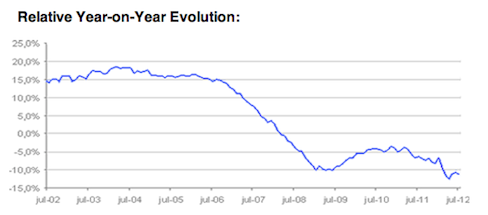
And the latest report from Tinsa makes it very clear that the bubble’s deflation is far from over:
The IMIE General index registered a year-on-year decline of 11.2% in July, pushing the index down to 1577 points. The cumulative decline in house prices since the market peaked in December 2007 is 31%.
In terms of the cumulative decline in house prices by region since peak prices, there was a 37.2% fall in July for the “Mediterranean Coast”; followed by 33.5% for “Capitals and Major Cities”, 32.1% for “Metropolitan Areas”, 29.2% for the “Balearic and Canary Islands” and 25.9% for “Other Municipalities”, which comprises the remainder.

Mariano Rajoy is expected to meet Herman Van Rompuy, Angela Merkel, Mario Monti and Finland’s President, Sauli Niinistoe, over the next few weeks in order to discuss his country’s future. It is, however, increasingly obvious that he will have little choice to accept whatever he is given, and I have to question again exactly how long he has left in politics.
By Delusional Economics, who is horrified at the state of economic commentary in Australia and is determined to cleanse the daily flow of vested interests propaganda to produce a balanced counterpoint. Cross posted from MacroBusiness
I mentioned back in early July that Spain had a serious political problem brewing because the draft Memorandum of Understanding for the Spanish banking system clearly stated that:
Banks and their shareholders will take losses before State aid measures are granted and ensure loss absorption of equity and hybrid capital instruments to the full extent possible.
From a market perspective this is absolutely the correct thing to do. Equity is a risky business. You take a punt, the banks falls over, your money it gone, fair enough. But in Spain it’s not that simple because of something I commented on in April:
The key in a banking crisis is to keep the confidence of depositors. But while many countries relied on capital injections and government guarantees, Spanish banks have added a unique twist of effectively turning some depositors into equity holders. That puts customers on the front line.
Some banks started by persuading depositors to switch from low, interest-bearing accounts into preference shares, which paid a fixed, higher interest rate. The benefit for the banks was that these securities counted as core capital under banking rules. UBS says Spanish banks issued €32 billion ($42.7 billion) of such instruments from 2007 to 2010.
But as the crisis deepened, these instruments became illiquid, trading at deep discounts. At the same time, they ceased to count as core capital under new rules known as Basel III. So banks have encouraged investors to convert preference shares into either common stock or mandatory convertible notes, which pay a high initial yield before later converting into stock.
And so now, under the watchful eye of the Spanish regulators, depositors in Spanish banks had been converted into equity holders and these same people were about to see their savings eaten up by the first stages of a banking bailout.
Although there are other factors involved, I think this is one of the primary reasons Mariano Rajoy has been so hesitant to move forward with any bailout, and it comes as no surprise that he is now attempting to negotiate a way out for these people:
The Spanish government is in talks with Brussels to allow tens of thousands of retail clients who bought risky savings products from now nationalized lenders to avoid losing their investments as part of Spain’s bank bailout.
In place of inflicting large losses on small savers who purchased savings products linked to preference shares in in the lenders known as cajas, the Spanish government is negotiating a compromise where they will suffer an instant haircut, and then be repaid in full over time by their banks, people familiar with the talks said.
The decision to inflict losses on holders of high interest preference shares and subordinated debt in rescued savings banks has been highly controversial in Spain, with the terms of the country’s bank rescue not distinguishing between professional and retail investors.
Apart from the obvious question of whether they will actually get a deal, the other question is will the banks be in any position to make those payments in the future. As WSJ reports, the banking system looks increasingly flakey as deposits continue to leave the country and the hole is filled by ECB:
Spanish banks borrowed a record amount from the European Central Bank in July, as other sources of funding evaporated further in the weeks following the announcement of a €100 billion ($123 billion) bailout for the country’s financial industry.
Bank of Spain data indicated that net ECB borrowing rose to €375.55 billion from €337.21 billion in June. It was the 10th straight month of increases, highlighting how the country’s lenders are having more and more difficulty financing themselves through private investors.
Spain’s traditional funding sources have been dwindling as the economy sinks deeper into a downturn. During the Spanish construction boom of the past decade, German and other European banks were more than willing to fund the rapid expansion of the Spanish banking system, inflating the country’s credit bubble.
And the latest report from Tinsa makes it very clear that the bubble’s deflation is far from over:
The IMIE General index registered a year-on-year decline of 11.2% in July, pushing the index down to 1577 points. The cumulative decline in house prices since the market peaked in December 2007 is 31%.
In terms of the cumulative decline in house prices by region since peak prices, there was a 37.2% fall in July for the “Mediterranean Coast”; followed by 33.5% for “Capitals and Major Cities”, 32.1% for “Metropolitan Areas”, 29.2% for the “Balearic and Canary Islands” and 25.9% for “Other Municipalities”, which comprises the remainder.
Mariano Rajoy is expected to meet Herman Van Rompuy, Angela Merkel, Mario Monti and Finland’s President, Sauli Niinistoe, over the next few weeks in order to discuss his country’s future. It is, however, increasingly obvious that he will have little choice to accept whatever he is given, and I have to question again exactly how long he has left in politics.
August 16, 2012
Marcy Wheeler: Standard Chartered Bank Admits Promontory’s Estimates of Its Iran Business Were Wrong
Yves here. A few quick comments on the New York state settlement. Some readers are unhappy that there wasn’t a prosecution. First, as we’ve written before, criminal prosecutions of big financial firms put them out of business (tons of customers are forbidden to do business with them) so they settle pronto (prosecuting individuals is another matter completely). Second, Lawsky is only a banking regulator and does not have prosecutorial powers. To do that, he would have needed Eric Schneiderman’s cooperation. But Lawksy’s boss, Andrew Cuomo and Schneiderman are rivals. And Schneiderman has thrown his lot in with the Obama Administration, which has been ferociously trying to undermine Lawsky. As Neil Barofksy noted in a Bloomberg story:
“I can’t think of another case where there has been such uniformity among federal regulators undercutting an enforcement case”
Marcy’s observation below is very important, and is being glossed over or even denied in the mainstream media. The Wall Street Journal has one of its all too common alternative reality editorial page pieces. Key snippet:
Of the $250 billion of transactions at issue, it now appears that $249 billion and change were legal at the time they occurred.
In a word, no.
By Marcy Wheeler. Cross posted from emptywheel
Standard Chartered just settled with NY’s Superintendent of Financial Services. The settlement–for $340 million and a monitor of SFS’ choosing–is less than some reports said the settlement might have been.
But here’s the detail I’m most interested in:
The New York State Department of Financial Services (“DFS”) and Standard Chartered Bank (“Bank”) have reached an agreement to settle the matters raised in the DFS Order dated August 6, 2012. The parties have agreed that the conduct at issue involved transactions of at least $250 billion. [my emphasis]
Just .1% fine, so not that big. But an admission that the scope of the fraud and the Iran business really did amount to $250 billion.
I find that interesting for two reasons. First, because it’s going to cause all kinds of headaches for the folks at Treasury who would like to let SCB off easy but ordinarily base settlements on the amount of the underlying activity.
More importantly, for me, because it demonstrates what a sham the Get Out of Jail Free industry is. A former OCC head and his minions at Promontory Financial Group claimed to have added it all up and determined that SCB only hid $14 million of transactions from Iran. SCB now says that Promontory was wrong.
By orders of magnitude.
Granted, SCB–and most of the people who pay Promontory to soft-pedal their crimes and risk–tried not to admit it had gotten that estimate from Promontory. Going forward, I expect we’ll see Promontory’s clients hide their involvement even more.
Still, this is a useful demonstration of how corrupt the Get Out of Jail Free industry is.
“I can’t think of another case where there has been such uniformity among federal regulators undercutting an enforcement case”
Marcy’s observation below is very important, and is being glossed over or even denied in the mainstream media. The Wall Street Journal has one of its all too common alternative reality editorial page pieces. Key snippet:
Of the $250 billion of transactions at issue, it now appears that $249 billion and change were legal at the time they occurred.
In a word, no.
By Marcy Wheeler. Cross posted from emptywheel
Standard Chartered just settled with NY’s Superintendent of Financial Services. The settlement–for $340 million and a monitor of SFS’ choosing–is less than some reports said the settlement might have been.
But here’s the detail I’m most interested in:
The New York State Department of Financial Services (“DFS”) and Standard Chartered Bank (“Bank”) have reached an agreement to settle the matters raised in the DFS Order dated August 6, 2012. The parties have agreed that the conduct at issue involved transactions of at least $250 billion. [my emphasis]
Just .1% fine, so not that big. But an admission that the scope of the fraud and the Iran business really did amount to $250 billion.
I find that interesting for two reasons. First, because it’s going to cause all kinds of headaches for the folks at Treasury who would like to let SCB off easy but ordinarily base settlements on the amount of the underlying activity.
More importantly, for me, because it demonstrates what a sham the Get Out of Jail Free industry is. A former OCC head and his minions at Promontory Financial Group claimed to have added it all up and determined that SCB only hid $14 million of transactions from Iran. SCB now says that Promontory was wrong.
By orders of magnitude.
Granted, SCB–and most of the people who pay Promontory to soft-pedal their crimes and risk–tried not to admit it had gotten that estimate from Promontory. Going forward, I expect we’ll see Promontory’s clients hide their involvement even more.
Still, this is a useful demonstration of how corrupt the Get Out of Jail Free industry is.
August 15, 2012
Goldman Sachs Free to Keep Stealing
Goldman again got off scot-free. On August 9, the Justice Department dropped criminal fraud charges. Evidence the equivalent of enough firepower to sink a carrier battle group was buried and forgotten. More on what happened below.
Black's Law Dictionary says:
"Fraud consists of some deceitful practice or willful device, resorted to with intent to deprive another of his right, or in some manner to do him an injury."
It includes "all acts, omissions, and concealments which involve a breach of legal or equitable duty, trust, or confidence justly reposed, and are injurious to another, or by which an undue and unconscientious advantage is taken of another."
The legal dictionary calls fraud:
"A false representation of a matter of fact - whether by words or by conduct, by false or misleading allegations, or by concealment of what should have been disclosed - that deceives and is intended to deceive another so that the individual will act upon it to her or his legal injury."
Criminal and civil frauds differ by level of proof required. The former needs a "preponderance of evidence." The latter must prove intent and be "beyond a reasonable doubt."
Goldman settled SEC charges for pennies on the dollar. What a business. Steal a fortune. Pay a pittance back. Goldman writes it off as operating cost.
Wall Street's business model reflects fraud and grand theft. Goldman steals with the best of them. Take away dirty money and the whole system collapses. It operates at the expense of investors and societies.
It profits hugely by swindling clients it calls "muppets." Small time con artists rip off marks. Goldman loots on a grand scale. Even nations are plundered for profits. It makes money the old-fashioned way. It steal and get away with it unaccountably.
No avenue with potential is ignored. It's an equal opportunity predator. Chairman/CEO Lloyd Blankfein calls it "doing God's work." Which one he didn't say. The Supreme Court ruled he and other Wall Street giants are immune from clients pursuing security fraud charges. Washington alone can sue.
Wall Street's culture encourages fraud. It's rewarded handsomely practically risk-free. The price for getting caught is chump change. It pales compared to fortunes stolen. Betting against Goldman faces long odds. Casino ones pay off better.
In April 2010, the SEC filed civil, not criminal, fraud charges. Goldman and one of its vice presidents was accused of defrauding investors by misstating and omitting key facts about junk assets tied to subprime mortgages.
Huge profits were made as the housing market faced collapsed. Structured and marketed synthetic collateralized debt obligations (CDOs) paid off big. Their performance depended on subprime residential mortgage-backed securities (RMBS).
Goldman withheld vital information from investors. Doing so let the firm and hedge fund investor John Paulson make huge profits. They correctly bet against the housing market. They were touting junk as safe investments that collapsed.
Charges involved violations of Section 17(a) of the Securities Act of 1933, Section 10(b) of the Securities Exchange Act of 1934, and Exchange Act Rule 10b-5. The SEC sought "injunctive relief, disgorgement of profits, prejudgment interest, and financial penalties."
It settled for pennies on the dollar. It closed the books for $550 million. It amounted to about four 2009 revenue days. It hardly mattered. No executive was fined or imprisoned. Goldman was free to keep stealing. Headlines left details most vital to reveal unexplained. Only scammed clients understand.
In April 2011, the Senate Permanent Subcommittee on Investigations released a report on how banking giants, federal regulators, and credit rating agencies conspired to crash the subprime mortgage market.
Around 40% of it discussed Goldman. It sold an alphabet soup of securitized junk. Garbage included mortgaged-backed securities (MBSs), collateralized mortgage obligations (CMOs), and various other assets structured to fail.
Combined, they sliced, diced, packaged, repackaged, and sold them in tranches to sophisticated and ordinary investors. Many bought them unwittingly through mutual funds, 401(k)s, pensions, and other investments.
The Senate listed federal security law violations. Goldman wasn't alone. Other major Wall Street banks conspired with financial partners to steal and get away with it. Justice Department officials and prosecutors got enough evidence to hang them.
Committee chairman Carl Levin said the panel's two-year probe found "a financial snake pit rife with greed, conflicts of interest and wrongdoing." He recommended prosecution. He added:
"In my judgment, Goldman clearly misled their clients and they misled Congress."
On August 9, the Justice Department said it conducted "an exhaustive review of the report." It concluded that "based on the law and evidence as they exist at this time, there is not a viable basis to bring a criminal prosecution with respect to Goldman Sachs or its employees in regard to the allegations set forth in the report."
In other words, fraud charges don't matter. Whatever Goldman does is OK. Stealing is how it does business. Obama officials find no fault. Goldman expressed relief it's all over.
It knows Democrat and Republican Justice Department prosecutors won't lay a glove on them. It's free to make money by stealing it.
Its only obligation is regular campaign contribution kickbacks, insider trading tips, other ways for pols to profit and get rich, and financial officials like Bernanke, Geithner, and others at Treasury and the Fed getting sweet revolving door jobs out of Washington when or if they plan to leave.
Each side helps the other. Political and Wall Street crooks conspire to keep a sweet racket going. Corruption is a way of life. Congress, administrations, the judiciary, and scoundrel media go along. Laws are only for ordinary people. Predators are free to prey.
Accountability never mattered. Now it's laughable on its face. Bad as things are now, expect much worse ahead. Massive fraud before 2007 crisis conditions exacerbated hard times. Far greater trouble looms. Financial wars lay waste like ravaging armies.
It's the system, stupid. Profiteering from plunder is too repugnant to tolerate. It's lawless, dysfunctional, and corrupt. It's too far gone to fix. Building a world fit to live in requires tearing it down and starting over. Nothing less can work.
Black's Law Dictionary says:
"Fraud consists of some deceitful practice or willful device, resorted to with intent to deprive another of his right, or in some manner to do him an injury."
It includes "all acts, omissions, and concealments which involve a breach of legal or equitable duty, trust, or confidence justly reposed, and are injurious to another, or by which an undue and unconscientious advantage is taken of another."
The legal dictionary calls fraud:
"A false representation of a matter of fact - whether by words or by conduct, by false or misleading allegations, or by concealment of what should have been disclosed - that deceives and is intended to deceive another so that the individual will act upon it to her or his legal injury."
Criminal and civil frauds differ by level of proof required. The former needs a "preponderance of evidence." The latter must prove intent and be "beyond a reasonable doubt."
Goldman settled SEC charges for pennies on the dollar. What a business. Steal a fortune. Pay a pittance back. Goldman writes it off as operating cost.
Wall Street's business model reflects fraud and grand theft. Goldman steals with the best of them. Take away dirty money and the whole system collapses. It operates at the expense of investors and societies.
It profits hugely by swindling clients it calls "muppets." Small time con artists rip off marks. Goldman loots on a grand scale. Even nations are plundered for profits. It makes money the old-fashioned way. It steal and get away with it unaccountably.
No avenue with potential is ignored. It's an equal opportunity predator. Chairman/CEO Lloyd Blankfein calls it "doing God's work." Which one he didn't say. The Supreme Court ruled he and other Wall Street giants are immune from clients pursuing security fraud charges. Washington alone can sue.
Wall Street's culture encourages fraud. It's rewarded handsomely practically risk-free. The price for getting caught is chump change. It pales compared to fortunes stolen. Betting against Goldman faces long odds. Casino ones pay off better.
In April 2010, the SEC filed civil, not criminal, fraud charges. Goldman and one of its vice presidents was accused of defrauding investors by misstating and omitting key facts about junk assets tied to subprime mortgages.
Huge profits were made as the housing market faced collapsed. Structured and marketed synthetic collateralized debt obligations (CDOs) paid off big. Their performance depended on subprime residential mortgage-backed securities (RMBS).
Goldman withheld vital information from investors. Doing so let the firm and hedge fund investor John Paulson make huge profits. They correctly bet against the housing market. They were touting junk as safe investments that collapsed.
Charges involved violations of Section 17(a) of the Securities Act of 1933, Section 10(b) of the Securities Exchange Act of 1934, and Exchange Act Rule 10b-5. The SEC sought "injunctive relief, disgorgement of profits, prejudgment interest, and financial penalties."
It settled for pennies on the dollar. It closed the books for $550 million. It amounted to about four 2009 revenue days. It hardly mattered. No executive was fined or imprisoned. Goldman was free to keep stealing. Headlines left details most vital to reveal unexplained. Only scammed clients understand.
In April 2011, the Senate Permanent Subcommittee on Investigations released a report on how banking giants, federal regulators, and credit rating agencies conspired to crash the subprime mortgage market.
Around 40% of it discussed Goldman. It sold an alphabet soup of securitized junk. Garbage included mortgaged-backed securities (MBSs), collateralized mortgage obligations (CMOs), and various other assets structured to fail.
Combined, they sliced, diced, packaged, repackaged, and sold them in tranches to sophisticated and ordinary investors. Many bought them unwittingly through mutual funds, 401(k)s, pensions, and other investments.
The Senate listed federal security law violations. Goldman wasn't alone. Other major Wall Street banks conspired with financial partners to steal and get away with it. Justice Department officials and prosecutors got enough evidence to hang them.
Committee chairman Carl Levin said the panel's two-year probe found "a financial snake pit rife with greed, conflicts of interest and wrongdoing." He recommended prosecution. He added:
"In my judgment, Goldman clearly misled their clients and they misled Congress."
On August 9, the Justice Department said it conducted "an exhaustive review of the report." It concluded that "based on the law and evidence as they exist at this time, there is not a viable basis to bring a criminal prosecution with respect to Goldman Sachs or its employees in regard to the allegations set forth in the report."
In other words, fraud charges don't matter. Whatever Goldman does is OK. Stealing is how it does business. Obama officials find no fault. Goldman expressed relief it's all over.
It knows Democrat and Republican Justice Department prosecutors won't lay a glove on them. It's free to make money by stealing it.
Its only obligation is regular campaign contribution kickbacks, insider trading tips, other ways for pols to profit and get rich, and financial officials like Bernanke, Geithner, and others at Treasury and the Fed getting sweet revolving door jobs out of Washington when or if they plan to leave.
Each side helps the other. Political and Wall Street crooks conspire to keep a sweet racket going. Corruption is a way of life. Congress, administrations, the judiciary, and scoundrel media go along. Laws are only for ordinary people. Predators are free to prey.
Accountability never mattered. Now it's laughable on its face. Bad as things are now, expect much worse ahead. Massive fraud before 2007 crisis conditions exacerbated hard times. Far greater trouble looms. Financial wars lay waste like ravaging armies.
It's the system, stupid. Profiteering from plunder is too repugnant to tolerate. It's lawless, dysfunctional, and corrupt. It's too far gone to fix. Building a world fit to live in requires tearing it down and starting over. Nothing less can work.
August 14, 2012
Currency and Credit Schemes Blow Up ... and Go Green
Sports reporter, boozer, prime minister . . . and social credit galore ... Bitter faction fights, backroom fixers and the perils of minority government shaped Australian prime minister John Curtin's early political career. It resonates uncannily with today's political scene, although the Douglas Credit Party that sprang up to help Depression-era battlers is now an irrelevant blip in history. Playwright Ingle Knight has clearly pored over Curtin's life and times to shape it into this new play. At certain moments - such as when Major C. H. Douglas's oddball social credit scheme is mentioned for the umpteenth time - it feels like a historical reading, rather than a full-blooded theatrical experience. Curtin's personal and political battles to fulfill that destiny are neatly handled in this modest production. As for the over-liberal references to the social credit philosophy that so appealed in Depression-ravaged Western Australia, they at least remind one how much times have changed in Curtin's electorate. – The Australian
Dominant Social Theme: These crank money programs are not important at all!
Free-Market Analysis: The Australian recently reviewed a play (see above excerpt) focusing on the life and times of Australian Prime Minister John Curtin's early career. While Curtin is not of special interest to us, Major C.H. Douglas certainly is, as is the statement implying "how much times have changed."
Unfortunately, times haven't changed. Depression looms around the world. As we know from experience, Major Douglas's theories have re-emerged.
His theories caught on during the Depression and the world's gradual monetary expansion after World War II. Wikipedia summarizes some of the main points thusly:
Douglas proposed ... augmenting consumers' purchasing power through a National Dividend and a Compensated Price Mechanism. According to Douglas, the true purpose of production is consumption, and production must serve the genuine, freely expressed interests of consumers.
Each citizen is to have a beneficial, not direct, inheritance in the communal capital conferred by complete and dynamic access to the fruits of industry (consumer goods) assured by the National Dividend and Compensated Price.
Consumers, fully provided with adequate purchasing power, will establish the policy of production through exercise of their monetary vote. In this view, the term economic democracy does not mean worker control of industry. Removing the policy of production from banking institutions, government, and industry, Social Credit envisages an "aristocracy of producers, serving and accredited by a democracy of consumers."
Condensing this, we come up with the idea that Douglas wanted government to print money (pure fiat) and put it in the hands of consumers directly.
Douglas disagreed with another economic (non-mainstream) sage who emerged around the same time, Silveo Gesell. Gesell wanted scrip to be issued that depreciated over time in order to provide people with an incentive to spend as much as possible, believing that increasing the velocity of money would increase prosperity.
Douglas wrote about Gesell as follows:
Gesell's theory was that the trouble with the world was that people saved money so that what you had to do was to make them spend it faster. Disappearing money is the heaviest form of continuous taxation ever devised. The theory behind this idea of Gesell's was that what is required is to stimulate trade—that you have to get people frantically buying goods—a perfectly sound idea so long as the objective of life is merely trading. (Wikipedia)
This is an interesting point that Douglas makes. Gesell's idea of disappearing money does indeed constitute a radical tax. But disappearing money was only one of Gesell's ideas. We learn from Wikipedia that Gesell's ideas were apparently threefold. You could call them the three Fs:
•Freigeld (free money) .... All money is issued for a limited period ... Long-term saving requires investment in bonds or stocks.
•Freiland (free land) ... All land is owned by public institutions and can only be rented, not purchased (a position of alternative economist Henry George).
•Freihandel (Free Trade) ... Free Trade has long been a mainstream position now, but the anti-globalization movement largely opposes it.
Gesell's ideas are very interesting, though obviously dirigiste. But for the rest of this article, we will return to Douglas because back in 2008, the Socialist Party of Great Britain posted an article entitled "Major Douglas rides again: The revival of currency crankism." In the space we have left, we'll try to analyze it.
It begins as follows:
In the course of our nearly one hundred years of socialist activity, one of the ideas that we have had to deal with from time to time has been currency crankism—the idea that economic and social problems are caused by some flaw in the monetary system and that what is required to put things right is not to get rid of the profit system that is capitalism but mere monetary reform (of one kind or another, depending on which particular school the currency crank belongs to).
Between the wars the most popular school of currency crankism in Britain was Social Credit, based on the ideas of Major Douglas (as he was known). His explanation for the slump—of poverty amidst potential plenty, of unmet needs alongside idle factories and widespread unemployment, of piles of unsold goods being destroyed—was simple, not to say simplistic: it was due to a lack of purchasing power, to people not having enough money to buy what they needed or to constitute a market worth catering for.
The solution, too, was simplistic: distribute purchasing power free to people in the form of a "social dividend" paid by the government. Douglas believed that banks could "create credit" by the mere stroke of a pen, but that they deliberately kept money scarce so as to be able to charge a higher rate of interest. Hence his solution that the banks should be taken over by the government and their supposed power to create credit exercised but in the general interest, as "social credit".
The article finds fault with Douglas on several grounds. Its authors argue that slumps actually arise "when, because of falling profit prospects, capitalist firms choose not to spend all their profits on fully renewing or on expanding production."
The article also argues that banks cannot "create credit" as they are "essentially only financial intermediaries, borrowing money at one rate of interest from people with cash to spare and lending this at a higher rate to those needing money to spend or invest, their profits coming from the difference between the two interest rates."
Being a socialist magazine, the (predictable) conclusion reached is that the problems of capitalism "will only end when the means of production are brought into common ownership and democratic control so that they can be oriented towards directly satisfying people's needs."
Obviously, from a free-market point of view, we'd disagree with this; but as always, the socialist perspective is interesting to read because of its analysis of capitalism's problems. The most fascinating part of the article is yet to come, however, and begins with references to an article by Derek Wall entitled, "Social Credit: The Ecosocialism of Fools", in Capitalism, Nature, Socialism.
Wall's article is all about the joining of forces between currency and credit schemes and proponents of various forms of green polity!
This is just what we've observed ourselves and have been writing about recently. We've written two articles on the subject now, plus this one:
Are 'Green' Reciprocal Exchange and Credit Systems Part of a Larger Elite Promotion?
Paper Money and the UN Perfect Together? More Currency and Credit Exchange Supported by the UN
Here's more from the Socialist Party article:
The modern-day followers of Major Douglas are well ensconced in the Green Party: "Brian Leslie, whose parents were members of the Social Credit Greenshirts during the 1930s, chairs the Green Party Economics Working Group.
The newsletter, Sustainable Economics, is almost entirely concerned with social credit and Party economics speaker Molly Scott Cato advocates monetary reform... Frances Hutchinson, a former member of the Green Party left grouping, the Association of Socialist Greens, has revived the Douglas Social Credit Secretariat... Wilfred Price, a member of the Greenshirts in the 1930s, joined the Ecology Party (now the Green Party) in the early 1980s and powerfully spoke for social credit as a form of green politics."
Currency cranks find it easy to infiltrate the Green Party because of the tendency amongst its members and supporters to blame "big banks" and international financial institutions for ecological problems and the ravages of capitalist globalisation. The Green Party has, for instance, lined up alongside the Tories, the UKIP and other reactionaries in the "defend the pound" camp because it sees the euro as an international (in the sense of anti- national) currency.
Now, just because these systems are popular in green eco-communities (many affiliated with the UN) doesn't necessarily speak to their utility or practicality. In fact, we're long on the record as arguing for competing currencies.
But within a free-market context, we believe gold and silver will find their rightful place as they have throughout history's larger monetary context. Before the Civil War in the US and in Scotland there are successful evidences (as Selgin and White have argued) for free banking, wildcat banking and a variety of monetary solutions.
Conclusion: The bottom line is that without a free market in money, there is no way of knowing how much money is enough and how much is too much. Absent some sort of private, free-market monitor, presumably one that includes freely traded gold and silver, there is no way to judge monetary volume.
Dominant Social Theme: These crank money programs are not important at all!
Free-Market Analysis: The Australian recently reviewed a play (see above excerpt) focusing on the life and times of Australian Prime Minister John Curtin's early career. While Curtin is not of special interest to us, Major C.H. Douglas certainly is, as is the statement implying "how much times have changed."
Unfortunately, times haven't changed. Depression looms around the world. As we know from experience, Major Douglas's theories have re-emerged.
His theories caught on during the Depression and the world's gradual monetary expansion after World War II. Wikipedia summarizes some of the main points thusly:
Douglas proposed ... augmenting consumers' purchasing power through a National Dividend and a Compensated Price Mechanism. According to Douglas, the true purpose of production is consumption, and production must serve the genuine, freely expressed interests of consumers.
Each citizen is to have a beneficial, not direct, inheritance in the communal capital conferred by complete and dynamic access to the fruits of industry (consumer goods) assured by the National Dividend and Compensated Price.
Consumers, fully provided with adequate purchasing power, will establish the policy of production through exercise of their monetary vote. In this view, the term economic democracy does not mean worker control of industry. Removing the policy of production from banking institutions, government, and industry, Social Credit envisages an "aristocracy of producers, serving and accredited by a democracy of consumers."
Condensing this, we come up with the idea that Douglas wanted government to print money (pure fiat) and put it in the hands of consumers directly.
Douglas disagreed with another economic (non-mainstream) sage who emerged around the same time, Silveo Gesell. Gesell wanted scrip to be issued that depreciated over time in order to provide people with an incentive to spend as much as possible, believing that increasing the velocity of money would increase prosperity.
Douglas wrote about Gesell as follows:
Gesell's theory was that the trouble with the world was that people saved money so that what you had to do was to make them spend it faster. Disappearing money is the heaviest form of continuous taxation ever devised. The theory behind this idea of Gesell's was that what is required is to stimulate trade—that you have to get people frantically buying goods—a perfectly sound idea so long as the objective of life is merely trading. (Wikipedia)
This is an interesting point that Douglas makes. Gesell's idea of disappearing money does indeed constitute a radical tax. But disappearing money was only one of Gesell's ideas. We learn from Wikipedia that Gesell's ideas were apparently threefold. You could call them the three Fs:
•Freigeld (free money) .... All money is issued for a limited period ... Long-term saving requires investment in bonds or stocks.
•Freiland (free land) ... All land is owned by public institutions and can only be rented, not purchased (a position of alternative economist Henry George).
•Freihandel (Free Trade) ... Free Trade has long been a mainstream position now, but the anti-globalization movement largely opposes it.
Gesell's ideas are very interesting, though obviously dirigiste. But for the rest of this article, we will return to Douglas because back in 2008, the Socialist Party of Great Britain posted an article entitled "Major Douglas rides again: The revival of currency crankism." In the space we have left, we'll try to analyze it.
It begins as follows:
In the course of our nearly one hundred years of socialist activity, one of the ideas that we have had to deal with from time to time has been currency crankism—the idea that economic and social problems are caused by some flaw in the monetary system and that what is required to put things right is not to get rid of the profit system that is capitalism but mere monetary reform (of one kind or another, depending on which particular school the currency crank belongs to).
Between the wars the most popular school of currency crankism in Britain was Social Credit, based on the ideas of Major Douglas (as he was known). His explanation for the slump—of poverty amidst potential plenty, of unmet needs alongside idle factories and widespread unemployment, of piles of unsold goods being destroyed—was simple, not to say simplistic: it was due to a lack of purchasing power, to people not having enough money to buy what they needed or to constitute a market worth catering for.
The solution, too, was simplistic: distribute purchasing power free to people in the form of a "social dividend" paid by the government. Douglas believed that banks could "create credit" by the mere stroke of a pen, but that they deliberately kept money scarce so as to be able to charge a higher rate of interest. Hence his solution that the banks should be taken over by the government and their supposed power to create credit exercised but in the general interest, as "social credit".
The article finds fault with Douglas on several grounds. Its authors argue that slumps actually arise "when, because of falling profit prospects, capitalist firms choose not to spend all their profits on fully renewing or on expanding production."
The article also argues that banks cannot "create credit" as they are "essentially only financial intermediaries, borrowing money at one rate of interest from people with cash to spare and lending this at a higher rate to those needing money to spend or invest, their profits coming from the difference between the two interest rates."
Being a socialist magazine, the (predictable) conclusion reached is that the problems of capitalism "will only end when the means of production are brought into common ownership and democratic control so that they can be oriented towards directly satisfying people's needs."
Obviously, from a free-market point of view, we'd disagree with this; but as always, the socialist perspective is interesting to read because of its analysis of capitalism's problems. The most fascinating part of the article is yet to come, however, and begins with references to an article by Derek Wall entitled, "Social Credit: The Ecosocialism of Fools", in Capitalism, Nature, Socialism.
Wall's article is all about the joining of forces between currency and credit schemes and proponents of various forms of green polity!
This is just what we've observed ourselves and have been writing about recently. We've written two articles on the subject now, plus this one:
Are 'Green' Reciprocal Exchange and Credit Systems Part of a Larger Elite Promotion?
Paper Money and the UN Perfect Together? More Currency and Credit Exchange Supported by the UN
Here's more from the Socialist Party article:
The modern-day followers of Major Douglas are well ensconced in the Green Party: "Brian Leslie, whose parents were members of the Social Credit Greenshirts during the 1930s, chairs the Green Party Economics Working Group.
The newsletter, Sustainable Economics, is almost entirely concerned with social credit and Party economics speaker Molly Scott Cato advocates monetary reform... Frances Hutchinson, a former member of the Green Party left grouping, the Association of Socialist Greens, has revived the Douglas Social Credit Secretariat... Wilfred Price, a member of the Greenshirts in the 1930s, joined the Ecology Party (now the Green Party) in the early 1980s and powerfully spoke for social credit as a form of green politics."
Currency cranks find it easy to infiltrate the Green Party because of the tendency amongst its members and supporters to blame "big banks" and international financial institutions for ecological problems and the ravages of capitalist globalisation. The Green Party has, for instance, lined up alongside the Tories, the UKIP and other reactionaries in the "defend the pound" camp because it sees the euro as an international (in the sense of anti- national) currency.
Now, just because these systems are popular in green eco-communities (many affiliated with the UN) doesn't necessarily speak to their utility or practicality. In fact, we're long on the record as arguing for competing currencies.
But within a free-market context, we believe gold and silver will find their rightful place as they have throughout history's larger monetary context. Before the Civil War in the US and in Scotland there are successful evidences (as Selgin and White have argued) for free banking, wildcat banking and a variety of monetary solutions.
Conclusion: The bottom line is that without a free market in money, there is no way of knowing how much money is enough and how much is too much. Absent some sort of private, free-market monitor, presumably one that includes freely traded gold and silver, there is no way to judge monetary volume.
August 13, 2012
Judge: 90% of Credit Card Lawsuits Can’t Prove Borrower Owes Money
As they work through a glut of bad loans, companies like American Express, Citigroup and Discover Financial are going to court to recoup their money. But many of the lawsuits rely on erroneous documents, incomplete records and generic testimony from witnesses, according to judges who oversee the cases.
Lenders, the judges said, are churning out lawsuits without regard for accuracy, and improperly collecting debts from consumers. The concerns echo a recent abuse in the foreclosure system, a practice known as robo-signing in which banks produced similar documents for different homeowners and did not review them.
“I would say that roughly 90 percent of the credit card lawsuits are flawed and can’t prove the person owes the debt,” said Noach Dear, a state civil court judge in Brooklyn, who said he presides over as many as 100 such cases a day….
The problem, according to judges, is that credit card companies are not always following the proper legal procedures, even when they have the right to collect money. Certain cases hinge on mass-produced documents because the lenders do not provide proof of the outstanding debts, like the original contract or payment history.
At times, lawsuits include falsified credit card statements, produced years after borrowers supposedly fell behind on their bills.
But the big reason that the credit card companies can ride roughshod over the law is that so few consumers contest these cases. The article reports that 95% go uncontested, meaning the lender will win a default judgment and can then garnish wages or bank account balances.
And if you think it’s bad with the credit card companies, it’s even worse with the bottom feeders. A colleague has a sister who lives in Texas, where the statute of limitations on unpaid debts is four years. Apparently a hedge fund is backing a company that buys bad debts from credit card companies, debt they’ve already written off, shortly before the statue of limitations is about to expire, for pennies on the dollar. They then file suit. They don’t even plan to spend any money fighting, they just intent to win default judgments. So if you hire a lawyer and merely file an answer, you win. But a remarkably high percentage of people fail to do that.
And for the credit card companies, the critics can substantiate their doubts about the accuracy of documentation. For instance:
In 2010, Discover sued Taryn Gregory for more than $7,000 in credit card debt. Ms. Gregory, of Commerce, Ga., had fallen behind on her bills, but said she had accumulated only $4,000 in debt.
After the suit was filed, Ms. Gregory, a 41-year-old child care assistant, asked Discover for proof of the balance. The resulting documents, which were reviewed by The New York Times, have inconsistencies. One statement, for example, says it was produced in 2004, but advertisements on the bottom of the document bear a 2010 date.
We’ve gone back over 300 years, to the ugly time before the 1677 Statute of Frauds. And the worse is too few people seem to appreciate how destructive that is not just to commerce, but to faith in the authority structure.
Lenders, the judges said, are churning out lawsuits without regard for accuracy, and improperly collecting debts from consumers. The concerns echo a recent abuse in the foreclosure system, a practice known as robo-signing in which banks produced similar documents for different homeowners and did not review them.
“I would say that roughly 90 percent of the credit card lawsuits are flawed and can’t prove the person owes the debt,” said Noach Dear, a state civil court judge in Brooklyn, who said he presides over as many as 100 such cases a day….
The problem, according to judges, is that credit card companies are not always following the proper legal procedures, even when they have the right to collect money. Certain cases hinge on mass-produced documents because the lenders do not provide proof of the outstanding debts, like the original contract or payment history.
At times, lawsuits include falsified credit card statements, produced years after borrowers supposedly fell behind on their bills.
But the big reason that the credit card companies can ride roughshod over the law is that so few consumers contest these cases. The article reports that 95% go uncontested, meaning the lender will win a default judgment and can then garnish wages or bank account balances.
And if you think it’s bad with the credit card companies, it’s even worse with the bottom feeders. A colleague has a sister who lives in Texas, where the statute of limitations on unpaid debts is four years. Apparently a hedge fund is backing a company that buys bad debts from credit card companies, debt they’ve already written off, shortly before the statue of limitations is about to expire, for pennies on the dollar. They then file suit. They don’t even plan to spend any money fighting, they just intent to win default judgments. So if you hire a lawyer and merely file an answer, you win. But a remarkably high percentage of people fail to do that.
And for the credit card companies, the critics can substantiate their doubts about the accuracy of documentation. For instance:
In 2010, Discover sued Taryn Gregory for more than $7,000 in credit card debt. Ms. Gregory, of Commerce, Ga., had fallen behind on her bills, but said she had accumulated only $4,000 in debt.
After the suit was filed, Ms. Gregory, a 41-year-old child care assistant, asked Discover for proof of the balance. The resulting documents, which were reviewed by The New York Times, have inconsistencies. One statement, for example, says it was produced in 2004, but advertisements on the bottom of the document bear a 2010 date.
We’ve gone back over 300 years, to the ugly time before the 1677 Statute of Frauds. And the worse is too few people seem to appreciate how destructive that is not just to commerce, but to faith in the authority structure.
August 10, 2012
A Step Towards Gold Confiscation
In attempting to stimulate risk appetite by taking “safe” assets out of the market, the Fed has actually achieved precisely the opposite of stimulating productive investment. First, it has turned bond markets into a race to the bottom as bond flippers end up piling into the very assets that the Fed is trying to discourage ownership of — because who care about low yields when the Fed will jump in at an even lower price floor, thus assuring the bond flippers a profit? Second it has energised other safe asset markets (such as gold) as longer term investors look for alternatives to preserve their purchasing power in the context of a global economic depression.
The Fed is firing at the wrong target; the real problem — the thing that is causing investors to scramble for safe assets — is an economic depression brought on by (among other non-monetary causes) the deleveraging costs of an unsustainable debt bubble. Without addressing the problem of excess total debt — and quantitative easing aims to increase lending — the Fed is firing blanks.
However, there seems little prospect that the Fed will listen to the debt-watchers who actually predicted the crisis. The likelihood is that the Fed will continue to attempt to take safe assets out of the market. And after treasuries, what will the Fed try to take out of the market?
Izabella Kaminska writes in FT Alphaville:
Fed purchases are the equivalent of hoarding the system’s supply of safe assets on the Fed’s own balance sheet, and in so doing preventing private investors — especially money market investors – from investing in the assets on favourable terms.
While this is mostly the point of QE — the idea, after all, is to stimulate risk appetite and cause investors to change their portfolios — a continued lack of risk appetite means the money created, rather than flowing into risky securities as hoped, is only crowding out the last remaining safe securities in the market instead. The consequences are negative rates and principal destruction — a lethal combination that is arguably far more dangerous and deflationary than no QE at all.
The idea that the Treasury could once again become the gold buyer of last resort, in exchange for liquidity, is interesting to say the least. Not only would such a strategy ease the squeeze in the Treasury market, it would do so without compromising the liquidity effects of QE.
What’s more it could help to support and stabilize the gold price, while taking zero-yielding safe assets out of the system in favour of yield bearing ones — giving money markets a fighting chance for survival in terms of yields.
While gold purchases have never been communicated as official central bank policy, there’s no denying that a shift in this direction is taking place. Be that wittingly or unwittingly.
A little behind the curve.
Last September I noted:
Bernanke has already heavily targeted yields on treasuries which have absorbed liquidity that has departed from productive ventures. But in recent years gold has offered a significantly increased yield over treasuries.
So what’s a central banker who wants to force investors into productive ventures to do? You can’t print gold — but you can buy it, and take it out of the marketplace.
And as the price of gold (in fiat) continues to rise, buying gold is exactly what central bankers may do.
Just as Roosevelt went out of his way to remove gold from the marketplace, the central bankers of today may eventually determine to do the same thing.
The main question if such an event were to occur is just how “compulsory” such purchases might be.
The Fed is firing at the wrong target; the real problem — the thing that is causing investors to scramble for safe assets — is an economic depression brought on by (among other non-monetary causes) the deleveraging costs of an unsustainable debt bubble. Without addressing the problem of excess total debt — and quantitative easing aims to increase lending — the Fed is firing blanks.
However, there seems little prospect that the Fed will listen to the debt-watchers who actually predicted the crisis. The likelihood is that the Fed will continue to attempt to take safe assets out of the market. And after treasuries, what will the Fed try to take out of the market?
Izabella Kaminska writes in FT Alphaville:
Fed purchases are the equivalent of hoarding the system’s supply of safe assets on the Fed’s own balance sheet, and in so doing preventing private investors — especially money market investors – from investing in the assets on favourable terms.
While this is mostly the point of QE — the idea, after all, is to stimulate risk appetite and cause investors to change their portfolios — a continued lack of risk appetite means the money created, rather than flowing into risky securities as hoped, is only crowding out the last remaining safe securities in the market instead. The consequences are negative rates and principal destruction — a lethal combination that is arguably far more dangerous and deflationary than no QE at all.
The idea that the Treasury could once again become the gold buyer of last resort, in exchange for liquidity, is interesting to say the least. Not only would such a strategy ease the squeeze in the Treasury market, it would do so without compromising the liquidity effects of QE.
What’s more it could help to support and stabilize the gold price, while taking zero-yielding safe assets out of the system in favour of yield bearing ones — giving money markets a fighting chance for survival in terms of yields.
While gold purchases have never been communicated as official central bank policy, there’s no denying that a shift in this direction is taking place. Be that wittingly or unwittingly.
A little behind the curve.
Last September I noted:
Bernanke has already heavily targeted yields on treasuries which have absorbed liquidity that has departed from productive ventures. But in recent years gold has offered a significantly increased yield over treasuries.
So what’s a central banker who wants to force investors into productive ventures to do? You can’t print gold — but you can buy it, and take it out of the marketplace.
And as the price of gold (in fiat) continues to rise, buying gold is exactly what central bankers may do.
Just as Roosevelt went out of his way to remove gold from the marketplace, the central bankers of today may eventually determine to do the same thing.
The main question if such an event were to occur is just how “compulsory” such purchases might be.
August 9, 2012
Knight's Berserk Algo Bought $2.6 Million Worth Of Stock Every Second
While we already presented, courtesy of Nanex, the modus operandi of the Knight berserker algo, there was one outstanding question. What was the bottom line. And no, not how much the loss on Knight's Income Statement would be as a result of this glimpse into what really happens in the market: we already knew that would be $440 million. The question is what is the notional amount of stock that this algo bought in the 45 minutes in which it was operational. We now know: $7 billion. Or $155 million per minute. Or $2.6 million per second. Or, assuming the algo impacted just 150 stocks as previously reported, it was buying on average $17,333 in each name every second. Or, assuming an average stock price of the universe of 150 stocks of $30/share, the Knight algo lifted the offer roughly 600 times each second. For 45 minutes straight! That's right - the market making algorithm of a designated market maker which is responsible for 10% of the order flow in the US stock market, entered a pre-programmed mode (because the computer was told to do whatever it did by someone, and not without reason) that saw it buy up $2.6 million worth of stock every second.
Now there has long been speculation that HFTs are a central planner's best friend because they traditionally provide not only a floor to the stock market, but a gradual levitation bias especially in a low volume environment (as well as liquidity its advocates claim, but that is total BS - HFT only provides volume and churn - liquidity disappears at the drop of a bat when real selling pressure appears). They do this not because they are evil instruments of Bernanke collusion (although who knows) but simply because they accelerate and accentuate legacy momentum bias, which at least historically, has been up. Now in the aftermath of the Knight debacle we can also extrapolate what would happen if, say, reality were to creep in one day, and all those mutual and hedge funds which have carbon-based life forms making the buy and sell decisions suddenly decided to sell. Well, at $7 billion in 45 minutes, or 1/10th of the trading day, this means that had the Knight algo been running all day, it could have bought $70 billion worth of stock. Throw in the remaining flow routers, aka DMMs in the market which account for the remaining 90% of order flow, and we get a total of $700 billion in vacuum tube mediated purchasing power.
In other words, this is the market "worst case" shock absorber, or inverse escape velocity, that Bernanke has at his disposal if things turn sour. That said, with hedge funds, aka fast money, holding about $3 trillion in unlevered assets, and about $6-9 trillion with leverage (ignoring plain vanilla slow mutual funds), and one can see why not even the HFT levitation bid would be sufficient to offset a wholesale market dump.
There is one last open question remaining on Knight: what discount did Goldman extract out of the firm to rid it of its residual position which as the WSj explains declined slightly from its peak as "traders worked frantically Aug. 1 to sell shares while trying to minimize losses due to a software problem, ultimately paring the total position to about $4.6 billion by the end of the trading day" (one wonders if the market would have just blown up if the Knight algo were to run in reverse, and just take out layer after layer of bids to unwind the inventory asap). We now know thanks to the WSJ:
Knight avoided that scenario by agreeing in the early morning hours last Thursday to sell the portfolio to Goldman Sachs Group Inc., after rejecting an offer from UBS.
The terms sought by the banks reflected how dire Knight's situation was: UBS wanted an 8% to 9% discount on the position, according to people familiar with the matter.
The equities trading desk at UBS, headed by Mike Stewart, bid for the portfolio around 6:30 p.m. Wednesday, people familiar with the discussions said. Mr. Stewart was a former colleague of Knight Chief Executive Thomas Joyce's at Merrill Lynch. The talks with UBS fell apart later that night.
Goldman ultimately negotiated buying the portfolio at a 5% discount, or about $230 million less than the value of the stocks, the people said. That amount, not previously reported, represents more than half the loss Knight disclosed on Thursday that it incurred as a result of the technology errors.
The deal with Goldman allowed Knight to move ahead. Last weekend, Knight negotiated a rescue package with six financial firms that injected $400 million in capital in exchange for securities that can convert to ownership of 73% of the trading firm.
And now you know why having cash on your balance sheet in a ZIRP environment may well be the best investment, because just like Goldman, one never knows just where a slam dunk distressed opportunity could come from in exchange for an immediate 5% pick up.
More importantly, the Goldman deal demonstrates what the true liquidity cost is in this market when one wishes to do a wholesale stock transaction (either BWIC or OWIC): it is not less than 5% and tops out at 9%.
Keep that in mind, because if and when the day when VWAPing in and out of positions is no longer possible, each and every fund will have no choice but to assume a guaranteed 5% minimum (up to 9%) haircut on one's entire portfolio of allegedly liquid stocks.
We dread to think what the wholesale implied liquidity premium is on less liquid products than stocks, which nowadays is virtually everything...
* * *
Finally, we leave readers with yet another transformative animation from Nanex, after our first rendition of the "rise of the machines" back in February left many speechless, and which recently appears to have been rediscovered by some of the slower elements in the blogosphere. Why: because it's pretty, and we feel like it. And because it once again confirms that only vacuum tubes with infinite balance sheets should be gambling in this loaded market.
Now there has long been speculation that HFTs are a central planner's best friend because they traditionally provide not only a floor to the stock market, but a gradual levitation bias especially in a low volume environment (as well as liquidity its advocates claim, but that is total BS - HFT only provides volume and churn - liquidity disappears at the drop of a bat when real selling pressure appears). They do this not because they are evil instruments of Bernanke collusion (although who knows) but simply because they accelerate and accentuate legacy momentum bias, which at least historically, has been up. Now in the aftermath of the Knight debacle we can also extrapolate what would happen if, say, reality were to creep in one day, and all those mutual and hedge funds which have carbon-based life forms making the buy and sell decisions suddenly decided to sell. Well, at $7 billion in 45 minutes, or 1/10th of the trading day, this means that had the Knight algo been running all day, it could have bought $70 billion worth of stock. Throw in the remaining flow routers, aka DMMs in the market which account for the remaining 90% of order flow, and we get a total of $700 billion in vacuum tube mediated purchasing power.
In other words, this is the market "worst case" shock absorber, or inverse escape velocity, that Bernanke has at his disposal if things turn sour. That said, with hedge funds, aka fast money, holding about $3 trillion in unlevered assets, and about $6-9 trillion with leverage (ignoring plain vanilla slow mutual funds), and one can see why not even the HFT levitation bid would be sufficient to offset a wholesale market dump.
There is one last open question remaining on Knight: what discount did Goldman extract out of the firm to rid it of its residual position which as the WSj explains declined slightly from its peak as "traders worked frantically Aug. 1 to sell shares while trying to minimize losses due to a software problem, ultimately paring the total position to about $4.6 billion by the end of the trading day" (one wonders if the market would have just blown up if the Knight algo were to run in reverse, and just take out layer after layer of bids to unwind the inventory asap). We now know thanks to the WSJ:
Knight avoided that scenario by agreeing in the early morning hours last Thursday to sell the portfolio to Goldman Sachs Group Inc., after rejecting an offer from UBS.
The terms sought by the banks reflected how dire Knight's situation was: UBS wanted an 8% to 9% discount on the position, according to people familiar with the matter.
The equities trading desk at UBS, headed by Mike Stewart, bid for the portfolio around 6:30 p.m. Wednesday, people familiar with the discussions said. Mr. Stewart was a former colleague of Knight Chief Executive Thomas Joyce's at Merrill Lynch. The talks with UBS fell apart later that night.
Goldman ultimately negotiated buying the portfolio at a 5% discount, or about $230 million less than the value of the stocks, the people said. That amount, not previously reported, represents more than half the loss Knight disclosed on Thursday that it incurred as a result of the technology errors.
The deal with Goldman allowed Knight to move ahead. Last weekend, Knight negotiated a rescue package with six financial firms that injected $400 million in capital in exchange for securities that can convert to ownership of 73% of the trading firm.
And now you know why having cash on your balance sheet in a ZIRP environment may well be the best investment, because just like Goldman, one never knows just where a slam dunk distressed opportunity could come from in exchange for an immediate 5% pick up.
More importantly, the Goldman deal demonstrates what the true liquidity cost is in this market when one wishes to do a wholesale stock transaction (either BWIC or OWIC): it is not less than 5% and tops out at 9%.
Keep that in mind, because if and when the day when VWAPing in and out of positions is no longer possible, each and every fund will have no choice but to assume a guaranteed 5% minimum (up to 9%) haircut on one's entire portfolio of allegedly liquid stocks.
We dread to think what the wholesale implied liquidity premium is on less liquid products than stocks, which nowadays is virtually everything...
* * *
Finally, we leave readers with yet another transformative animation from Nanex, after our first rendition of the "rise of the machines" back in February left many speechless, and which recently appears to have been rediscovered by some of the slower elements in the blogosphere. Why: because it's pretty, and we feel like it. And because it once again confirms that only vacuum tubes with infinite balance sheets should be gambling in this loaded market.
August 8, 2012
Fed Bankrupting Consumers While Enriching Wall Street as a Matter of Policy?
Majority of Wall Street dealers still expect Fed QE3 ... Despite improved hiring last month, most Wall Street economists still expect the Federal Reserve to do more to stimulate growth this year, with the majority looking for action as soon as September. The median of forecasts from a Reuters poll of 17 primary dealers - the large financial institutions that do business directly with the Fed - showed a 63 percent chance the central bank will for the third time expand its balance sheet via large-scale bond purchases. If the Fed does act, 13 said they thought it would do so at its next policy meeting in September, up from eight in a July 6 Reuters poll of 16 dealers. There are 21 primary dealers. Friday's poll was conducted after a government report showed employers added 163,000 new jobs. − Reuters
Dominant Social Theme: We are doing all we can to benefit the average consumer and job-holder.
Free-Market Analysis: Here is a question that needs answering: Why is the Fed giving away money freely to big professional investors that hold massive amounts of government bonds ("quantitative easing") while starving small businesspeople and investors of loans?
In this article, we'll try to provide an answer. Let's re-examine the business cycle in order to set the stage for our analysis.
It is government that creates recessions and depressions to begin with via the overprinting of money. Over time, the booms grow stronger as more and more money is pumped into the economy. The busts likewise grow deeper. The current bust is among the deepest in recent memory.
Many paper-money pundits have advocated reinflation via Fed money printing. In fact, the New York Times' Paul Krugman wrote the following in 2002:
The basic point is that the recession of 2001 wasn't a typical postwar slump, brought on when an inflation-fighting Fed raises interest rates and easily ended by a snapback in housing and consumer spending when the Fed brings rates back down again. This was a prewar-style recession, a morning after brought on by irrational exuberance. To fight this recession the Fed needs more than a snapback; it needs soaring household spending to offset moribund business investment. And to do that, as Paul McCulley of Pimco put it, Alan Greenspan needs to create a housing bubble to replace the Nasdaq bubble.
Read this statement carefully. Is there anything about it that strikes you as playful? Krugman quotes a top official with one of the largest bond complexes in the world to back up his statements. He doesn't seem the least bit facetious to us. But nonetheless in 2009, Krugman felt compelled to offer the following explanation:
And I was on the grassy knoll, too ... One of the funny aspects of being a somewhat, um, forceful writer is that I'm regularly accused of all sorts of villainy ... The latest seems to be that I called for the creation of a housing bubble — in fact, the bubble is my fault!
Guys, read [the article] again. It wasn't a piece of policy advocacy, it was just economic analysis. What I said was that the only way the Fed could get traction would be if it could inflate a housing bubble. And that's just what happened.
Krugman is being evasive here, in our view. He is very obviously a reflationist, someone who believes that government monopoly money printing can provide the boost an economy needs to regain prosperity.
For this reason, the Fed's Ben Bernanke (also an avid reflationist) has printed lots of money for purposes of "quantitative easing" 1&2. The easing has not done much to stimulate the larger economy, however, which is why there is speculation that Bernanke will shortly embark on a QE3.
This brings us to our second point. Incredibly enough, the Fed itself is paying big banks interest on money it has printed and deposited in its money center banks. The Fed is essentially paying banks .25 percent NOT to lend. In an article in the New York Times, economic commentator Bruce Bartlett noted the following:
The Fed can penalize banks for holding excess reserves by charging them interest rather than paying them interest. This has been done in other countries." ... On July 5 the central bank of Denmark announced that it would begin charging an interest rate of 0.2 percent on reserves.
Bartlett also noted it was "puzzling" as to why the Fed continued to basically discourage banks from making loans.
So here is a question that needs answering: Can the Fed reflate the larger dollar economy by encouraging its biggest banks to lend? Could it have done so directly after the bust of 2008?
Remember, at the time the Fed rushed tens of trillions around the world in supposed short term loans. This money, it is said, effectively unfroze locked-up liquidity and allowed the current money structure to survive.
But the larger economy STILL hasn't recovered. Likely, it is simply not feasible to reflate right away after a large bust. One can perhaps provide stability via liquidity, but this is a bit like putting a corpse on ice. It doesn't stink ... but it's not alive, either.
It was the opinion of no less an acute observer of the markets than Murray Rothbard that when a big bust occurred, such as took place in 1929, reflation was not particularly possible, immediately anyway.
It was Rothbard's contention that "deflation" would have to take place within the larger economy before a recovery. Rothbard granted that deflation – a contraction of the money supply – would inevitably have the effect of lowering prices.
But the key for Rothbard lies in the following statement from his famous book, Man, Economy and State: "Circulating credit can contract only as far down as the total amount of specie in circulation. In short, its maximum possible limit is the eradication of all previous credit expansion."
For this reason, Rothbard did not fear deflation so much as some, as he believed the process was the natural and inevitable result of central banking's artificial booms.
Okay. Let's review what we've established in our free-market analysis thus far.
We've established that the initial global crisis was caused by the overprinting of money. We've also established that four years later, the Fed is still trying to reflate the US economy ... or so politicians and Fed spokespeople proclaim every day.
But four years into a monumental economic bust, the Fed has shown no great urgency to force its banks to lend to the end-of-the-line consumer. Instead, there is talk of yet another quantitative easing that will somehow, we are sure, enrich the larger financial industry without having an impact on the employment-starved US economy.
If the Fed wanted to provide money to average consumers to reflate the US economy, it would do so by getting funds into consumers' hands. This seems self-evident. Instead, the Fed has actually paid banks not to lend!
One could argue that the Fed is actually trying to let the economy unwind with these tactics. And actually, we'd be in favor of that. But we don't believe for a second.
In the past, we've pointed out that it is most difficult to reflate aggressively after a large bust. Yet we are four years into this thing. It is time to say, therefore, what others for one reason or another have not: The Fed is TRYING to keep the economy on ice.
Of course, those at the top won't admit it for a lot of reasons, including the necessity of providing President Barack Obama with a pretense of monetary activity.
But the activity is not working.
Or rather it is benefitting the financial world that is basically owned and controlled by a tiny power elite. This elite is trying to create formal world government and uses tools of war, economic depression and general chaos to generate globalist change.
Yes, there would seem to be an elite dominant social theme here: "We are doing all we can, though it is not enough." In fact, the idea is perhaps to starve Western economies of cash (it's happening in Europe, too) in order to create conditions more conducive to world government.
If we are correct, this is a big and bold gamble the elites are taking in the 21st century during what we call the Internet Reformation ... when all eyes are on them. Having created misaligned economies via central banking, the elites have now embarked on a surreptitious program of retarding economic recovery.
Of course, from a free-market point of view, we are not big fans of reflating the current economy, which does nothing but support the plans of the power elite.
In a sense, the citizens of the West have perhaps got the worst of all worlds ... a depressed economy that is still in the grip of monopoly central banking.
Conclusion: Is this what Bernanke and his central banking colleagues are REALLY up to?
Dominant Social Theme: We are doing all we can to benefit the average consumer and job-holder.
Free-Market Analysis: Here is a question that needs answering: Why is the Fed giving away money freely to big professional investors that hold massive amounts of government bonds ("quantitative easing") while starving small businesspeople and investors of loans?
In this article, we'll try to provide an answer. Let's re-examine the business cycle in order to set the stage for our analysis.
It is government that creates recessions and depressions to begin with via the overprinting of money. Over time, the booms grow stronger as more and more money is pumped into the economy. The busts likewise grow deeper. The current bust is among the deepest in recent memory.
Many paper-money pundits have advocated reinflation via Fed money printing. In fact, the New York Times' Paul Krugman wrote the following in 2002:
The basic point is that the recession of 2001 wasn't a typical postwar slump, brought on when an inflation-fighting Fed raises interest rates and easily ended by a snapback in housing and consumer spending when the Fed brings rates back down again. This was a prewar-style recession, a morning after brought on by irrational exuberance. To fight this recession the Fed needs more than a snapback; it needs soaring household spending to offset moribund business investment. And to do that, as Paul McCulley of Pimco put it, Alan Greenspan needs to create a housing bubble to replace the Nasdaq bubble.
Read this statement carefully. Is there anything about it that strikes you as playful? Krugman quotes a top official with one of the largest bond complexes in the world to back up his statements. He doesn't seem the least bit facetious to us. But nonetheless in 2009, Krugman felt compelled to offer the following explanation:
And I was on the grassy knoll, too ... One of the funny aspects of being a somewhat, um, forceful writer is that I'm regularly accused of all sorts of villainy ... The latest seems to be that I called for the creation of a housing bubble — in fact, the bubble is my fault!
Guys, read [the article] again. It wasn't a piece of policy advocacy, it was just economic analysis. What I said was that the only way the Fed could get traction would be if it could inflate a housing bubble. And that's just what happened.
Krugman is being evasive here, in our view. He is very obviously a reflationist, someone who believes that government monopoly money printing can provide the boost an economy needs to regain prosperity.
For this reason, the Fed's Ben Bernanke (also an avid reflationist) has printed lots of money for purposes of "quantitative easing" 1&2. The easing has not done much to stimulate the larger economy, however, which is why there is speculation that Bernanke will shortly embark on a QE3.
This brings us to our second point. Incredibly enough, the Fed itself is paying big banks interest on money it has printed and deposited in its money center banks. The Fed is essentially paying banks .25 percent NOT to lend. In an article in the New York Times, economic commentator Bruce Bartlett noted the following:
The Fed can penalize banks for holding excess reserves by charging them interest rather than paying them interest. This has been done in other countries." ... On July 5 the central bank of Denmark announced that it would begin charging an interest rate of 0.2 percent on reserves.
Bartlett also noted it was "puzzling" as to why the Fed continued to basically discourage banks from making loans.
So here is a question that needs answering: Can the Fed reflate the larger dollar economy by encouraging its biggest banks to lend? Could it have done so directly after the bust of 2008?
Remember, at the time the Fed rushed tens of trillions around the world in supposed short term loans. This money, it is said, effectively unfroze locked-up liquidity and allowed the current money structure to survive.
But the larger economy STILL hasn't recovered. Likely, it is simply not feasible to reflate right away after a large bust. One can perhaps provide stability via liquidity, but this is a bit like putting a corpse on ice. It doesn't stink ... but it's not alive, either.
It was the opinion of no less an acute observer of the markets than Murray Rothbard that when a big bust occurred, such as took place in 1929, reflation was not particularly possible, immediately anyway.
It was Rothbard's contention that "deflation" would have to take place within the larger economy before a recovery. Rothbard granted that deflation – a contraction of the money supply – would inevitably have the effect of lowering prices.
But the key for Rothbard lies in the following statement from his famous book, Man, Economy and State: "Circulating credit can contract only as far down as the total amount of specie in circulation. In short, its maximum possible limit is the eradication of all previous credit expansion."
For this reason, Rothbard did not fear deflation so much as some, as he believed the process was the natural and inevitable result of central banking's artificial booms.
Okay. Let's review what we've established in our free-market analysis thus far.
We've established that the initial global crisis was caused by the overprinting of money. We've also established that four years later, the Fed is still trying to reflate the US economy ... or so politicians and Fed spokespeople proclaim every day.
But four years into a monumental economic bust, the Fed has shown no great urgency to force its banks to lend to the end-of-the-line consumer. Instead, there is talk of yet another quantitative easing that will somehow, we are sure, enrich the larger financial industry without having an impact on the employment-starved US economy.
If the Fed wanted to provide money to average consumers to reflate the US economy, it would do so by getting funds into consumers' hands. This seems self-evident. Instead, the Fed has actually paid banks not to lend!
One could argue that the Fed is actually trying to let the economy unwind with these tactics. And actually, we'd be in favor of that. But we don't believe for a second.
In the past, we've pointed out that it is most difficult to reflate aggressively after a large bust. Yet we are four years into this thing. It is time to say, therefore, what others for one reason or another have not: The Fed is TRYING to keep the economy on ice.
Of course, those at the top won't admit it for a lot of reasons, including the necessity of providing President Barack Obama with a pretense of monetary activity.
But the activity is not working.
Or rather it is benefitting the financial world that is basically owned and controlled by a tiny power elite. This elite is trying to create formal world government and uses tools of war, economic depression and general chaos to generate globalist change.
Yes, there would seem to be an elite dominant social theme here: "We are doing all we can, though it is not enough." In fact, the idea is perhaps to starve Western economies of cash (it's happening in Europe, too) in order to create conditions more conducive to world government.
If we are correct, this is a big and bold gamble the elites are taking in the 21st century during what we call the Internet Reformation ... when all eyes are on them. Having created misaligned economies via central banking, the elites have now embarked on a surreptitious program of retarding economic recovery.
Of course, from a free-market point of view, we are not big fans of reflating the current economy, which does nothing but support the plans of the power elite.
In a sense, the citizens of the West have perhaps got the worst of all worlds ... a depressed economy that is still in the grip of monopoly central banking.
Conclusion: Is this what Bernanke and his central banking colleagues are REALLY up to?
August 7, 2012
Where Are the Feds? NY Banking Superintendent: Standard Chartered a “Rogue Institution,” Made $250 Billion of Illegal Transfers With Iran
The New York Superintendent of Financial Services dropped a bombshell today, filing an order against Britain’s Standard Chartered Bank. It charges the bank with having engaged in at least $250 billion of illegal transactions with Iranian banks, including its central bank, from 2001 to 2010, and of engaging in similar schemes with Libya, Myanmar and Sudan (those investigations are in progress). It threatens SCB with the loss of its New York banking license and termination of access to dollar clearing services. The latter alone is as huge deal. You are not a real international bank unless you have dollar clearing. Sumitomo Bank looked at giving up its US banking license in 1985 when it was examining deal structures for making an investment in Goldman, and ascertained that giving up access to Fedwire would cost it over $100 million a year and considerably weaken its position in Japan. SCB is certain to be a much more active dollar player than Sumitomo was and the volume of international transactions has grown hugely since then.
SCB squealed like a stuck pig, claiming that only $14 million of transactions were out of compliance. But the bank has nowhere to go. The NY Superintendent, Benjamin Lawsky, has made his determination. The only thing open for discussion is what sort of punishment he is going to impose. The bank must …submit to and pay for an independent, on-premises monitor of the Department’s selection to ensure compliance with rules governing the international transfer of funds.
SCB is also up for a license revocation hearing and needs to “demonstrate” why it should not be suspended from clearing dollar transactions in the interim. Having poised a sword of Damocles over the bank’s head, I would expect Lawsky to demand a lot to make this go away, ideally including some executives’ heads as proof the bank was turning over a new leaf (the filing notes that any money damages are to be determined). The flip side is Lawsky may come under pressure precisely because he has shown up the Treasury, Fed, and DoJ. This is a Spitzer-level move from an unexpected source.
Bear in mind, the facts presented are far worse than the Libor price fixing that led to the departure of Barclays’ chairman, CEO, and president. Lawsky has evidence that this scheme was devised at the senior levels of the bank, while the Barclays Libor actions took place at comparatively low levels (although it is hard to believe there was not knowledge at executive levels prior to the October 2008 conversations between the Bank of England’s Paul Tucker and Bob Diamond).
The filing is riveting reading. In very simple terms, SCB altered (“repaired”) wire transfer information so as to omit the fact that Iranian banks were involved. By way of background, “U-turns” were a permitted transaction with Iranian banks and individuals, when the recipient and sender of the wire were both non-US, non-Iranian banks (although they might represent an Iranian party). The compliance requirements were stringent; funds were to be frozen if a transfer request did not have enough information to determine whether or not it was with a sanctioned party. But that was no deterrent to SCB:
20. As early as 1995, soon after President Clinton issued two Executive Orders announcing U.S. economic sanctions against Iran, SCB’s General Counsel embraced a framework for regulatory evasion. He strategized with SCB’s regulatory compliance staff by advising that “if SCB London were to ignore OFACs regulations AND SCB NY were not involved in any way & (2) had no knowledge of SCB Londons [sic] activities & (3) could not be said to be in a position to control SCB London, then IF OFAC discovered SCBLondons [sic] breach, there is nothing they could do against SCB London, or more importantly against SCBNY.” He also instructed that a memorandum containing this plan was “highly confidential & MUST NOT be sent to the US.” (emphasis in original)
21. Years later, another SCB executive closely weighed the costs and benefits of concealing the identities of Iranian Clients. He observed that “the current process under which some SWIFT messages are manually ‘repaired’ to remove reference to Iran could (despite accepted SWIFT protocols) be perceived by OFAC [U.S. Office of Foreign Assets Control] as a measure to conceal the Iranian connection from SCB NY, and therefore evade their controls for filtering Iran-related payments. Unless transactions are repaired they face delays caused by investigations in the U.S. banking system, subjecting SCB to interest claims. He described SCB‟s repair procedures as a “process to check that a payment is, prima facie, an acceptable U-turn transaction (i.e. offshore to offshore),” and fully acknowledged that “they do not provide assurance that it does not relate to a prohibited transaction, and therefore SCB NY is exposed to the risk of a breach of sanctions.” (emphasis added).”
A footnote to this section quotes an e-mail from the general counsel to the compliance manager on precisely how the wire instructions are to be doctored.
And Deloitte Touche is depicted of being critical to this scheme:
SCB carefully planned its deception and was apparently aided by its consultant Deloitte & Touche, LLP (“D&T”), which intentionally omitted critical information in its “independent report” to regulators. This ongoing misconduct was especially egregious because – during a key period between 2004 and 2007 – SCB‟s New York branch was subject to a formal supervisory action by the Department and the Federal Reserve Bank of New York (“FRBNY”) for other regulatory compliance failures involving the Bank Secrecy Act (BSA”), anti-money laundering policies and procedures (“AML”), and OFAC regulations.
If Lawsky indeed has the goods on Deloitte, this is the sort of thing which ought to put it out of business, except all of the Big Four accounting firms have “too big” or more accurately, “too few” to fail status.
The filing recounts how eager SBC was to get the business in 2001 for acting as recipient bank for the proceeds of Iran’s dollar based oil sales, roughly $500 million a day. This required SBC to deal directly with a sanctioned bank and was seen as attractive in its own right and as providing an entre to other Iranian, as in sanctioned, banks. The Iranians emphasized they wanted the transcations processed quickly (code for they did not want to run the risk of having funds seized) and asked for SCB to pay funds in advance of receipts, up to $200 million a day! To put it mildly, this level of financial exposure would motivate SCB to make sure the arrangement was not uncovered. Even though SCB ascertained that its New York branch would have to be fully appraised of transaction/customer information to be in compliance with the law, it instead provided false details in the SWIFT data fields. And this procedure, and the fact that it was done on behalf of Iranian banks, was commemorated in SCB operating manuals. .
By 2003, SCB’s outside counsel for the US was hectoring the bank for failing to comply with the law and the spirit of OFAC; London staff shrugged it off, regarding the secrecy as necessary since they wanted to keep the business. And as SCB’s competitors heeded warnings like this and exited the Iran business, SCB happily filled the void. I strongly suggest you read the actual filing; it details the additional ruses the bank engaged in over the years, all with the supervision and approval of senior legal and business officers.
And the piece de resistance is the role played by Deloitte. In 2003, SCB was sanctioned by the New York Fed and the New York banking superintendent for serious lapses in filing suspicious activity reports and customer due diligence. As part of the settlement, SCB had to hire an independent monitor. That monitor, Deloitte, instead decided it was much better off aiding SCB in figuring out how to evade the rules:
44…In August and September 2005, D&T unlawfully gave SCB confidential historical transaction review reports that it had prepared for two other major foreign banking clients that were under investigation for OFAC violations and money laundering activities. These reports contained detailed and highly confidential information concerning foreign banks involved in illegal U.S. dollar clearing activities.
45. Having improperly gleaned insights into the regulators‟ concerns and strategies for investigating U-Turn-related misconduct, SCB asked D&T to delete from its draft “independent” report any reference to certain types of payments that could ultimately reveal SCB‟s Iranian U-Turn practices. In an email discussing D&T‟s draft, a D&T partner admitted that “we agreed” to SCB‟s request because “this is too much and too politically sensitive for both SCB and Deloitte. That is why I drafted the watered-down version.”
The filing contains even more salacious detail on the extent of the flouting of the law and the misrepresentations to regulators.
But it also appears that Lawsky has end run, as in embarrassed, the Treasury and the New York Fed. As part of its defense, SCB contends it was already cooperating with Federal regulators:
In January 2010, the Group voluntarily approached all relevant US agencies, including the DFS, and informed them that we had initiated a review of historical US dollar transactions and their compliance with US sanctions…The Group waived its attorney-client and work product privileges to ensure that all the US agencies would receive all relevant information.
The agencies in question are “DFS, the Department of Justice, the Office of Foreign Assets Control, the Federal Reserve Group of New York and the District Attorney of New York.”
Bloomberg points out that the current management team has long tenures in the bank, meaning they will deservedly be in the cross hairs. And Peter Rudegeair at Reuters tells us they’ve been horribly sanctimonious too.
The lack of action by everyone ex the lowly New York banking supervisor is mighty troubling. The evidence presented in Lawsky’s filing is compelling; he clearly has not gone off half cocked. Why has he pressed forward and announced this on his own? The Treasury Department’s Office of Terrorism and Financial Intelligence has supposedly been all over terrorist finance; the consultants to that effort typically have very high level security clearances and top level access (one colleague who worked on this effort in the Paulson Treasury could get the former ECB chief Trichet on the phone). For them not to have pursued it anywhere as aggressively as a vastly less well resourced state banking regulator, particularly when Iran is now the designated Foreign Enemy #1, does not pass the smell test.
At a minimum, this lack of sufficient inquisitiveness on behalf of the Feds would the bank snookered them by being terribly forthcoming (as in it was responding only to specific inquiries, and then as narrowly as possible). But it raises the more troubling specter that Federal regulators (oh, and the US Department of Justice) wanted to keep this all quiet so as not to lead to embarrassing headlines. Although there is nothing in the filing to point to failure to act by the New York Fed, which was presumably the lead party in the 2003 sanctions against SCB (indeed, it says specifically that SCB deceived Federal regulators), the flip side is there would be only downside to Lawsky in doing anything that would make Fed or Treasury think he was trying to make then look bad.
There was a huge furor in the UK over who among the banking regulators knew what when on the Libor scandal. If our Congresscritters are at all worth their salt, they ought to be putting Geithner and the relevant folks at the New York Fed under the hot lights. We’ll see soon enough how the Fed and Treasury play this. If they don’t launch parallel actions pronto, it will be a damning sign as to where they think their, and perhaps most importantly, Geithner’s, interests lie.
SCB squealed like a stuck pig, claiming that only $14 million of transactions were out of compliance. But the bank has nowhere to go. The NY Superintendent, Benjamin Lawsky, has made his determination. The only thing open for discussion is what sort of punishment he is going to impose. The bank must …submit to and pay for an independent, on-premises monitor of the Department’s selection to ensure compliance with rules governing the international transfer of funds.
SCB is also up for a license revocation hearing and needs to “demonstrate” why it should not be suspended from clearing dollar transactions in the interim. Having poised a sword of Damocles over the bank’s head, I would expect Lawsky to demand a lot to make this go away, ideally including some executives’ heads as proof the bank was turning over a new leaf (the filing notes that any money damages are to be determined). The flip side is Lawsky may come under pressure precisely because he has shown up the Treasury, Fed, and DoJ. This is a Spitzer-level move from an unexpected source.
Bear in mind, the facts presented are far worse than the Libor price fixing that led to the departure of Barclays’ chairman, CEO, and president. Lawsky has evidence that this scheme was devised at the senior levels of the bank, while the Barclays Libor actions took place at comparatively low levels (although it is hard to believe there was not knowledge at executive levels prior to the October 2008 conversations between the Bank of England’s Paul Tucker and Bob Diamond).
The filing is riveting reading. In very simple terms, SCB altered (“repaired”) wire transfer information so as to omit the fact that Iranian banks were involved. By way of background, “U-turns” were a permitted transaction with Iranian banks and individuals, when the recipient and sender of the wire were both non-US, non-Iranian banks (although they might represent an Iranian party). The compliance requirements were stringent; funds were to be frozen if a transfer request did not have enough information to determine whether or not it was with a sanctioned party. But that was no deterrent to SCB:
20. As early as 1995, soon after President Clinton issued two Executive Orders announcing U.S. economic sanctions against Iran, SCB’s General Counsel embraced a framework for regulatory evasion. He strategized with SCB’s regulatory compliance staff by advising that “if SCB London were to ignore OFACs regulations AND SCB NY were not involved in any way & (2) had no knowledge of SCB Londons [sic] activities & (3) could not be said to be in a position to control SCB London, then IF OFAC discovered SCBLondons [sic] breach, there is nothing they could do against SCB London, or more importantly against SCBNY.” He also instructed that a memorandum containing this plan was “highly confidential & MUST NOT be sent to the US.” (emphasis in original)
21. Years later, another SCB executive closely weighed the costs and benefits of concealing the identities of Iranian Clients. He observed that “the current process under which some SWIFT messages are manually ‘repaired’ to remove reference to Iran could (despite accepted SWIFT protocols) be perceived by OFAC [U.S. Office of Foreign Assets Control] as a measure to conceal the Iranian connection from SCB NY, and therefore evade their controls for filtering Iran-related payments. Unless transactions are repaired they face delays caused by investigations in the U.S. banking system, subjecting SCB to interest claims. He described SCB‟s repair procedures as a “process to check that a payment is, prima facie, an acceptable U-turn transaction (i.e. offshore to offshore),” and fully acknowledged that “they do not provide assurance that it does not relate to a prohibited transaction, and therefore SCB NY is exposed to the risk of a breach of sanctions.” (emphasis added).”
A footnote to this section quotes an e-mail from the general counsel to the compliance manager on precisely how the wire instructions are to be doctored.
And Deloitte Touche is depicted of being critical to this scheme:
SCB carefully planned its deception and was apparently aided by its consultant Deloitte & Touche, LLP (“D&T”), which intentionally omitted critical information in its “independent report” to regulators. This ongoing misconduct was especially egregious because – during a key period between 2004 and 2007 – SCB‟s New York branch was subject to a formal supervisory action by the Department and the Federal Reserve Bank of New York (“FRBNY”) for other regulatory compliance failures involving the Bank Secrecy Act (BSA”), anti-money laundering policies and procedures (“AML”), and OFAC regulations.
If Lawsky indeed has the goods on Deloitte, this is the sort of thing which ought to put it out of business, except all of the Big Four accounting firms have “too big” or more accurately, “too few” to fail status.
The filing recounts how eager SBC was to get the business in 2001 for acting as recipient bank for the proceeds of Iran’s dollar based oil sales, roughly $500 million a day. This required SBC to deal directly with a sanctioned bank and was seen as attractive in its own right and as providing an entre to other Iranian, as in sanctioned, banks. The Iranians emphasized they wanted the transcations processed quickly (code for they did not want to run the risk of having funds seized) and asked for SCB to pay funds in advance of receipts, up to $200 million a day! To put it mildly, this level of financial exposure would motivate SCB to make sure the arrangement was not uncovered. Even though SCB ascertained that its New York branch would have to be fully appraised of transaction/customer information to be in compliance with the law, it instead provided false details in the SWIFT data fields. And this procedure, and the fact that it was done on behalf of Iranian banks, was commemorated in SCB operating manuals. .
By 2003, SCB’s outside counsel for the US was hectoring the bank for failing to comply with the law and the spirit of OFAC; London staff shrugged it off, regarding the secrecy as necessary since they wanted to keep the business. And as SCB’s competitors heeded warnings like this and exited the Iran business, SCB happily filled the void. I strongly suggest you read the actual filing; it details the additional ruses the bank engaged in over the years, all with the supervision and approval of senior legal and business officers.
And the piece de resistance is the role played by Deloitte. In 2003, SCB was sanctioned by the New York Fed and the New York banking superintendent for serious lapses in filing suspicious activity reports and customer due diligence. As part of the settlement, SCB had to hire an independent monitor. That monitor, Deloitte, instead decided it was much better off aiding SCB in figuring out how to evade the rules:
44…In August and September 2005, D&T unlawfully gave SCB confidential historical transaction review reports that it had prepared for two other major foreign banking clients that were under investigation for OFAC violations and money laundering activities. These reports contained detailed and highly confidential information concerning foreign banks involved in illegal U.S. dollar clearing activities.
45. Having improperly gleaned insights into the regulators‟ concerns and strategies for investigating U-Turn-related misconduct, SCB asked D&T to delete from its draft “independent” report any reference to certain types of payments that could ultimately reveal SCB‟s Iranian U-Turn practices. In an email discussing D&T‟s draft, a D&T partner admitted that “we agreed” to SCB‟s request because “this is too much and too politically sensitive for both SCB and Deloitte. That is why I drafted the watered-down version.”
The filing contains even more salacious detail on the extent of the flouting of the law and the misrepresentations to regulators.
But it also appears that Lawsky has end run, as in embarrassed, the Treasury and the New York Fed. As part of its defense, SCB contends it was already cooperating with Federal regulators:
In January 2010, the Group voluntarily approached all relevant US agencies, including the DFS, and informed them that we had initiated a review of historical US dollar transactions and their compliance with US sanctions…The Group waived its attorney-client and work product privileges to ensure that all the US agencies would receive all relevant information.
The agencies in question are “DFS, the Department of Justice, the Office of Foreign Assets Control, the Federal Reserve Group of New York and the District Attorney of New York.”
Bloomberg points out that the current management team has long tenures in the bank, meaning they will deservedly be in the cross hairs. And Peter Rudegeair at Reuters tells us they’ve been horribly sanctimonious too.
The lack of action by everyone ex the lowly New York banking supervisor is mighty troubling. The evidence presented in Lawsky’s filing is compelling; he clearly has not gone off half cocked. Why has he pressed forward and announced this on his own? The Treasury Department’s Office of Terrorism and Financial Intelligence has supposedly been all over terrorist finance; the consultants to that effort typically have very high level security clearances and top level access (one colleague who worked on this effort in the Paulson Treasury could get the former ECB chief Trichet on the phone). For them not to have pursued it anywhere as aggressively as a vastly less well resourced state banking regulator, particularly when Iran is now the designated Foreign Enemy #1, does not pass the smell test.
At a minimum, this lack of sufficient inquisitiveness on behalf of the Feds would the bank snookered them by being terribly forthcoming (as in it was responding only to specific inquiries, and then as narrowly as possible). But it raises the more troubling specter that Federal regulators (oh, and the US Department of Justice) wanted to keep this all quiet so as not to lead to embarrassing headlines. Although there is nothing in the filing to point to failure to act by the New York Fed, which was presumably the lead party in the 2003 sanctions against SCB (indeed, it says specifically that SCB deceived Federal regulators), the flip side is there would be only downside to Lawsky in doing anything that would make Fed or Treasury think he was trying to make then look bad.
There was a huge furor in the UK over who among the banking regulators knew what when on the Libor scandal. If our Congresscritters are at all worth their salt, they ought to be putting Geithner and the relevant folks at the New York Fed under the hot lights. We’ll see soon enough how the Fed and Treasury play this. If they don’t launch parallel actions pronto, it will be a damning sign as to where they think their, and perhaps most importantly, Geithner’s, interests lie.
August 6, 2012
Dubious Study Defends SEC Revolving Door
Nothing like being reminded on a regular basis that you live in the best of all possible worlds.
The New York Times tells us a new study is being presented today at the American Accounting Association which defends the revolving door. I’m at a disadvantage at not having access to the actual report, but a summary at Accounting Today provides a bit more detail about the study methodology. This is the Times’ recap:
The revolving door has long been the focus of government watchdogs here, a symbolic portal that business executives and lawyers pass through on their way to government posts and back again to the private sector. There, the thinking goes, they use their influence with former colleagues to reap benefits for themselves and their companies…
Now, a group of accounting professors has produced a study showing that the revolving door actually toughens enforcement results at the Securities and Exchange Commission — the opposite of what government critics have long maintained.
Yves here. Given that the SEC only hands out parking tickets pursues insider trading with any vigor, the idea that you can use any variant of the word “tough” in connection with SEC enforcement is a stretch. Back to the article:
The study, by researchers at Emory University, Rutgers, the University of Washington and Nanyang Technological University in Singapore, found that S.E.C. enforcement lawyers who leave to join private law firms that specialize in commission matters actually produced tougher enforcement results than their peers while at the agency.
The study also found no evidence that law firms that have hired large numbers of S.E.C. alumni are able to extract more lenient enforcement outcomes from the agency.
Oooh, sounds convincing, right? Well, the big problem is that the study focuses on the wrong level of employee. The direction and tone of a government agency is set at the senior levels, such as the head of the SEC (Mary Shapiro) and its head of enforcement (Robert Khuzami). But the study looked at 336 lawyers who worked on civil litigations. That is pretty much certain to mean that it did not include attorneys who were working in a managerial capacity (almost certainly not the chief of enforcement). That is where the revolving door is most pernicious, for it is the folks at the top who determine what sorts of matters will be pursued and how vigorously. For instance, when I was a young person on Wall Street, people were afraid of the SEC because the head of enforcement in the 1970s, Stanley Sporkin, filed a lot of cases, was aggressive in pursuing them, and was not afraid of losing cases. By contrast, we’ve repeatedly criticized Khuzami, who was the general counsel of the Americas at Deutsche Bank from 2004 to 2009, for his failure to pursue CDO related fraud on anything other than a token basis. As we presented long-form in ECONNED, CDOs were central to the crisis, and turned what would otherwise have been a contained subprime bubble into a global financial crisis. We believe that the reason Khuzami has not given CDOs the attention they warrant is that any serious investigation would embroil Deutsche Bank, an early and aggressive participant and put him in the hot seat.
And by contrast, being tough minded in a senior role is not without consequences. Arthur Levitt, who was the head of the SEC under Clinton, was no doubt expected to be friendly to the industry, since he was the first appointee in decades who had not been an attorney and had been head of the American Stock Exchange. But Levitt was serious about consumer protection, and that put him in bad graces with Congress even though he was securities-firm friendly on other matters (for instance, not taking a tough stand on regulating derivatives, both in the wake of the 1994 blowups and more famously, teaming up with other regulators against Brooksley Born on credit default swaps). Former agency heads normally have no trouble getting on lots of industry boards. The only major company that would have Levitt on its board after his SEC stint was Bloomberg (although Levitt has more recently gotten some no doubt well remunerated “senior advisor” gigs and became a board member of RiskMetrics, which pedaled Value at Risk models).
So the study is already verging on “garbage in-garbage out” by focusing on too junior a level of staffer. But let’s just take what the Times wrote at face value:
In addition, revolving-door lawyers who specifically went on to law firms that specialized in S.E.C. matters produced, while at the agency, more aggressive enforcement outcomes, with higher penalties, a greater likelihood of criminal charges and a greater chance that a chief executive was named as a defendant in the S.E.C. action.
They have the causality backwards. What this actually says is prospective employers are smart enough to recruit the best lawyers from the SEC’s enforcement division. Duh! And we are supposed to believe a plus for the SEC, that it’s real job is to serve a a cheap training ground for white shoe law firms? First, the study fails to consider the fact that this kind of poaching means that the SEC will have trouble developing skilled attorneys (it would have been instructive to know the seniority of the lawyers who left) if they can’t hang on to at least a decent portion of their best lawyers to develop the juniors (by contrast, my impression is the the US Attorney’s Office in the Southern District of New York, which is the kick ass grounds for developing prosecutors, is able to retain a significant portion of good lawyers well beyond their training years). Second, it takes the position, without noting that this is an assumption, that the reason these attorneys outperformed their peers is the prospect of private sector employment. From what I can tell from the summaries, they have no proof for this belief. If you go into any office environment, you’ll have better and weaker performers. You’d need to do more granular work to ascertain what role, if any, trying to groom oneself for an exit to the private sector had in performance while at the SEC. (And by contrast, note that Stanley Sporkin’s exit path was to become general counsel to the CIA and then a federal judge. Nothing private sector about that. So one might just as easily contend that the revolving door is the result of the lack of career paths in government service that are perceived to be attractive to ambitious young attorneys. Similarly, the FDIC requires a two year hiatus between when employees leave the agency and when they can work for regulated firms. If we were to believe the implicit logic of this analysis, the FDIC should be less effective by not having its staff motivated by a private sector carrot for its best staffers. Yet the FDIC is widely considered to be a far more effective regulator than the SEC).
Let’s go to the next part. The authors contend that law firms and private companies that hired SEC lawyers didn’t get more lenient treatment than ones that didn’t.
The study also contends that firms that were targets for litigation by the SEC got no better outcomes when they had either ex-SEC lawyers at their firm or well represented at the law firms they worked at that other companies did. Given the relatively small number of lawyers in question (the 98 who left the SEC between 1990 and 2007), I’m not sure this sample is big enough to reach firm conclusions. Moreover, the Times quoted a skeptic who had concerns similar to mine, that litigation was far from a complete picture of how ex SEC staffers could interact with the agency. It isn’t hard to imagine their highest and best use would be to settle matters quietly, meaning to forestall litigation being filed. Per the Times:
Michael Smallberg, an investigator at the project [Project on Government Oversight], said that while the new study was valuable, it looked only at S.E.C. lawyers who were involved in litigation against investment companies.
“We found interactions between current and former S.E.C. employees that occurred long before an investigation got to the litigation stage,” Mr. Smallberg said. “We don’t have any disagreements with” the accounting group’s findings, he added. “But I don’t think a single study could possibly track all the ways that the revolving door could affect the S.E.C.
But it is a no-brainer that the defenders of elite corruption the status quo will tout this study as proof that nothing needs to be done, that our clearly defective and captured regulatory apparatus is working just fine. And it is if you are on the other side of the table from a diminished, ineffective watchdog like the SEC.
The New York Times tells us a new study is being presented today at the American Accounting Association which defends the revolving door. I’m at a disadvantage at not having access to the actual report, but a summary at Accounting Today provides a bit more detail about the study methodology. This is the Times’ recap:
The revolving door has long been the focus of government watchdogs here, a symbolic portal that business executives and lawyers pass through on their way to government posts and back again to the private sector. There, the thinking goes, they use their influence with former colleagues to reap benefits for themselves and their companies…
Now, a group of accounting professors has produced a study showing that the revolving door actually toughens enforcement results at the Securities and Exchange Commission — the opposite of what government critics have long maintained.
Yves here. Given that the SEC only hands out parking tickets pursues insider trading with any vigor, the idea that you can use any variant of the word “tough” in connection with SEC enforcement is a stretch. Back to the article:
The study, by researchers at Emory University, Rutgers, the University of Washington and Nanyang Technological University in Singapore, found that S.E.C. enforcement lawyers who leave to join private law firms that specialize in commission matters actually produced tougher enforcement results than their peers while at the agency.
The study also found no evidence that law firms that have hired large numbers of S.E.C. alumni are able to extract more lenient enforcement outcomes from the agency.
Oooh, sounds convincing, right? Well, the big problem is that the study focuses on the wrong level of employee. The direction and tone of a government agency is set at the senior levels, such as the head of the SEC (Mary Shapiro) and its head of enforcement (Robert Khuzami). But the study looked at 336 lawyers who worked on civil litigations. That is pretty much certain to mean that it did not include attorneys who were working in a managerial capacity (almost certainly not the chief of enforcement). That is where the revolving door is most pernicious, for it is the folks at the top who determine what sorts of matters will be pursued and how vigorously. For instance, when I was a young person on Wall Street, people were afraid of the SEC because the head of enforcement in the 1970s, Stanley Sporkin, filed a lot of cases, was aggressive in pursuing them, and was not afraid of losing cases. By contrast, we’ve repeatedly criticized Khuzami, who was the general counsel of the Americas at Deutsche Bank from 2004 to 2009, for his failure to pursue CDO related fraud on anything other than a token basis. As we presented long-form in ECONNED, CDOs were central to the crisis, and turned what would otherwise have been a contained subprime bubble into a global financial crisis. We believe that the reason Khuzami has not given CDOs the attention they warrant is that any serious investigation would embroil Deutsche Bank, an early and aggressive participant and put him in the hot seat.
And by contrast, being tough minded in a senior role is not without consequences. Arthur Levitt, who was the head of the SEC under Clinton, was no doubt expected to be friendly to the industry, since he was the first appointee in decades who had not been an attorney and had been head of the American Stock Exchange. But Levitt was serious about consumer protection, and that put him in bad graces with Congress even though he was securities-firm friendly on other matters (for instance, not taking a tough stand on regulating derivatives, both in the wake of the 1994 blowups and more famously, teaming up with other regulators against Brooksley Born on credit default swaps). Former agency heads normally have no trouble getting on lots of industry boards. The only major company that would have Levitt on its board after his SEC stint was Bloomberg (although Levitt has more recently gotten some no doubt well remunerated “senior advisor” gigs and became a board member of RiskMetrics, which pedaled Value at Risk models).
So the study is already verging on “garbage in-garbage out” by focusing on too junior a level of staffer. But let’s just take what the Times wrote at face value:
In addition, revolving-door lawyers who specifically went on to law firms that specialized in S.E.C. matters produced, while at the agency, more aggressive enforcement outcomes, with higher penalties, a greater likelihood of criminal charges and a greater chance that a chief executive was named as a defendant in the S.E.C. action.
They have the causality backwards. What this actually says is prospective employers are smart enough to recruit the best lawyers from the SEC’s enforcement division. Duh! And we are supposed to believe a plus for the SEC, that it’s real job is to serve a a cheap training ground for white shoe law firms? First, the study fails to consider the fact that this kind of poaching means that the SEC will have trouble developing skilled attorneys (it would have been instructive to know the seniority of the lawyers who left) if they can’t hang on to at least a decent portion of their best lawyers to develop the juniors (by contrast, my impression is the the US Attorney’s Office in the Southern District of New York, which is the kick ass grounds for developing prosecutors, is able to retain a significant portion of good lawyers well beyond their training years). Second, it takes the position, without noting that this is an assumption, that the reason these attorneys outperformed their peers is the prospect of private sector employment. From what I can tell from the summaries, they have no proof for this belief. If you go into any office environment, you’ll have better and weaker performers. You’d need to do more granular work to ascertain what role, if any, trying to groom oneself for an exit to the private sector had in performance while at the SEC. (And by contrast, note that Stanley Sporkin’s exit path was to become general counsel to the CIA and then a federal judge. Nothing private sector about that. So one might just as easily contend that the revolving door is the result of the lack of career paths in government service that are perceived to be attractive to ambitious young attorneys. Similarly, the FDIC requires a two year hiatus between when employees leave the agency and when they can work for regulated firms. If we were to believe the implicit logic of this analysis, the FDIC should be less effective by not having its staff motivated by a private sector carrot for its best staffers. Yet the FDIC is widely considered to be a far more effective regulator than the SEC).
Let’s go to the next part. The authors contend that law firms and private companies that hired SEC lawyers didn’t get more lenient treatment than ones that didn’t.
The study also contends that firms that were targets for litigation by the SEC got no better outcomes when they had either ex-SEC lawyers at their firm or well represented at the law firms they worked at that other companies did. Given the relatively small number of lawyers in question (the 98 who left the SEC between 1990 and 2007), I’m not sure this sample is big enough to reach firm conclusions. Moreover, the Times quoted a skeptic who had concerns similar to mine, that litigation was far from a complete picture of how ex SEC staffers could interact with the agency. It isn’t hard to imagine their highest and best use would be to settle matters quietly, meaning to forestall litigation being filed. Per the Times:
Michael Smallberg, an investigator at the project [Project on Government Oversight], said that while the new study was valuable, it looked only at S.E.C. lawyers who were involved in litigation against investment companies.
“We found interactions between current and former S.E.C. employees that occurred long before an investigation got to the litigation stage,” Mr. Smallberg said. “We don’t have any disagreements with” the accounting group’s findings, he added. “But I don’t think a single study could possibly track all the ways that the revolving door could affect the S.E.C.
But it is a no-brainer that the defenders of elite corruption the status quo will tout this study as proof that nothing needs to be done, that our clearly defective and captured regulatory apparatus is working just fine. And it is if you are on the other side of the table from a diminished, ineffective watchdog like the SEC.
August 3, 2012
Failure of Facebook ... and We Are Not Surprised
Facebook's Slide Continues Despite the Company's Reach and the Market's Hopes ... Facebook shares fell nearly 4 percent on Wednesday to $20.88 — nearly half of what they were worth when the company went public on May 17 ... It has been a tough week for Facebook. Last Thursday, the company's shares declined 8.5 percent in regular trading, as investors reacted to the weak earnings report the day before of Zynga, the social gaming site that is a major Facebook partner. Then last Friday, the stock was down again, to slightly under $23 a share in after-hours trading, after Facebook's own earnings report. This week the stock declined steadily each day. – New York Times
Dominant Social Theme: Facebook and social networks in general represent the best of the Internet and the hope of the future.
Free-Market Analysis: We are in our "told you so" mode these past few weeks so we might as well add one more. As reporters on the dominant social themes of the elite, we never believed in the whole social network nonsense.
We wrote several articles about the impending Facebook fiasco. You can see one of our articles here:
"Wishful Thinking: Why The Economist Wants Social Media to Replace Blogs"
And here's an excerpt:
The Economist Magazine is out with an article entitled "The end of mass media: Coming full circle." It actually provides us with a kind of sub-dominant social theme – that "social media" take us back to the pamphleteering days of Samuel Johnson, Ben Franklin, Thomas Paine and others.
This has been, in a sense, a message of ours for many years. And here at DB, we've regularly compared the output of the Gutenberg Press and its revolutionary influence to the Internet. The Economist is about 10 years late in joining the party.
Even so ... The Economist is making the wrong comparison and doing it on purpose. Blogs and websites are a far more appropriate comparison to the Gutenberg Press than "social media."
This was our conclusion then and even more so now. The powers-that-be are proponents of social media because social media is eminently controllable, trackable and traceable.
Blogs and social networks are fundamentally dissimilar. Mark Zuckerberg has a good deal of control over "his" network. Over time, it could be argued, Facebook will begin to monitor conversations and might even take steps to bar or ban speech considered offensive to the power elite that is intent on creating global governance.
Facebook, in our view, is part of this larger effort. The Internet is a fairly subversive place from the point of view of the elites and they would like nothing better than to control and neuter it. Facebook is thus a kind of Trojan horse. Using Facebook, the powers-that-be hoped to give the impression of fostering controversial conversation on the Internet without the reality.
Many news and media websites now allow Facebook to monitor and organize their feedback queues. It is unheard of for news organizations to give over control of their "letters" facility to an outside entity, especially one that is not a news organization.
But somehow Facebook has ended up as the de facto arbiter of feedback commentary throughout the English-speaking world. Very strange.
Or possibly not if you adopt our (and others) paradigm and simply accept that a handful of dynastic families own and run most of the West's important, mainstream media and much of its multinationals as well.
Look at Facebook's penetration of commentary streams from this point of view and it makes perfect sense. The one area of mainstream media where the elites did not have control was in feedback.
But now, thanks to Facebook, the powers-that-be are busily aggregating feedback replies from throughout the blogospere, including email addresses and other user information. The database that Facebook can compile will be enormous and of great use, no doubt, to its CIA handlers.
Which brings us to another issue, which is Facebook's revenue and profitability. The powers-that-be have surely provided Facebook with a neat business by allowing Facebook to build a business out of managing big media feedback streams. But as we have pointed out in the past, along with other alternative news sites, Facebook is really a vast enterprise that has no business purpose. There is no "there" there.
You can see one of our articles on this topic here: "Facebook IPO is US Intel Operation?"
We don't believe the hype. It's directed history, perhaps, not reality. Zuckerberg is in his later twenties. Did you ever meet anyone who'd built a US$100 billion company in a single decade, much less at a time when most young men and women are still deciding on career choices?
It strikes us as a dominant social theme of sorts, despite all the excitement that the IPO has caused (see excerpt above). The media is full of breathless adulation regarding Facebook and Zuckerberg.
We're supposed to accept this narrative unquestioningly. We don't.
There is a group of impossibly wealthy families, in our view − a power elite initially based in the City of London − that controls central banking around the world. This handful of families uses trillions in cash flow to aid in the construction of what is popularly known as the New World Order.
This NWO is not erected without a good deal of effort, and what we call the Internet Reformation has proven to be a stumbling block. The information revealed on the Internet has generated extreme opposition to what the NWO families are trying to do, along with their enablers and associates.
In order to overcome this opposition, the power elite has launched a series of false flags that are intended to make the Internet more confusing to the opposition and more supportive of its efforts.
Facebook, from what we can tell, is a kind of false flag intended to gather huge numbers of users in an environment that will be – at least gently – pro-globalist. Or at least useful to the globalist agenda.
We were most dubious about the ultimate success of the IPO as well. In the same article, we wrote:
Google provides a service – a search algorithm. Microsoft provides computer software. Apple provides innovative and beautiful software ... And what about Facebook? It sells "connectivity" – but really, that's a fairly ubiquitous thing in this era of technology togetherness.
One can connect in many ways. Thus, Facebook's barrier to entry is exquisitely thin. It can be undone at any time. Anyway, connectivity doesn't seem to us to be a very good business model. A business model, after all, involves money – invoices and payments.
What exactly is the bottom line for Facebook? As we tried to point out previously, the viewers themselves are not easily monetized. Many of Facebook's users may have double or triple accounts. Many may not use the system very often.
Essentially, the company is worth whatever information it can pilfer from its client base. And that information may be worth more to the American intelligence companies that apparently crowd around Facebook than to the private sector itself.
This is a company, then, that is fundamentally at war with its users. It provides the "thinnest" of services – social connectivity.
We are not surprised that Facebook has shed about 50 percent of its value since its IPO. It merely confirms our perception about the tremendous arrogance of US Intel and the contempt it has for average citizens.
Even were Facebook's value to double (bringing it back to the initial IPO), the fundamental contempt of the elites and their proxies has surely been reconfirmed.
The control of the stock market and the financial pornography that has accompanied its functioning over the past decades has all led to this penultimate moment when a dubious investment provided the pace for a sputtering market.
When the real history of the current globalist conspiracy is written, it will be seen that the Facebook IPO and its failure mark yet another turning point in the elite's increasing "coming out."
Conclusion: In this era of the Internet, much is made clear that was confused before. Facebook is not merely a company or IPO. It is also increasingly an object lesson in how elites manipulate markets and attempt to disguise their evident and obvious control.
Dominant Social Theme: Facebook and social networks in general represent the best of the Internet and the hope of the future.
Free-Market Analysis: We are in our "told you so" mode these past few weeks so we might as well add one more. As reporters on the dominant social themes of the elite, we never believed in the whole social network nonsense.
We wrote several articles about the impending Facebook fiasco. You can see one of our articles here:
"Wishful Thinking: Why The Economist Wants Social Media to Replace Blogs"
And here's an excerpt:
The Economist Magazine is out with an article entitled "The end of mass media: Coming full circle." It actually provides us with a kind of sub-dominant social theme – that "social media" take us back to the pamphleteering days of Samuel Johnson, Ben Franklin, Thomas Paine and others.
This has been, in a sense, a message of ours for many years. And here at DB, we've regularly compared the output of the Gutenberg Press and its revolutionary influence to the Internet. The Economist is about 10 years late in joining the party.
Even so ... The Economist is making the wrong comparison and doing it on purpose. Blogs and websites are a far more appropriate comparison to the Gutenberg Press than "social media."
This was our conclusion then and even more so now. The powers-that-be are proponents of social media because social media is eminently controllable, trackable and traceable.
Blogs and social networks are fundamentally dissimilar. Mark Zuckerberg has a good deal of control over "his" network. Over time, it could be argued, Facebook will begin to monitor conversations and might even take steps to bar or ban speech considered offensive to the power elite that is intent on creating global governance.
Facebook, in our view, is part of this larger effort. The Internet is a fairly subversive place from the point of view of the elites and they would like nothing better than to control and neuter it. Facebook is thus a kind of Trojan horse. Using Facebook, the powers-that-be hoped to give the impression of fostering controversial conversation on the Internet without the reality.
Many news and media websites now allow Facebook to monitor and organize their feedback queues. It is unheard of for news organizations to give over control of their "letters" facility to an outside entity, especially one that is not a news organization.
But somehow Facebook has ended up as the de facto arbiter of feedback commentary throughout the English-speaking world. Very strange.
Or possibly not if you adopt our (and others) paradigm and simply accept that a handful of dynastic families own and run most of the West's important, mainstream media and much of its multinationals as well.
Look at Facebook's penetration of commentary streams from this point of view and it makes perfect sense. The one area of mainstream media where the elites did not have control was in feedback.
But now, thanks to Facebook, the powers-that-be are busily aggregating feedback replies from throughout the blogospere, including email addresses and other user information. The database that Facebook can compile will be enormous and of great use, no doubt, to its CIA handlers.
Which brings us to another issue, which is Facebook's revenue and profitability. The powers-that-be have surely provided Facebook with a neat business by allowing Facebook to build a business out of managing big media feedback streams. But as we have pointed out in the past, along with other alternative news sites, Facebook is really a vast enterprise that has no business purpose. There is no "there" there.
You can see one of our articles on this topic here: "Facebook IPO is US Intel Operation?"
We don't believe the hype. It's directed history, perhaps, not reality. Zuckerberg is in his later twenties. Did you ever meet anyone who'd built a US$100 billion company in a single decade, much less at a time when most young men and women are still deciding on career choices?
It strikes us as a dominant social theme of sorts, despite all the excitement that the IPO has caused (see excerpt above). The media is full of breathless adulation regarding Facebook and Zuckerberg.
We're supposed to accept this narrative unquestioningly. We don't.
There is a group of impossibly wealthy families, in our view − a power elite initially based in the City of London − that controls central banking around the world. This handful of families uses trillions in cash flow to aid in the construction of what is popularly known as the New World Order.
This NWO is not erected without a good deal of effort, and what we call the Internet Reformation has proven to be a stumbling block. The information revealed on the Internet has generated extreme opposition to what the NWO families are trying to do, along with their enablers and associates.
In order to overcome this opposition, the power elite has launched a series of false flags that are intended to make the Internet more confusing to the opposition and more supportive of its efforts.
Facebook, from what we can tell, is a kind of false flag intended to gather huge numbers of users in an environment that will be – at least gently – pro-globalist. Or at least useful to the globalist agenda.
We were most dubious about the ultimate success of the IPO as well. In the same article, we wrote:
Google provides a service – a search algorithm. Microsoft provides computer software. Apple provides innovative and beautiful software ... And what about Facebook? It sells "connectivity" – but really, that's a fairly ubiquitous thing in this era of technology togetherness.
One can connect in many ways. Thus, Facebook's barrier to entry is exquisitely thin. It can be undone at any time. Anyway, connectivity doesn't seem to us to be a very good business model. A business model, after all, involves money – invoices and payments.
What exactly is the bottom line for Facebook? As we tried to point out previously, the viewers themselves are not easily monetized. Many of Facebook's users may have double or triple accounts. Many may not use the system very often.
Essentially, the company is worth whatever information it can pilfer from its client base. And that information may be worth more to the American intelligence companies that apparently crowd around Facebook than to the private sector itself.
This is a company, then, that is fundamentally at war with its users. It provides the "thinnest" of services – social connectivity.
We are not surprised that Facebook has shed about 50 percent of its value since its IPO. It merely confirms our perception about the tremendous arrogance of US Intel and the contempt it has for average citizens.
Even were Facebook's value to double (bringing it back to the initial IPO), the fundamental contempt of the elites and their proxies has surely been reconfirmed.
The control of the stock market and the financial pornography that has accompanied its functioning over the past decades has all led to this penultimate moment when a dubious investment provided the pace for a sputtering market.
When the real history of the current globalist conspiracy is written, it will be seen that the Facebook IPO and its failure mark yet another turning point in the elite's increasing "coming out."
Conclusion: In this era of the Internet, much is made clear that was confused before. Facebook is not merely a company or IPO. It is also increasingly an object lesson in how elites manipulate markets and attempt to disguise their evident and obvious control.
August 2, 2012
Another Way Banks Abuse Homeowners and Distort Markets: Refusing to Take Title to Foreclosed Properties
If there’s any way for banks to cut the cake to work to their advantage, they do.
One example that has not gotten attention is that servicers will complete all the steps of a foreclosure, sometimes even scheduling the sheriff’s sale, and then not put in a bid. The reason? The home is of so little value that at even a $100 price, the bank deems it to be not worth the trouble.
But keeping houses in limbo is a horrorshow for the old homeowner, who unknown to them, still owns the property (meaning they could have lived in in it and maintained it, preventing neighborhood blight) and is still on the hook for property taxes. And of course, these abandoned homes damage the value of neighboring properties.
And needless to say, because they aren’t on the market, these houses are also not considered to be part of official inventories. Foreclosure experts in Florida have told me they see a lot of houses where the banks take the home up to the final step of foreclosure, then let it languish. This story, from Cleveland.com via April Charney, is confirmation that this is a broader phenomenon. Notice that this is a long standing practice; the article cites examples dating from 2006 and 2007. Key extracts:
Banks are backing away from properties they have foreclosed on creating a new set of issues for neighborhoods..
These so-called “bank walkaways” are another troubling development in the foreclosure crisis, particularly in cities like Cleveland with weaker housing markets, say housing advocates and government officials.
Lenders or mortgage companies decide they don’t want homes they have already foreclosed on, sometimes because the value has plummeted or they believe the homes could become costly liabilities if they are socked with housing code violations.
But without that sale, the property can languish abandoned and ripe for vandalism. As liens and liabilities mount — creating a so-called “toxic title” — it becomes even harder to transfer the property. Neighborhoods and local governments are left to deal with the mess….
Some of the fallout that results when properties languish vacant and abandoned shows up in Cleveland Housing Judge Raymond Pianka’s courtroom.
“I see shocked people every single week,” Pianka said. “They thought the burden was lifted because they filed bankruptcy or because somebody somewhere told them they’re no longer responsible, and then they’re pulled back in facing criminal code violations.”
His court also has worked with such owners on moving the property into the hands of another owner such as a nonprofit agency, the city land bank or the next door neighbor.
But trying to transfer a problem to somebody else can become a thorny and protracted process if the long-gone owner can’t be found or the foreclosed house is saddled with so many financial obligations that it is too expensive to touch.
Notice that there is a remedy, and I hope more states push for it:
State Rep. Dennis Murray of Sandusky is drafting a bill he hopes to introduce in the next two months that would require lenders or mortgage service companies to take foreclosed properties to sheriff sale within a certain time — or see their mortgage lien erased.
Some judges are also taking matters into their own hands:
Separately, Cuyahoga County Common Pleas Judge Nancy Margaret Russo recently began ordering those granted a foreclosure decree in her courtroom to file the paperwork for a sheriff’s sale in about 30 days — or face being ordered to court for a contempt hearing.
“I think it’s a big problem,” Russo said. “It’s creating more abandoned homes with nobody responsible for taking care of them.”
It’s not clear whether she has the jurisdiction to issue such orders. But Russo — who was not aware of Murray’s initiative when she began hers — believed it was time to start a discussion.
The more straightforward approach is for places like Cleveland to fine servicers. It would help to work with someone who understood how pooling & servicing agreements worked to construct it in such a way that it would be difficult for them to pass it on to investors. Oh wait, what am I thinking? Servicers pass on all sorts of impermissible fees to investors as it is. The more likely point of short-term leverage is for the city to identify which servicers have been the worst actors and to have community groups encourage businesses, churches, and foundations to move their accounts away from the banks that own them. Losing that type of customer has a vastly bigger impact on banks than individuals moving their money.
One example that has not gotten attention is that servicers will complete all the steps of a foreclosure, sometimes even scheduling the sheriff’s sale, and then not put in a bid. The reason? The home is of so little value that at even a $100 price, the bank deems it to be not worth the trouble.
But keeping houses in limbo is a horrorshow for the old homeowner, who unknown to them, still owns the property (meaning they could have lived in in it and maintained it, preventing neighborhood blight) and is still on the hook for property taxes. And of course, these abandoned homes damage the value of neighboring properties.
And needless to say, because they aren’t on the market, these houses are also not considered to be part of official inventories. Foreclosure experts in Florida have told me they see a lot of houses where the banks take the home up to the final step of foreclosure, then let it languish. This story, from Cleveland.com via April Charney, is confirmation that this is a broader phenomenon. Notice that this is a long standing practice; the article cites examples dating from 2006 and 2007. Key extracts:
Banks are backing away from properties they have foreclosed on creating a new set of issues for neighborhoods..
These so-called “bank walkaways” are another troubling development in the foreclosure crisis, particularly in cities like Cleveland with weaker housing markets, say housing advocates and government officials.
Lenders or mortgage companies decide they don’t want homes they have already foreclosed on, sometimes because the value has plummeted or they believe the homes could become costly liabilities if they are socked with housing code violations.
But without that sale, the property can languish abandoned and ripe for vandalism. As liens and liabilities mount — creating a so-called “toxic title” — it becomes even harder to transfer the property. Neighborhoods and local governments are left to deal with the mess….
Some of the fallout that results when properties languish vacant and abandoned shows up in Cleveland Housing Judge Raymond Pianka’s courtroom.
“I see shocked people every single week,” Pianka said. “They thought the burden was lifted because they filed bankruptcy or because somebody somewhere told them they’re no longer responsible, and then they’re pulled back in facing criminal code violations.”
His court also has worked with such owners on moving the property into the hands of another owner such as a nonprofit agency, the city land bank or the next door neighbor.
But trying to transfer a problem to somebody else can become a thorny and protracted process if the long-gone owner can’t be found or the foreclosed house is saddled with so many financial obligations that it is too expensive to touch.
Notice that there is a remedy, and I hope more states push for it:
State Rep. Dennis Murray of Sandusky is drafting a bill he hopes to introduce in the next two months that would require lenders or mortgage service companies to take foreclosed properties to sheriff sale within a certain time — or see their mortgage lien erased.
Some judges are also taking matters into their own hands:
Separately, Cuyahoga County Common Pleas Judge Nancy Margaret Russo recently began ordering those granted a foreclosure decree in her courtroom to file the paperwork for a sheriff’s sale in about 30 days — or face being ordered to court for a contempt hearing.
“I think it’s a big problem,” Russo said. “It’s creating more abandoned homes with nobody responsible for taking care of them.”
It’s not clear whether she has the jurisdiction to issue such orders. But Russo — who was not aware of Murray’s initiative when she began hers — believed it was time to start a discussion.
The more straightforward approach is for places like Cleveland to fine servicers. It would help to work with someone who understood how pooling & servicing agreements worked to construct it in such a way that it would be difficult for them to pass it on to investors. Oh wait, what am I thinking? Servicers pass on all sorts of impermissible fees to investors as it is. The more likely point of short-term leverage is for the city to identify which servicers have been the worst actors and to have community groups encourage businesses, churches, and foundations to move their accounts away from the banks that own them. Losing that type of customer has a vastly bigger impact on banks than individuals moving their money.
August 1, 2012
Yet Another Study Predicting a 'Worldwide Glut of Oil'
We face a worldwide glut of oil, with profound economic and geopolitical implications, most of them good ... So much for peak oil. According to a fascinating new study by Leonardo Maugeri of the Belfer Center for Science and International Affairs at the the John F Kennedy School of Government, we should stop worrying about when the oil runs out and get ready for $70 a barrel prices (using the Brent benchmark). Likely supply of the black stuff has been significantly underestimated, he reckons, with a veritable glut of new production due to come on stream over the next eight years. – UK Telegraph
Dominant Social Theme: OIl is scarce, damnit!
Free-Market Analysis: There are many opportunities for us to say "told you so," as the 2000s wind on. We've been "on the money" about gold and silver going up, about the establishment of an Islamic crescent arc in the Middle East and generally about the elite's phony scarcity memes ... which brings us to Peak Oil.
Less than a year ago, we posted an article entitled, "America's New Production and the Farce of Peak Oil." Here's an excerpt:
We have been writing about the economic illiteracy that supports Peak Oil for nearly a decade now. We have always believed it to be a kind of propaganda – a dominant social theme advanced by the Anglosphere power elite for purposes of control and further exploitation.
The great Western banking families always float scarcity memes as a way to consolidate control and further expand global governance. In fact, if the Peak Oil meme is now going out of fashion, this may only mean that some other kind of propagandistic measures is about to be initiated. We don't know what it is but we can guess, as it seems obvious and evident that the powers-that-be are trying to form pan-national building blocks for world government. The EU is supposed to be one and the North American Union – a merger of Mexico, Canada and the US – is supposed to be another.
This sudden "discovery" of the Americas' potential for energy sufficiency may be a way of tying together North and South American economies. By making energy available within the Americas, a certain degree of continental solidarity may be fostered, along with a number of binding political and economic ties.
Here's the link to that story: "America's New Production and the Farce of Peak Oil."
Here are two more links on the farce of Peak Oil:
"Peak Oil"
"Libertarian Truths and the Big Lie of Peak Oil ... Now Confirmed?"
As we've observed, reports about increased oil production and potential production are beginning to become more plentiful within the mainstream media ... as plentiful as expanded oil discoveries themselves.
This article in the Telegraph is just one more reversing the tide of gloom and doom fostered by the power elite's scarcity memes. The idea of these dominant social themes is to panic people into accepting globalist solutions to non-existent problems.
What we call the Internet Reformation has made the propagation of these memes increasingly questionable and now it would seem for Peak Oil, anyway, that the floodgates are opening. Here's some more from the Telegraph article:
Here's the relevant bit of Mr Maugeri's analysis: Based on original bottom up, field by field analysis of most oil exploration and development projects in the world, this paper suggests that an unrestricted, additional production (the level of production targeted by each single project, according to its schedule, unadjusted for risk) of more than 49 million barrels per day of oil (crude oil, and natureal gas liquids, or NGLs) is targeted for 2020, the equivalent of more than half the current world production capacity of 93mbd.
Even adjusting this figure for risk factors, the additional production by 2020 could be 29mbd. Factoring in depletion rates from currently producing fields reduces the net gain to around 17.6mbd, but even this would represent the most significant percentage gain in any decade since the 1980s.
Where's all this stuff coming from? Since 2003, the industry has been engaged in an unparalleled investment cycle to meet growing world demand, which reached its climax from 2010 onwards. Three year investment in oil and gas exploration and production was more than $1.5 trillion.
As can be seen ... production increases almost everywhere, with "unconventional oils", such as US shale/tight oils, Canadian tar sands, and Brazil's pre-salt oils, accounting for a growing proportion ...
This all looks very encouraging. According to Mr Maugeri, all but 20pc of this new production is economic at $70 a barrel, so depending on demand by 2020, the price could fall a lot lower once all that new supply comes on stream. It looks as if we going to be able to get down and dirty with oil for a long time yet.
There's a tonality of surprise in the article, but really there shouldn't be. There are so many reasons to suspect the narrative of Peak Oil that the only real surprise is how long it's taken the lies to collapse.
In fact, the same nonsensical scarcity theme was last peddled aggressively in the 1970s, a time that parallels the current decade-plus in uncanny ways.
It is not clear to us why the power elite behind scarcity memes has sought to mimic so much of the 1970s in these slightly more modern times. But obviously, they have some sort of playbook. The simplest argument is that the elites are simply nudging us toward a "greener" world within a do-able timeline. The 1970s began the process and the 2000s have continued it.
Is a "greener" world as the elites conceive of it an admirable environment? Not from our point of view. It would simply be a more controlled one that would support ever-more intrusive global governance. We always believed this was the goal of Peak Oil promotions and it's gratifying to see these scarcity memes begin to dissipate.
It cannot be repeated too often: Austrian economics and human action show us clearly that we have little to fear regarding a catastrophic collapse of civilization from a resource standpoint.
People have the ability of foresight and most calamities are visible far away and easily ameliorated with some planning. Oil itself may be abiotic and in any event, were oil to really start to run out, chances are something else would take its place fairly smoothly.
It is important to debunk elite scarcity propaganda wherever possible, for it eases the grip that elites have tried to obtain. Whether it is food, water, air or oil ... we have more to fear from fellow humans than any sudden scarcity.
Conclusion: Our "elites" are far more of a problem than any phony scarcities they promote. Debunking scarcity memes is perhaps the easy part.
Dominant Social Theme: OIl is scarce, damnit!
Free-Market Analysis: There are many opportunities for us to say "told you so," as the 2000s wind on. We've been "on the money" about gold and silver going up, about the establishment of an Islamic crescent arc in the Middle East and generally about the elite's phony scarcity memes ... which brings us to Peak Oil.
Less than a year ago, we posted an article entitled, "America's New Production and the Farce of Peak Oil." Here's an excerpt:
We have been writing about the economic illiteracy that supports Peak Oil for nearly a decade now. We have always believed it to be a kind of propaganda – a dominant social theme advanced by the Anglosphere power elite for purposes of control and further exploitation.
The great Western banking families always float scarcity memes as a way to consolidate control and further expand global governance. In fact, if the Peak Oil meme is now going out of fashion, this may only mean that some other kind of propagandistic measures is about to be initiated. We don't know what it is but we can guess, as it seems obvious and evident that the powers-that-be are trying to form pan-national building blocks for world government. The EU is supposed to be one and the North American Union – a merger of Mexico, Canada and the US – is supposed to be another.
This sudden "discovery" of the Americas' potential for energy sufficiency may be a way of tying together North and South American economies. By making energy available within the Americas, a certain degree of continental solidarity may be fostered, along with a number of binding political and economic ties.
Here's the link to that story: "America's New Production and the Farce of Peak Oil."
Here are two more links on the farce of Peak Oil:
"Peak Oil"
"Libertarian Truths and the Big Lie of Peak Oil ... Now Confirmed?"
As we've observed, reports about increased oil production and potential production are beginning to become more plentiful within the mainstream media ... as plentiful as expanded oil discoveries themselves.
This article in the Telegraph is just one more reversing the tide of gloom and doom fostered by the power elite's scarcity memes. The idea of these dominant social themes is to panic people into accepting globalist solutions to non-existent problems.
What we call the Internet Reformation has made the propagation of these memes increasingly questionable and now it would seem for Peak Oil, anyway, that the floodgates are opening. Here's some more from the Telegraph article:
Here's the relevant bit of Mr Maugeri's analysis: Based on original bottom up, field by field analysis of most oil exploration and development projects in the world, this paper suggests that an unrestricted, additional production (the level of production targeted by each single project, according to its schedule, unadjusted for risk) of more than 49 million barrels per day of oil (crude oil, and natureal gas liquids, or NGLs) is targeted for 2020, the equivalent of more than half the current world production capacity of 93mbd.
Even adjusting this figure for risk factors, the additional production by 2020 could be 29mbd. Factoring in depletion rates from currently producing fields reduces the net gain to around 17.6mbd, but even this would represent the most significant percentage gain in any decade since the 1980s.
Where's all this stuff coming from? Since 2003, the industry has been engaged in an unparalleled investment cycle to meet growing world demand, which reached its climax from 2010 onwards. Three year investment in oil and gas exploration and production was more than $1.5 trillion.
As can be seen ... production increases almost everywhere, with "unconventional oils", such as US shale/tight oils, Canadian tar sands, and Brazil's pre-salt oils, accounting for a growing proportion ...
This all looks very encouraging. According to Mr Maugeri, all but 20pc of this new production is economic at $70 a barrel, so depending on demand by 2020, the price could fall a lot lower once all that new supply comes on stream. It looks as if we going to be able to get down and dirty with oil for a long time yet.
There's a tonality of surprise in the article, but really there shouldn't be. There are so many reasons to suspect the narrative of Peak Oil that the only real surprise is how long it's taken the lies to collapse.
In fact, the same nonsensical scarcity theme was last peddled aggressively in the 1970s, a time that parallels the current decade-plus in uncanny ways.
It is not clear to us why the power elite behind scarcity memes has sought to mimic so much of the 1970s in these slightly more modern times. But obviously, they have some sort of playbook. The simplest argument is that the elites are simply nudging us toward a "greener" world within a do-able timeline. The 1970s began the process and the 2000s have continued it.
Is a "greener" world as the elites conceive of it an admirable environment? Not from our point of view. It would simply be a more controlled one that would support ever-more intrusive global governance. We always believed this was the goal of Peak Oil promotions and it's gratifying to see these scarcity memes begin to dissipate.
It cannot be repeated too often: Austrian economics and human action show us clearly that we have little to fear regarding a catastrophic collapse of civilization from a resource standpoint.
People have the ability of foresight and most calamities are visible far away and easily ameliorated with some planning. Oil itself may be abiotic and in any event, were oil to really start to run out, chances are something else would take its place fairly smoothly.
It is important to debunk elite scarcity propaganda wherever possible, for it eases the grip that elites have tried to obtain. Whether it is food, water, air or oil ... we have more to fear from fellow humans than any sudden scarcity.
Conclusion: Our "elites" are far more of a problem than any phony scarcities they promote. Debunking scarcity memes is perhaps the easy part.
Subscribe to:
Posts (Atom)