March 7, 2013

China Threatens Currency War Retaliation, Warns Japan Against Using China As "Garbage Bin" In Race To Debase

About a year ago we warned that in a world devoid of bond vigilantes, long emasculated by the Fed's relentless attempt to bring inflation back or go bust trying, the only forces left willing to stand up to Bernanke are the Brent Vigilantes TM, who succeed in crushing every recent reflation attempt whenever Brent reaches $130 or above (and US gas at the pump rises above $3.80) yet which are rather leery and susceptible to the CME's surprise margin-hike counterattacks, and of course China, the same China which every other lemming said last summer would scramble to join the global reflation except for us, as we made it very clear that all hopes of an RRR or interest rate cut are unfounded. Because all the inflation that China (did not) need would be exported to it courtesy of Bernanke and Company's deliberate and now open-ended printing. For a long time China kept its mouth shut, however, when Japan also joined in this pathological central bank pumping, China may have just had enough. As the WSJ reports,"The president of China's giant sovereign-wealth fund warned Japan against using its neighbors as a "garbage bin" by deliberately devaluing the yen, joining growing international griping about a potential currency war."

Perhaps more important than what is said, is what was unsaid, which is that as the animosity between China and Japan accelerates, this time shifting from purely territorial and political demands, Japan will continue to have no access to the China import market which accounts for over 20% of all Japanese exports. This also means that while the country imports commodity inflation and as the bulk of the Japanese citizens suffer under the weight of a collapsing economy, where the soaring Nikkei only benefits 1%, the conflict with China will get worse by the month: "In unusually strong language, Gao Xiqing, president of China Investment Corp., echoed alarms from Latin America to Europe that the new Japanese government is aiming to boost its exports at other countries' expense via a weaker currency—allegations often leveled at China itself by the U.S. and others."

More from the WSJ on the seemingly endless conflict between China and Japan:

Mr. Gao also expressed skepticism about the prospects of the world economy despite the recent surge in global stock markets, citing persistent structural problems and uncertainties over financial regulations. "Overall, we hold a cautious view of the [global] economy," he said.
 He noted that regulators in countries including the U.K. have toughened their oversight of financial institutions and limited bankers' bonuses. "People are not sure about the long-term repercussions of those measures," Mr. Gao said.

With about $500 billion in assets under management, CIC is the world's fifth-largest sovereign fund. It was founded by the Chinese government in 2007 to seek better returns for China's mammoth currency reserves, which had typically been parked in low-yielding securities such as U.S. Treasurys. Chinese leaders have singled out better management of China's $3.3 trillion in foreign-exchange reserves, the world's largest, as a priority for the financial sector.

In the past few years, CIC has significantly reduced its holdings of public securities and accelerated a push into longer-term investments as the fund seeks to shield itself from short-term market swings. The fund's target is to have 51% of its portfolio in alternative assets such as private equity, real estate and infrastructure and the rest in public securities, Mr. Gao said.
However before Japan gets worried that China is only targeting its monetary policies, the truth is that China really is against every other G-7 nation doing just this. And if CIC's Gao was the bad cop focused on Japan, it was China's incoming premier who just did his worse cop impression. Via Bloomberg:

China doesn’t approve of excessively loose monetary policies by other nations, according to a senior government adviser who wrote a book with Li Keqiang, the country’s incoming premier.
“We have already taken a position on this before and China doesn’t approve of some countries’ overly accommodative monetary policy,” Li Yining, 82, a Peking University professor and delegate to China’s top advisory body, said at a briefing in Beijing today when asked about Japan’s recent easing. “This is an act of transferring the crisis to others.”

The remarks may reflect official displeasure over the yen’s depreciation amid Japanese Prime Minister Shinzo Abe’s campaign for more monetary easing to fight deflation. China is “fully prepared” for a currency war should one happen, central bank Deputy Governor Yi Gang said March 1, according to the official Xinhua News Agency.

China can take steps to counter the effects of other nations’ monetary policies such as expediting industrial upgrading and boosting indigenous innovation, Li said, without mentioning Japan in his response. “Given the size of our foreign exchange reserves, we will continue to go out and invest overseas and import more from abroad,” Li said.

Yi said that in terms of monetary policies and other mechanisms, China “will take into full account the quantitative easing policies implemented by central banks of foreign countries,” Xinhua reported March 2.

Speaking in Beijing yesterday, Yi reiterated that he hopes monetary authorities worldwide will adhere to the Group of 20 consensus and avoid currency wars, which “will have no winners.” Finance ministers and central bankers from G-20 nations meeting in Moscow last month sharpened their stance against governments trying to influence exchange rates as they sought to tame speculation of tit-for-tat competitive devaluations.
Leaving aside the hypocrisy that if indeed China is so concerned about soaring inflation, that it could simply hike its currency, oh wait, it can't because it is pegged to the most serial offender of all - the USD, what is becoming clear is that as Chinese inflation is set to take off any minute (the real inflation, not the reported one), the days of global "open-ended easing" are now numbered, because while the distraction of "growth" in the US and Europe may have fooled some people, some of the time, absent China - the world's most important marginal economy - going all in in credit creation, and thus "growth", global GDP will not rise. And the longer Bernanke and Co., create hot money which finds its way almost instantly into Chinese real estate and keep Chinese property prices soaring, the shorter the time until China finally says "no more" and forces the G-7 to pull the plug on the global reflation which at this rate will lead to the same social instability that rocked China in early 2011.

As for China entering the currency wars - perhaps in a world hypnotized by the endless nightly algo-driven risk levitation, in which nothing can ever go wrong again, this may be just the cathartic event so very needed to get some true price discovery in what has become a global experiment in reflexive asset-price fixing, which is then expected to feedback into the underlying economy: a process which has failed for four years in a row, and is why the central banks are getting so desperate, they have collectively now gone all in.

Source

March 6, 2013

What the EU Bank Bonus Plan Really Accomplishes

Europe Union Agrees on Plan to Limit Bankers' Bonuses ... The move, part of a package of banking regulations known as Basel III that is aimed at reducing the danger of big bank failures, was hailed Thursday by some European lawmakers. 'We've achieved the most comprehensive banking reform in the European Union,' said Othmar Karas, an Austrian member of the European Parliament who helped find a compromise in a late-night negotiating session with representative from E.U. member states and the European Commission. A majority of the Union's 27 member nations would need to approve the rules for them to take effect. – The New York Times

Dominant Social Theme: Let's make sure bankers don't profit at our expense.

Free-Market Analysis: At this point in the business cycle it's pretty amazing that those running the EU believe that controlling bank bonuses by regulatory fiat is going to do anything to ameliorate the EU's larger problems.

The issue, of course, is not out-of-control banks or bankers but an out of control credit situation that has resulted in a slow unraveling of the euro and perhaps of the EU itself. Instead of dealing with the fundamental problem of the EU, which is the ability of member states to flexibly recapitalize, Eurocrats have spent precious time and regulatory capital focusing on industry compensation issues.
The idea is that banks and bankers are incentivized to take too much risk – and that is one of the reasons for the state that Europe is in. But this doesn't make sense given that past leaders of the EU are on record as stating that they hoped for a financial crisis to drive a more powerful political union.
Given the deeper currents that are flowing around this issue, Euroleaders may have reconsidered what their predecessors wished for. The situation is increasingly intractable – or so it seems to be – and it's hard not to look at bank bonus regulations as something of a public relations gambit meant to appeal to disgruntled EU citizens who are suffering under various austerity programs. Here's more from the article:

The agreement on the proposed banking rules reflects the global backlash against the lavish compensation in the financial sector that many politicians say rewarded risky trading and investments that triggered the financial crisis. ... The limits on bonuses would also apply to bankers employed by E.U. banks but working outside the bloc, in New York, for example. The E.U. authorities are drafting separate rules that could restrict remuneration at private equity firms and hedge funds.
... The law is intended to reduce the financial incentives that led bankers to take risky bets, like those made on subprime housing debt in the United States during the credit bubble. But some critics of the legislation have warned that institutions might defeat the intent of the legislation by simply raising bankers' base pay.

Mark Boleat, the policy chairman at the City of London Corp., which is the voice of London's financial center, said Thursday that 'removing flexibility from pay arrangements in this highly cyclical industry would seem counterintuitive, especially if it leads to higher fixed salaries.'
Some bankers said the rule posed the question of why the bonus cap would not apply to other industries where staff members stand to gain large bonuses. Stephen Hester, the chief executive of Royal Bank of Scotland, told BBC radio on Thursday morning that he did not think 'bankers should be treated as special creatures in any way.'

This is certainly a true remark. Bankers make a lot of money because the Western economic system has organized currencies around central banking – and commercial banks act as the distribution arm for these banks. Remove monopoly central banking and you will reduce and perhaps eliminate the gigantic capital flows that create bank bonuses to begin with.

There is a good deal of pressure on the central banking system these days but not enough – so far – to motivate any major changes. Instead, those behind the current system continue to try to redefine its weaknesses by pointing the proverbial finger elsewhere.

What is ironic is that this exercise in blame-passing is not going to achieve its intended purpose. The problems with the EU and the euro are fundamental and have to do with the structure of the euro currency and lack of flexibility that Southern European countries now face. Couple this with IMF-style austerity and you have a recipe for social unrest. And that has, in fact, been the result.

The latest gambit is for the ECB to inflate aggressively – and ironically, this will only make the banking sector increasingly flush, leading to higher salaries and other kinds of perks that Eurocrats want to do away with. Again, it is the system itself that is skewed toward enriching Europe's big banks and bonus issues have little impact on larger capital flows or their eventual direction and redirection.

By continuing to concentrate on these tangential issues, the EU is doing itself no favors. Officials look distinctly unserious and the larger problems that the EU legitimately faces go unattended.
In fact, the whole exercise of restricting bonuses tells us that the deeper structural issues faced by the EU and the euro are not going to be grappled with any serious way. The solutions that have been taken so far involve the deliberate and increasing debasing of the euro itself.

This may eventually reduce some of the civil unrest in the Southern PIGS but it will stir up the Germans who sit at the heart of the European economic engine and regard inflationary policies with a kind of ingrained horror.

Conclusion: It may be – as more and more believe – that the situation itself is intractable and even unsolvable. But by wasting time catering to social resentments rather than attempting to grapple with systematic flaws, the powers-that-be are indicating a lack of seriousness that will be doubtless be noted by the larger financial community.

Source

March 5, 2013

The Missing Recovery

Officially, since June 2009 the US economy has been undergoing an economic recovery from the December 2007 recession. But where is this recovery? I cannot find it, and neither can millions of unemployed Americans.

The recovery exists only in the official measure of real GDP, which is deflated by an understated measure of inflation, and in the U.3 measure of the unemployment rate, which is declining because it does not count discouraged job seekers who have given up looking for a job.

No other data series indicates an economic recovery. Neither real retail sales nor housing starts, consumer confidence, payroll employment, or average weekly earnings indicate economic recovery.
Neither does the Federal Reserve’s monetary policy. The Fed’s expansive monetary policy of bond purchases to maintain negative real interest rates continues 3.5 years into the recovery. Of course, the reason for the Fed’s negative interest rates is not to boost the economy but to boost asset values on the books of “banks too big to fail.”

The low interest rates raise the prices of the mortgage-backed derivatives and other debt-related assets on the banks’ balance sheets at the expense of interest income for retirees on their savings accounts, money market funds, and Treasury bonds.

Despite recovery’s absence and the lack of job opportunities for Americans, Republicans in Congress are sponsoring bills to enlarge the number of foreigners that corporations can bring in on work visas. The large corporations claim that they cannot find enough skilled Americans. This is one of the most transparent of the constant stream of lies that we are told.

Foreign hires are not additions to the work force, but replacements. The corporations force their American employees to train the foreigners, and then the American employees are discharged. Obviously, if skilled employees were in short supply, they would not be laid off. Moreover, if the skills were in short supply, salaries would be bid up, not down, and the 36% of those who graduated in 2011 with a doctorate degree in engineering would not have been left unemployed. The National Science Foundation’s report, “Doctorate Recipients From U.S. Universities,” says that only 64% of the Ph.D. engineering graduates found a pay check.

As I have reported on numerous occasions for many years, neither the payroll jobs statistics nor the Bureau of Labor Statistics’ job projections show job opportunities for university graduates. But this doesn’t stop Congress from helping US corporations get rid of their American employees in exchange for campaign donations.

There was a time not that long ago when US corporations accepted that they had obligations to their employees, customers, suppliers, the communities in which they were located, and to their shareholders. Today they only acknowledge obligations to shareholders. Everyone else has been thrown to the wolves in order to maximize profits and, thereby, shareholders’ capital gains and executive bonuses.

By focusing on the bottom line at all costs, corporations are destroying the US consumer market. Offshoring jobs reduces labor costs and raises profits, but it also reduces domestic consumer income, thus reducing the domestic market for the corporation’s products. For awhile the reduction in consumer income can be filled by the expansion of consumer debt, but when consumers reach their debt limit sales cannot continue to rise. The consequence of jobs offshoring is the ruination of the domestic consumer market.

Today the stock market is high not from profits from expanding sales revenues, but from labor cost savings.

US economic policy has been focused away from the real problems and onto a consequence of those problems–the large US budget deficit. As no interest group wants to be gored, Congress has been unable to deal with the trillion dollar plus annual budget deficit, the continuation of which raises the specter of dollar collapse and inflation.

John Maynard Keynes made it clear long ago, as has Greece today, that trying to reduce the ratio of debt to GDP by austerity measures doesn’t work.

Among the countries in the world the US is in a unique position. It not only has its own central bank to provide the money necessary to finance the government’s deficit, but also the money that is provided, the US dollar, is the world’s reserve currency used to settle international accounts among all nations and, thus, always in demand. The dollar thus serves as the world’s transaction currency and also as a store of value for countries with trade surpluses who invest their surpluses in US Treasury bonds and other dollar-denominated assets.

Without the support that the reserve currency status gives to the dollar’s exchange value (its price in foreign currencies), the enormous expansion in the quantity of dollars produced by the Fed’s years of quantitative easing would have resulted in a drop in the dollar’s exchange value, a rise in interest rates, and a rise in inflation. Since my time in government, the US has become an import-dependent economy, and import-dependent economies are subject to domestic inflation when the currency loses exchange value.

To sum up, the corporations’ focus on the bottom line has disconnected US incomes from the production of the goods and services that the American people consume, thus weakening and ultimately destroying the domestic consumer market. The Fed’s focus on saving banks, which mindless deregulation allowed to become “too big to fail,” has created a bond market bubble of negative real interest rates and a dollar bubble in which the dollar’s exchange rate has not declined in keeping with the large increase in its supply. Both the corporations and the Fed have created a stock market bubble based on profits obtained from labor arbitrage (the substitution of cheaper foreign labor for US labor) and from banks speculating with the money that the Fed is providing to them.

This situation is untenable. Sooner or later something will pop these bubbles, and the consequences will be horrendous.

Source

March 4, 2013

Student Loan Bubble So Big It’s Trumping Credit Cards as a Spending Driver

It turns out Lambert’s mother-in-law research is pretty good. A February 27 report from Orono, Maine:
Long conversation between the driver of the municipal shuttle bus, a chatty type, and a passenger. She’s going to back to school to become a nurse (“those will be the last jobs to go”) he’s an older engineering student also working grocery bagging and doing internships.

They both think:

The economy is never going to get better
The next crash will be student loans
Not excited or angered about, just the way it is. And they’re both going into debt over student loans anyhow (she $40K worth but “a job for the rest of my life”).
Neither of them from the country, as it were. Both pretty cosmopolitan.
Word from the hinterlands…
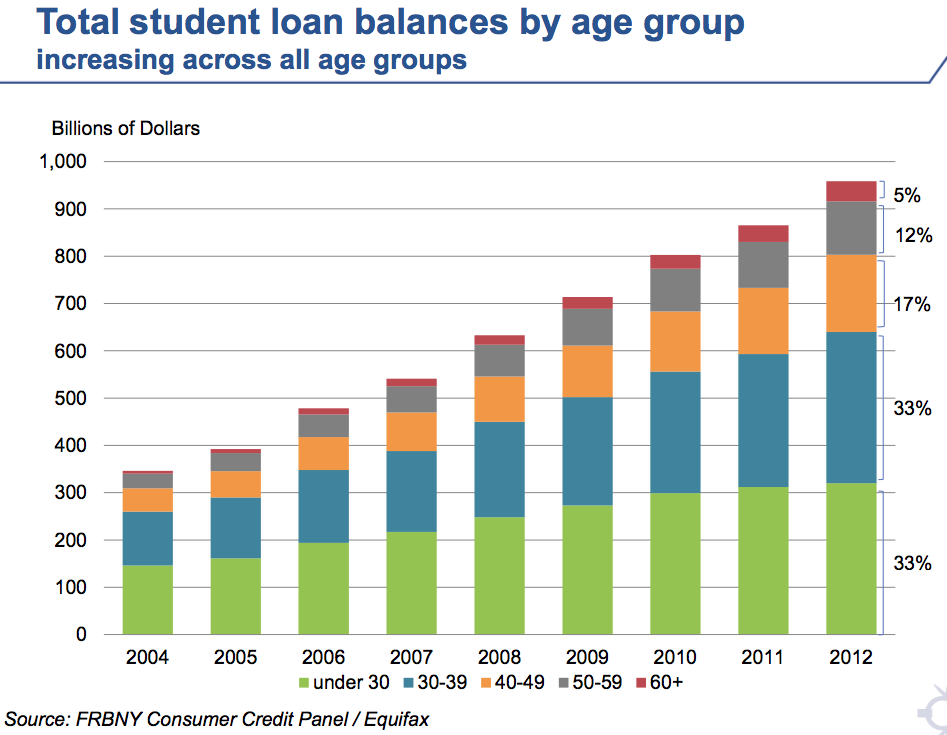
On February 28, the New York Fed released a study on student loans. Much blogosphere chatter, of the “it’s a bird, it’s a plane, it’s a bubble” based on charts like this…


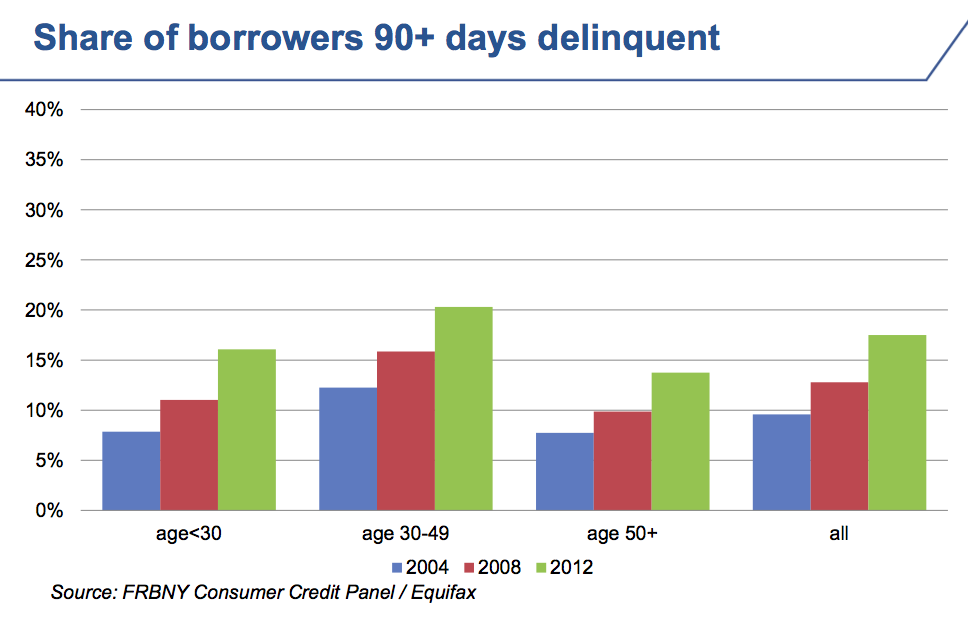
….pointing out that student debt outstanding is nearly three times as large as the total as of 2004, and more scary charts like this:
This is even uglier than you might think, since 30-49 are peak earning years. Oh wait, that was the old normal.

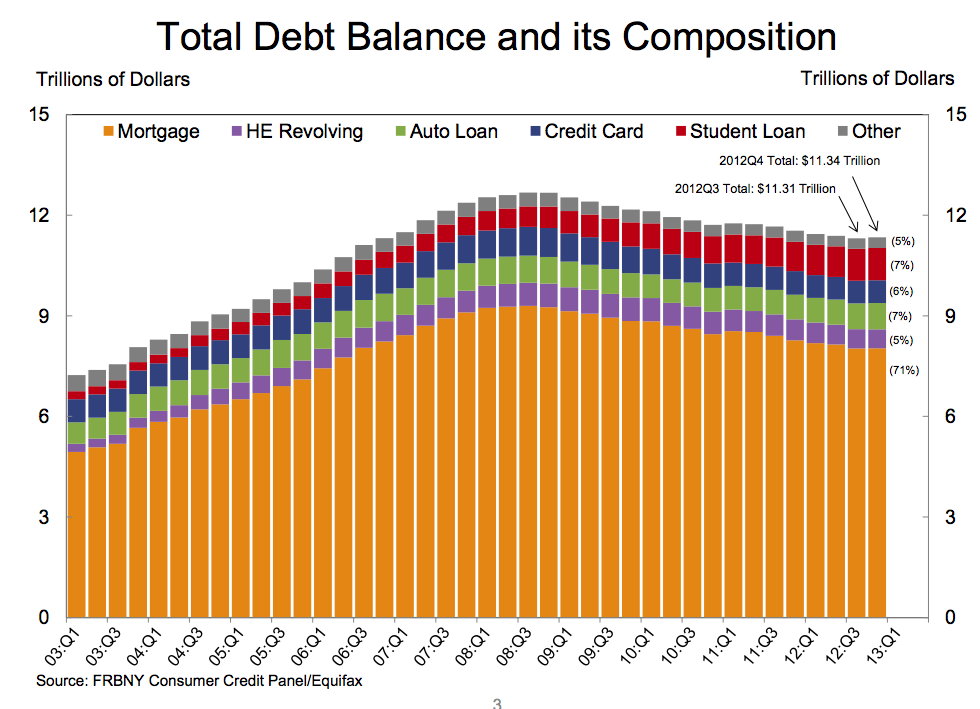
And when you integrate this with the just-released New York Fed quarterly household credit survey, you reach some not pretty conclusions. Student debt is now a bigger source of consumer borrowing than credit cards (we are speaking in terms of macroecomoic impact):


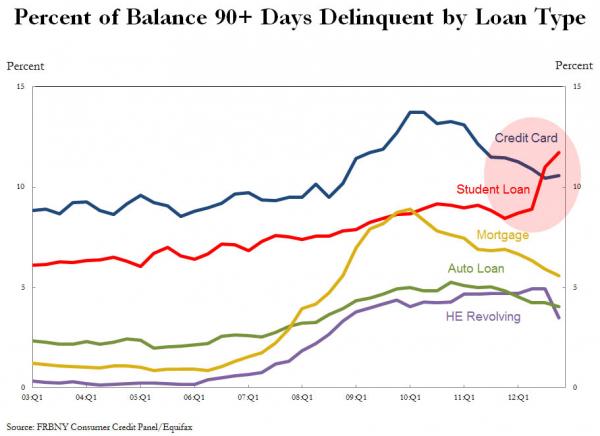
And it’s now the loan category where borrowers are in most distress (hat tip Russell H):

This level is particularly ugly given that student loans cannot be discharged in bankruptcy. It’s more rational to get in arrears on anything else, since you have some hope of negotiating for a restructuring.

As Warren Mosler said via e-mail:
Student loans have been making a meaningful contribution to aggregate demand.
If origination slows it’s another negative for growth and output to add to the tax hikes and spending cuts.
This is not to say I favor the student loan channel for education. Quite the contrary, in fact.
But just like the savings and loan credit expansion leg propelled the Reagan years, the .com and y2k credit expansion the Clinton years, and the sub prime credit expansion the Bush years, to a much lesser extent the student loan credit expansion has supported the current modest recovery.
And when they end the support ends.
So Lambert’s bus sources were spot on: student loans are not only looking bubbly, but the level of borrower stress is saying something has got to give. One sign is that law school enrollment has fallen 15% since 2010. Students are correctly worried about borrowing heavily in a weak job market. But so far, enough people believe in the value of education as a workplace credential that the student loans outstanding are still rising. It’s hard to discern how this plays out, but the endgame might not be that far off.

Source

March 1, 2013

USSR Redux: Top Eurocrats Indicate Europe's Recovery Will Be Centrally Planned and Green

Europe's Green Recovery ... BRUSSELS – The need for clean energy has returned to the top of the global economic agenda ... In his second inaugural address, US President Barack Obama discussed climate change more than any other issue, saying, "We cannot cede to other nations the technology that will power new jobs and new industries." At the World Economic Forum in Davos, International Monetary Fund Managing Director Christine Lagarde and World Bank President Jim Yong Kim surprised business and government leaders with their warnings that genuine economic recovery would be impossible without serious action on climate change. And, at the most recent EU summit, leaders agreed to commit at least 20% of their entire common budget to climate-related spending. – Project Syndicate

Dominant Social Theme: Our centrally planned economic recovery will be just as rigorous Pre-War Germany's or the USSR's but it will work much better because it will be "green."

Free-Market Analysis: It is no accident that people refer to the EU as the EUSSR. In a not very noticeable but nonetheless breathtakingly arrogant statement, a top EU Commissioner has just served notice that EU commissars intend to subject Europe to a massive amount of environmental central planning.

Central planning doesn't work as it is essentially price fixing on a grand scale. As those who run these programs are cynically aware, people will pursue their own self-interest regardless of state-mandated regulation. What these mandates provide, therefore, are a recipe for intentional impoverishment and continued social unrest.

And presumably that, too, is part of the plan. Out of chaos, purposefully inflicted, comes a new kind of order, one shaped by those who are helping generate the chaos and are thus in position to provide pre-calibrated and increasingly globalist solutions.

The article in question (see excerpt above) is written by Connie Hedegaard, EU Commissioner for Climate Action, and provides us with a new and disturbing direction for the European Union's recovery.

The article, posted to the elite-leftist Project Syndicate among other places, makes the case for a "green" European recovery – one that is to be managed to meet certain goals, in other words. The thrust of her argument is encompassed in this statement:

Beyond the global economic crisis, the world is experiencing a social and employment crisis, as well as a climate and resource crisis. And none can be resolved without addressing the others.

This is a breathtaking announcement of bureaucratic central planning. Europe's "recovery," which surely has not even begun to take place, is to be managed comprehensively.

This is, in fact, what appears to be the second stage of a two-part process to reshape Europe not just into a unitary political union but into a unified society that accepts – however reluctantly – the entirety of a controversial elite sociopolitical and economic paradigm.

There is no consensus on global warming, environmental solutions (or problems) or alternative energy facilities, but Ms. Hedegaard is indicating in this article that there will be no argument, either. Out of the ashes of an "old Europe," a new Europe will emerge, one shaped around an elite "green" agenda implemented out of Brussels and designed by Money Power itself. Here's more from the article:

Europe's main commercial competitors have begun to recognize that pursuing short-term development policies, while ignoring long-term threats to the global economy, is both irresponsible and a strategic mistake for those who aspire to global leadership in the twenty-first century. Although Europeans have known this for decades, in the wake of the recent economic crisis, immediate goals took priority over – and often at the expense of – long-term objectives.

With the European Union's economy growing more slowly than those of its major competitors, its leaders must take a more far-sighted approach to restoring – and preserving – its members' growth potential. They must begin by identifying not only what is undermining Europe's competitiveness today, but also those factors that are putting its long-term prospects at risk.

Analysts often point to Europe's costly social-welfare systems, high labor costs, and increasing tax rates as a drag on competitiveness. But other, less widely discussed factors must be considered – particularly the costs of delayed action on climate change. For example, Unilever CEO Paul Polman reported that extreme weather cost his company $250-300 million in 2012. Once considered an issue for the future, action on climate change has become increasingly urgent, as the outlays required to mitigate its negative effects have grown ...

Meanwhile, China – the world's leading investor in renewable-energy projects – is undergoing a transformation from the world's low-cost factory to a global leader in green innovation and a major exporter of clean technologies. In the contest for this global market, Europe cannot compete on price alone.

But Europe does have options. EU leaders can build an economy that is less dependent on imported energy through increased efficiency and greater reliance on domestically produced clean energy. At the same time, they should tackle other major threats to Europe's long-term competitiveness, including low productivity, an incomplete internal market, and insufficient innovation.

Ms. Hedegaard has done us a favor by explaining clearly and succinctly just what is in store for the EU and its suffering citizens. Whatever recovery is to be tolerated will be shaped along certain lines – and highly inefficient ones. It is authoritarianism with a green face: Jettisoned is any notion that the Invisible Hand of marketplace competition should choose what people are comfortable and wish to use in their personal and professional lives.

Marketplace competition is democratic and empowering. Central planning is intolerant and brutal. Ms. Hedegaard is not asking permission when it comes to implementing her assertions. She is merely giving us notice.

It gets even worse, however. Later in the article, she states that "Europe's high environmental standards are crucial to its future competitiveness, and should therefore be actively promoted, particularly in trade agreements."

Not content with imposing questionable industrial policies on Europe, Brussels Eurocrats have in mind exporting their errors throughout the world. This is not hypothetical, either. It is happening now.

While trade deals have often come at the expense of stronger domestic climate action, the EU's new trade agreement with Singapore aims to boost trade and investment in clean-energy technologies and promote green public tendering. This should serve as an environmental benchmark for future agreements – including with the US, despite some American constituencies' expectations that EU standards could be relaxed in a bilateral trade deal.

The idea, we are told, is that by being a leader in environmental standards, Europe can support the growing global market for clean-energy technologies." For Eurocrats it follows logically that once a market has been established, it can be cultivated and expanded.

The green-technology market is set to triple in value by 2020 – so the article explains – and thus Europe could "regain competitiveness and secure its role in the future global economy" by focusing its industrial policy on the green solutions.

In reality, trying to force billions of people to use questionable solutions to seemingly non-existent problems, the top elites behind these campaigns are wasting resources and lowering living standards. Again, from our humble point of view, they implement these schemes on purpose, and for just these reasons.

Conclusion: There is an active campaign underway to lower Europe's living standards and weaken its middle classes. Creating and imposing a pan-European "environmental economy" on Europe's suffering masses will likely promote both of these goals.

 Source

February 28, 2013

Disastrous Financial Transaction Tax Gains Traction

5 Reasons the World Is Catching on to the Financial Transaction Tax ... It has been more than 70 years since John Maynard Keynes wrote about the value of a financial transaction tax in "mitigating the predominance of speculation over enterprise in the United States." A financial transaction tax works by levying a miniscule fee on the estimated $2.9 trillion of daily financial activity through the trading of stocks, bonds, and derivatives in U.S. financial markets, based on our analysis. The tax makes some of the most speculative unproductive trading unprofitable, thus steadying markets and promoting real investment while raising much-needed revenues. Though many countries around the world already have a financial transaction tax in place, the United States does not yet levy such a fee on trading. – American Progress

Dominant Social Theme: Wall Street parasites are simply a blight; taxing them is good.

Free-Market Analysis: Like a bad penny, the "financial transaction tax" keeps turning up and if this article is accurate, the tax is gaining momentum around the world and will eventually penetrate the United States as well.

And that would be too bad. Wall Street is basically a creation of central banking – the Federal Reserve, in this case. Without monetary stimulation, Wall Street would not be what it is today. And thus the entire emphasis of this financial tax is likely incorrect.

Instead of removing the facilities of modern monopoly monetary stimulation, those behind the financial transaction obviously want to capitalize on it. Buy it's a bit like the government and smoking. Government bureaucrats don't REALLY want to get rid of smoking because it is a cash cow. So they only pretend to dislike the practice while expanding taxes and tariffs whenever they can.

The financial transaction tax, perversely, will put governments around the world into a similar posture. Bureaucrats will denounce "wasteful financial speculation" while working behind the scenes to facilitate it. A financial transaction tax will make changing the system in any meaningful way even more difficult – which is no doubt what its supporters really want. Here's more from the article:

While the idea of a modest financial transaction tax—or FTT, as it is often known—has been around for a long me, with budget balances and economic growth strained in the aftermath of the Great Recession policymakers around the world are taking a new look at the tax. Below are five reasons why the world is catching on to the financial transaction tax as a smart policy tool.

A financial transaction tax would bring in much-needed revenue The U.S. government is currently operating at its lowest level of revenues in more than 60 years. A 2010 report from the International Monetary Fund identifies the financial sector of the economy—particularly in the United States—as substantially undertaxed ...

Business and civic leaders support a financial transaction tax The idea of a financial transaction tax isn't new, but the chorus singing its praises is growing every day—from leading economists such as Nobel Prize winners Joseph Stiglitz and Paul Krugman to entrepreneurs such as Bill Gates and Marc Cuban, to financial leaders the likes of John Bogle, founder of the mutual-fund giant Vanguard Group. The financial transaction tax also has the support of unions for nurses and other health care professionals and service-sector workers ...

A financial transaction tax helps stabilize volatile financial markets An astounding share of transactions on financial markets today consists of high-frequency trades made on the millisecond by computers programmed with sophisticated algorithms. The computers make large-volume trades based on tiny changes in prices—fractions of a penny—and, in so doing, reap tremendous trading profits. While economic theory might suggest that this would lead to slightly more efficient financial markets, the Bank of England's Andrew Haldane has shown that "high-frequency trading appears to have amplified" the markets' erratic undulations ...

A financial transaction tax incentivizes investment for real growth The financial transaction tax by design increases transaction costs of financial trading, thereby encouraging investors to hold financial assets in their investment portfolios for longer periods ...

Many countries already have a financial transaction tax The standard stalling tactic for bringing a financial transaction tax to the United States is saying that we should wait until other countries do it first. But financial transaction taxes already operate in at least 23 countries around the world—including in international financial centers such as the United Kingdom, Switzerland, Hong Kong, and Japan—and that number is about to grow ...

Okay, let's comment on some of the highlights. First of all, the US government in particular doesn't need more revenue. Various US governmental entities already spend some US$3-4 trillion a year. This particular Leviathan should shrink rather than grow.

We don't see, either, how a financial transaction tax will stabilize volatile markets in a meaningful way. The problem with modern financial markets is that they are stimulated by a central banking boom/bust cycle. The best way to deal with the havoc caused by modern financial markets is to diminish irresponsible monopoly fiat money printing. As we've pointed out above, the financial transaction tax will actually – perversely – encourage and expand the current destructive system by giving governments more "skin in the game."

The article makes the argument as well that since because many other countries have adopted a financial transaction tax, the US should, too. But the US financial markets are the largest in the world and thus what is detrimental elsewhere shall be disastrous in the US. Foolish policies are not ameliorated by expanding them.

The biggest misunderstanding held by proponents of a financial transaction tax is that such a tax will somehow diminish Wall Street while supporting Main Street. In fact, this is a kind of middle-man prejudice. There is nothing wrong with speculation – theoretically, anyway: It has its place.

And as we often point out, because of fiat-money stimulation modern Main Street is just as distorted and unproductive as Wall Street itself. Promoting industrial distortions at the expense of speculative distortions doesn't improve the underlying economic situation a bit.

Bottom line: A financial transaction tax, like most government policies, will actually do the opposite of what it is meant to do. It will further solidify linkages between bureaucracy and modern central banking while providing Leviathan even more sources of revenue for additional forays into destructive regulation and enforcement thereof.

Once major Western countries adopt a financial transaction tax in force, the second part of this exercise will doubtless come into play – which is attempting to divert some of the funding stream to the United Nations.

Conclusion: World government will come another step closer with the increased penetration of this tax. It is being sold to people as a progressive measure that will damp bad business practices. But the solution in this case is more destructive to civil society than the problem.

Source

February 27, 2013

Jack Lew’s Grotesque Citi Employment Deal and the Institutionalization of Corruption

Corruption has now become so routine in Washington that improprieties far worse than Turbo Timmie’s implausible failure to pay taxes on income from his days working as a consultant to the World Bank barely evoke a yawn from the media. Apparently the fourth estate is either so bedazzled by star turns, like Michelle Obama presenting at the Oscars (!!!) or so cowed by the prospect of being cut off from information that it dutifully falls in line.

Let’s look at the presumed incoming Treasury Secretary, Jack Lew. He’s a die hard neoliberal, played a role in financial deregulation as Clinton economics team member, and a backer of NAFTA. But what is surprising is the limited interest in his personal dealings, which have been examined critically by Pam Martens and Bloomberg’s Jonathan Weil. Recall that Lew is essentially a career elite technocrat, with his major stint out of government being during the Bush Administration, when he first served as the Executive Vice President for Operations at NYU (where his noteworthy accomplishment was busting the bargaining rights of grad students) and then became the chief operating officer for Citigroup’s alternative investment group.

Weill zeroed in one provision of Lew’s employment agreement at Citigroup, that if Lew left for a “high level position with the United States government or regulatory body” his 2006 and 2007 guaranteed incentive and retention awards. The 2008 rider to the letter provided that if Lew left for the same type of “high level position” his restricted stock would vest immediately. Frankly, I think Weil is more riled up about this provision than he ought to be. The bank was giving particularly generous guarantees for joining. There was no reason to pay out on those guarantee if Lew broke his contract, unless he went to do something that would be of comparable value to the bank. You may not like the logic, but this is pretty cold commercial logic at work. Weil seems to have misread the “guaranteed incentive and retention awards” to mean Lew’s annual bonus on an ongoing basis. It didn’t. It’s a defined term that refers only to special goodies he got in 2006 and 2007.

What I find more disturbing is if you read the totality of Lew’s agreement versus Citi’s performance and Lew’s 2008 pay.

Remember, Lewis came from a job at NYU where he already looks to have been considerably overpaid. He received over $840,000 for the academic year 2002-2003, which had him earning more than most university presidents, including NYU’s president. And on top of that, as Pam Martens ferreted out, he was apparently given a $1.3 million house. I’m not making that up, go read her piece. The mechanism was that NYU lent the $1.3 million to buy the house to Lew and then forgave it over five years. Oh, and they paid him the money to pay the interest too. We will assume that the forgiveness of debt was reported properly to the IRS.

Now the house deal (which is rather bizarre given that NYU owns lots of nice faculty housing) might be what made Lew’s pay deal so out of line relative to his job. But if the forgiveness of debt was not included in the total, it’s even more insane, the equivalent of $1.1 million a year.

But Citi was still happy to pay over the market. If you read the Lew employment agreement, he got a $300,000 salary and a $1 million a year guaranteed incentive and retention award for each of 2006 and 2007. Oh, and he ALSO got a $700,000 signing bonus in restricted stock (or cash if the relevant committee did not approve the award!) that would vest 25% a year over the next four years. Oh, and the last goodies: he got his offer letter on June 26, 2006, and he joined in July. But his $1 million guaranteed incentive and retention award was NOT pro-rated for that year. And he got to take a $400,000 advance against it when he joined.

Now a general rule in headhunter land is you need to pay someone a 30% premium over their current job to get them to leave. But that is when they are recruiting someone with a good resume who is well situated away from a pretty secure position. You are paying them for assuming the risk of failure in a new job. There’s no evidence that Lew was aggressively courted to leave his job at NYU because a university administrator would be the perfect guy to play an executive role in a hedge fund business. The flip side, of course, is if a guy like Lew landed a plum government or regulatory job after Citi, pretty much any pay level would be a screaming bargain. And between Lew’s own history and then Citigroup vice chairman Bob Rubin’s deep network in the Democratic party, it would seem that the only risk was how long it took to get the Dems back in power.

But let’s look at what happened. Remember how Citi’s stock has cratered?

It is really hard to discern the scales, but Lew’s $700,000 award would have been made when Citi was trading (in post reverse split term) in the $480 to $500 a share range. When he joined the Obama administration as deputy secretary of state, the stock was in the $15 to $18 range. So it was pretty much worthless. Any restricted stock component of his 2007 bonus would also have lost most of its value.
Now, Lew’s salary was increased to $350,000 in 2008. Given that the bank was hemorrhaging losses and his unit was part of the problem, there’s no justification for a salary rise (remember, the wheels were staring to come off in 2007, as Citi’s stock price attests). Let us look at how Goldman, which was one of the stronger major players,* handled executive and staff pay in 2008. From Bloomberg:
Goldman Sachs Group Inc. eliminated 2,500 jobs in the fourth quarter and slashed average pay per worker 45 percent to $363,654 as the firm posted the first quarterly loss since going public almost a decade ago….

Goldman Sachs Chief Executive Officer Lloyd Blankfein and six deputies agreed to forgo their year-end bonuses after the firm converted to a bank-holding company and accepted $10 billion from the government to help it survive a financial crisis that eliminated three smaller rivals. The firm’s bonus pool, estimated at 60 percent of total compensation, dropped to $6.56 billion or an average $218,193 per employee this year.
Yet Lew’s 2008 bonus of $944,000 was almost identical to his 2007 guarantee (note that we don’t know if he got any other goodies in cash, but again, given that the earnings of the bank fell 83% from prior year levels, that would be awfully unseemly). And let us not forget that this came out of taxpayer largess, not earnings.

Weill adds that Lew stood to receive another $250,001 to $500,000 in the cashout of restricted stock. Given the stock chart above, that has to have been almost entirely a 2008 award, any prior year awards would be worth chicken feed. And the bank knew as of November 15 (if not sooner) that Lew was going to the Administration, hence the award would be paid out in cash, out of taxpayer monies. In other words, that award should not be mistaken as a prior year grant, it’s almost all for 2008, and on top of that, probably understood at the time it was awarded to be effectively a cash award.

This isn’t hard to understand. When Lloyd Blankfein, who was excoriated by former Goldman co-chairman John Whitehead for Goldman’s role in leading “outrageous”n pay increases over Wall Street, is requiring significantly lower pay levels of his executives and troops for their 2008 pay. By contrast, a mere (albeit senior) administrator at a bank on government life support, got an effective increase. Yet as reported in the Washington Times, Lew had the temerity to tell Congress:
My position at Citi was a management position,” Mr. Lew replied. “I was not an investment adviser. My compensation was in line with other management executives at the firm and in similarly complex operations.”
It may be true that the entire executive team was feeding at the trough as much as Lew. However, a look at the proxy shows that none of the top five executives at Citi took cash bonuses for 2008. So if top executives were taking major pay cuts, how could Lew, an administrator in a money-losing unit, claim to be treated just the same as everyone else?

But this simply means that Lew is a member of a protected class. The rules that apply to little people, including giving accurate, as opposed to strained-at-best, answers to Congressmen, just don’t apply to him. The idea that his pay package was basically a huge option payment by Citi on the pretty good odds that he’d land another big deal official post, doesn’t seem to occur to him. And why is that worth so much to Citi? Well, as we know, corruption in the US does not (often) take the form of briefcases full of cash being left in an office. It’s an ugly combination of intellectual capture, of mutual backscratching, and “don’t rock the boat,” of accepting norms of discourse, behavior, and action, that circumscribe the range of possible actions.
Lew no doubt believes he was paid according to merit, despite the blindingly obviously evidence to the contrary. And that sense of entitlement is what will enable him to kill old people without a second though. Because that is what winning cuts to Social Security and Medicare will do, given that Obama punted on his chance to tackle the health care cost problem.

I had predicted Lew would have us wanting Geithner back. At least Geithner would get twitchy when grilled. That means, somewhere inside, he actually knows right from wrong. Lew is such a bland technocrat that I wonder whether he has any compunctions.

But the lack of consternation about Lew’s financial record, and the way some respected members of what passes for the left (Robert Reich and Jamie Galbraith) have defended Lew, in part also shows how much things have changed in a mere four years. Obama’s lying has become so predictable that it’s hard to stir up any outrage over it.** And since fish rot from the head, one of Obama’s singular accomplishments is in defining deviancy down throughout the Beltway. For instance, Obama took the unheard-of step of collecting “unlimited corporate cash” in the words of Roll Call, with virtually nil in the way of disclosure, taking even stalwart supporters like the Grey Lady aback.

So Lew is indeed perfect for his new role, just not in the way ordinary Americans expect him to be.
_____

* I don’t buy Jamie Dimon’s claims re JP Morgan’s financial condition. Yes, the traditional bank was in vastly better shape than Citi or Bank of America. But JP Morgan runs a monster derivatives clearing operation which dwarfs the risk in the traditional bank. If AIG or Morgan Stanley had failed after Lehman, the blowback would most assuredly have taken JP Morgan down as well.

** Yes I know politicians lie, but Obama has completely redefined the boundaries of acceptable political fudging. It’s now all dishonesty, all the time.

Source

February 26, 2013

The Big Dogs On Wall Street Are Starting To Get Very Nervous

Why are some of the biggest names in the corporate world unloading stock like there is no tomorrow, and why are some of the most prominent investors on Wall Street loudly warning about the possibility of a market crash? Should we be alarmed that the big dogs on Wall Street are starting to get very nervous? In a previous article, I got very excited about a report that indicated that corporate insiders were selling nine times more of their own shares than they were buying. Well, according to a brand new Bloomberg article, insider sales of stock have outnumbered insider purchases of stock by a ratio of twelve to one over the past three months. That is highly unusual. And right now some of the most respected investors in the financial world are ringing the alarm bells. Dennis Gartman says that it is time to "rush to the sidelines", Seth Klarman is warning about "the un-abating risks of collapse", and Doug Kass is proclaiming that "we're headed for a sharp fall". So does all of this mean that a market crash is definitely on the way? No, but when you combine all of this with the weak economic data constantly coming out of the U.S. and Europe, it certainly does not paint a pretty picture.

According to Bloomberg, it has been two years since we have seen insider sales of stock at this level. And when insider sales of stock are this high, that usually means that the market is about to decline...
Corporate executives are taking advantage of near-record U.S. stock prices by selling shares in their companies at the fastest pace in two years.

There were about 12 stock-sale announcements over the past three months for every purchase by insiders at Standard & Poor’s 500 Index (SPX) companies, the highest ratio since January 2011, according to data compiled by Bloomberg and Pavilion Global Markets. Whenever the ratio exceeded 11 in the past, the benchmark index declined 5.9 percent on average in the next six months, according to Pavilion, a Montreal-based trading firm.
But it isn't just the number of stock sales that is alarming. Some of these insider transactions are absolutely huge. Just check out these numbers...
Among the biggest transactions last week were a $65.2 million sale by Google Inc.’s 39-year-old Chief Executive Officer Larry Page, a $40.1 million disposal by News Corp.’s 81- year-old Chairman and CEO Rupert Murdoch and a $34.2 million sale from American Express Co. chief Kenneth Chenault, who is 61. Nolan Archibald, the 69-year-old chairman of Stanley Black & Decker Inc. who plans to leave his post next month, unloaded $29.7 million in shares last week and Amphenol Corp. Chairman Martin Hans Loeffler, 68, sold $27.5 million, according to data compiled by Bloomberg.

Google Chairman Eric Schmidt, 57, announced plans to sell as many as 3.2 million shares in the operator of the world’s most-popular search engine. The planned share sales, worth about $2.5 billion, represent about 42 percent of Schmidt’s holdings.
So why are all of these very prominent executives cashing out all of a sudden?
That is a very good question.

Meanwhile, some of the most respected names on Wall Street are warning that it is time to get out of the market.

For example, investor Dennis Gartman recently wrote that the game is "changing" and that it is time to "rush to the sidelines"...
"When tectonic plates in the earth’s crust shift earthquakes happen and when the tectonic plants shift beneath our feet in the capital markets margin calls take place. The tectonic plates have shifted and attention... very careful and very substantive attention... must be paid.

"Simply put, the game has changed and where we were playing a 'game' fueled by the monetary authorities and fueled by the urge on the part of participants to see and believe in rising 'animal spirits' as Lord Keynes referred to them we played bullishly of equities and of the EUR and of 'risk assets'. Now, with the game changing, our tools have to change and so too our perspective.

"Where we were buyers of equities previously we must disdain them henceforth. Where we were sellers of Yen and US dollars we must buy them now. Where we had been long of gold in Yen terms, we must shift that and turn bullish of gold in EUR terms. Where we might have been 'technically' bullish of the EUR we must now be technically and fundamentally bearish of it. The game board has been flipped over; the game has changed... change with it or perish. We cannot be more blunt than that."
That is a very ominous warning, but he is far from alone. Just the other day, I wrote about how legendary investor Seth Klarman is warning that the collapse of the financial markets could happen at literally any time...
"Investing today may well be harder than it has been at any time in our three decades of existence," writes Seth Klarman in his year-end letter. The Fed's "relentless interventions and manipulations" have left few purchase targets for Baupost, he laments. "(The) underpinnings of our economy and financial system are so precarious that the un-abating risks of collapse dwarf all other factors."
Other big hitters on Wall Street are ringing the alarm bells as well. For example, Seabreeze Partners portfolio manager Doug Kass recently told CNBC that what he is seeing right now reminds him of the period just before the crash of 1987...
"I'm getting the 'summer of 1987 feeling' in the U.S. equity market," Kass told CNBC, "which means we're headed for a sharp fall."
And of course the "perma-bears" continue to warn that the months ahead are going to be very difficult. For instance, "Dr. Doom" Marc Faber recently said that he "loves the high odds of a ‘big-time’ market crash".

Another "perma-bear", Nomura's Bob Janjuah, is convinced that the stock market will experience one more huge spike before collapsing by up to 50%...
I continue to believe that the S&P500 can trade up towards the 1575/1550 area, where we have, so far, a grand double top. I would not be surprised to see the S&P trade marginally through the 2007 all-time nominal high (the real high was of course seen over a decade ago – so much for equities as a long-term vehicle for wealth creation!). A weekly close at a new all-time high would I think lead to the final parabolic spike up which creates the kind of positioning extreme and leverage extreme needed to create the conditions for a 25% to 50% collapse in equities over the rest of 2013 and 2014, driven by real economy reality hitting home, and by policymaker failure/loss of faith in "their system".
So are they right?

We will see.

At the same time that many of the big dogs are pulling their money out of the market, many smaller investors are rushing to put their money back in to the market. The mainstream media continues to assure them that everything is wonderful and that this rally can last forever.

But it is important to keep in mind that the last time that Wall Street was this "euphoric" was right before the market crash in 2008.

So what should we be watching for?

As I have mentioned before, it is very important to watch the financial markets in Europe right now.

If they crash, the financial markets in the U.S. will probably crash too.

And the financial markets in Europe definitely have had a rough week. Just check out what happened on Thursday. The following is from a report by CNBC's Bob Pisani...
Italy, Germany, France, Spain, U.K., Greece, and Portugal all on track to log worst day since Feb. 4. European PMI numbers were disappointing, with all major countries except Germany reporting numbers below 50, indicating contraction.

What does this mean? It means Europe remains mired in recession: "The euro zone is on course to contract for a fourth consecutive quarter," Markit, who provides the PMI data, said. A new insight is that France is now joining the weakness shown in periphery countries.

You're giving me agita: Italy was the worst market, down 2.5 percent. The CEO of banking company, Intesa Sanpaolo, said Italy's recession has been so bad it could cause a fifth of Italian companies to fail, noting that topline for those bottom fifth have been shrinking 35 to 45 percent. Italian elections are this weekend.

It wasn't any better in Asia. The Shanghai Index had its worst day in over a year, closing down nearly three percent.
And the economic numbers coming out of the U.S. also continue to be quite depressing.
On Thursday, the Department of Labor announced that there were 362,000 initial claims for unemployment benefits during the week ending February 16th. That was a sharp rise from a week earlier.

But I am not really concerned about that number yet.

When it rises above 400,000 and it stays there, then it will be time to officially become alarmed.
So what is the bottom line?

There are trouble signs on the horizon for the financial markets. Nobody should panic right now, but things certainly do not look very promising for the remainder of the year.

Source

February 25, 2013

US judge freezes Goldman Sachs account over 'suspicious' Heinz trading

A US judge froze a Goldman Sachs account that regulators say was used to make suspicious trades in H J Heinz, after unknown traders failed to appear in court to defend their claims to the assets.
When the unidentified traders didn't show up at a hearing on Friday in Manhattan, a US district judge, Jed Rakoff, said he would grant the US Securities and Exchange Commission's (SEC) request to freeze the Goldman Sachs account in Zurich until the case was resolved.

"They can hide, but their assets can't run," Mr Rakoff announced, saying he had granted the SEC's request and signed the freeze order.

The agency said in its complaint that the trades came a day before Warren Buffett's Berkshire Hathaway and 3G Capital announced the US$23 billion (Dh84.4bn) takeover of Pittsburgh-based Heinz. The suspicious trading involved call-option contracts, the SEC said.

Goldman Sachs told the regulator it doesn't have "direct access" to information about the beneficial owner behind transactions in the account. The New York-based bank told the agency the account holder is a Zurich private-wealth client, the SEC said. Goldman has said it is co-operating with authorities.

The SEC on February 15 sued "unknown" traders who used an "omnibus account" and invested almost $90,000 in Heinz option positions the day before the deal was announced. As a result, their position increased to more than $1.8 million, a rise of almost 2,000 per cent in one day.

The SEC, which obtained a preliminary freeze on the funds from Mr Rakoff on February 15, said that the traders had material nonpublic information about the impending deal when they bought 2,533 call options, which had a strike price of $65 on February 13. Shares closed that day at $60.48.

Heinz shares jumped 20 per cent to $72.50 on February 14, following the announcement that Berkshire Hathaway and Jorge Paulo Lemann's 3G Capital had agreed to buy Heinz. As a result of the takeover announcement, the price of the June call options jumped to a close of $7.33 on February 14 from 40 cents the day before, an increase of more than 1,700 per cent.

Mr Rakoff, who on February 15 put a temporary freeze on the assets in the Goldman Sachs account, directed anyone connected to the trades to appear before him at 2pm local time on Friday to explain why the assets should not be permanently restrained.

The FBI said last week that it was also investigating the matter and was working with the SEC.

The SEC wants the assets frozen until the case is resolved because there is a "serious risk that the substantial proceeds from the defendants' trading will leave the jurisdiction of the US courts in the next few days and may never be recovered," according to a court filing.

Source

February 22, 2013

Nirvana, Creditopia, And Why Central Banks Are The Devil

Central banks are the devil. They are like drug dealers except they administer regular doses of supposedly legally prescribed barbiturates to their addicts. The 'easy money' or 'credit' they create is an opiate and like all addictions there is a payback for the addicts, one exacted only in loss of health, misery and death.

The economic system is an addict, but that system is comprised of banks, corporations, non-profit organisations, small businesses all of which are communities. And what comprises communities, us, human beings - individuals. We are the addicts.

Popular economic academia understates human action in the economic equation of money. It is human preferences that determine our desire for goods and services and so in turn really determines the utility of money. Sadly the desire of the State to control money and administer it like a drug has left our economies unproductive and incapable of standing on their own two feet.

Our reliance on 'easy money' as facilitated by credit has become terminal. Like drug users we continue to attempt to find a heightened state of Nirvana. We continue to hark for the utopian days prior to the eruption of the post 2008 crisis, even though our well-being was fallacious and based on an illusion of wealth paid for by credit - a creditopia. The abuse of credit is what defined the Great Financial crisis and one that still defines our economic system and one which will define a much worse crisis to come.

Central bankers have begun a concerted effort to fight the global debt problem which has been stifling growth as tax revenues merely serve to finance debt servicing rather than addressing the repayment of principal outstanding. Omnipotent governors, Bernanke, Carney, Draghi, Svensson and Iwata or Kuroda (either are likely to replace Shirakawa) are to take a far more aggressive and activist role in pursuing a new framework for growth and inflation by seeking an alternative way to conduct monetary policy. It's called Nominal GDP Level targeting and it is in our opinion as significant a moment as Volcker's appointment to the Federal Reserve governorship in 1978.

Many will recall Volcker's moment was to engineer a swift monetary contraction and deceleration of the money velocity to try and reign in excessively high inflation and stabilise growth. It worked. Today we are witnessing an ‘Inverse Volcker’ moment, whereby the opposite is likely true.

The question remains are they all still ‘inflation nutters' as Mervyn King, the BoE Governor glibly referred to those central bankers who focussed solely on inflation targets to the potential detriment of stable growth, employment and exchange rates.

Are central bankers merely expanding the boundaries of monetary largesse by focusing on a broader mandate and merely evolving the singular variable approach of inflation targeting or have they finally found a solution to eradicating boom bust business cycles? This is a question we need to answer as we are currently witnessing a Central Bank Revolution which could portend severe consequences for prices in our economies - and all the attendant misery that comes with very high inflation.

Nominal GDP Level targeting advocates believe they have a plausible case for a change of mandate by central banks and one which is being gradually adopted, but we believe that like central banks they have misdiagnosed the cause of the crisis by failing to examine the impact of credit creation in our global economy.

Money matters less credit matters more.

Global economies are still credit driven and Keynesian counterfeiting has merely arrested the collapse. The maintenance of heightened credit levels by financing of deficits with 'easy' money is beginning to see prices and output rise in the short term. In the long run only higher prices will remain whilst growth stagnates. A classic monetarist conclusion.

Hinde Capital has provided a long and consistent discourse on the relationship between credit and growth. Policymakers by now may well grasp that sustainable growth is not possible as nations still have an overreliance on credit-based sectors, namely the F.I.R.E. sectors, (Finance, Insurance and Real Estate). This is an understatement as all sectors are now directly or indirectly underpinned by this false mammon called credit.


Once upon a time merely altering the levels of money in the economic system could help an economy expand and contract without creating excessive levels of inflation both in asset, goods and service prices. However as this fiat currency regime has grown older so has the ability of central bank policy to contain large swings in the business cycle.

++++++

It is our contention that central banks feel they need to maintain the balance of credit in the system as it currently stands by adjusting the money supply and monetary velocity (MV) but by doing so they merely circumvent the necessary adjustment in the economic system that comes about by market failure. If they don't allow this failure then any attempt to influence MV will only lead to higher prices (P) at the expense of output (T) in the famous monetary equation MV=PT.

Central Bank's Checklist Manifesto

At Hinde Capital we have attempted to codify both our objective and subjective observations of asset classes over the years and have naturally migrated to a checklist routine to eliminate any behavioural biases that lead to a misdiagnosis of events before an investment decision.

Source

February 21, 2013

Goldman Sachs Back To Hurting Clients As Firm Is Targeted In Insider Trading Probe

Goldman Sachs is apparently back to it’s old tricks despite the $550 million settlement with the SEC over hurting clients in the mortgage securities market. Acting on what may have been inside information (more on that later) the firm decided it wanted to heavily invest in Heinz (HNZ), which later would announce it was in talks to be bought out by Warren Buffet. So Goldman Sachs started buying up shares ahead of the merger.

And here is where Goldman’s clients get involved.
An investment bank having a Sell rating on a stock? Usually an unheard of thing: why alienate the management, why prevent future banking business – it’s not like banks are ethical creatures – and sure enough in this particular case, the bank in question had sell recos on just 14% of the stocks in its coverage universe. Which begs the question: what does a Sell rating really accomplish? Well, in this case, and in all such cases, it merely provides the firm’s prop, pardon flow, traders the opportunity to accumulate the shares its “clients” are advised by the same bank’s sellside group to Sell, preferably to the bank in question…

Bottom line: 20% gain for Goldman’s prop traders who bought all the HNZ stock they indirectly “advised” their client counterparts to sell to them.
Ouch. Why would a client ever trust a Goldman advisor again? They just pushed you out of a stock they believed (possibly due to inside information) was about to take off – so they could buy it.
And the hits keep coming on Goldman Sachs’ activity in the Heinz Merger as Reuters revealed the firm is being targeted in an insider trading investigation by the SEC.
Goldman Sachs Group Inc is cooperating with a U.S. Securities and Exchange Commission probe into insider options trading in H.J. Heinz Co before the food company announced it was being acquired, Goldman said on Friday.

Earlier in the day, the SEC filed suit against unknown traders using an account in Switzerland to buy options in Heinz before the company was purchased. The SEC suit does not explicitly name Goldman Sachs but refers to the account in Switzerland as the “GS Account.”
We already knew Goldman was lying about not prop trading but now the firm is back to screwing its clients and insider trading. But then again, can you blame them when the Department of Justice refuses to prosecute and the firm only has to pay a relatively small fine for its criminal behavior? Ripping off clients, insider trading, disrupting markets – it’s just business and now so is breaking the law.

Source

February 20, 2013

The Pound Gets Pounded

As the global currency war intensifies, the majority of attention has been paid to the 17% fall of the Japanese yen against the US dollar over the past few months. The implosion has given cover to the sad performance of another once mighty currency: the British pound sterling. But in many ways the travails of the pound is far more instructive to those pondering the fate of the US currency.

Japan has a unique economic and demographic profile, which makes it a poor stalking horse. Newly elected Prime Minister Shinzo Abe and the Bank of Japan have clearly and forcefully committed Japan to a policy of inflation at any cost. Even in a world of serial money printers their plans stand out as exceptional. Britain, on the other hand, is charting a more conventional course to the same destination.

The UK government, under conservative Prime Minister David Cameron and Chancellor of the Exchequer George Osborne, has succeeded in bringing marginal discipline to their budgetary imbalances. From 2009 to 2012, British government expenditures rose a total of just 1.6%, which was far below the official pace of inflation. (In contrast, US federal spending grew by 7.9% over that time period). Since 2009 the British have kept their debt-to-GDP ratio lower than America's and have cut into that metric at a faster rate. But while the British are conservative when compared to their American cousins, they are hardly austere when compared to Germany (which continues to have a nearly balanced budget and extremely low debt to GDP). Paul Krugman blames Britain's lackluster economic performance on their misguided experiment with austerity.

The monetary side of the equation also puts the UK within the spectrum of its peers. Ever since the Great Recession began in 2008 the Bank of England, led by outgoing Governor Mervyn King, has been far more stimulative than the European Central Bankers in Frankfort (but not quite as much as the Federal Reserve or the Bank of Japan). In contrast to the permanent and ongoing bond-buying quantitative easing programs underway in the US and Japan, the Bank of England has engaged in such measures only selectively.

Given the relatively moderate approach pursued by the British, the poor performance of their currency may be hard to fathom. The deciding factor may be that the Pound Sterling is not nearly as vital to investors, or as integrated into the global economy, as the US dollar or the euro. The greenback, being the world's reserve currency, has always benefited from demand that is independent of its economic fundamentals. The euro benefits from the size of the euro zone and the legacy of German banking discipline. The pound enjoys no such privileges and as a result foreign central banks do not feel as pressured to prop it up. As a result, over the past few years the pound has been... pounded. Since July 2010, the currency is down 26.7% against the US dollar, and in recent months it has started falling faster than all other developed currencies except for the Abe-pummeled yen. Since October 1, 2012 the pound has fallen by 4% against the dollar and 8% against the euro.

The pound's health is made more suspect by the extreme challenges faced by the Bank of England as it tries to stimulate the most admittedly inflation prone economy among the major Western nations. Unlike the Federal Reserve, which is tasked by statute to combat both inflation and unemployment, the BofE has only a single mandate: to keep inflation contained. On that score it has been failing habitually. Inflation in the UK has been north of its 2% target for the past five years (the current official rate is 2.7%). In its most recent inflation projections, Mr. King admitted that it will stay that way for years to come, and that it may exceed 3% this year and next. With its currency weakening and inflation accelerating, the mandate of the BofE would clearly indicate that the time has come for monetary tightening.

However, like all central bankers, Mr. King, and his successor, the Canadian Mark Carney, will not be bound by such triflings as statutory mandates and past promises. In his press conference last week, Mr. King spoke of "looking past" current inflation figures to a time when he expects inflation will moderate. When the choice is between inflation and the political pain of economic contraction, bankers (at least those who don't speak German) will choose inflation every time.

While the American media has poked fun at the Bank of England's backtracking, they somehow do not understand that the Federal Reserve would be doing the same if not for the advantages given to us by the dollar's reserve status. Our ability to monetize the vast majority of the annual government deficit while exporting our inflation through half trillion dollar trade deficits and the overseas sale of hundreds of billions of Treasury bonds annually means that we do not yet face the pressures bearing down on the Bank of England.

For now at least Cameron is sticking to his guns and making the politically difficult case to voters that today's hard choices will yield benefits down the road. This puts all the pressure on the Bank of England to satisfy the calls for stimulus. The Federal Reserve is fortunate in that the Obama Administration shares none of Cameron's fiscal determination.

But already the Fed has done plenty of backing off from its prior promises. Just a few months ago Ben Bernanke announced specific inflation and unemployment triggers that would apparently put monetary policy on automatic pilot. But just last week, Fed Vice Chairman Janet Yellen announced that those goalposts (6.5% unemployment and 2.5% inflation) should not be considered "triggers" but as thresholds past which the Fed "may consider" tightening. When US prices start to rise in earnest, look for the denials and rationalizations to come in torrents. The Fed will never acknowledge high inflation no matter what the data, nor will it ever take any steps to combat it. The simple reason is that it will be unable to do so without bringing on the economic contraction that is so terrifying to the British.

However, as British inflation accelerates, the pressure on the Bank of England to change course will intensify. As monetary stimulus continues to take its toll on the pound, price pressures will mount, even as the economy continues to stagnate. In other words, it is charting a course to stagflation. Perversely, this will put even more pressure on the BofE to ease. However, more cheap money will not stimulate the economy but merely cripple it further by fueling the inflationary fire.

At some point the British will have to admit that stimulus doesn't work. To break the inflationary spiral and rescue the ailing pound, the BofE will be forced to aggressively raise rates, at which point the British government will have no choice but to slash spending more deeply than would have been the case had they taken their medicine sooner. However, if the BofE refuses to tighten even in the face of much higher official inflation, the pound may deteriorate further and the UK might be left with the embarrassing choice of adopting the euro.

As far as the United States is concerned, the UK is the canary in the coal mine. What they are going through now, and what they may be about to go through, we will surely experience in the years ahead. The only difference is that the leeway afforded to us by our special status simply gives us more rope to hang ourselves. When the noose finally tightens, the fall will be that much more painful.
Peter and Euro Pacific Metals are the subject of a Daily Bell Special Report: "To Survive the Coming Financial Hurricane, Physical Holdings of Gold and Silver Are a Must. This Solution Provider Can Help You Now – Without Leverage or High Pressure Tactics."
Source

February 19, 2013

Retail Apocalypse: Why Are Major Retail Chains All Over America Collapsing?

If the economy is improving, then why are many of the largest retail chains in America closing hundreds of stores? When I was growing up, Sears, J.C. Penney, Best Buy and RadioShack were all considered to be unstoppable retail powerhouses. But now it is being projected that all of them will close hundreds of stores before the end of 2013. Even Wal-Mart is running into problems. A recent internal Wal-Mart memo that was leaked to Bloomberg described February sales as a "total disaster". So why is this happening? Why are major retail chains all over America collapsing? Is the "retail apocalypse" upon us? Well, the truth is that this is just another sign that the U.S. economy is falling apart right in front of our eyes. Incomes are declining, taxes are going up, government dependence is at an all-time high, and according to the Bureau of Labor Statistics the percentage of the U.S. labor force that is employed has been steadily falling since 2006. The top 10% of all income earners in the U.S. are still doing very well, but most U.S. consumers are either flat broke or are drowning in debt. The large disposable incomes that the big retail chains have depended upon in the past simply are not there anymore. So retail chains all over the United States are now closing up unprofitable stores. This is especially true in low income areas.

When you step back and take a look at the bigger picture, the rapid decline of some of our largest retail chains really is stunning.

It is happening already in some areas, but soon half empty malls and boarded up storefronts will litter the landscapes of cities all over America.

Just check out some of these store closing numbers for 2013. These numbers are from a recent Yahoo Finance article...

Best Buy
Forecast store closings: 200 to 250
Sears Holding Corp.
Forecast store closings: Kmart 175 to 225, Sears 100 to 125
J.C. Penney
Forecast store closings: 300 to 350
Office Depot
Forecast store closings: 125 to 150
Barnes & Noble
Forecast store closings: 190 to 240, per company comments
Gamestop
Forecast store closings: 500 to 600
OfficeMax
Forecast store closings: 150 to 175
RadioShack
Forecast store closings: 450 to 550
The RadioShack in a nearby town just closed up where I live. This is all happening so fast that it is hard to believe.

But the truth is that those store closings are not the entire story. When you dig deeper you find a lot more retailers that are in trouble.

For example, Blockbuster recently announced that this year they will be closing about 300 stores and eliminating about 3,000 jobs.

Toy manufacturer Hasbro recently announced that they will be reducing the size of their workforce by about 10 percent.

Even Wal-Mart is going through a tough stretch right now. According to documents that were leaked to Bloomberg, Wal-Mart is having an absolutely disastrous February...
Wal-Mart Stores Inc. had the worst sales start to a month in seven years as payroll-tax increases hit shoppers already battling a slow economy, according to internal e-mails obtained by Bloomberg News.

“In case you haven’t seen a sales report these days, February MTD sales are a total disaster,” Jerry Murray, Wal- Mart’s vice president of finance and logistics, said in a Feb. 12 e-mail to other executives, referring to month-to-date sales. “The worst start to a month I have seen in my ~7 years with the company.”
So what in the world is going on here?

The mainstream media continues to proclaim that we are experiencing a robust "economic recovery", but at the same time there are a whole host of indications that things are continually getting worse.

Even global cell phone sales actually declined slightly in 2012. That was the first time that has happened since the last recession.

Perhaps it is time that we faced the truth. The middle class is shrinking, incomes are declining and there are not nearly as many jobs as there used to be.

Mort Zuckerman pointed this out in a recent article in the Wall Street Journal...
The U.S. labor market, which peaked in November 2007 when there were 139,143,000 jobs, now encompasses only 132,705,000 workers, a drop of 6.4 million jobs from the peak. The only work that has increased is part-time, and that is because it allows employers to reduce costs through a diminished benefit package or none at all.
So how can the mainstream media be talking about how "good" things are if we still have 6.4 million fewer jobs than we had back in November 2007?

And sadly, things may soon be getting a lot worse. If Congress does not do anything about the "sequester", millions of federal workers may shortly be facing some very painful furloughs according to CNN...
Federal workers could start facing furloughs as early as April, according to federal agencies trying to prepare for the worst.

Unless Congress steps in, some $85 billion in massive spending reductions will hit the federal government, doling out furloughs to much of the nation's 2.1 million federal workforce, experts say.
If you still live in an area of the country where the stores and the restaurants are booming, you should be very thankful because that is not the reality for most of the country.

I often write about the stunning economic decline of major cities such as Detroit, but there are huge sections of rural America that are in even worse shape than Detroit in many ways.

For example, many Indian reservations all over America have been shamefully neglected by the federal government and have become hotbeds for crime, drugs and poverty.

Business Insider recently profiled the Wind River Indian reservation in western Wyoming. The following is a brief excerpt from that outstanding article...
The Wind River Indian Reservation is not an easy place to get to, but I had to see it for myself.

Thirty-five-hundred square miles of prairie and mountains in western Wyoming, the reservation is home to bitter ancestral enemies: the Eastern Shoshone and Northern Arapaho tribes.

Even among reservations, it's renowned for brutal crime, widespread drug use, and legal dumping of toxic waste.
You can see some amazing photos of the Wind River Indian reservation right here.

It is hard to believe that there are places like that in America, but the truth is that conditions like that are spreading to more U.S. communities with each passing day.

We are a nation that is in an advanced state of decline. But as long as the financial markets are okay, our leaders don't seem too concerned about the suffering that everyone else is going through.
In fact, former Federal Reserve Chairman Alan Greenspan essentially admitted as much during a recent interview with CNBC. The following is how a Zero Hedge article summarized that interview...
Starting at around 1:50, Greenspan states the odds of sequester occurring are very high - in fact, the playdough-faced ex-Chair-head notes, "I find it very difficult to find a scenario in which [the sequester] doesn't happen" But when asked how this will affect the economy, Awkward Alan is unusually clearly spoken - "the issue is how does it affect the stock market."

While not so many of our leaders have taken the path to direct truthiness, Greenspan somewhat shocks a Botox'd and babbling Bartiromo when he admits "the stock market is the key player in the game of economic growth."

Bartiromo shifts uncomfortably in her seat, strokes her imaginary beard and stares blankly as Greenspan explains that while the sequester will have a real effect on the real economy, "if the stock market can hold up through this, then the effect will be rather minor."
Do you see?

As long as the stock market is moving higher they think that everything is just fine and dandy.
And the Obama administration?

They continue to pursue the same policies that got us into this mess.

Their idea of "economic reform" is to threaten to sue businesses that do not hire ex-convicts.
And of course now that Obama has been re-elected he is putting a tremendous amount of effort into "stimulating the economy".

For example, he spent this weekend golfing in Florida, and the Obamas recently spent about 20 million taxpayer dollars vacationing in Hawaii.

Meanwhile, the U.S. economy is getting worse with each passing day.

If you doubt that economic conditions are getting worse, please read this article: "Show This To Anyone That Believes That 'Things Are Getting Better' In America".

When you look at the cold, hard numbers, it is undeniable what is happening to America.

And our leaders are not doing anything to fix our problems. In fact, most of the time they are just making things worse.

So buckle up and get prepared. We are in for very bumpy ride, and this is only just the beginning.

Source