April 16, 2013

Is The Takedown Of Gold A Sign That The Entire Global Financial System Is About To Crash?

Somebody out there is sure getting prepared for something really big.  We have just witnessed a takedown of gold and silver unlike anything that we have witnessed in decades.  On Monday, the price of gold had fallen by more than 10 percent at one point.  It shocked investors all over the globe, and overall what we have just seen was the largest two day decline in the price of gold in 30 years.  The price of silver dropped even more rapidly on Monday.  It was down more than 14 percent at one point.  There was an atmosphere of "panic selling" as investors and financial institutions raced to liquidate their holdings of silver and gold.  But was this exactly what someone out there wanted?  As I wrote about the other day, big banks and news outlets all over the world have been boldly proclaiming for weeks that gold is entering a "bear market" and that now is the time for all of us to sell our gold.  In particular, Goldman Sachs reportedly told their clients earlier this month that they "recommend initiating a short COMEX gold position".  Was that just a "good guess" on their part, or was something else going on?  Were they actually trying to help create a "selling frenzy" that would drive the price of gold much lower?

What we witnessed on Monday was absolutely jaw-dropping.  Just check out this chart of the price of gold over the past 10 years.  The takedown of gold on Monday sticks out like a sore thumb...
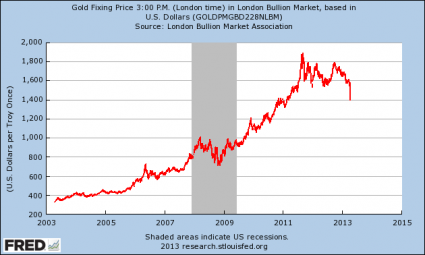

And that chart does not even show the full extent of the collapse.  As I write this, the price of gold is sitting at $1355.20.

But this is just the beginning for gold and silver.  As I have warned repeatedly, the price of gold and the price of silver will experience wild swings in the years ahead.

For example, the following is what I wrote about gold and silver on August 7th, 2012...
I like precious metals myself, but if you are going to invest you need to get educated so that you know what you are doing.  If you go in blindly you are likely to get burned at some point. 
In addition, you need to be prepared for wild fluctuations in price over the coming years.  There will be times when gold and silver absolutely soar and there will be times when they drop like a rock. 
So if you are going to play the game you need to be able to handle the ride.
Monday was an example of what I meant when I said that "you need to be able to handle the ride".  There are going to be a lot more days like Monday (both up and down) for gold and silver in the years ahead.

The foolish people are those that are scared out of their wits and that are selling off all of their gold and silver right now.

Sadly, there was reportedly a tremendous amount of panic selling of gold and silver during this collapse.  The following is what Dennis Gartman told CNBC on Monday...
"There are a lot of people throwing up their hands. Throwing positions overboard. Panic is everywhere," Gartman said in a "Squawk Box" interview on Monday. "I've never seen anything like this. I mean it."
It just shows that there are a lot of stupid people out there.  The following is an excerpt from another CNBC report about the panic selling that was happening on Monday...
"I think the last $20 has been margin selling. The market is falling like a knife. People are saying, 'Get me out now,' " Phoenix Futures President Kevin Grady said. "You're also seeing people selling energy profits to pay for metals losses. You're seeing a tremendous amount of gold liquidation today."
According to Dr. Paul Craig Roberts, Assistant Secretary of the Treasury under President Ronald Reagan, all of this panic selling is the result of an orchestrated takedown of gold and silver...
This is an orchestration (the smash in gold). It’s been going on now from the beginning of April. Brokerage houses told their individual clients the word was out that hedge funds and institutional investors were going to be dumping gold and that they should get out in advance. 
Then, a couple of days ago, Goldman Sachs announced there would be further departures from gold. So what they are trying to do is scare the individual investor out of bullion. Clearly there is something desperate going on...
So who is behind all of this orchestration?  Well, according to Dr. Paul Craig Roberts, it is actually the Federal Reserve...
The Federal Reserve began its April Fool’s assault on gold by sending the word to brokerage houses, which quickly went out to clients, that hedge funds and other large investors were going to unload their gold positions and that clients should get out of the precious metal market prior to these sales. As this inside information was the government’s own strategy, individuals cannot be prosecuted for acting on it. By this operation, the Federal Reserve, a totally corrupt entity, was able to combine individual flight with institutional flight. Bullion prices took a big hit, and bullishness departed from the gold and silver markets. The flow of dollars into bullion, which threatened to become a torrent, was stopped.
In fact, Dr. Roberts says that former Goldman Sachs trader Andrew Maguire is reporting that the Fed orchestrated the dumping of 500 tons of naked gold shorts into the market on Friday...
According to Andrew Maguire, on Friday, April 12, the Fed’s agents hit the market with 500 tons of naked shorts. Normally, a short is when an investor thinks the price of a stock or commodity is going to fall. He wants to sell the item in advance of the fall, pocket the money, and then buy the item back after it falls in price, thus making money on the short sale. If he doesn’t have the item, he borrows it from someone who does, putting up cash collateral equal to the current market price. Then he sells the item, waits for it to fall in price, buys it back at the lower price and returns it to the owner who returns his collateral. If enough shorts are sold, the result can be to drive down the market price.
As Dr. Roberts noted, this represents an absolutely massive amount of gold...
Consider the 500 tons of paper gold sold on Friday. Begin with the question, how many ounces is 500 tons? There are 2,000 pounds to one ton. 500 tons equal 1,000,000 pounds. There are 16 ounces to one pound, which comes to 16 million ounces of short sales on Friday. 
Who has 16 million ounces of gold? At the beginning gold price that day of about $1,550, that comes to $24,800,000,000. Who has that kind of money?
If any of the allegations above are even remotely true, then a whole lot of people need to be criminally investigated.

Meanwhile, many are considering this takedown of gold to be an ominous sign that another major financial crisis may be heading our way.

Just remember what happened back in 2008.  As Zero Hedge noted on Monday, the price of gold suddenly plunged 21 percent in July 2008.  That was just a couple of months before the U.S. stock market crashed in the fall...
The rapidity of gold's drop is impressive, concerning, and disorderly. We have seen two other such instances of disorderly 'hurried' selling in the last five years. In July 2008, gold quickly dropped 21% - seemingly pre-empting the Lehman debacle and the collapse of the western banking system.
Is this collapse in the price of gold a harbinger of another major stock market crash?
Time will tell.

Meanwhile, many average Americans are wondering if they should dump their gold and silver while they still can.

As I mentioned above, gold and silver are going to experience wild fluctuations over the next few years.  When the next stock market crash comes, gold and silver are probably going to go even lower than they are today for a short time.  But in the long run gold and silver are going to soar to unprecedented heights.

Investing in gold and silver is not for the faint of heart.  If you cannot handle the ride, you should sit on the sidelines.  We are entering a period of tremendous financial instability, and holding gold and silver is going to be like riding a roller coaster.  The ups and downs are going to shake a lot of people up, but the rewards are going to be great for those that stick with it the entire time.

Source


April 15, 2013

Today's Low Gold & Silver Prices Are Not Realistic

During this very tumultuous week for precious metals prices, Chris sat down with Mike Maloney, founder and owner of GoldSilver.com, one of the world's largest bullion dealers.

Mike is a true scholar of monetary history. His reasons for getting into the bullion business have their roots in a very predictable cycle that has happened time and again over the centuries (more accurately millennia):
  1. A new monetary system is introduced, based on sound money (most commonly, using gold and/or silver)
  2. Currency (e.g., paper bills backed by sound money) is introduced to faciliate trade and commerce
  3. Governments begin to tinker with ways to 'print' more currency than can be fully backed (e.g., coin clipping, partially-backed notes, FRNs)
  4. A false prosperity ensues. Those closest to the new money creation benefit most and debase the currency further to forward their advantage.
  5. Reality begins to catch up with this deficit spending and the purchasing power of the currency weakens dramatically.
  6. The monetary system collapses under too many claims on a limited pool of sound money.
  7. Eventually, a new monetary system backed by sound money rises from the ashes (see Step 1, above).
Mike believes that we are currently experiencing Step 6 and that we will witness the birth of a new monetary regime within the next ten years.

What makes this moment in history unique is that all past monetary regime collapses have happened regionally. This is the first time in human history in which all the world's major currencies are collapsing together. Which is why he is so passionate about owning gold and silver.

In his opinion, we will soon witness the greatest transfer of wealth ever seen, as countries worldwide realize they need to revert to monetary systems backed by sound money (i.e., the precious metals). Those acquiring gold and silver beforehand will not only preserve their wealth as existing fiat currencies are extinguished, but will see staggering increases in their purchasing power. Those interested in learning more of Mike's specific vision can watch Episode One of his new Hidden Secrets of Money video series. (Chris and I received advance screenings of the next few episodes, which are excellent in terms of explaining the processes and shortcomings of our current monetary system.)

On the Tightening Physical Market for Gold & Silver

What most people do not understand is that the price of gold and silver are not determined by how much gold and silver is being sold. It is how many gold and silver IOUs are being sold. And you can write as many IOUs, futures contracts and options, as you want. Those are unlimited. The supply, though, of physical gold and silver is quite limited, and so when people actually start asking for it and they want the physical, then there is a divergence of the paper price versus the physical price, and we are seeing that right now.

We are in a back-order situation with all of the suppliers. Spreads are going up. Silver eagles cost about fifty cents over spot more than they normally cost because all of the suppliers have had to raise their price to try and find the supply/demand equilibrium that the markets are for. The markets are there to try and find a supply/demand equilibrium, so then price is the arbitrator. Price rises; that draws more supply and reduces demand. Price falls; that reduces supply and increases demand.

So the price discovery mechanism of the markets is what is supposed to ensure that things are in equilibrium. We have this broken system where there are a few big players that manipulate the market, and it always shows up when shortages start developing in the physical market. You know that the price of gold and silver right now are too low to be realistic. And the good thing about that is that it cannot last.

On the Hidden Wealth Transfer Caused by Inflation Targeting

Everybody got in an uproar over [the Cyprus bank deposit haircuts], but nobody gets in an uproar over the central banks targeting 3% inflation. That compounds out to 34% of your wealth that they are confiscating every decade. People got mad because it happened all at once and they could see it. One day their bank account said one thing; the next day it said another thing. With this insidious confiscation known as inflation, this is the inflation tax – you do not see it because the number on your bank account might say that you could make a deposit and if there are no fees or anything on that deposit, $100,000 deposit a decade ago still stays $100,000. Except gasoline went from $1.25 to near $5.  Measured in gasoline, you lost 75% of that $100,000, but it still says $100,000.

So the central banks targeting this 3% inflation rate is a wealth transfer from the public to the financial sector.

On the Recent Price Weakness in the Precious Metals

You do not want to stay in just one investment class your whole lifetime. But it is a very powerful tool to be able to measure these classes against each other and then jump from an over-valued asset class to an under-valued asset class at the appropriate time for the road to true wealth. And it only requires a few big decisions during your lifetime.

Now, when I discovered wealth cycles, I was looking at the Dow Gold ratio and thinking this thing has a cycle. I made another check of the Gold Dow ratio instead the Dow Gold ratio, and put them on top of each other. Lo and behold – there is a cycle. It has a positive side and a negative side. If you are doing a Dow Gold ratio, you jump from being invested in paper assets like stocks and then back to gold for the long investment waves. I would say it is somewhere between 8 and 20 years you spend in an asset class, and you can do this with anything. If you measure your house in how many barrels of oil it is worth over a century and you jump back and forth from being invested in oil wells to being invested in real estate, it is the same thing as being invested in gold or the Dow. It is a very powerful tool that I believe has a high degree of predictability and safety to it, if you do not let the short-term noise flush you out.

Right now we are in consolidation. Gold has been chopping sideways for 19 months now, and it has worn people out. But basically gold is up. It is not up from 19 months ago when it was nearing $2,000, but it sure is up over the last decade. So I do not let the short-term noise affect me now that I know that we have not reached the point where the price of gold equals the points on the Dow. Right now gold’s value is one-ninth of the Dow, and so I know that it needs to rise by a factor of 18 against stocks before I need to get worried and start watching gold.

So I am very comfortable in these pullbacks. It gets a little aggravating, but still it does not bother me that much and is definitely not going to flush me out.
 Source

April 12, 2013

Of Bubbles and Bitcoins

The newest invention in monetary affairs are the so-called Bitcoins. Their creators and promoters explain them as follows: 'Bitcoins are digital money. They are transferred person to person through Internet without going a bank or a clearinghouse, so they are independent of the current monetary system. Several currency exchanges exists where you can trade your Bitcoins for dollars or euros, and some small business and freelancers are starting to accept them in payment.'

The Bitcoin is a game. We live in a highly confused and perplexed world regarding what real money has to be. Let's get this straight: Real money has to be the commodity that is generally accepted by society as payment in full for goods or services received.

Throughout history, the commodity most generally accepted in payment has been gold. Silver has taken the second place after gold. Gold and silver were chosen by humanity thousands of years ago, as the commodities with which to make payments.

In the exchange of any given merchandise for gold (or silver), neither of the parties to the interchange ends up owing the other party. There has been "settlement."

The Bitcoin may serve as a medium of exchange, as do the world's currencies, but neither the Bitcoin nor any of the currencies of the world can achieve settlement, because the Bitcoin is not a commodity, and neither are the dollar, the euro, the yen, the yuan, etc.

Since there can be no settlement with Bitcoins, at some point many people are going to be more or less seriously burnt when this Bitcoin game goes out of fashion, depending on how much they are holding when the game ends.

So you won playing that great game, "Monopoly"? It's a great satisfaction to win playing "Monopoly" – you have all those bills, and your game partners are busted! In truth, all the high and mighty fellows running the world's Central Banks are keeping us amused and busy as we attempt to gather as much as we can of the "Monopoly" money they print up for us. But when you have a lot of their "Monopoly" money, or of Bitcoins, what do you really have when the game ends? You have papers or worthless digits, period.

The only thing that the holder of Bitcoins can do – like any holder of currencies – is to get rid of them by buying things, while there is someone willing to receive them in "payment." I use quotes around the word "payment," because since August 1971 there is in this world no real payment at all. Real payment involves settlement, and neither Bitcoins nor currencies can achieve settlement. The proof lies in the $11 Trillion of International Reserves that have built up around the world, because there has been no settlement of international trade imbalances since August 1971. If the Bitcoin mania continues to grow, expect digital quantities of Bitcoins to show up in Chinese Central Bank reserves. Then the creators of the Bitcoins will have to proceed to issuing Bitbonds, so that the Chinese can trade there Bitcoins for Bitbonds which pay interest. It's all a huge game, dollars, euros, pounds, yen, yuan and now Bitcoins – all the same garbage.

Bitcoins cannot be accumulated safely as savings, because they are not a commodity, nor redeemable into any commodity. We are seeing how unsuspecting depositors of sums of currency in banks are in danger of seeing their deposits cancelled by government decree. Tangible commodities such as gold and silver cannot evaporate because they are not created artificially.

The world of artificial currencies – which now includes the famous Bitcoin – will end in disaster. A truly maddened world knows not where to turn for safety. The vicious drug of artificial money has got the world on a "high." More drug will kill our civilization, but less drug will send it into a violent withdrawal. Humanity seems to be trapped in a death-cult.

The popularity of the Bitcoin is based on the existing mentality, which considers that something designed "scientifically" must have some value.

The Bitcoin is an example of the tremendous hold that the idea of the omnipotence of technology to solve human problems has upon humanity. However, technology cannot create matter; it cannot create commodity-money, as it cannot create petroleum. Technology may give various forms to matter, but it cannot create matter or substance, and money must be the substance that is most accepted in commerce. All the Ph.D.s and Nobels in Economics are playing games to keep the world entertained. The less their pronouncements make sense, the wiser they think we will consider them.

You tell me: What is the future that awaits a humanity so confused that it can no longer distinguish between an abstract concept and what is real and material? Very confused people are participating in speculations in imitation currencies – dollars, pounds, euros, yen, yuans, Bitcoins − in the hopes of obtaining some profit or benefit, because unable to think for themselves, they can do nothing but speculate − and ruin themselves.

What worries me is not how the speculators will fare; what worries me is: how are the masses going to behave toward me and my family when the fraudulent currencies of the world, Bitcoins included, have turned those masses into hungry beggars?

Source

April 11, 2013

Fed Argues that Mortgage Abuses are Trade Secrets, Meaning Institutionalized Fraud

When the media discusses how banks have ridden like a steamroller over borrowers and investors, the typical response is a combination of minimization and distancing: that the offense wasn’t such a big deal and that it was a mistake. Recall the PR barrage in the wake of the robosigning scandal: its was “sloppiness,” “paperwork errors”. Servicers kept claiming, despite overwhelming evidence of bad faith and the institutionalization of impermissible practices, that there was really nothing wrong with how they were operating. Remember it was important for them to take that position, because if they were to admit that the bank knew it was engaging in widespread abuses with management knowledge and approval, it would be admitting to fraud.

Two major government settlements later, this position is looking awfully strained. And the Fed, in stonewalling Elizabeth Warren’s and Elijah Cumming’s efforts to get more information about the Independent Foreclosure Reviews, presented the bad practices as servicer policies, which means that they were deliberate, hence, fraudulent.

By way of background: Warren and Cummings have been asking the OCC and Fed for some time for more information about what happened in the foreclosure reviews. Out of fourteen information requests they made in a January letter, they got only one question answered in full, and mere partial responses to three other questions. They requested, and got, a meeting yesterday. They issued a letter Wednesday that described what transpired. Key sections:
Two years ago this week, your offices issued a public report announcing that you determined that 14 mortgage servicing companies were engaging in “violations of applicable federal and state law.” You found that these abuses have “widespread consequences for the national housing market and borrowers.” You also explicitly referenced instances of abuse, including illegal foreclosures against our nation’s men and women in uniform who are protected by the Servicemembers Civil Relief Act (SCRA)…. 
We have requested information about the process used to conduct this review and the extent to which violations of law were found…. 
At the meeting yesterday, Federal Reserve staff argued that the documents relating to widespread legal violations are the “trade secrets” of mortgage servicing companies. In addition, staff from the Office of the Comptroller of the Currency (OCC) argued that these documents should be withheld from Members of Congress because producing them could be interpreted as a waiver of their authority to prevent disclosure to the public of confidential supervisory bank examination information.
Now since the Fed is apparently making this absurd argument in all seriousness, let’s look at the implications. A trade secret is a form of intellectual property. I encourage IP experts to pipe up in comments, but my understanding, based on the experience of a client who successfully sued a former employee for violating trade secrets, is that it is difficult to prove that your internal know-how rises to the level of being a trade secret. One of the key elements in making the case is that you have to show you went to some length to keep your special tricks secret, such as limiting access to them, having employees sign confidentiality agreements, etc.

Why does this matter? You can’t have internal knowledge rise to the level of being a trade secret unless their was an institutional decision to keep it secret. That means the Fed is effectively saying that servicer management, and almost certainly bank management (since servicing units don’t have their own corporate counsel) was fully aware of the nature of the practices at issue and chose to keep them secret, supposedly for competitive reasons. This is fact is one of the things lawyers have been eager to establish, namely that bank management knew full well all these servicing tricks were happening, and sought to protect them as important sources of profit. Way to go, Fed!

Now, of course, this argument is revealing in a lot of other ways. The Fed has also just admitted it thinks it is more important to protect bank knowledge of how to break the law than expose the information. So the Fed has also made explicit that it wants to preserve banks’ ability to rip off people. So the Fed’s official policy is bank profits trump the law. Not that we didn’t know that, but it has now been stated in a baldfaced manner.

The OCC’s position, that they need to preserve confidential bank examination information, is equally ridiculous (the letter gives a long-form debunking). Warren and Cummings noted,
You may protect against such a waiver by including standard language in a cover letter explaining that providing documents to Members of Congress, even if normally not disclosed to the public because of their proprietary or confidential nature, does not constitute a waiver.
But it’s doubtful that the information at hand is “bank examination information”. The reason for keeping bank examination results confidential is to prevent bank runs. Mortgage servicing units are not banks. In fact, the OCC said repeatedly when it was pilloried for its failure to supervise servciers that didn’t have much in the way of formal authority over them. It wasn’t acting as a bank examiner of servicing units for the period that was the focus of the IFR, 2009 and 2010. Given the poor control over information during the IFR (for instance, at Bank of America, the army of temps who performed the project didn’t sign enforceable confidentiality agreements), and the fact that lots of relevant information (investor reports, court documents, including the affidavits used for the fraudulent fees) are public records, the OCC argument isn’t credible. It becomes even more of a howler when you look at the questions that the OCC and Fed are refusing to answer. Tell me how bank operations might be harmed by answering this question, for instance:

Screen shot 2013-04-11 at 3.26.09 AM

And why are the Fed and the OCC fighting Warren and Cummings so hard? It’s not as if the information they seek would help an individual borrower in litigation against a bank, except in a very general way. For instance, Warren and Cummings ask for the number of borrower files in which unsafe or unsound practices were found. If it was revealed that Bank of America had a high proportion of files with errors, as our whistleblowers found, that might persuade a judge that a borrower case not be thrown out in summary judgment.

But the real exposure of the banks is to investor litigation. The Bank of America sources who did fee reviews found virtually all their files had errors (their reflex was to say all files had errors, but most would then correct themselves and say 90% or 95% since they could not be sure someone didn’t get a batch of files that were fine). In many cases, the errors weren’t large enough to have caused a borrower to lose his house. But remember, if a home is foreclosed on, all fees (late fees, attorney fees, property inspection charges) are reimbursed first, so excessive frequency or size of foreclosure-related fees is a transfer from investors to servicers. So if the OCC and Fed were to confirm that there were large-scale abuses, investors might saddle up to go after the servicers.

This exchange also confirms something the public knows all too well: the regulators are in the business of protecting the banks, and only secondarily in enforcing the law. And until that changes, it is the safety and soundness of the population that is at risk.

Source

April 10, 2013

The Banks' "Penalty" To Put Robosigning Behind Them: $300 Per Person

Back in late 2010, there was much hope that as a result of the unfolding robosigning "Linda Green" scandal, not only would banks would be forced to fix their ways by incurring crippling civil penalties (because not even the most optimistic hoped any bankers would ever face criminal charges for anything), but that the US housing market may even reprice to a fair price as for a brief moment there nobody had any idea who owned what mortgage. Ironically, what did end up happening was to provide banks with a legal impetus to slow down the foreclosure process to such a crawl that an artificial backlog of millions and millions of houses at the start of the foreclosure process  formed, bottlenecking the foreclosure exits even more (as described in Foreclosure Stuffing) and in the process providing an artificial, legal subsidy to housing prices manifesting itself best in what is erroneously titled a "housing recovery" for many months now.

What this did was to allow banks to aggressively reprice the mortgage-linked "assets" on their balance sheets much higher, and in the process unleash much capital, primarily for bonus and shareholder dividend purposes. Yet this epic self-benefiting act did not come without a cost. Yes, it turns out the banks will have to fork over some out-of-pocket change to put not only the robosigning scandal behind them but the indirect housing subsidy from which they have benefited to the tune of hundreds of billions. That quite literally change, which is what the final cost of the release and bank indemnity amounts to, is roughly $300 for each of the affected borrowers!


American Banker explains:
Mortgage servicers tied to the independent foreclosure review settlement will begin sending the first wave of $1.2 billion in checks to troubled borrowers on Friday, federal regulators said.

More than 4 million borrowers will be compensated as part of the amended settlements between the 13 mortgage servicers and the Office of the Comptroller of the Currency and the Federal Reserve Board. The regulators said Tuesday that payments will be sent out in waves with the first 1.4 million checks totaling $1.2 billion sent out this week. By the end of the month, about 90% of the cash payments will be sent with the final wave ending in mid-July.

Regulators also released further details in how it broke down payments for each borrower and how many people fit into each category — a question that has come up repeatedly since the agencies announced the settlement earlier this year. It has identified more than 3.9 million borrowers that will receive payments from $300 up to $125,000 depending on their status of foreclosure or modification. Based on the chart released by regulators Tuesday, more than 60% of the affected borrowers, or 2.4 million, will receive the lowest amount of $300. Only 1,135 borrowers are receiving the maximum amount.
Where specifically does the $300 number come from?
Regulators reached the mortgage settlement in January after calling off a prolonged and costly independent foreclosure review. The settlements call for a total of $3.6 billion in cash payments to borrowers who faced foreclosure in 2009 or 2010 and were serviced by one of the 13 companies. Those companies are: Aurora, Bank of America, Citibank, Goldman Sachs, HSBC, JPMorgan Chase, MetLife Bank, Morgan Stanley, PNC, Sovereign, SunTrust, U.S. Bank and Wells Fargo. Only Goldman Sachs and Morgan Stanley did not provide payment information but it's expected to be announced "in the near future," the regulators said.
Obviously one can't have "independent reviews" in the US - especially prolonged and costly ones:  why, there is so much less opportunity to game the outcome for the benefits of those who control the same regulators who as the SEC revolving door has shown, are entirely controlled and in the pocket of Wall Street. Which is why a quick and dirty settlement was best, if only for the banks. And there is your "Linda Green" release.

So congratulations America: you allowed yourself to be pushed over for the measly sum of $300 per person. Even 2000 years ago a comparable act of betrayal cost some 30 pieces of silver. But at least this time a few Obamaphones were the defining variable that tipped the scales of "justice" into their final resting place.

Source

April 9, 2013

The MF fraud: As bad as you thought

Why is Jon Corzine still at large?

Corzine, the former New Jersey senator and governor, former chief executive of Goldman Sachs, led MF Global, a futures broker and bond dealer that collapsed in 2011. MF Global investors lost as much as $2.1 billion. At the time MF ran into trouble, Corzine was eligible for as much as a $12.1 millon golden parachute. However, Steven Goldberg, a spokesman for Corzine, told me this afternoon that Corzine didn’t take any compensation when he stepped down. He also said Corzine has been unemployed since then, spending time with his family and doing philanthropic work.

Vanity Fair produced an exhaustive look at the collapse last year. Now a report to the bankruptcy trustee by Former FBI director Louis Freeh confirms what anyone paying attention already knew. According to Reuters, Freeh’s 124-page report states, “The risky business strategy engineered and executed by Corzine and other officers and their failure to improve the company’s inadequate systems and procedures so that the company could accommodate that business strategy contributed to the company’s collapse.” As is the habit of the likes of Corzine, he was not using the investments of MF Global to fund productive enterprises and create jobs and innovations, but betting to profit from the misery of others, on European sovereign debt.

The story continues:
Freeh’s report found MF Global management ignored the hedging recommendations of its chief risk officer, Michael Stockman, and lacked the controls to monitor its cash on a real-time basis. 
The weak reporting system also prevented the company from knowing that cash from segregated customer accounts was being used to meet margin calls tied to MF Global’s own bets on the sovereign debt of countries such as Portugal and Ireland. 
“These glaring deficiencies were long known to Corzine and management, yet they failed to implement sufficient corrective measures promptly,” the report said.
Goldberg, Corzine’s spokesman, gave me this prepared statement (from him, not Corzine). In the interests of fairness, I will quote it in its entirety:
The Trustee’s report, with its allegations of negligent conduct, is a clear case of Monday Morning Quarterbacking.  It intentionally ignores the failure of counterparties to fulfill their commercially contracted obligations to MF Global and the profound impact this failure had on MF Global’s customers and other stakeholders. 
As we have said before, there simply is no basis for the suggestion that Mr. Corzine breached his fiduciary duties or was negligent.  When Mr. Corzine joined MF Global, the firm had lost money in each of the previous three years and in five consecutive quarters.  During his entire tenure as CEO, Mr. Corzine worked tirelessly and in good faith to turn the business around.  He and the rest of the Board engaged in a rigorous and careful evaluation of the appropriate strategy for the firm.  After extensive discussions with the Board, the senior management team and a highly respected management consulting firm, Mr. Corzine set a new, publicly disclosed strategy to replace the existing unsustainable model. The strategic plan, which was approved by the Board, also included review of internal processes and controls by respected consultants and outside auditors.  As a result of the new strategy, there was a marked improvement of MF Global’s financial performance. 
While Mr. Corzine is disappointed by the Trustee’s report, he is encouraged by the recent settlements with banks and creditors whose conduct contributed to the failure of the firm and delayed the ability of customers to be repaid.  Mr. Corzine respects the efforts of both Trustees in this regard and is pleased that the settlements and the proposed plan of reorganization make it probable that customers will receive full recovery of their funds.
It’s no mystery why Jon Corzine is still at large, and not merely because he was a high-profile Democrat at a time when the Democrats control the Department of “Justice.” Like all the grifters whose hustles brought on the Panic of 2008 and help make the recovery so anemic, he’s not blue or red — he’s green. And in Washington, D.C., and our criminal justice system, money talks. The same corrupt system continues.

As I’ve written before, if this were still the Cold War, one could be forgiven for suspecting that Corzine, Blankfein, Killinger et al were KGB plants, like the characters in the FX series, The Americans. Hiding in plain sight, wrecking not just the economy but faith in capitalism.

Source

April 8, 2013

GAO Report on Foreclosure Reviews Misses How Regulators Conspired with Banks Against Homeowners

I suppose one has to be grateful for any official pushback against failed regulatory initiatives, such as the just-released GAO report criticizing the Independent Foreclosure Reviews. Of course, in this instance, I am charitably assuming that these reviews were a failure. They have certainly proven to be an embarrassment to the lead actor, the OCC, which has tried to maintain as low a profile as possible on this topic rather than offer any defenses.

But “failure” assumes that the OCC and the Fed did not achieve their real objective, which was to protect the banks. That hardly appears to be the case. The short story of the reviews is that to dampen down criticism of the many foreclosure horrors revealed in the media and in courtrooms all over the country, borrowers who were foreclosed on or had foreclosure actions underway in 2009 and 2010 were promised an independent review and compensation if they were found to have suffered financial harm. And even though the abrupt termination of the reviews has left the regulators with a lot of egg on their face, the result is that the banks paid a lot less than if the reviews had lived up to their billing.

Maxine Waters, to her credit, tried to put a little heat under the OCC and Fed by requesting that the GAO look into the matter. But as Dave Dayen stressed in his commentary on the GAO report, the overseer was blinkered in its approach:
Furthermore, its narrow scope – GAO only looked at the regulators’ design and ovesight of the foreclosure reviews, rather than what the independent reviewers did, and in fact they used the bank consultant reviewers as primary sources – tends to give a very circumscribed picture of the reviews. You could even say that this report will help get the bank consultants off the hook by putting the blame on OCC and the Fed.
The biggest problem, though, is the GAO was tasked only to do a very high level review of process, which meant it looked for how procedural weaknesses led to bad outcomes. It did not question the intent of the review, nor did it examine at how the reviews operated in practice, as opposed to theory (remember, the OCC relied on interviews of the consultants and questionnaires to them; there was no checking of the consultants’ processes or guides with independent experts, and the odds are very high that the only personnel that the GAO met from the consultants were individuals who would be attuned to and protective of their firms’ interest).

Some of the gaps in the report are simply stunning. For instance, the GAO points out at several junctures the intent of the exercise:
According to regulators, the goals of the foreclosure review were for consultants to identify as many harmed borrowers as possible, to treat similarly situated borrowers across all 14 servicers similarly, and to help restore public confidence in the mortgage market.
The GAO never considered that these goals are in conflict. If the reviews had indeed exposed the full extent of the rot in servicing, it would have undermined, not increased confidence in the mortgage market. It is obvious that the OCC either believed the bank PR that borrowers were deadbeats and complaints, for the most part, were simply the creation of clever foreclosure defense lawyers, or they had an inkling that there were serious failings, and so Potemkin reviews were necessary to shield the banks from liability. If they could claim to have made a meaningful investigation and found little amiss, that would undermine borrowers’ efforts to get a hearing in courts and to press for tougher curbs on servicers

Another conflict the GAO never considered was conflicts of interest; in fact, the word “conflict” does not appear once in the entire document. Yet as numerous independent parties pointed out from the very outset, the structure of having miscreant banks select and pay directly for “independent” reviews turned them into “bought” reviews. Sheila Bair described what happened when she was pressed for management changes at Citigroup in the wake of a bailout in the form of guarantees on $306 billion of toxic assets. A consultant was brought in to shield CEO Vikram Pandit:
When the “independent consultant” report came back in the fall, it compared Pandit to small European bank CEOs and gave him glowing marks. As for its review of the rest of Citi’s management, it gave high grades to Pandit loyalists while criticizing those who were not viewed as part of the Pandit team…
That was my first and last experience in asking bank consultants to assist regulators in reviewing bank operations. They are hopelessly conflicted, given their desire to secure future consulting work at those big banks. The consultants clearly considered their primary client to be Vikram Pandit. Indeed, they reported to him regularly on their review and sought his input until we found out about it and objected…..But Citi’s primary regulators, the OCC and NY Fed, didn’t seem to mind one bit.
While the GAO took its signals from the OCC and Fed and didn’t question the true interests of the consultants, Waters is not taking the matter lying down and is introducing legislation this week to curb this form of putting the foxes in charge of the henhouse.

A third major gap in the report is its failure to look at the borrower-requested reviews in any meaningful way. The report focuses mainly on failings that made the reviews overly labor-intensive and inconsistent. For instance, it criticizes the regulators for failing to talk to community groups, housing counselors, or other stakeholders. It also spends a great deal of time on problems with the sampling methodology for the loans that were to be examined in addition to the ones where a review was requested. It also discusses how the reviewers reinvented the wheel in terms of the state law elements of the reviews, where different servicers came up with different approaches and answers. For instance, at least one didn’t look at state law rules on fees at all but merely relied on “investor guidelines” meaning Fannie/Freddie/FHA/VA requirements. But the OCC consent orders specifically required that the consultants examine compliance with state law. It’s astonishing that the GAO blandly reports this “investor only” review as an inconsistency, rather than a blatant failure to adhere to the consent order requirements.

The GAO similarly mentions that the reviewers expected from 0 errors on certain types of loans and the highest level of errors anticipated was 10%. Huh? These are astonishingly low assumptions. The GAO does discuss how overly low assumptions can affect sampling. But it failed to consider how these assumptions served as “anchoring,” a well known cognitive bias. An assumption of low error rates would lead the consultants, even if they really had been independent, to have trouble with results that depart significantly from your assumptions. If you expect a 0 error rate and you find 15% of the sample to have problems, you’ll assume the problem is your sample or your error definition.

But what I found most striking was the way the GAO managed not to talk at all about how the borrower reviews were conducted. Yes, they did talk about the problems with borrower outreach, and also discussed in some detail how the regulators haven’t said much about how borrowers who asked for a review will be compensated, and they don’t look to have come up with a way to assure that similarly-situated borrowers at different servicers will be treated the same. But there was absolutely no consideration of the issues exposed by our whistleblowers: that the consultants and the servicers were working hard to suppress any findings of harm, when the evidence of harm was widespread.

And this gets back to a basic question: why was the sampling being done at all? Remember, in the engagement letters, the effort devoted to the sampling was roughly the same as that expended on the borrower letters. Why did that make any sense? If you had adequate borrower outreach and education as to what types of harm would be eligible for compensation, why would you need the sampling, or at least sampling of that scale? Absent any explanation, it’s hard not to imagine the sampling was intended to come up with low error rates (as in confirm the low expected error rates) which would then be used to justify low findings of harm in the borrower letters.

But we are past that point, so the GAO pulls the veil and focuses on the mess that is left in the wake of the abruptly-shuttered reviews, which is also pretty ugly. Consider this section of that discussion:
In most cases, servicers, with regulators’ approval, have engaged the third-party consultants to review borrowers’ files in two categories (SCRA and foreclosed borrowers who were not in default) to determine whether borrowers experienced those specific types of harm. According to one third-party consultant, at the time of the agreements that led to the amended consent orders, consultants were waiting on additional guidance from regulators to complete aspects of these reviews.
Now you probably missed the “gotcha” in that section” “borrowers who were not in default”. Shouldn’t that include borrowers who had gotten modifications and were complying with the terms of the mod, yet were foreclosed upon? There are tons of cases like that, where payments were misapplied or where the bank simply started refusing to accept payment even though a mod had been executed. There are also instances of banks refusing payments from borrowers who were current and proceeding to foreclosure (I’ve just heard of a new case like that and I may be writing it up). Yet at Bank of America, Promontory deemed borrower who were having their checks returned by the bank not to be making payments! So with this sort of Catch 22 going on (presumably “if you were foreclosed on, you must have been in default”) you can rest assured that “borrowers who were not in default and were foreclosed upon” will be as scarce as unicorns.
The OCC’s excuse is that this new approach will be less inconsistent than the one that had been in place:
As discussed earlier, regulators had limited and unsystematic centralized control mechanisms to monitor consistency among the foreclosure review processes and did not have the information to assess the implications of any differences. According to regulators, achieving consistent results for borrowers, so that similarly situated borrowers receive similar payment amounts, is a goal of the amended consent orders, as it was of the foreclosure review process. OCC staff stated that the direct payments provided under the amended consent orders will likely be more consistent than what would have occurred under the foreclosure review because servicers are using a standard framework and objective criteria to categorize borrowers and all borrowers in a particular category will receive the same payment amount.
But even then, the GAO isn’t convinced:
Without using mechanisms to centrally monitor the consistency of servicers’ activities to categorize borrowers, regulators may risk delays in providing direct payments to borrowers and inconsistent results.
So even where the GAO does look, what it finds is pretty ugly, but you have to read through bureaucrat-speak to discern the implications. I hope Sherrod Brown is in the mood in his hearings later this week to put the consultants and regulators on the spot. It will take some determined probing. The obfuscation is almost always thicker when there is more to hide.

Source

April 5, 2013

Obama Pumps a New Housing Bubble

Obama administration pushes banks to make home loans to people with weaker credit ... The Obama administration is engaged in a broad push to make more home loans available to people with weaker credit, an effort that officials say will help power the economic recovery but that skeptics say could open the door to the risky lending that caused the housing crash in the first place. President Obama's economic advisers and outside experts say the nation's much-celebrated housing rebound is leaving too many people behind, including young people looking to buy their first homes and individuals with credit records weakened by the recession. − Washington Post

Dominant Social Theme: No homeowner left behind.

Free-Market Analysis: It's happening again ... In the late 1990s, credit was screwed down in the US, creating in the tech bubble and bust. In the early 2000s, the Fed kept rates so low that some homebuyers actually received offers of remuneration were they to take advantage of credit offers.
There was a lot of talk early on during the financial crisis about the Fed's too-low rates. But all that died away with Ben Bernanke's various quantitative easing programs.

It was a kind of "shock and awe." What Bernanke had decided to do was so outrageous that it made low rates pale by comparison. When there are reports of Bernanke writing checks for up to US$16 trillion, it is hard to summon a great deal of interest in discussions over too-low rates.

And no doubt, this is what the Obama administration is counting on – though why they would seek to repeat the mistakes of the earlier 2000s when they are still fresh in the minds of many is a puzzle. But it seems the administration is going too push ahead.

... Administration officials say they are working to get banks to lend to a wider range of borrowers by taking advantage of taxpayer-backed programs − including those offered by the Federal Housing Administration − that insure home loans against default.

Housing officials are urging the Justice Department to provide assurances to banks, which have become increasingly cautious, that they will not face legal or financial recriminations if they make loans to riskier borrowers who meet government standards but later default.

Officials are also encouraging lenders to use more subjective judgment in determining whether to offer a loan and are seeking to make it easier for people who owe more than their properties are worth to refinance at today's low interest rates, among other steps.

Obama pledged in his State of the Union address to do more to make sure more Americans can enjoy the benefits of the housing recovery, but critics say encouraging banks to lend as broadly as the administration hopes will sow the seeds of another housing disaster and endanger taxpayer dollars.

"If that were to come to pass, that would open the floodgates to highly excessive risk and would send us right back on the same path we were just trying to recover from," said Ed Pinto, a resident fellow at the American Enterprise Institute and former top executive at mortgage giant Fannie Mae.

Administration officials say they are looking only to allay unnecessary hesi-ta-tion among banks and encourage safe lending to borrowers who have the financial wherewithal to pay.

When reading the last paragraph of the above the term "famous last words" comes to mind. Everything about the US economy at this point is not just distorted but distorted cyclically.

Distortions are countered with more distortions until the inevitable collapse takes place.

The solution to prosperity is getting government planners out of the way. The market itself and the Invisible Hand need a few years to reacquaint themselves with the economy which thanks to endless central bank stimulation has never unwound.

We don't think the economy is "recovering" anyway, so the chances of the new program doing a great deal of damage is slim. What is more bothersome is its arrogance and determination to repeat past mistakes even when they are widely acknowledged. In a sense one gets the feeling the administration simply doesn't care.

Conclusion: Perhaps that's even more frightening than the policies now being recycled.

Source

April 4, 2013

David Stockman: The Keynesian Endgame

Even the tepid post-2008 recovery has not been what it was cracked up to be, especially with respect to the Wall Street presumption that the American consumer would once again function as the engine of GDP growth. It goes without saying, in fact, that the precarious plight of the Main Street consumer has been obfuscated by the manner in which the state’s unprecedented fiscal and monetary medications have distorted the incoming data and economic narrative.

These distortions implicate all rungs of the economic ladder, but are especially egregious with respect to the prosperous classes. In fact, a wealth-effects driven mini-boom in upper-end consumption has contributed immensely to the impression that average consumers are clawing their way back to pre-crisis spending habits. This is not remotely true.

Five years after the top of the second Greenspan bubble (2007), inflation-adjusted retail sales were still down by about 2 percent. This fact alone is unprecedented. By comparison, five years after the 1981 cycle top real retail sales (excluding restaurants) had risen by 20 percent. Likewise, by early 1996 real retail sales were 17 percent higher than they had been five years earlier. And with a fair amount of help from the great MEW (measurable economic welfare) raid, constant dollar retail sales in mid-2005 where 13 percent higher than they had been five years earlier at the top of the first Greenspan bubble.

So this cycle is very different, and even then the reported five years’ stagnation in real retail sales does not capture the full story of consumer impairment. The divergent performance of Wal-Mart’s domestic stores over the last five years compared to Whole Foods points to another crucial dimension; namely, that the averages are being materially inflated by the upbeat trends among the prosperous classes.

For all practical purposes Wal-Mart is a proxy for Main Street America, so it is not surprising that its sales have stagnated since the end of the Greenspan bubble. Thus, its domestic sales of $226 billion in fiscal 2007 had risen to an inflation-adjusted level of only $235 billion by fiscal 2012, implying real growth of less than 1 percent annually.

By contrast, Whole Foods most surely reflects the prosperous classes given that its customers have an average household income of $80,000, or more than twice the Wal-Mart average. During the same five years, its inflation-adjusted sales rose from $6.5 billion to $10.5 billion, or at a 10 percent annual real rate. Not surprisingly, Whole Foods’ stock price has doubled since the second Greenspan bubble, contributing to the Wall Street mantra about consumer resilience.

To be sure, the 10-to-1 growth difference between the two companies involves factors such as the healthy food fad, that go beyond where their respective customers reside on the income ladder. Yet this same sharply contrasting pattern is also evident in the official data on retail sales.

* * *

That the consumption party is highly skewed to the top is born out even more dramatically in the sales trends of publicly traded retailers. Their results make it crystal clear that Wall Street’s myopic view of the so-called consumer recovery is based on the Fed’s gifts to the prosperous classes, not any spending resurgence by the Main Street masses.

The latter do their shopping overwhelmingly at the six remaining discounters and mid-market department store chains—Wal-Mart, Target, Sears, J. C. Penney, Kohl’s, and Macy’s. This group posted $405 billion in sales in 2007, but by 2012 inflation-adjusted sales had declined by nearly 3 percent to $392 billion. The abrupt change of direction here is remarkable: during the twenty-five years ending in 2007 most of these chains had grown at double-digit rates year in and year out.

After a brief stumble in late 2008 and early 2009, sales at the luxury and high-end retailers continued to power upward, tracking almost perfectly the Bernanke Fed’s reflation of the stock market and risk assets. Accordingly, sales at Tiffany, Saks, Ralph Lauren, Coach, lululemon, Michael Kors, and Nordstrom grew by 30 percent after inflation during the five-year period.

The evident contrast between the two retailer groups, however, was not just in their merchandise price points. The more important comparison was in their girth: combined real sales of the luxury and high-end retailers in 2012 were just $33 billion, or 8 percent of the $393 billion turnover reported by the discounters and mid-market chains.

This tale of two retailer groups is laden with implications. It not only shows that the so-called recovery is tenuous and highly skewed to a small slice of the population at the top of the economic ladder, but also that statist economic intervention has now become wildly dysfunctional. Largely based on opulence at the top, Wall Street brays that economic recovery is under way even as the Main Street economy flounders. But when this wobbly foundation periodically reveals itself, Wall Street petulantly insists that the state unleash unlimited resources in the form of tax cuts, spending stimulus, and money printing to keep the simulacrum of recovery alive.

Accordingly, the central banking branch of the state remains hostage to Wall Street speculators who threaten a hissy fit sell-off unless they are juiced again and again. Monetary policy has thus become an engine of reverse Robin Hood redistribution; it flails about implementing quasi-Keynesian demand–pumping theories that punish Main Street savers, workers, and businessmen while creating endless opportunities, as shown below, for speculative gain in the Wall Street casino.

At the same time, Keynesian economists of both parties urged prompt fiscal action, and the elected politicians obligingly piled on with budget-busting tax cuts and spending initiatives. The United States thus became fiscally ungovernable. Washington has been afraid to disturb a purported economic recovery that is not real or sustainable, and therefore has continued to borrow and spend to keep the macroeconomic “prints” inching upward. In the long run this will bury the nation in debt, but in the near term it has been sufficient to keep the stock averages rising and the harvest of speculative winnings flowing to the top 1 percent.

The breakdown of sound money has now finally generated a cruel endgame. The fiscal and central banking branches of the state have endlessly bludgeoned the free market, eviscerating its capacity to generate wealth and growth. This growing economic failure, in turn, generates political demands for state action to stimulate recovery and jobs.

But the machinery of the state has been hijacked by the various Keynesian doctrines of demand stimulus, tax cutting, and money printing. These are all variations of buy now and pay later—a dangerous maneuver when the state has run out of balance sheet runway in both its fiscal and monetary branches. Nevertheless, these futile stimulus actions are demanded and promoted by the crony capitalist lobbies which slipstream on whatever dispensations as can be mustered. At the end of the day, the state labors mightily, yet only produces recovery for the 1 percent.

Source

April 3, 2013

How Wall Street Gets Development Agencies to Push Emerging Economies into Derivatives

Why are development institutions so supportive of the derivatives industry? Given what we now know about derivative instruments and markets—they are complex, volatile, poorly regulated, crisis-prone, and dominated by very large financial firms—the alliance between prominent global development agencies like the World Bank and UNCTAD and the derivatives industry gives real reason for concern. In fact, this appears to be yet another instance in which the interests of the development establishment seem grossly misaligned relative to the goals of the constituencies they purport serve.

As I detail in my recent book on the topic, the governments of commodity dependent economies, agricultural firms involved in commodity trading and processing, and even small farmers have been targeted by these two institutions as actors who stand to benefit from more derivatives trading and the expansion of derivative markets across the developing world. The basic argument is that the welfare of these actors depends critically on prices in global commodities markets. By using derivatives to manage the risk of price fluctuation, tax and export revenues, business revenues and personal incomes could be stabilized and even raised in some cases.

To this end, UNCTAD has been recommending the establishment of local commodity exchanges in a variety of developing countries, exchanges that can both facilitate spot exchanges as well as provide opportunities for forward contracting, and futures and options trading. Similarly, though with a slightly different orientation, the World Bank has been recommending that various developing country parties (public and private) trade on global derivatives exchanges (located mostly in the West) in order to mitigate price risk.

Despite the fact that UNCTAD pictures itself as an “honest broker”, merely “informing those active in the commodity sector of the new possibilities open to them, assisting in the evaluation of the benefits of new tools and the implications of their use”, the evidence suggests that UNCTAD and the World Bank have positioned themselves both as friends of and marketing tools for the derivatives industry itself. In at least three contexts—employment crossovers, programmatic cooperation, and joint research and promotion—the uncomfortable closeness of the development establishment and the derivatives industry is apparent, leading me to question the impartiality of the derivatives policy recommendations issued.

First, there are several cases of employment crossover between prominent global development institutions and the derivatives industry. This means that the people recommending derivatives for development have subsequently reaped personal financial and professional benefits from the implementation of such projects on the ground, creating a clear conflict of interest. In one case, UNCTAD’s Chief of Finance and Risk Management in the Commodities Division was hired on as a top manager of India’s MultiCommodity Exchange (MCX). In another case, a senior economist at the World Bank and former commodities expert with UNCTAD was subsequently hired on as the CEO of the Ethiopian Commodity Exchange.

Second, there are a growing number of instances of cooperation between the development establishment and specific financial firms, for the purposes of marketing derivatives to developing country actors. For example, in 2011 the World Bank announced a new program to be undertaken in conjunction with JP Morgan. The program intends to “improve access to hedging instruments to shield consumers and producers of agricultural commodities from price volatility” by extending lines of credit along with derivatives expertise to potential hedgers in the developing world (consumers and producers alike). JP Morgan is matching the credit extended to these prospective traders by the World Bank’s IFC: “In the debut facility with J.P. Morgan, IFC will commit up to $200 million in credit exposure to clients that use specific price hedging products, while J.P. Morgan will take on at least an equal amount of exposure to them. Since the exposure associated with risk management operations is typically smaller than the principal amount of hedges made available to clients, these combined credit exposures should enable up to $4 billion in price protection to be arranged by J.P. Morgan for emerging markets agricultural producers and buyers.”

Not only do the derivatives and development industries share personnel and programmatic work, but they also sometimes jointly prepare the research and documentation that provides ideological and empirical support for increased derivatives usage in developing country agriculture. For example, UNCTAD collaborated with the Swiss Futures and Options Association (an industry advocacy and lobbying group) to produce a 2006 report that unequivocally recommends increased derivatives usage in the development context. I quote the report at length as it exposes the uncomfortably close, “friendly” relationship between UNCTAD and the derivatives industry, despite UNCTAD’s assertions of its “impartiality” on the matter of expanding commodity exchanges in the South:

As an international organization with considerable accumulated knowledge of commodity sector development, UNCTAD is ideally placed to overcome the trust gap that often still exists between the public and private sectors in developing countries and which hinders investments in trade-related institutions. An organization like UNCTAD brings a measure of impartiality to the discussion on the use of modern risk management and financing tools, and thus helps potential users of these tools to feel more comfortable about such use…There are many further opportunities out there which are yet to be realized and much poverty that could be alleviated if only decision-makers know how to utilize modern financial tools for managing commodity production and trade, particularly the commodity exchange. With the continued support of our stakeholders in government and friends in the industry, we will stand for a brighter future in this domain.

As I detail in my book, derivatives have at best an erratic record of success in mitigating price risk in the agricultural commodity context; in many cases, derivatives trading can augment risk. The tools are difficult and costly to use, and the markets are dominated by large financial institutions (exchanges, clearinghouses, brokers and speculators) whose interests are not necessarily aligned with those of developing country agricultural actors. Why, then, do development institutions continue to recommend them so brazenly and carelessly? Alliances and friendships between development institutions and the industry itself appear to partly explain this continued advocacy.

Source

April 2, 2013

The Global Elite Are Very Clearly Telling Us That They Plan To Raid Our Bank Accounts

Don't be surprised when the global elite confiscate money from your bank account one day.  They are already very clearly telling you that they are going to do it.  Dutch Finance Minister Jeroen Dijsselbloem is the president of the Eurogroup - an organization of eurozone finance ministers that was instrumental in putting together the Cyprus "deal" - and he has said publicly that what has just happened in Cyprus will serve as a blueprint for future bank bailouts.  What that means is that when the chips are down, they are going to come after YOUR money.  So why should anyone put a large amount of money in the bank at this point?  Perhaps you can make one or two percent on your money if you shop around for a really good deal, but there is also a chance that 40 percent (or more) of your money will be confiscated if the bank fails.  And considering the fact that there are vast numbers of banks all over the United States and Europe that are teetering on the verge of insolvency, why would anyone want to take such a risk?  What the global elite have done is that they have messed around with the fundamental trust that people have in the banking system.  In order for any financial system to work, people must have faith in the safety and security of that financial system.  People put their money in the bank because they think that it will be safe there.  If you take away that feeling of safety, you jeopardize the entire system.

So exactly how did the big banks in Cyprus get into so much trouble?  Well, they have been doing exactly what hundreds of other large banks all over the U.S. and Europe have been doing.  They have been gambling with our money.  In particular, the big banks in Cyprus made huge bets on Greek sovereign debt which ended up failing.

But what happened in Cyprus is just the tip of the iceberg.  All over the planet major financial institutions are being incredibly reckless with client money.  They are leveraged to the hilt and they have transformed the global financial system into a gigantic casino.

If they win on their bets, they become fabulously wealthy.

If they lose on their bets, they know that the politicians won't let the banks fail.  They know that they will get bailed out one way or another.

And who pays?

We do.

Either our tax dollars are used to fund a government-sponsored bailout, or as we have just witnessed in Cyprus, money is directly confiscated from our bank accounts.

And then the game begins again.

People need to understand that the precedent that has just been set in Cyprus is a game changer.
The next time that a major bank fails in Greece or Italy or Spain (or in the United States for that matter), the precedent that has been set in Cyprus will be looked to as a "template" for how to handle the situation.

Eurogroup president Jeroen Dijsselbloem has even publicly admitted that what just happened in Cyprus will serve as a model for future bank bailouts.  Just check out what he said a few days ago...
"If there is a risk in a bank, our first question should be 'Okay, what are you in the bank going to do about that? What can you do to recapitalise yourself?'. If the bank can't do it, then we'll talk to the shareholders and the bondholders, we'll ask them to contribute in recapitalising the bank, and if necessary the uninsured deposit holders"
Dijsselbloem insists that this will cause people "to think about the risks" before they put their money somewhere...
"It will force all financial institutions, as well as investors, to think about the risks they are taking on because they will now have to realise that it may also hurt them. The risks might come towards them."
Well, as depositors in Cyprus just found out, there is a risk that you could lose 40 percent (and that is the best case scenario) of your money if you put it in the bank.

Why would anyone want to take that risk - especially in a nation that is already experiencing very serious financial troubles such as Greece, Italy or Spain?

As if that was not enough, Dijsselbloem later went in front of the Dutch parliament and publicly defended a wealth tax like the one that was just imposed in Cyprus.

Dijsselbloem is being widely criticized, and rightfully so.  But at least he is being more honest that many other politicians.  His predecessor as the head of the Eurogroup, Jean-Claude Juncker, once said that "you have to lie" to the people in order to keep the financial markets calm...
Mr. Dijsselbloem's style contrasts with that of his predecessor, Jean-Claude Juncker, Luxembourg's prime minister, who spoke in a low mumble at news conferences and was expert at sidestepping questions. Mr. Juncker once even advocated lying as a way to prevent financial markets from panicking—as they did Monday after Mr. Dijsselbloem's comments. 
"When it becomes serious, you have to lie," Mr. Juncker said in April 2011. "If you have pre-indicated possible decisions, you are feeding speculation in the financial markets."
But Dijsselbloem is certainly not the only one among the global elite that is admitting what is coming next.  Just check out what Joerg Kraemer, the chief economist at Commerzbank, recently told Handelsblatt about what he believes should be done in Italy...
"A tax rate of 15 percent on financial assets would probably be enough to push the Italian government debt to below the critical level of 100 percent of gross domestic product"
Yikes!

And as I wrote about the other day, the Finance Minister of New Zealand is proposing that bank account holders in his nation should be required to "take a haircut" if any banks in his nation fail.
They are telling us what they plan to do.

They are telling us that they plan to raid all of our bank accounts when the global financial system fails.

And calling it a "haircut" does not change the fact of what it really is.  The truth is that when they confiscate money from our bank accounts it is outright theft.  Just check out what the Daily Mail had to say about the situation in Cyprus...
People who rob old ladies in the street, or hold up security vans, are branded as thieves. Yet when Germany presides over a heist of billions of pounds from private savers’ Cyprus bank accounts, to ‘save the euro’ for the hundredth time, this is claimed as high statesmanship. 
It is nothing of the sort. The deal to secure a €10 billion German bailout of the bankrupt Mediterranean island is one of the nastiest and most immoral political acts of modern times.  
It has struck fear into the hearts of hundreds of millions of European citizens, because it establishes a dire precedent.
And when you cause paralysis in the banking system, a once thriving economy can freeze up almost overnight.  The following is an excerpt from a report from someone that is actually living over in Cyprus...
As it stands now, nowhere in Cyprus accepts credit or debit cards anymore for fear of not being paid, it is CASH ONLY. Businesses have stopped functioning because they cannot pay employees OR pay for the stock they receive because the banks are closed. If the banks remain closed, the economy will be destroyed and STOP COMPLETELY. Looting, robberies and theft are already on the rise. If the banks open now, there will be a massive run on the bank, and the banks will FAIL loosing all of its deposits, also causing an economic crash. TONIGHT there are demonstrations at most street corners and especially at the parliament building (just 2 miles from me). 
Many are thinking that the ECB and EU are allowing Cyprus to fail as a test ground for new financial standards. 
Just wanted all you guys to know the real story of whats going on here. Prayers are appreciated (although this is very interesting to watch) many of my local friends have lots of money in the banks.
Would similar things happen in the United States if there was a major banking crisis someday?
That is something to think about.

In any event, the problems in the rest of Europe continue to get even worse...

-The stock market in Greece is crashing.  It is down by more than 10 percent over the past two days.

-The stock markets in Italy and Spain are experiencing huge declines as well.  Banking stocks are being hit particularly hard.

-The Bank of Spain says that the Spanish economy will sink even deeper into recession this year.

-The latest numbers from the Spanish government show that Spain's debt problem is rapidly getting worse...
"The central government’s interest bill surged 15 percent last year to 26 billion euros, while tax receipts slumped 21 percent. The cost of servicing debt represented 30 percent of the taxes collected at the end of December, up from 20 percent a year earlier."
-The euro took quite a tumble on Thursday and the euro will likely continue to decline steadily in the weeks and months to come.

For a very long time I have been warning that the next major wave of the economic collapse is going to originate in Europe.

Hopefully people are starting to see what I am talking about.

As this point, the major banks in Europe are leveraged about 26 to 1, and that is close to the kind of leverage that Lehman Brothers had when it finally collapsed.  As a whole, European banks are drowning in debt, they are taking risks that are almost incomprehensible and now faith in those banks has been greatly undermined by what has happened in Cyprus.

Anyone that cannot see a crisis coming in Europe simply does not understand the financial world.  A moment of reckoning is rapidly approaching for Europe.  The following is from a recent article by Graham Summers...
At the end of the day, the reason Europe hasn’t been fixed is because CAPITAL SIMPLY ISN’T THERE. Europe and its alleged backstops are out of money. This includes Germany, the ECB and the mega-bailout funds such as the ESM. 
Germany has already committed to bailouts that equal 5% of its GDP. The single largest transfer payment ever made by one country to another was the Marshall Plan in which the US transferred an amount equal to 5% of its GDP. Germany WILL NOT exceed this. So don’t count on more money from Germany. 
The ECB is chock full of garbage debts which have been pledged as collateral for loans. If anyone of significance defaults in Europe, the ECB is insolvent. Sure it can print more money, but once the BIG collateral call hits, money printing is useless because the amount of money the ECB would have to print would implode the system. 
And then of course there are the mega bailout funds such as the ESM. The only problem here is that Spain and Italy make up 30% of the ESM's supposed “funding.” That’s right, nearly one third of the mega-bailout fund’s capital will come from countries that are bankrupt themselves.
What could go wrong?
Right now, close to half of all money that is on deposit at banks in Europe is uninsured.  As people move that uninsured money out of the banks, the amount of money that will be required to "fix the banks" will go up even higher.

It would be wise to try to avoid the big banks at this point - especially those with very large exposure to derivatives.  Any financial institution that uses customer money to make reckless bets is not to be trusted.

If you can find a small local bank or credit union to do business with you will probably be better off.
And don't think that this kind of thing can never happen in the United States.

One of the key players that was pushing the idea of a "wealth tax" in Cyprus was the IMF.  And everyone knows that the IMF is heavily dominated by the United States.  In fact, the headquarters of the IMF is located right in the heart of Washington D.C. not too far from the White House.  When I worked in D.C. I would walk by the IMF headquarters quite a bit.

So if the United States thought that confiscating money from bank accounts was a great idea in Cyprus, why wouldn't they implement such a thing here under similar circumstances?

The global elite are telling us what they plan to do, and the game has dramatically changed.
Move your money while you still can.

Unfortunately, it is already too late for the people of Cyprus.

Source

April 1, 2013

Two Reasons to End US QE? We Can Think of One More ...

Why Fed hawks and doves are both starting to talk about ending QE ... Inside the Federal Reserve, consensus is growing over the need to dial back the central bank's $85-billion-dollar-a-month bond-buying program — but for very different reasons. It boils down to two sides: Hawks, who want to curtail quantitative easing programs because of the risks they create. And doves, who see evidence that they're working well enough at stimulating growth that they might soon no longer be needed. – Washington Post

Dominant Social Theme: The Fed has succeeded and must rest.

Free-Market Analysis: According to the Washington Post, there is a growing consensus for shutting off the Federal Reserve's monetary stimulus plan – see above – that is based on two reasons.

Either it has succeeded brilliantly or it has introduced macro-economic risks that have yet to be realized. We can think of a third reason and will mention it toward the end of this article.

What IS clear is that after five years and somewhere between US$25 and $50 TRILLION (as near as we can tell), the US central bank has been effective at re-igniting portions of the US economy.

There are, of course, those free-market ideologues that will reprove this point of view by saying that the issuance of yet more debt (modern fiat money) cannot stimulate anything – but we trust our eyes. Those closest to the spigot of modern fiat money DO benefit from the issuance of new money, so far as we can tell, often inordinately.

It is no coincidence that the parts of the US economy doing the best now are the paper-driven industries such as the legal profession and those affiliated with the US's blazing stock market.

Much else when it comes to US industry remains, as it should, in the doldrums. Keynesian issuances can only do so much. But as we can see, above, no matter the results, the QE program is coming under increased scrutiny. Here's more from the article:

First, let's consider the hawks, who worry that the Fed is doing too much to juice the economy. They want to scale back on so-called quantitative easing because they are worried that the program's unintended consequences are outweighing any benefits.

Kansas City Fed President Esther George warned that the Fed's exit from the bond purchases could be potentially messy. Fed Governor Jeremy Stein has voted for the measures, but also has expressed worries that easy monetary policy could be creating credit bubbles. Markets shuddered when minutes from the Fed's December policy-setting meeting revealed members had discussed the costs of the program — with some calling for ending it as early as this year.

That put Fed Chairman Ben S. Bernanke and his supporters on the defensive. The Fed promised to keep the punch flowing until there is substantial improvement in the labor market — and the unemployment rate is simply still too high.

But over the past week, there has been a slight shift in tone. The arguments they make to defend the bond purchases also sound like pretty good reasons to start slowing them down: Pushing down long-term interest rates has helped spur the rebound in the housing market and create jobs. Stocks are on the rise as investors seek higher yields. The economy is getting stronger, which means it will need less help from the Fed.

"At some point, I expect that I will see sufficient evidence of economic momentum to cause me to favor gradually dialing back the pace of asset purchases," New York Fed President Bill Dudley, allied with Bernanke as a supporter of QE, said this week.

In a speech Wednesday, Boston Fed President Eric Rosengren, one of the most dovish members of the committee, opened the door to reducing the amount of bond purchases this year. Analysis by his staff showed $500 billion in purchases helps reduce the unemployment rate by one-quarter percentage point, which amounts to 400,000 jobs.

We can see from this reporting that indeed both "hawks" and "doves" are contemplating the end of quantitative easing, albeit for different reasons. Fed chairman Ben Bernanke himself is broadcasting hints he is on board as well.

The question is apparently timing, not fostering agreement. The article concludes by reemphasizing that a tapering off easing programs is going to "find support from both sides."

As we stated above, however, we would tend to believe there is a third side that the Washington Post is not clearly expressing. And that is that quantitative easing should never have been tried at all.

The Post article, like most mainstream articles, presents QE programs as necessity. Bad or good, its implementation was never in question. But, in fact, it shouldn't have taken place because it has just contributed to a further distortion of an already horribly distorted economy, worldwide.

Who knows what economies would like without all this endless monetary stimulation. It is safe to say that interest rates have now been too low for about a CENTURY. Rates were obviously too low in the 1920s, and probably the 1930s, 1940s, etc. When economies get into trouble because of easy money, modern monopoly central banks ... lower rates some more!

Economies exist in a constant state of hyper-stimulation. In the US you get the erection and consolidation of whole industries, with the commensurate cost to entrepreneurs, shareholders and unfortunate families caught up in the mania.

In China, you get a mania of overbuilding that has resulted in empty cities throughout the country. And always at the end of the cycle you get the heartache of consolidation as banks – the only facilities with money – come in and scoop up the blighted dreams and properties of those that banking policies have made jobless and homeless.

The dollar reserve system basically died in 2008. How the US funds its deficit when interest rates start to rise is a conundrum that central bankers have yet to solve. Ben Bernanke has hinted he intends to leave when his term is up. Maybe he, too, has realized that dropping trillions in cash from "helicopters" wasn't such a good idea.

One day, we are convinced, those involved in these various easings will admit in various candid retrospectives and autobiographies that they were not after all a panacea. Economies, in fact, cannot be "saved" or salvaged by printing paper money.

And we are also convinced that some day in the future there will come a "blessed" time when even the leaders of nation-states will admit that monetary policy is nothing but a wretched attempt to fix the price and value of money.

Price fixing never works. It only stores up more trouble. Interest rates will rise. Too much paper money already printed will circulate, causing price inflation.

Conclusion: Those responsible may someday admit they were wrong. Everyone else will live with the consequences.

Source