August 10, 2014

The Gold Market: An Analysis Of Recent Geopolitical, Economic And Banking Events

Gold Market : An Analysis of Recent Geopolitical, Economic and Banking Events

There are many events to be analysed for these last few weeks. As happens every year, this time of year is, once again, quite fertile.

These events, whether geopolitical, economic, financial or historical (end of the London Gold & Silver Fixing), all exert influence, more or less on the long term, on the precious metals markets.

Within a long-term investment perspective, it is best to analyse first the geo-strategic events, since they might give us a clue on the hard trends in regard to the international monetary system, albeit without short-term fluctuations.

All of those events can be tied together and provide hints that confirm, as I’ve been showing with the rest of Goldbroker.com’s editorial team for several years, that a financial paradigm change is occurring and that it will lead, as has always been the case historically, to a return of a form of gold standard. We are not inventing this: Owning gold has always constituted a means of protecting one’s wealth in times of transition between monetary systems.

By following our analyses, you will be able to keep an eye on the different stages of these changes, in the midst of media fog and financial disinformation.

Spot Prices Performance

Gold and silver did well these last few weeks, since the start of June, coming out of their long-term correction phase, before experimenting a significant correction, Monday 14 and Tuesday 15 (July), following two more attacks on the COMEX.

At a time when both London fixes in gold and silver are being questioned, we have to reckon that this last blatant manipulation attempt was a sign of despair from the manipulators. As Egon von Greyerz states in a new article, the manipulators (Western commercial banks and governments) have almost no physical gold left, and they are desperately trying to kill this bullish sentiment in the markets in order to keep investors from flocking to physical gold and silver, which would make demand explode, at a time when there’s no available physical gold at these artificially-low prices and, thus, no physical gold to insure the convertibility of millions of paper contracts owned by thousands of investors in physical gold.

These last two attacks, at the most illiquid times of the day, constitute new evidence of blatant manipulation. GATA (Gold Anti Trust Action Committee) will gladly add these two new episodes to its long list of proofs it has been gathering for over a decade. And, without a doubt, BAFIN (German financial regulation organism) must have closely watched the price action on Monday and Tuesday. BAFIN has turned out, these last few months, to be the sole regulation agency paying attention to the price manipulation (certainly due to the United States’ refusal to repatriate even a small portion of their gold reserves), since its director stated that the gold market manipulation was much more important than LIBOR’s.

As can be seen, judicial enquiries have progressively moved from LIBOR to Forex and, finally, the gold market. In fact, this is a natural progression, because (confirmed) manipulations of LIBOR and Forex cannot occur unless gold is, also, manipulated.

The main financial and economic media in the West do not cover this phenomenon, or ever so hardly, but we all know who their financial masters are. Trusting their analyses to make investment decisions seems suicidal when, for instance, we know that central banks are buying stock shares and are, thus, pushing stocks higher. But you won’t read about that in the traditional “financial” media.

This media silence contributes to exposing millions of investors to bubble-prone assets (stocks, bonds and real estate, in certain countries).

Whatever the case may be, the manipulators are trapped in all scenarios, because these organised crashes only increase the transfer of physical god and silver toward the East (Asia, Russia, China, India) and lessen their capability to provide physical metals at a time when no heavy buyer (Russia, China, BRICs) is trusting paper gold. So, whatever they do from now on, the end of their capability of manipulating the precious metals’ prices is nearing.

The Zerohedge website, in two articles (read here and here), details the colossal number of gold futures contracts sold in order to crush the prices, on Monday and Tuesday, July 14-15.

Paul Craig Roberts, former State Secretary to the Treasury, has also explained, in a recent article, the scope of this manipulation.

We have been observing this price manipulation phenomenon for several years now, and the length of its duration may drive one to exasperation, but the truth is that reality cannot be manipulated forever. As with any other phenomenon, imbalances end up being corrected in long-term cyclical movements.

COMEX: Disconnect between virtual and physical confirmed on official CME site

A few weeks ago, I published an article focusing on the disconnection between the physical and virtual markets with regard to silver. Another proof of this disconnection can be found just by reading the official definition of silver futures contracts on the official CME website. In the bottom of the page, in the F.A.Q. section, it is written that “price may be managed separately from physical supply”. This does confirm a disconnection in fixing the price of silver on futures contracts. Because we know that, for the moment, as Paul Craig Roberts explains, those futures contracts are what the silver price is based on. In this context, no one can know the real worth of physical silver, given the amount of paper silver contracts floating above a tiny available physical silver market.

Could there be gold confiscation in Germany?

BAFIN confirmed to the German website Goldreporter.de it had asked banks for information about clients having invested in gold, which quickly gave rise to rumours of confiscation from the German authorities.

I do not agree. BAFIN has been, in the last few months, the only regulating agency speaking openly about price manipulation, and has certainly had something to do with Deutsche Bank letting go of its seat in the London Gold Fix.

In a context where Germany has also been told by the United States that it could not even get back quickly a mere tiny portion of their gold stored at the New York Fed, and where Germany is cooling off its relation with the U.S. in favour or Russia and China (Germany just expelled the CIA chief in Germany because of spying accusations).

My take is rather that BAFIN is trying to know the level of exposure of German investors to the paper gold fraud.

BAFIN knows the price of gold is being manipulated, it has stated as much, and this request rather shows it is worried about the consequences of the implosion of the paper gold market for the German investors.

This gold audit, by the way, and this is revealing, only deals with gold derivatives and contracts sold to German investors by banks and investment funds, and not with sales of physical gold. As far as I know, no information was requested from precious metals storage companies.

So BAFIN is most likely worried about a coming implosion in gold derivatives.


Now to the financial/banking sector: Several news items confirm the seriousness of the situation (which, in fact, has been serious since the 2008 crash) and shed light on the fragility of the international banking system. Savers should take note of the deteriorating situation.

Banks are underestimating their risks

As Philippe Herlin writes in his recent analysis for Goldbroker.com, according to some analysts, banks have been revising their risk models in order to lower their required outright funds by underestimating the risks and by grossly overestimating the value of their assets.

And this comes out of the 84th annual report from the BIS (Bank for International Settlements), the “central bank of central banks”, the institution in charge of implementing prudential norms for commercial banks across the globe (Basel III).

Their underestimation of risks puts them in jeopardy, should an un-foreseen event take place.

And, as we’ve seen these last few weeks, un-foreseen events are occurring:

The main banks from Austria (Erste Bank) and Portugal (Banco Espirito Santo) announced some serious problems. There has even been a bank run in Bulgaria.

This puts in perspective ECB chairman Mario Draghi’s announcement about a 1 Trillion euro bail-out plan for banks, even though he’s saying it is to jumpstart credit.

Meanwhile, the IMF is suggesting, again, seizing depositors’ accounts.

The German newspaper Die Welt reported that the International Monetary Fund (IMF), on June 22nd, published a new call to use depositors’ accounts to pay sovereign debt (of course, after having paid the banks’ derivatives).

“The IMF is preparing for another round of confiscating depositors’ accounts”

In the United States, the Securities and Exchange Commission (SEC) will make official a rule making it impossible (we don’t know yet if it will be only temporary) to redeem funds invested in certain money market funds, amounting to a sort of bail-in or capital control in case of a crisis.

In this case, only sums invested in those funds will be impossible to redeem.


Let’s end this report with geopolitical events. Colossal changes are happening; these things take time, but the trend will not be reversed: The move toward global rejection of the US dollar is now underway, it’s a reality. And the rejection of the dollar makes the creation of a new international monetary system mandatory, to which effect the BRIC countries are actively preparing, notwithstanding the refusal of Western countries to modify the current system.

BRICs : Creation of a new development bank to compete with the IMF

The BRICs Development Bank is now a reality. In my articles, since 2011, I have often written about events to come that would confirm this challenge to the current monetary system, and the creation of this BRICs bank is one of those important events.

The case of Germany

Germany, angry about a few situations, such as the ECB’s lax monetary policy, to which it has been strongly opposed for a long time, the refusal of the United States to repatriate even a meagre portion of its gold stored in New York with the Fed in short time, and the revelations of the United States spying in Germany, is starting to walk away from the destructive influence of English-speaking countries and of Europe and toward the East (integration in the Euro-Asia free-trade zone) and the BRICs.

I wouldn’t be surprised to see Germany leave the European Union to join the BRICs which, as we’ve seen, are starting to build a base toward a new monetary system via the creation of their development bank, totally opposed to the IMF.

It’s difficult to find fault with the BRICs trying to walk away from a destructive and predator institution like the IMF. Case in point: the IMF loaned 17 billion to Ukraine under the condition that it doesn’t lose control of its eastern territories.

The IMF’s proposed evolution only consists of implementing their Special Drawing Rights (SDRs), another paper currency experiment without any change in the voting rights, with many countries being under-represented.

Germany’s position is not to be confused with Angela Merkel’s position. German industry leaders, notably, are accusing her of not taking Germany’s commercial interests with Russia at heart. Her position does not reflect the thinking of Germany’s commercial and industrial base, which will certainly push her toward the exit or even an anticipated one, since she is openly talking about leaving office before the end of her mandate in 2017.

Should this anticipated resignation be confirmed, it will reveal the end of the influence of political, banking and financial circles in Germany, and the seizure of control by the industrial leaders. As is always the case, commercial interests do end up dictating a country’s strategic orientations.

Germany’s behaviour, in the months to come, is to be monitored closely. Once its tilting toward the East is really officialised, probably in reaction to the next financial crisis that should come, end of 2014- start of 2015, it will have quick and severe consequences on the European Union and the survival of the euro.

Movements of de-dollarization and defiance against U.S. leadership

Sanctions against Russia are starting to turn against the United States, with nine European countries ready to ignore them, because Russia is a more important commercial partner than the U.S. for certain European countries.

Furthermore, these same countries consider that the Transatlantic Trade and Investment Partnership (TTIP), proposed by the Obama administration, is an attempt to annex Europe in a sort of economic NATO benefiting only American large corporations. Let’s recall that this treaty will place the interests of large corporations above national interests.

Russia’s influence in Europe, due to energy and commercial links that cannot be broken, is leading European countries to ignore the sanctions and to question their use of the dollar.

This questioning of the use of the dollar has even been announced publicly, recently, by two Frenchmen. Let’s hope France will follow Germany in this trend toward closer ties to the East.

TOTAL: Christophe de Margerie, its CEO, announced he was seeing no reason to keep buying oil with dollars, adding that it made perfect sense to use other international currencies for the settlement of oil transactions.

This questioning of the petrodollar by the CEO of one of the largest oil companies in the world is not just candid, when we take into account that the dollar’s stability is based on oil being traded in dollars, which automatically sustains the currency.

Since 2013-14, the direct questioning of the dollar use isn’t coming from small countries prone to conflicts, such as Lybia, Iraq or Iran, but directly from top leaders of important countries that can’t be worried about economic, or even military, pressures (Russia, China).

Another example:

Banque de France: The president of Banque de France, Christian Noyer, who is also a member of the board of governance of the European central bank, announced that sanctions against BNP would bring companies to massively reject the dollar.

He is clearly stating that “commercial transactions between China and Europe must be done in euros and renminbis. Let’s stop using the dollar... this case (sanctions against BNP-Paribas) will have consequences”.

The sanctions that are being imposed directly by the United States to its European partners or the ones it asks them to impose against Russia, at a time when the TTP is being negotiated, are not appreciated at all or even simply ignored, with direct consequences for the dollar.

Toward a new monetary system

All of the events mentioned above are part of the fundamental trend, i.e. a migration toward a new monetary system.

Physical gold is migrating to the East (Russia, China) and, with it, power and influence. We see it with China and Russia progressively imposing their will, building consensus with a great many countries that wish to end American domination made possible by their capacity (privilege) of issuing the world reserve currency.


The saying, “He who holds the (physical) gold makes the rules”, is truer than ever. The announcement of the creation of the BRICs development bank is just the first cornerstone in the new international monetary edifice. All we have to wait for is the first official announcement from the East of a new means of settlement of commercial trade based on one or more tangible assets, with gold. Afterwards, logically, an announcement of the convertibility of certain currencies into gold, or even the creation of a new currency that would be convertible to gold, should be made.

August 8, 2014

Fed Study Finds 2 million in "Forced Retirement", 52% Cannot Afford an Unexpected $400 Expense

I have talked about "forced retirement" 174 times over the course of the past few years.

I defined the term as those who retired because they had to, not because they wanted to.

Why might they have to? Easy. If someone of retirement age wants a job and needs a job and needs income, but does not have a job the choice (after expiring unemployment benefits is to retire).

These people should be considered unemployed, but they are not. Instead they dropped out of the labor force.

We can now put some numbers on "forced retirement" thanks to a Fed study that shows 40% of households show signs of financial stress
Four out of 10 American households were straining financially five years after the Great Recession -- many struggling with tight credit, education debt and retirement issues, according to a new Federal Reserve survey of consumers.

This latest snapshot, which the Fed said was aimed at monitoring the recovery and risks to financial stability, adds to the understanding of the severity of the Great Recession's effect on households and individuals.

The survey found, for example, that 15% of those who had retired since 2008 had retired earlier than planned because of the downturn. Only 4% said they had retired later than expected. Based on demographics, that translates into roughly 2 million more people retiring since 2008 than if the recession had not occurred.

"This suggests that some of the folks who dropped out of the labor force during the recession will not be returning," said Scott Hoyt, an economist at Moody's Analytics.
Study Results

The above is from the LA Times which (as typical of mainstream media) did not bother linking to the study.

Inquiring minds may wish to see the actual study results.

The Fed report on the Economic Well-Being of U.S. Households in 2013, released today, is 200 pages long, but that is no excuse for failing to link to it.

Items in red below are things I found particularly noteworthy.

Key Findings
  • Over 60 percent of respondents reported that their families are either “doing okay” or “living comfortably” financially; another one-fourth, however, said that they were “just getting by” financially and another 13 percent said they were struggling to do so
  • The effects of the recession continued to be felt by many: 34 percent reported that they were somewhat worse off or much worse off financially than they had been five years earlier, 34 percent reported that they were about the same, and 30 percent reported that they were somewhat or much better off
  • 42 percent reported that they had delayed a major purchase or expense directly due to the recession, and 18 percent put off what they considered to be a major life decision as a result of the recession
  • Just over half of respondents were putting some portion of their income away in savings, although about one-fifth were spending more than they earned
  • 61 percent reported that they expected their income to stay the same in the next 12 months, while 21 percent expected it to increase and 16 percent expected it to decline
Renters
  • The most common reasons cited by renters for renting rather than owning a home were an inability to afford the necessary down payment (45 percent) and an inability to qualify for a mortgage (29 percent)
  • 10 percent of renters reported that they were currently looking to buy a home
Credit experiences and expectations
  • 31 percent of respondents had applied for some type of credit in the prior 12 months
  • One-third of those who applied for credit were turned down or given less credit than they applied for
  • 19 percent of respondents put off applying for some type of credit because they thought they would be turned down
  • Just over half of respondents were confident in their ability to obtain a mortgage, were they to apply
  • Experience with credit appears to vary by race and ethnicity, with non-Hispanic blacks and Hispanics disproportionately likely to report being denied credit, to put off applying for credit, and to express a lack of confidence about successfully applying for a mortgage, though these effects are partially explained by other factors correlated with race/ethnicity and credit, such as education
Financing of education
  • 24 percent reported having education debt of some kind, with 16 percent having acquired debt for their own education, 7 percent for their spouse/partner’s education, and 6 percent for their child’s education
  • Among those with debt for their own education, those who failed to complete the program they borrowed money for were far more likely to report having to cut back on spending to make their student loan payments (54 percent versus 39 percent for those who completed) and to believe that the costs of the education outweighed any financial benefits they received from the education (56 percent versus 38 percent for those who completed)
Savings
  • Among those who had savings prior to 2008, 57 percent reported using up some or all of their savings in the Great Recession and its aftermath
  • Only 48 percent of respondents said that they would completely cover a hypothetical emergency expense costing $400 without selling something or borrowing money
Retirement
  • Almost half of respondents had not planned financially for retirement, with 24 percent saying they had given only a little thought to financial planning for their retirement and another 25 percent saying they had done no planning at all
  • 31 percent of respondents reported having no retirement savings or pension, including 19 percent of those ages 55 to 64, and 25 percent didn’t know how they will pay their expenses in retirement
  • Among those ages 55 to 64 who had not yet retired, only 18 percent planned to follow the traditional retirement model of working full time until a set date and then stop working altogether, while 24 percent expected to keep working as long as possible, 18 percent expected to retire and then work a part-time job, and 9 percent expected to retire and then become self-employed
  • The Great Recession pushed back the planned date of retirement for two-fifths of those ages 45 and over who had not yet retired
  • 15 percent of those who had retired since 2008 reported that they retired earlier than planned due to the recession, while only 4 percent had retired later than expected
Medical expenses
  • 34 percent of respondents reported going without some form of medical care in the prior 12 months because they could not afford it
  • 43 percent of respondents reported that they could not afford to pay for a major medical expense out of pocket, and 34 percent reported that it is only somewhat likely that they could afford to pay
  • 24 percent of respondents experienced what they described as a major unexpected medical expense that they had to pay out of pocket in the prior 12 months

Interestingly, 60% say they are doing OK or better , yet 52% cannot find a mere $400 for an unexpected emergency.

That suggests to me that over half the county is on a paycheck-to-paycheck struggle.

Here's another curiosity: The above report is clearly deflationary, as is "McCashier" Your $15.00 Per Hour McDonald's Worker Replacement, yet people manage to get hyperinflation out of this mix.

Correction:

I originally stated "48% Cannot Afford an Unexpected $400 Expense". A reader correctly pointed out that is only 48% who can afford an unexpected $400 expense. Thus it is 52% who cannot.

Source

August 7, 2014

New Oil and Gas Drilling Financed Largely With Debt

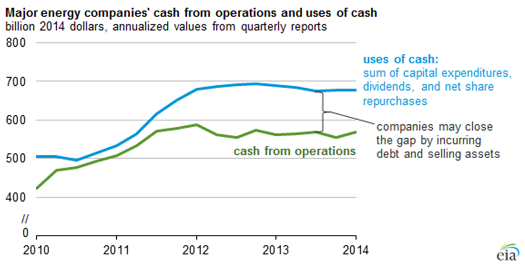
Major oil and gas companies are taking on an increasing share of debt in order to maintain drilling momentum, according to data from the U.S. Energy Information Administration.

Beginning around 2010, energy companies have been increasing their spending, particularly in the United States, as the tight oil revolution took off. Major firms snatched up acreage in oil-rich shale formations like the Bakken and the Eagle Ford and began drilling at a frenzied pace.

The significant outlays required to ramp up such an operation were offset by the rising price of oil, which allowed oil companies to expand their operations without having to take on substantial volumes of debt.

But after several years of increases, global oil prices began to plateau in mid-2011 and have stayed relatively steady since then. In fact, 2013 experienced the least oil price volatility since 2006.

And oil prices in 2014 have remained remarkably consistent, especially taking into account record levels of global demand and the abundance of geopolitical tension around the globe, from Ukraine to Iraq and Syria.  

As a result of oil prices trading in a narrow band – roughly between $100 and $120 for Brent Crude and $90 and $105 for WTI – revenues for oil and gas companies flattened out even as their costs continued to rise.

From 2012 through the beginning of 2014, average cash from drilling operations increased by $59 billion over the same average seen in 2010-2011. But spending rose at a faster clip: up more than $136 billion. The yawning gap that opened up between spending and revenues has largely been closed by the acquisition of more debt. 


For shale drillers in particular, debt has doubled over the last four years while revenues grew at a meager 5.6 percent.

As the EIA points out, taking on debt is not necessarily a bad thing, especially if it is used to invest in new sources of production and growth.

But a new report from Taxpayers for Common Sense points to one other factor that may be contributing to the rise in spending long after earnings flat-line.

Under the U.S. tax code, oil and gas companies can defer billions of dollars in taxes by maintaining elevated levels of spending. That is partly by design. Drilling new oil and gas wells is capital intensive, and thanks to a provision in the 2009 stimulus bill, energy companies can use what is known as “bonus depreciation” to write off all depreciation in a single year, as opposed to spreading it out over future tax cycles.

The intended effect was to incentivize spending – to allow companies to earn immediate cash from producing wells and use that revenue to drill subsequent wells. Meanwhile, the country’s energy production receives a boost.  

But Taxpayers for Common Sense sees something more nefarious. True, the companies theoretically have to eventually pay those tax bills, but in reality, the group argues, the tax incentives amount to a huge subsidy. By taking all the tax benefits upfront, energy companies don’t have to pay interest on billions of dollars in taxes that are pushed off to some point in the future.

“Often, in their financial statements, these companies tout how they finance their exploration and development investments with cash flow from operations. Yet, many have significant deferred tax liabilities. In effect, these companies are financing significant parts of their business with interest-free loans from U.S. taxpayers [emphasis in the original],” the report says.

Through the various peculiarities of the tax code, oil and gas companies already pay a much lower effective tax rate than the statutory 35 percent. ExxonMobil for example, paid a 19.3 percent effective tax rate between 2009 and 2013. But by deferring taxes, oil and gas companies can wind up paying even less than that.

But the heady days of drilling might be drawing to a close. The bonus depreciation allowance expired at the end of 2013 (although Congress is considering partially reinstating it). And although taxes can be deferred, energy companies will have to eventually pay their bill.

Also, much of the debt-fueled spending has been built on the back of low interest rates. With the economy improving, the Federal Reserve will soon end its program of extraordinary asset purchases, perhaps leading to a period of higher interest rates. This could dramatically raise the cost of drilling.

But more importantly, when oil and gas production stops rising, heavily indebted energy companies could face a day of reckoning.   

August 6, 2014

The Rise Of The Petroyuan And The Slow Erosion Of Dollar Hegemony

For seventy years, one of the critical foundations of American power has been the dollar’s standing as the world’s most important currency. For the last forty years, a pillar of dollar primacy has been the greenback’s dominant role in international energy markets. Today, China is leveraging its rise as an economic power, and as the most important incremental market for hydrocarbon exporters in the Persian Gulf and the former Soviet Union, to circumscribe dollar dominance in global energy - with potentially profound ramifications for America’s strategic position.             

Since World War II, America’s geopolitical supremacy has rested not only on military might, but also on the dollar’s standing as the world’s leading transactional and reserve currency. Economically, dollar primacy extracts “seignorage”—the difference between the cost of printing money and its value—from other countries, and minimises U.S. firms’ exchange rate risk. Its real importance, though, is strategic: dollar primacy lets America cover its chronic current account and fiscal deficits by issuing more of its own currency – precisely how Washington has funded its hard power projection for over half a century.   
    
Since the 1970s, a pillar of dollar primacy has been the greenback’s role as the dominant currency in which oil and gas are priced, and in which international hydrocarbon sales are invoiced and settled. This helps keep worldwide dollar demand high. It also feeds energy producers’ accumulation of dollar surpluses that reinforce the dollar’s standing as the world’s premier reserve asset, and that can be “recycled” into the U.S. economy to cover American deficits.  

Many assume that the dollar’s prominence in energy markets derives from its wider status as the world’s foremost transactional and reserve currency. But the dollar’s role in these markets is neither natural nor a function of its broader dominance. Rather, it was engineered by U.S. policymakers after the Bretton Woods monetary order collapsed in the early 1970s, ending the initial version of dollar primacy (“dollar hegemony 1.0”). Linking the dollar to international oil trading was key to creating a new version of dollar primacy (“dollar hegemony 2.0”)—and, by extension, in financing another forty years of American hegemony. 

Gold and Dollar Hegemony 1.0
Dollar primacy was first enshrined at the 1944 Bretton Woods conference, where America’s non-communist allies acceded to Washington’s blueprint for a postwar international monetary order. Britain’s delegation—headed by Lord Keynes—and virtually every other participating country, save the United States, favoured creating a new multilateral currency through the fledgling International Monetary Fund (IMF) as the chief source of global liquidity. But this would have thwarted American ambitions for a dollar-centered monetary order. Even though almost all participants preferred the multilateral option, America’s overwhelming relative power ensured that, in the end, its preferences prevailed. So, under the Bretton Woods gold exchange standard, the dollar was pegged to gold and other currencies were pegged to the dollar, making it the main form of international liquidity.  

There was, however, a fatal contradiction in Washington’s dollar-based vision. The only way America could diffuse enough dollars to meet worldwide liquidity needs was by running open-ended current account deficits. As Western Europe and Japan recovered and regained competitiveness, these deficits grew. Throw in America’s own burgeoning demand for dollars—to fund rising consumption, welfare state expansion, and global power projection—and the U.S. money supply soon exceeded U.S. gold reserves. From the 1950s, Washington worked to persuade or coerce foreign dollar holders not to exchange greenbacks for gold. But insolvency could be staved off for only so long: in August 1971, President Nixon suspended dollar-gold convertibility, ending the gold exchange standard; by 1973, fixed exchange rates were gone, too.

These events raised fundamental questions about the long-term soundness of a dollar-based monetary order. To preserve its role as chief provider of international liquidity, the U.S. would have to continue running current account deficits. But those deficits were ballooning, for Washington’s abandonment of Bretton Woods intersected with two other watershed developments: America became a net oil importer in the early 1970s; and the assertion of market power by key members of the Organization of Petroleum Exporting Countries (OPEC) in 1973-1974 caused a 500% increase in oil prices, exacerbating the strain on the U.S. balance of payments. With the link between the dollar and gold severed and exchange rates no longer fixed, the prospect of ever-larger U.S. deficits aggravated concerns about the dollar’s long-term value.

These concerns had special resonance for major oil producers. Oil going to international markets has been priced in dollars, at least since the 1920s—but, for decades, sterling was used at least as frequently as dollars in order to settle transnational oil purchases, even after the dollar had replaced sterling as the world’s preeminent trade and reserve currency. As long as sterling was pegged to the dollar and the dollar was “as good as gold,” this was economically viable. But, after Washington abandoned dollar-gold convertibility and the world transitioned from fixed to floating exchange rates, the currency regime for oil trading was up for grabs. With the end of dollar-gold convertibility, America’s major allies in the Persian Gulf—the Shah’s Iran, Kuwait, and Saudi Arabia—came to favour shifting OPEC’s pricing system, from denominating prices in dollars to denominating them in a basket of currencies.

In this environment, several of America’s European allies revived the idea (first broached by Keynes at Bretton Woods) of providing international liquidity in the form of an IMF-issued, multilaterally-governed currency—so-called “Special Drawing Rights” (SDRs). After rising oil prices engorged their current accounts, Saudi Arabia and other Gulf Arab allies of the United States pushed for OPEC to begin invoicing in SDRs. They also endorsed European proposals to recycle petrodollar surpluses through the IMF, in order to encourage its emergence as the main post-Bretton Woods provider of international liquidity. That would have meant Washington could not continue to print as many dollars, as it wanted to support rising consumption, mushrooming welfare expenditures, and sustained global power projection. To avert this, American policymakers had to find new ways to incentivise foreigners to continue holding ever-larger surpluses of what were now fiat dollars.       

Oil and Dollar Hegemony 2.0
To this end, U.S. administrations from the mid-1970s devised two strategies. One was to maximise demand for dollars as a transactional currency. The other was to reverse Bretton Woods’ restrictions on transnational capital flows; with financial liberalisation, America could leverage the breadth and depth of its capital markets, and it could cover its chronic current account and fiscal deficits by attracting foreign capital at relatively low cost. Forging strong links between hydrocarbon sales and the dollar proved critical on both fronts.

To forge such links, Washington effectively extorted its Gulf Arab allies, quietly conditioning U.S. guarantees of their security to their willingness to financially help the United States. Reneging on pledges to its European and Japanese partners, the Ford administration clandestinely pushed Saudi Arabia and other Gulf Arab producers to recycle substantial parts of their petrodollar surpluses into the U.S. economy through private (largely U.S.) intermediaries, rather than through the IMF. The Ford administration also elicited Gulf Arab support for Washington’s strained finances, reaching secret deals with Saudi Arabia and the United Arab Emirates for their central banks to buy large volumes of U.S. Treasury securities outside normal auction processes. These commitments helped Washington prevent the IMF from supplanting the United States as the main provider of international liquidity; they also gave a crucial early boost to Washington’s ambitions to finance U.S. deficits by recycling foreign dollar surpluses via private capital markets and purchases of U.S. government securities. 

OPEC’s commitment to the dollar as the invoice currency for international oil sales was key to broader embrace of the dollar as the oil market’s reigning transactional currency.

A few years later, the Carter administration struck another secret deal with the Saudis, whereby Riyadh committed to exert its influence to ensure that OPEC continued pricing oil in dollars. OPEC’s commitment to the dollar as the invoice currency for international oil sales was key to broader embrace of the dollar as the oil market’s reigning transactional currency. As OPEC’s administered price system collapsed in the mid-1980s, the Reagan administration encouraged universalised dollar invoicing for cross-border oil sales on new oil exchanges in London and New York. Nearly universal pricing of oil—and, later on, gas—in dollars has bolstered the likelihood that hydrocarbon sales will not just be denominated in dollars, but settled in them as well, generating ongoing support for worldwide dollar demand.    

In short, these bargains were instrumental in creating “dollar hegemony 2.0.” And they have largely held up, despite periodic Gulf Arab dissatisfaction with America’s Middle East policy, more fundamental U.S. estrangement from other major Gulf producers (Saddam Husseinn’s Iraq and the Islamic Republic of Iran), and a flurry of interest in the “petro–Euro” in the early 2000s. The Saudis, especially, have vigorously defended exclusive pricing of oil in dollars. While Saudi Arabia and other major energy producers now accept payment for their oil exports in other major currencies, the larger share of the world’s hydrocarbon sales continue to be settled in dollars, perpetuating the greenback’s status as the world’s top transactional currency. Saudi Arabia and other Gulf Arab producers have supplemented their support for the oil-dollar nexus with ample purchases of advanced U.S. weapons; most have also pegged their currencies to the dollar—a commitment which senior Saudi officials describe as “strategic.” While the dollar’s share of global reserves has dropped, Gulf Arab petrodollar recycling helps keep it the world’s leading reserve currency.            

The China Challenge
Still, history and logic caution that current practices are not set in stone. With the rise of the “petroyuan,” movement towards a less dollar-centric currency regime in international energy markets—with potentially serious implications for the dollar’s broader standing—is already underway.

As China has emerged as a major player on the global energy scene, it has also embarked on an extended campaign to internationalise its currency. A rising share of China’s external trade is being denominated and settled in renminbi; issuance of renminbi-denominated financial instruments is growing. China is pursuing a protracted process of capital account liberalisation essential to full renminbi internationalisation, and is allowing more exchange rate flexibility for the yuan. The People’s Bank of China (PBOC) now has swap arrangements with over thirty other central banks—meaning that renminbi already effectively functions as a reserve currency. 

Looking ahead, use of renminbi to settle international hydrocarbon sales will surely increase, accelerating the decline of American influence in key energy-producing regions.

Chinese policymakers appreciate the “advantages of incumbency” the dollar enjoys; their aim is not for renminbi to replace dollars, but to position the yuan alongside the greenback as a transactional and reserve currency. Besides economic benefits (e.g., lowering Chinese businesses’ foreign exchange costs), Beijing wants—for strategic reasons—to slow further growth of its enormous dollar reserves. China has watched America’s increasing propensity to cut off countries from the U.S. financial system as a foreign policy tool, and worries about Washington trying to leverage it this way; renminbi internationalisation can mitigate such vulnerability. More broadly, Beijing understands the importance of dollar dominance to American power; by chipping away at it, China can contain excessive U.S. unilateralism.      

China has long incorporated financial instruments into its efforts to access foreign hydrocarbons. Now Beijing wants major energy producers to accept renminbi as a transactional currency—including to settle Chinese hydrocarbon purchases—and incorporate renminbi in their central bank reserves. Producers have reason to be receptive. China is, for the vastly foreseeable future, the main incremental market for hydrocarbon producers in the Persian Gulf and former Soviet Union. Widespread expectations of long-term yuan appreciation make accumulating renminbi reserves a “no brainer” in terms of portfolio diversification. And, as America is increasingly viewed as a hegemon in relative decline, China is seen as the preeminent rising power. Even for Gulf Arab states long reliant on Washington as their ultimate security guarantor, this makes closer ties to Beijing an imperative strategic hedge. For Russia, deteriorating relations with the United States impel deeper cooperation with China, against what both Moscow and Beijing consider a declining, yet still dangerously flailing and over-reactive, America.

For several years, China has paid for some of its oil imports from Iran with renminbi; in 2012, the PBOC and the UAE Central Bank set up a $5.5 billion currency swap, setting the stage for settling Chinese oil imports from Abu Dhabi in renminbi—an important expansion of petroyuan use in the Persian Gulf. The $400 billion Sino-Russian gas deal that was concluded this year apparently provides for settling Chinese purchases of Russian gas in renminbi; if fully realised, this would mean an appreciable role for renminbi in transnational gas transactions.

Looking ahead, use of renminbi to settle international hydrocarbon sales will surely increase, accelerating the decline of American influence in key energy-producing regions. It will also make it marginally harder for Washington to finance what China and other rising powers consider overly interventionist foreign policies—a prospect America’s political class has hardly begun to ponder.

August 5, 2014

Another Settlement – JP Morgan Receives Slap On The Wrist Despite Years Of Fraudulent CFTC Data

The Commodities Futures Trading Commission (CFTC) has been long viewed as one of the most corrupt of American institutions – and that’s saying a lot. Putting aside all the accusations with regard to silver manipulation in recent years, the most stunning controversy occurred back in 2010 when a retiring judge accused the other remaining judge of being a total bought and paid for Wall Street crony.

The retiring judge was George Painter, who accused fellow judge Bruce Levine of not once ever ruling in favor of an investor in his 20 years on the bench. Not only that, but he claimed this was the result of a promise Levine made to Wendy Gramm, the former head of the CFTC and the wife of Phil Gramm. Phil Gramm was the Congressman who spearheaded the repeal of Glass-Steagall in 1999, which is seen by many (including myself) as one of the most catastrophic pieces of legislation in American history since it laid the groundwork for the financial crisis of 2008, as well as the continued cancerous permanence and power of TBTF banks. FiredogLake covered the CFTC controversy in 2010:
An Administrative Law Judge at the CFTC (Commodity Futures Trading Commission), George Painter, revealed in his retirement letter that a colleague of his, Judge Bruce Levine, has never awarded a case in favor of a plaintiff in 20 years on the bench. He traces this back to a deal Levine made with Wendy Gramm, the former head of the CFTC and the wife of Phil Gramm (R-Enron and UBS). Indeed, the numbers check out, at least for the time period we know about; Judge Levine has never decided in favor of a plaintiff, i.e. never decided in favor of an investor crying mistreatment or fraud by a commodity dealer or major broker in commodity futures and derivatives trading.

Here’s why Painter accused Levine of this misconduct: there are only two Administrative Law judges at the CFTC. “If I simply announced my intention to retire,” Judge Painter says in his letter, “the seven reparation cases on my docket would be reassigned to the only other administrative law judge at the commission, Judge Levine. This I cannot do in good conscience.” He wanted his docket to transfer to an admin law judge at the SEC or FERC instead.
Well it appears nothing has changed at the CFTC. Less than two weeks ago we learned that former CFTC commissioner Scott O’Malia, who had fought hard against any new rules intended to reign in Wall Street practices, was leaving the CFTC to head one the biggest bank lobbying groups in the world, the International Swaps and Derivatives Association (ISDA). This is the exact lobbying group that had been pressing against new CFTC rules. Reuters reported that:
The International Swaps and Derivatives Association said on Wednesday that Scott O’Malia, a Republican who often voted against new CFTC policy in the wake of the financial crisis, will become the trade group’s next chief executive. O’Malia will start his new job as of Aug. 18, ISDA said. The news came only days after O’Malia said he planned to leave the CFTC as of Aug. 8.
There is just zero shame at this point.
A staffer for Republican Senator Mitch McConnell – now the Senate Minority leader – from 1992 to 2001, O’Malia focused on energy policy during much of his career.
Links to Mitch McConnell. No surprise there.
ISDA is a global lobby group for non-listed derivatives, counting the world’s largest investment banks among its members, and has frequently fought regulatory efforts to reform the market after the financial crisis.
Moving along to today’s story, we learn that the CFTC will impose a meager $650,000 fine on JP Morgan, despite years of warnings about fraudulent data reports. The CFTC announced that:
Washington, DC - The U.S. Commodity Futures Trading Commission (CFTC) today issued an Order filing and simultaneously settling charges against J.P. Morgan Securities LLC (JPMS), a wholly-owned subsidiary of JPMorgan Chase & Co. and a CFTC-registered Futures Commission Merchant (FCM), for submitting inaccurate reports to the CFTC relating to the required reporting of positions held by certain large traders whose accounts are carried by JPMS. The reporting violations occurred despite the CFTC notifying JPMS of numerous errors in its reports. The CFTC Order requires JPMS to pay a $650,000 civil monetary penalty to address its unlawful conduct. The reports are known as the “large trader” reports and are used by the CFTC in order to evaluate potential market risks and monitor compliance with CFTC requirements.
These reports are also used by investors to make judgments about markets, so just imagine how much money other firms or even individual investors may have lost using JP Morgan’s fraudulent data? I’m sure it was far more than $650k. As the CFTC itself notes:
CFTC Director of Enforcement Aitan Goelman commented: “The large trader reports are vital to the CFTC’s role in monitoring market behavior and are important to members of the public, many of whom rely on that information in forming trading strategies. Therefore, submission of accurate and reliable data to the CFTC is essential. The CFTC will be vigilant in enforcing these rules in order to ensure the integrity of the regulatory structure and to maintain transparency in the markets.”

The CFTC Order specifically finds that since at least 2012, the CFTC was notifying JPMS about errors in its large trader reports, which increased in frequency throughout the year. In December 2012, the CFTC notified JPMS that the on-going problems were unacceptable. JPMS, relying on its third-party vendor that generated the reports for JPMS, assured CFTC staff that the problems would be resolved on or before the end of January 2013. However, JPMS continued to submit large trader reports that contained hundreds of errors throughout the period from February 1, 2013 to February 2014.
So the CFTC claims it will be vigilant. Like, for example, allowing JP Morgan to continue to issue fraudulent reports for well over a year despite repeated warnings, and then ultimately settle for a dollar amount that is probably equivalent to the Dimon family’s annual budget for toilet paper? Yeah, that’ll show ‘em who’s boss.

You gotta love American justice. In the same week that an NYPD officer’s illegal and fatal chokehold was ruled a homicide (incredibly the man who shot the video has now been arrested), JP Morgan gets off with another slap on the wrist. As Glenn Greenwald noted, it’s Liberty and Justice for Some.

August 4, 2014

Marc Faber on Commodity Cycles, Monopoly Central Banking and the Wealth Redistribution Craze

Daily Bell: Hello, again. Since last we spoke, in June 2011, things have grown worse in some cases and better in other ways. How do you see the world today? What pleases you the most economically and what are you most concerned about?

Marc Faber: Economically, there is not much that pleases me because I think we are in an economy that is on steroids – in other words, the money printing – and the money printing goes essentially to wealthy people. Of course, they spend and as a result of the asset bubbles, temporarily the economy improves worldwide but it's not sustainable growth. We have to realize that. So economically, I'm actually more pessimistic today than I have been in a long time. That does not imply that asset markets cannot go higher. That is a possibility and, in fact, I hope the US market goes ballistic and creates a gigantic bubble, which will then embarrass the Federal Reserve because every bubble eventually gets deflated.

Daily Bell: What are you most concerned about in regard to the bubble, then – that it won't happen?

Mark Faber: We have a two-tier economy. We have an economy of well-to-do people from which I have benefited because I'm in the financial sector. My asset value has gone up, I benefit from rising asset prices because I own shares and I'm on the board of companies that own shares, fund management companies and so forth, but I'm not happy about the fact that the typical household and the working class worldwide is not doing well. And what will eventually happen and has begun to happen – and I have written about this already five, six years ago – when you have rising wealth inequality, eventually you have politicians that will not assume personal responsibility for the rising wealth inequality that is largely fostered by monetary policies by central banks, notably the Federal Reserve. They will then go to the public, like Bill de Blasio, and say, "Look, if you are not doing well it's the fault of the rich people. The rich people are ripping you off."

The rich people aren't ripping off anyone. They just took advantage of a situation that was given to them by the Federal Reserve. And so these politicians will go to the people and say, "What we have to do is to punish the rich and let's introduce a massive wealth tax," like this clown, Piketty, who has studied – and I do not disagree that he's done serious work; it's not exactly correct but he's done serious work about wealth inequality. When wealth inequality grows too much you have either significant social reforms, social strife or revolutions. And in Europe and everywhere I hear more and more talk about taxing the rich and that is going to happen. It's not going to help. Redistribution of wealth eventually ends up in redistributing poverty.

Daily Bell: This seems to be what we're seeing with the recent resurgence of Occupy Wall Street-type resistance and the "1%" meme. What do you think of OWS, generally?

Marc Faber: Basically, I don't think they should occupy Wall Street. They should go and burn down the Federal Reserve in Washington and hang up the ultra-dovish Fed governors that advocate even more money printing. That they should do.

Daily Bell: You are known as Dr. Doom because of your crash predictions. We think stock markets are being pushed higher and then will crash radically, giving rise to suggestions for a more global marketplace. Any truth to this?

Marc Faber: Well, all markets are correlated. If the S&P drops 20% I don't see many markets going up. If you print money you will get symptoms of inflation and one of the symptoms of inflation is rising asset markets. It can also be rising consumer prices, rising wages and so on. Because we have an absence of foreign exchange controls and we have a globalized economy, the US may print money and there is more inflation in the US in terms of consumer price increases than what the Fed is suggesting. But at the same time, the larger inflation has been in emerging economies and even larger bubbles have occurred there. My view is that to boost economic activity by boosting asset prices is a horrendous – and I repeat, horrendous – mistake because it's been established by numerous economies starting with Copernicus and David Hume and Irving Fisher that asset bubbles impoverished the majority to the benefit of the few.

Daily Bell: There are some exciting new investment prospects, specifically as regards cannabis. What do you think about the legalization of marijuana? Is it an investment opportunity?

Marc Faber: In general, I believe that any kind of drug should be legalized and there would be less crime and probably less usage. I'm all in favor of legalizing drugs because all I see, and I've looked at it very carefully when I was in Mexico – the drug business is so incredibly profitable that there is widespread corruption, at the CIA, at the FBI, at the police force, in the military, and that is not a very desirable outcome. If it was legalized, we would have far less crime and far less corruption. It's like during the Prohibition time – alcohol consumption if anything rose and there was much more crime and much more corruption.

Daily Bell: How do you see it from an investment perspective?

Marc Faber: I really have no idea. I'm not interested to invest in any kind of drugs because I don't use them. I have smoked a joint from time to time and I may still do it once in a while but it's not an investment destination that interests me.

Daily Bell: Let's look at precious metals. Is the dollar due to drop against gold? How about silver?

Marc Faber: My inclination is to believe that the central banks eventually will have to make a choice. They have created asset bubbles. At the same time, the economy has hardly recovered. What will happen when the asset bubbles burst again, say the stock market goes down 20%, the property market goes down and so forth? What will be in the mind of the Federal Reserve and other central banks? What will be in their minds is more money printing will do less damage than no money printing. And so the asset purchases, the QE I, II, III, IV will go on to what I predicted in 2009: It will go to QE 99. And as a result of that, not only the US dollar but all currencies will lose in value against some assets, irregularly at times. Real estate will go up at times. At times commodities will go up at times. Stocks and bonds will go up at times. Buy my inclination is to think that when this all happens and even before – because the market is a discounting mechanism – is that gold and silver will again appreciate against the US dollar.

And don't forget – and I have to stress this – the media is all over the fact that gold hasn't performed well, in September of this year, for the past three years and silver equally. But they never mention that between '99 and 2001, all precious metals significantly outperformed stocks and even today, precious metals between 2000 and today have significantly outperformed stocks. But the media paints people that own gold as kind of out of this world, out of touch. In my view, the recent gold rally has occurred amidst very negative sentiment. I get so many research reports from all over the world, from banks, investment advisers, gold bugs and so forth. By and large in this rally the mood has stayed negative. I think we made a major low over the last two years around $1180 to $1200 on the gold price and around $20 on the silver price, and I don't recommend people to put all their money into gold – but maybe they should; the question is, where would they keep it? Certainly not in the US – but in general I would say now is probably quite a good time to buy some gold and silver, and I believe that from here on gold and silver will outperform the S&P 500, the Nasdaq and the Russell 2000. It's my view.

Now, if we have a complete breakdown of the monetary system then maybe everything goes down and then stocks may go down 80% and gold only 40% or 50%. I'm just saying, relatively speaking in my view, gold and silver, platinum, palladium are quite attractive and I recommend people to have at least some exposure to precious metals in physical form.

Daily Bell: That is a question – where to store it.

Marc Faber: I wouldn't store it in the US. I would rather store it in Singapore or in Hong Kong or maybe you bury it somewhere. But as I mentioned earlier, I think the tendency is going to be for politicians that have completely failed and utterly failed to essentially blame rich people for wealth inequality and then they will go to the people, to the masses, and say, "You know what? What we have to do is take away their gold. These are the people who damaged your economy. Let's take away their gold." And in the US they may do that, and in the ECB in Europe. The horrible politicians in Brussels and the US government are one in the same. They will go to the Europeans and say, "If we do it, why don't you also do it?" and Draghi and all these characters will say, "Yeah, good idea." And then they'll knock on the door of the Swiss and the Swiss, who have no backbone anymore – except their soccer team, who consists of foreigners, not Swiss, all born overseas or children of foreigners in Switzerland – the politicians and the Greens and the Socialists will say, "Yeah, good idea. Take the gold from the rich people." So my view is it's probably best to hold gold in Asia and Singapore and Hong Kong where there is a culture of private property and a culture of gold.

Read the entire interview

August 1, 2014

Is the Wall Street Party Over?

Yes, Stocks Could Drop 50% ... After meandering higher for most of the year, the stock market is now sputtering. That's triggering chatter about a minor "correction," which many people believe is long overdue. And maybe that's what we're at the start of, a minor correction. Or maybe this is just a blip, and the brilliant and prudent Jeremy Grantham is right that we're on the cusp of a new bubble that will take the S&P 500 up another 10% to 15% over the next year to 2,250. (As a stockholder, I sure hope so!) Or maybe we'll get both — a minor correction and a new bubble spike. – Business Insider 

Dominant Social Theme: Stocks are going down. This is the big one. 

Free-Market Analysis: Bail out. The party's over! That's what we're reading in some publications now that markets have taken a tumble. We're not so sure. 

Our short-term perspective has been that this faux Wall Street Party can go on at least until the fall – as we've been writing about it for a year now. 

Our longer-term perspective is that it can go on for another year or even two and as a result garner headlines such as "Dow 20,000" before generating what Saddam Hussein would call "the mother of all crashes." 

 As of this writing, markets around the world were still selling off and probably US marts can move down farther on Friday as well, and perhaps into next week. But, you know, it's August, and we're not aware of any great sell-off taking place in August, a time when most market moguls and a lot of other lesser market participants tend to take time off, recharging for fall campaigns. 

If this sell-off truly marks the end of the great "Wall Street Party," we'd expect its epitaph to be written in the markets' cruelest months – September, October and November. That's when mutual fund managers begin to "dress up" their funds by selling to declare gains. Other market participants are selling, too, and sometimes this wave of selling turns into a tsunami. 

Maybe we're wrong. Maybe we'll see "blood in August" when we're used to seeing the reddest ink in October. We did mention just yesterday that the market might "correct" – but a correction is not a 2009-type sell off. It's certainly not the 50 percent that Business Insider's Henry Blodget is muttering about (see excerpt above). 

Here's some more from Blodget: ... 

Maybe we're just in the middle years of a fantastic bull market. I don't know. (Neither does anyone else, by the way.) I'm also not predicting a crash. One thing I do know, though, is that stocks are extremely expensive on every valid historical measure I know of. In the past, this level of overvaluation has presaged poor long-term returns. So I'm not expecting my retirement account to do well from this level over the next seven to 10 years. The other thing that this level of valuation has also often preceded is something much worse than a "minor correction" — a crash. 

And there are other things that are happening now that have also preceded crashes. So I would not be surprised to see stocks fall 50% from this level in the next few years. And, if that happens, you shouldn't be surprised either. A crash of that magnitude wouldn't even make stocks "cheap." It would merely take them back to their long-term average. And to deny the possibility that stocks might someday drop back to their long-term average seems the height of delusion to me. 

Yes, maybe it's "different this time." Maybe, this time, stocks really have "reached a permanently high plateau." But I doubt it. And it's not just price that concerns me ... Lest you be concerned that I'm just "talking my book," I should be clear about one thing: I own stocks, and I'm not selling them. (For many reasons, including that I'm a long-term investor.) From a personal-finance perspective, I would like nothing more than for the market to keep going up. 

I also want to point out one new thing that is worrying me lately: the rise of investor margin debt. Money is cheap right now and the stock market has been going up for five years. As a result, lots of investors are borrowing money to buy stocks. This, in turn, is making stocks go up more, which encourages more investors to borrow more money to buy stocks. And so on ... 

The problem with margin debt is that the cycle is just as self-reinforcing on the downside. Once stocks drop, investors are forced to sell stocks to meet margin demands. That selling causes stocks to drop more. And so on. Basically, if and when stocks reverse course, conditions are ripe for them to fall a long, long way before anything begins to prop them up. ... 

By all means, go ahead and tell yourself that stocks aren't expensive. But be aware of what you're likely doing. What you're likely doing is what others who persuaded themselves to buy stocks near previous market peaks (as I did in 2000) were doing: Saying, "it's different this time." 

Blodget is correct about all this, and we've mentioned some of it as well. But our main point throughout this past year of covering the current asset insanity that passes for equity "investing" has been that every major mechanism remains directed at moving markets upwards. 

Interest rates are screwed to very low levels, the Fed continues to print and has signaled that it won't necessarily tighten radically even if faced with an obvious asset bubble. Deregulation has opened up IPO and private equity channels and there are plenty of "green solutions" that the globalist crowd still wants to price in the larger marketplace. 

Then there's the so-called "plunge protection team" that we assume is still fully functional and probably working overtime at the moment. Powerful central bankers such as Mark Carney and Janet Yellen are "doves" – and have actually been resistant to most tightening measures. 

Of course, we're talking about timing when it comes to the current insanity. At some point, something has to give. The question, as always, is when. We've suggested market timing and hedging as strategies that can be employed when faced with sky-high equity valuations. 

But we return to our basic premise: the forces that want to see stocks go up – and up some more – likely haven't reversed their priorities. The myth of the great "recovery" has to be sustained and many investors who lost money in 2009 probably haven't fully reinvested even now. 

For all the above reasons, there's still a lot of upward pressure when it comes to the markets in the US and abroad, at least from elite sources. Financiers and banking controllers in China, Japan, the BRICS generally and, of course, the Anglosphere are all pulling in the same direction. 

We tend to peg the resurgence of the market as beginning in late 2009 or early 2010, which means we've had about a five-year bull run. That's plenty long, but given what we see as the determination of forces arrayed against any significant downturn, we figure there may be at least another year left in the ol' nag. 

Of course, as we've cautioned, not only are current equity valuations entirely out of sync with reality, this rally has come in the midst of what we call the "Golden Bull." That is, the larger cycle is commodity oriented and at some point that cycle will reassert itself, just as it did in the 1970s. 

Let's see what happens today, this week and then later on ... in the fall. Even a sharp sell-off might not derail things. Calling the end of any market is difficult, especially one that is as massaged and promoted as this. 

Conclusion One thing we're fairly sure of: There are plenty of players that will fight hard for a continuance of this massive asset bubble. Indeed, it's all going to come tumbling down – but perhaps better next year than this.