October 9, 2014

Serious Financial Trouble Is Erupting In Germany And Japan

There are some who believe that the next great financial crash will not begin in the United States.  Instead, they are convinced that a financial crisis that begins in Europe or in Japan (or both) will end up spreading across the globe and take down the U.S. too.  Time will tell if they are ultimately correct, but even now there are signs that financial trouble is already starting to erupt in both Germany and Japan.  German stocks have declined 10 percent since July, and that puts them in "correction" territory.  In Japan, the economy is a total mess right now.  According to figures that were just released, Japanese GDP contracted at a 7.1 percent annualized rate during the second quarter and private consumption contracted at a 19 percent annualized rate.  Could a financial collapse in either of those nations be the catalyst that sets off financial dominoes all over the planet?

This week, the worst German industrial production figure since 2009 rattled global financial markets.  Germany is supposed to be the economic "rock" of Europe, but at this point that "rock" is starting to show cracks.

And certainly the civil war in Ukraine and the growing Ebola crisis are not helping things either.  German investors are becoming increasingly jittery, and as I mentioned above the German stock market has already declined 10 percent since July...
German stocks, weighed down by the economic fallout spawned by the Ukraine-Russia crisis and the eurzone’s weak economy, are now down more than 10% from their July peak and officially in correction territory. 
The DAX, Germany’s benchmark stock index, has succumbed to recent data points that show the German economy has ground to a halt, hurt in large part by the economic sanctions levied at its major trading partner, Russia, by the U.S. and European Union as a way to get Moscow to butt out of Ukraine’s affairs. The economic slowdown in the rest of the debt-hobbled eurozone has also hurt the German economy, considered the economic locomotive of Europe. 
In trading today, the DAX fell as low as 8960.43, which put it down 10.7% from its July 3 closing high of 10,029.43 and off nearly 11% from its June 20 intraday peak of 10,050.98.
And when you look at some of the biggest corporate names in Germany, things look even more dramatic.

Just check out some of these numbers...
The hardest hit sectors have been retailers, industrials and leisure stocks with sports clothing giant Adidas down 37.7pc for the year, airline Lufthansa down 27pc, car group Volkswagen sliding 23.6pc and Deutchse Bank falling 20.2pc so far this year.
Meanwhile, things in Japan appear to be going from bad to worse.

The government of Japan is more than a quadrillion yen in debt, and it has been furiously printing money and debasing the yen in a desperate attempt to get the Japanese economy going again.

Unfortunately for them, it is simply not working.  The revised economic numbers for the second quarter were absolutely disastrous.  The following comes from a Japanese news source...
On an annualized basis, the GDP contraction was 7.1 percent, compared with 6.8 percent in the preliminary estimate. That makes it the worst performance since early 2009, at the height of the global financial crisis. 
The blow from the first stage of the sales tax hike in April extended into this quarter, with retail sales and household spending falling in July. The administration signaled last week that it is prepared to boost stimulus to help weather a second stage of the levy scheduled for October 2015. 
Corporate capital investment dropped 5.1 percent from the previous quarter, more than double the initial estimate of 2.5 percent. 
Private consumption was meanwhile revised to a 5.1 percent drop from the initial reading of 5 percent, meaning it sank 19 percent on an annualized basis from the previous quarter, rather than the initial estimate of 18.7 percent, Monday’s report said.
For the moment, things are looking pretty good in the United States.

But as I have written about so many times, our financial markets are perfectly primed for a fall.

Other experts see things the same way.  Just consider what John Hussman wrote recently...
As I did in 2000 and 2007, I feel obligated to state an expectation that only seems like a bizarre assertion because the financial memory is just as short as the popular understanding of valuation is superficial: I view the stock market as likely to lose more than half of its value from its recent high to its ultimate low in this market cycle.
…
At present, however, market conditions couple valuations that are more than double pre-bubble norms (on historically reliable measures) with clear deterioration in market internals and our measures of trend uniformity. None of these factors provide support for the market here. In my view, speculators are dancing without a floor.
And it isn't just stocks that could potentially be on the verge of a massive decline.  The bond market is also experiencing an unprecedented bubble right now.  And when that bubble bursts, the carnage will be unbelievable.  This has become so obvious that even CNBC is talking about it...
Picture this: The bond market gets spooked by a sudden interest rate scare, sending a throng of buyers streaming toward the exits, only to find a dearth of buyers on the other side. 
As a result, liquidity evaporates, yields soar, and the U.S. finds itself smack in the middle of another debt crisis no one saw coming. 
It's a scenario that TABB Group fixed income head Anthony J. Perrotta believes is not all that far-fetched, considering the market had what could be considered a sneak preview in May 2013. That was the "taper tantrum," which saw yields spike and stocks sell off after then-Federal Reserve Chairman Ben Bernanke made remarks that the market construed as indicating rates would rise sooner than expected.
If the strength of our financial markets reflected overall strength in the U.S. economy there would not be nearly as much cause for concern.

But at this point our financial markets have become completely and totally divorced from economic reality.

The truth is that our economic fundamentals continue to decay.  In fact, the IMF says that China now has the largest economy on the planet on a purchasing power basis.  The era of American economic dominance is ending.  It is just that the financial markets have not gotten the memo yet.

Hopefully we still have at least a few more months before stock markets all over the world start crashing.  But remember, we are entering the seventh year of the seven year cycle of economic crashes that so many people are talking about these days.  And we are definitely primed for a global financial collapse.

Sadly, most people did not see the crash of 2008 coming, and most people will not see the next one coming either.

October 8, 2014

Swiss Move to Back Franc with Gold for Real?

Swiss Gold Initiative Would Hamper SNB Policy, Government Says ... Asking the Swiss National Bank to hold a fixed portion of its assets in gold would hinder monetary policy, the government said today. Switzerland will vote on the initiative "Save Our Swiss Gold" on Nov. 30 that would force the central bank to hold at least twenty percent of its assets in gold. It would also forbid the sale of any such holdings and require all the gold be held in Switzerland. – Bloomberg 

Dominant Social Theme: This is ridiculous. Everyone knows central banks are progressive and gold is a barbarous relic. 

Free-Market Analysis: So having severed what was left of the link between gold and the Swiss franc around 2000 AD, the Swiss are now having second thoughts. Good luck to them. 

We've tried to figure out if there's more to this than meets the eye. We're not sure. Usually when something like this happens, the globalist clique that works hard to maintain and expand its control wants to control both sides of the argument. 

We think that's happening with the BRICS, for instance. We need to remind ourselves that the concept of the BRICS was developed by former Goldman Sachs economist Jim O'Neill. And the BRICS don't really offer an alternative money, do they? 

 In fact, the BRICS radical idea of monetary reform is to create alternative International Monetary Fund and World Bank structures. They can't do better than that? India, China, Brazil and Russia – even South Africa – are fiat-money based with central banks, etc. 

That's why we're skeptical about this so-called schism between the BRICS and the Western world. The idea is that the BRICS have had enough of the dollar and want to create an alternative currency. The upshot may be a phony currency war leading to proposed international money of sorts, perhaps a basket of currencies. It could even include gold. 

But why wait? If one of the BRICS wanted to create a currency to take over the world, that country would simply have to link its currency to gold. 

And now the Swiss seem to be considering that. Here's more: 

Opinion polls will be published later this month. The SNB's balance sheet ballooned in the wake of the currency interventions it waged to defend the minimum exchange rate of 1.20 per euro set in 2011. The SNB held foreign-exchange reserves of 462.2 billion francs ($481 billion) at the end of September, with total assets of about 522 billion francs. 

Initiatives are a key element of Switzerland's direct democracy. The gold initiative was started by several members of the Swiss People's Party SVP, who collected the requisite 100,000 signatures for the measure. SNB President Thomas Jordan has on several occasions urged its rejection, saying it would make it difficult to fulfill the institution's mandate for price stability. 

"The initiative has the potential to limit the central bank's ability to act," he told Frankfurter Allgemeine Zeitung in an Oct. 1 interview. According to Beat Siegenthaler, currency strategist at UBS AG in Zurich, the SNB would be forced to buy about 1,500 tons of gold over five years to meet the required 20 percent threshold. 

As of the end of June, the central bank, based in Zurich and Bern, owned 1,040 tons of the precious metal. Its gold holdings have made the SNB dependent on market developments. It was forced to scrap its dividend last year after it suffered a 9.1 billion-franc loss after price of gold experienced its biggest plunge since 1981. 

The SNB said in April 2013 that about 20 percent of its gold was with the Bank of England and 10 percent at the Bank of Canada, with the remainder stored in Switzerland. 

When we look at reports surrounding the Swiss Franc and its central bank we find considerable skepticism regarding even the gold that the Swiss Bank claims to have. TFMetalsReport.com provided an insightful look into the modern Swiss monetary economy in May in an article entitled, "An Open Letter to the Good People of Switzerland." 

Here's a sample: 

I hate to be the bearer of bad news, Switzerland, but what you suspected all along is actually true. Your gold is gone. All of it. Leased and sold away by your central bankers and politicians. 

As recently as 1996, the Swiss Franc was considered "good as gold". Why was this the case? Since the early 20th century, the Swiss Franc had offered a reserve backing of gold. This uniquely sound currency had given the country of Switzerland considerable financial power and independence, yet, at the urging of their politicians and central bankers, the Swiss willingly forfeited this enviable position. 

The demise of the Franc and Swiss sovereignty began in 1992 when the Swiss made the fateful decision to join the International Monetary Fund (IMF). The IMF's Articles of Agreement (Article IV, Sec 2b) clearly state that no member country can have a currency linked to gold and, as such, Switzerland immediately set out on a course to de-link the Franc from gold. Just four short years later, the Swiss National Bank (SNB) and the Swiss government had formed a plan to eliminate the Franc's gold backing and, in March of 1997, a revision of the Nationalbank Act was passed and all links of gold to the Franc were removed. Further, since the Swiss constitution mandated sound money, it had to be amended, too. Thus, in a hastily organized vote, a new Swiss constitution was approved in May of 2000. 

(http://www.efd.admin.ch/dokumentation/medieninformationen/archiv/00382/index.html?lang=en) 

This served to finally and permanently sever the Franc's gold backing and initiated the Swiss into the world of global fiat currency. 

The SNB has spent the 14 years since leasing and re-leasing the country's gold reserves. In 1999, the SNB reported gold reserves of 2,590 metric tonnes. The most current "audit" of SNB reserves showed just 1,040 metric tonnes of gold remaining on the balance sheet and I believe that none of this is actual, physical gold. Instead, what the SNB holds are paper claims and promissory notes. The remaining 1,040 tonnes has been sold and re-sold into the marketplace by greedy bullion banks, intent upon suppressing price through the leverage of paper metal futures contracts and rehypothecation. In other words, the "gold" that the SNB claims to hold/own on behalf of the Swiss people is gone. This makes the Swiss people just another bagholder, certain to be left in line wanting with all of the other holders of unallocated accounts when the fractional reserve bullion banking system inevitably collapses. 

Furthermore, I've come to the conclusion that it was this last bit of Swiss gold that was utilized to suppress and manipulate price away from the alltime highs of September 2011. 

Now, we can't vouch for the information above, but it does parallel other reports about central bank gold. Germany, for instance, is going to have to wait many years to receive its gold from the US Federal Reserve. That doesn't exactly inspire confidence. 

As the excerpt above indicates, those who distrust modern central banking believe that much of the gold that central banks have traditionally been charged with safeguarding has actually been lent out at low prices to "suppress" the gold price. Central banks are under enormous pressure these days, however. As we predicted long ago, the whole paradigm is likely starting to collapse, and it hasn't been helped by this six-year long financial crisis. 

Before the Internet era, modern Western citizens were likely baffled by the system of "high finance." But after the pain of the past half-decade, an increasing number still may not understand it, but they are considerably more disenchanted. The belief that the system must work the way it does is not so strong as it used to be. And certainly there are historical precedents that inform people of other kinds of monetary precedents. 

When we looked into this upcoming Swiss initiative, we couldn't find any "smoking gun" that allowed us to conclude that it was being stage-managed by a kind of controlled opposition. It does come out of the conservative right wing of the Swiss political system – and one of its proponents claims to be a "radical libertarian" even though he famously campaigned to ban minarets from Switzerland. 

Those globalists that have propelled central banks from about five at the beginning of the 20th century to about 150 now have been fairly clear that growing financial globalism is an eternal goal. Whether the apparent basket of currencies that seems to be in the works includes gold or not is unclear at the moment. Perhaps the currency will formally be called the bancor, which is what Keynes wanted to name it. 

Is this initiative spontaneous? If not, perhaps it's a way to begin to integrate gold back into a conversation about a more global currency. Best case, this gold initiative is both spontaneous and popular. Emotionally and intellectually, that would be a satisfying result.

Conclusion A good one for the Swiss people, too. 

Source

October 7, 2014

AIG Bailout Trial Bombshell II: Fed and Treasury Cornered AIG’s Board into Taking a Legally-Dubious Bailout

As we said in our companion post today on the AIG bailout trial, former AIG CEO Hank Greenberg may have a case after all. Mind you, we are not fans of Greenberg. But far too much of what happened during the crisis has been swept under the rug, in the interest of preserving the officialdom-flattering story that the way the bailouts were handled was necessary, or at least reasonable, and any errors were good faith mistakes, resulting from the enormity of the deluge.

Needless to say, the picture that emerges from the Greenberg camp, as presented in the “Corrected Plaintiff’s Proposed Findings of Fact,” filed in Federal Court on August 22, is radically different. I strongly urge readers, particularly those with transaction experience, to read the document, attached at the end, in full. It makes a surprisingly credible and detailed case that AIG’s board was muscled into a rescue that was punitive, when that was neither necessary nor warranted. And the tactics used to corner the board were remarkably heavy-handed.

Note that our earlier post describes that, contra previous accounts, AIG had numerous deep-pocket suitors petitioning Treasury to buy into struggling insurer. That means that rather than having the US nationalize the insurer, it would have been viable to see if a mere bridge facility could have been taken out by a consortium of investors. If that failed, the nationalization option remained open. The failure to take that course makes the idea that the AIG bailout was intended to serve as a money laundering vehicle for wobbly banks, a theory before that sounded like a stretch, appear far more credible.

Another hard-hitting charge in the filing by Greenberg’s attorneys is that the Fed didn’t have the authority to take an equity stake in AIG, yet clearly did so before passing it to a trust, which was a clear sham. The trust has only three trustees, with no meaningful staff. Government officials operated in a very open manner in managing AIG, from installing the new CEO, a Goldman board director Ed Liddy, new board members, putting staff on site, and even meeting with ratings agencies about ratings decisions.

Now you might say that all these legal fine points were niceties. But the violations of both normal governance practices, the most important being asking the AIG board repeatedly to make decisions while withholding critical information or making actual misrepresentations, and of various laws, were significant and numerous.

Another stunning new allegation in the “Corrected Proposed Findings of Fact” document is that, in stark contrast with previous claims by the Fed, that only UBS was willing to take a haircut, it turns out the New York Fed only bothered talking to eight of the 16 counterparties (and then as we already know from the SIGTARP report on this issue, using a script that was delivered by junior staffers, as opposed to having Geithner or Paulson call and force them to take a haircut). Moreover, BlackRock, which was advising the Fed, believed that Bank of America and Goldman would be receptive to discounts.

Contrast the railroading of AIG with the kid gloves treatment of preferred parties. Recall Geithner’s sanctimonious claims about needing to respect contracts when that excuse served the Fed-Treasury combo, as the pretext for forcing discounts on the payments of credit default swaps with AIG, or for paying high wages to AIG staffers who were working on winding down the operations of AIG Financial Products, hardly as demanding a job as running an ongoing entity. It’s these repeated, public professions of the need to be scrupulous about observing proper protocols that make the AIG railroading look so striking.

Mind you, I do not buy everything this filing is selling. For instance, they argue that some of the value of AIG was shifted into two bailout-related vehicles, Maiden Lane II and III. That’s a potentially legitimate point. However, they argue for what was “taken” from Greenberg based on the eventual payout on both. The problem with that approach is ZIRP and QE were continuing subsidies to the banks, and thus to AIG. Conceptually, it’s not obvious why Greenberg should get that benefit, since AIG did have to be salvaged in some manner in September 2008, and a rescue then (say with considerable investment by a foreign consortium) would mean valuations on the toxic CDOs would need to be taken around that time.

Greenberg’s lawyers also base that valuation argument on work done by BlackRock, which as the asset manager for the Fed, could be argued to be not predisposed to AIG’s side. However, BlackRock could be argued to be expected, to the extent reasonable, to make the Maiden Lane vehicles look like good investments, and hence have an optimistic bias to their valuations. We were doing valuation work on the Maiden Lane vehicles, and based on the information we had, the initial valuations looked to be inflated. But the flip side is that the Maiden Lane II and III counterparties, as part of the deal, got a very valuable release from liability, and the Maiden Lane vehicles (and even more so, AIG) was never paid for that bennie.

There is a lot of salacious material in the document. For your reading pleasure, I’ve extracted some key sections below:

Fed and Treasury Muscling the AIG Board

CEO Robert Willumstad, who desperately needed some sort of bridge loan, was given a term sheet to review on September 16. It was a “drop dead” offer. Take a credit facility for up to $85 billion, with an interest rate of 650 basis points over Libor, and give up 79.9% of the company, which the AIG side understood to be in the form of warrants. He was also told he had to get board approval in two hours. The document was amateurish:
(a) At around 3 or 3:30 pm on September 16, 2008, AIG’s outside counsel showed Willumstad a term sheet that was “maybe two pages” and that was “mostly bullet points. It wasn’t a professional looking document” but rather looked like it “may have been put together by” Willumstad’s “grandchildren” who are “ten and twelve” (Willumstad (Oct. 15, 2013) Dep. 269:22-271:8). (numbered text page 24, PDF page 28)
Then get a load of this (emphasis original):
12.1 The AIG Board was never presented with the version of the term sheet Defendant claims was executed.


12.1.1 Willumstad was the only member of the AIG Board of Directors that 12.1.1saw a term sheet on September 16, 2008.

12.1.2.The term sheet Willumstad saw on September 16 has not been produced in this litigation.….
(d) After the AIG Board of Directors meeting on September 16, 2008, Willumstad signed a single signature page that had nothing attached (JX 76 at 1-2), a copy of which was faxed to Defendant at 8:44 pm (PTX 94 at 1-2) and subsequently appended to a copy of a term sheet Willumstad had not seen.(numbered text page 14, PDF page 28)
Yves here. The board let Willumstad sign what amounted to a blank check to the government? And the government, in a trial, is refusing to turn over the term sheet it provided to Willumstad? What kind of nonsense is this?

This deal was only a short term secured credit facility, to be taken out by a more buttoned-up credit agreement. To the extent there were actual agreed terms here, principal, interest and fees were due either on the demand of the NY Fed or September 23. Even though the board was in theory still in charge, Paulson unilaterally fired Willumstad on September 16 and along with the New York Fed, replaced him with Ed Liddy as chairman and CEO. It also started moving staff into AIG. Note the Fed Board of Governors has not authorized the New York Fed to take this step.

There was already a disconnect between the AIG and the government as to what this first deal was about. AIG issued press releases and an 8-K filing about the secured credit facility and described the 79.9% interest in the form of warrants. The Feds demanded that AIG issue a corrected 8-K and describe the equity position in unusually vague terms:
The summary of terms also provides for a 79.9% equity interest in AIG. The corporate approvals and formalities necessary to create this equity interest will depend upon its form.
When the board met the following weekend to approve the credit facility, much to its surprise, the Treasury and Fed presented terms that were substantially worse, and board had already regarded the initial deal as barely acceptable (emphasis original):


14.4 Even at the September 21 Board meeting, the AIG Board was not given a copy of the draft credit agreement…
15.0 THE TERMS OF THE CREDIT AGREEMENT WERE MATERIALLY WORSE FOR AIG SHAREHOLDERS THAN THE TERMS DEFENDANT HAD OFFERED, AND WHICH THE FEDERAL RESERVE BOARD OF GOVERNORS HAD APPROVED, ON SEPTEMBER 16.
15.1 The form of equity was material to AIG…
15.2 Defendant changed the form of equity from non-voting warrants to voting convertible preferred stock in order to obtain immediate control of AIG.
(a) “FRBNY considered whether it should seek equity in the form of warrants, but concluded that, among other shortcomings, this approach would not be consistent with all of its objectives because the warrants would not carry voting rights until exercised” (Def. Resp. to Pl. 2nd Interrogatories No. 2)…
15.4 Defendant changed the form of equity from non-voting warrants to voting convertible preferred stock to avoid the shareholder vote that would be required to issue warrants…

16.0 THE BOARD OF GOVERNORS OF THE FEDERAL RESERVE NEVER APPROVED THE CREDIT AGREEMENT NOR THE CHANGES MADE TO THE TERMS OF THE $85 BILLION 13(3) LOAN TO AIG AS APPROVED BY THE BOARD OF GOVERNORS ON SEPTEMBER 16.. (numbered text pages 31-36, PDF pages 35-40
I don’t want to bog less technically oriented readers in details, but a major thread in the case was the machinations the Fed and Treasury went through to obtain a voting interest while circumventing shareholder approval. Among other things, that meant requiring AIG, which they effectively controlled as of September 16, to violate New York stock exchange rules.
Here is the hijacking section (emphasis original):
17.0 ON SEPTEMBER 21, 2008, DEFENDANT TOLD AIG’S OFFICERS AND DIRECTORS THAT IF THEY DID NOT APPROVE THE CREDIT AGREEMENT AS PROPOSED BY DEFENDANT, INCLUDING WITH THE CHANGES DEFENDANT HAD UNILATERALLY MADE, DEFENDANT WOULD CALL ITS SECURED DEMAND NOTES AND AIG WOULD BE REQUIRED TO FILE FOR BANKRUPTCY..


17.2 At the September 21, 2008 meeting, Liddy told the Board: “the Corporation will be required by the Bank and the Treasury Department to finalize the documentation and sign the Credit Agreement before the opening of the market the following day” (JX 103 at 2)…
17.4 Defendant threatened to cut off funding for AIG by calling its secured demand notes if the AIG Board did not approve the Credit Agreement as drafted by Defendant…
18.0 FACED WITH DEFENDANT’S NON-NEGOTIABLE DEMANDS, ITS THREAT TO CALL ITS SECURED DEMAND NOTES, AND THE OPINION OF AIG COUNSEL THAT A DECISION TO FILE FOR BANKRUPTCY WOULD NO LONGER BE PROTECTED BY THE BUSINESS JUDGMENT RULE, AIG HAD NO CHOICE BUT TO ACCEPT DEFENDANT’S LOAN ON DEFENDANT’S TERMS.


18.1 The AIG Board of Directors’ outside counsel, Rodgin Cohen of Sullivan & Cromwell LLP, advised the Board during the September 21, 2008 meeting that “bankruptcy was a considerably worse alternative now than it was previously,” (JX 103 at 6), and that “if the Board accepted the Bank transaction, the Board would have properly exercised its business judgment,” but that “if the Board chose to file for bankruptcy, he was not prepared to render a similar opinion to the Board” (JX 103 at 5-6). (See also Bollenbach (Dec. 4, 2013) Dep. 165:6-25.)


18.1. By contrast, during the September 16, 2008 AIG Board meeting, Cohen had advised the Board that it “could accept either option” of accepting the proposed credit facility or filing for bankruptcy “if the Board believed in good faith that that option was in the best interests of the constituencies to whom the Board now owes its duties” (JX 74 at 5).
AIG’s counsel, bank uber-lawyer Rodgin Cohen, has long been one of Goldman’s most important advisors, back to the day when I was an associate at Goldman. For instance, he represented Goldman on Sumitomo Bank’s acquisition of a special limited partnership interest in Goldman in 1986. Query how independent his advice to AIG could have been. 
These corporate governance issues are over my pay grade, but the Treasury and Fed held a gun to the AIG board’s head on September 16 and September 21, in both cases leaving it with the option of only a bankruptcy filing. Cohen was willing to given board members an opinion that would have covered them in the unlikely event they had chosen to defy the government bear hug and file for bankruptcy on the 16th. He wasn’t on the 21st. What was different in the two fact sets to lead to a different conclusion? 
The Fed and Treasury Allowed Non-Systemically Important Firms to Become Bank Holding Companies 
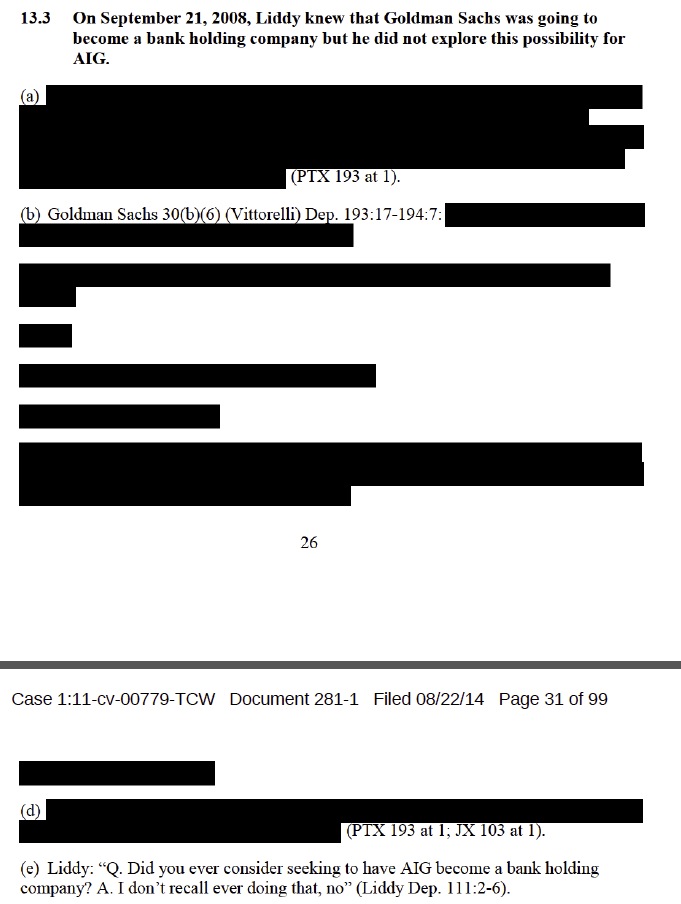
The “Proposed Findings of Fact” document points out that GE, General Motors, and American Express all were permitted to take banking units they owned and turn them into bank holding companies in order to obtain access to bailout funds. Investment banks Goldman and Morgan Stanley were also allowed to form bank holding companies to facilitate the Fed support. Rodgin Cohen had asked the Fed if AIG could turn its thrift bank into a bank so as to also become a bank and get access to Fed lifelines. The answer was no.
And get a load of this:
Screen shot 2014-10-05 at 11.13.33 PM
As I said, there is more juicy material here. I strongly urge readers to dig in. I know this is only one side of a complicated picture. But given how much specific detail is marshaled in this AIG bailout trial filing, it is going to be interesting to see how the Paulson, Geithner and Bernanke justify the actions they took. Greenberg has always been seen as unlikely to win this case, but the government might find a victory to be more costly than it anticipated. 
Source

October 6, 2014

The US Dollar Is About To Inflict Carnage All Around The Planet

As I watch the euro losing another 1.3% against the dollar today, it’s now at $1.25, and down from close to $1.40 recently, it’s getting clearer all the time: the greenback is busy eating currencies and economies alive.

There is of course the fact that Abenomics in Japan is living up to its longstanding promise of utter failure. And there is Mario Draghi torn between two lovers, one the one hand the Germany/Austria camp – with France as a surprise third – who don’t want the ECB to buy up junk paper, and on the other hand those EU members whose sole road to survival inside the EU is for Draghi to buy up anything that even looks like it was once toilet paper.

But Japan and Europe have been in the economic doghouse for a long time. It wasn’t until the Fed pulled the trigger on the dollar steamroller that they started paying the real price for it.

Japan, at least as long as it chooses to cling to the growth fairy, has nowhere to turn but to something in the vein of Abenomics, i.e. huge money and credit expansion. But it’s not the money supply, no matter how it’s defined, that is the problem, it’s that people refuse to spend. And if people don’t spend, no government or central banks has a way to boost inflation. Why they should want to in the first place is another question.

Europe has the added problem of disagreement on how to escape the walls that are closing in. And the more they close in, the less comfortable the shared living space on the old continent becomes. With a bit of imagination, you can see different people, different cultures, different languages, and different economies, all forced to live in the same ever shrinking – economic -space.

There’s less of everything to go around, and no-one wants to give up what’s theirs. Still, at the same time we already saw that two-thirds of Greeks live at or below the poverty line, and that Naples is even worse than Greece. Where do you personally think that will go? With a dollar that is set to make lots of things, not the least of which is oil and gas, more expensive?

It’s not just that for Europe, the growth fairy is evasive, their economies are bound to shrink a lot more still. And then what is Draghi, or his successor, supposed to do? The eurozone, and the EU itself, has already become a straightjacket with a noose attached to it, and that noose will start to tighten as we go forward. Brussels and Frankfurt can spin all they want – and do they ever -, but they can’t squeeze milk out of a deceased goat.

No matter what side of which fence you’re sitting on here, you have to give it to the Fed and Wall Street, though: their timing is impeccable. Victim no. 1 of the "Dollar is King"-move are the emerging markets:

The yen’s slide to a six-year low is amplifying a rout in emerging-market stocks as investors shift their focus to Japanese companies with earnings in dollars, according to Morgan Stanley. The MSCI Emerging Market Index tumbled 7.6% in September, the most since May 2012, led by China and Hong Kong. That compares with a 3.8% drop for the Topix Index in the period. The yen depreciated 5.1% versus the dollar to the weakest level since August 2008 last month, while a gauge tracking developing-nation currencies retreated 3.8%. “Asset allocation away from emerging markets was in part because Japan was back and that yen weakness is a positive catalyst,” Jonathan Garner, Hong Kong-based head of Asia and emerging-market strategy at Morgan Stanley, said by phone on Sept. 25.

“We don’t have a large export-industrial dollar earnings sector for EM, while Japan’s corporate-sector earnings responded positively to yen weakness.” Japan’s exporters are benefiting from a weaker currency, which boosts overseas income when repatriated, while developing-nation assets have come under pressure as the prospect for higher Federal Reserve interest rates dents demand for riskier assets. Toyota, the world’s biggest carmaker by market value which derives most of its revenue from the U.S., rallied 9% last month. Net inflows to U.S. exchange-traded funds that invest in emerging-markets tumbled 82% to $977.9 million in September, led by a 90% decline to China and Hong Kong, data compiled by Bloomberg show.
And the weak yen has long since stopped boosting Japan in a net, overall, sense:

After ticking just above 110.00, USDJPY has been a one-way street lower and that means only one thing… Japanese stocks are cratering. From Friday’s highs, The Nikkei 225 has crashed over 1000 points (despite Abe’s promises yet again of more pension reform buying of stocks). Of note, perhaps, is that, Japanese investors bought a net $3.6 billion of foreign stocks last week – the most since January 2009 – perfectly top-ticking global equities… Well played Mrs. Watanabe.
And:

When the Japanese yen began its long descent in late 2012 — around the time it became clear Shinzo Abe would be elected to another prime-ministership — the executives running Japan’s top corporations seemed to believe that the lower the currency, the better, regardless of all else. But since then, the yen has trekked steadily, inexorably downward against the dollar, with the greenback rising from around ¥78 two years ago to ¥110 earlier this week. And, at least according to a Nikkei news survey out Friday, some senior corporate officers are having second thoughts about the race to the bottom for forex. [..] … not a single CFO said they wanted to see the dollar breach above ¥115.
And also:

The yen’s steepest decline in 20 months is prompting concern in Japan that the central bank’s support for a weaker currency may hurt consumers and companies. Monetary authorities intervention to curb the slump is “possible,” according to Hirohisa Fujii, a former finance minister and member of the opposition party, after the currency’s steepest drop last month since January 2013. Some companies are suffering from the weaker yen, Nobuhide Minorikawa, Japan’s vice finance minister said this week [..] The chorus of dissent against the Bank of Japan’s accommodative monetary policy [..] is growing louder, as consumer prices remain depressed and growth is anemic. The weaker yen puts Japan at risk of recession, Kazumasa Iwata, deputy governor of the central bank until 2008, warned last month.

“The whole notion of devaluing the currency has been a bad policy,” Robert Sinche, a global strategist at Pierpont Securities, said. [..] BOJ Governor Haruhiko Kuroda said last month, after the dollar rose above 109 yen, that he didn’t see any big problems with current movements in exchange rates.
You have to like the suggestion that “The weaker yen puts Japan at risk of recession”. Tokyo may want to pick whatever stats they like, but it should be obvious that Japan, like the EU, is in a recession, not at risk of one. Take a look:

The weakening yen is starting to squeeze Japanese consumers as prices rise for everything from Burgundy wine to instant noodles, threatening Prime Minister Shinzo Abe’s plans to revive the country’s economy. The currency slid to 110 yen to the dollar yesterday, the lowest level in six years, making imported goods and materials more expensive. Though inflation is one of Abe’s monetary goals, the yen’s sharp slide undermines steps to boost consumer spending and endangers public backing for his economic program.

[..] The success of Abe’s plans for a sustained economic recovery after two decades of stagnation depends on consumers, since they account for about 60% of GDP. They’ve turned cautious as the sales tax rose and companies, including many that profited from the weaker yen, have failed to raise wages enough to keep up with inflation.

Supermarket sales fell for a 5th straight month in August, following an April jump in the consumption tax to 8% from 5%. Wages adjusted for inflation fell 2.6% in August from a year earlier, the 14th straight monthly decline …

Nissin Food Products, inventor of the world’s first instant noodles, is increasing their price in January and Ueshima Coffee Co., Japan’s biggest supplier of beans to retailers, will sell them for 25% more from November

[..] Abe, who must decide whether to raise Japan’s sales tax to 10% as planned next year. The increase this April plunged the economy into its deepest contraction in five years as the government tries to cap gains in the developed world’s highest debt burden.

Japan’s biggest employers, including Toyota, Hitachi and Panasonic, have benefited from the yen’s drop. A weaker currency makes their exports more competitive and increases the value of overseas earnings when converted into yen. Japanese companies’ pretax profit rose to a record 17.5 trillion yen ($161 billion) in the quarter ended March 31, according to figures from the finance ministry.

In the five years prior to Abe’s call for unprecedented monetary easing, the Japanese currency averaged 85.69 yen to the dollar and never rose above 93.03 yen, prompting manufacturers to move production out of the country and fueling declines in consumer prices.

The yen’s drop since Abe started his campaign to become prime minister helped fuel a 23% gain in the benchmark Nikkei 225 Stock Average in 2012, followed by a 57% surge last year, the biggest annual gain since 1972.

Abe’s failure so far to broaden the recovery beyond the direct benefits of a weaker currency and unprecedented monetary easing has damped enthusiasm, leaving the Nikkei down 1.3% this year, as of yesterday. Fast Retailing, which is Asia’s largest clothing retailer and accounts for 8.9% of the Nikkei, has fallen 15% this year. Aeon Co., the nation’s largest retailer, is down 22%.

Japan’s GDP shrank an annualized 7.1% in the April-to-June period, the most since the first quarter of 2009.

“The impact to the overall economy is not necessarily all positive; rather, negatives may be outweighing,” Kazumasa Iwata, the BoJ deputy from 2003-2008, said.

Japanese consumers have started to expect that imported foods will become too pricey. “I don’t go to import food shops much recently,” said Kazuha Hemmi, who works in the overseas section of a company in Tokyo. “Some of them stopped selling bargain products.”
“Not necessarily all positive”. Now there’s a dead spin. Any country that sees a 7.1% drop in GDP, no matter what sales tax changes, is in very serious trouble. The nation’s largest retailer is down 22% (!) Want to try that on for size at WalMart?

And then there’s Europe. Where plenty folk probably think they’re in some lower euro honeymoon still. Today, EU exchanges are up 1% or so. While the euro loses big. I suggest these happy shiny people should check on Japan to see what’s in store.

Broad European stocks plunged into the red for 2014 today as a rattled Mario Draghi disappointed a hungry-for-more risk market. Bloomberg’s BE500 index dropped its most since June 2013 to 2-month lows led by weakness in Italian banks. UK stocks underperformed (-3.6%) but Spain, Italy, and Portugal all tumbled 2-3%. The selling pressure interestingly stayed in stocks as bond spreads rose only modestly and EURUSD roundtripped to only a small rise from pre-ECB. Notably, US equities are cratering as they are so used to the pre-EU-close pump that did not happen.
Draghi’s plan to buy Toilet Paper Backed Securities is dead is a dead in the water as it is on dry land:

France’s Christian Noyer joined European Central Bank policy makers from Germany and Austria in opposing a program to buy asset-backed securities, according to two euro-area officials. His dissent leaves President Mario Draghi facing a clash with policy makers from the region’s two largest economies, albeit for different reasons. While Noyer disapproved of the way the purchases will be conducted, Austrian central bank Governor Ewald Nowotny shared Bundesbank President Jens Weidmann’s view that the measure involves too much balance-sheet risk, said the people, who asked not to be identified because the talks are private.
 
Draghi unveiled details of the program yesterday, pledging to buy both covered bonds and ABS before the end of the year. He shied away from a definitive goal for the plan, saying total stimulus may fall short of the 1 trillion euros ($1.3 trillion) he had signaled in September. Noyer opposed the design of the program because it will exclude national central banks from its implementation …
And there’s more to that:

European stocks have suffered the steepest one-day fall in 15 months after the European Central Bank retreated from pledges for a €1 trillion blitz of stimulus and failed to clarify the scale of quantitative easing. The sell-off came amid a mounting political storm in Europe as leading German economists and jurists reacted with fury to the ECB’s first asset purchases, denouncing the move as monetary debauchery, and threatening a blizzard of lawsuits in the German courts. “Our worst fears are being fulfilled,” said Hans Werner Sinn, head of Germany’s IFO Institute. The Milan bourse tumbled almost 4pc, led by sharp falls in Italian banks counting on fresh ECB liquidity. [..]

Mario Draghi, the ECB’s president, seemed unable to secure backing for far-reaching measures from Germany’s two ECB members or from the German finance ministry, forcing him to play down earlier hints for a €1 trillion boost to the ECB’s balance sheet. As he spoke inside a renaissance palace in Naples, riot police doused crowds of protesters on the street outside with water cannon. The city has become a political cauldron, with the highest “misery index” Europe. Youth unemployment in Italy’s Mezzogiorno is still rising, topping 56pc in the second quarter. Mr Draghi said the ECB would start to buy covered bonds and asset-backed securities (ABS) as soon as this month, but gave no concrete figure and deflected all questions on the scope of stimulus.

“I wouldn’t want to emphasise the balance sheet size per se,” he said. Sovereign bond strategist Nicholas Spiro said the ECB was “backtracking” on earlier pledges and seemed to be losing confidence in its ability to halt deflation at all. “Mr Draghi is facing a severe credibility problem,” he said.
It’s not just Draghi, the entire EU leadership has a severe credibility problem. With – seemingly – nothing left on the economical front that member nations can agree on, other than there’s a huge and imminent disaster waiting in the wings, what ways forward are available? There’s only one, really: split up the whole caboodle in as amicable a divorce as you can muster, and then try to stay friends.

But even that doesn’t seem likely, at all. A split-up of the EU would obviously be grossly costly, and the lion’s share of those costs would have to be borne by the richer north. But the richer north, too, is getting poorer fast. So what campaign slogan do you think will win out in the next election in Germany, France etc?

Will it be: let’s pay for Greek debts, so they can have a good life again? Or will it be: let them cook in their own fat, so we can party on for a while longer in Berlin and Paris?

I think you know the answer. So does Albert Edwards. And he includes the US, and China, in his dark panorama for good measure. And he’s right of course

The Japanese yen goes into freefall. China’s fragile economy tips over the edge. A wave of profit-crushing deflation comes washing over the U.S. and Europe. Investors panic. That’s the view of perennial pessimist Albert Edwards. The London-based analyst and his team at investment bank Societe Generale SA have been ranked No. 1 for global strategy in surveys by Thomson Reuters Extel every year since 2007, even with a history of saying unpleasant things that few want to hear. “My role is to step back from the excessive enthusiasm that builds up in the market, and to just say, ‘This is wrong. This is going to go horribly wrong,’” the 53-year-old said by phone last week. The cliche is that when the U.S. sneezes, Japan catches a cold. Edwards says Japan is just as apt to lead the way.

When the Internet bubble burst in 2000, Japan’s tech-heavy Jasdaq index started to slide weeks before the Nasdaq. Japan also pioneered the deflation that now threatens the West. In 1997, it was a plunging yen that helped trigger Asia’s currency crisis. With the yen’s drop this week to a six-year low of 110 versus the dollar, Japan’s currency may once again be the first domino to fall in a chain of events that could be bad for everyone, according to Edwards. The U.S. stock market rally has been going for 66 months since the financial crisis bottomed in March 2009, a streak that’s already a year longer than average. A disconnect between buoyant equity prices and corporate profit growth in the low single-digits makes the situation especially precarious. “Almost 100% of investors think we’re at the start of a long recovery,” Edwards said.

“It’s already a long recovery. Forget about starting from here.” In an hour-long interview, during which he made the global economy sound like a game of Mousetrap, Edwards explained why investors should be watching Japan for clues about what may happen in the next big trouble-spot: China, whose economy is already headed for its slowest full-year growth since 1990. The argument was this: if the yen falls, it will take other Asian currencies down with it. Eventually China will be forced to weaken the yuan, by adjusting its trading range and expanding its money supply, to keep its exports competitive. That will squeeze developed economies that have yet to fully recover from the financial crisis.

[..] In 2006, when the S&P 500 was rising ever higher and then-Fed Chairman Alan Greenspan was being feted as “the Maestro,” Edwards called him “an economic war criminal.” Two years later financial markets were in crisis. Edwards’ aversion to equities stems from watching the experience of Japan, where the market took more than two decades to find a bottom after the 1989 bust. According to Edwards’ view, it’s a template for the extended bear market that will unfold in the U.S. and Europe, as stocks recover only to crash again and plumb ever-new lows. “What happened in March 2009, when the S&P 500 touched 666, that was just a brief stop,” he said. “We will go lower than that.” The structural bear market ends when equities are dirt cheap.”
More Albert Edwards:

Inflation expectations in the US have just followed the eurozone by plunging lower. Until very recently, the Fed and the ECB had been quite successful at keeping inflation expectations in their normal range – this despite their clear failure to control actual inflation itself, which has consistently undershot expectations. Investors are beginning to realise that contrary to their confident actions and assurances, the Fed and the ECB have failed to prevent a dreaded replay of Japan’s deflationary template a decade earlier in the West.

The Ice Age is once again about to exert its frosty embrace on markets as investors wake up to a new and colder reality. There were two key parts to our Ice Age thesis. First, that the West would drift ever closer to outright deflation, following Japan’s template a decade earlier. And second, financial markets would adjust in the same way as in Japan. Government bonds would re-rate in absolute and relative terms compared to equities, which would also de-rate in absolute terms. [..]

Another associated element of the Ice Age we also saw in Japan is that with each cyclical upturn, equity investors have assumed with child-like innocence, that central banks have somehow ‘fixed’ the problem and we were back in a self-sustaining recovery. Those hopes would only be crushed as the next cyclical downturn took inflation, bond yields and equity valuations to new destructive lows. In the Ice Age, hope is the biggest enemy.

[..] “amid the inevitable impending global economic and financial carnage, when people, like Queen Elizabeth ask, as she did in November 2008, why no-one saw this coming, tell them that many did. But just like in 2006, before the Great Recession, investors once again chose to tilt their ears towards the reassuring siren songs of the Central Bankers and away from the increasingly hysterical ramblings of the perma-bears and doomsayers.”
Down the line, the insane debt levels all around the globe will do in everyone. That goes for, in order of appearance, Japan, Europe, China and the USA. An order that can still be shaken up by various kinds of unrest and other black swans. Hong Kong protests, Catalunya, a country voting to leave the EU, there are too many options to mention.

But aside from these, Japan looks the furthest gone, with 400%+ debt to GDP and rapidly rising. Europe is a good second, because of debt levels AND the difference in wealth between rich and poor member nations AND all the other differences between rich and poor member nations.

China is a bit of an odd one out, it has room to move, but it also committed to $25 trillion in new debt in just a few years, without anything solid to show for it except apartment buildings that can only go down in price and bridges to a nowhere nobody wants to go to. And then there’s dozens of emerging nations with nowhere to go but down.

For the US, it’s now shooting fish in a barrel – but just for now. The three-pronged plan the Fed has started to execute is plain for everyone to see:
1) Stop QE. This hauls back in to the US dollars from around the planet, from a million parties that owe debt denominated in USD. Already happening at a frantic pace, though no-one involved would advertize it.

2) Raise the value of the greenback. This makes it that more expensive for all parties under 1) to pay off their debts. They have to offer ever more just to stand still. And when they can’t, assets will be confiscated.

3) Raise interest rates. The final blow. It will make life much harder on the US government too, but they’ll have trillions of dollars flowing in to cope with that. It’ll put millions of Americans into the equivalent of medieval torture instruments, and out of their homes and cars and jobs, but that too will be initially softened by the dollars coming home to papa. Crucial take home: they’ve given up on the US real economy, likely a long time ago.
And it will have the rest of the world begging for mercy. In that regard, it’s funny to see Britain planning to raise its rates too. Do be careful what you wish for there, lads.

The full taper of QE means everyone needs dollars, and most who do are leveraged to the hilt, while the combination of higher interest rates and higher dollar value means the buck will come much more expensive.

It’s going to be carnage out there.

October 3, 2014

Europe's Losing Battle For Recovery

The wobble in world markets continues, with stock indices across all time zones down steeply in recent sessions. Investors are not only realigning their exposure in anticipation of tighter liquidity conditions as the US Federal Reserve finally brings its asset purchases to a close later this month. After today’s European Central Bank (ECB) meeting they are also looking nervously at the magnitude of the task facing eurozone policymakers. And they appear to be coming to the conclusion that generating a rebound in growth may be too tough a job for Europe’s leaders to accomplish in the near term.

With France and Italy - the eurozone’s second and third biggest economies - either stagnating or contracting, to achieve a convincing recovery will require policymakers to press home their attack on three fronts: structural reform to increase economic flexibility, fiscal easing to stimulate activity, and monetary expansion to support credit growth. On all three fronts they face determined opposition.
Structural reform: On Sunday President Francois Hollande’s ruling Socialist Party lost control of the Senate to France’s center-right Union for Popular Movement (UMP) party, a development which will only complicate the implementation of reform plans already facing staunch resistance from strikers in the transport, manufacturing and service sectors. Meanwhile Italy’s three most powerful trade unions agreed on Monday to form a united front in opposition to Prime Minster Matteo Renzi’s proposed Jobs Act. Worse, Renzi has failed to win over the left wing of his own party, which accuses him of slavish obedience to Berlin’s policy diktat. Although the party’s senior leadership pledged its support for the bill this week, a possible showdown in the Senate on October 7 could still see key reform proposals significantly watered down.

Fiscal policy: In recent days both France and Italy have revised their deficit reduction targets. Yesterday French Finance Minister Michel Sapin rejected austerity, saying Paris will not bring its deficit below 3% of GDP until 2017, two years later than it earlier targeted. The Italian government this week also pushed back the date when it expects to balance its books, postponing its target by a year. The two governments face an uphill struggle in selling their delayed targets in Brussels and Berlin, however. The recent appointment of France’s former finance minister, Pierre Moscovici, as Europe’s economics and financial affairs commissioner with the key role of approving national budgets had raised hopes that France and Italy would be given greater flexibility in meeting fiscal targets. But in a surprise move this week Commission President Jean-Claude Juncker curbed Moscovici’s powers, appointing hawkish Latvian commissioner Valdis Dombrovskis to oversee and sign off Moscovici’s budget approvals. The move was widely seen as aimed at placating opinion in Berlin, where Chancellor Angela Merkel is uneasily watching the rise in popularity of anti-European political part, anti-euro party (AfD). Although AfD is still small, the threat of losing voters to Germany’s Euro-skeptic right will only encourage the chancellor to take a tough line with France and Italy over fiscal policy, especially in the absence of significant progress on structural reform.

Monetary policy: Investors are looking to ECB president Mario Draghi to announce details of a major program of asset-backed securities purchases at the central bank’s meeting today. However, given the insistence of the Bundesbank that the ECB should only buy superior quality investment grade securities and the reluctance of the German and French finance ministries to back ECB purchases with government guarantees, there is a clear risk that markets will find Draghi’s program deeply underwhelming. To make things even more difficult, on October 14 the European Court of Justice is set to rule on the legality of the ECB’s proposed Outright Monetary Transactions program of secondary market sovereign bond purchases. A decision against the program would effectively rule out the possibility of full-blown quantitative easing in Europe.
With efforts to procure a European recovery belabored on all three fronts, and prospects for eurozone corporate earnings set to disappoint, it should be no surprise that investors are jittery. The only bright spot for Europe at the moment is the weakness of the euro, which has fallen nearly 10% against the US dollar since May; a decline that will both help to support eurozone exporters and to ease disinflationary pressure.

As the US moves closer to tightening monetary policy and with European policymakers facing an uphill struggle in their efforts to generate a recovery, the decline in the euro looks set to continue. 

October 2, 2014

Debt Demise Is Cooked Into Current Market Mania?

Mass default looms as world sinks beneath a sea of debt ... As if the fast degenerating geo-political situation isn't bad enough, here's another lorry load of concerns to add to the pile. The UK and US economies may be on the mend at last, but that's not the pattern elsewhere. On a global level, growth is being steadily drowned under a rising tide of debt, threatening renewed financial crisis, a continued squeeze to living standards, and eventual mass default. I exaggerate only a little in depicting this apocalyptic view of the future as the conclusion of the latest "Geneva Report", an annual assessment informed by a top drawer conference of leading decision makers and economic thinkers of the big challenges facing the global economy. – UK Telegraph 

Dominant Social Theme: The markets need to float a lot of debt. 

Free-Market Analysis: There is nothing in this world today that provides much comfort for a rational investor – in the long term. 

In the short term, as we have argued, this expanding Wall Street Party may provide a last chance for significant, individual investment gains. More on that below. 

We are told that economies are "recovering" – and this Telegraph article excerpt mentions that, but the main point here, one we agree with, is that sovereign debt continues to rise and has not been paid down. 

 Eventually, the article tells us, lenders will realize that debt levels are unsupportable and averages will reverse. 

Here's more: 

Aptly titled "Deleveraging? What Deleveraging?", the report points out that, far from paying down debt since the financial crisis of 2008/9, the world economy as a whole has in fact geared up even further. 

The raw numbers make explosive reading. Contrary to widely held assumptions, the world has not yet begun to de-lever. In fact global debt-to-GDP – public and private non financial debt - is still growing, breaking new highs by the month. 

There was a brief pause at the height of the crisis, but then the rise in the global debt-GDP ratio resumed, reaching nearly 220c of global GDP over the past year. Much of the more recent growth in this headline figure has been driven by China, which in response to the crisis, unleashed a massive expansion in credit. ... 

The UK remains the fourth most highly indebted major economy in the world after Japan, Sweden and Canada, with total non financial debt of 276pc of GDP. The US is not far behind with debt of 264pc of GDP. However, the real stand-out is China, which since the crisis began has seen debt spiral from a very manageable 140pc of GDP to 220pc and rising. 

This is obviously still lower than many developed economies, but the speed of the increase, combined with the fact that it is largely private sector debt, makes a hard landing virtually inevitable. The only way the world can keep growing, it would appear, is by piling on debt. Not good, not good at all. 

The article also points out that increased debt loads may play a role in depressing growth generally. Certainly, this would be the case if a given nation seeks to raise taxes (as some are doing) to try to control deficit. 

The US is mentioned (along with the UK) as a country that has managed to extricate itself from some potential financial difficulties through a "recovery." But there are numerous questions about the strength and duration of this recovery. And in the meantime, the debt levels of the US keep climbing. 

Here, from Michael Snyder at alternative media website Economic Collapse: 

I know [this] sounds completely outrageous. But ... the U.S. government is borrowing about 8 trillion dollars a year, and you are about to see the hard numbers that prove this. When discussing the national debt, most people tend to only focus on the amount that it increases each 12 months. And as I wrote about recently, the U.S. national debt has increased by more than a trillion dollars in fiscal year 2014. 

But that does not count the huge amounts of U.S. Treasury securities that the federal government must redeem each year. When these debt instruments hit their maturity date, the U.S. government must pay them off. This is done by borrowing more money to pay off the previous debts. In fiscal year 2013, redemptions of U.S. Treasury securities totaled $7,546,726,000,000 and new debt totaling $8,323,949,000,000 was issued. The final numbers for fiscal year 2014 are likely to be significantly higher than that. 

Snyder suggests that the reason for so much borrowing is because US fedgov has been borrowing in shorter increments because the carrying costs are so much less. But this means that the money rolls over year-to-year and government must borrow again and again. 

It is hard to say whether the difficulties that Western governments (and Asian ones like China and Japan) face are deliberate or not. We're well aware that governments in Europe were encouraged to borrow by various European banks, and in the US, a series of wars and expensive domestic programs under President George Bush destabilized the US economy. 

In Europe, as we've long reported, top Eurocrats long ago made statements that European unity would only be enhanced by significant crises. It was surely anticipated that the rigidity of the euro would precipitate an ongoing crisis because individual central banks could not devalue separately, putting Southern Europe at a disadvantage relative to the North. 

EU's Prodi Admits Leaders Knew Euro Would Cause Ruin but Hoped Political Union Would Follow

Leave aside the apparent manufacture of the current crisis and we face an important point: Whatever small momentum Western economies have accumulated is due in large part to central bank money printing and subsequent stock market activity. 

Central bank super money flows to commercial bank distributor channels and thence mostly to large corporations. Top executives and company portfolio managers benefit the most from such funds – which often find their way into stock markets. 

As stocks go up, certain asset bubbles are ignited in real estate, art, yachting, etc. The hope is that high-end asset bubbles eventually generate economic activity at lower levels – a kind of trickle-down theory. 

This is certainly what's going on today. But as the Telegraph article points out, high levels of debt are making this strategy increasingly dubious. If the larger economic scene cannot be ignited from the top down, then there are few weapons left for central banks to use. 

Pump priming, the idea that government can generate increased economic activity via job generation, etc., might be more viable (conceptually, anyway, from a Keynesian standpoint) were such programs not inordinately expensive. But they are – and thus their pursuit will only add further to debt expansion. 

We are left to conclude as we have before that this market will continue as long as it can and those behind it, especially the central banks, will spread it as widely as possible before everything crashes down. 

There is a good possibility, if the market survives October, that it may run on into the new year, even deep into the new year. If this happens, a kind of mania cannot be far behind. 

For this reason, we've been suggesting the possibility that individuals seek some modest exposure to the market in areas where they see promise – so long as they are adequately hedged and diversified. 

There may never come a market like this again, or not for a significant time period. It won't last forever. 

What this Telegraph article surely reinforces is that at some point a spiraling decline is "cooked" into today's market and that when the current market unwinds, the world's larger economy will likely unwind with it. 

This will provide a prime opportunity for globalist forces to agitate for yet further centralization of markets, banking and currencies – and we will be surprised if they do not take advantage of it.

Conclusion 

Time will prove our suspicions right or wrong. Either way, we don't look forward to finding out. 

Source

October 1, 2014

SECRET TAPES – NY FED Helping Wall Street BANKSTERS – Matt Taibbi And Alexis Goldstein

Carmen Segarra, a former NY Fed regulator, went public on “This American Life” radio with secret recordings. The recordings raise questions over whether the Federal Reserve has gotten any tougher on the big banks it is supposed to regulate. With Matt Taibbi and Alexis Goldstein.

From ALL IN, MSNBC, Ari Melber in for Chris Hayes.
34 Total Views 5 Views Today