Local traders in the CME Group Inc. (CME)’s Eurodollar options pit walked off the job today to protest a block trade yesterday.
“These guys that stand in there all day and make prices would have loved to participate in that particular price, but they weren’t able to,” Rocco Chierici, a broker at R.J. O’Brien & Associates on the floor of the Chicago Mercantile Exchange, said in a telephone interview.
Prices for the block trades of options on Eurodollar futures were higher than offers in the pit, which wouldn’t be allowed in open-outcry trading, Chierici said. Local traders buy and sell for their own account and in the process help add liquidity to a market. Block trades are privately negotiated transactions that are conducted outside the normal pit or via computer-based trading systems used by exchanges.
“There are rules that prohibit that in the pit, but you can circumvent the pit” in a block trade, Chierici said. “I believe they wanted to make the point that the system is not fair.”
Six block trades totaling 215,200 options traded at 8:11 a.m. Chicago time yesterday, according to CME Group’s website. The trade was rolling positions from April contracts, which expired today, into June contracts.
‘Longstanding Rules’
“The block trade in question was managed by longstanding rules and processes of our exchanges,” Michael Shore, a CME Group spokesman, said in an e-mail. “It was a legitimate, well- managed trade, which was executed within one tick of the market and in one trade.”
Other traders continued to help buy and sell options on Eurodollars, which are contracts tied to three-month expectations for interest rates, Shore said.
While volume has been down recently, the walk-off cut the number of orders to buy and sell today, Chierici said. “There was a small drop because a lot of the volume is local,” he said.
CME Group has seen demand for Eurodollars, once the largest contract by volume, fall as the Federal Reserve has kept its benchmark interest rate near zero since December 2008. Eurodollar options volume last month averaged 811,000 contracts per day, compared with 1.3 million on average in the same month in 2007, according to CME statements.

DAILY BUSINESS REPORT - Financial Updates, International Markets and Business News


April 13, 2012
Why The Market Is Praying The Fed Does Not Plug Its Heavy Flow
As we have recently pointed out (here), the exponential level of global central bank one-upmanship has created a level of dependency in capital markets never seen so obviously before. Critically, though, it is not the sheer scale of the balance sheet (or STOCK of assets) that is good enough anymore - equity market performance is all about the marginal change in that stock (FLOW). Nowhere is this "It's The Flow Stupid" better highlighted than in the chart below showing the periods of central bank balance sheet expansion coinciding almost perfectly with the largest surges in equity market performance. Furthermore, as the flow fades so the performance starts to fade (unable to counter the natural tendency of retail to exit the risky markets perhaps) and as the Fed's balance sheet begins to actually compress marginally (as it has the last few weeks), so equity market performance has turned negative - and notably so. This leaves the Fed with the dilemma that it is not just about the size of the bazooka anymore but the frequency with which you are willing to use it - and as we are likely to see this week - jaw-boning alone will not do the trick (no matter what today's market might have been hoping for) as unless we see the balance sheet of the Fed expand again (which would mean a rise of around 0.4% - something we haven't seen since mid February), we should expect the rolling 4-week performance of equities to continue to fall.
Fed Balance Sheet FLOW...

The heavy 'positive' flow from late November (green oval), surged equity markets. Their performance (green arrow) has not been better than at that time for the last five months.
As that flow faded to light marginal flow (orange oval), then rolling performance (orange arrow) started to wane.
Interesting side-note that this week and last are the first to see a negative rolling four-week performance (red arrow) since the rally began which coincides with an extended period of Fed balance sheet compression (negative flow - red oval).
Or an alternative is the Aggregate Monetary Base FLOW...

which is perhaps even more closely-related?
Fed Balance Sheet FLOW...

The heavy 'positive' flow from late November (green oval), surged equity markets. Their performance (green arrow) has not been better than at that time for the last five months.
As that flow faded to light marginal flow (orange oval), then rolling performance (orange arrow) started to wane.
Interesting side-note that this week and last are the first to see a negative rolling four-week performance (red arrow) since the rally began which coincides with an extended period of Fed balance sheet compression (negative flow - red oval).
Or an alternative is the Aggregate Monetary Base FLOW...

which is perhaps even more closely-related?
April 12, 2012
Regulators Build Too-Big-to-Fail Empire
Do Regulators Know Who the SIFIs Are? ... A little-noticed sentence in the 93-page regulation top U.S. regulators approved last week suggests officials could be well down the path to figuring out which firms pose a threat to the financial system. Under Dodd-Frank, regulators must pick out which financial firms — other than banks — are so big, complex, and interconnected that they warrant tougher oversight because their failure could rock the wider system. Last week, regulators comprising the so-called Financial Stability Oversight Council finalized the three-stage process they'll use to identify which hedge funds, insurers, private equity firms and other nonbanks deserve the designation. (Banks with at least $50 billion in assets automatically get slapped with tougher oversight.) Here's the key line: "Based on data currently available to the Council through existing public and regulatory sources, the Council has estimated that fewer than 50 nonbank financial companies meet the Stage 1 thresholds." – Wall Street Journal
Dominant Social Theme: These Too-Big-Fail corporations and financial firms must be supported by the government and by the people's taxes.
Free-Market Analysis: It used to be in the US that you were on your own, at least when it came to building a business. If it succeeded, great – if not, then ... too bad.
But not anymore. Now there are too-big-too-fail companies that are so designated by the US regulatory authorities. These are companies that must be supported by the US taxpayer because if they topple, the system as it is currently positioned will topple, too.
This is merely an expansion of the US ideology of empire, so it can't be too surprising. But nonetheless it is further unwelcome evidence that the US has in a sene passed the point of no return. Ther tipping point has been reached. The rulers have seized the initiative. The ruled are being despoiled.
The best thing that could happen now would be for the system to essentially disintegrate. It will anyway. Why prolong the agony?
We encourage the toppling ... metaphorically, not violently. It is not that we wish havoc for America or the West but we see a real crisis as the only way to move the West toward sanity again and away from the global governance seemingly sought by the elites.
One could argue that chaos is what the elites want – because out of chaos comes order ... a New World Order. But the elites, in our view, want chaos that is controlled on their terms.
These dynastic families and their enablers and associates apparently control central banking around the world and want to create global government. They use mercantilism – passing laws and regulations that aid their control – to ensure that events move in a certain direction. We've taken to calling this directed history.
The power elite has created the current financial system, in our view, and controls government and regulators as well. They do not want the current system to founder and fail.
But the current system is THEIR system, designed to maximize control and move the world toward global government. The too-big-to-fail approach is basically a dominant social theme.
The elites use these memes to frighten middle classes into giving up power and wealth to specially designed international facilities the elites control. But now they are taking it a step further. Having caused a rolling economic depression in the West, the elites now propound the theme that society as a whole must support its purposefully failing institutions.
The same toxic mix of regulators, central banks and financial firms that created the economic mess are now to conspire together to ensure that the worst of the failing institutions are to be propped up at any cost.
This is, in fact, a kind of communism. It is beyond fascism, even. The state is not merely merging its authority with private enterprise; it is basically taking over these entities in a regulatory way. There shall be a fundamental blurring between regulatory and private market lines.
Of course, one could argue that in the big picture, this is just what was intended. The USSR and the US were apparently purposeful different sides of the dialectic. The USSR was perhaps "taken down" and moved toward a "capitalist" model. Now it is perhaps the turn of the US to move toward a communist one.
The "synthesis" continues preparatory to a greater merger, or so "conspiratorial historians" might argue. What is certainly true is that the US regulatory structure with the consent of Congress is building a kind of communist infrastructure under the noses of the American people. Here's some more from the article:
There's a universe of fewer than 50 firms that will get scrutinized more closely in stage two to see if they deserve the dreaded "systemically important" label. The first stage sets out a variety of "quantitative thresholds" that will be used to filter out which firms go on to stage two, where regulators dig into firm specifics. ...
Of course "fewer than 50" is still pretty vague. But some observers believe that one little line in the rule means regulators may have informally started stage two well before the process was finalized. Regulators spent a total of 18 months creating the process, even though they made very few changes between an October draft and what they approved last week.
The firms wouldn't necessarily know if they'd passed on to stage two yet. Regulators rejected financial industry suggestions that they routinely notify all companies that enter stage two of the process; formal notice is only insured for firms that pass on to the third stage.
The rolling economic depression that is overtaking the West is surely the direct result of the artificial monetary distortions that central banks create every day. Monopoly central banking generates first booms and then busts. That's because those generating the paper money never know how much is too much.
But this monetary expansion is purposeful. It's been taking place for a century or more, and the system has expanded to 150 central banks. The idea that those behind the system don't understand its destructive potential is surely naive.
The system, with its booms and busts, constantly centralizes power ... first economic power and now legal power. The new regulations wil enshrine certain corporations into existence for perpetuity. But these are the very firms that SHOULD fail. They are part of a much larger financial bubble.
Central banking itself is a bubble, one that has gone "unpopped" for many decades. The too-big-to-fail firms are actually its distribution arm. The whole system needs to be purged, but instead it is being given a regulatory life-support.
Having created these distortions, the powers-that-be now propose to solve the problem by propping up failing entities with the full power of the state. This is supposed to be a "normal" evolution, given the larger state of affairs. We would argue that it is not. It is an elaboration of empire, and a purposeful one.
Unfortunately, the system has been cleverly designed to involve the average citizen in its midst via 401ks, stocks, options and other instruments and pension elements. This involvement makes individuals extremely concerned about the system as it is, and effectively damps a good deal of protest against what otherwise might be conceived as an increasingly unfair financial environment.
Conclusion: All this has been cleverly designed over time in our view. It is hardly a natural evolution. The object is not to salvage the system but to create elitist facilities divorced from the market's discipline. US citizens are watching, with varying degrees of passivity, as a formal corporate and regulatory elite is created, one with privileges beyond what any democratic society should be forced to endure.
Dominant Social Theme: These Too-Big-Fail corporations and financial firms must be supported by the government and by the people's taxes.
Free-Market Analysis: It used to be in the US that you were on your own, at least when it came to building a business. If it succeeded, great – if not, then ... too bad.
But not anymore. Now there are too-big-too-fail companies that are so designated by the US regulatory authorities. These are companies that must be supported by the US taxpayer because if they topple, the system as it is currently positioned will topple, too.
This is merely an expansion of the US ideology of empire, so it can't be too surprising. But nonetheless it is further unwelcome evidence that the US has in a sene passed the point of no return. Ther tipping point has been reached. The rulers have seized the initiative. The ruled are being despoiled.
The best thing that could happen now would be for the system to essentially disintegrate. It will anyway. Why prolong the agony?
We encourage the toppling ... metaphorically, not violently. It is not that we wish havoc for America or the West but we see a real crisis as the only way to move the West toward sanity again and away from the global governance seemingly sought by the elites.
One could argue that chaos is what the elites want – because out of chaos comes order ... a New World Order. But the elites, in our view, want chaos that is controlled on their terms.
These dynastic families and their enablers and associates apparently control central banking around the world and want to create global government. They use mercantilism – passing laws and regulations that aid their control – to ensure that events move in a certain direction. We've taken to calling this directed history.
The power elite has created the current financial system, in our view, and controls government and regulators as well. They do not want the current system to founder and fail.
But the current system is THEIR system, designed to maximize control and move the world toward global government. The too-big-to-fail approach is basically a dominant social theme.
The elites use these memes to frighten middle classes into giving up power and wealth to specially designed international facilities the elites control. But now they are taking it a step further. Having caused a rolling economic depression in the West, the elites now propound the theme that society as a whole must support its purposefully failing institutions.
The same toxic mix of regulators, central banks and financial firms that created the economic mess are now to conspire together to ensure that the worst of the failing institutions are to be propped up at any cost.
This is, in fact, a kind of communism. It is beyond fascism, even. The state is not merely merging its authority with private enterprise; it is basically taking over these entities in a regulatory way. There shall be a fundamental blurring between regulatory and private market lines.
Of course, one could argue that in the big picture, this is just what was intended. The USSR and the US were apparently purposeful different sides of the dialectic. The USSR was perhaps "taken down" and moved toward a "capitalist" model. Now it is perhaps the turn of the US to move toward a communist one.
The "synthesis" continues preparatory to a greater merger, or so "conspiratorial historians" might argue. What is certainly true is that the US regulatory structure with the consent of Congress is building a kind of communist infrastructure under the noses of the American people. Here's some more from the article:
There's a universe of fewer than 50 firms that will get scrutinized more closely in stage two to see if they deserve the dreaded "systemically important" label. The first stage sets out a variety of "quantitative thresholds" that will be used to filter out which firms go on to stage two, where regulators dig into firm specifics. ...
Of course "fewer than 50" is still pretty vague. But some observers believe that one little line in the rule means regulators may have informally started stage two well before the process was finalized. Regulators spent a total of 18 months creating the process, even though they made very few changes between an October draft and what they approved last week.
The firms wouldn't necessarily know if they'd passed on to stage two yet. Regulators rejected financial industry suggestions that they routinely notify all companies that enter stage two of the process; formal notice is only insured for firms that pass on to the third stage.
The rolling economic depression that is overtaking the West is surely the direct result of the artificial monetary distortions that central banks create every day. Monopoly central banking generates first booms and then busts. That's because those generating the paper money never know how much is too much.
But this monetary expansion is purposeful. It's been taking place for a century or more, and the system has expanded to 150 central banks. The idea that those behind the system don't understand its destructive potential is surely naive.
The system, with its booms and busts, constantly centralizes power ... first economic power and now legal power. The new regulations wil enshrine certain corporations into existence for perpetuity. But these are the very firms that SHOULD fail. They are part of a much larger financial bubble.
Central banking itself is a bubble, one that has gone "unpopped" for many decades. The too-big-to-fail firms are actually its distribution arm. The whole system needs to be purged, but instead it is being given a regulatory life-support.
Having created these distortions, the powers-that-be now propose to solve the problem by propping up failing entities with the full power of the state. This is supposed to be a "normal" evolution, given the larger state of affairs. We would argue that it is not. It is an elaboration of empire, and a purposeful one.
Unfortunately, the system has been cleverly designed to involve the average citizen in its midst via 401ks, stocks, options and other instruments and pension elements. This involvement makes individuals extremely concerned about the system as it is, and effectively damps a good deal of protest against what otherwise might be conceived as an increasingly unfair financial environment.
Conclusion: All this has been cleverly designed over time in our view. It is hardly a natural evolution. The object is not to salvage the system but to create elitist facilities divorced from the market's discipline. US citizens are watching, with varying degrees of passivity, as a formal corporate and regulatory elite is created, one with privileges beyond what any democratic society should be forced to endure.
April 11, 2012
The Shocking Truth About Unemployment In America In One Chart
The mainstream media is not telling you the truth about unemployment in the United States. The percentage of working age Americans that are employed is not increasing. In March 2010, 58.5 percent of all working age Americans had a job. In March 2012, 58.5 percent of all working age Americans had a job. So if the employment rate is exactly the same as it was two years ago, then how in the world can the Obama administration claim that things have gotten significantly better since then? According to the Bureau of Labor Statistics, the official unemployment rate in the United States was 9.8 percent in March 2010 and it declined to 8.2 percent in March 2012. So how is this possible if the percentage of working age Americans that have jobs hasn't moved? Well, what they do is they claim that there are millions upon millions of Americans that have "left the labor force". In other words, they claim that there are millions upon millions of unemployed Americans that don't want jobs anymore. Of course that is a total farce, but the mainstream media and most Americans are buying it. They actually believe that the unemployment rate is going down. But the truth is that the unemployment crisis in America has not subsided. In fact, we are pretty much exactly where we were two years ago, and things are about to get a whole lot worse.
If you want to know the shocking truth about unemployment in America, all you need to do is to look at one chart. The chart posted below shows the change in the employment-population ratio over the past few years. What the employment-population ratio measures is the percentage of working age Americans that actually have jobs. As you can see, it fell dramatically during 2008 and 2009, and since then it has been hovering between 58 and 59 percent....

So there has been no employment recovery, and this is very odd because the employment-population ratio always bounces back after a recession.
The chart posted below shows how the employment-population ratio has changed since the late 1940s. The shaded areas represent recessions. Please take note that after every single recession (other than the current one) the employment-population ratio has always bounced back substantially.

During the most recent recession, the employment-population ratio fell farther than it had during any other recession in the post-World War II era.
If these were normal economic times, it would have been reasonable to expect a huge surge in hiring by now.
But we have not seen that.
Instead, the employment rate in the United States has been remarkably flat for more than two years.
So Barack Obama should not even begin to say anything at all about a "recovery" until the employment rate at least breaks the 59 percent barrier.
In the past I have written about how fraudulent the employment statistics put out by the federal government are.
Well, fortunately there are some folks up on Capitol Hill that are starting to take notice of this phenomenon as well. There is a new bill in Congress that would change the way that the unemployment rate is calculated....
A Republican lawmaker is intensifying his push for legislation that would change how the government measures the unemployment rate.
Rep. Duncan Hunter (R-Calif.) intends to press GOP leaders to move his bill to include the number of individuals who gave up looking for work in the percentage of jobless claims.
Of course there is probably not a chance that such a bill would ever get through the Senate, but at least some lawmakers are trying to get people to notice what is going on.
The sad truth of the matter is that the employment crisis in America is still about as bad as it was a couple of years ago.
Do you remember a couple of months ago when Barack Obama spoke with the wife of an unemployed engineer and asked her to send his resume to the White House?
Well, it turns out that the unemployed engineer still doesn't have a job....
More than two months after President Barack Obama asked for Darin Wedel's résumé, the phone is quiet, e-mails are no longer flooding in and the long-sought-after job interviews -- which had begun to be scheduled -- have petered out.
"Not even recruiting companies are calling anymore," said Jennifer Wedel, the Fort Worth mother of two who chatted online this year with Obama about her out-of-work husband.
She says his job search has been hurt by a program to hire skilled foreign workers.
But Barack Obama is doing the same thing on a national level.
He is promising all of us that things are improving and that there will be lots of jobs for everyone soon, but it is all a lie.
The truth is that this period of relative stability that has been purchased by unprecedented levels of government debt will soon give way to even more economic trouble.
One of my readers recently brought to my attention a list of some of the major companies that are currently getting rid of workers....
Ford will be laying off 1,200 assembly line workers later on this month.
Pittsburgh-based paint and coating manufacturer PPG has announced that it will be laying off 2,000 workers.
J.C. Penney recently laid off 600 workers and has plans to lay off another 300 workers in July.
Lockheed Martin has announced that it will be laying off hundreds of workers.
Dow Chemical has announced that hundreds of workers are going to be laid off.
Yahoo has formally announced that it will be getting rid of about 2,000 workers.
Sony has announced plans to eliminate 10,000 jobs globally.
Even Oprah Winfrey is laying off workers. Oprah is reducing the size of the staff at the OWN network by 20 percent.
Meanwhile, our economy continues to bleed jobs at an astounding pace. At a time when American workers desperately need jobs, millions of them continue to be sent overseas.
In fact, even some jobs that you would think would be impossible to outsource are being given to foreigners. Just recently, ABC News did a major report on all of the roads and bridges all over the United States that are being built by Chinese companies. If you have not seen that report yet, you can view it online right here.
If you go into a Wal-Mart or a dollar store and you start turning over products you will find that huge numbers of them are made in China and that very few of them are made in the United States. China is absolutely dominating us on the global economic stage. Last year our trade deficit with China was the largest trade deficit that one nation has had with another nation in the history of the world. Yet we continue to pursue the exact same trade policies year after year.
So how is the American economy ever supposed to recover if we continue to play to lose?
As a nation we spend far more than we make, we consume far more than we produce and our federal government implements thousands of new business-crippling regulations every single year.
If you still have a good job, you should treasure it and you should try to hold on to it for as long as you can. Soon the next major economic downturn will be upon us and millions more Americans will lose their jobs and their homes.
Things did not have to turn out this way, but we made horribly bad decisions for decades and now the consequences are catching up with us.
You better get ready.
If you want to know the shocking truth about unemployment in America, all you need to do is to look at one chart. The chart posted below shows the change in the employment-population ratio over the past few years. What the employment-population ratio measures is the percentage of working age Americans that actually have jobs. As you can see, it fell dramatically during 2008 and 2009, and since then it has been hovering between 58 and 59 percent....
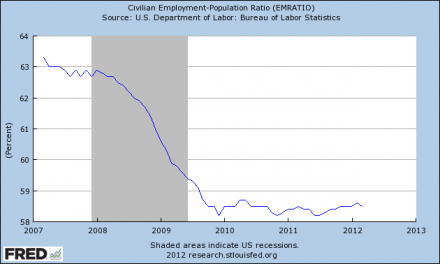
So there has been no employment recovery, and this is very odd because the employment-population ratio always bounces back after a recession.
The chart posted below shows how the employment-population ratio has changed since the late 1940s. The shaded areas represent recessions. Please take note that after every single recession (other than the current one) the employment-population ratio has always bounced back substantially.
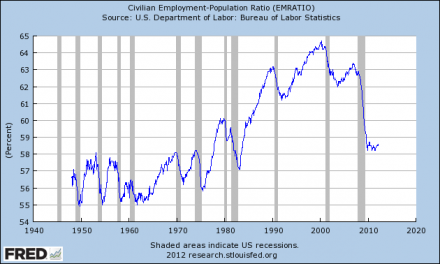
During the most recent recession, the employment-population ratio fell farther than it had during any other recession in the post-World War II era.
If these were normal economic times, it would have been reasonable to expect a huge surge in hiring by now.
But we have not seen that.
Instead, the employment rate in the United States has been remarkably flat for more than two years.
So Barack Obama should not even begin to say anything at all about a "recovery" until the employment rate at least breaks the 59 percent barrier.
In the past I have written about how fraudulent the employment statistics put out by the federal government are.
Well, fortunately there are some folks up on Capitol Hill that are starting to take notice of this phenomenon as well. There is a new bill in Congress that would change the way that the unemployment rate is calculated....
A Republican lawmaker is intensifying his push for legislation that would change how the government measures the unemployment rate.
Rep. Duncan Hunter (R-Calif.) intends to press GOP leaders to move his bill to include the number of individuals who gave up looking for work in the percentage of jobless claims.
Of course there is probably not a chance that such a bill would ever get through the Senate, but at least some lawmakers are trying to get people to notice what is going on.
The sad truth of the matter is that the employment crisis in America is still about as bad as it was a couple of years ago.
Do you remember a couple of months ago when Barack Obama spoke with the wife of an unemployed engineer and asked her to send his resume to the White House?
Well, it turns out that the unemployed engineer still doesn't have a job....
More than two months after President Barack Obama asked for Darin Wedel's résumé, the phone is quiet, e-mails are no longer flooding in and the long-sought-after job interviews -- which had begun to be scheduled -- have petered out.
"Not even recruiting companies are calling anymore," said Jennifer Wedel, the Fort Worth mother of two who chatted online this year with Obama about her out-of-work husband.
She says his job search has been hurt by a program to hire skilled foreign workers.
But Barack Obama is doing the same thing on a national level.
He is promising all of us that things are improving and that there will be lots of jobs for everyone soon, but it is all a lie.
The truth is that this period of relative stability that has been purchased by unprecedented levels of government debt will soon give way to even more economic trouble.
One of my readers recently brought to my attention a list of some of the major companies that are currently getting rid of workers....
Ford will be laying off 1,200 assembly line workers later on this month.
Pittsburgh-based paint and coating manufacturer PPG has announced that it will be laying off 2,000 workers.
J.C. Penney recently laid off 600 workers and has plans to lay off another 300 workers in July.
Lockheed Martin has announced that it will be laying off hundreds of workers.
Dow Chemical has announced that hundreds of workers are going to be laid off.
Yahoo has formally announced that it will be getting rid of about 2,000 workers.
Sony has announced plans to eliminate 10,000 jobs globally.
Even Oprah Winfrey is laying off workers. Oprah is reducing the size of the staff at the OWN network by 20 percent.
Meanwhile, our economy continues to bleed jobs at an astounding pace. At a time when American workers desperately need jobs, millions of them continue to be sent overseas.
In fact, even some jobs that you would think would be impossible to outsource are being given to foreigners. Just recently, ABC News did a major report on all of the roads and bridges all over the United States that are being built by Chinese companies. If you have not seen that report yet, you can view it online right here.
If you go into a Wal-Mart or a dollar store and you start turning over products you will find that huge numbers of them are made in China and that very few of them are made in the United States. China is absolutely dominating us on the global economic stage. Last year our trade deficit with China was the largest trade deficit that one nation has had with another nation in the history of the world. Yet we continue to pursue the exact same trade policies year after year.
So how is the American economy ever supposed to recover if we continue to play to lose?
As a nation we spend far more than we make, we consume far more than we produce and our federal government implements thousands of new business-crippling regulations every single year.
If you still have a good job, you should treasure it and you should try to hold on to it for as long as you can. Soon the next major economic downturn will be upon us and millions more Americans will lose their jobs and their homes.
Things did not have to turn out this way, but we made horribly bad decisions for decades and now the consequences are catching up with us.
You better get ready.
April 10, 2012
High Gas Prices? Blame Goldman Sachs
Democrats in Congress are preparing a volley against oil market speculators in their effort to counter charges by Republican frontrunner Mitt Romney that the Obama administration’s energy policies are to blame for skyrocketing gasoline prices.
A coalition of consumer groups, petroleum marketers and some industrial users said Thursday that legislation will be introduced in the House and Senate in the next few weeks that would slap new controls on oil futures markets. The goal is to curb the speculation that they say is driving up oil and gasoline prices and threatening to derail the economic recovery.
According to Mark Cooper, the chief economist of the Consumer Federation of America, and University of Maryland law professor Michael Greenberger, who in the late 1990s oversaw derivatives trading at the Commodity Futures Trading Commission, the proposed law would stop investment banks like Goldman Sachs and Morgan Stanley from selling oil-based commodity index funds; order an immediate Justice Department probe into oil speculation; and add 400 oversight staff to the CFTC to police oil and other futures markets.
“The American consumer is paying 75 cents more per gallon because of excessive speculation,” said Cooper. “That’s eating a hole in consumers’ pocketbooks and the U.S. economy.”
Given the U.S.’s declining dependence on foreign oil, which is a globally traded and priced commodity in any case, Democrats plan to point in coming weeks to oil speculators as a major cause of the recent run-up in prices, just as they did in 2008. During both price spikes, there was a coincident massive jump in the number of open crude oil futures contracts sold on the New York Mercantile Exchange. Cheaper West Texas Intermediate Crude sold for about $103.21 a barrel in late trading Thursday afternoon, over $10 a barrel more than a year ago.
The recent spike clearly has nothing to do with underlying demand, which has fallen by nearly 10 percent in the past year. “Anything over $80 is certainly linked to some extent to speculation,” said James Williams, a long-time oil industry economist at WTRG Economics.
The Securities Industry and Financial Markets Association, which represents investment banks like Goldman Sachs, refused to comment for this story.
IMPACT ON THE ELECTION
With the economy showing signs of taking off and generating hundreds of thousands of private sector jobs a month, the Romney campaign in recent weeks has shifted gears to focus attention on the pain at the pump being felt by most Americans. Gasoline prices have reached $4 a gallon in many parts of the country and are now approaching levels not seen since the height of the financial crisis, when prices also temporarily soared above $4 a gallon.
Democrats in Congress are preparing a volley against oil market speculators in their effort to counter charges by Republican frontrunner Mitt Romney that the Obama administration’s energy policies are to blame for skyrocketing gasoline prices.
A coalition of consumer groups, petroleum marketers and some industrial users said Thursday that legislation will be introduced in the House and Senate in the next few weeks that would slap new controls on oil futures markets. The goal is to curb the speculation that they say is driving up oil and gasoline prices and threatening to derail the economic recovery.
According to Mark Cooper, the chief economist of the Consumer Federation of America, and University of Maryland law professor Michael Greenberger, who in the late 1990s oversaw derivatives trading at the Commodity Futures Trading Commission, the proposed law would stop investment banks like Goldman Sachs and Morgan Stanley from selling oil-based commodity index funds; order an immediate Justice Department probe into oil speculation; and add 400 oversight staff to the CFTC to police oil and other futures markets.
“The American consumer is paying 75 cents more per gallon because of excessive speculation,” said Cooper. “That’s eating a hole in consumers’ pocketbooks and the U.S. economy.”
Given the U.S.’s declining dependence on foreign oil, which is a globally traded and priced commodity in any case, Democrats plan to point in coming weeks to oil speculators as a major cause of the recent run-up in prices, just as they did in 2008. During both price spikes, there was a coincident massive jump in the number of open crude oil futures contracts sold on the New York Mercantile Exchange. Cheaper West Texas Intermediate Crude sold for about $103.21 a barrel in late trading Thursday afternoon, over $10 a barrel more than a year ago.
The recent spike clearly has nothing to do with underlying demand, which has fallen by nearly 10 percent in the past year. “Anything over $80 is certainly linked to some extent to speculation,” said James Williams, a long-time oil industry economist at WTRG Economics.
The Securities Industry and Financial Markets Association, which represents investment banks like Goldman Sachs, refused to comment for this story.
IMPACT ON THE ELECTION
With the economy showing signs of taking off and generating hundreds of thousands of private sector jobs a month, the Romney campaign in recent weeks has shifted gears to focus attention on the pain at the pump being felt by most Americans. Gasoline prices have reached $4 a gallon in many parts of the country and are now approaching levels not seen since the height of the financial crisis, when prices also temporarily soared above $4 a gallon.
Republicans on Capitol Hill blame the price run-up on the administration’s failure to open more public lands to drilling and what they say is Obama’s misguided touting of clean energy technologies. The Obama administration counters that the U.S. is producing more oil than ever, and is now a net exporter due to the president’s decision to open more lands to drilling and the industry’s new drilling technologies.
U.S. dependence on foreign oil has in fact fallen from a peak of 60 percent in 2005 to 49 percent in 2010 because of increased domestic production. Falling demand from more fuel-efficient vehicles has also contributed to falling imports. The Energy Information Agency predicts U.S. consumption of foreign-produced oil will decline to 36 percent of total supply by 2035.
HOW THE GAME WORKS
Since repeal of the Glass-Steagall Act in the late 1990s that separated traditional banking from other financial activities, investment banks have been allowed to sell exchange-traded futures funds linked to commodities. The volume of oil sold in these “synthetic” markets is now equal to 18 times daily consumption compared to 6 or 8 times daily consumption in the 1990s.
“The market functioned quite well at 8 days,” Williams said. “There were plenty of speculators to keep the market liquid.”
But before consumers grab their hatchets to go looking for a Goldman Sachs scalp, they should realize that the speculators pouring money into the commodity-based ETFs include major pension funds, hedge funds and other money managers seeking higher yields. When oil prices begin to rise because of heightened tensions with Iran or an oil workers strike in Venezuela, they buy the ETFs in hopes of making a quick killing on rising prices.
The investment bank that underwrites that contract, in turn, goes into the futures markets to offset its risk. Since there are few speculators betting the market will go down in such an environment (the buyers outnumber the sellers by a wide margin), the futures price goes even higher.
That rising price feeds back into the physical market where real people actually buy and sell oil. Oil producers look at the futures price and tell the refiners that they won’t deliver supply at the current price because they can make more money by holding onto it for another 30 days. The storage price is less than the differential, Williams explained. That immediately drives the spot price higher because the refiners need crude. The price at the pump rises right along with it.
“Anytime the future price is above the cost of storage, it will drag up the price on the spot market,” Williams said. “There actually is a connection.”
At a public hearing of the House Democratic Steering and Policy Committee Wednesday, Gene Guilford, who heads the Independent Connecticut Petroleum Marketers Association, demanded that only companies that actually use commodities – the end-users of products like oil – be allowed to participate in futures markets. A final rule on end-users under the Dodd-Frank financial reform legislation is hung up at the CFTC.
“This game of Wall Street placing bets on the direction of these products . . . should not be allowed,” the former Reagan administration Energy Department official said. “What we’re talking about here is the food that Americans buy and the energy we rely upon to run our economy.”
A coalition of consumer groups, petroleum marketers and some industrial users said Thursday that legislation will be introduced in the House and Senate in the next few weeks that would slap new controls on oil futures markets. The goal is to curb the speculation that they say is driving up oil and gasoline prices and threatening to derail the economic recovery.
According to Mark Cooper, the chief economist of the Consumer Federation of America, and University of Maryland law professor Michael Greenberger, who in the late 1990s oversaw derivatives trading at the Commodity Futures Trading Commission, the proposed law would stop investment banks like Goldman Sachs and Morgan Stanley from selling oil-based commodity index funds; order an immediate Justice Department probe into oil speculation; and add 400 oversight staff to the CFTC to police oil and other futures markets.
“The American consumer is paying 75 cents more per gallon because of excessive speculation,” said Cooper. “That’s eating a hole in consumers’ pocketbooks and the U.S. economy.”
Given the U.S.’s declining dependence on foreign oil, which is a globally traded and priced commodity in any case, Democrats plan to point in coming weeks to oil speculators as a major cause of the recent run-up in prices, just as they did in 2008. During both price spikes, there was a coincident massive jump in the number of open crude oil futures contracts sold on the New York Mercantile Exchange. Cheaper West Texas Intermediate Crude sold for about $103.21 a barrel in late trading Thursday afternoon, over $10 a barrel more than a year ago.
The recent spike clearly has nothing to do with underlying demand, which has fallen by nearly 10 percent in the past year. “Anything over $80 is certainly linked to some extent to speculation,” said James Williams, a long-time oil industry economist at WTRG Economics.
The Securities Industry and Financial Markets Association, which represents investment banks like Goldman Sachs, refused to comment for this story.
IMPACT ON THE ELECTION
With the economy showing signs of taking off and generating hundreds of thousands of private sector jobs a month, the Romney campaign in recent weeks has shifted gears to focus attention on the pain at the pump being felt by most Americans. Gasoline prices have reached $4 a gallon in many parts of the country and are now approaching levels not seen since the height of the financial crisis, when prices also temporarily soared above $4 a gallon.
Democrats in Congress are preparing a volley against oil market speculators in their effort to counter charges by Republican frontrunner Mitt Romney that the Obama administration’s energy policies are to blame for skyrocketing gasoline prices.
A coalition of consumer groups, petroleum marketers and some industrial users said Thursday that legislation will be introduced in the House and Senate in the next few weeks that would slap new controls on oil futures markets. The goal is to curb the speculation that they say is driving up oil and gasoline prices and threatening to derail the economic recovery.
According to Mark Cooper, the chief economist of the Consumer Federation of America, and University of Maryland law professor Michael Greenberger, who in the late 1990s oversaw derivatives trading at the Commodity Futures Trading Commission, the proposed law would stop investment banks like Goldman Sachs and Morgan Stanley from selling oil-based commodity index funds; order an immediate Justice Department probe into oil speculation; and add 400 oversight staff to the CFTC to police oil and other futures markets.
“The American consumer is paying 75 cents more per gallon because of excessive speculation,” said Cooper. “That’s eating a hole in consumers’ pocketbooks and the U.S. economy.”
Given the U.S.’s declining dependence on foreign oil, which is a globally traded and priced commodity in any case, Democrats plan to point in coming weeks to oil speculators as a major cause of the recent run-up in prices, just as they did in 2008. During both price spikes, there was a coincident massive jump in the number of open crude oil futures contracts sold on the New York Mercantile Exchange. Cheaper West Texas Intermediate Crude sold for about $103.21 a barrel in late trading Thursday afternoon, over $10 a barrel more than a year ago.
The recent spike clearly has nothing to do with underlying demand, which has fallen by nearly 10 percent in the past year. “Anything over $80 is certainly linked to some extent to speculation,” said James Williams, a long-time oil industry economist at WTRG Economics.
The Securities Industry and Financial Markets Association, which represents investment banks like Goldman Sachs, refused to comment for this story.
IMPACT ON THE ELECTION
With the economy showing signs of taking off and generating hundreds of thousands of private sector jobs a month, the Romney campaign in recent weeks has shifted gears to focus attention on the pain at the pump being felt by most Americans. Gasoline prices have reached $4 a gallon in many parts of the country and are now approaching levels not seen since the height of the financial crisis, when prices also temporarily soared above $4 a gallon.
Republicans on Capitol Hill blame the price run-up on the administration’s failure to open more public lands to drilling and what they say is Obama’s misguided touting of clean energy technologies. The Obama administration counters that the U.S. is producing more oil than ever, and is now a net exporter due to the president’s decision to open more lands to drilling and the industry’s new drilling technologies.
U.S. dependence on foreign oil has in fact fallen from a peak of 60 percent in 2005 to 49 percent in 2010 because of increased domestic production. Falling demand from more fuel-efficient vehicles has also contributed to falling imports. The Energy Information Agency predicts U.S. consumption of foreign-produced oil will decline to 36 percent of total supply by 2035.
HOW THE GAME WORKS
Since repeal of the Glass-Steagall Act in the late 1990s that separated traditional banking from other financial activities, investment banks have been allowed to sell exchange-traded futures funds linked to commodities. The volume of oil sold in these “synthetic” markets is now equal to 18 times daily consumption compared to 6 or 8 times daily consumption in the 1990s.
“The market functioned quite well at 8 days,” Williams said. “There were plenty of speculators to keep the market liquid.”
But before consumers grab their hatchets to go looking for a Goldman Sachs scalp, they should realize that the speculators pouring money into the commodity-based ETFs include major pension funds, hedge funds and other money managers seeking higher yields. When oil prices begin to rise because of heightened tensions with Iran or an oil workers strike in Venezuela, they buy the ETFs in hopes of making a quick killing on rising prices.
The investment bank that underwrites that contract, in turn, goes into the futures markets to offset its risk. Since there are few speculators betting the market will go down in such an environment (the buyers outnumber the sellers by a wide margin), the futures price goes even higher.
That rising price feeds back into the physical market where real people actually buy and sell oil. Oil producers look at the futures price and tell the refiners that they won’t deliver supply at the current price because they can make more money by holding onto it for another 30 days. The storage price is less than the differential, Williams explained. That immediately drives the spot price higher because the refiners need crude. The price at the pump rises right along with it.
“Anytime the future price is above the cost of storage, it will drag up the price on the spot market,” Williams said. “There actually is a connection.”
At a public hearing of the House Democratic Steering and Policy Committee Wednesday, Gene Guilford, who heads the Independent Connecticut Petroleum Marketers Association, demanded that only companies that actually use commodities – the end-users of products like oil – be allowed to participate in futures markets. A final rule on end-users under the Dodd-Frank financial reform legislation is hung up at the CFTC.
“This game of Wall Street placing bets on the direction of these products . . . should not be allowed,” the former Reagan administration Energy Department official said. “What we’re talking about here is the food that Americans buy and the energy we rely upon to run our economy.”
April 9, 2012
Judge Rules Wells Fargo Engages in “Reprehensible,” Systemic Accounting Abuses on Mortgages, Hit with $3.1 Million Punitive Damages for One Loan
One of our ongoing frustrations about media coverage of the mortgage mess is its failure to pay much attention to ample evidence of substantial servicer overcharges to borrowers. It’s bad enough that that happens, but far worse is that when servicers are told that they’ve been caught out, they refuse to make corrections and stonewall court-ordered remedies.
The facts that have surfaced in before one bankruptcy judge, Elizabeth Magner of the Eastern District of Louisiana, and one servicer, Wells Fargo, should give industry defenders pause. Wells, as we have pointed out repeatedly, has an annoying habit of piously claiming it is better than other servicers when it engages in the same indefensible conduct as its peers. So if you were to take Wells at its word, the conduct of other servicers is at least as bad as what has taken place in this jurisdiction, if not worse. Remember, servicers are highly routinized operations, so if something, it is almost certain to be standard practice. And Wells has admitted that in this case.
Here is a snippet of background from another case in Magner’s courtas recounted by the Center for Public Integrity:
In an April 2008 ruling, Elizabeth Magner, a U.S. bankruptcy judge in New Orleans, rejected the two charges [for broker price opinions charged when the parish in which the home was located was evacuated thanks to Hurricane Katrina] as invalid. She also disallowed 43 home inspections, 39 late charges, and thousands of dollars in legal fees charged to the Stewarts’ account.
Almost every disallowed fee was imposed while the Stewarts were making regular monthly payments on their home…
Magner determined that Wells Fargo had been “duplicitous and misleading” and ordered the bank to pay $27,000 in damages and attorneys’ fees. She also took the unusual step of requiring the servicer to audit about 400 home loan files in cases in the Eastern District of Louisiana.
Wells fought successfully to keep the results of the audit under seal, and last summer a federal appeals court overturned the part of Magner’s ruling that required the audit. But two people familiar with the results told iWatch News that Wells Fargo’s audit had turned up accounting errors in nearly every loan file it reviewed.
The latest example of Wells bad behavior in Magner’s courtroom that has come to a resolution of sorts is another case of Wells overcharging a borrower. In this suit, Jones v. Wells Fargo, filed in 2007, involved a borrower having to sue Wells to recoup overcharges by Wells plus actual damages, plus a request for punitive damages. The ruling sets forth the sorry history in some detail and I strongly suggest you read it in full.
In Re Jones
Jones was awarded over $24,000 plus interest on the overcharges. Manger determined then that additional amounts were due because Wells had violated the bankruptcy stay because it applied payments made during the bankruptcy to charges that had not been authorized by the court and thus in violation of the plan of reorganization. She ruled Wells’ conduct to be willful and egregious. The ruling noted (emphasis ours): Despite assessing postpetition charges, Wells Fargo withheld this fact from its borrower and diverted payments made by the trustee and Debtor to satisfy claims not authorized by the plan or Court. Wells Fargo admitted that these actions were part of its normal course of conduct, practiced in perhaps thousands of cases. Wells agreed with Magner to remedy certain “systemic problems” with its record keeping. In this ruling, the court also awarded Jones over $67,000 in compensatory sanctions.
Four months after the initial ruling on this case, the Stewart case (the one with the clearly bogus broker price opinions) was filed. The violations were identical to the ones in the Jones case, and this took place after Wells had agreed to fix this sort of accounting problem . Among other things, applying payments to fees first, when they are required to go to principal, interest, and escrow first, which resulted in improper amortization, which then led to additional interest, default fees and costs being incurred. Those additional charges were done without obtaining approval of the court and were flat out not permitted (this is a blatant violation of well established procedures in bankruptcy, hence the vehemence of Magner’s reaction. And notice this comment from her ruling:
The evidence established the utilization of this application method for every Wells Fargo mortgage loan in bankruptcy.
To make a long story short, Wells repeatedly engaged in scorched earth tactics:
While every litigant has a right to pursue appeal, Wells Fargo’s style of litigation was particularly vexing. After agreeing at trial to the initial injunctive relief in order to escape a punitive damage award, Wells Fargo changed its position and appealed. This resulted in:
1. A total of seven (7) days spent in the original trial, status conferences, and hearings before this Court;
2. Eighteen (18) post-trial, pre-remand motions or responsive pleadings filed by Wells Fargo, requiring nine (9) memoranda and nine (9) objections or responsive pleadings;
3. Eight (8) appeals or notices of appeal to the District Court by Wells Fargo, with fifteen (15) assignments of error and fifty-seven (57) sub-assignments of error, requiring 261 pages in briefing, and resulting in a delay of 493 days from the date the Amended Judgment was entered to the date the Fifth Circuit dismissed Wells Fargo’s appeal for lack of jurisdiction;47 and
4. Twenty-two (22) issues raised by Wells Fargo for remand, requiring 161 pages of briefing from the parties in the District Court and 269 additional days since the Fifth Circuit dismissed Wells Fargo’s appeal.
The above was only the first round of litigation contained in this case….
The judge also describes Wells’ “reprehensible” conduct:
Wells Fargo has taken the position that every debtor in the district should be made to challenge, by separate suit, the proofs of claim or motions for relief from the automatic stay it files. It has steadfastly refused to audit its pleadings or proofs of claim for errors and has refused to voluntarily correct any errors that come to light except through threat of litigation. Although its own representatives have admitted that it routinely misapplied payments on loans and improperly charged fees, they have refused to correct past errors. They stubbornly insist on limiting any change in their conduct prospectively, even as they seek to collect on loans in other cases for amounts owed in error.
Wells Fargo’s conduct is clandestine. Rather than provide Jones with a complete history of his debt on an ongoing basis, Wells Fargo simply stopped communicating with Jones once it deemed him in default. At that point in time, fees and costs were assessed against his account and satisfied with postpetition payments intended for other debt without notice. Only through litigation was this practice discovered. Wells Fargo admitted to the same practices for all other loans in bankruptcy or default. As a result, it is unlikely that most debtors will be able to discern problems with their accounts without extensive discovery….
Over eighty (80%) of the chapter 13 debtors in this district have incomes of less than $40,000.00 per year. The burden of extensive discovery and delay is particularly overwhelming. In this Court’s experience, it takes four (4) to six (6) months for Wells Fargo to produce a simple accounting of a loan’s history and over four (4) court hearings. Most debtors simply do not have the personal resources to demand the production of a simple accounting for their loans, much less verify its accuracy, through a litigation process.
Wells Fargo has taken advantage of borrowers who rely on it to accurately apply payments and calculate the amounts owed. But perhaps more disturbing is Wells Fargo’s refusal to voluntarily correct its errors. It prefers to rely on the ignorance of borrowers or their inability to fund a challenge to its demands, rather than voluntarily relinquish gains obtained through improper accounting methods. Wells Fargo’s conduct was a breach of its contractual obligations to its borrowers. More importantly, when exposed, it revealed its true corporate character by denying any obligation to correct its past transgressions and mounting a legal assault ensure it never had to.
Society requires that those in business conduct themselves with honestly and fair dealing. Thus, there is a strong societal interest in deterring such future conduct through the imposition of punitive relief….
The word “predatory” is not adequate to describe Wells’ conduct. The bank is not simply willing to steal from consumers, via blatant, institutionalized violations of its own agreements on mortgages and later on bankruptcy plans. It has absolutely no respect for the law, whether it be contracts or court procedures. It’s a band of marauders that our society treats as legitimate because the perpetrators wear suits and can afford to hire lobbyists. And the Federal government and state attorneys general are certain to have emboldened Wells and its brethren by rewarding them rather than treating them like the criminals they are.
The facts that have surfaced in before one bankruptcy judge, Elizabeth Magner of the Eastern District of Louisiana, and one servicer, Wells Fargo, should give industry defenders pause. Wells, as we have pointed out repeatedly, has an annoying habit of piously claiming it is better than other servicers when it engages in the same indefensible conduct as its peers. So if you were to take Wells at its word, the conduct of other servicers is at least as bad as what has taken place in this jurisdiction, if not worse. Remember, servicers are highly routinized operations, so if something, it is almost certain to be standard practice. And Wells has admitted that in this case.
Here is a snippet of background from another case in Magner’s courtas recounted by the Center for Public Integrity:
In an April 2008 ruling, Elizabeth Magner, a U.S. bankruptcy judge in New Orleans, rejected the two charges [for broker price opinions charged when the parish in which the home was located was evacuated thanks to Hurricane Katrina] as invalid. She also disallowed 43 home inspections, 39 late charges, and thousands of dollars in legal fees charged to the Stewarts’ account.
Almost every disallowed fee was imposed while the Stewarts were making regular monthly payments on their home…
Magner determined that Wells Fargo had been “duplicitous and misleading” and ordered the bank to pay $27,000 in damages and attorneys’ fees. She also took the unusual step of requiring the servicer to audit about 400 home loan files in cases in the Eastern District of Louisiana.
Wells fought successfully to keep the results of the audit under seal, and last summer a federal appeals court overturned the part of Magner’s ruling that required the audit. But two people familiar with the results told iWatch News that Wells Fargo’s audit had turned up accounting errors in nearly every loan file it reviewed.
The latest example of Wells bad behavior in Magner’s courtroom that has come to a resolution of sorts is another case of Wells overcharging a borrower. In this suit, Jones v. Wells Fargo, filed in 2007, involved a borrower having to sue Wells to recoup overcharges by Wells plus actual damages, plus a request for punitive damages. The ruling sets forth the sorry history in some detail and I strongly suggest you read it in full.
In Re Jones
Jones was awarded over $24,000 plus interest on the overcharges. Manger determined then that additional amounts were due because Wells had violated the bankruptcy stay because it applied payments made during the bankruptcy to charges that had not been authorized by the court and thus in violation of the plan of reorganization. She ruled Wells’ conduct to be willful and egregious. The ruling noted (emphasis ours): Despite assessing postpetition charges, Wells Fargo withheld this fact from its borrower and diverted payments made by the trustee and Debtor to satisfy claims not authorized by the plan or Court. Wells Fargo admitted that these actions were part of its normal course of conduct, practiced in perhaps thousands of cases. Wells agreed with Magner to remedy certain “systemic problems” with its record keeping. In this ruling, the court also awarded Jones over $67,000 in compensatory sanctions.
Four months after the initial ruling on this case, the Stewart case (the one with the clearly bogus broker price opinions) was filed. The violations were identical to the ones in the Jones case, and this took place after Wells had agreed to fix this sort of accounting problem . Among other things, applying payments to fees first, when they are required to go to principal, interest, and escrow first, which resulted in improper amortization, which then led to additional interest, default fees and costs being incurred. Those additional charges were done without obtaining approval of the court and were flat out not permitted (this is a blatant violation of well established procedures in bankruptcy, hence the vehemence of Magner’s reaction. And notice this comment from her ruling:
The evidence established the utilization of this application method for every Wells Fargo mortgage loan in bankruptcy.
To make a long story short, Wells repeatedly engaged in scorched earth tactics:
While every litigant has a right to pursue appeal, Wells Fargo’s style of litigation was particularly vexing. After agreeing at trial to the initial injunctive relief in order to escape a punitive damage award, Wells Fargo changed its position and appealed. This resulted in:
1. A total of seven (7) days spent in the original trial, status conferences, and hearings before this Court;
2. Eighteen (18) post-trial, pre-remand motions or responsive pleadings filed by Wells Fargo, requiring nine (9) memoranda and nine (9) objections or responsive pleadings;
3. Eight (8) appeals or notices of appeal to the District Court by Wells Fargo, with fifteen (15) assignments of error and fifty-seven (57) sub-assignments of error, requiring 261 pages in briefing, and resulting in a delay of 493 days from the date the Amended Judgment was entered to the date the Fifth Circuit dismissed Wells Fargo’s appeal for lack of jurisdiction;47 and
4. Twenty-two (22) issues raised by Wells Fargo for remand, requiring 161 pages of briefing from the parties in the District Court and 269 additional days since the Fifth Circuit dismissed Wells Fargo’s appeal.
The above was only the first round of litigation contained in this case….
The judge also describes Wells’ “reprehensible” conduct:
Wells Fargo has taken the position that every debtor in the district should be made to challenge, by separate suit, the proofs of claim or motions for relief from the automatic stay it files. It has steadfastly refused to audit its pleadings or proofs of claim for errors and has refused to voluntarily correct any errors that come to light except through threat of litigation. Although its own representatives have admitted that it routinely misapplied payments on loans and improperly charged fees, they have refused to correct past errors. They stubbornly insist on limiting any change in their conduct prospectively, even as they seek to collect on loans in other cases for amounts owed in error.
Wells Fargo’s conduct is clandestine. Rather than provide Jones with a complete history of his debt on an ongoing basis, Wells Fargo simply stopped communicating with Jones once it deemed him in default. At that point in time, fees and costs were assessed against his account and satisfied with postpetition payments intended for other debt without notice. Only through litigation was this practice discovered. Wells Fargo admitted to the same practices for all other loans in bankruptcy or default. As a result, it is unlikely that most debtors will be able to discern problems with their accounts without extensive discovery….
Over eighty (80%) of the chapter 13 debtors in this district have incomes of less than $40,000.00 per year. The burden of extensive discovery and delay is particularly overwhelming. In this Court’s experience, it takes four (4) to six (6) months for Wells Fargo to produce a simple accounting of a loan’s history and over four (4) court hearings. Most debtors simply do not have the personal resources to demand the production of a simple accounting for their loans, much less verify its accuracy, through a litigation process.
Wells Fargo has taken advantage of borrowers who rely on it to accurately apply payments and calculate the amounts owed. But perhaps more disturbing is Wells Fargo’s refusal to voluntarily correct its errors. It prefers to rely on the ignorance of borrowers or their inability to fund a challenge to its demands, rather than voluntarily relinquish gains obtained through improper accounting methods. Wells Fargo’s conduct was a breach of its contractual obligations to its borrowers. More importantly, when exposed, it revealed its true corporate character by denying any obligation to correct its past transgressions and mounting a legal assault ensure it never had to.
Society requires that those in business conduct themselves with honestly and fair dealing. Thus, there is a strong societal interest in deterring such future conduct through the imposition of punitive relief….
The word “predatory” is not adequate to describe Wells’ conduct. The bank is not simply willing to steal from consumers, via blatant, institutionalized violations of its own agreements on mortgages and later on bankruptcy plans. It has absolutely no respect for the law, whether it be contracts or court procedures. It’s a band of marauders that our society treats as legitimate because the perpetrators wear suits and can afford to hire lobbyists. And the Federal government and state attorneys general are certain to have emboldened Wells and its brethren by rewarding them rather than treating them like the criminals they are.
April 8, 2012
Did JPMorgan Pop The Student Loan Bubble?
Back in 2006, contrary to conventional wisdom, many financial professionals were well aware of the subprime bubble, and that the trajectory of home prices was unsustainable. However, because there was no way to know just when it would pop, few if any dared to bet against the herd (those who did, and did so early despite all odds, made greater than 100-1 returns). Fast forward to today, when the most comparable to subprime, cheap credit-induced bubble, is that of student loans (for extended literature on why the non-dischargeable student loan bubble will "create a generation of wage slavery" read this and much of the easily accessible literature on the topic elsewhere) which have now surpassed $1 trillion in notional. Yet oddly enough, just like in the case of the subprime bubble, so in the ongoing expansion of the credit bubble manifested in this case by student loans, we have an early warning that the party is almost over, coming from the most unexpected of sources: JPMorgan.
Recall that in October 2006, 5 months before New Century started the March 2007 collapsing dominoes that ultimately translated to the bursting of both the housing and credit bubbles several short months later, culminating with the failure of Bear, Lehman, AIG, The Reserve Fund, and the near end of capitalism 'we know it', it was JPMorgan who sounded a red alert, and proceeded to pull entirely out of the Subprime space. From Fortune, two weeks before the Lehman failure: "It was the second week of October 2006. William King, then J.P. Morgan's chief of securitized products, was vacationing in Rwanda. One evening CEO Jamie Dimon tracked him down to fire a red alert. "Billy, I really want you to watch out for subprime!" Dimon's voice crackled over King's hotel phone. "We need to sell a lot of our positions. I've seen it before. This stuff could go up in smoke!" Dimon was right (as was Goldman, but that's another story), while most of his competitors piled on into this latest ponzi scheme of epic greed, whose only resolution would be a wholesale taxpayer bailout. We all know how that chapter ended (or hasn't - after all everyone is still demanding another $1 trillion from the Fed at least to get their S&P limit up fix, and then another, and another). And now, over 5 years later, history repeats itself: JPM is officially getting out of student loans. If history serves, what happens next will not be pretty.
American Banker brings us the full story:
U.S. Bancorp (USB) is pulling out of the private student loans market and JPMorgan Chase (JPM) is sharply reducing its lending, as banking regulators step up their scrutiny of the products.
JPMorgan Chase will limit student lending to existing customers starting in July, a bank spokesman told American Banker on Friday. The bank laid off 24 employees who make sales calls to colleges as part of its decision.
The official reason:
"The private student loan market is continuing to decline, so we decided to focus on Chase customers," spokesman Thomas Kelly says.
Ah yes, focusing on customers, and providing liquidity no doubt, courtesy of Blythe Masters. Joking aside, what JPMorgan is explicitly telling us is that it can't make money lending out to the one group of the population where demand for credit money is virtually infinite (after all 46% of America's 16-24 year olds are out of a job: what else are they going to?), and furthermore, with debt being non-dischargable, this is about as safe a carry trade as any, even when faced with the prospect of bankruptcy. What JPM is implicitly saying, is that the party is over, and all private sector originators are hunkering down, in anticipation of the hammer falling. Or if they aren't, they should be.
JPM is not alone:
Minneapolis-based U.S. Bank sent a letter to participating colleges and universities saying that it would no longer be accepting student loan applications as of March 29, a spokesman told American Banker on Friday.
"We are in fact exiting the private student lending business," U.S. Bank spokesman Thomas Joyce said, adding that the bank's business was too small to be worthwhile.
"The reasoning is we're a very small player, less than 1.5% of market share," Joyce adds. "It's a very small business for the bank, and we've decided to make a strategic shift and move resources."
Which, however, is not to say that there will be no source of student loans. On Friday alone we found out that in February the US government added another $11 billion in student debt to the Federal tally, a run-rate which is now well over $10 billion a month an accelerating: a rate of change which is almost as great as the increase in Apple market cap. So who will be left picking up the pieces? Why the Consumer Financial Protection Bureau, funded by none other than Ben Bernanke, and headed by the same Richard Cordray that Obama shoved into his spot over Republican protests, when taking advantage of a recessed Congress.
"What we are likely to see over the next few months is a lot of private education lenders rethinking the product, particularly if it appears that the CFPB is going to become more activist," says Kevin Petrasic, a partner with law firm Paul Hastings.
"Historically there's been a patchwork of regulation towards private student lenders," he adds. "The CFPB allows for a more uniform and consistent approach and identification of the issues. It also provides a network, effectively a data-gathering base that is going to enable the agency to get all the stories that are out there."
The CFPB recently began accepting student loan complaints on its website.
"I think there's going to be a lot of emphasis and focus … in terms of what is deemed to be fair and what is over the line with collections and marketing," Petrasic says, warning that "the challenge for the CFPB in this area is going to be trying to figure out how to set consumer protection standards without essentially eviscerating availability of the product."
And with all private players stepping out very actively, it only leaves the government, with its extensive system of 'checks and balances', to hand out loans to America's ever more destitute students, with the reckless abandon of a Wells Fargo NINJA-specialized loan officer in 2005. What will be hilarious in 2014, when taxpayers are fuming at the latest multi-trillion bailout, now that we know that $270 billion in student loans are at least 30 days delinquent which can only have one very sad ending, is that the government will have no evil banker scapegoats to blame loose lending standards on. And why would they: after all it is this administration's sworn Keynesian duty to make every student a debt slave in perpetuity, but only after they buy a lifetime supply of iPads. Then again by 2014 we will have far greater problems (and for most in the administration, it will be "someone else's problem").
For now, our advice - just do what Jamie Dimon is doing: duck and hide for cover.
Oh, and if there is a cheap student loan synthetic short out there, which has the same upside potential as the ABX did in late 2006, please advise.
Recall that in October 2006, 5 months before New Century started the March 2007 collapsing dominoes that ultimately translated to the bursting of both the housing and credit bubbles several short months later, culminating with the failure of Bear, Lehman, AIG, The Reserve Fund, and the near end of capitalism 'we know it', it was JPMorgan who sounded a red alert, and proceeded to pull entirely out of the Subprime space. From Fortune, two weeks before the Lehman failure: "It was the second week of October 2006. William King, then J.P. Morgan's chief of securitized products, was vacationing in Rwanda. One evening CEO Jamie Dimon tracked him down to fire a red alert. "Billy, I really want you to watch out for subprime!" Dimon's voice crackled over King's hotel phone. "We need to sell a lot of our positions. I've seen it before. This stuff could go up in smoke!" Dimon was right (as was Goldman, but that's another story), while most of his competitors piled on into this latest ponzi scheme of epic greed, whose only resolution would be a wholesale taxpayer bailout. We all know how that chapter ended (or hasn't - after all everyone is still demanding another $1 trillion from the Fed at least to get their S&P limit up fix, and then another, and another). And now, over 5 years later, history repeats itself: JPM is officially getting out of student loans. If history serves, what happens next will not be pretty.
American Banker brings us the full story:
U.S. Bancorp (USB) is pulling out of the private student loans market and JPMorgan Chase (JPM) is sharply reducing its lending, as banking regulators step up their scrutiny of the products.
JPMorgan Chase will limit student lending to existing customers starting in July, a bank spokesman told American Banker on Friday. The bank laid off 24 employees who make sales calls to colleges as part of its decision.
The official reason:
"The private student loan market is continuing to decline, so we decided to focus on Chase customers," spokesman Thomas Kelly says.
Ah yes, focusing on customers, and providing liquidity no doubt, courtesy of Blythe Masters. Joking aside, what JPMorgan is explicitly telling us is that it can't make money lending out to the one group of the population where demand for credit money is virtually infinite (after all 46% of America's 16-24 year olds are out of a job: what else are they going to?), and furthermore, with debt being non-dischargable, this is about as safe a carry trade as any, even when faced with the prospect of bankruptcy. What JPM is implicitly saying, is that the party is over, and all private sector originators are hunkering down, in anticipation of the hammer falling. Or if they aren't, they should be.
JPM is not alone:
Minneapolis-based U.S. Bank sent a letter to participating colleges and universities saying that it would no longer be accepting student loan applications as of March 29, a spokesman told American Banker on Friday.
"We are in fact exiting the private student lending business," U.S. Bank spokesman Thomas Joyce said, adding that the bank's business was too small to be worthwhile.
"The reasoning is we're a very small player, less than 1.5% of market share," Joyce adds. "It's a very small business for the bank, and we've decided to make a strategic shift and move resources."
Which, however, is not to say that there will be no source of student loans. On Friday alone we found out that in February the US government added another $11 billion in student debt to the Federal tally, a run-rate which is now well over $10 billion a month an accelerating: a rate of change which is almost as great as the increase in Apple market cap. So who will be left picking up the pieces? Why the Consumer Financial Protection Bureau, funded by none other than Ben Bernanke, and headed by the same Richard Cordray that Obama shoved into his spot over Republican protests, when taking advantage of a recessed Congress.
"What we are likely to see over the next few months is a lot of private education lenders rethinking the product, particularly if it appears that the CFPB is going to become more activist," says Kevin Petrasic, a partner with law firm Paul Hastings.
"Historically there's been a patchwork of regulation towards private student lenders," he adds. "The CFPB allows for a more uniform and consistent approach and identification of the issues. It also provides a network, effectively a data-gathering base that is going to enable the agency to get all the stories that are out there."
The CFPB recently began accepting student loan complaints on its website.
"I think there's going to be a lot of emphasis and focus … in terms of what is deemed to be fair and what is over the line with collections and marketing," Petrasic says, warning that "the challenge for the CFPB in this area is going to be trying to figure out how to set consumer protection standards without essentially eviscerating availability of the product."
And with all private players stepping out very actively, it only leaves the government, with its extensive system of 'checks and balances', to hand out loans to America's ever more destitute students, with the reckless abandon of a Wells Fargo NINJA-specialized loan officer in 2005. What will be hilarious in 2014, when taxpayers are fuming at the latest multi-trillion bailout, now that we know that $270 billion in student loans are at least 30 days delinquent which can only have one very sad ending, is that the government will have no evil banker scapegoats to blame loose lending standards on. And why would they: after all it is this administration's sworn Keynesian duty to make every student a debt slave in perpetuity, but only after they buy a lifetime supply of iPads. Then again by 2014 we will have far greater problems (and for most in the administration, it will be "someone else's problem").
For now, our advice - just do what Jamie Dimon is doing: duck and hide for cover.
Oh, and if there is a cheap student loan synthetic short out there, which has the same upside potential as the ABX did in late 2006, please advise.
April 7, 2012
Fed may fine firms not part of foreclosure deal
Federal regulators are poised to crack down on eight financial firms that are not part of the recent government settlement over home foreclosure practices involving sloppy, inaccurate or forged documents.
Last week, a senior Federal Reserve official recommended fines for these additional financial institutions, raising questions about how deep foreclosure problems run through the banking industry.
In addition, judges, lawyers and advocates for homeowners say that people are still losing their homes despite improper documentation and other flaws in the foreclosure process often involving these firms.
The eight firms cited by the Federal Reserve — HSBC’s United States bank division, SunTrust Bank, MetLife, U.S. Bancorp, PNC Financial Services, EverBank, OneWest and Goldman Sachs — should be fined for “unsafe and unsound practices in their loan servicing and foreclosure processing,” Suzanne G. Killian, a senior associate director of the Federal Reserve’s Division of Consumer and Community Affairs, told lawmakers last month in a House Oversight Committee hearing in Brooklyn.
The recommendation is the culmination of an investigation begun nearly two years ago over accusations that bank representatives had been churning through hundreds of documents a day in foreclosure proceedings without reviewing them for accuracy, a practice known as robo-signing.
Some see the Fed’s recommendation as an attempt to push these firms to agree to the terms of the broader mortgage settlement involving the state attorneys general and federal officials. During those settlement talks, federal regulators contacted other institutions in hopes that they would also agree to the terms, according to people briefed on the negotiations.
Much of the foreclosure attention has focused on the five largest mortgage servicers — Bank of America, Citigroup, JPMorgan Chase, Wells Fargo and Ally Financial — which agreed to the $25 billion settlement this year without admitting wrongdoing.
Despite the pledges of the giant servicers to amend their practices, there are signs that foreclosure cases with other companies remain problematic. An examination of dozens of court cases by The New York Times found questionable documents involving some of the eight institutions cited by the Fed.
Arthur M. Schack, a New York State Supreme Court judge in Brooklyn, has cracked down on fraudulent documentation and said he was concerned that foreclosures moving through the courts continued to be flawed. Even after mortgage servicers have been excoriated by a judge in one state, they still use similar documents in other cases in other states, according to the examination.
For example, last December, Judge Schack tossed out a foreclosure lawsuit filed by U.S. Bancorp after determining that a bank employee, Kim Stewart, had identified herself in two conflicting ways in documents throughout the lawsuit.
In 2008, Ms. Stewart signed an assignment of mortgage — which gives the mortgage servicer the right to foreclose — to U.S. Bancorp, identifying herself as assistant secretary of Mortgage Electronic Registration Systems. Yet in 2009, Ms. Stewart signed a separate document in the lawsuit as vice president of U.S. Bancorp, court records show.
The judge, in a derisive tone, suggested that perhaps the bank and its law firm “do not want the court to confront the conflicted Ms. Stewart,” according to a court transcript. U.S. Bancorp strongly disagreed with the judge’s ruling and plans to appeal the decision, said Teri Charest, a spokeswoman for the bank. She added that Ms. Stewart was an officer of the bank and had “signed all documents appropriately.”
George Babcock, a lawyer in Pawtucket, R.I., who represents homeowners, estimated that roughly 300 of his clients were being threatened with foreclosures that include documents signed by Ms. Stewart.
A similar problem has cropped up on the West Coast, where an employee of a mortgage servicing firm whose signature appeared in a lawsuit filed by one of the eight firms had already been flagged as problematic.
Phillip Bennett, a retired schoolteacher in California, was evicted from the home he shared with his wife in Rancho Cucamonga last month.
Mr. Bennett said he thought he might be able to save his home, despite falling behind on his loan payments, because the mortgage assignment was signed by a mortgage company employee, Marti Noriega, who was previously involved in a foreclosure that had been halted.
In October 2010, Garr M. King, a senior judge with the United States District Court in Oregon, blocked a foreclosure after spotting a suspicious document from Ms. Noriega. In that lawsuit, Ms. Noriega, acting as vice president of Mortgage Electronic Registration Systems, signed an assignment of mortgage.
The problem, court records show, was with the date. Ms. Noriega’s signature transferring the mortgage from Mortgage Lenders Network USA to LaSalle National Bank (now part of Bank of America) was dated 15 months after Mortgage Lenders Network halted its operations.
Some foreclosures include documents from people who have testified to being robo-signers in other courts.
In July 2010, Erica Johnson-Seck, whose signatures appeared in foreclosure cases filed by OneWest, acknowledged, in a deposition in state court in Palm Beach County in Florida, having signed 750 mortgage documents a week, usually with only a cursory review.
Yet Carla Duncan, a social worker, is fighting a lawsuit over the foreclosure on her three-bedroom home in Cleveland Heights, Ohio. The lawsuit, which was filed in March 2010 in Ohio state court, includes a document signed by Ms. Johnson-Seck.
“It’s so totally unfair,” said Ms. Duncan.
A spokesman for OneWest declined to comment on Ms. Duncan’s lawsuit.
Last November, federal banking regulators forced the nation’s largest servicers, including the eight cited by the Fed, to comb through foreclosure records and to rectify any problems.
As part of that process, consumers who believe that they have suffered “financial injury” have until July 31 to request an independent review of their foreclosure and potentially receive compensation.
But Matt Englett, a lawyer in Orlando, Fla., who defends struggling homeowners, said that many people who had already lost their homes were focusing on simply staying afloat and did not realize they can ask for an independent review.
So far, more than 128,000 people have requested a review, according to the Office of the Comptroller of the Currency.
“These are the forgotten homeowners,” Mr. Englett said.
Last week, a senior Federal Reserve official recommended fines for these additional financial institutions, raising questions about how deep foreclosure problems run through the banking industry.
In addition, judges, lawyers and advocates for homeowners say that people are still losing their homes despite improper documentation and other flaws in the foreclosure process often involving these firms.
The eight firms cited by the Federal Reserve — HSBC’s United States bank division, SunTrust Bank, MetLife, U.S. Bancorp, PNC Financial Services, EverBank, OneWest and Goldman Sachs — should be fined for “unsafe and unsound practices in their loan servicing and foreclosure processing,” Suzanne G. Killian, a senior associate director of the Federal Reserve’s Division of Consumer and Community Affairs, told lawmakers last month in a House Oversight Committee hearing in Brooklyn.
The recommendation is the culmination of an investigation begun nearly two years ago over accusations that bank representatives had been churning through hundreds of documents a day in foreclosure proceedings without reviewing them for accuracy, a practice known as robo-signing.
Some see the Fed’s recommendation as an attempt to push these firms to agree to the terms of the broader mortgage settlement involving the state attorneys general and federal officials. During those settlement talks, federal regulators contacted other institutions in hopes that they would also agree to the terms, according to people briefed on the negotiations.
Much of the foreclosure attention has focused on the five largest mortgage servicers — Bank of America, Citigroup, JPMorgan Chase, Wells Fargo and Ally Financial — which agreed to the $25 billion settlement this year without admitting wrongdoing.
Despite the pledges of the giant servicers to amend their practices, there are signs that foreclosure cases with other companies remain problematic. An examination of dozens of court cases by The New York Times found questionable documents involving some of the eight institutions cited by the Fed.
Arthur M. Schack, a New York State Supreme Court judge in Brooklyn, has cracked down on fraudulent documentation and said he was concerned that foreclosures moving through the courts continued to be flawed. Even after mortgage servicers have been excoriated by a judge in one state, they still use similar documents in other cases in other states, according to the examination.
For example, last December, Judge Schack tossed out a foreclosure lawsuit filed by U.S. Bancorp after determining that a bank employee, Kim Stewart, had identified herself in two conflicting ways in documents throughout the lawsuit.
In 2008, Ms. Stewart signed an assignment of mortgage — which gives the mortgage servicer the right to foreclose — to U.S. Bancorp, identifying herself as assistant secretary of Mortgage Electronic Registration Systems. Yet in 2009, Ms. Stewart signed a separate document in the lawsuit as vice president of U.S. Bancorp, court records show.
The judge, in a derisive tone, suggested that perhaps the bank and its law firm “do not want the court to confront the conflicted Ms. Stewart,” according to a court transcript. U.S. Bancorp strongly disagreed with the judge’s ruling and plans to appeal the decision, said Teri Charest, a spokeswoman for the bank. She added that Ms. Stewart was an officer of the bank and had “signed all documents appropriately.”
George Babcock, a lawyer in Pawtucket, R.I., who represents homeowners, estimated that roughly 300 of his clients were being threatened with foreclosures that include documents signed by Ms. Stewart.
A similar problem has cropped up on the West Coast, where an employee of a mortgage servicing firm whose signature appeared in a lawsuit filed by one of the eight firms had already been flagged as problematic.
Phillip Bennett, a retired schoolteacher in California, was evicted from the home he shared with his wife in Rancho Cucamonga last month.
Mr. Bennett said he thought he might be able to save his home, despite falling behind on his loan payments, because the mortgage assignment was signed by a mortgage company employee, Marti Noriega, who was previously involved in a foreclosure that had been halted.
In October 2010, Garr M. King, a senior judge with the United States District Court in Oregon, blocked a foreclosure after spotting a suspicious document from Ms. Noriega. In that lawsuit, Ms. Noriega, acting as vice president of Mortgage Electronic Registration Systems, signed an assignment of mortgage.
The problem, court records show, was with the date. Ms. Noriega’s signature transferring the mortgage from Mortgage Lenders Network USA to LaSalle National Bank (now part of Bank of America) was dated 15 months after Mortgage Lenders Network halted its operations.
Some foreclosures include documents from people who have testified to being robo-signers in other courts.
In July 2010, Erica Johnson-Seck, whose signatures appeared in foreclosure cases filed by OneWest, acknowledged, in a deposition in state court in Palm Beach County in Florida, having signed 750 mortgage documents a week, usually with only a cursory review.
Yet Carla Duncan, a social worker, is fighting a lawsuit over the foreclosure on her three-bedroom home in Cleveland Heights, Ohio. The lawsuit, which was filed in March 2010 in Ohio state court, includes a document signed by Ms. Johnson-Seck.
“It’s so totally unfair,” said Ms. Duncan.
A spokesman for OneWest declined to comment on Ms. Duncan’s lawsuit.
Last November, federal banking regulators forced the nation’s largest servicers, including the eight cited by the Fed, to comb through foreclosure records and to rectify any problems.
As part of that process, consumers who believe that they have suffered “financial injury” have until July 31 to request an independent review of their foreclosure and potentially receive compensation.
But Matt Englett, a lawyer in Orlando, Fla., who defends struggling homeowners, said that many people who had already lost their homes were focusing on simply staying afloat and did not realize they can ask for an independent review.
So far, more than 128,000 people have requested a review, according to the Office of the Comptroller of the Currency.
“These are the forgotten homeowners,” Mr. Englett said.
April 6, 2012
Capitalism’s Dirty Secret: Corporations Don’t Create Jobs, They Destroy Them
Corporations are not working for the 99 percent. But this wasn’t always the case. In a special five-part AlterNet series, William Lazonick, professor at UMass, president of the Academic-Industry Research Network, and a leading expert on the business corporation, along with journalist Ken Jacobson and AlterNet’s Lynn Parramore, will examine the foundations, history and purpose of the corporation to answer this vital question: How can the public take control of the business corporation and make it work for the real economy?
For the last four decades, U.S. corporations have been sinking our economy through the off-shoring of jobs, the squeezing of wages, and a magician’s hat full of bluffs and tricks designed to extort subsidies and sweetheart deals from local and state governments that often result in mass layoffs and empty treasuries.
We keep hearing that corporations would put Americans back to work if they could just get rid of all those pesky encumbrances – things like taxes, safety regulations, and unions. But what happens when we buy that line? The more we let the corporations run wild, the worse things get for the 99 percent, and the scarcer the solid jobs seem to be.
Yet the U.S. Chamber of Commerce wants us to think that corporations – preferably unregulated! – are the patriotic job creators in our economy. They want us to think it so much that in 2009, after the financial crash, they launched a $100 million campaign, which, among other things, draped their Washington, DC building with an enormous banner proclaiming “Jobs: Brought to you by the free market system.”
But the truth is that unfettered corporations are just about the worst thing for creating decent jobs. Here’s a look at why, and where the good jobs really come from.
Taming the Wild Horses
Corporations are kind of like wild horses. They can run you down. Or sweep you around in circles till you’re exhausted. And in today’s world, they’ll surely run off and take your jobs to China or someplace else if you don’t learn how to tame them.
Bad things happen when corporations are unconstrained by strong national policies that force players to think long term, behave decently, and refrain from dumping their short-term costs on the rest of us. They tend to focus single-mindedly on maximizing profits for shareholders at the expense of all else – including jobs. Executives set their sights on a path to short-term boosts in share prices paved with layoffs, wage cuts, and jobs moved overseas, while slashing research and development and investing in the skills of their employees.
The U.S. Department of Commerce found that from 2000 to 2009, U.S. transnational corporations, which employ about 20 percent of all American workers, cut their domestic employment by 2.9 million even as they boosted their overseas workforce by 2.4 million. The result was an enormous loss of jobs nationally, as well as a net loss globally.
In the 1990s, these companies added more jobs at home than abroad. What changed? 1) The rise of India and China, with 37 percent of the world’s population, as hotspots for off-shoring; and 2) the availability of tens of millions of workers in these places, many with college degrees, to do the jobs previously done by American workers.
In India, indigenous companies like TCS, Infosys and Wipro along with transnationals like IBM, HP and Accenture, employ hundreds of thousands of college-educated workers to perform IT services, in large part for American firms. In China, the electronics contract manufacturer Foxconn (headquartered in Taiwan) barely existed a decade ago, but now employs about 1.2 million workers, with Apple its single biggest customer.
And yet Big Business still trumpets itself as the American Job Creator Fairy. Apple has released a report claiming to have created half a million domestic jobs – a highly dubious number which takes credit for everything from the app industry to FedEx delivery jobs (never mind that drivers would be hauling someone else’s gadgets if Apple went out of business). It’s true that in the U.S. managers, engineers and other professionals have found good jobs at Apple. But the non-professional employees are just barely scraping by. A study of the iPod value chain in 2006 calculated that among Apple’s domestic employees, professionals earned around $85,000, not counting stock options, but the retail workers in Apple’s stores earned only $26,000. This is troubling because as Apple has grown in size, most of the employees it has hired in the U.S. work in retail. Are these jobs paths to long-term, stable careers? Quite likely they are not.
While a company like Apple whistles "God Bless America", executives are not going to talk about the job losses induced by off-shoring, nor the horrifically abused foreign workforce that moving jobs to China has produced. And they’re not going to tell us about Apple’s preference for hiring part-time employees who can’t afford to buy health insurance. When such uninsured people have health emergencies, someone has to pay, and the burden falls on the taxpayers.
Here is what Apple executives tell us instead: “We don’t have an obligation to solve America’s problems.”
The Real Deal
Corporate executives have lost the sense that they owe anything to the public. They have forgotten that the 99 percent, as taxpayers, have made huge investments in them. They fight to lower taxes as if all the money “belongs” to the companies. They fight regulations as if the public doesn’t have the right to interfere in their business.
All nonsense.
Despite the anti-government rhetoric from conservative leaders, the truth is that the government, elected by the people, plays a critical role in creating the conditions in which companies can succeed and good jobs can flourish. The government is able to invest in human capital through key services like education. What’s the point of a job if you don’t have an educated worker to fill it? The government also creates job-friendly conditions by investing in infrastructure. How can you get to work if your roads and bridges are falling apart? And it boosts job creation through investing in technology. How could Google create its amazing search engine without state investment in the creation of the Internet? When the government invests in the knowledge infrastructure, businesses can then employ and train people who can, in turn, engage in the kind of organizational learning that leads to that wondrous thing called "innovation."
We learned this once before. After Wall Street financiers ran amok to cause the Great Depression in the 1930s, the government responded by putting in place regulations on banks and corporations, a highly progressive tax system, and a robust social safety net. President Franklin D. Roosevelt created the conditions in which good jobs were possible with programs like the Civilian Conservation Corps and other New Deal initiatives. He focused on the development of highways, railways, airports and parks, investing in the future rather than focusing solely on short-term profits. The GI Bill, rather than leaving graduates with big debts, left them well educated and therefore with a chance of to provide a middle-class life for their families and to retire with dignity.
After victory in World War II, America was able to emerge as the world’s most powerful nation because it had a large middle-class and a strong industrial and technological base. The horses of Big Business were tamed, and they could be harnessed to do useful things for society. Then came the Reagan Revolution and Big Business freed itself from the regulations, unions and taxes that had curbed its worst instincts and it began to shred the nation’s economic and social safety net. The gap in income inequality grew, and jobs were eliminated and outsourced. Long-term investment in innovation and human capital slowed down, while fraud and financial speculation took off.
Today, corporate executives ask for more special treatment and freer rein in calling the shots in our economy, and they threaten to pack their bags if we don’t agree. Some politicians and policy makers respond to this blackmail by saying that we have to create a “friendly business climate” to convince them to stay. But what makes a "friendly business climate"–low wages, minimal taxes and so on — creates a very hostile climate for the 99 percent, which is ultimately bad for everyone – business included. The state of Mississippi and Rick Perry’s Texas, where city and state officials bent over backwards to lure Big Business with subsidies and other perks, are hardly bursting with good jobs.
Many researchers have concluded that tax rates are actually not terribly important to where a company locates. Further, a common rule of thumb for business headquarters location is that quality of life for key personnel is decisive. True, vastly different levels of regulation in the U.S. and China is a problem for which there are no easy answers. But there are real costs to ignoring the environment and keeping workers in a state of misery. If you want job growth, you have to have demand growth: profits and consumption go hand in hand.
That’s why the best way to unleash America’s job-creating potential is to support rights and protections for ordinary people. A climate friendly to the 99 percent is not just fair, it makes the best sense for the economy. We need to remember the complementary roles that government and business have to play in creating well-paid, stable employment opportunities and then ensuring that people can access these opportunities over the course of their careers. To get corporations working for the 99 percent on the job front, we have three major challenges:
1) Education: Young people from low-income groups (especially blacks and Hispanics) need schooling and training to move to good career jobs.
2) Incentives: Corporations must have incentives to retain educated and experienced workers instead of laying them off or off-shoring their jobs. (To do so forces valuable workers into low-skill jobs and wastes their human capital, which was expensive to acquire.)
3) Investment: Executives of financialized corporations who want the government to invest in the knowledge base have to make complementary investments in people that can keep the U.S. economy innovative and generate good jobs. That would mean changing the single-minded focus on boosting company stock prices through buybacks and other financial manipulations that serve the 1 percent but no one else.
For the last four decades, U.S. corporations have been sinking our economy through the off-shoring of jobs, the squeezing of wages, and a magician’s hat full of bluffs and tricks designed to extort subsidies and sweetheart deals from local and state governments that often result in mass layoffs and empty treasuries.
We keep hearing that corporations would put Americans back to work if they could just get rid of all those pesky encumbrances – things like taxes, safety regulations, and unions. But what happens when we buy that line? The more we let the corporations run wild, the worse things get for the 99 percent, and the scarcer the solid jobs seem to be.
Yet the U.S. Chamber of Commerce wants us to think that corporations – preferably unregulated! – are the patriotic job creators in our economy. They want us to think it so much that in 2009, after the financial crash, they launched a $100 million campaign, which, among other things, draped their Washington, DC building with an enormous banner proclaiming “Jobs: Brought to you by the free market system.”
But the truth is that unfettered corporations are just about the worst thing for creating decent jobs. Here’s a look at why, and where the good jobs really come from.
Taming the Wild Horses
Corporations are kind of like wild horses. They can run you down. Or sweep you around in circles till you’re exhausted. And in today’s world, they’ll surely run off and take your jobs to China or someplace else if you don’t learn how to tame them.
Bad things happen when corporations are unconstrained by strong national policies that force players to think long term, behave decently, and refrain from dumping their short-term costs on the rest of us. They tend to focus single-mindedly on maximizing profits for shareholders at the expense of all else – including jobs. Executives set their sights on a path to short-term boosts in share prices paved with layoffs, wage cuts, and jobs moved overseas, while slashing research and development and investing in the skills of their employees.
The U.S. Department of Commerce found that from 2000 to 2009, U.S. transnational corporations, which employ about 20 percent of all American workers, cut their domestic employment by 2.9 million even as they boosted their overseas workforce by 2.4 million. The result was an enormous loss of jobs nationally, as well as a net loss globally.
In the 1990s, these companies added more jobs at home than abroad. What changed? 1) The rise of India and China, with 37 percent of the world’s population, as hotspots for off-shoring; and 2) the availability of tens of millions of workers in these places, many with college degrees, to do the jobs previously done by American workers.
In India, indigenous companies like TCS, Infosys and Wipro along with transnationals like IBM, HP and Accenture, employ hundreds of thousands of college-educated workers to perform IT services, in large part for American firms. In China, the electronics contract manufacturer Foxconn (headquartered in Taiwan) barely existed a decade ago, but now employs about 1.2 million workers, with Apple its single biggest customer.
And yet Big Business still trumpets itself as the American Job Creator Fairy. Apple has released a report claiming to have created half a million domestic jobs – a highly dubious number which takes credit for everything from the app industry to FedEx delivery jobs (never mind that drivers would be hauling someone else’s gadgets if Apple went out of business). It’s true that in the U.S. managers, engineers and other professionals have found good jobs at Apple. But the non-professional employees are just barely scraping by. A study of the iPod value chain in 2006 calculated that among Apple’s domestic employees, professionals earned around $85,000, not counting stock options, but the retail workers in Apple’s stores earned only $26,000. This is troubling because as Apple has grown in size, most of the employees it has hired in the U.S. work in retail. Are these jobs paths to long-term, stable careers? Quite likely they are not.
While a company like Apple whistles "God Bless America", executives are not going to talk about the job losses induced by off-shoring, nor the horrifically abused foreign workforce that moving jobs to China has produced. And they’re not going to tell us about Apple’s preference for hiring part-time employees who can’t afford to buy health insurance. When such uninsured people have health emergencies, someone has to pay, and the burden falls on the taxpayers.
Here is what Apple executives tell us instead: “We don’t have an obligation to solve America’s problems.”
The Real Deal
Corporate executives have lost the sense that they owe anything to the public. They have forgotten that the 99 percent, as taxpayers, have made huge investments in them. They fight to lower taxes as if all the money “belongs” to the companies. They fight regulations as if the public doesn’t have the right to interfere in their business.
All nonsense.
Despite the anti-government rhetoric from conservative leaders, the truth is that the government, elected by the people, plays a critical role in creating the conditions in which companies can succeed and good jobs can flourish. The government is able to invest in human capital through key services like education. What’s the point of a job if you don’t have an educated worker to fill it? The government also creates job-friendly conditions by investing in infrastructure. How can you get to work if your roads and bridges are falling apart? And it boosts job creation through investing in technology. How could Google create its amazing search engine without state investment in the creation of the Internet? When the government invests in the knowledge infrastructure, businesses can then employ and train people who can, in turn, engage in the kind of organizational learning that leads to that wondrous thing called "innovation."
We learned this once before. After Wall Street financiers ran amok to cause the Great Depression in the 1930s, the government responded by putting in place regulations on banks and corporations, a highly progressive tax system, and a robust social safety net. President Franklin D. Roosevelt created the conditions in which good jobs were possible with programs like the Civilian Conservation Corps and other New Deal initiatives. He focused on the development of highways, railways, airports and parks, investing in the future rather than focusing solely on short-term profits. The GI Bill, rather than leaving graduates with big debts, left them well educated and therefore with a chance of to provide a middle-class life for their families and to retire with dignity.
After victory in World War II, America was able to emerge as the world’s most powerful nation because it had a large middle-class and a strong industrial and technological base. The horses of Big Business were tamed, and they could be harnessed to do useful things for society. Then came the Reagan Revolution and Big Business freed itself from the regulations, unions and taxes that had curbed its worst instincts and it began to shred the nation’s economic and social safety net. The gap in income inequality grew, and jobs were eliminated and outsourced. Long-term investment in innovation and human capital slowed down, while fraud and financial speculation took off.
Today, corporate executives ask for more special treatment and freer rein in calling the shots in our economy, and they threaten to pack their bags if we don’t agree. Some politicians and policy makers respond to this blackmail by saying that we have to create a “friendly business climate” to convince them to stay. But what makes a "friendly business climate"–low wages, minimal taxes and so on — creates a very hostile climate for the 99 percent, which is ultimately bad for everyone – business included. The state of Mississippi and Rick Perry’s Texas, where city and state officials bent over backwards to lure Big Business with subsidies and other perks, are hardly bursting with good jobs.
Many researchers have concluded that tax rates are actually not terribly important to where a company locates. Further, a common rule of thumb for business headquarters location is that quality of life for key personnel is decisive. True, vastly different levels of regulation in the U.S. and China is a problem for which there are no easy answers. But there are real costs to ignoring the environment and keeping workers in a state of misery. If you want job growth, you have to have demand growth: profits and consumption go hand in hand.
That’s why the best way to unleash America’s job-creating potential is to support rights and protections for ordinary people. A climate friendly to the 99 percent is not just fair, it makes the best sense for the economy. We need to remember the complementary roles that government and business have to play in creating well-paid, stable employment opportunities and then ensuring that people can access these opportunities over the course of their careers. To get corporations working for the 99 percent on the job front, we have three major challenges:
1) Education: Young people from low-income groups (especially blacks and Hispanics) need schooling and training to move to good career jobs.
2) Incentives: Corporations must have incentives to retain educated and experienced workers instead of laying them off or off-shoring their jobs. (To do so forces valuable workers into low-skill jobs and wastes their human capital, which was expensive to acquire.)
3) Investment: Executives of financialized corporations who want the government to invest in the knowledge base have to make complementary investments in people that can keep the U.S. economy innovative and generate good jobs. That would mean changing the single-minded focus on boosting company stock prices through buybacks and other financial manipulations that serve the 1 percent but no one else.
April 5, 2012
The Second Foreclosure Tsunami Is Coming, And Is About To Kill Any Hopes Of A "Housing Bottom"
In what appears to be surprising news for some, Reuters has an article titled "Americans brace for next foreclosure wave" whose key premise is that "a painful part two of the [housing] slump looks set to unfold: Many more U.S. homeowners face the prospect of losing their homes this year as banks pick up the pace of foreclosures." Thank the robosettlement, where in exchange for a few wrist slaps, contract law was thoroughly trampled by America's attorneys general, but far more importantly to the country's crony capitalist system, the foreclosure pipeline was once again unclogged, and whether one does or does not have a legal title on a given house, the banks are now fully in their right to foreclose on it. What this means also is that America's record shadow housing inventory, which is far greater than any fabricated number the NAR reports on a monthly basis, is about to get unleashed on buyers, shifting the supply curve much further to the right, as up to 9 million new properties slowly but surely appear on the market. And while many will no longer be able to live mortgage free, forcing them to go out and rent (and no longer be able to afford incremental iGizmos), it also means that the prevalent price of homes is about to take another major tumble, making buffoons out of all those who, once again, called for a housing bottom in early 2012. Here's the simply math: there will be no housing bottom until the 9 million excess homes clear. Period. Until then it is a buyer's market, even if said buyer is unable to obtain bank financing, as ultimately it will be the seller who is forced to monetize (or vacate if underwater) their home in a world of ever diminishing cashflows. The fear of the supply onslaught will only make the dumpage that much faster.
As a reminder, this is what America's recover shadow inventory looked like recently (read more here):

For those curious how much more foreclosed properties are about to hit the market, we have the answer. Courtesy of RealtyTrac we know how many homes were foreclosed upon in the period until November 2010, when robosigning became a prevalent, if short-lived issue, or roughly 330,000 a month. In the aftermath, this average has dropped to 227,000 a month: a roughly 100,000 difference in less foreclosures each month! Which means that in the deferred amount of foreclosures, over and above the already endogenous deterioration in home prices and declining household income, means that there is at least 1.6 million in homes that are just waiting for a green light to be foreclosed upon, sending shadow inventory in the double digit millions, and unleashing a selling wave unlike any seen before. Behold the deffered foreclosures in all their glory:

Translation: Just like John Paulson lost billions on his massively wrong way bets that housing would soar (ironically, after getting the move lower correct), so Goldman's recent bet that properties will rebound is about to cost the firm dearly.
Because at the end of the day, it is all about supply and demand, or, said otherwise, money.
Reuters explains further:
"We are right back where we were two years ago. I would put money on 2012 being a bigger year for foreclosures than 2010," said Mark Seifert, executive director of Empowering & Strengthening Ohio's People (ESOP), a counseling group with 10 offices in Ohio.
"Last year was an anomaly, and not in a good way," he said.
In 2011, the "robo-signing" scandal, in which foreclosure documents were signed without properly reviewing individual cases, prompted banks to hold back on new foreclosures pending a settlement.
Five major banks eventually struck that settlement with 49 U.S. states in February. Signs are growing the pace of foreclosures is picking up again, something housing experts predict will again weigh on home prices before any sustained recovery can occur.
Mortgage servicing provider Lender Processing Services reported in early March that U.S. foreclosure starts jumped 28 percent in January.
Well, no. LPS which is going through legal troubles of its own, unfortunately, is very much, less than credible. For the only real source on foreclosure data, we go to RealtyTrac, where we find that February foreclosures hit 206,900, the second lowest in many years, and higher only than December 2011's period low 205,000 (see chart above). But while there is no need to fabricate data, foreclosures will eventually come, as banks, first slowly, then very, very fast, start sending out foreclosure notices. What happens next will be entire neighborhoods with "Foreclosure" signs in front of the houses, doing miracles to prevailing home prices.
A January report by the Neighborhood Economic Development Advocacy Project in New York found that in the first half of 2011 the number of 90-day pre-foreclosure notices in New York City outnumbered court foreclosure actions by a ratio of 14 to one, indicating that while proceedings were initiated against many homeowners, they were left incomplete.
"Now the banks have a settlement, foreclosure numbers for 2012 are going to be high," said NEDAP co-director Josh Zinner.
A recent survey by the California Reinvestment Coalition, an umbrella group of nearly 300 non-profit groups in the state, of member agencies found 75 percent of respondents expected increased demand for their foreclosure prevention services in 2012 but more than a third had to scale back services because of funding cuts.
"Funding is a major concern given what our members expect for this year," said associate director Kevin Stein.
Needless to say, the return of reality, i.e., when one actually has to pay for living somewhere, instead of living 5 years without making a mortgage payment like the Ritters, means a return of ever louder calls for socialist debt principal reduction. What is odd is that nobody seems to care: certainly not the millions of other hard working Americans who would end up footing the bill.
All this has non-profits intensifying calls for the Federal Housing Finance Agency to drop its opposition to allowing the government-backed mortgage giants Fannie Mae and Freddie Mac it regulates to reduce principal for underwater homeowners.
Principal reduction involves reducing the amount borrowers owe in order to make a loan modification affordable for struggling homeowners. Republicans and the FHFA oppose principal reduction because of the risk of "moral hazard"- that homeowners who do not need help will seek to abuse largesse and have their mortgages reduced too.
"Until banks engage in meaningful principal reduction as a matter of course," ESOP's Seifert said after a recent protest at a Chase branch in Cleveland, "this crisis will not end."
Well then it won't. Because since every bank asset is another bank's liability, unless the government pulls a GSE, and funds the wholesale mortgage reduction (call it the "final solution" of ubiquitous and unquestioned socialism), banks will not do this. And while this next bank bailout is only years (at most) away, in the meantime we will see banks do just what they always do: foreclose once again, and release the pent up vacant homes into the market. Which for anyone who has taken Econ 101 means prices are about to take yet another dive lower, and the entire housing recovery plan can be scrapped. As to what it means for the Fed's plans for future easing, well... we believe our readers are smart enough to figure this out on their own.
As a reminder, this is what America's recover shadow inventory looked like recently (read more here):

For those curious how much more foreclosed properties are about to hit the market, we have the answer. Courtesy of RealtyTrac we know how many homes were foreclosed upon in the period until November 2010, when robosigning became a prevalent, if short-lived issue, or roughly 330,000 a month. In the aftermath, this average has dropped to 227,000 a month: a roughly 100,000 difference in less foreclosures each month! Which means that in the deferred amount of foreclosures, over and above the already endogenous deterioration in home prices and declining household income, means that there is at least 1.6 million in homes that are just waiting for a green light to be foreclosed upon, sending shadow inventory in the double digit millions, and unleashing a selling wave unlike any seen before. Behold the deffered foreclosures in all their glory:

Translation: Just like John Paulson lost billions on his massively wrong way bets that housing would soar (ironically, after getting the move lower correct), so Goldman's recent bet that properties will rebound is about to cost the firm dearly.
Because at the end of the day, it is all about supply and demand, or, said otherwise, money.
Reuters explains further:
"We are right back where we were two years ago. I would put money on 2012 being a bigger year for foreclosures than 2010," said Mark Seifert, executive director of Empowering & Strengthening Ohio's People (ESOP), a counseling group with 10 offices in Ohio.
"Last year was an anomaly, and not in a good way," he said.
In 2011, the "robo-signing" scandal, in which foreclosure documents were signed without properly reviewing individual cases, prompted banks to hold back on new foreclosures pending a settlement.
Five major banks eventually struck that settlement with 49 U.S. states in February. Signs are growing the pace of foreclosures is picking up again, something housing experts predict will again weigh on home prices before any sustained recovery can occur.
Mortgage servicing provider Lender Processing Services reported in early March that U.S. foreclosure starts jumped 28 percent in January.
Well, no. LPS which is going through legal troubles of its own, unfortunately, is very much, less than credible. For the only real source on foreclosure data, we go to RealtyTrac, where we find that February foreclosures hit 206,900, the second lowest in many years, and higher only than December 2011's period low 205,000 (see chart above). But while there is no need to fabricate data, foreclosures will eventually come, as banks, first slowly, then very, very fast, start sending out foreclosure notices. What happens next will be entire neighborhoods with "Foreclosure" signs in front of the houses, doing miracles to prevailing home prices.
A January report by the Neighborhood Economic Development Advocacy Project in New York found that in the first half of 2011 the number of 90-day pre-foreclosure notices in New York City outnumbered court foreclosure actions by a ratio of 14 to one, indicating that while proceedings were initiated against many homeowners, they were left incomplete.
"Now the banks have a settlement, foreclosure numbers for 2012 are going to be high," said NEDAP co-director Josh Zinner.
A recent survey by the California Reinvestment Coalition, an umbrella group of nearly 300 non-profit groups in the state, of member agencies found 75 percent of respondents expected increased demand for their foreclosure prevention services in 2012 but more than a third had to scale back services because of funding cuts.
"Funding is a major concern given what our members expect for this year," said associate director Kevin Stein.
Needless to say, the return of reality, i.e., when one actually has to pay for living somewhere, instead of living 5 years without making a mortgage payment like the Ritters, means a return of ever louder calls for socialist debt principal reduction. What is odd is that nobody seems to care: certainly not the millions of other hard working Americans who would end up footing the bill.
All this has non-profits intensifying calls for the Federal Housing Finance Agency to drop its opposition to allowing the government-backed mortgage giants Fannie Mae and Freddie Mac it regulates to reduce principal for underwater homeowners.
Principal reduction involves reducing the amount borrowers owe in order to make a loan modification affordable for struggling homeowners. Republicans and the FHFA oppose principal reduction because of the risk of "moral hazard"- that homeowners who do not need help will seek to abuse largesse and have their mortgages reduced too.
"Until banks engage in meaningful principal reduction as a matter of course," ESOP's Seifert said after a recent protest at a Chase branch in Cleveland, "this crisis will not end."
Well then it won't. Because since every bank asset is another bank's liability, unless the government pulls a GSE, and funds the wholesale mortgage reduction (call it the "final solution" of ubiquitous and unquestioned socialism), banks will not do this. And while this next bank bailout is only years (at most) away, in the meantime we will see banks do just what they always do: foreclose once again, and release the pent up vacant homes into the market. Which for anyone who has taken Econ 101 means prices are about to take yet another dive lower, and the entire housing recovery plan can be scrapped. As to what it means for the Fed's plans for future easing, well... we believe our readers are smart enough to figure this out on their own.
April 4, 2012
Regulators Expected to Penalize JPMorgan Over Lehman Collapse
When Lehman Brothers collapsed at the height of the financial crisis, JPMorgan Chase was at the center of the storm. The bank was a major lender to the firm, which filed the biggest bankruptcy in United States history.
Now, more than three years later, regulators are set to penalize JPMorgan for actions tied to Lehman’s demise, according to people briefed on the matter. It will be the first federal enforcement case to stem from Lehman’s downfall.
The Commodity Futures Trading Commission is expected this week to file a civil case against JPMorgan. The bank is expected to settle the Lehman matter and pay a fine of approximately $20 million. While the penalty is significant for the agency, the sum is little more than a rounding error for a bank as large as JPMorgan.
The Lehman action stems from the questionable treatment of customer money — an issue that has been at the forefront of the recent outcry over MF Global. JPMorgan was also intimately involved in the final days of that brokerage firm.
The trading commission is expected to accuse JPMorgan of overextending credit to Lehman for two years leading up to its bankruptcy in 2008, the people briefed on the matter said.
JPMorgan extended the credit using an inaccurate evaluation of Lehman’s worth, improperly counting Lehman’s customer money as belonging to the firm. Under federal law, firms are not allowed to use customer money to secure or extend credit.
The arrangement worked well for both parties, according to the people briefed on the matter, who spoke on the condition of anonymity because the case was not yet public. Lehman wanted a larger loan, and suggested counting money from the customer account to justify it. JPMorgan complied, counting the money as part of Lehman’s coffers.
It is unclear whether JPMorgan knew the money belonged to clients. But in the view of regulators, it should have — the customer funds were kept at a JPMorgan account. The funds belonged to investors trading in the futures market.
The agency is also set to accuse JPMorgan of withholding separate Lehman customer funds for nearly two weeks, rather than turning them over to authorities, the people said. In the course of resolving that matter, regulators became aware of JPMorgan’s questionable credit to Lehman, one of the people briefed on the matter said.
JPMorgan declined to comment. The bank is expected to neither admit nor deny wrongdoing as part of the settlement.
In some ways, the commission’s case echoes MF Global, which is the biggest financial collapse since Lehman. In the case of MF Global, JPMorgan received money belonging to the brokerage firm’s customers, who are still out $1.6 billion. The money vanished in the final week before the firm went under and its disappearance is the subject of a federal investigation. Unlike the MF Global fiasco, however, customer money never went missing from Lehman. JPMorgan is not accused of any wrongdoing in the MF Global case.
In addition to being an investment bank, JPMorgan and Bank of New York Mellon are the two big institutions that process transactions for most other Wall Street firms. As a result, JPMorgan is often at the center of financial maelstroms. So-called clearing banks have a great deal of leverage over the firms they serve, because they play central roles in their financial solvency.
This role is particularly important when a company is under duress. In the case of Lehman Brothers, JPMorgan grew nervous as questions about Lehman’s capital and real estate holdings mounted in the late summer and fall of 2008. The bank asked Lehman to post more than $8 billion in collateral to continue clearing its trades, a condition that if not met might have expedited Lehman’s collapse.
Those collateral calls — issued in the week before the firm collapsed — drained Lehman of money it could have used to stay afloat. And that money is the subject of a 2010 lawsuit that Lehman’s estate has filed against JPMorgan that accuses the bank of hastening its demise.
State and private lawsuits have emerged after Lehman’s bankruptcy, including a New York attorney general lawsuit against Lehman’s auditor, Ernst & Young. But federal regulators have not previously filed Lehman-related actions — even though its collapse was at the center of the financial crisis.
The trading commission’s action against JPMorgan is the latest prominent action filed by the Commodity Futures Trading Commission, which once had a reputation as a sleepy regulator. On Monday, the agency sued the Royal Bank of Canada, accusing it of operating a major trading scheme that it used to reap lucrative tax benefits.
The agency’s enforcement division has experienced a makeover under its current chief, David Meister, a former federal prosecutor. The division filed a record 99 enforcement actions last fiscal year, 74 percent more than the previous year.
The MF Global case presents a bigger test for the agency. In the firm’s final days, MF Global tapped $175 million in customer money to patch an overdrawn firm account at JPMorgan.
The bank, suspicious about the origin of the money, sought assurances from MF Global that the money did not belong to customers. In testimony before Congress last week, a JPMorgan official said that MF Global never signed a letter verifying that the transfer was legitimate.
Now, more than three years later, regulators are set to penalize JPMorgan for actions tied to Lehman’s demise, according to people briefed on the matter. It will be the first federal enforcement case to stem from Lehman’s downfall.
The Commodity Futures Trading Commission is expected this week to file a civil case against JPMorgan. The bank is expected to settle the Lehman matter and pay a fine of approximately $20 million. While the penalty is significant for the agency, the sum is little more than a rounding error for a bank as large as JPMorgan.
The Lehman action stems from the questionable treatment of customer money — an issue that has been at the forefront of the recent outcry over MF Global. JPMorgan was also intimately involved in the final days of that brokerage firm.
The trading commission is expected to accuse JPMorgan of overextending credit to Lehman for two years leading up to its bankruptcy in 2008, the people briefed on the matter said.
JPMorgan extended the credit using an inaccurate evaluation of Lehman’s worth, improperly counting Lehman’s customer money as belonging to the firm. Under federal law, firms are not allowed to use customer money to secure or extend credit.
The arrangement worked well for both parties, according to the people briefed on the matter, who spoke on the condition of anonymity because the case was not yet public. Lehman wanted a larger loan, and suggested counting money from the customer account to justify it. JPMorgan complied, counting the money as part of Lehman’s coffers.
It is unclear whether JPMorgan knew the money belonged to clients. But in the view of regulators, it should have — the customer funds were kept at a JPMorgan account. The funds belonged to investors trading in the futures market.
The agency is also set to accuse JPMorgan of withholding separate Lehman customer funds for nearly two weeks, rather than turning them over to authorities, the people said. In the course of resolving that matter, regulators became aware of JPMorgan’s questionable credit to Lehman, one of the people briefed on the matter said.
JPMorgan declined to comment. The bank is expected to neither admit nor deny wrongdoing as part of the settlement.
In some ways, the commission’s case echoes MF Global, which is the biggest financial collapse since Lehman. In the case of MF Global, JPMorgan received money belonging to the brokerage firm’s customers, who are still out $1.6 billion. The money vanished in the final week before the firm went under and its disappearance is the subject of a federal investigation. Unlike the MF Global fiasco, however, customer money never went missing from Lehman. JPMorgan is not accused of any wrongdoing in the MF Global case.
In addition to being an investment bank, JPMorgan and Bank of New York Mellon are the two big institutions that process transactions for most other Wall Street firms. As a result, JPMorgan is often at the center of financial maelstroms. So-called clearing banks have a great deal of leverage over the firms they serve, because they play central roles in their financial solvency.
This role is particularly important when a company is under duress. In the case of Lehman Brothers, JPMorgan grew nervous as questions about Lehman’s capital and real estate holdings mounted in the late summer and fall of 2008. The bank asked Lehman to post more than $8 billion in collateral to continue clearing its trades, a condition that if not met might have expedited Lehman’s collapse.
Those collateral calls — issued in the week before the firm collapsed — drained Lehman of money it could have used to stay afloat. And that money is the subject of a 2010 lawsuit that Lehman’s estate has filed against JPMorgan that accuses the bank of hastening its demise.
State and private lawsuits have emerged after Lehman’s bankruptcy, including a New York attorney general lawsuit against Lehman’s auditor, Ernst & Young. But federal regulators have not previously filed Lehman-related actions — even though its collapse was at the center of the financial crisis.
The trading commission’s action against JPMorgan is the latest prominent action filed by the Commodity Futures Trading Commission, which once had a reputation as a sleepy regulator. On Monday, the agency sued the Royal Bank of Canada, accusing it of operating a major trading scheme that it used to reap lucrative tax benefits.
The agency’s enforcement division has experienced a makeover under its current chief, David Meister, a former federal prosecutor. The division filed a record 99 enforcement actions last fiscal year, 74 percent more than the previous year.
The MF Global case presents a bigger test for the agency. In the firm’s final days, MF Global tapped $175 million in customer money to patch an overdrawn firm account at JPMorgan.
The bank, suspicious about the origin of the money, sought assurances from MF Global that the money did not belong to customers. In testimony before Congress last week, a JPMorgan official said that MF Global never signed a letter verifying that the transfer was legitimate.
April 3, 2012
The World Bank Is Hopeless and Changing Leaders Won't Help
Hats off to Ngozi ... A golden opportunity for the rest of the world to show Barack Obama the meaning of meritocracy ... When economists from the World Bank visit poor countries to dispense cash and advice, they routinely tell governments to reject cronyism and fill each important job with the best candidate available. It is good advice. The World Bank should take it. In appointing its next president, the bank's board should reject the nominee of its most influential shareholder, America, and pick Nigeria's Ngozi Okonjo-Iweala. – Economist
Dominant Social Theme: The World Bank is a great institution. We just need the right person to run it.
Free-Market Analysis: The World Bank is a part of a kind of "tag team" with the International Monetary Fund. The World Bank lends money to dictators and sundry thugs and then when these unsavory individuals abscond, the IMF is hauled in to make the people pay.
The process enriches Western corporations and ultimately creates more control for the Western power elite that has constructed the globalist echelon to begin with. The UN, the World Bank, the IMF, the International Criminal Court and many other internationalist entities are hopelessly corrupt and evidently were designed to be so.
Every part of the globalist government-in-waiting deals with other governments, and all the corruption this entails. The entire elitist mechanism is focused on providing a variety of bureaucrats with fiat money-from-nothing in order to first distort developing world economies and then collapse them.
This basic mechanism has been documented endlessly by the Internet's alternative media, and choosing an African to run the World Bank won't change an iota of the larger corrupt system.
That doesn't stop the Economist, a leading mouthpiece of the power elite, from making the case that by switching the titular head from a Western person to an African person will somehow make a difference in what the World Bank is and what it was intended to be. Here's more from the article:
The World Bank is the world's premier development institution. Its boss needs experience in government, in economics and in finance (it is a bank, after all). He or she should have a broad record in development, too. Ms Okonjo-Iweala has all these attributes ... She has not broken Nigeria's culture of corruption—an Augean task—but she has sobered up its public finances and injected a measure of transparency. She led the Paris Club negotiations to reschedule her country's debt and earned rave reviews as managing director of the World Bank in 2007-11. Hers is the CV of a formidable public economist ...
Ms Okonjo-Iweala is an orthodox economist, which many will hold against her. But if there is one thing the world has discovered about poverty reduction in the past 15 years, it is that development is not something rich countries do to poor ones. It is something poor countries manage for themselves, mainly by the sort of policies that Ms Okonjo-Iweala has pursued with some success in Nigeria.
For almost 70 years, the leadership of the IMF and World Bank has been subject to an indefensible carve-up. The head of the IMF is European; the World Bank, American. This shabby tradition has persisted because it has not been worth picking a fight over ... The rest of the world should rally round Ms Okonjo-Iweala. May the best woman win.
We can see in these excerpts many of the dominant social themes of the elite – the fear-based propaganda that is used to frighten mostly Western middle classes into giving up wealth and power to internationalist institutions like the UN, World Bank, etc.
There is, of course, the code phrase, "orthodox economist." No doubt this means that Ms. Okonjo-Iweala is a Keynesian, someone who believes that government can eradicate poverty by printing a lot of paper money.
This is simply not feasible. People cannot put themselves in control of monopoly money printing without, over time, printing too much of it.
The result is the debasement of the currency and the distortion of the economy as those who print the money also tend to fund increasingly illegitimate forms of economic development. There is a reason the world is overbanked and that people cannot find jobs.
We can also note the hoary promotion of governmental "transparency." Ironically, there is even an international entity devoted to encouraging transparency in government – founded by a former executive of the World Bank!
Transparency does nothing really to foster better government. The problem is government itself, which has a monopoly on force and which, by definition, excludes itself from competition.
Competition is the most important tool of the Invisible Hand that regulates commerce. Without competition and marketplace results, the people running government are free to do as they choose and pursue whatever nonsensical initiatives they choose.
Government also provides a control methodology for the elite families that apparently run the world's central banks and seek world government. The control mechanism that is used is called mercantilism. This is the process of passing laws and regulations that benefit one's personal private interest at the expense of others.
But there is even more to the World Bank's brief that benefits the power elite and its one-world conspiracy. This conspiracy has various elements that mostly involve scarcity memes. The idea is that the world is running out of things and only strong government action can ameliorate the subsequent problems.
This agenda – the presentation of false scarcity memes and subsequent World Bank solutions can be seen in various criteria that the World Bank has enshrined as its "goals." These are actually United Nation goals, but the World Bank is part of the UN and thus enforces its mandates.
The "Millennium Development Goals" are intended to be "realized" (whatever that means) by 2015, and the World Bank proclaims its commitment to "achieving MDG goals" on its website, WorldBank.Org. MDG has eight goals. Each one of these items involves government bureaucracy at the local, national and international level.
Basically, the World Bank's enunciation of problems tracks the elite's phony promotional regime closely. More specifically, the goals are:
Eradicate Extreme Poverty and Hunger:
Achieve Universal Primary Education:
Reduce Child Mortality
Promote Gender Equality
Improve Maternal Health:
Combat HIV/AIDS, Malaria, and Other Diseases
Ensure Environmental Sustainability
Develop a Global Partnership for Development
Start at the beginning. When it comes to eradicating extreme poverty and hunger, the World Bank is hopeless. Wikipedia, for instance, points out that, "Africa's poverty ... is expected to rise, and most of the 36 countries where 90% of the world's undernourished children live are in Africa. Less than a quarter of countries are on track for achieving the goal of halving under-nutrition."
This is entirely indefensible. The West and NATO have spent up to US$2 trillion in the past decade prosecuting an apparently phony war on terror, while irradiating parts of the Middle East with depleted uranium weapons.
The World Bank meanwhile, run by the same Western interests that run NATO, has been in business for well over a half-century – and yet African poverty is on the rise. This is because the World Bank's stated intentions have nothing to do with its reality.
Most of the other goals of the World Bank are similarly perverse. Universal public schooling is a disaster wherever it has been tried, but the World Bank is intent on inculcating it in developing countries.
The promotion of gender equality and the campaign to empower women is merely an additional effort to create a "battle between the sexes" that weakens traditional society and makes it easier for Western elements to exploit the resultant social tensions. Female emancipation should come from the society itself, not be imposed from the outside.
On and on. The goals sound laudable, but in practice the result is exploitative. The intention to ensure environmental sustainability is especially questionable as is the emphasis on greenhouse gases.
There is no sure scientific evidence that the world is warming or that human beings are the cause of the possibly non-existent warming. But the World Bank will be used to distort economies as it pursues this chimera. The end result will be to make societies poorer not richer.
In fact, the World Bank is an evidently destructive entity. Its approach encourages bureaucracy by channeling funds through the very governments it decries as corrupt and un-transparent. Its policies then enshrine impoverishment and social tension.
This is entirely in keeping with the REAL agenda of the World Bank that involves maintaining poverty in developing countries and establishing ever-more corrupt governmental entities that will be responsive to the elite agenda of world control.
Conclusion: It doesn't matter who leads the World Bank. Only private enterprise can lift people out of poverty. Government can't do it, and the World Bank is in any case actually configured to do the opposite of its stated intentions.
Dominant Social Theme: The World Bank is a great institution. We just need the right person to run it.
Free-Market Analysis: The World Bank is a part of a kind of "tag team" with the International Monetary Fund. The World Bank lends money to dictators and sundry thugs and then when these unsavory individuals abscond, the IMF is hauled in to make the people pay.
The process enriches Western corporations and ultimately creates more control for the Western power elite that has constructed the globalist echelon to begin with. The UN, the World Bank, the IMF, the International Criminal Court and many other internationalist entities are hopelessly corrupt and evidently were designed to be so.
Every part of the globalist government-in-waiting deals with other governments, and all the corruption this entails. The entire elitist mechanism is focused on providing a variety of bureaucrats with fiat money-from-nothing in order to first distort developing world economies and then collapse them.
This basic mechanism has been documented endlessly by the Internet's alternative media, and choosing an African to run the World Bank won't change an iota of the larger corrupt system.
That doesn't stop the Economist, a leading mouthpiece of the power elite, from making the case that by switching the titular head from a Western person to an African person will somehow make a difference in what the World Bank is and what it was intended to be. Here's more from the article:
The World Bank is the world's premier development institution. Its boss needs experience in government, in economics and in finance (it is a bank, after all). He or she should have a broad record in development, too. Ms Okonjo-Iweala has all these attributes ... She has not broken Nigeria's culture of corruption—an Augean task—but she has sobered up its public finances and injected a measure of transparency. She led the Paris Club negotiations to reschedule her country's debt and earned rave reviews as managing director of the World Bank in 2007-11. Hers is the CV of a formidable public economist ...
Ms Okonjo-Iweala is an orthodox economist, which many will hold against her. But if there is one thing the world has discovered about poverty reduction in the past 15 years, it is that development is not something rich countries do to poor ones. It is something poor countries manage for themselves, mainly by the sort of policies that Ms Okonjo-Iweala has pursued with some success in Nigeria.
For almost 70 years, the leadership of the IMF and World Bank has been subject to an indefensible carve-up. The head of the IMF is European; the World Bank, American. This shabby tradition has persisted because it has not been worth picking a fight over ... The rest of the world should rally round Ms Okonjo-Iweala. May the best woman win.
We can see in these excerpts many of the dominant social themes of the elite – the fear-based propaganda that is used to frighten mostly Western middle classes into giving up wealth and power to internationalist institutions like the UN, World Bank, etc.
There is, of course, the code phrase, "orthodox economist." No doubt this means that Ms. Okonjo-Iweala is a Keynesian, someone who believes that government can eradicate poverty by printing a lot of paper money.
This is simply not feasible. People cannot put themselves in control of monopoly money printing without, over time, printing too much of it.
The result is the debasement of the currency and the distortion of the economy as those who print the money also tend to fund increasingly illegitimate forms of economic development. There is a reason the world is overbanked and that people cannot find jobs.
We can also note the hoary promotion of governmental "transparency." Ironically, there is even an international entity devoted to encouraging transparency in government – founded by a former executive of the World Bank!
Transparency does nothing really to foster better government. The problem is government itself, which has a monopoly on force and which, by definition, excludes itself from competition.
Competition is the most important tool of the Invisible Hand that regulates commerce. Without competition and marketplace results, the people running government are free to do as they choose and pursue whatever nonsensical initiatives they choose.
Government also provides a control methodology for the elite families that apparently run the world's central banks and seek world government. The control mechanism that is used is called mercantilism. This is the process of passing laws and regulations that benefit one's personal private interest at the expense of others.
But there is even more to the World Bank's brief that benefits the power elite and its one-world conspiracy. This conspiracy has various elements that mostly involve scarcity memes. The idea is that the world is running out of things and only strong government action can ameliorate the subsequent problems.
This agenda – the presentation of false scarcity memes and subsequent World Bank solutions can be seen in various criteria that the World Bank has enshrined as its "goals." These are actually United Nation goals, but the World Bank is part of the UN and thus enforces its mandates.
The "Millennium Development Goals" are intended to be "realized" (whatever that means) by 2015, and the World Bank proclaims its commitment to "achieving MDG goals" on its website, WorldBank.Org. MDG has eight goals. Each one of these items involves government bureaucracy at the local, national and international level.
Basically, the World Bank's enunciation of problems tracks the elite's phony promotional regime closely. More specifically, the goals are:
Eradicate Extreme Poverty and Hunger:
Achieve Universal Primary Education:
Reduce Child Mortality
Promote Gender Equality
Improve Maternal Health:
Combat HIV/AIDS, Malaria, and Other Diseases
Ensure Environmental Sustainability
Develop a Global Partnership for Development
Start at the beginning. When it comes to eradicating extreme poverty and hunger, the World Bank is hopeless. Wikipedia, for instance, points out that, "Africa's poverty ... is expected to rise, and most of the 36 countries where 90% of the world's undernourished children live are in Africa. Less than a quarter of countries are on track for achieving the goal of halving under-nutrition."
This is entirely indefensible. The West and NATO have spent up to US$2 trillion in the past decade prosecuting an apparently phony war on terror, while irradiating parts of the Middle East with depleted uranium weapons.
The World Bank meanwhile, run by the same Western interests that run NATO, has been in business for well over a half-century – and yet African poverty is on the rise. This is because the World Bank's stated intentions have nothing to do with its reality.
Most of the other goals of the World Bank are similarly perverse. Universal public schooling is a disaster wherever it has been tried, but the World Bank is intent on inculcating it in developing countries.
The promotion of gender equality and the campaign to empower women is merely an additional effort to create a "battle between the sexes" that weakens traditional society and makes it easier for Western elements to exploit the resultant social tensions. Female emancipation should come from the society itself, not be imposed from the outside.
On and on. The goals sound laudable, but in practice the result is exploitative. The intention to ensure environmental sustainability is especially questionable as is the emphasis on greenhouse gases.
There is no sure scientific evidence that the world is warming or that human beings are the cause of the possibly non-existent warming. But the World Bank will be used to distort economies as it pursues this chimera. The end result will be to make societies poorer not richer.
In fact, the World Bank is an evidently destructive entity. Its approach encourages bureaucracy by channeling funds through the very governments it decries as corrupt and un-transparent. Its policies then enshrine impoverishment and social tension.
This is entirely in keeping with the REAL agenda of the World Bank that involves maintaining poverty in developing countries and establishing ever-more corrupt governmental entities that will be responsive to the elite agenda of world control.
Conclusion: It doesn't matter who leads the World Bank. Only private enterprise can lift people out of poverty. Government can't do it, and the World Bank is in any case actually configured to do the opposite of its stated intentions.
April 2, 2012
BRICs Bank To Rival World Bank And IMF And Challenge Dollar Dominance
BRICs Bank To Rival World Bank And IMF And Challenge Dollar Dominance
Gold’s London AM fix this morning was USD 1,664.00, EUR 1,246.16, and GBP 1,037.54 per ounce. Friday's AM fix was USD 1,655.75, EUR 1,245.86 and GBP 1,041.22 per ounce.
Silver is trading at $32.41/oz, €24.29/oz and £20.21/oz. Platinum is trading at $1,634.50/oz, palladium at $651.96/oz and rhodium at $1,350/oz.
Cross Currency Table – (Bloomberg)
Gold rose $8.10 or 0.49% in New York on Friday and closed at $1,668.20/oz. Gold traded volatile in Asia with quick gains seen at the open prior to determined selling which saw a drop to $1,663.77/oz in late Asian trading and European trading saw further weakness.
Gold climbed towards $1,700 last week after the U.S. Federal Reserve Chairman Ben Bernanke alluded to the possibility of more QE.
Gold continues to be guided by the currency markets. The dollar index hit near a 1 month low last Friday and this plus weakness in all major currencies is seeing gold supported close to the 200 day moving averages.
Gold 1 Year – (Bloomberg)
Gold's short term technicals remain poor after a lower monthly close in March (-6.4%) and the weekly close below the 200 day moving average.
However, the technicals are not uniformly bad as gold had a higher weekly close last week - rising 0.33% for the week.
The higher quarterly close of a 6.7% gain in Q1, 2012 and 11 consecutive years of annual gains mean that the long term technicals remain favourable.
Gold’s still strong long term supply demand fundamentals and the long term trend of rising gold prices remain a gold buyer’s friend.
Jewellers in India, plan to suspend the longest nationwide strike after the government said that it will delay the implementation of an increase in excise duty on non-branded ornaments.
India’s gold imports will drop near 59% to about 125 tonnes in the 3 months through March as the tax increases boost retail prices by more than 6%, Prithviraj Kothari, president of the Bombay Bullion Association, said. That compares with 306 tonnes imported a year earlier, according to data from the World Gold Council.
The lack of Indian demand has almost certainly contributed to recent weakness and the renewal of India demand in the coming days should provide further support to gold.
BRICs Bank To Rival World Bank and IMF and Challenge Dollar Dominance
Outgoing President of the World Bank, Robert Zoellick, after just three days ago dismissing the idea of a BRICs created, new global multi lateral bank, has come around and endorsed a BRICs bank in an interview with the FT.
Zoellick had initially said that a BRICs bank and potential rival to the western and U.S. dominated IMF and World Bank, would be difficult to implement given competing BRIC interests.
He acknowledged that a BRICs bank was being created and said that the World Bank supported such a bank. He said that not having Russia and China as part of "the World Bank system" would be a “mistake of historic proportions”.
Leaders of the BRICS nations meeting in India appear to have made much progress in creating a new global bank as the emerging economies seek to convert their growing economic might into collective diplomatic influence.
The five countries now account for nearly 28% of the global economy, a figure that is expected to continue to grow.
On Thursday morning, President Hu Jintao of China, President Dmitry Medvedev of Russia , President Dilma Rousseff of Brazil, President Jacob Zuma of South Africa and Prime Minister Manmohan Singh of India shook hands at the start of the one day meeting in New Delhi.
BRICS leaders, from left, Brazil’s President Dilma Rousseff, Russian President Dmitry Medvedev, Indian Prime Minister Manmohan Singh, Chinese President Hu Jintao and South African President Jacob Zuma.
Top of the agenda was the creation of the grouping's first institution, a so-called "BRICS Bank" that would fund development projects and infrastructure in developing nations.
The initiative would allow the countries to pool resources for infrastructure improvements, and could also be used in the longer term as a vehicle for lending during global financial crises such as the one in Europe, officials said.
Less noticed and commented upon is the aspirations of the BRIC nations to become less dependent on the global reserve currency, the dollar and to position their own currencies as internationally traded currencies.
The leaders of BRIC nations and other emerging market nations have adopted the idea of conducting trade between the five nations in their own currencies. Two agreements, signed among the development banks of Brazil, Russia, India, China and South Africa, say that local currency loans will be made available for trade between these countries.
The five fast growing nations participating in local currency trade will allow participants to diversify their foreign exchange reserves, hedging against the growing risk of a euro or dollar crisis.
The BRICS want to have easy convertibility of currency to make it easier to use the real, ruble, rupee, renminbi and rand amongst themselves without having to always use the US dollar. Higher intra-Brics trade, conducted in their own currencies would shield their economies from economic dislocations in the west.
In the long run, if global dependence and exposure to the dollar is to be reduced, then the BRICs currencies will have to trade amongst themselves, creating an intra Brics currency market. This could lead to a special reserve BRICs currency that could rival the IMF's Special Drawing Rights (SDRs) and in time a regional currency could emerge. However, the EU's experience of a single currency may make this less likely.
Left unsaid so far is the possibility that one of the BRICs or the BRICs in unison might peg the value of their respective currencies to the ultimate store of value and money - gold.
Having a gold standard enforces a form of fiscal self or national control and does not allow any one nation to have an exorbitant privilege in terms of monetary affairs that can be used in order to further selfish national or national corporate or banking interests.
Having a new gold standard or even a quasi gold standard, as proposed by Zoellick himself some months ago, would lead to the end of the greenback as the sole global reserve currency.
This is likely an objective of some of the BRICs, especially China and Russia, and has obvious ramifications which should inform decisions regarding investments, savings and managing wealth in the coming years.
Global diversification and owning the hard monetary asset of gold has never been more important.
OTHER NEWS
(Bloomberg) -- U.S. Mint March Gold-Coin Sales Rise to Estimated 62,500 Ounces
Sales of gold coins by the U.S. Mint rose to an estimated 62,500 ounces this month from 21,000 ounces in February, data on the Mint’s website showed today.
Sales of silver coins climbed to 2.542 million ounce in March from 1.49 million in February.
(Bloomberg) -- Gold Imports by India Plunge in March After Industry Shutdown
Gold imports by India, the world’s biggest, plunged in March after jewelers closed stores for more than two weeks to protest against higher taxes, an industry group said.
Purchases may have been about 15 metric tons to 20 tons last month, compared with 75 tons to 80 tons a year ago, Prithviraj Kothari, president of the Bombay Bullion Association, said today by phone. Second-quarter imports may slide to 150 tons, from 250 tons a year earlier, he said.
India may buy about 700 tons to 800 tons of gold in 2012, Kothari said. That compares with record purchases last year of 969 tons, according to World Gold Council data.
(Bloomberg) -- India Raises Benchmark Import Price of Gold to $539/10 Grams
India raised the benchmark price for imports of gold to $539 per 10 grams from $530, according to a statement from the finance ministry.
The benchmark price for imports of silver was cut to $1,032 per kilogram, from $1,036, it said.
The benchmark prices are used to set the tax on precious metals imports.
(Financial Times) -- Rush to scrap household gold and silver is taking its toll on Birmingham jewellery
In a back room in Birmingham Nigel Blackburn is busy smashing up pieces of Georgian silver in preparation for a "melt".
(Bloomberg) -- Gold Traders Increase Bets on Price Rise, CFTC Data Shows
Hedge-fund managers and other large speculators increased their net-long position in New York gold futures in the week ended March 27, according to U.S. Commodity Futures Trading Commission data.
Speculative long positions, or bets prices will rise, outnumbered short positions by 147,821 contracts on the Comex division of the New York Mercantile Exchange, the Washington-based commission said in its Commitments of Traders report. Net-long positions rose by 16,358 contracts, or 12 percent, from a week earlier.
Gold futures rose this week, gaining 0.4 percent to $1,671.90 a troy ounce at today's close.
Miners, producers, jewelers and other commercial users were net-short 185,076 contracts, an increase of 18,938 contracts, or 11 percent, from the previous week.
Each Friday the CFTC publishes aggregate numbers for long and short positions for speculators such as hedge funds and institutional investors, as well as commercial companies that buy or sell futures to protect against price moves. Analysts and investors follow changes in speculators' positions because such transactions can reflect an expectation of a change in prices.
(Bloomberg) -- Silver Traders Trim Bets on Price Rise, CFTC Data Shows
Hedge-fund managers and other large speculators decreased their net-long position in New York silver futures in the week ended March 27, according to U.S. Commodity Futures Trading Commission data.
Speculative long positions, or bets prices will rise, outnumbered short positions by 18,655 contracts on the Comex division of the New York Mercantile Exchange, the Washington-based commission said in its Commitments of Traders report. Net-long positions fell by 2,514 contracts, or 12 percent, from a week earlier.
Silver futures rose this week, gaining 0.7 percent to $32.48 a troy ounce at today's close.
Miners, producers, jewelers and other commercial users were net-short 29,678 contracts, down 2,448 contracts, or 8 percent, from the previous week.
Each Friday the CFTC publishes aggregate numbers for long and short positions for speculators such as hedge funds and institutional investors, as well as commercial companies that buy or sell futures to protect against price moves. Analysts and investors follow changes in speculators' positions because such transactions can reflect an expectation of a change in prices.
Gold’s London AM fix this morning was USD 1,664.00, EUR 1,246.16, and GBP 1,037.54 per ounce. Friday's AM fix was USD 1,655.75, EUR 1,245.86 and GBP 1,041.22 per ounce.
Silver is trading at $32.41/oz, €24.29/oz and £20.21/oz. Platinum is trading at $1,634.50/oz, palladium at $651.96/oz and rhodium at $1,350/oz.
Cross Currency Table – (Bloomberg)
Gold rose $8.10 or 0.49% in New York on Friday and closed at $1,668.20/oz. Gold traded volatile in Asia with quick gains seen at the open prior to determined selling which saw a drop to $1,663.77/oz in late Asian trading and European trading saw further weakness.
Gold climbed towards $1,700 last week after the U.S. Federal Reserve Chairman Ben Bernanke alluded to the possibility of more QE.
Gold continues to be guided by the currency markets. The dollar index hit near a 1 month low last Friday and this plus weakness in all major currencies is seeing gold supported close to the 200 day moving averages.
Gold 1 Year – (Bloomberg)
Gold's short term technicals remain poor after a lower monthly close in March (-6.4%) and the weekly close below the 200 day moving average.
However, the technicals are not uniformly bad as gold had a higher weekly close last week - rising 0.33% for the week.
The higher quarterly close of a 6.7% gain in Q1, 2012 and 11 consecutive years of annual gains mean that the long term technicals remain favourable.
Gold’s still strong long term supply demand fundamentals and the long term trend of rising gold prices remain a gold buyer’s friend.
Jewellers in India, plan to suspend the longest nationwide strike after the government said that it will delay the implementation of an increase in excise duty on non-branded ornaments.
India’s gold imports will drop near 59% to about 125 tonnes in the 3 months through March as the tax increases boost retail prices by more than 6%, Prithviraj Kothari, president of the Bombay Bullion Association, said. That compares with 306 tonnes imported a year earlier, according to data from the World Gold Council.
The lack of Indian demand has almost certainly contributed to recent weakness and the renewal of India demand in the coming days should provide further support to gold.
BRICs Bank To Rival World Bank and IMF and Challenge Dollar Dominance
Outgoing President of the World Bank, Robert Zoellick, after just three days ago dismissing the idea of a BRICs created, new global multi lateral bank, has come around and endorsed a BRICs bank in an interview with the FT.
Zoellick had initially said that a BRICs bank and potential rival to the western and U.S. dominated IMF and World Bank, would be difficult to implement given competing BRIC interests.
He acknowledged that a BRICs bank was being created and said that the World Bank supported such a bank. He said that not having Russia and China as part of "the World Bank system" would be a “mistake of historic proportions”.
Leaders of the BRICS nations meeting in India appear to have made much progress in creating a new global bank as the emerging economies seek to convert their growing economic might into collective diplomatic influence.
The five countries now account for nearly 28% of the global economy, a figure that is expected to continue to grow.
On Thursday morning, President Hu Jintao of China, President Dmitry Medvedev of Russia , President Dilma Rousseff of Brazil, President Jacob Zuma of South Africa and Prime Minister Manmohan Singh of India shook hands at the start of the one day meeting in New Delhi.
BRICS leaders, from left, Brazil’s President Dilma Rousseff, Russian President Dmitry Medvedev, Indian Prime Minister Manmohan Singh, Chinese President Hu Jintao and South African President Jacob Zuma.
Top of the agenda was the creation of the grouping's first institution, a so-called "BRICS Bank" that would fund development projects and infrastructure in developing nations.
The initiative would allow the countries to pool resources for infrastructure improvements, and could also be used in the longer term as a vehicle for lending during global financial crises such as the one in Europe, officials said.
Less noticed and commented upon is the aspirations of the BRIC nations to become less dependent on the global reserve currency, the dollar and to position their own currencies as internationally traded currencies.
The leaders of BRIC nations and other emerging market nations have adopted the idea of conducting trade between the five nations in their own currencies. Two agreements, signed among the development banks of Brazil, Russia, India, China and South Africa, say that local currency loans will be made available for trade between these countries.
The five fast growing nations participating in local currency trade will allow participants to diversify their foreign exchange reserves, hedging against the growing risk of a euro or dollar crisis.
The BRICS want to have easy convertibility of currency to make it easier to use the real, ruble, rupee, renminbi and rand amongst themselves without having to always use the US dollar. Higher intra-Brics trade, conducted in their own currencies would shield their economies from economic dislocations in the west.
In the long run, if global dependence and exposure to the dollar is to be reduced, then the BRICs currencies will have to trade amongst themselves, creating an intra Brics currency market. This could lead to a special reserve BRICs currency that could rival the IMF's Special Drawing Rights (SDRs) and in time a regional currency could emerge. However, the EU's experience of a single currency may make this less likely.
Left unsaid so far is the possibility that one of the BRICs or the BRICs in unison might peg the value of their respective currencies to the ultimate store of value and money - gold.
Having a gold standard enforces a form of fiscal self or national control and does not allow any one nation to have an exorbitant privilege in terms of monetary affairs that can be used in order to further selfish national or national corporate or banking interests.
Having a new gold standard or even a quasi gold standard, as proposed by Zoellick himself some months ago, would lead to the end of the greenback as the sole global reserve currency.
This is likely an objective of some of the BRICs, especially China and Russia, and has obvious ramifications which should inform decisions regarding investments, savings and managing wealth in the coming years.
Global diversification and owning the hard monetary asset of gold has never been more important.
OTHER NEWS
(Bloomberg) -- U.S. Mint March Gold-Coin Sales Rise to Estimated 62,500 Ounces
Sales of gold coins by the U.S. Mint rose to an estimated 62,500 ounces this month from 21,000 ounces in February, data on the Mint’s website showed today.
Sales of silver coins climbed to 2.542 million ounce in March from 1.49 million in February.
(Bloomberg) -- Gold Imports by India Plunge in March After Industry Shutdown
Gold imports by India, the world’s biggest, plunged in March after jewelers closed stores for more than two weeks to protest against higher taxes, an industry group said.
Purchases may have been about 15 metric tons to 20 tons last month, compared with 75 tons to 80 tons a year ago, Prithviraj Kothari, president of the Bombay Bullion Association, said today by phone. Second-quarter imports may slide to 150 tons, from 250 tons a year earlier, he said.
India may buy about 700 tons to 800 tons of gold in 2012, Kothari said. That compares with record purchases last year of 969 tons, according to World Gold Council data.
(Bloomberg) -- India Raises Benchmark Import Price of Gold to $539/10 Grams
India raised the benchmark price for imports of gold to $539 per 10 grams from $530, according to a statement from the finance ministry.
The benchmark price for imports of silver was cut to $1,032 per kilogram, from $1,036, it said.
The benchmark prices are used to set the tax on precious metals imports.
(Financial Times) -- Rush to scrap household gold and silver is taking its toll on Birmingham jewellery
In a back room in Birmingham Nigel Blackburn is busy smashing up pieces of Georgian silver in preparation for a "melt".
(Bloomberg) -- Gold Traders Increase Bets on Price Rise, CFTC Data Shows
Hedge-fund managers and other large speculators increased their net-long position in New York gold futures in the week ended March 27, according to U.S. Commodity Futures Trading Commission data.
Speculative long positions, or bets prices will rise, outnumbered short positions by 147,821 contracts on the Comex division of the New York Mercantile Exchange, the Washington-based commission said in its Commitments of Traders report. Net-long positions rose by 16,358 contracts, or 12 percent, from a week earlier.
Gold futures rose this week, gaining 0.4 percent to $1,671.90 a troy ounce at today's close.
Miners, producers, jewelers and other commercial users were net-short 185,076 contracts, an increase of 18,938 contracts, or 11 percent, from the previous week.
Each Friday the CFTC publishes aggregate numbers for long and short positions for speculators such as hedge funds and institutional investors, as well as commercial companies that buy or sell futures to protect against price moves. Analysts and investors follow changes in speculators' positions because such transactions can reflect an expectation of a change in prices.
(Bloomberg) -- Silver Traders Trim Bets on Price Rise, CFTC Data Shows
Hedge-fund managers and other large speculators decreased their net-long position in New York silver futures in the week ended March 27, according to U.S. Commodity Futures Trading Commission data.
Speculative long positions, or bets prices will rise, outnumbered short positions by 18,655 contracts on the Comex division of the New York Mercantile Exchange, the Washington-based commission said in its Commitments of Traders report. Net-long positions fell by 2,514 contracts, or 12 percent, from a week earlier.
Silver futures rose this week, gaining 0.7 percent to $32.48 a troy ounce at today's close.
Miners, producers, jewelers and other commercial users were net-short 29,678 contracts, down 2,448 contracts, or 8 percent, from the previous week.
Each Friday the CFTC publishes aggregate numbers for long and short positions for speculators such as hedge funds and institutional investors, as well as commercial companies that buy or sell futures to protect against price moves. Analysts and investors follow changes in speculators' positions because such transactions can reflect an expectation of a change in prices.
Subscribe to:
Posts (Atom)