March 18, 2013

Cyprus: The World’s Biggest "Poker Game"

While this kind of 'wealth tax' has been predicted, as we noted yesterday, this stunning move in Cyprus is likely only the beginning of this process (which seems only stoppable by social unrest now). To get a sense of both what just happened and what its implications are, RBS has put toegther an excellent summary of everything you need to know about what the Europeans did, why they did it, what the short- and medium-term market reaction is likely to be, and the big picture of this "toxic policy error." As RBS summarizes, "the deal to effectively haircut Cypriot deposits is an unprecedented move in the Euro crisis and highlights the limits of solidarity and the raw economics that somebody has to pay. It is also the most dangerous gambit that EMU leaders have made to date." And so we await Europe's open and what to expect as the rest of the PIIGSy Banks get plundered.


Authored by Harvinder Sian and Michael Michaelides of RBS,

Cyprus: the world’s biggest “poker game”

The deal to effectively haircut Cypriot deposits is an unprecedented move in the Euro crisis and highlights the limits of solidarity and the raw economics that somebody has to pay. It is also the most dangerous gambit that EMU leaders have made to date.
  • What did they do? Hit depositors.
  • Why did they do it? Politics, economics, and because they think they can get away with it.
  • Cyprus needs to vote on this and any delay of opening the banks on Tuesday is more risk-off.
  • Short term market reaction: Risk-off. The situation is fluid but watch politics, Cyprus bank runs risk, weak periphery banks impact and rating agencies. Worst case scenario? EMU exit talk. The Best case scenario? Germany is correct and the ECB bridges the time to when this is clear.
  • Big picture: This is toxic and a policy error.
  • Long bunds, sell the euro, sell periphery, Spain could underperform Italy, but nobody in the periphery wins.
1. What did they do?

In the early hours of this weekend, the Troika decided to impose an effective haircut to both uninsured and even more interestingly insured (<€100k) Cypriot bank deposits. More precisely, the €10bn bank rescue in Cyprus will end up with a bail-in on junior bondholders and a one-time tax on depositors. Deposits below €100k will be taxed 6.75%, and those above at 9.9%, for a total contribution of €5.8bn. Depositors will receive bank equity as compensation and the Cypriot President has offered Gas-linked notes if deposits are kept in the country for two years.

In addition, the Eurogroup expects the Russian government to come to an agreement with Cyprus soon to make a contribution to the rescue.

The Eurogroup head, Dutchman Jeroen Dijsselbloem, has refused to rule out that Cyprus will be the last instance where deposit holders get hit. Olli Rehn however has ruled this out by saying Cyprus is unique. The difference is that Mr Dijsselbloem represents the views of national finance ministers and leaders.

2. Why did they do it?

There is an excess debt problem and somebody has to pay. The division of costs is a policy choice.
The typical choices beyond growth and inflation, are via (a) getting friendly foreigners to pay such as Germany/EFSF/ESM etc; (b) getting wealthy domestics to pay (c) forcing the debtor nation to make good the loans over time through austerity; and (d) force losses on creditors such as the expropriation of SNS Reaal subordinated bonds, losses on Anglo Irish senior bonds, OSI, and of course PSI.

The signal is on the limits of core solidarity

The haircut on the deposit base in Cyprus is unique in hitting the most secure ladder in bank capital, when Cypriot government bonds and senior bank paper are still planned to be made whole. That policy choice was unexpected. One key message is that the decision represents visible evidence of the limits of core EMU solidarity. In truth, this was already evident via the ESM’s seniority and the CACs in 1y+ new government bonds.

...and the limits of the economics

According to media reports (FT) the Cypriot leaders were felt to be left with little choice. We discuss this below but why should Germany, other core countries and even the ECB threaten to take down the Cyprus’ largest banks or threaten full bail-in of depositors? The answer is that resources are limited. Core EMU is not large enough to bailout the periphery risk and so default has to be part of the solution.

Politicians are taking on the prospect that Cyprus is not systemic

Behind this political and economic backdrop is also another crucial factor: The implicit gambit here from the Troika is that the actions in Cyprus will not have systemic consequences. For instance, UK Sky television sources reported that this was indeed the message to the Cypriots over the weekend.

Is that true? Yes, on a myopic level this is correct. Cyprus has special features which include the size of the banking sector with assets of €126.4bn, or over 7-times GDP. The deposit base is €68bn, of with over €20bn is by non residents, mostly Russian. Moreover, there was little else in the banking sector to haircut with around €2bn in senior and sub, and PSI in Cypriot government bonds is was always problematic given that a large share of the debt is under English law where the CACs mean 25% holdings can provide a block while 55% domestic debt ownership implies PSI would necessitate further bank recapitalisation.
  • In other words, breaking the taboo on hitting depositors, was a deliberate policy on politics, economics and a ‘bet’ from the Trokia that Cyprus’ problems will not radiate into more widespread Euro risk concerns.
  • Very clearly, the OMT announcement effect coupled with the moderate reaction to SNS Reaal, Anglo Irish, and Italian elections have helped to embolden political ‘poker-like’ tactics with the markets.
3. Cyprus needs to vote on this and any delay of opening the banks on Tuesday is even more risk-off

The decision to hit depositors is a surprise to the markets but also Cypriot leaders, some of which had very recently described the idea of hitting depositors as ‘stupid’. So what happened? According to the FT and other media, a creditor group led by Germany & Finland and supported by the IMF, had been pushing for depositor haircuts to limit the overall size of the rescue loan. There was seemingly no appetite to recreate the fudges in the Greek debt sustainability analysis. The Cypriot leadership were stunned by this move but were cornered by news the ECB would otherwise pull the plug on Cyprus’ Laiki bank, which rather fortuitously, apparently no longer qualified for ELA. This in turn would have meant the sovereign would be on the hook for all insured deposits, which according to the FT would be some €30bn or 175% of GDP, as well as ushering in social upheaval.

This explains the fact that Cyprus – which had planned to vote for deal on Sunday 17th March – has had to delay the vote to Monday 18th March.
  • The reason is that Cypriot President Anastasiades did not have a mandate a move to haircut deposits.
Moreover, Anastasiades’ calls for all political parties to support the Eurogroup decision in parliament, to avoid an uncontrolled collapse of financial system; job losses and Euro exit, is a signal that a Yes vote is not assured.

As for the vote count in Parliament, the main governing party will likely say Yes but the junior coalition partner has set three conditions for support, (i) written confirmation this is a one-off, (ii) the ECB must provide unlimited liquidity to make up for any deposit run and (iii) no new austerity measures beyond those already agreed. We do not know whether these conditions can be met. Note all opposition parties are against. It is possible that the vote could be with abstentions. In addition, note the initial read of popular opinion is overwhelming against the deal with 71% of respondents to an early survey saying Parliament should reject the deal.

Bank runs and bank holidays

The local Cypriot media report that bank ATM machines have run dry and that there is general anger about a freeze in electronic transfers

The move by the Eurogroup is unprecedented but the fear is rather obviously that a bank run may be in the offing. This is behind the rationale of President Anastasiades’ statement that depositors keeping their money in Cyprus for 2-years will receive securities linked to future profits from natural gas revenues. It remains to be seen whether the confidence trick of paying Cypriot taxpayers with their own resources works.
  • The situation is rather fluid and there is enough concern on the political backlash in Cyprus that it has been mooted that Cypriot banks will stay closed beyond the Monday bank holiday. If this is the outcome (probably from political paralysis) then risk markets are likely to take even greater fright.
4. Short term market reaction
a) This is risk-off but how far it goes is too fluid to pin down with markets initially focused on bank risk, and related political risk, but also be watchful for ratings risk.
b) Worst case scenario: EMU exit debate.
c) Best case scenario: Cyprus swallows the medicine and this looks like a policy error at the next crisis... But even here we have a period of darkness to get through first.
The OMT announcement effect has been very powerful in reducing investor sensitivity to event risks in the European periphery. The fact the ECB can stand conditionally behind a sovereign is important in helping markets to differentiate between tail risks and this reduces contagion. This is part of the explanation behind the muted reaction to Anglo Irish Seniors, SNS Reaal subs and the Italian election. Nonetheless, wiping out depositors is at another level of concern.
What we are watching near term
  • Cypriot politics will dictate the most immediate reaction and obviously the local bank runs. A delay to the vote for the deal (which means extending the bank holiday) or a ‘No’, will heighten market concerns. Conversely, a ‘Yes’ vote could materially reduce near term risk as the ECB can stand behind the Cypriot financial system with ELA to compensate for lost deposits. The hope here will be that confidence and deposits eventually return as they have done in other countries such as Greece.
  • Cross border bank contagion - most likely to weaker periphery banks. The Cypriot banking system is sufficiently unique to mean that we are not looking at wholesale cross border contagion.
  • Ratings agencies: The sheer guile in taking haircuts to deposits means there is less EMU solidarity than initially thought and one could also make the argument that Loss-Given-Default is materially higher now. This combination means in our view that there is downside rating risk to the periphery.
How bad could it get? If Cyprus rejects the deal, there is a political vacuum, and uncertain funding vacuum in who will fill the gap when the Cypriot banks eventually do open, and net this means speculation on EMU exit.

The best scenario? The Parliament swallows the medicine fearing financial collapse and/or EMU exit, and in time the one-off promise of the deposit tax is seen as more credible, meaning that deposits flow back into Cyprus. In the meantime, the ECB ELA keeps the banks alive.

5. Big picture, this is toxic and policy error

Our view has been that debt restructuring is a necessary albeit painful component of the crisis resolution. This stems from the fact that creditor nations are simply too small to absorb debtor risk and because sovereign EMU states will still exist for many years. That means a line has to be drawn under the available cross-border assistance and in practical terms this means (a) sovereign debt restructuring risk is higher than the consensus believes and (b) private sector and intra-country wealth transfers would have to be forced.
The decision to hit depositors was however much bolder than we expected – and we think this has two major influences.

Firstly, game theory the future where a country such as Italy is reaching the limits of debt sustainability. The analogue here is to get wealthy Italians to finally pay tax via perhaps a one-time solidarity tax on sovereign bond coupons/principal, given that domestic residents and the ECB own 71% of the market. Alternatively, getting the locals to make a sacrifice by extending the debt maturity is also feasible under the concept of ‘you broke it – you pay for it’.
  • In a sense, the more domestic financial architecture, including ownership of government bonds, makes such local burden-sharing solutions more politically viable. One could even say that the ownership moves in markets aids some type of Paris Club and London Club workout.
Secondly, even if the Eurogroup wins on the idea that Cyprus wants the Euro so much that it takes the medicine, and Cyprus’ banks are unique enough to mean limited contagion effects, then that would only be phase one of the impact.
  • We think the very fact that deposit haircuts have been put on the table means the cost of future bailouts will be higher as banks (at a minimum the weak banks) will be destabilised.
6. Markets

This is risk-off, and we think that the most likely scenarios involve more political wrangling where Cyprus tries to fight for a better deal – and waits to see if there is contagion to force the hands of core EMU. That means, the odds are on the banks remaining closed for a few more days and more local political wrangling. We are also attentive to any deal with Russia. Moreover, once the banks do open, markets will be attentive to the scale of deposit flight. As we mentioned above, we are also alert to ratings risks and that even in a best case scenario, there is a period of turmoil to pass through.

This is a recipe for long bunds, sell the Euro FX, selling periphery risk in general. The focus on banks and deposits could see Spain underperform Italy.

Source

March 15, 2013

Senate “Whale” Report Reveals JP Morgan as a Lying, Scheming Rogue Trader

There is so much grist in the just-released Senate Permanent Subcommittee report on the JP Morgan London Whale trades that the initial reports are merely high level summaries, which is understandable. Even with the admirable job done by the committee in documenting its findings and recommendations, it will take some doing to pull out the critical observations and convey them to the public. Plus the hearings tomorrow should provide good theater and further hooks for commentary.
But some critical findings emerge, quickly. We here at NC were particularly harsh critics of JP Morgan’s conduct, and disappointed in the media’s failure to understand that the information JP Morgan presented as it bobbed and weaved showed glaring deficiencies in risk controls. Yet the failings described in the report are even worse than we imagined. For instance, Michael Crimmins, in a post, Why Hasn’t Jamie Dimon Been Fired by His Board Yet? wrote last July:
The first stunner, that JP Morgan was restating the first quarter financials, should have caused a deafening ringing of alarm bells. For a company of JP Morgan’s stature to be compelled to restate prior period financials is a very clear signal of bigger problems with their overall financial reporting. In isolation we would normally expect to see a massive selloff with an event of that seriousness. Analysts and reporters may have missed the significance since it was dropped into a footnote and overshadowed by the other disclosures. …

But the real cause for alarm is the reason for the restatement. JPM was forced to disclose that it relied on its traders to provide honest and accurate valuations for its financial statement disclosures. That’s like putting the foxes in charge of not just the henhouse, but the entire farm. Much to its chagrin that was a costly choice. Note that was not a mistake, but a conscious choice….

t appears that JPM is attempting to make the case that rogue traders, with criminal intent, mismarked the books. That may be so and relevant criminal charges against those traders should be pursued. But that strategy does not protect management. If there was mismarking, especially to the extent that occurred here, it is the responsibility of management to know or have procedures in place to alert them to the potential for fraud. Step one in that control process: Don’t let your traders mark their own books. If you do you have no excuse. Your controls are worthless and as CEO, you are responsible for ignoring that fundamental control gap. Full stop.

Which leads to the second underreported stunner.

It is a very big deal when a firm is compelled to disclose a material weakness in internal controls. That’s the worst level of internal control failure a going conern can report. In JP Morgan’s case its more damning since Dimon, as recently as May 10, 2012, certified that all was well with internal controls as of the end of 1Q2012.

That assessment means that it is impossible for the firm’s external auditor to sign off on the financial statements until and unless the control breakdowns are remediated sufficiently for the auditor to provide assurance. The description of the control weaknesses at JP Morgan appear to be design flaws, so it’s likely the weaknesses existed in periods earlier than the first quarter of 2012, when it was ‘discovered’. The fact that the unit with the weaknesses by all accounts was under the direct control of the CEO throws doubt on the validity of his prior certifications about the quality of the internal controls. The external auditors will be under extreme pressure to either support or refute the earlier certifications. Falsifying the certification is the worst Sarbanes Oxley violation there is, so Dimon is going to have to come up with an airtight rebuttal.
Not only does the Senate report hew to the Crimmins’ take, it presents an even worse picture. Just to give a few highlights:
Management hid the existence and role of the unit within the JP Morgan Chief Investment office that entered into the “whale” trades, the Synthetic Credit Portfolio, from its inception, even as its exposures ballooned, from the OCC

The bank made repeated, knowing misrepresentations about the size of the losses, the severity of the control failures, and the degree of management knowledge to regulators and investors

The contempt for regulators and for the need for timely and adequate disclosure is symptomatic of an out of control environment. Between the beginning of the year and end of April 2012, the SPG breached risk limits 330 times, sometimes even violating bank-wide limits. Yet staff and management regarded them as an inconvenience rather than treating them as shrieking alarms that warranted swift action

JP Morgan managers and risk control officers were aware of and complicit in the mismarking of positions (this is a very big deal in a financial institution)
One illustration of how damning the report is in the discussion of the Value at Risk measure used. Those who followed this debacle closely may recall that JP Morgan disclosed that it had changed its VaR model for the SCP portfolio in early 2012 and that it showed much lower levels of VAR. JP Morgan then reverted to the older VaR model after the Whale trade blew up. The impression the bank gave and the media duly parroted was that this was a big “oopsie,” that the bank had implemented a model that had a serious bug in it and just happened to flatter the SCP. We doubted it and assumed the bank had implemented the model knowing full well that it would allow the CIO to take much bigger risks (and thus book more profits if the trades worked out) with the new model. In other words, our belief was that the model didn’t innocently allow the SCP to take more risk, that more risk-taking was the entire point, but we also assumed the bank was being truthful in implying that the model contributed to the trade getting out of hand. As Crimmins wrote in a May post, Why the Cops Should be Knocking on Jamie Dimon’s Door Soon, noted that the model was implemented with unusual haste and was not vetted by the OCC and added:
This sort of “whoops our models understated risk” is a convenient way to shift blame off management to “model error” for a decision to take on additional risk. Given that easy profits in banking are vanishing, which are we to believe: that JPM, heretofore seen as a leader in the CDS marker, suddenly became grossly incompetent? Or did they decide to take on more risk and implement models that would mask from regulators and the public the scale of the wagers they were taking?
So how can reality turn out to be worse than our cynical take? JP Morgan implemented the new VaR model as part of its extensive efforts to cover up the risk limit breaches:
The SCP’s many breaches were routinely reported to JPMorgan Chase and CIO management, risk personnel, and traders. The breaches did not, however, spark an in-depth review of the SCP or require immediate remedial actions to lower risk. Instead, the breaches were largely ignored or ended by raising the relevant risk limit.

In addition, CIO traders, risk personnel, and quantitative analysts frequently attacked the accuracy of the risk metrics, downplaying the riskiness of credit derivatives and proposing risk measurement and model changes to lower risk results for the Synthetic Credit Portfolio. In the case of the CIO VaR, after analysts concluded the existing model was too conservative and overstated risk, an alternative CIO model was hurriedly adopted in late January 2012, while the CIO was in breach of its own and the bankwide VaR limit. The bank did not obtain OCC approval as it should have. The CIO’s new model immediately lowered the SCP’s VaR by 50%, enabling the CIO not only to end its breach, but to engage in substantially more risky derivatives trading. Months later, the bank determined that the model was improperly implemented, requiring error-prone manual data entry and incorporating formula and calculation errors. On May 10, the bank backtracked, revoking the new VaR model due to its inaccuracy in portraying risk, and reinstating the prior model.
If you believe the problem with the new, risk friendly VaR model was that it was “improperly implemented, requiring error-prone manual data entry and incorporating formula and calculation errors,” I have a bridge I’d like to sell you.

In another example of the aggressiveness and the ineptitude of the cover-up, the traders were mis-marking the position. And it was not, as is already being well reported in the media, of their own discretion and with management either not noticing or pretending not to notice, it was at the instigation of management in the CIO and known and sanctioned at the top levels of the bank, at least for a while.

Rather than using the “mid-mark,” the midpoint of the bid-asked spreads, as the basis for its valuations in keeping with established JP Morgan policy, the Whale positions were valued according to trader wishful thinking:
According to notes of an interview of Bruno Iksil as part of the JPMorgan Chase Task Force review, Mr. Martin-Artajo, told him that he was not there to provide “mids.” Mr. Martin Artajo thought that the market was irrational…Recorded telephone conversations, instant messaging exchanges, and a five-day spreadsheet indicate that key CIO London traders involved with the marking process were fully aware and often upset or agitated that they were using inaccurate marks to hide the portfolio’s growing losses..

On January 31, 2012, CIO trader Bruno Iksil, manager of the Synthetic Credit Portfolio, made a remark in an email to his supervisor, Javier Martin-Artajo, which constitutes the earliest evidence uncovered by the Subcommittee that the CIO was no longer consistently using the midpoint of the bid-ask spread to value its credit derivatives. Mr. Iksil wrote that, with respect to the IG9 credit index derivatives: “we can show that we are not at mids but on realistic level.”648 A later data analysis conducted by the bank’s Controller reviewing a sample of SCP valuations suggests that, by the end of January, the CIO had stopped valuing two sets of credit index instruments on the SCP’s books, the CDX IG9 7-year and the CDX IG9 10-year, near the midpoint price and had substituted instead noticeably more favorable prices.649

This change in the CIO’s pricing practice coincided with a change in the SCP’s profitloss pattern in which the Synthetic Credit Portfolio began experiencing a sustained series of daily losses.
And these differences were large:
On March 23, Mr. Iksil estimated in an email that the SCP had lost about $600 million using midpoint prices and $300 million using the “best” prices, but the SCP ended up reporting within the bank a daily loss of only $12 million. On March 30, the last business day of the quarter, the CIO internally reported a sudden $319 million daily loss. But even with that outsized reported loss, a later analysis by the CIO’s Valuation Control Group (VCG) noted that, by March 31, 2012, the difference in the CIO’s P&L figures between using midpoint prices versus more favorable prices totaled $512 million.
Now recall the plot so far: this optimistic marking is still all within the CIO. Here’s where we get to upper management weighing in officially:
On May 10, 2012, the bank’s Controller issued an internal memorandum summarizing a special assessment of the SCP’s valuations from January through April. Although the memorandum documented the CIO’s use of more favorable values through the course of the first quarter, and a senior bank official even privately confronted a CIO manager about using “aggressive” prices in March, the memorandum generally upheld the CIO valuations. The bank memorandum observed that the CIO had reported about $500 million less in losses than if it had used midpoint prices for its credit derivatives, and even disallowed and modified a few prices that had fallen outside of the permissible price range (bid-ask spread), yet found the CIO had acted “consistent with industry practices.”
So the Controller is fully on board with a substantial, erm, deviation from long established practice. And why did he do that? To legitimate the public financials reflecting the flattering marks:
The sole purpose of the Controller’s special assessment was to ensure that the CIO had accurately reported the value of its derivative holdings, since those holdings helped determine the bank’s overall financial results. The Controller determined that the CIO properly reported a total of $719 million in losses, instead of the $1.2 billion that would have been reported if midpoint prices had been used. That the Controller essentially concluded the SCP’s losses could legitimately fall anywhere between $719 million and $1.2 billion exposes the subjective, imprecise, and malleable nature of the derivative valuation process.
Now get this bit:
The bank told the Subcommittee that, despite the favorable pricing practices noted in the May memorandum, it did not view the CIO as having engaged in mismarking until June 2012, when its internal investigation began reviewing CIO recorded telephone calls and heard CIO personnel disparaging the marks they were reporting. On July 13, 2012, the bank restated its first quarter earnings, reporting additional SCP losses of $660 million. JPMorgan Chase told the Subcommittee that the decision to restate its financial results was a difficult one, since $660 million was not clearly a “material” amount for the bank, and the valuations used by the CIO did not clearly violate bank policy or generally accepted accounting principles. The bank told the Subcommittee that the key consideration leading to the restatement of the bank’s losses was its determination that the London CIO personnel had not acted in “good faith” when marking the SCP book, which meant the SCP valuations had to be revised.
So why did the Comptroller flip his position? Because there was incriminating evidence in the bank! You really have to get what happened: the Comptroller tried to play along with wildly unrealistic marks, figuring it would somehow not come back to bite the bank. May 10 was the day the bank disclosed that the Whale losses were $2 billion and might be higher. So this looks to be a CYA contemporaneous document. The New York Times reported on May 11 that the SEC had opened an investigation “in recent days.” But it may have been the opening of an FBI investigation later that month that led the bank to decide to take a harder look at how exposed it was. As CNN reported at the time:
Erik Gordon, a law and business professor at the University of Michigan, said the opening of an FBI investigation escalates pressure on the bank.
“The FBI are not guys looking for violations of civil and and securities law,” Gordon said. “They look for one thing, and one thing only: criminality.”
James Cox, a professor at Duke Law School, said that it is unusual for the FBI to launch an investigation so soon after an incident in which no malfeasance is immediately apparent.
Ahem, this blog disagreed with the “no malfeasance apparent” bit, and explained why.
One last bit: The Senate committee also went hard after the bank’s claim that the SCP was as hedge. Readers may recall Dimon’s astonishing claim the Whale trade was a “economic hedge.” To understand the significance, you also need to appreciate why Dimon located a proprietary trading unit (the Senate report makes a forceful case for this description) in the CIO.

The CIO can hold “available for sale” portfolios, and their purpose is to meet bank liquidity needs. The bank of course can also seek to get some profit from them, but in theory, that is a secondary objective. Because they are supposedly to help the bank manage its Treasury, the special “available for sale” treatment means, basically, that the bank can trade them at any time (they are “available for sale”) BUT does not realize gains or losses until sale. In other words, it can be traded like a trading book but not be marked to market! How perfect is that for speculating? Now you can understand why this book got so big and why Ina Drew and her team were paid so handsomely.

Crimmins explained how disingenuous Dimon’s claims about the CIO’s “economic hedge” were:
Further confirmation that the ‘hedge’ wasn’t technically a hedge comes from Jamie Dimon himself.
In hindsight, the new strategy was flawed, complex, poorly reviewed, poorly executed and poorly monitored. The portfolio has proven to be riskier, more volatile and less effective an economic hedge than we thought.
As Dublon explained above, “There is a difference between accounting and economic valuations.” Dimon takes care to refer to the ‘economic hedge’, which is a term of art. It has no significance for financial disclosure purposes. It means whatever the user wants it to mean. If Dimon has not been vigilant in using the phrase ‘economic hedge’ in his disclosures and public comments about this portfolio then he’s made some false disclosures.

An “economic hedge’ is not a ‘hedge’ for financial disclosure purposes. ‘Economic hedge’ is a meaningless phrase. The abbreviated term ‘hedge’ when used to describe the trading portfolio embedded in the CIO book is a false characterization of the portfolio.
This is only a small section of the Senate report’s evisceration of the claim that the portfolio was a hedge:
When asked – despite the lack of contemporaneous documentation – to identify the assets or portfolio that the SCP was intended to hedge, CIO and other bank officials gave inconsistent answers…[several examples]… At the same time, the CIO’s most senior quantitative analyst, Patrick Hagan, who joined the CIO in 2007 and spent about 75% of his time on SCP projects, told the Subcommittee that he was never asked at any time to analyze another portfolio of assets within the bank, as would be necessary to use the SCP as a hedge for those assets.

While it is possible that the portfolio the SCP was meant to hedge changed over time; the absence of SCP documentation is inadequate to establish whether that was, in fact, the case. 251 In fact, he told the Subcommittee that he was never permitted to know any of the assets or positions held in other parts of the bank.252

Given the lack of precision on the assets to be hedged, JPMorgan Chase representatives have admitted to the Subcommittee, that calculating the size and nature of the hedge was “not that scientific”253 and “not linear.”254 According to Ms. Drew, it was a “guesstimate.”255 She told the Subcommittee that there was “broad judgment” about how big the hedge should be, and that she used her “partners” as “sounding boards” if she later wanted to deviate from what had been agreed to.256
The report makes clear that the OCC didn’t see this as a hedge and thought that any insurance-style tail-risk hedging should be done at the business unit level, not on a bank-wide basis, as the CIO claims it was doing.

I’ve been astonished that the press and the markets have bought Dimon’s bluster as long as they have. The Senate revelations, combined with Josh Rosner’s documentation of massive control failures across the JP Morgan and the Fed slapping the bank for “weaknesses” in its capital management may finally lead to a long-overdue reassessment of Slimin’ Dimon. Bullying is a poor substitute for basic operational blocking and tackling.

Source

March 14, 2013

David Dayen: Out of Control – New Report Exposes JPMorgan Chase as Mostly a Criminal Enterprise

There’s been an unlikely yet welcome resurgence of chatter about breaking up the nation’s largest and most powerful banks. Bloomberg’s story quantifying the too big to fail subsidy grabbed some eyeballs (and there’s an upcoming GAO report on the subsidy that will do the same). Sherrod Brown announced an unlikely pairing with David Vitter working on legislation on the subject. Dallas Fed President Richard Fisher is going to give a big speech on Friday on breaking up the banks… at CPAC, the largest conservative political conference of the year.

At the same time the unending stream of reports of abuses and fraudulent actions give fuel to the movement. And we’ll get another one Friday, when Carl Levin’s Senate Permanent Subcommittee on Investigations releases their report, complete with a companion hearing, on the London “Fail Whale” trades, the losses for which stretch as high as $8 billion. Early reports suggest that the report will be unsparing. Levin’s committee did an excellent job in prior investigations of Wall Street, including Goldman Sachs (which they gift-wrapped to the Justice Department as a criminal referral, only to see DoJ toss it in the wastebasket). People I’ve talked to expect the hearing to be explosive.

As an excellent preview for the Friday fireworks, I urge you to read an astonishing new report, which I’ve embedded below, from analyst Josh Rosner of Graham-Fisher and Co. The best way to describe the report, “JPM – Out of Control,” is that it reads like a rap sheet. Notably, Rosner takes mortgage abuses almost entirely out of the equation, and yet still manages to fill a 45-page report with documented case after documented case of serious fraud and abuse, most of which JPM has already admitted to (at least in the sense of reaching a settlement; given out captured regulatory structure the end result is invariably a settlement with the “neither admit nor deny wrongdoing” boilerplate appended). Rosner writes, “we could not find another ‘systemically important’ domestic bank that has recently been subject to as many public, non-mortgage related, regulatory actions or consent orders.”

Obviously this contrasts with Jamie Dimon’s spotless reputation (at least in Washington) and his bold talk of a “fortress balance sheet.” Yet as you read the report, it’s hard to see the bank as anything but a criminal racket just days away from imploding, were it not propped up by implicit bailout guarantees and light-touch regulators. Rosner paints a picture of a corporation saddled with pervasive internal control problems, which end up costing shareholders, and which “could materially impact profitability in the future.” He calculates that since 2009, JPM has paid out $8.5 billion in settlements for its outlaw activity, which equals nearly 12% of net income over the same period.

It’s hard to summarize all of the documented instances in this report of JPM has been breaking the law, but here’s my best shot. I try to keep up on these matters, and yet some of these I’m learning about for the first time:

Bank Secrecy Act violations;
Money laundering for drug cartels;
Violations of sanction orders against Cuba, Iran, Sudan, and former Liberian strongman Charles Taylor;
Violations related to the Vatican Bank scandal (get on this, Pope Francis!);
Violations of the Commodities Exchange Act;
Failure to segregate customer funds (including one CFTC case where the bank failed to segregate $725 million of its own money from a $9.6 billion account) in the US and UK;
Knowingly executing fictitious trades where the customer, with full knowledge of the bank, was on both sides of the deal;
Various SEC enforcement actions for misrepresentations of CDOs and mortgage-backed securities;
The AG settlement on foreclosure fraud;
The OCC settlement on foreclosure fraud;
Violations of the Servicemembers Civil Relief Act;
Illegal flood insurance commissions;
Fraudulent sale of unregistered securities;
Auto-finance ripoffs;
Illegal increases of overdraft penalties;
Violations of federal ERISA laws as well as those of the state of New York;
Municipal bond market manipulations and acts of bid-rigging, including violations of the Sherman Anti-Trust Act;
Filing of unverified affidavits for credit card debt collections (“as a result of internal control failures that sound eerily similar to the industry’s mortgage servicing failures and foreclosure abuses”);
Energy market manipulation that triggered FERC lawsuits;
“Artificial market making” at Japanese affiliates;
Shifting trading losses on a currency trade to a customer account;
Fraudulent sales of derivatives to the city of Milan, Italy;

Obstruction of justice (including refusing the release of documents in the Bernie Madoff case as well as the case of Peregrine Financial).

And, exhale.

The sheer litany of illegal activities just overwhelms you. And these are only the ones where the company has entered into settlements or been sanctioned; it doesn’t even include ongoing investigations into things like Libor, illegally concealing inclusions of mortgage-backed securities in employer funds (another ERISA violation), the Fail Whale trades, and especially putback suits for mortgages, where a recent ruling by Judge Jed Rakoff has seriously increased exposure. While the risks are still very much alive and will continue to weigh on the firm, ultimately shareholders will pay, certainly not executives as long as the no-prosecutions standard holds.

Again, read the report, but two case studies stand out. First, JPM is trying to stick the public with losses related to its purchase of Washington Mutual and its related liabilities. Rosner documents painstakingly how JPM originally accepted the risks and responsibilities with the WaMu deal, and continued to do so for several years. But now that they see the actual possibility of mass mortgage-related putback claims, JPM wants to shift losses on over $190 billion in MBS onto the FDIC. They hope to get out from under as much as $5 billion in losses in this fashion. It’s impossible to logically follow JPM’s claim that they purchased WaMu but not any of its risk-related activities. The case “demonstrates the unwillingness to accept responsibility for their own management failures,” Rosner writes.

Finally, we have the Fail Whale trade, the subject of the Friday Permanent Subcommittee on Investigations hearing. Rosner keys in on JPM’s internal “Task Force” report, which he compellingly characterizes as a complete whitewash. The Task Force was led by the heir apparent to the company, Michael Cavanagh (“like asking Joe Paterno to do the Penn State investigation instead of Louis Freeh,” in the words of former SEC chair Harvey Pitt). It limited the scope of the investigation to late 2011 and 2012, when now-public data clearly shows the problems at the Chief Investment Office going back years earlier, and fully known to senior management at the time. Rosner correctly brings up Sarbox Title III violations in conjunction with this, as top executives annually attested to the accuracy of financial statements now known to be untrue. The Task Force tried to exonerate Jamie Dimon by actually saying in a footnote that he was out of town for a period of time covered by the report.

And this footnote from the Task Force takes the cake:
The description of “what happened” is not a technical analysis of the Synthetic Credit Portfolio or the price movements in the instruments held in the Synthetic Credit Portfolio. Instead, it focuses on the trading decision-making process and actions taken (or not taken) by various JPMorgan personnel. The description of activities described in this Report (including the trading strategies) is based in significant measure on the recollections of the traders (and in particular the trader who had day-to-day responsibility for the Synthetic Credit Portfolio and was the primary architect of the trades in question) and others. The Task Force has not been able to independently verify all of these recollections.
Hey, who knows, don’t believe anything we’re saying, it’s not an investigation so much as an impressionistic collage.
Rosner has compiled an impressive dossier for any systemic risk regulator, if we had such things in more than name only in America. And I trust this will be a contribution to the ongoing debate – there really is one – over whether these mega-banks have become too big to manage, and too corrupt to continue.

Here’s the Executive Summary:

Source

March 13, 2013

Which 'Patriotic' US Companies 'Invested' The Most Cash Overseas Last Year?

A Wall Street Journal analysis of 60 big U.S. companies found that, together, they parked a total of $166 billion offshore last year. That shielded more than 40% of their annual profits from U.S. taxes, though it left the money off-limits for paying dividends, buying back shares or making investments in the U.S. The 60 companies were chosen for the analysis because each of them had held at least $5 billion offshore in 2011. Within the group of 60 companies, WSJ found 10 that parked more earnings offshore last year than they generated for their bottom lines. The trend was most pronounced among the 26 technology and health-care companies. Not all of the earnings parked offshore are in cash. Some of the money is used to build plants and buy equipment overseas. Why? Apple said it held $40.4 billion in untaxed earnings outside the U.S. and estimated that it would owe $13.8 billion in tax if it brought that money back to the U.S. That is a 34% tax rate. Since foreign income taxes are creditable on U.S. taxes, that means Apple has paid less than 5% tax on those earnings to date.

Click image for larger version (or here for interactive version)

March 12, 2013

Who Spends The Most Dollars Lobbying Washington, DC?

Oil? Financials? Aerospace? When someone asks who the biggest sources of lobby dollars for DC's politicians-for-purchase are, these are the three usual suspects that come to mind. Some may, therefore, be surprised to learn according to the database kept by OpenSecrets between Pharmaceutical and health product industry, hospital and nursing homes, health professionals and health services, HMOs, or more broadly Pharma/Healthcare/HMO, the total lobby dollars spent between 1998 and 2012 was a staggering $5.3 billion, or nearly three times greater than the second most generous industry: insurance, and well above Oil and Gas at $1.4 billion, and Securities and Investment at $1.0 billion. Is it becoming clearer why the US government has few qualms about unsustainable taxpayer funded healthcare spending, especially when there are so many current benefits accruing to the politicians who see so many billions in benefits from passing lobby-friendly laws now (by which we mean generous taxpayer funding, the bulk of which benefits the healthcare industry's bottom line)?

As for the costs: who cares - just dump them on future generations. It's not like anyone expects the $16.7 trillion in US debt to be ever repaid.


Why is this important? Because as we showed nearly a year ago, the IRR on lobbying is by and far the highest of any investment return under the sun.

From: Presenting The Greatest ROI Opportunity Ever

The dream of virtually anyone who has ever traded even one share of stock has always been to generate above market returns, also known as alpha, preferably in a long-term horizon. Why? Because those who manage to return 30%, 20% even 10% above the S&P over the long run, become, all else equal (expert networks and collocated flow-frontrunning HFT boxes aside), legendary investors in the eyes of the general public, which brings the ancillary benefits of fame and fortune (usually in the form of 2 and 20). This is the ultimate goal of everyone who works on Wall Street. Yet, ironically, what most don't realize, is that these returns, or Returns On Investment (ROI), are absolutely meaningless when put side by side next to something few think about when considering investment returns.

Namely lobbying.

Because it is the ROIs for various forms of lobbying the put the compounded long-term returns of the market to absolute shame. As the following infographic demonstrates, ROIs on various lobbying efforts range from a whopping 5,900% (oil subsidies) to a gargantuan 77,500% (pharmaceuticals).
How are these mingboggling returns possible? Simple - because they appeal to the weakest link: the most corrupt, bribable, and infinitely greedy unit of modern society known as 'the politician'.

Yet who benefits from these tremendous arbitrage opportunities? Not you and I, that is for certain.
No - it is the faceless corporations - the IBM Stellar Sphere, the Microsoft Galaxy, Planet Starbucks - which are truly in the control nexus of modern society, and which, precisely courtesy of these lobbying "efforts", in which modest investments generate fantastic returns allowing the status quo to further entrench itself, take advantage of this biggest weakness of modern "developed" society to make the rich much richer (a/k/a that increasingly thinner sliver of society known as investors), who are the sole beneficiaries of this "Amazing ROI" - the stock market is merely one grand (and lately broken, and very much manipulated) distraction, to give everyone the impression the playing field is level.

Source

March 11, 2013

This Is Why Central Planners Are So Scared of Italy's Beppe Grillo

Incredible Video: Beppe Grillo Dissects the Financial System... on 1998


Whom does the money belong to?  Who does its ownership belong to?  To the State fine…then to us, we are the State. You know that the State doesn’t exist, it is only a legal entity.  WE are the state, then the money is ours…fine.  Then let me know one thing.  If the money belongs to us…Why…do they lend it to us??

- Beppe Grillo in 1998

If you really want to know why Beppe Grillo is causing Central Planners throughout the European continent to wet themselves, this video will show you.  There’s a real revolution happening in Italy.  This guy is the real deal and he understands the heart of the whole issue plaguing the world.  All I can say is:  WOW.

March 8, 2013

Corporatism: A System Of Control Designed By The Monopoly Men Of The Global Elite

The Dow is at a record high and so are corporate profits - so why does it feel like most of the country is deeply suffering right now? Real household income is the lowest that it has been in a decade, poverty is absolutely soaring, 47 million Americans are on food stamps and the middle class is being systematically destroyed. How can big corporations be doing so well while most American families are having such a hard time? Isn't their wealth supposed to "trickle down" to the rest of us? Unfortunately, that is not how the real world works. Today, most big corporations are trying to minimize the number of "expensive" American workers on their payrolls as much as they can. If the big corporation that is employing you can figure out a way to replace you with a worker in China or with a robot, it will probably do it. Corporations are in existence to maximize wealth for their shareholders, and most of the time the largest corporations are dominated by the monopoly men of the global elite. Over the decades, the politicians that have their campaigns funded by these monopoly men have rigged the game so that the big corporations are able to easily dominate everything. But this was never what those that founded this country intended. America was supposed to be a place where the power of collectivist institutions would be greatly limited, and individuals and small businesses would be free to compete in a capitalist system that would reward anyone that had a good idea and that was willing to work hard. But today, our economy is completely and totally dominated by a massively bloated federal government and by absolutely gigantic predator corporations that are greatly favored by our massively bloated federal government. Our founders tried to warn us about the dangers of allowing government, banks and corporations to accumulate too much power, but we didn't listen. Now they dominate everything, and the rest of us are fighting for table scraps.

In early America, most states had strict laws governing the size and scope of corporations. Individuals and small businesses thrived in such an environment, and the United States experienced a period of explosive economic growth. We showed the rest of the world that capitalism really works, and we eventually built the largest middle class that the world had ever seen.

But now we have replaced capitalism with something that I like to call "corporatism". In many ways, it shares a lot of characteristics with communism, and that is why nations such as communist China have embraced it so readily. Under "corporatism", monolithic predator corporations run around sucking up as much wealth and economic power as they possibly can. Most individuals and small businesses cannot compete and end up getting absorbed by the corporations. These mammoth collectivist institutions are in private hands rather than in government hands (as would be the case under a pure form of communism), but the results are pretty much the same either way. A tiny elite at the top gets almost all of the economic rewards.

There are some out there that would suggest that the answer to our problems is to move more in the direction of "socialism", but to be honest that wouldn't be the solution to anything. It would just change how the table scraps that the rest of us are getting are distributed.

If we truly wanted a return to prosperity, we need to dramatically shift the rules of the game so that they are tilted back in favor of individuals and small businesses. A much more pure form of capitalism would mean more wealth, less poverty and a more equitable distribution of the economic rewards in this country.

But it will never happen. Most of our politicians are married to the big corporations and the wealthy elitists that fund their campaigns. And most Americans are so uneducated that they believe that what we actually have today is "capitalism" and that the only alternative is to go "to the left" toward socialism.

Very few people out there are suggesting that we need to greatly reduce the power of the federal government and greatly reduce the power of the big corporations, but that is exactly what we need to do. We need to give individuals and small businesses room to breathe once again.

With each passing year, things get even worse. In fact, the founder of Subway Restaurants recently said that the environment for small businesses is so toxic in America today that he never would have been able to start Subway if he had to do it today.

For much more on how small business is being strangled to death in the United States, please see my previous article entitled "We Are Witnessing The Death Of Small Business In America".

What I want to do now is to discuss some of the results that "corporatism" is producing in America.
First of all, we continue to see incomes go down even though we live in an inflationary economy.
As Time Magazine recently reported, personal incomes took a huge nosedive during the month of January...
Data released by the Commerce Department last week showed that personal income fell 3.6% in January, the biggest decline in 20 years. The drop was even bigger when taxes and inflation are taken into account. Real personal disposable income fell by 4%, the biggest monthly drop in half a century.
But this is part of a longer term trend. Median household income in the U.S. has declined for four consecutive years, and it is now significantly lower than it was all the way back in 2001...
Real median US household income -- that's "real," as in "adjusted for inflation" -- was $50,054 in 2011, the most recent data available from the US Census Bureau. That's 8% lower than the 2007 peak of $54,489.
Meanwhile, big corporations are absolutely raking in the cash. The following is from a recent New York Times article...
“So far in this recovery, corporations have captured an unusually high share of the income gains,” said Ethan Harris, co-head of global economics at Bank of America Merrill Lynch. “The U.S. corporate sector is in a lot better health than the overall economy. And until we get a full recovery in the labor market, this will persist.”
The result has been a golden age for corporate profits, especially among multinational giants that are also benefiting from faster growth in emerging economies like China and India.
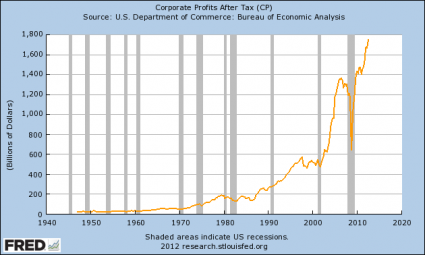
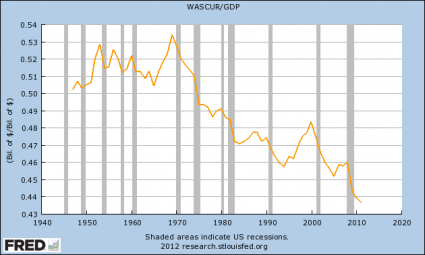
Today, corporate profits as a percentage of U.S. GDP are at an all-time high, but wages as a percentage of U.S. GDP are near an all-time low.
Just check out the following chart. Corporate profits have absolutely exploded over the past decade...

 
Meanwhile, wages as a percentage of GDP continue to fall rapidly...
 

Most of the jobs being created in America today are "low wage" jobs. Tens of millions of Americans are working as hard as they can only to find that they can barely put food on the table and provide a roof over the heads of their children. The ranks of the "working poor" are exploding and the middle class continues to shrink.

Many of you that are reading this article are members of the working poor. You know what it is like to stare up at your ceiling at night wondering how you are going to pay the bills next month.

Today, most Americans are living very close to the edge financially. A recent article by NBC News staff writer Allison Linn shared some of their stories. The following is one example...
Crystal Dupont knows what it’s like to try to live on the federal minimum wage.
Dupont has no health insurance, so she hasn’t seen a doctor in two years. She’s behind on her car payments and has taken out pawn shop and payday loans to cover other monthly expenses. She eats beans and oatmeal when her food budget gets low.
When she got her tax refund recently, she used the money to get ahead on her light bill.
“I try to live within my means, but sometimes you just can’t,” said Dupont, 25. The Houston resident works 30 to 40 hours a week taking customer service calls, earning between $7.25 and $8 an hour. That came to about $15,000 last year.
It’s a wage she’s lived on for a while now, but just barely.
Sadly, the number of Americans that are "just barely" surviving continues to grow.

But if corporate profits are soaring to unprecedented heights, then who is getting all of those rewards?
The monopoly men of the global elite are.

Just check out the following video which does a great job of illustrating how corporatism has systematically funneled all of the economic rewards in our system to the very top...


Once again, I want to make it very clear that I am not advocating socialism as the answer in any way, shape or form. Socialism takes away the incentive to create wealth and it almost always results in almost all of the economic rewards going to a very tiny elite anyway.

As I said earlier, what we need is a return to a much more pure form of capitalism, but this is so foreign to the way that most people think that most people will not be able to grasp this.

It certainly would be possible to greatly reduce the power of the federal government and greatly reduce the power of the big corporations at the same time, but this is so "outside the box" for most people that they cannot even conceive of doing such a thing.

We need to create an environment where individuals and small businesses can thrive once again. But instead, most of us are content to continue "playing the game" and getting enslaved in even more debt.

For example, according to CNBC, auto loans just continue to get larger and continue to get stretched out for longer periods of time...
American car buyers, attracted by new models and cheap financing, are taking out bigger auto loans and stretching out the terms of those loans to a new record length.
New analysis from Experian Automotive shows the average new car loan in the fourth quarter of last year was $26,691 and stretched out over an average of 65 months. The length of the average loan is one month longer than the previous record set in the third quarter of last year.
What will they think of next?

Will we eventually have auto loans that get paid off over 10 years?

By the way, that is another way that the monopoly men of the global elite get all of our money. They enslave us to debt, and we spend year after year of our lives slaving away to make them even wealthier.

They are very smart. There is a reason why they have 32 TRILLION dollars stashed away in offshore tax havens. They know how to play the game, and they are very happy that most of the rest of us are asleep.

Fortunately, it appears that an increasing number of Americans are waking up.

For example, I wanted to share with you all an excerpt from a comment that one of my readers left on one of my recent articles...
In the past year, I've been slowly but surely waking up to the nonsense happening around me. There's so many things I need to simply get off my chest, so excuse the length of this post. Recently in the past two years, I've gotten married and have been medically discharged from the Marines after being injured in Afghanistan. Being 23 years old and married, my goal is secure a secure a future for my family, but with the way things are going, I'm not exactly sure how much of a future we're going to have in 50 years. I can't explain it, but I've felt this need to change my attitude and motivations lately.

I started by turning off the garbage music, television and other mindless entertainment that seems to plague my generation. It was easier than it looked - I don't miss most of it really. The next order of business was to educate myself on world news, so that's what I did. Every day, like clockwork, I check all major mainstream news feeds (NBC, Fox, Abc, CNN, Reuters, BBC, etc.) as well as not-so-mainstream news sites - yours being one of them. It's incredible how fast our world changes and the manner in which it changes. The local 10 o'clock doesn't show anything but local news, sports, weather, lottery #'s and whatever else they decide to throw in. It's a night and day difference once you start to actually research and see what's happening all over the world. Look at the number of comments about a news story on the economy and then look at a celebrity story on the "news"....People are so blind, it truly amazes me. My friends, family and classmates at college seem to be under a spell of some sort. They're distracted - and it's contagious. Nobody I know gives a damn about global affairs/economics. They're more interested in the newest iPhone, cars, shows, movies, and just about anything else you can think of. I'm not saying there's anything wrong with these things, but my friends/family/peers are CONSUMED by these distractions. When the election was taking place in 2012, every Tom, Dick and Harry on Facebook had an opinion and rant. After the circus ended however, everyone simply went back to posting about parties, kittens, Farmville etc. It's a huge joke. For me, it's little terrifying and exciting to see history unfolding in front of our eyes. This country of ours is going through big changes now that will most certainly affect our future, so I strive to adapt and prepare myself and my family. I'm looking at buying my first home this summer. Right now I live in an apartment right outside Philly and spend more money on rent than most pay for a mortgage. I need a house with a little land to raise chickens, grow fruits/vegetables, store canned food - and to be as independent from the system as I can. For my job, I wanted a skill/trade that people would always need, so I picked the funeral business. On the side, I work in construction and have been learning everything there is to know about building with my own two hands. I feel as though these old forgotten skills are going to be handy in a short while.
Hopefully we can get a lot more people to wake up and start breaking out of "the matrix" of control that is all around us.

Right now, the system is designed to continually funnel more money and more power to the very top of the pyramid. The global elite are becoming more dominant with each passing day. Unless something dramatic happens, at some point the American people will become so powerless that they won't be able to do anything about it even if they wanted to.

The idea of a very tiny elite completely dominating all the rest of us goes against everything that America is supposed to stand for. In the end, it will result in absolute tyranny if it is not stopped.

Source

March 7, 2013

China Threatens Currency War Retaliation, Warns Japan Against Using China As "Garbage Bin" In Race To Debase

About a year ago we warned that in a world devoid of bond vigilantes, long emasculated by the Fed's relentless attempt to bring inflation back or go bust trying, the only forces left willing to stand up to Bernanke are the Brent Vigilantes TM, who succeed in crushing every recent reflation attempt whenever Brent reaches $130 or above (and US gas at the pump rises above $3.80) yet which are rather leery and susceptible to the CME's surprise margin-hike counterattacks, and of course China, the same China which every other lemming said last summer would scramble to join the global reflation except for us, as we made it very clear that all hopes of an RRR or interest rate cut are unfounded. Because all the inflation that China (did not) need would be exported to it courtesy of Bernanke and Company's deliberate and now open-ended printing. For a long time China kept its mouth shut, however, when Japan also joined in this pathological central bank pumping, China may have just had enough. As the WSJ reports,"The president of China's giant sovereign-wealth fund warned Japan against using its neighbors as a "garbage bin" by deliberately devaluing the yen, joining growing international griping about a potential currency war."

Perhaps more important than what is said, is what was unsaid, which is that as the animosity between China and Japan accelerates, this time shifting from purely territorial and political demands, Japan will continue to have no access to the China import market which accounts for over 20% of all Japanese exports. This also means that while the country imports commodity inflation and as the bulk of the Japanese citizens suffer under the weight of a collapsing economy, where the soaring Nikkei only benefits 1%, the conflict with China will get worse by the month: "In unusually strong language, Gao Xiqing, president of China Investment Corp., echoed alarms from Latin America to Europe that the new Japanese government is aiming to boost its exports at other countries' expense via a weaker currency—allegations often leveled at China itself by the U.S. and others."

More from the WSJ on the seemingly endless conflict between China and Japan:

Mr. Gao also expressed skepticism about the prospects of the world economy despite the recent surge in global stock markets, citing persistent structural problems and uncertainties over financial regulations. "Overall, we hold a cautious view of the [global] economy," he said.
 He noted that regulators in countries including the U.K. have toughened their oversight of financial institutions and limited bankers' bonuses. "People are not sure about the long-term repercussions of those measures," Mr. Gao said.

With about $500 billion in assets under management, CIC is the world's fifth-largest sovereign fund. It was founded by the Chinese government in 2007 to seek better returns for China's mammoth currency reserves, which had typically been parked in low-yielding securities such as U.S. Treasurys. Chinese leaders have singled out better management of China's $3.3 trillion in foreign-exchange reserves, the world's largest, as a priority for the financial sector.

In the past few years, CIC has significantly reduced its holdings of public securities and accelerated a push into longer-term investments as the fund seeks to shield itself from short-term market swings. The fund's target is to have 51% of its portfolio in alternative assets such as private equity, real estate and infrastructure and the rest in public securities, Mr. Gao said.
However before Japan gets worried that China is only targeting its monetary policies, the truth is that China really is against every other G-7 nation doing just this. And if CIC's Gao was the bad cop focused on Japan, it was China's incoming premier who just did his worse cop impression. Via Bloomberg:

China doesn’t approve of excessively loose monetary policies by other nations, according to a senior government adviser who wrote a book with Li Keqiang, the country’s incoming premier.
“We have already taken a position on this before and China doesn’t approve of some countries’ overly accommodative monetary policy,” Li Yining, 82, a Peking University professor and delegate to China’s top advisory body, said at a briefing in Beijing today when asked about Japan’s recent easing. “This is an act of transferring the crisis to others.”

The remarks may reflect official displeasure over the yen’s depreciation amid Japanese Prime Minister Shinzo Abe’s campaign for more monetary easing to fight deflation. China is “fully prepared” for a currency war should one happen, central bank Deputy Governor Yi Gang said March 1, according to the official Xinhua News Agency.

China can take steps to counter the effects of other nations’ monetary policies such as expediting industrial upgrading and boosting indigenous innovation, Li said, without mentioning Japan in his response. “Given the size of our foreign exchange reserves, we will continue to go out and invest overseas and import more from abroad,” Li said.

Yi said that in terms of monetary policies and other mechanisms, China “will take into full account the quantitative easing policies implemented by central banks of foreign countries,” Xinhua reported March 2.

Speaking in Beijing yesterday, Yi reiterated that he hopes monetary authorities worldwide will adhere to the Group of 20 consensus and avoid currency wars, which “will have no winners.” Finance ministers and central bankers from G-20 nations meeting in Moscow last month sharpened their stance against governments trying to influence exchange rates as they sought to tame speculation of tit-for-tat competitive devaluations.
Leaving aside the hypocrisy that if indeed China is so concerned about soaring inflation, that it could simply hike its currency, oh wait, it can't because it is pegged to the most serial offender of all - the USD, what is becoming clear is that as Chinese inflation is set to take off any minute (the real inflation, not the reported one), the days of global "open-ended easing" are now numbered, because while the distraction of "growth" in the US and Europe may have fooled some people, some of the time, absent China - the world's most important marginal economy - going all in in credit creation, and thus "growth", global GDP will not rise. And the longer Bernanke and Co., create hot money which finds its way almost instantly into Chinese real estate and keep Chinese property prices soaring, the shorter the time until China finally says "no more" and forces the G-7 to pull the plug on the global reflation which at this rate will lead to the same social instability that rocked China in early 2011.

As for China entering the currency wars - perhaps in a world hypnotized by the endless nightly algo-driven risk levitation, in which nothing can ever go wrong again, this may be just the cathartic event so very needed to get some true price discovery in what has become a global experiment in reflexive asset-price fixing, which is then expected to feedback into the underlying economy: a process which has failed for four years in a row, and is why the central banks are getting so desperate, they have collectively now gone all in.

Source

March 6, 2013

What the EU Bank Bonus Plan Really Accomplishes

Europe Union Agrees on Plan to Limit Bankers' Bonuses ... The move, part of a package of banking regulations known as Basel III that is aimed at reducing the danger of big bank failures, was hailed Thursday by some European lawmakers. 'We've achieved the most comprehensive banking reform in the European Union,' said Othmar Karas, an Austrian member of the European Parliament who helped find a compromise in a late-night negotiating session with representative from E.U. member states and the European Commission. A majority of the Union's 27 member nations would need to approve the rules for them to take effect. – The New York Times

Dominant Social Theme: Let's make sure bankers don't profit at our expense.

Free-Market Analysis: At this point in the business cycle it's pretty amazing that those running the EU believe that controlling bank bonuses by regulatory fiat is going to do anything to ameliorate the EU's larger problems.

The issue, of course, is not out-of-control banks or bankers but an out of control credit situation that has resulted in a slow unraveling of the euro and perhaps of the EU itself. Instead of dealing with the fundamental problem of the EU, which is the ability of member states to flexibly recapitalize, Eurocrats have spent precious time and regulatory capital focusing on industry compensation issues.
The idea is that banks and bankers are incentivized to take too much risk – and that is one of the reasons for the state that Europe is in. But this doesn't make sense given that past leaders of the EU are on record as stating that they hoped for a financial crisis to drive a more powerful political union.
Given the deeper currents that are flowing around this issue, Euroleaders may have reconsidered what their predecessors wished for. The situation is increasingly intractable – or so it seems to be – and it's hard not to look at bank bonus regulations as something of a public relations gambit meant to appeal to disgruntled EU citizens who are suffering under various austerity programs. Here's more from the article:

The agreement on the proposed banking rules reflects the global backlash against the lavish compensation in the financial sector that many politicians say rewarded risky trading and investments that triggered the financial crisis. ... The limits on bonuses would also apply to bankers employed by E.U. banks but working outside the bloc, in New York, for example. The E.U. authorities are drafting separate rules that could restrict remuneration at private equity firms and hedge funds.
... The law is intended to reduce the financial incentives that led bankers to take risky bets, like those made on subprime housing debt in the United States during the credit bubble. But some critics of the legislation have warned that institutions might defeat the intent of the legislation by simply raising bankers' base pay.

Mark Boleat, the policy chairman at the City of London Corp., which is the voice of London's financial center, said Thursday that 'removing flexibility from pay arrangements in this highly cyclical industry would seem counterintuitive, especially if it leads to higher fixed salaries.'
Some bankers said the rule posed the question of why the bonus cap would not apply to other industries where staff members stand to gain large bonuses. Stephen Hester, the chief executive of Royal Bank of Scotland, told BBC radio on Thursday morning that he did not think 'bankers should be treated as special creatures in any way.'

This is certainly a true remark. Bankers make a lot of money because the Western economic system has organized currencies around central banking – and commercial banks act as the distribution arm for these banks. Remove monopoly central banking and you will reduce and perhaps eliminate the gigantic capital flows that create bank bonuses to begin with.

There is a good deal of pressure on the central banking system these days but not enough – so far – to motivate any major changes. Instead, those behind the current system continue to try to redefine its weaknesses by pointing the proverbial finger elsewhere.

What is ironic is that this exercise in blame-passing is not going to achieve its intended purpose. The problems with the EU and the euro are fundamental and have to do with the structure of the euro currency and lack of flexibility that Southern European countries now face. Couple this with IMF-style austerity and you have a recipe for social unrest. And that has, in fact, been the result.

The latest gambit is for the ECB to inflate aggressively – and ironically, this will only make the banking sector increasingly flush, leading to higher salaries and other kinds of perks that Eurocrats want to do away with. Again, it is the system itself that is skewed toward enriching Europe's big banks and bonus issues have little impact on larger capital flows or their eventual direction and redirection.

By continuing to concentrate on these tangential issues, the EU is doing itself no favors. Officials look distinctly unserious and the larger problems that the EU legitimately faces go unattended.
In fact, the whole exercise of restricting bonuses tells us that the deeper structural issues faced by the EU and the euro are not going to be grappled with any serious way. The solutions that have been taken so far involve the deliberate and increasing debasing of the euro itself.

This may eventually reduce some of the civil unrest in the Southern PIGS but it will stir up the Germans who sit at the heart of the European economic engine and regard inflationary policies with a kind of ingrained horror.

Conclusion: It may be – as more and more believe – that the situation itself is intractable and even unsolvable. But by wasting time catering to social resentments rather than attempting to grapple with systematic flaws, the powers-that-be are indicating a lack of seriousness that will be doubtless be noted by the larger financial community.

Source

March 5, 2013

The Missing Recovery

Officially, since June 2009 the US economy has been undergoing an economic recovery from the December 2007 recession. But where is this recovery? I cannot find it, and neither can millions of unemployed Americans.

The recovery exists only in the official measure of real GDP, which is deflated by an understated measure of inflation, and in the U.3 measure of the unemployment rate, which is declining because it does not count discouraged job seekers who have given up looking for a job.

No other data series indicates an economic recovery. Neither real retail sales nor housing starts, consumer confidence, payroll employment, or average weekly earnings indicate economic recovery.
Neither does the Federal Reserve’s monetary policy. The Fed’s expansive monetary policy of bond purchases to maintain negative real interest rates continues 3.5 years into the recovery. Of course, the reason for the Fed’s negative interest rates is not to boost the economy but to boost asset values on the books of “banks too big to fail.”

The low interest rates raise the prices of the mortgage-backed derivatives and other debt-related assets on the banks’ balance sheets at the expense of interest income for retirees on their savings accounts, money market funds, and Treasury bonds.

Despite recovery’s absence and the lack of job opportunities for Americans, Republicans in Congress are sponsoring bills to enlarge the number of foreigners that corporations can bring in on work visas. The large corporations claim that they cannot find enough skilled Americans. This is one of the most transparent of the constant stream of lies that we are told.

Foreign hires are not additions to the work force, but replacements. The corporations force their American employees to train the foreigners, and then the American employees are discharged. Obviously, if skilled employees were in short supply, they would not be laid off. Moreover, if the skills were in short supply, salaries would be bid up, not down, and the 36% of those who graduated in 2011 with a doctorate degree in engineering would not have been left unemployed. The National Science Foundation’s report, “Doctorate Recipients From U.S. Universities,” says that only 64% of the Ph.D. engineering graduates found a pay check.

As I have reported on numerous occasions for many years, neither the payroll jobs statistics nor the Bureau of Labor Statistics’ job projections show job opportunities for university graduates. But this doesn’t stop Congress from helping US corporations get rid of their American employees in exchange for campaign donations.

There was a time not that long ago when US corporations accepted that they had obligations to their employees, customers, suppliers, the communities in which they were located, and to their shareholders. Today they only acknowledge obligations to shareholders. Everyone else has been thrown to the wolves in order to maximize profits and, thereby, shareholders’ capital gains and executive bonuses.

By focusing on the bottom line at all costs, corporations are destroying the US consumer market. Offshoring jobs reduces labor costs and raises profits, but it also reduces domestic consumer income, thus reducing the domestic market for the corporation’s products. For awhile the reduction in consumer income can be filled by the expansion of consumer debt, but when consumers reach their debt limit sales cannot continue to rise. The consequence of jobs offshoring is the ruination of the domestic consumer market.

Today the stock market is high not from profits from expanding sales revenues, but from labor cost savings.

US economic policy has been focused away from the real problems and onto a consequence of those problems–the large US budget deficit. As no interest group wants to be gored, Congress has been unable to deal with the trillion dollar plus annual budget deficit, the continuation of which raises the specter of dollar collapse and inflation.

John Maynard Keynes made it clear long ago, as has Greece today, that trying to reduce the ratio of debt to GDP by austerity measures doesn’t work.

Among the countries in the world the US is in a unique position. It not only has its own central bank to provide the money necessary to finance the government’s deficit, but also the money that is provided, the US dollar, is the world’s reserve currency used to settle international accounts among all nations and, thus, always in demand. The dollar thus serves as the world’s transaction currency and also as a store of value for countries with trade surpluses who invest their surpluses in US Treasury bonds and other dollar-denominated assets.

Without the support that the reserve currency status gives to the dollar’s exchange value (its price in foreign currencies), the enormous expansion in the quantity of dollars produced by the Fed’s years of quantitative easing would have resulted in a drop in the dollar’s exchange value, a rise in interest rates, and a rise in inflation. Since my time in government, the US has become an import-dependent economy, and import-dependent economies are subject to domestic inflation when the currency loses exchange value.

To sum up, the corporations’ focus on the bottom line has disconnected US incomes from the production of the goods and services that the American people consume, thus weakening and ultimately destroying the domestic consumer market. The Fed’s focus on saving banks, which mindless deregulation allowed to become “too big to fail,” has created a bond market bubble of negative real interest rates and a dollar bubble in which the dollar’s exchange rate has not declined in keeping with the large increase in its supply. Both the corporations and the Fed have created a stock market bubble based on profits obtained from labor arbitrage (the substitution of cheaper foreign labor for US labor) and from banks speculating with the money that the Fed is providing to them.

This situation is untenable. Sooner or later something will pop these bubbles, and the consequences will be horrendous.

Source

March 4, 2013

Student Loan Bubble So Big It’s Trumping Credit Cards as a Spending Driver

It turns out Lambert’s mother-in-law research is pretty good. A February 27 report from Orono, Maine:
Long conversation between the driver of the municipal shuttle bus, a chatty type, and a passenger. She’s going to back to school to become a nurse (“those will be the last jobs to go”) he’s an older engineering student also working grocery bagging and doing internships.

They both think:

The economy is never going to get better
The next crash will be student loans
Not excited or angered about, just the way it is. And they’re both going into debt over student loans anyhow (she $40K worth but “a job for the rest of my life”).
Neither of them from the country, as it were. Both pretty cosmopolitan.
Word from the hinterlands…
On February 28, the New York Fed released a study on student loans. Much blogosphere chatter, of the “it’s a bird, it’s a plane, it’s a bubble” based on charts like this…


….pointing out that student debt outstanding is nearly three times as large as the total as of 2004, and more scary charts like this:
This is even uglier than you might think, since 30-49 are peak earning years. Oh wait, that was the old normal.

And when you integrate this with the just-released New York Fed quarterly household credit survey, you reach some not pretty conclusions. Student debt is now a bigger source of consumer borrowing than credit cards (we are speaking in terms of macroecomoic impact):


And it’s now the loan category where borrowers are in most distress (hat tip Russell H):

This level is particularly ugly given that student loans cannot be discharged in bankruptcy. It’s more rational to get in arrears on anything else, since you have some hope of negotiating for a restructuring.

As Warren Mosler said via e-mail:
Student loans have been making a meaningful contribution to aggregate demand.
If origination slows it’s another negative for growth and output to add to the tax hikes and spending cuts.
This is not to say I favor the student loan channel for education. Quite the contrary, in fact.
But just like the savings and loan credit expansion leg propelled the Reagan years, the .com and y2k credit expansion the Clinton years, and the sub prime credit expansion the Bush years, to a much lesser extent the student loan credit expansion has supported the current modest recovery.
And when they end the support ends.
So Lambert’s bus sources were spot on: student loans are not only looking bubbly, but the level of borrower stress is saying something has got to give. One sign is that law school enrollment has fallen 15% since 2010. Students are correctly worried about borrowing heavily in a weak job market. But so far, enough people believe in the value of education as a workplace credential that the student loans outstanding are still rising. It’s hard to discern how this plays out, but the endgame might not be that far off.

Source