May 20, 2014

The Rise of Free-Trade Imperialism and Military Keynesianism

World War I provided a dramatic opportunity for the muscular Christians to display American power on a world wide stage although the population of the United States was not ready for another war, especially after the negative experience in the Philippines.

President Woodrow Wilson, previously a founder of the American Economic Association, president of Princeton University, and governor of New Jersey, was first elected president in 1912, before the war had begun. He ran for reelection in 1916, with a promise to stay out of World War I, angering Theodore Roosevelt who responded, charging that “professional pacifists, through President Wilson, have forced the country into a path of shame and dishonor” (Thayer 1919, p. 419).

Once safely reelected, Wilson, in the grand tradition of American politics, quickly broke his word, calling for an American entry into the war. Unlike Roosevelt for whom war was a romantic adventure, Wilson’s war promised great material benefits.

Running as a peace candidate had helped Wilson win reelection, especially in light of the sour taste left by the war in the Philippines. Neutrality, besides being popular, made good economic sense. The war was already bringing the United States out of the depression it had entered in 1913. Its future First World War allies purchased 77 per cent of U.S. exports in 1913, generating ‘the greatest industrial boom the nation had had until that time’ (Lens 2003: 253). Large conglomerates benefited disproportionately, expanding production of munitions and other exports (Desai 2013, p. 74).

Since the British had suspended gold payments and embargoed loans “for undertakings outside the Empire,” Wall Street was now the banking center of the world (Desai 2013, p. 74; citing Lens 2003, p. 252). American business also profited from the withdrawal of British and other European businesses from Latin America, allowing the United States to take center stage as a global financial power. American business benefited further from the withdrawal of British and other European businesses from Latin America.

This situation was too good to last. Because the war so fully depleted the Allies’ financial resources, European buying power could no longer buoy the U.S. economy. The US ambassador in London reported on the international situation, which he found “most alarming to the financial and industrial outlook of the United States.” He warned that British and French inability to keep up orders would surely mean “a panic in the United States.” The ambassador concluded, in a clear anticipation of military Keynesianism (to be discussed in the next chapter), that it was not ‘improbable that the only way of maintaining our present preeminent trade position and averting a panic is by declaring war on Germany’ (quoted in Lens, 2003, p. 260).

Wilson complied with the ambassador’s suggestion. In retrospect, Wilson timed his move very well. Keeping the United States out of the war until his second term gave the European powers time to exhaust themselves, leaving an opening for a fresh United States military to play a prominent, if not decisive, role.

Wartime conditions also proved to be a dramatic turning point in the financial status of the United States, which had always been a chronic debtor, dependent upon a considerable part of Britain’s capital exports. The sudden surge of wartime costs, including American exports, turned the tables, making the Allies dependent on external credit (Desai 2013, p. 75). Between 1914 and 1917, the years between United States’ entry into the war and the outbreak of the Russian Revolution, Europe’s need for wartime financing opened the door for U.S. banks, led by Morgan, to raise massive loans for the allied governments.

Waiting to join the war until the Allies were exhausted offered an enormous geo political victory well beyond what the use of military force could have brought. As Radika Desai observed: “The United States was far from isolationist when the First World War started: Wilson kept the United States out of the war initially to wait for a stalemate so that it could step in as arbiter and architect of a US centred postwar order” (Desai 2013, pp. 74).

Making the World Safe for War

Wilson’s victory was short lived. To begin with, Wilson suffered a debilitating stroke that removed him from the political scene. Public knowledge of the human costs of World War I was temporarily limited because of intense censorship. Even though the armistice came relatively fast after the United States entered the fray, the country still lost 100,000 troops. The prosperity that massive spending on World War I brought was only temporary. By 1920, the economy experienced the second most severe depression of the Twentieth Century.

Had Wilson’s health held up, a reelection campaign would have been doomed from the start. The unpopularity of the war, the depression that followed, as well as Wilson’s internationalist vision, symbolized by his plan for the League of Nations, created a political atmosphere that allowed the Republicans to regain their longstanding political control, which they had exercised throughout most of the late Nineteenth Century.

Because a high degree of economic planning was key to the American success in the war, the belief in market efficiency waned; however, the postwar depression revived support for market fundamentalism, allowing the Coolidge administration to win election on a platform of doctrinaire laissez faire policy, despite the highly regarded performance of economic planning during the war.

The Tragic Imperial Dance

Wars, of course, always have unforeseen consequences. In a biblical sense, wars beget more wars. Consider the case of World War I. In the lead up to the war the same war which was sold as a war to end all wars three challengers United States, Germany, and Japan were already nipping at the heels of the great imperial powers of France and England. All three were experiencing very rapid economic growth without enjoying comparable political and economic influence around the world. Germany was the great looser in the conflict, although the Ottoman Empire lost the most territory. The resulting instability in the Middle East has troubled the world ever since.

Germany’s military defeat and the even more humiliating conditions of its surrender set the stage for a far more devastating challenge to the world order. Crushing reparations, along with the loss of territory, created untenable political conditions. As John Maynard Keynes, a major representative of the English government during the peace negotiations, predicted: “(People in) their distress may overturn the remnants of organization, and submerge civilization itself” (Keynes 1919, p. 144).

Conditions in Germany eventually led to the rise of the Nazis. France and England suffered lesser setbacks. Besides their human and economic costs of the war, the United States demanded that they repay their immense war debts to American creditors, allowing the United States to gain power and influence at their expense. This demand was part of the United States’ effort to use its postwar power to dislodge the colonial holdings France and England.

Japan, following its defeat of Russia in the early part of the century, was not involved in World War I, sparing her the heavy costs experienced by the great European powers. Instead, Japan was busily building up its military power and extending its sphere of control. Most worrying was its expanding occupation of China, a country lusted after by all of the five rival imperial powers. Unlike France, England, Japan, and Germany, which already had beachheads in China, the United States had only gotten as far as the Philippines.

After the War, the United States, concerned about Japan’s rising influence in the Pacific, used embargoes of strategic materials, such as petroleum, tin, and rubber to strangle the Japanese economy. Eventually, Japan responded in the attack on Pearl Harbor. Germany began carving out territory in Europe to regain and expand its prewar powers.

When the United States entered the war, just as was the case in World War I, the country’s intentions were to elevate its degree of international influence. In particular, the United States was intent on ramping up its efforts to strip France and England of their colonies, especially in the case of India. The American goal was not to create its own traditional colonial empire, but to build a new kind of empire based on trade rather than direct colonial authority. Opening the previously colonial territories to American trade would give the United States what it wanted. It could dominate territories by virtue of its economic muscle without incurring the expense of administration. This kind of policy was expected to be capable of displacing much of the French and English power, without the need to resort to military force – an ideology that came to be known as free trade imperialism.

Because the expected benefits from American market efficiency in the new territories turned out to be insufficient to create conditions in which the territories were free from effective resistance to American influence, the United States lacked a means of control that would serve as an alternative to direct colonial rule.

The experience in the Philippines, where extensive military surveillance allowed the United States to shame or blackmail people to refrain from challenging the power of the United States proved to be extremely effective. After World War II, the CIA raised this practice to a much higher level, but the agency never acquired the means to operate as extensive a network of informants that the military had in the Philippines.

As a result, the CIA frequently resorted to overthrowing uncooperative governments. Doing so also gave considerable force to threats of installing a new government. Such actions frequently created blowbacks that worked against the interests of the United States.

Military Keynesianism

One of the most embarrassing episodes in the relationship between war and economic thinking came at the end of World War II. The combination of the Great Depression followed by World War II led to a period of unparalleled economic success in the history of the United States. However, few economists recognized the role of the Depression in eliminating old and obsolete businesses, clearing the way for this period of prosperity. Alexander Field has recently made a powerful case for the rapid productivity gains during the Depression (Field 2011). The Depression set the stage for the New Deal, which put the economy on more solid ground – a thesis that has become increasingly controversial in the face of growing market fundamentalism.

Instead, most economists emphasized how World War II created enough government spending to rescue the economy. This perspective gained powerful support in John Maynard Keynes’ influential book, The General Theory of Employment, Interest and Money (Keynes 1936), which laid out the case for government intervention during economic downturns. However, doctrinaire supporters of laissez faire still believed that depressions should be allowed to run their course. Other than giving tax cuts, the best government policy would be to remain neutral, allowing market forces to make the necessary corrections.

Antagonists of government activism tarred Keynes as a socialist, or even worse, a communist. In reality, Keynes was hardly attempting to lay out a roadmap to socialism; Instead, Keynes himself was deeply conservative, writing once: “[T]he class war will find me on the side of the educated bourgeoisie” (Keynes 1925, p. 297).

Seeing how the Great Depression unleashed a powerful disgust with what markets wrought, Keynes had feared that capitalism was threatened, especially since the Nazi takeover in Germany and the communist revolution in Russia were elevating the role of the state relative to private business. This trend was not limited to these two dramatic examples. All of the great capitalist states were increasing the role of government relative to the market. In that environment, Keynes saw his work as an effort to safeguard capitalism by stemming the growing tide of socialism.

Because Keynes’ American followers mostly advocated a relatively a crude application of his work, narrowly emphasizing government spending alone, without taking Keynes’ far broader approach into account, they were partially responsible for business’ hostile response to Keynes. Keynes expressed his distance from the crude version of American Keynesian in 1944, when Lady Keynes enquired after some prominent Keynesians gave a dinner for Keynes in Washington, “How was it?” Keynes replied, “I was the only non Keynesian there” (Ballard 1995, p. 335; citing Robinson 1972).

Business leaders as a whole initially appreciated the immediate beneficial results of the New Deal in healing some of the wounds that the Depression caused. However over time, many of them became increasingly suspicious of government involvement in the economy. In addition, while business had also been supportive of the government’s economic activism during World War II, they also realized that successful government wartime planning had improved the public’s faith in the government’s capacity to manage the economy. Given the woeful performance of business leading up to the depression business had good reason to be nervous about public opinion.

As a result, the political climate became increasingly antagonistic to the gains of the New Deal and unreceptive to Keynes’ analysis. Shortly after the war, business interests began a concerted effort to undo some of the gains of the New Deal, beginning with the weakening of the labor movement. For this reason, the opening shot in the attack on the New Deal was the Taft Hartley law, which greatly weakened the power of unions. Business’ support for this measure was strong enough that Congress was able to override a presidential veto.

McCarthyism made the political atmosphere poisonous. Economic issues became framed in terms of patriotism rather than serious economics. Economists soon became reluctant to advocate anything that could be even remotely associated with socialistic tendencies, learning from the case of a Canadian economist, Lorie Tarshis, who wrote the earliest textbook that included Keynes’ economic theory. A firestorm pressured universities to cease assigning it. Paul Samuelson, who later became an advisor to Presidents Kennedy and Johnson in addition to being the first American economist to win the Nobel Prize in economics, followed with his own offering, which became the most popular introductory economics textbook in the United States.

The attack on Samuelson’s book was fierce. The Veritas Foundation was a leader in this war on Samuelson’s book (Leeson 1997, p. 125). A commentator in the right wing Educational Reviewer asked: “Now if (1) Marx is communistic (2) Keynes is partly Marxian, and (3) Samuelson is Keynesian, what does that make Samuelson and others like him? The answer is clear: Samuelson and the others are mostly part Marxian socialist or communist in their theories” (quoted in MacIver 1955, p. 128). Despite Samuelson’s long history of antagonism to Marxian ideas, tarring him along with Keynes was effective.

Samuelson recalled how much he felt the pressure, “having tasted blood in trying to root the Tarshis text out of colleges everywhere, some of the same people turned toward my effort” (Samuelson 1997, p. 158). Samuelson succeeded at defending his work, but at a serious cost. In a 1977 lecture, Samuelson described how he felt compelled to go to great lengths to make his book less controversial, undermining its quality:
… if you were a teacher at many a school and the Board of Regents of your university was on your neck for using subversive textbooks, it was no laughing matter. Many months were involved in preparing mimeographed documentation of misquotations on the part of critics and so forth. Make no mistake about it, intimidation often did work in the short run …. My last wish was to have an intransigent formulation that would be read by no one … As a result I followed an Aesopian policy of paying careful attention to every criticism of every line and word of my text …. In a sense this careful wording achieved its purpose: at least some of my critics were reduced to complaining that I played peek a boo with the reader and didn’t come out and declare my true meaning. [Samuelson 1977, pp. 870 72]
In the United States, during the end of the 1950s, the economy was showing signs of sluggishness. Economists took to heart Keynes’ idea that special efforts are necessary to revive the economy when demand is insufficient.

Cold War antipathy toward anything even vaguely related to socialism made one vulnerable to accusations of dangerous political sentiments. While support for government spending might be dangerous, military spending was patriotic because it was largely directed against the Soviet Union.

In addition, much of the anti-government rhetoric in the United States was built on a dogmatic insistence that government spending is, by its very nature, an unproductive drain on the economy, while private business spending alone is productive.

Given this environment, many of the leading Keynesian economists in the United States learned to avoid the scrutiny that Samuelson and Tarshis experienced, shielding themselves from any taint of socialism by using the military as a cover. Either because they succumbed to the anticommunist climate of the day or because they feared they had no chance of stimulating the economy through any productive government spending, they recommended unproductive spending. These Keynesians adopted a stunted version of their master’s approach to immunize their brand of economics from the charge of socialism or communism. They did so by restricting their calls for increased spending to military programs, presumably intended to assist in the fight against communism – an approach that became known as military Keynesianism.

The underlying principle of military Keynesianism was not new, as shown by the advice of the ambassador in the last chapter; however the benefits of advocating military Keynesianism were undeniable. Military Keynesianism allowed economists to burnish their patriotic credentials while getting credit for improving the economy at the same time. In this way, economists could win the gratitude of powerful interests in government, business and the military.

Here is Business Week writing about the position of a one time radical, but highly respected economist, Lawrence Klein:
Some Keynesian economists adapted nimbly to the Pentagon State, touting warfare for work relief. They earned the name of “Keynesian Hawks”. Here is model building Lawrence Klein, President of the American Economic Association, 1976: “Defense spending … has been a large part of the whole expansion of the American economy since World War II.” The key question is “whether we should hold down defense spending for either economic or security reasons, and I think not, on both counts …. Every cutback of a dollar in defense will cut two dollars from overall GNP and drag down a lot of jobs …. If we were to hold spending to $395 billion, the recovery of the economy would fade away (Anon. 1976, pp. 51 52).
Klein’s example suggests how thoroughly McCarthyism still affected the political climate, long after the senator had faded from the scene. The leading U.S. Keynesians also proceeded as if they could ignore the relative merits of different kinds of spending, treating military spending as the default. Although Keynes himself preferred that the government spend its funds on productive activities, his theory offered few specifics to dissuade the new cold warriors who acted in his name (Perelman 1989).

Leading Democrats followed a similar trajectory, becoming closely associated with military contractors, so much so that Eisenhower’s farewell address, warning about the Military Industrial Complex (Eisenhower initially intended to condemn the Military Industrial Congressional Complex), referred to the Democrats’ defense spending.

To be fair, Keynes’ General Theory blandly looked at the economy as a whole, paying no attention to what was produced. To make matters worse, Keynes’s followers could take heart from Keynes’ humorous aside about burying bottles of money and then digging them up, suggesting that society could disregard the direct benefits from any particular program. Economists often fell back on saying that a rising tide supposedly lifts all ships. According to this line of thinking, spending of any kind – even wasteful military spending – stimulates the economy.

The Democratic Party followed a similar line of retreat, casting aside the occasional daring ideas that had bubbled up during the New Deal and the early postwar period. Instead, the party almost completely purged itself of leftist or even progressive influences, largely pinning its hopes on increased government spending – all too often military spending.

In his widely praised, but largely unheeded Farewell Address, President Eisenhower warned of this unprecedented power of the military industrial complex in American life: “In the councils of government, we must guard against the acquisition of unwarranted influence, whether sought or not, by the military industrial complex. The potential for the disastrous rise of misplaced power exists and will persist.” Eisenhower was directing his warning at the military Keynesianism of the Democratic Party, which had just alarmed the public about an imaginary missile gap vis à vis the Soviets during John F. Kennedy’s presidential campaign. But then, it was Eisenhower who had ramped up the atomic arsenal that was a key element of the Cold War.

The policy of military Keynesianism was self defeating for two reasons. First, Republicans at the time emphasized the importance of budget deficits. Increasing taxes to pay for military Keynesianism would have neutralized some of the stimulative capacity of military expenditures. Consequently, military Keynesianism effectively increased pressure to rein in nondefense spending, especially those programs intended to help people toward the bottom of the income scale – the same people who were supposed to benefit from economic growth.

A second contradiction of military Keynesianism seems to be far more dangerous. The early English aristocrats were probably correct in their fear that a standing army might tempt the government to launch wars. Similarly, access to a huge arsenal of weapons of mass destruction creates an irresistible drive to brandish them, or even worse, to deploy them.

Military Keynesianism never went so far as to say that business benefits from war, just that military spending is an important component of maintaining a sufficient level of employment. Proponents of military spending my even argue that striving for military dominance is necessary to maintaining peace. Of course, striving for military dominance can unleash arms races, which require even more defense spending, or even worse, run the risk of triggering wars in which rivals attempt to prevent others from acquiring dominance.

Military Keynesianism poses another danger: military spending drains resources from productive sectors of the economy, potentially weakening both the domestic economy and military power, which ultimately depends upon the strength of the domestic economy. William Nordhaus of Yale University forcefully made this point with an (unintentional?) allusion to Curzon’s chessboard:
At best, an excessive military budget is simply economic waste. At worst, it causes problems rather than solving them by tempting leaders to use an existing military capability. During the Clinton administration, Madeleine Albright is reported to have asked Colin Powell, then Chairman of the Joint Chiefs of Staff, what’s the point of having this superb military if we can’t use it? Colin Powell is said to have replied, wisely if not presciently, that American soldiers are not toy soldiers to be moved around on some global game. [Nordhaus 2005]
Powell’s thinking echoed a widespread suspicion that the urge to use untested modern weapons in battle was one of the major causes of the Vietnam War. In that way, military Keynesianism may bear some responsibility.

In short, military Keynesianism was a clever tactic for putting Keynesian like economics in effect. However, the unintended consequences more than wiped out any positive benefits. Nonetheless, military Keynesianism remains a major part of fiscal policy despite its serious negative consequences.

In 2013, a hypocritical form of military Keynesianism swept across Washington, when a foolish program was about to take a meat ax to all government spending. In 2007, the same political forces that normally insist that all government spending necessarily has a negative effect on the vitality of the economy turned on a dime, welcoming lavish bailouts, especially for the nearly fatally wounded financial sector. Admittedly, many of these hypocrites denounced the bailouts, but would have gone bananas if the government had let the financial system fail. By 2011, in line with the virulent anti government ideology that was sweeping across the country, Congress passed a ridiculous law that imposed devastating, future cuts in domestic programs, as well as cuts in military spending. These cuts were to be imposed unless a bitterly divided Congress could agree on a program to reduce the budget by the beginning of 2013. This sequestration should have pleased those who held to the popular anti government dogma, which insisted government spending does not create jobs; at best, it only transfers employment from the private sector to the public sector.

As the deadline approached, the Anti Keynesians developed a modified version of military Keynesianism, claiming that military spending (but military spending alone) creates jobs. This revisionist Keynesianism set off a hysterical cry about the large number of jobs that would be lost if Congress went along with the cuts to military spending that it had legislated. To save the economy, non defense spending must be cut to stay within the bounds of the sequestration, while ruthlessly directing tax cuts to programs intended to help the less well off.

Because the combination of defense spending, massive tax cuts, and the bailout had led to large budget deficits, the proponents of this perverted military Keynesianism insisted that programs for productive government expenditures had to be cut in the name of fiscal responsibility to make way for (wasteful) military spending.

Whether the weapons acquisition pushed by the military Keynesians actually played a major role in instigating the Vietnam War remains a matter of speculation, but the long term negative economic effects of Vietnam seem indisputable, as will be discussed in the next section.

Another commonly held explanation for the war concerned the relationship between China and Japan. Although anti Japanese feelings must have been strong in China, given Japan’s recent, brutal invasion of the country, physically, China and Japan seemed to be natural trading partners. Japan had a modern manufacturing economy and a very poor resource base. China, with far more extensive resources and a relatively primitive productive sector with modest resource requirements at the time, would seem to be a very likely trading partner. By “clearing” Vietnam of dangerous influences, the United States could offer Southeast Asia to Japan as an alternative trading partner to China – an important consideration given the high priority for “containing” communism at the time.

May 19, 2014

Russia's "Holy Grail" Gas Deal With China Now "Only One Digit Away"

We have previously profiled the "holy grail" gas deal between Russia and China on several occasions, and noted last week how it is expected to be signed this week - pending some final price negotiations. It appears that was spot on as Reuters reports, Russian state-run Gazprom said it was still "one digit" away from finalising a 30-year gas supply deal with Beijing which is expected to crown Russian President Vladimir Putin's visit to China next week. On the heels of Russia's de-dollarization meetings, the coming week appears a crucial one for the history books of the US Dollar as reserve currency (or will China leverage Russia's need to diversify from Europe and stall the deal once again?)


As we have discussed in detail, Russia has been in talks with China to supply it with 38 billion cubic metres (bcm) of gas a year for more than a decade but the deal has been postponed repeatedly over price disagreements. And as Reuters reports, last week, state China National Petroleum Corp (CNPC) said that it and Gazprom had reached an agreement to sign a contract during Putin's visit but that the two sides had yet to iron out price differences.
Gazprom chief executive Alexei Miller confirmed in an interview on state Rossiya 24 television that the talks were in the final stage and only centred around base price.

"There is just one question - it's ... a starting, base price in the price formula which, it's remarkable, has already been fully agreed upon with our Chinese partners," Miller told news show Vesti on Saturday with Sergey Brilev.

"It's a very little more - to put in only one digit, and a 30-year contract to supply 38 bcm of gas from East Siberia to China will be signed," said Miller.
The question is - of course - will the price disagreements once again spoil the party...
With tensions high with the West over Russia's role in the Ukraine crisis, Moscow is eager to divert some oil and gas from European markets, part of its wider push to Asia.

About 80 percent of Gazprom's revenue comes from gas sales to Europe and analysts say that failure to clinch a deal with China, the world's top energy consumer, would expose its huge reliance on Western consumers and might strengthen Beijing's bargaining positions in the months to come.

Miller emphasized that the contract would be signed on mutually beneficial terms, adding that the sides had also agreed to start talks on a second route for Russian gas supplies to China after the current deal is signed.
As we noted previously, quid pro quo:
"Observers expect both leaders to take a united stand on major international issues, and Putin may seek China's support on Russia's dealings with Ukraine."

And also on the dollar as we reported in "Russia Holds "De-Dollarization Meeting": China, Iran Willing To Drop USD From Bilateral Trade." In which case expect random Chinese space rockets to mysteriously explode during take off too.

May 16, 2014

Are Russia and China About to Announce the End of the US Dollar Era?

Countries all over the world are meeting for a purpose that concerns you greatly, whether or not you're American: disuse of the US dollar.

Since the outbreak of the Ukraine crisis the end of the US dollar seems closer than ever. In move-after-move, Russia and China have become closer allies. There are numerous examples of this. For brevity's sake, two recent examples catch the eye. Gazprom issued bonds in the Chinese Yuan and Russia and China also signed a gas deal. There are many more examples. 40 central banks have even placed bets on the yuan as the future reserve currency.

Until 2014 tales of dollar collapse seemed to be for conspiracy nuts, as geopolitics only faintly reflected this seeming reality. This year, that all has changed. It seems nation-states the world over are making moves towards a post-US Dollar world. It is not a matter of "if," but "when," and if you don't understand this coming-to-pass you will be in for quite the shock...and awe.

Once Russia, along with numerous allies, makes the fateful move, you can be sure many nations will follow. They already are trying to do so. Why? Because the US is the most destructive force on the planet, and it's achille's heel is its "exorbitant privilege" known as the US dollar by most, and the Federal Reserve Note by those "in the know."

This will spell hyperinflation, social chaos, civil war, among other dislocations. Think this is hyperbole? It's not. To know that all one needs to do is look at the history of socialist banana republics...and then imagine something much, much worse. Why much worse? Because none of those banana republics were issuer of the world's reserve currency. The US doesn't produce a thing except the US dollar which are extremely easy to print as one man in Canada proved. He printed millions of dollars with a simple operation and circulated them. Moreover, Canada chose not to extradite him so he is a free man.

And so major nation-states are joining together to move beyond the dollar system. A "de-dollarized" world, as it is called in Russia, will change the lives of millions of Americans.

RISE OF RUSSIA & CHINA

According to Voice of Russia, the Russian Ministry of Finance is looking to significantly increase the role of the Russian ruble in export operations while reducing the share of dollar-denominated transactions. The Russian banking sector, believe many, is "ready to handle the increased number of ruble-denominated transactions".

The Prime news agency reported that, on April 24th, the government organized a special meeting dedicated to finding a solution for getting rid of the US dollar in Russian export operations. Top level experts from banks, government and the energy sector came together as a number of proposals were put forth as a response for American sanctions against Russia.

This "de-dollarization meeting" was chaired by First Deputy Prime Minister of the Russian Federation Igor Shuvalov, demonstrating how serious Moscow is when it comes to moving beyond the dollar.

A subsequent meeting, chaired by Deputy Finance Minister Alexey Moiseev, reviewed how "the amount of ruble-denominated contracts will be increased." According to Moiseev, none of the experts and bank representatives polled found problems with the government's plan to increase the share of ruble payments.

The dollar, of course, has been in an elongated freefall, of course, since the invocation of the Federal Reserve and the income tax act in 1913.

But what little remains appears to be hanging by a thread.

RUSSIA'S NOT ALONE

Russia wouldn't be so bold if it didn't have support. Other nations want to engage in a de-dollarization of the world. Both China and Iran, for instance, have been vocal about their interest in moving forward with such a plan. Many other leaders have expressed such interest, only to meet Washington's notorious bullets and eternity.

Vladimir Putin is scheduled to visit Beijing on May 20th and speculation suggests that gas and oil contracts will be signed between Russia and China and denominated in rubles and yuan, not dollars.

In just one week, we could be living in a significantly different world.

The West is out of control, with russophobes in control of US foreign policy. This means the US will antagonize Russia and other nations. This will only quicken the abandonment of the US dollar by Russia, China and the world.

The world is setting up the financial and economic infrastructure to simply ignore the United States entirely. What can the US do about it? Bomb more countries. But I am not so sure that is entirely possible for the US like it was just one decade ago. Humanity has awoken and already one war (Syria) was stopped by public outrage. There will be more such wars stopped by popular opposition.

The US's compromised position means one thing: China and Russia will make their moves, playing chess while Obama plays checkers.

– China called for a new reserve currency in 2013

– Japan and India signed a currency dealing linking their currencies in 2011.

– Gulf Arabs are planning – alongside China, Russia, Japan and France – to end dollar dealings for oil, using instead a basket of currencies including the Japanese yen and Chinese yuan, the euro, gold and a new, unified currency planned for nations in the Gulf Co-operation Council, including Saudi Arabia, Abu Dhabi, Kuwait and Qatar.

THE END OF THE MONETARY SYSTEM AS WE KNOW IT (TEOTMSAWKI)

We are on the cusp of a massive paradigm shift in the global monetary system and hardly anyone is aware of it. Businessmen in the US are making plans and expending capital as though we are in a recovery. Americans continue to spend money and save little with the same expectations. And investors continue to invest as though everything is perfectly fine. They have difficulty conceptualizing the truth about the US economy, which is that it is as mired in debt as it possibly could be. The US is in so much debt that the numbers are mind-expanding for humanity.

Trillions of dollars in capital will be lost due to this and will enter the Western world into something that may be written about for centuries as one of the darkest periods in human history and labelled the Great Collapse. And yet not one in a hundred in the US are even aware of it nor even think it is possible.

Those who are aware, however, and who have internationalized their assets and have the great majority of them in hard assets such as precious metals (also internationalized – find out how to do that here) outside of the financial system stand the best chance to survive the coming changes.

Never before has it been more important to turn off your television, do your own research and take control of your financial affairs.

A lot will be happening and, of course, we here at The Dollar Vigilante will be covering it all in realtime.

May 15, 2014

Climate Mitigation and Confusion About “Cost”: Who Benefits?

Even the most progressive proponents of climate change mitigation frame their argument with the proposition that the “cost” of mitigation today is far less than what the “cost” of climate change will be down the road if we fail to act now. While it sounds compelling, this argument perpetrates a deep confusion about what “cost” means when applied to the idea of inventing, designing and building the carbon-neutral infrastructure and energy systems that climate mitigation will require. This confusion, in turn, makes it more difficult for the political process to make rational decisions.

To illustrate, we need look no further than the recent United Nations IPCC report which, for the first time, not only details the potential catastrophe of climate change by the end of this century, but projects a “cost” for preventing that catastrophe from unfolding. This “cost” is calculated as a percentage of annual global GDP.

Right off the bat, the confusion begins. In some reporting, the IPCC’s projected “cost” of climate mitigation is described as a .06% reduction in global GDP annually. Other analysis state that the “cost” will equal .06% of annual global GDP. Obviously, there’s a significant difference. Reducing GDP means the world will produce less goods and services, employing fewer people to do less stuff—a dire prediction given the current high levels of unemployment world-wide. Saying the “cost” will equal some percentage of global GDP, on the other hand, means that GDP won’t decline, but that some percentage of the goods and services produced by the GDP will be directed towards climate change mitigation. Some of the media explainers—Bloomberg News, for example (whom you’d expect to know better)—included both meanings in a single pair of sentences: Headline: “Climate Protection May Cut World GDP 4% by 2030, UN Says”—and the article’s opening line: “The cost of holding rising temperatures to safe levels may reach 4 percent of economic output by 2030, according to a draft United Nations report.”

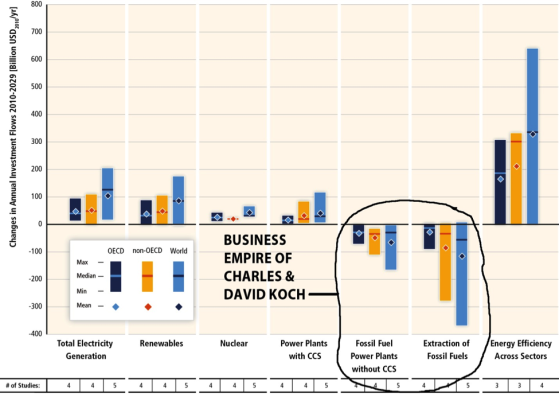
Confusion seems to reign even within the IPCC. A post on the website Real Climate, which is managed by climate scientists themselves, frames it this way: “The IPCC represents the costs (of climate change mitigation) as consumption losses as compared to a hypothetical ‘business-as-usual’ case.” But the IPCC report itself contains a summary chart showing global “Annual Investment Flows 2010-2029” increasing (according to my math, adding up the median projected global numbers) by a potential net gain of approximately $510 billion per year. So how can the “investment flow” increase by $510 billion annually while the world GDP decreases (consumption losses) by 4% between now and 2030?

But the confusion runs even deeper. Even if we accept the fact that the world will have to spend an additional $510 billion annually (instead of being forced to spend $510 billion less), we are led by semantic and political logic to believe we will be “losing” $510 billion every year as a global society. After all, that’s what “cost” means, right?—something you lose, something you no longer have because you’ve paid it out. So our minds resist. We don’t want to have to incur that $510 billion “cost”. We’d rather save the money and take our chances that maybe all these IPCC predictions will prove to be wrong, or that our kids, when they grow up, will figure out a great way to make everything okay again.

The forces aligned against mitigation exploit this confusion at every opportunity. A 4% reduction  in global GDP by 2030 proves that climate mitigation “destroys jobs”—a favorite refrain. $510 billion that we have to spend on goods and services for climate mitigation means that much less is available to spend on the goods and services we’re buying today—money “lost” to a cause we’re not 100% sure is even necessary. The more we can convince ourselves we’re “not sure”, the more iffy it becomes to incur that “cost”—hence the strident effort to counter every new climate report with the opinion of some scientist somewhere that seems to refute the scientific evidence.

Then there is this confusion, as expressed by Robert J. Samuelson recently in the Washington Post: “Carbon capture and storage—pumping carbon dioxide emissions from power plants underground—has been discussed for years. So far, it’s not commercially viable.” (Emphasis mine.) So we implicitly assume—as Mr. Samuelson demonstrates—that the infrastructure and carbon-neutral energy systems we’re going to need have to be “commercially viable.” In other words, their development must be market-driven. If the “market” isn’t willing to pay for it, there can’t be any justification for creating it. No doubt the IPCC’s “Changes in Annual Investment Flows” includes a substantial number of electric vehicles and the nation-wide network of public charging stations that will make them convenient and desirable. Until those items become “commercially viable”, however, there’s no reason to expect them to be built because no business is willing to incur the “costs” without the promise of a substantial reward. While Tesla and others have started the inevitable transition, the IPCC report makes clear there isn’t time for the long evolution that radical technology change typically requires. So, we are pretty much left with only the option of prayer—which has the virtue of not “costing” a cent.

If we came to our senses, however, and removed our soot coated “cost goggles”, we’d see the most obvious and simple thing: The $510 billion the IPCC suggests must be spent annually to invent and build carbon-zero infrastructure and energy systems—that money gets paid to somebody in exchange for the doing and the inventing and the building. Who would that be that it gets paid to? Well, it might be you if you got busy and positioned yourself as someone who could usefully contribute in some way to the effort. To say that the “cost” of climate mitigation is .06% of global GDP annually is no different than saying the “cost” of pizza is .06% of global GDP. “Cost”—by the simple logic of accounting—is actually something we, the people, get paid—just like people get paid to make pizza.

This, of course, reveals the ACTUAL point of contention amidst all the confusion: Into whose pockets is the .06% of annual GDP for climate mitigation going to be directed? If you look at the IPCC’s chart of “Changes in Annual Investment Flows” it becomes clear what the strident complaining and foot-dragging is really all about—and understandable with regard to where it’s coming from (see below): Those projected negative investment flows happen to be in the cash-generating business empire owned by Charles and David Koch. That simple fact pretty much sums up the whole American political scene about global warming.


May 14, 2014

Russia Holds "De-Dollarization Meeting": China, Iran Willing To Drop USD From Bilateral Trade

That Russia has been pushing for trade arrangements that minimize the participation (and influence) of the US dollar ever since the onset of the Ukraine crisis (and before) is no secret: this has been covered extensively on these pages before (see Gazprom Prepares "Symbolic" Bond Issue In Chinese Yuan; Petrodollar Alert: Putin Prepares To Announce "Holy Grail" Gas Deal With China; Russia And China About To Sign "Holy Grail" Gas Deal; 40 Central Banks Are Betting This Will Be The Next Reserve Currency; From the Petrodollar to the Gas-o-yuan and so on).

But until now much of this was in the realm of hearsay and general wishful thinking. After all, surely it is "ridiculous" that a country can seriously contemplate to exist outside the ideological and religious confines of the Petrodollar... because if one can do it, all can do it, and next thing you know the US has hyperinflation, social collapse, civil war and all those other features prominently featured in other socialist banana republics like Venezuela which alas do not have a global reserve currency to kick around.

Or so the Keynesian economists, aka tenured priests of said Petrodollar religion, would demand that the world believe.

However, as much as it may trouble the statists to read, Russia is actively pushing on with plans to put the US dollar in the rearview mirror and replace it with a dollar-free system. Or, as it is called in Russia, a "de-dollarized" world.

Voice of Russia reports citing Russian press sources that the country's Ministry of Finance is ready to greenlight a plan to radically increase the role of the Russian ruble in export operations while reducing the share of dollar-denominated transactions. Governmental sources believe that the Russian banking sector is "ready to handle the increased number of ruble-denominated transactions".

According to the Prime news agency, on April 24th the government organized a special meeting dedicated to finding a solution for getting rid of the US dollar in Russian export operations. Top level experts from the energy sector, banks and governmental agencies were summoned and a number of measures were proposed as a response for American sanctions against Russia.

Well, if the west wanted Russia's response to ever escalating sanctions against the country, it is about to get it.
The "de-dollarization meeting” was chaired by First Deputy Prime Minister of the Russian Federation Igor Shuvalov, proving that Moscow is very serious in its intention to stop using the dollar. A subsequent meeting was chaired by Deputy Finance Minister Alexey Moiseev who later told the Rossia 24 channel that "the amount of ruble-denominated contracts will be increased”, adding that none of the polled experts and bank representatives found any problems with the government's plan to increase the share of ruble payments.

For the benefit of our Russian-speaking readers, the interview with Moiseev is below and the transcript can be found here:

Further, if you thought that only Obama can reign supreme by executive order alone, you were wrong - the Russians can do it just as effectively. Enter the "currency switch executive order":
It is interesting that in his interview, Moiseev mentioned a legal mechanism that can be described as "currency switch executive order”, telling that the government has the legal power to force Russian companies to trade a percentage of certain goods in rubles. Referring to the case when this level may be set to 100%, the Russian official said that "it's an extreme option and it is hard for me to tell right now how the government will use these powers".
Well, as long as the options exists.

But more importantly, none of what Russia is contemplating would have any practical chance of implementation if it weren't for other nations who would engage in USD-free bilateral trade relations. Such countries, however, do exist and it should come as a surprise to nobody that the two which have already stepped up are none other than China and Iran.
Of course, the success of Moscow's campaign to switch its trading to rubles or other regional currencies will depend on the willingness of its trading partners to get rid of the dollar. Sources cited by Politonline.ru mentioned two countries who would be willing to support Russia: Iran and China. Given that Vladimir Putin will visit Beijing on May 20, it can be speculated that the gas and oil contracts that are going to be signed between Russia and China will be denominated in rubles and yuan, not dollars.
In other words, in one week's time look for not only the announcement of the Russia-China "holy grail" gas agreement described previously here, but its financial terms, which now appears virtually certain will be settled exclusively in RUB and CNY. Not USD.

And as we have explained repeatedly in the past, the further the west antagonizes Russia, and the more economic sanctions it lobs at it, the more Russia will be forced away from a USD-denominated trading system and into one which faces China and India. Which is why next week's announcement, as groundbreaking as it most certainly will be, is just the beginning. 

May 13, 2014

Deflation Shock Coming?

While the US is celebrating a (supposed) recovery, other big parts of the global financial system are behaving as if some sort of deflationary crash is just around the corner. In Europe, for instance, interest rates are not just declining, they’re plunging. From a recent Sober Look blog:
The Unprecedented Chase for Yield 
The major market surprise of 2014 so far has been the extent of investors’ appetite for yield in the developed fixed income markets. It has been quite spectacular. The Eurozone in particular has been a key beneficiary of this trend. We’ve seen German government bond yields hit a low not seen in almost a year (see Twitter post), but the real action has taken place in the periphery bonds. We are seeing multi-year and even all-time lows in government bond yields. 
 And this trend is not limited to sovereign paper. European corporate high yield bonds are now yielding just over 3.6% on average – a record low. Let’s just put this in perspective – this is sub-investment-grade paper trading at these levels.
Learn About American Express Serve  
Why are European crappy-bond yields collapsing? Because everyone now expects the European Central Bank to start buying this paper at any price. From today’s Sober Look:
The ECB struck a dovish tone this morning, with Draghi hinting that the Governing Council is prepared to take action. 
BBC: – He said that the 24-member ECB council was “dissatisfied about the projected path of inflation” and is “not resigned to have too low inflation for too long a time”. 
… he added that the ECB was “comfortable with acting next time”, raising expectations that the bank could alter policy in June. 
Eurozone bonds rallied in response, with periphery yields hitting new lows. 
Draghi: – … although labor markets have stabilized and shown the first signs of improvement, unemployment remains high in the euro area and, overall, unutilized capacity continues to be sizable. Moreover, the annual rate of change of MFI loans to the private sector remained negative in March and the necessary balance sheet adjustments in the public and private sectors continue to weigh on the pace of the economic recovery. 
The risks surrounding the economic outlook for the euro area continue to be on the downside. Geopolitical risks, as well as developments in global financial markets and emerging market economies, may have the potential to affect economic conditions negatively. Other downside risks include weaker than expected domestic demand and insufficient implementation of structural reforms in euro area countries, as well as weaker export growth. 
However it remains unclear what options the ECB really has. A traditional bond buying program could be difficult, given the unease in the Eurozone core with the central bank taking on more periphery credit risk. And a program focused on ABS and other consumer and corporate credit products will be limited in scope (see post). 
The ECB is hoping that this dovish language by itself will ease monetary conditions. It has worked so far by lowering bond yields and capping euro’s appreciation. But with the Eurosystem’s balance sheet continuing to decline (draining liquidity), will talk be enough?
Eurosystem consolidated balance sheet (source: ECB)
And then there’s China, as reported by London’s Telegraph:
China Deflation Fears as Price Rises Slow Sharply 
Concerns That China could be slipping into deflation were sharpened on Friday as official figures showed annual inflation fell sharply in April to its lowest level in 18 months, raising concerns about the risk of deflation in the world’s second-largest economy. 
Annual inflation fell to 1.8pc in April, its lowest in 18 months, the National Bureau of Statistics (NBS) said in a statement. This compares with 2.4pc in March and was the slowest pace of growth since October 2012, when inflation stood at 1.7pc. 
The April figure was also well below the 3.5pc annual inflation target set by Beijing and added to analysts’ worries that deflation could be looming as Chinese growth slows. 
Moderate inflation can be a boon to consumption as it encourages consumers to buy before prices rise, but economists say falling prices encourage consumers to put off spending and companies to delay investment, both of which act as brakes on growth. 
The producer price index (PPI), a measure of costs for goods at the factory gate, fell by 2pc year-on-year in April, the NBS said in a separate statement, its 26th month of deflation, albeit less steep than its 2.3pc decline in March. 
“As the PPI inflation remained negative for more than two years and the PPI is an important leading indicator for CPI, the risk of deflation is looming large on the horizon,” ANZ economists Liu Ligang and Zhou Hao said in a research note. 
Bank of America Merrill Lynch economists Lu Ting and Zhi Xiaojia said in a report that the CPI figure was “below market expectations” and reflected “the weakness of aggregate demand including both consumption and investment”. 
A survey of China’s manufacturing sector by HSBC showed the sector contracted for a fourth consecutive month in April. In contrast, last week the government’s official survey remained in marginal expansion.
Some thoughts

Remember that this tip into deflation is happening after five years of economic recovery. Generally by this point in a cycle deflation is the last thing anyone is worried about. It’s all asset bubbles and accelerating prices and anxiety over when the central bank or the bond vigilantes will start aggressively raising interest rates. This time around the global financial system is suffering from a serious case of bipolar disorder, with bubbles in equities, art, and high-end real estate pushing up asset prices, while in Europe and China growth is slowing and consumer price inflation is trending towards zero.

How can these conditions co-exist? Blame it on debt, old and new. The global recovery was due mainly to China borrowing something like (no one really knows for sure) $15 trillion and spending it on infrastructure projects which pumped up demand for pretty much everything everywhere. But the now-completed projects aren’t generating enough cash flow to cover the related interest. So huge sections of that economy are grinding to a halt.

Europe’s excess debt was taken on in the previous recovery, and now sits like a lead weight on the balance sheets of Spanish homeowners, Greek small businesses and German banks. No one wants to borrow or lend while still encumbered by the mistakes of hubris past.

Meanwhile, the ECB has been operating as if it were a legitimate central bank in normal times, by focusing on stable prices and a strong currency.

A strong currency did indeed used to be a sign of wise monetary policy. But in a system with excessive debt, it’s a recipe not for stability but for crisis, as existing debt has to be paid off in more expensive currency and the resulting deflation becomes a “capital-D” Depression. This is the modern central banker’s nightmare, and the reason why the ECB appears to have accepted the inevitability of vacuuming up trillions of euros of sub-prime debt.

So which trend wins? Do soaring equity and real estate prices take the world into an inflationary spiral, or do falling prices in Europe and China pull down everything else? Or do they offset each other and produce another five years of low growth and rising inequality?

That depends on how the bubble sectors respond to the ECB’s shock-and-awe debt monetization — or to China’s, when and if its credit problem becomes a credit crisis. Because the one thing that we have (or should have) learned from the past few decades is that new currency, once created, goes where it wants to go rather than where its creators hope. 

Source

May 12, 2014

TPP Is Another Upward Transfer of Wealth

Those at the top have never done better,” President Obama ruefully acknowledged in his January 28 State of the Union speech. “But average wages have barely budged. Inequality has deepened.”

Yet, moments later, Obama heartily endorsed the Trans-Pacific Partnership (TPP), which as drafted directly reflects the demands of “those at the top” and would, if passed, severely intensify the very inequality spotlighted by the president. The TPP would provide transnational corporations with easier access to cheap labor in Pacific Rim nations and new power to trump public-interest protections—on labor, food safety, drug prices, financial regulation, domestic procurement laws, and a host of others—established over the last century by democratic governments. The nations currently negotiating the TPP—which together comprise nearly 40%of the world economy—include the United States, Australia, Brunei, Canada, Chile, Japan, Malaysia, Mexico, New Zealand, Peru, Singapore, and Vietnam. Among them, Malaysia, Brunei, Mexico, Singapore, and Vietnam, are all notorious violators of labor rights The TPP’s labor provisions are far too weak to begin uplifting wages, conditions, and rights for workers in these nations.

As with NAFTA, the TPP will benefit U.S. companies relocating jobs to low-wage, high-repression nations, argues economist Mark Weisbrot, co-director of the Center for Economic and Policy Research (CEPR). This would also exert strong downward pressures on the pay of U.S. workers, “Most U.S. workers are likely to lose out from the TPP,” Weisbrot says. “This may come as no surprise after 20 years of NAFTA and an even-longer period of trade policy designed to put lower- and middle-class workers in direct competition with low-paid workers in the developing world.”

Obama has billed the TPP as a “trade agreement” that will create U.S. jobs. The pact, however, actually has little to do with reducing trade restrictions. Tariffs are now a minimal factor for most global trade. Lori Wallach, director of Public Citizen’s Global Trade Watch, points out that only five of the TPP’s twenty-nine chapters are about trade at all. But the remaining provisions cover such immensely important measures as the creation of a kind of corporate supremacy over the democratically established regulations enacted by member nations. If an existing law threats to diminish profits, corporations in the TPP nations would be entitled to bring their complaint to an international dispute panel of anonymous corporate members, who could impose major financial penalties on the “offending” countries. “The Trans-Pacific Partnership,” Wallach concludes, “is a Trojan horse for a host of awful measures that have nothing to do with trade and would never get through Congress in the light of day.”

Some of the most controversial TPP features have become public only thanks to Wikileaks. American participation in the TPP negotiations has been limited to a tiny circle of just 600 top corporate executives. Numerous members of Congress have complained about the secrecy surrounding the negotiations, charging that it exceeds even that practiced by the Bush-Cheney administration. The public’s understanding of the massive stakes involved in the TPP has been further hampered by the failure of major media to offer even minimal analysis. The major-network news shows, according to a new study by Media Matters, made no mention at all of the TPP from August 2013 through January 2014.

Despite remaining in the shadows, the TPP has met fierce opposition from both elected representatives and hundreds of labor, consumer, small-farmer, health-reform, and other civic organizations. TPP’s only foreseeable path to passage in the near future had been the use of a “fast-track” procedure, under which NAFTA and subsequent international agreements have been negotiated. Instead of the normal process of deliberation and debate by Congress, the fast-track process (which requires separate congressional approval) substitutes minimal debate and permits no amendments. Senate Majority Leader Harry Reid, acutely aware of residual public resentment against NAFTA’s 20-year legacy of job loss and wage decline, has firmly ruled out the fast-track route for the TPP. Influential Democratic senators like Elizabeth Warren (D-MA) and Sherrod Brown (D-OH) have already directed their fire at the TPP, with Warren demonstrating her seriousness by voting against Obama’s nominee for U.S. Trade Representative, former Citigroup director Michael Froman. Meanwhile, 150 House Democrats and several dozen Republicans signed a November letter opposing the fast-track process.

“We’re seeing ‘trans-partisan’ opposition to the Partnership,” said Michael Dolan, the International Brotherhood of Teamsters (IBT) legislative representative on trade issues. As with NAFTA where some conservative Pat Buchanan-style nationalists saw a transnational corporate threat to U.S. sovereignty, some normally pro-corporate members of Congress are adopting an oppositional stance. The Republican opposition to the TPP includes Tea Partiers Michele Bachmann (R-MN) and Louie Gohmert (R-TX) and over 20 others. According to Arthur Stamoulis, executive director of the Citizens Trade Campaign which is leading opposition to the TPP, the stance of these Republicans goes beyond their seemingly-reflexive opposition to any Obama initiative.

While a number of Tea Party Republicans voted in favor of the three Obama-promoted free-trade agreements in 2011, they are viewing the TPP differently because of its magnitude and due to pressure from the Republican base. “Because of its massive size, the TPP has captured a lot more attention from the Right than the Korea pact ever did,” Stamoulis says. “With Republicans’ base much more engaged on the TPP—the Tea Party Nation and others opposing it—I expect to see a lot more Republican opposition this time around, and indeed, we already are seeing that.” The visceral dislike of Obama by many on the Right may add fuel to rightist opposition to the TPP and the fast-track procedure, Stamoulis concedes, but he points out that opposition to corporate-style globalization has been mounting among Republican voters for some time. “Polls showed that Republican voters’ opposition to free-trade agreements existed back during the Bush administration as well,” he notes.

On the Democratic side, only a relative handful of remaining “free-traders” (their ranks having been thinned in recent elections that unseated a number of the pro-globalization Dems) like Rep. Ron Kind (Wisc.), stand with Obama at this point. Unlike the NAFTA vote in 1993, where about almost half of House Democrats and over 3/4 of Senate Republicans voted for the measure, Democrats in both Houses have become notably disenchanted with the results of “free trade” and the resultant offshoring of jobs. “Democratic opposition to job-killing Free Trade Agreements has hardened in recent years,” says CTC’s Stamoulis.

“Not only do more members of Congress understand the disastrous effects of pacts like NAFTA, but they also see that two years into President Obama’s biggest trade agreement to date—the Korea Free Trade Agreement—not only is our deficit with South Korea up, but the promised exports are actually down.” The Democratic base, as reflected in polling data, also seems more actively opposed to any massive new free trade agreement, based on their experiences with 20 years of job losses and community devastation that they see as products of NAFTA. A wide array of mostly progressive organizations, including 564 labor, environmental, family farm, human rights and other groups, signed on to a letter opposing the fast-track route to passing the TPP. With this pressure from the grass roots, “Democrats in Congress are beginning to understand not only the policy folly of TPP, but the political folly associated with it as well,” Stamoulis states.

With implacable opposition to the TPP among both the president’s strongest allies and most ardent enemies, the TPP has little realistic passage before the November mid-term elections, the Teamsters’ Dolan told Dollars & Sense. But there is still a danger that Obama might seek to gain passage of the Trans-Pacific Partnership, using the fast-track procedure, in the “lame-duck” session after the elections when defeated and retiring members of Congress are no longer accountable to voters.

However, such a ploy would leave Obama with a legacy of making little headway for workers against rising inequality*, while succeeding only in promoting the TPP and other trade agreements that will worsen America’s glaring economic fault lines.**