August 14, 2013

This Is The Biggest Cluster Of Hindenburg Omens Since The Last Stock Market Crash

Are we heading for a major stock market decline?  Warnings about a crash of the financial markets are quite common these days, and usually they don't materialize.  But this time may be different.  A number of top analysts are pointing out the fact that the biggest cluster of "Hindenburg Omens" has appeared since the last stock market crash.  And those that have studied this insist that the more "Hindenburg Omens" there are in a cluster, the stronger the signal is.  Meanwhile, another very disturbing sign is the fact that the yield on 10 year U.S. Treasuries is starting to soar again.  On Tuesday it shot up from 2.62% to 2.727%.  As I have written about previously, the yield on 10 year U.S. Treasuries is the most important number in the U.S. economy right now.  If that number continues to rise, it is going to be very, very bad news for the financial system.

But before I discuss rising interest rates any further, I want to talk about this unusual cluster of Hindenburg Omens that we have just witnessed.  In a previous article, I shared a list of the criteria that are commonly used to determine whether a Hindenburg Omen has appeared or not...
1. The daily number of NYSE new 52 Week Highs and the daily number of new 52 Week Lows must both be greater than 2.2 percent of total NYSE issues traded that day.
2. The smaller of these numbers is greater than or equal to 69 (68.772 is 2.2% of 3126). This is not a rule but more like a checksum. This condition is a function of the 2.2% of the total issues.
3. That the NYSE 10 Week moving average is rising.
4. That the McClellan Oscillator ( a market breadth indicator used to evaluate the rate of money entering or leaving the market and interpretively indicate overbought or oversold conditions of the market)is negative on that same day.
5. That new 52 Week Highs cannot be more than twice the new 52 Week Lows (however it is fine for new 52 Week Lows to be more than double new 52 Week Highs).
When the Hindenburg Omen makes an appearance, it is supposedly a signal that the U.S. stock market will likely experience a significant decline within the next 40 days.

But of course this has not always happened when a Hindenburg Omen has appeared.  However, what we are seeing right now is a highly concentrated cluster of Hindenburg Omens.  According to SentimenTrader's Jason Goepfert, the last time such a cluster appeared was before the last stock market crash...
Sometimes a topic in the market takes hold and it's hard to shake it off. One of those is the technical "market crash" signal called the Hindenburg Omen. 
It has its boosters and its detractors, and we're not going to get caught up in debating its merits. We've discussed it for 12 years, always with the same arguments. 
On June 10th, we outlined the market's historical performance after suffering at least 5 signals from the Hindenburg Omen within a two-week period. Stocks were consistently weak afterward, and proved to be so again, at least for a while. 
With the latest market rally, the Omens are flaring up again.There have been 5 Omens triggered out of the past 8 trading sessions (your data may vary—we're using the same sources we've always used for historical data). That's actually the closest-grouped cluster since early November 2007. 
It's extremely rare to see as many Omens occurring together as we've seen over the past 50 days. The last time was prior to the bear market in 2007. 
The time before that was prior to the bear market in 2000.
Will the pattern hold up this time?

We'll see.

But without a doubt we have been witnessing some very unusual activity in the markets over the past couple of weeks.  In fact, according to Tyler Durden of Zero Hedge, we have now seen a Hindenburg Omen occur five times in the last seven trading days...
For the 5th time in the last 7 days, equity market internals have triggered an anxiety-implying Hindenburg Omen. Based on our data, this is the most concentrated cluster of new highs, new lows, advancing/declining based confusion on record. The last few occurrences have not ended well (though obviously not disastrously) but as the creator of the 'Omen' notes, the more occurrences that cluster, the stronger the signal.
But the Hindenburg Omen is not the only sign that a stock market crash may be coming.  Marc Faber, the publisher of the Gloom, Boom & Doom Report, says that the markets are repeating the exact same pattern that we saw just before the stock market crash of 1987...
"In 1987, we had a very powerful rally, but also earnings were no longer rising substantially, and the market became very overbought," Faber said on Thursday's "Futures Now." "The final rally into Aug. 25 occurred with a diminishing number of stocks hitting 52-week highs. In other words, the new-high list was contracting, and we have several breaks in different stocks." 
Faber says that's exactly where we find ourselves this August.
Faber is projecting a stock market decline of "20 percent, maybe more" in the month ahead.
Meanwhile, as I mentioned at the top of the article, the yield on 10 year U.S. Treasuries shot up to 2.727% today.  The Federal Reserve is starting to lose control of long-term interest rates, and the only way that Fed officials are going to be able to get control back is to substantially raise the level of quantitative easing that they are doing, but of course that would create a whole bunch of other problems.

For now, the Fed keeps dropping hints that "tapering" is coming.  But if the Fed does "taper", there might not be any support for bond prices from the private sector.  BAML credit strategist Hans Mikkelsen recently detailed why this is the case...
Since the financial crisis, Treasuries have been supported by numerous types of investors, including mutual funds/ETFs, banks, [emerging market] central banks and the foreign official sector (in addition to the Fed of course). However, these four sources of Treasury demand are unlikely to support the market in the short term going forward.
First, with continued outflows from non-short term high grade bond funds, money managers are unlikely to provide support for Treasuries any time soon. 
Second, with increasing loan demand reducing the need for banks to support profitability by buying Treasuries, as well as significant mark-to-market losses in [available-for-sale] portfolios that in the future will count against capital, banks are unlikely to add long-duration assets in a rising interest rate environment. 
Third, in light of continued depreciation of [emerging market] currencies, it appears unlikely that [emerging market] countries are experiencing inflows that need to be reinvested in Treasuries. 
Finally, custody holdings of Treasuries continue to decline, suggesting foreign official sales of Treasuries.
If the yield on 10 year U.S. Treasuries continues to rise sharply over the coming months, that could potentially cause the 441 trillion dollar interest rate derivatives bubble to implode.  As John Embry recently told King World News, that would be "disastrous" for the global financial system...
Interest rates have already risen dramatically, so any tapering will simply throw gasoline on that fire and torch the banking system which is up to its eyeballs in interest rate derivatives. This would be disastrous for the entire financial system. 
Someone recently suggested that there was already a $4 trillion hole in the European banking system. If we look at the Japanese situation, that is totally unstable as well. So the destruction of paper money will only accelerate, and this is what you are seeing reflected today in the prices of gold and silver. 
We also have this shortage of physical gold, which is reflected by the fact that the gold lease rates have been negative for 25 consecutive days. We then had the revelation that the Bank of England had dumped a staggering 1,300 tons of physical gold into the market that they were supposed to be safely storing for other countries. The Bank of England wouldn’t even comment, they just pleaded the 5th.
Hopefully these Hindenburg Omens will pass and nothing will happen.

Hopefully the yield on 10 year U.S. Treasuries will not continue to rise.

But you know what they say - hope for the best but prepare for the worst.

I hope that you are getting prepared for the worst while you still can.

Source

August 13, 2013

Municipal Workers in Bankrupt Cities Facing Financial Nightmare

Georgetown law school professor and bankruptcy expert Adam Levitin in a must read article in Salon parses how municipal workers, who on paper should actually be well protected in the event of a municipal bankruptcy, are likely to be butchered.

Before we get to the legal and negotiating issues, it’s important to deal with some of the ugly myths and jealousies that an organized effort in the 1970s by what then was the extreme right wing has succeeded in making hatred of all things government, including government workers, a mainstream view. I have to say I don’t get it. I live in high tax New York, and I’ve lived in higher tax Sydney.

Guess what? Taxes aren’t objectionable if you get services. In Sydney, you got really good infrastructure. Here, one of the bennies is I have a state insurance regulator which I can get to bust the chops of my health insurer when it tries denying claims for dubious reasons or otherwise not honoring contract terms. By contrast, unless you are in a low density area where you can’t provide public services efficiently, low taxes almost guarantee crap services and as a result, public dissatisfaction. It virtually insures a vicious spiral.

Getting various elements of the working classes in petty fight over scraps serves to divert their attention as the wealthy continue their plunder. And no, this depiction is not an exaggeration, just look at the increase in concentration of wealth and income of the top 0.1% over the last 20 years. It’s not an exaggeration to call it rapacious. Admittedly, not all members of the 0.1% were actively involved in either the PR campaign to move the country to the right nor were they all necessarily backers or funders of the policies that facilitates this wealth transfer, particularly changes in tax policies. But they most assuredly have been beneficiaries.

As much as it has become fashionable to pin the blame for municipal bankruptcies on municipal workers, Levitin reminds us that the collapse in tax revenues was the result of the financial crisis. The weaker municipalities may still have gone critical, but less catastrophically. As he points out:
Municipal finance problems are not due only to pensions. The collapse of the housing bubble seriously damaged many cities’ finances. Property tax and income tax revenue suffered, while municipalities were saddled with increased costs of tending to abandoned properties. While the banks that fueled the housing bubble got bailed out, local governments had to bear the costs of the crisis on their own. Now, with cities in their weakened state, the fair-weather pension promises that cities made to their employees are coming home to roost. It seems that unlike banks, cities will not get bailed out. The banks came first in the bailouts, and again they will come first in the bankruptcies.
It is also worth stressing that even though current poster child Detroit has been charged with having rosy forecasts for its pension funds’ performance, it turns out its assumptions fell within private sector norms. In addition, there’s a robust debate as to how sick the Detroit pension funds are, with skeptics saying that the emergency manager is making a bad situation look even worse than it is. From the Detroit Free Press:
Kevyn Orr, the city’s emergency manager, has estimated the underfunding of the city’s two pension funds at $3.5 billion. The pension fund managers disagree, saying the funds are more than 90% funded, meaning that there are adequate resources to pay almost all future liabilities. 
The Bond Buyer reported Friday that Morningstar, a major investment adviser, found that the actuarial assumptions made by the two pension funds to come up with their more optimistic assessment were in line with industry practice….. 
The Bond Buyer reported Friday that Detroit’s pensions funds have long been considered relatively well funded, at around 91%, largely because of a $1.5-billion pension certificate borrowing in 2005 and 2006. 
The question is far from academic. The size of the unfunded obligations has major implications for the bankruptcy case. On Friday, Orr’s legal team was in federal bankruptcy court to argue that the city was insolvent and needed to be allowed to file for Chapter 9 municipal bankruptcy. Creditors can argue that the city is not eligible to file for a number of reasons — among them that the city is not really insolvent.
Another issue for Detroit that we discussed in an earlier post that is likely to come up with other stressed municipalities is that the city did an extend and pretend funding in 2005. That refinancing involved the heavy use of swaps. Guess what? Swaps are secured, and hence senior to a normal bond issuance or bank borrowing. So the swaps counterparties moved themselves to the head of the line in a restructuring or bankruptcy.

Now to Levitin on the pensioner mess. Municipal pensioners aren’t terribly well protected in a municipal bankruptcy because historically they pretty much never happened and contractually, pension holders can’t be crammed down. But we are entering uncharted waters. Levitin explains:
No city has ever reduced its pension obligations in bankruptcy without pensioner consent…Few of the local government units that have filed for bankruptcy since the 1930s have even been true municipalities. Most have been sewer, water and hospital districts plus oddballs like county fairs and NYC Off-Track Betting or the Las Vegas Monorail… 
The new wave of municipal bankruptcies — Detroit, Stockton and San Bernardino being the leading cases — are all set to test the question of whether pensions can be cut in bankruptcy, particularly in the face of state laws protecting those pension obligations. If municipal pensions can be cut in bankruptcy, we should expect to see more cities eyeing bankruptcy as a possibility, and other cities using the threat of bankruptcy as negotiating leverage to wring concessions from pensioners and employees.
And the problem is public pensions were based on the assumption that they were inviolate:
Absent special protection in state law, pensioners are already behind most other creditors in municipal bankruptcies. Banks that enter into derivates transactions with cities, such as interest rate swaps, get paid first. Then come most of the bondholders. Most bondholders hold so-called revenue bonds rather than “general obligation bonds.”  
Detroit, for example, has $6.4 billion in revenue bonds outstanding, but only $650 million in general obligation bonds. These revenue bonds give bondholders first dibs on particular municipal revenue streams, such as tolls or sewage taxes. General obligation bonds are a generic unsecured claim against the city. Pensioners have to compete with general obligation bondholders for repayment after the swaps and revenue bonds get paid. 
Pensioners are not well positioned for this contest. They have little negotiating leverage. Bondholders can threaten the city with higher borrowing costs going forward or even being shut out of capital markets if they aren’t repaid as promised. There is a lot of bluster to bondholder admonitions, but pensioners cannot credibly make similar threats of withholding labor.
And here is the real kicker (emphasis mine):
What really distinguishes the impact of bankruptcy on public pensions from private sector pensions is that the
public pensions are uninsured, whereas there is a solid pension insurance system for private sector guaranteed-benefit pension plans. Since 1974, federal law has required private employers with defined-benefit plans to maintain certain funding levels for their pension plans and to pay insurance premiums to a federally run insurance fund called the Pension Benefit Guaranty Corp. (PBGC). In exchange, the PBGC provides partial insurance of the private sector defined-benefit pension obligations — up to nearly $57,500 annually for a 65-year old retiree. The PBGC provides a critical safety net for pension obligations (although not for other retiree benefits, such as healthcare). The lack of PBGC insurance for municipal employees is particularly acute because many do not participate in Social Security; their retirement security rests solely on their uninsured pensions.
Levitin argues for expanding PBGC coverage to municipal employees. Thats a great idea going forward, but since the municipalities haven’t participated heretofore, it’s not a remedy for existing obligations.

It’s going to be an interesting next few months. While conventional thinking is that the pension-holders will lose their court fight, if they were get a favorable ruling (that their pensions indeed can’t be raided), I have to say I’m going to very much enjoy the spectacle of Wall Street going on tilt. But regardless of how these struggles resolve, it’s simply astonishing to see the bland acceptance in the media of major cities hitting the wall financially. This is yet another reflection of how the US has descended into third-world status, and yet somehow our domestic religion of American exceptionalism hasn’t shown much in the way of losses of adherents.

Source

August 12, 2013

U.S. Energy Independence Doesn’t Mean a Thing

Yves here. The headline above, which is a carryover from OilPrice, is deliberately provocative. Of course US energy independence means something. After all, it’s one of the big rationales given for destroying America’s supply of potable water fracking. But the argument in this piece is geopolitical, that US energy independence is less important than typical, as in parochial, Americans believe.

By Daniel Graeber, a writer and political analyst based in Michigan. Cross posted from OilPrice

Libyan oil production is at its lowest level since the onset of civil war in 2011. In Iraq, oil production is down below the 3 million barrel mark for the first time in five months. Much of the region was highlighted in a global security alert issued recently by the U.S. State Department. For struggling OPEC members in the region, the International Energy Agency said oil production from North America was providing relief for the global marketplace. Some U.S. lawmakers have been banging the drum of energy independence amid record-setting levels of oil and natural gas production. While reducing foreign imports is a source of domestic appeal, it does little to address the ripple effects of international turmoil.

Labor strikes by oil workers in Libya, and demonstrations by the frustrated throngs of the unemployed, have suppressed oil production in the troubled North African country. Oil production stands at around 600,000 barrels per day, about half of the level posted in July. Libya pumped out around 1.6 million bpd before western forces intervened in civil war. Without Libyan oil at the height of the conflict, the IEA called on its members to release oil from strategic reserves to keep the market moving.

In its market report Friday, the IEA said oil production from Iraq fell below 3 million barrels for the first time in five months. The Paris-based agency blamed insurgent attacks on Iraqi oil pipelines for much of the decline in oil production in July. That same month, the United Nations said more than 1,000 civilians were killed in acts of terrorism, the highest since “the blind rage” of sectarian war prompted the U.S. military to adopt its so-called surge strategy for Iraq.

The IEA said production from members outside OPEC was helping address supply issues in the Middle East and North Africa. Non-OPEC output should reach 55.4 million bpd by the fourth quarter of 2013 with the help of North American production. The U.S. Energy Department said domestic crude oil production reached 7.5 million bpd, the highest monthly level of production in more than 20 years.

The increase in North American oil production is expected to help buffer against the increase in demand expected as the global economy recovers. For the United States, the production boom means imports of foreign oil should fall to their lowest level since 1985. That means less strain on OPEC. Rep. Fred Upton, R-Mich., chairman of the Energy and Commerce Committee, said North American oil production would “displace our need for imports from hostile nations overseas and help free us from OPEC’s influence.” The U.S. Labor Department, meanwhile, said the U.S. oil and natural gas sector accounted for the bulk of the employment gains seen since the onset of the global economic crisis.

The rhetoric on energy independence does not hold up well when considering the strategic petroleum release that coincided with the 2011 crisis in Libya. The IEA said the release was meant to provide short-term liquidity to international oil markets trying to make do without Libyan oil. U.S. oil production gains, meanwhile, means the United States is using less foreign oil, not adding more to a market plagued by conflict in oil-rich regions. A Congressional measure enacted in response to the Arab oil embargo in 1973 means the United States can’t export crude oil except under very specific circumstances. When oil prices escalated in July, it was because of the Egyptian political crisis. No amount of U.S. oil production could change that.

National security and energy security are interconnected because of the economic ties to foreign and domestic policies. Overseas engagement means just as much for security as does domestic economic achievements. To borrow from former President George W. Bush, lawmakers should reject “the false comfort of isolationism” not support the cause.

Source

August 9, 2013

Summers v Yellen

HOW to choose someone for the most powerful economic job in the world? With name-calling and innuendo, it seems. A rancorous campaign for the Federal Reserve’s top job has disturbed the normal August sleepiness in Washington, DC. Janet Yellen, an esteemed economist and vice-chairman to current Fed chairman Ben Bernanke, has been dismissed as lacking “gravitas” in what could easily be mistaken for thinly veiled sexism (no woman has yet held the role). Another front-runner, the brilliant and polarising Larry Summers, is caricatured as a nightmare to work with and a handmaiden to Wall Street. However petty the race, Barack Obama’s eventual decision, which will come this autumn, will prove momentous.

Much has changed since Mr Bernanke took the helm in 2006. Since late 2008 the Fed has taken unprecedented steps to battle the recession and pep up the recovery, cutting interest rates to near zero and printing trillions of dollars to buy up government and mortgage-backed bonds (“quantitative easing”, or QE). It has also tweaked its obscure policy statements to link rate rises to concrete labour-market progress. His successor must decide if the treatment still suits the ailment—and in time wean the economy from the medicine.

Although they boast similar credentials the two leading candidates have very different reputations. Mr Summers has been a dominant figure in Democratic policy circles for two decades, serving as Bill Clinton’s treasury secretary and chair of Mr Obama’s National Economic Council. For his management of the financial crises of the 1990s Time named him a member of “the committee to save the world”. Yet his roles have often been marked by blunders. A stint as president of Harvard University ended badly, after missteps prompted a faculty vote of no confidence.

Janet Yellen’s service on Mr Clinton’s Council of Economic Advisers in the late 1990s was comparatively quiet. She is little known outside the world of central banking. From 2004 to 2011 Ms Yellen was president of the Federal Reserve Bank of San Francisco; since 2010 she has worked as the Fed’s vice-chairman, helping craft the central bank’s response to a weak recovery.

Dark horses cannot be ruled out, like Donald Kohn, a retired Fed veteran and Ms Yellen’s predecessor as vice-chairman, or Timothy Geithner, Mr Obama’s first treasury secretary. Still other names may be on the list. Yet the campaign for the Fed job has become an intense and occasionally uncivil battle between supporters of Mr Summers and Ms Yellen.

The low tone of the debate is disappointing. Not enough attention is being paid to the candidates’ economic views. In a 2003 study of past Fed chairmen Christina Romer and David Romer of the University of California, Berkeley, reckon that a candidate who subscribes to a “sound” framework of basic monetary principles is most likely to do well. They find that appointees’ past statements are a valuable guide to their later actions.

That presents a problem. Ms Yellen’s views are an open book. She has written and spoken extensively on monetary policy and the thinking behind the Fed’s current strategy. And she has argued that more could be done to help the jobless given the Fed’s dual mandate: price stability and maximum employment.

Mr Summers’s writing suggests his views are conventionally Keynesian. He reckons the government can help most by boosting demand. But he has sat out the day’s heated monetary debates—save for a mildly sceptical take on QE in remarks at an April conference— and focused instead on fiscal issues. His most recent research argues that fiscal spending could be self-financing if it shortens unemployment spells. Although he is surely more open on monetary policy with Mr Obama, the rest of the world is left guessing his views.

Personality and management style will also be factors. In 2012 Laurence Ball, an economist at Johns Hopkins University, speculated that Mr Bernanke’s retiring temperament may make him too eager for consensus. A more assertive and self-confident chairman, in the mould of Mr Summers, could be more comfortable pushing unpopular policies such as a temporary increase in inflation (which Mr Bernanke recommended for a struggling Japan in the 1990s, but has rejected as treatment for America’s economy). Yet policymaking by consensus may also enhance the Fed’s credibility. The central bank has promised to keep interest rates low beyond the end of Mr Bernanke’s term, for example. Were the current chairman a more bull-headed figure, markets might assume that policy would change with personnel.

A chairman’s greatest challenge is to anticipate—and react to—surprises. Mr Summers’s backers argue that no one can match his nimble mind. Ms Yellen’s partisans contrast Mr Summers’s past enthusiasm for financial engineering with her prescient forecasting record. She was the most accurate of Fed officials between 2009 and 2012, according to a recent survey.

Some wonder whether the net for candidates should have been cast wider. Under Mr Bernanke the Fed has performed well relative to peers but has repeatedly missed its own inflation and unemployment targets. A true outsider is unlikely to be appointed but could be just the thing.

Source

August 8, 2013

JPMorgan Faces Criminal Probe as Bank Says U.S. Faults MBS Sales

JPMorgan Chase & Co. (JPM), the biggest U.S. bank, said it’s under federal criminal investigation for practices tied to sales of mortgage-backed bonds that the Justice Department has already concluded broke civil laws.

The department’s civil division told the bank in May of its preliminary finding after examining securities tied to subprime and Alt-A loans, which were sold to investors from 2005 through 2007, JPMorgan said yesterday. The office of U.S. Attorney Benjamin Wagner in Sacramento, California, has been conducting civil and criminal inquiries, the bank said.

“It would be a major decision for them to indict a major U.S. bank, and frankly I would not predict it,” said John Coffee, a professor at Columbia Law School in New York. “You can often bring dual investigations, civil and criminal, in order to maximize pressure for a global civil resolution.”

Investigators are seeking to wrap up years-long probes of abuses that fueled the housing collapse and led global credit markets to freeze in 2008. This week, the Justice Department and Securities and Exchange Commission sued Bank of America Corp., the nation’s second-biggest lender, accusing it of misleading investors in an $850 million mortgage-backed bond.

“Whether they are waking up belatedly to the public’s need for retribution or looking at the expiration of the statute of limitations, they are reaching similar decisions about Bank of America and JPMorgan,” Coffee said in an interview.

Subpoenas, Requests

The U.S. is investigating JPMorgan under the Financial Institutions Reform, Recovery and Enforcement Act, according to a person briefed on the matter, requesting anonymity because details of the inquiry aren’t public.

The 1989 law, known as FIRREA, allows the government to seek civil penalties for losses to federally insured financial firms. The Bank of America case cited the same statute.

Lauren Horwood, a spokeswoman for Wagner in Sacramento, declined to comment on the bank’s disclosures.

JPMorgan “continues to respond to other MBS-related regulatory inquiries,” the New York-based company wrote in a regulatory filing listing investigations. Federal and state authorities have sent subpoenas and requests for information about its origination and purchase of mortgages, and the packaging of debts into bonds, the bank said.

Investigators asked about the “treatment of early payment defaults, potential breaches of securitization representations and warranties, reserves and due diligence in connection with securitizations,” it said.

Prosecutors’ Reluctance

Joe Evangelisti, a company spokesman, declined to comment. Charlotte, North Carolina-based Bank of America has said buyers of its mortgage bonds were sophisticated investors with ample access to underlying data.

Federal prosecutors are reluctant to bring criminal charges against a large bank that’s tightly interconnected with other firms because it could endanger national or global economies, U.S. Attorney General Eric Holder told a Senate Judiciary Committee hearing in March.

“It has an inhibiting impact on our ability to bring resolutions that I think would be more appropriate,” he told lawmakers.

JPMorgan, led by Chief Executive Officer Jamie Dimon, 57, had $2.44 trillion in assets and $1.2 trillion in deposits at the end of June, the filing shows. The company also held derivative contracts with a notional value of $73.5 trillion.
 
‘Extremely Cautious’

“The Department of Justice is likely to be extremely cautious” in the criminal probe, Coffee said. “If they did anything, they might indict a subsidiary” or individual executives, he said.

The Justice Department also cited FIRREA while suing McGraw Hill Financial Inc.’s Standard & Poor’s unit this year and Bank of New York Mellon Corp. in 2011. The act has a 10-year statute of limitations, giving investigators more time to file a complaint than other securities laws, which can have limits half that length.

The U.S. has said it may seek as much as $5 billion in penalties against S&P for losses to banks and credit unions that relied on its credit ratings to invest in instruments including mortgage-backed securities. The government alleges the ratings weren’t objective and independent as promised. S&P has said the claims are without merit and that other raters placed the same grades on products.

Authorities accused BNY Mellon of misleading clients of its foreign-exchange services by concealing the way it was pricing trades. A federal judge in New York in April rejected the firm’s argument that it couldn’t be sued under the law.

Other Inquiries

JPMorgan said it’s also cooperating with the Justice Department’s four-year-old antitrust probe of the credit-default-swaps market.

The firm is among more than a dozen financial institutions, including Morgan Stanley (MS) and Citigroup Inc., accused by the European Commission last month of colluding to curb competition in credit derivatives. JPMorgan said yesterday that it’s cooperating with that inquiry, among others.

Separately, the bank received subpoenas and other requests for information from the U.S. Attorney’s Office in Connecticut and the SEC regarding its discussions with other firms about mortgage-bond transactions, the filing shows. New York state bank regulators are examining JPMorgan’s handling of home loans for properties affected by superstorm Sandy last year.

August 7, 2013

Bank Of England Announces Big Change To Monetary Policy

The Bank of England's press conference on the inflation report and Marc Carney's announcement on forward guidance has begun.

Carney has announced that the UK will get forward guidance.

Bank of England upgraded its GDP forecast to 1.5% in 2013 and 3.7% in 2014.
"At a minimum exceptionally accommodative policy will remain in place until slack has been reduced," said Carney.

"The MPC intends not to raise bank rate until above 0.5% unless unemployment has fallen to a threshold of 7%. Until the threshold is reached MPC does not plan to reduce stock of purchases below  £375 billion."

Carney has made clear that forward guidance won't be time contingent, rather it will be state contingent.

The UK economy has begun growing again but there is much to be done he said.

------------------------------------------------------------------

Here is Marc Carney's statement:

In the Monetary Policy Committee's (MPC) latest remit, you asked the MPC to provide its assessment of the case for adopting some form of forward guidance, including the possible use of intermediate  thresholds, as well as its view of the trade-off between growth and inflation. The attached document fulfils that request.
 
In its assessment the MPC has concluded that explicit forward guidance can enhance the effectiveness of the exceptionally stimulative monetary stance in three ways. First, it provides greater clarity regarding the MPC's view of the appropriate trade-off between the horizon over which inflation is returned to target and the speed with which growth and employment recover. Second, it reduces uncertainty about the future path of monetary policy, in particular helping to avoid the risk that market interest rates rise prematurely as the recovery gains traction. Third, it gives monetary policy greater scope to explore the potential sustainable level of employment and output without putting price and financial stability at risk.
 
In these ways, forward guidance can help to secure the recovery that is now in train.
 
In light of that assessment, the MPC agreed at its meeting on 1st  August - and is announcing today - forward guidance about the future path for monetary policy. In essence, the MPC intends at a minimum to maintain the current exceptionally accommodative stance of monetary policy until economic slack has been substantially reduced, provided that this does not put at risk either price stability or financial stability.

In practice, that means the MPC intends not to raise Bank Rate above its current level of 0.5%, at least until the Labour Force Survey headline measure of unemployment has fallen to a threshold of 7%. While the unemployment rate remains above 7%, the MPC stands ready to undertake further asset purchases if additional stimulus is warranted. But until the unemployment threshold is reached, and subject to maintaining price and financial stability, the MPC intends not to reduce the stock of asset purchases  financed by the issuance of central bank reserves. Consistent with that, the MPC intends to reinvest the cashflows associated with all maturing gilts held in the Asset Purchase Facility.
 
The MPC has considered how forward guidance could best be captured in the form of intermediate thresholds. The attached document contains its assessment of the various alternatives. The MPC has  concluded that forward guidance is best implemented using an unemployment threshold of 7%. This is not to say that Bank Rate will automatically be increased when the unemployment threshold is reached.

7 August 2013 
 
Moreover, it would be wrong to think of 7% as a target for unemployment. The rate of unemployment consistent with price stability - a rate that monetary policy can do little to affect - is likely to be lower than this. So 7% is merely a 'way station' at which the MPC would reassess the state of the economy, the progress of the nascent economic recovery, and, in that context, the appropriate stance of monetary policy.
 
The threshold is specified in terms of unemployment for two reasons. First, we consider measures of unemployment to be reliable and well understood. Second, an unemployment threshold allows monetary policy to test the scope for a rebound in productivity, while the knockouts ensure that price and financial stability will not be put at risk. As you are well aware, productivity in the UK is currently significantly below  its pre-crisis trend, and there is considerable uncertainty around the degree to which that shortfall will unwind as the recovery gains strength. The unemployment threshold is robust to this uncertainty.
 
 If productivity growth accelerates as output recovers - such that unemployment falls only slowly - there would be more scope for the economy to expand without generating inflation. Consistent with that, our forward guidance makes clear that Bank Rate would then be held at its current low level for longer than otherwise. The opposite is also true.
 
The guidance will cease to apply if material risks to price stability or financial stability are judged to have arisen. In that event, the unemployment threshold would be 'knocked out'. Again, this would not be a trigger for raising Bank Rate; it would simply be a prompt for the MPC to reconsider the appropriate stance of policy. The price stability knockouts allow the threshold guidance to remain in place only if, in the MPC's view, CPI inflation 18 to 24 months ahead is more likely than not to be below 2.5%, and medium-term inflation expectations remain sufficiently well anchored.

The design of the financial stability knockout - in which the Financial Policy Committee (FPC) is asked to judge whether the stance of monetary policy poses a significant threat to financial stability that cannot be contained through the considerable supervisory and regulatory policy tools of the various authorities - takes advantage of the new institutional structure put in place by the Financial Services Act. These price stability and financial stability knockouts ensure that our forward guidance is consistent with the MPC's primary objective of ensuring price stability, and the requirement in its remit to have regard to the policy actions of the FPC.
 
The MPC's current assessment is that, with Bank Rate remaining constant at 0.5% during the
three-year forecast period ending in 2016 Q3, it is as likely that unemployment will reach the 7% threshold  sometime beyond the three-year forecast horizon as before. It is important to be clear, however, that forward guidance does not mean the MPC is promising to keep interest rates low for a particular period of time. The path of Bank Rate and asset purchases will, as always, depend on economic conditions. Instead, we are setting out the conditions that will need to be met before we consider increasing Bank Rate or reducing our stock of asset purchases.
 
The introduction of forward guidance adds to the MPC's policy toolkit. It is part of a mixed strategy that includes Bank Rate at a historic low, asset purchases - with scope for further asset purchases possible should conditions warrant - and the Funding for Lending Scheme. Our strategy is also complemented by the use ofthe Bank's other policy tools, in particular, the recent actions taken to increase the resilience of the UK banking sector.
 
The introduction of forward guidance will reinforce the Bank's efforts to secure a sustainable recovery in the UK and return inflation to the target. Much is at stake. A recovery in productivity driven by an increase in demand will boost real incomes. A fall in unemployment from its current level of 7.8% to 7% would mean more than a quarter of a million additional jobs, even if the labour force did not grow.

Allowing for expected labour force growth over the next three years, that figure would become well over three-quarters of a million.
 
In the face of considerable headwinds created by the global financial crisis, UK monetary policy is currently providing an extraordinary degree of support to the British economy. The decision to adopt  forward guidance will further enhance the effectiveness of monetary policy so that it fully plays its part in securing a sustainable recovery over the medium term.

Source

August 6, 2013

Billionaire Issues Chilling Warning About Interest Rate Derivatives

Will rapidly rising interest rates rip through the U.S. financial system like a giant lawnmower blade?  Yes, the U.S. economy survived much higher interest rates in the past, but at that time there were not hundreds of trillions of dollars worth of interest rate derivatives hanging over our financial system like a Sword of Damocles.  This is something that I have been talking about for quite some time, and now a Mexican billionaire has come forward with a similar warning.  Hugo Salinas Price was the founder of the Elektra retail chain down in Mexico, and he is extremely concerned that rising interest rates could burst the derivatives bubble and cause "massive bankruptcies around the globe".  Of course there are a whole lot of people out there that would be quite glad to see the "too big to fail" banks go bankrupt, but the truth is that if they go down our entire economy will go down with them.  Our situation is similar to a patient with a very advanced stage of cancer.  You can try to kill the cancer with drugs, but you will almost certainly kill the patient at the same time.  Well, that is essentially what our relationship with the big banks is like.  Our entire economic system is based on credit, and just like we saw back in 2008, if the big banks start failing credit freezes up and suddenly nobody can get any money for anything.  When the next great credit crunch comes, every important number in our economy will rapidly start getting much worse.

The big banks are going to play a starring role in the next financial crash just like they did in the last one.  Only this next crash may be quite a bit worse.  Just check out what billionaire Hugo Salinas Price told King World News recently...
I think we are going to see a series of bankruptcies. I think the rise in interest rates is the fatal sign which is going to ignite a derivatives crisis. This is going to bring down the derivatives system (and the financial system). 
There are (over) one quadrillion dollars of derivatives and most of them are related to interest rates. The spiking of interest rates in the United States may set that off. What is going to happen in the world is eventually we are going to come to a moment where there is going to be massive bankruptcies around the globe. 
What is going to be left after the dust settles is gold, and some people are going to have it and some people are not. Then the problem is going to be to hold on to what you’ve got because it’s not going to be a very pleasant world.
Right now, there are about 441 trillion dollars of interest rate derivatives sitting out there.  If interest rates stay about where they are right now and they don't go much higher, we will be fine.  But if they start going much higher, all bets will be off and we could see financial carnage on a scale that we have never seen before.

And at the moment the big banks have got to behave themselves because the government is investigating allegations that they have been cheating pension funds and other investors out of millions of dollars by manipulating the trading of interest rate derivatives.  The following is from an article that the Telegraph posted on Friday...
The Commodity Futures Trading Commission (CFTC) is probing 15 banks over allegations that they instructed brokers to carry out trades that would move ISDAfix, the leading benchmark rate for interest rate swaps. 
Pension funds and companies who invest in interest rate derivatives often deal with banks to insure against big movements in the ISDAfix rate or to speculate on changes to interest rate swaps. 
ISDAfix is published each morning after banks submit bids for swaps via Icap, the inter-dealer broker, in a number of currencies. The CFTC has been investigating suggestions that the banks deliberately moved the rate in order to profit on these deals. 
Given the hundreds of trillions of dollars worth of interest rate derivatives trades that occur annually, even the slightest manipulation can have a substantial effect. The CFTC, which started to investigate ISDAfix after last summer’s Libor scandal has now been handed emails and phone call recordings that show the rate was deliberately moved, according to Bloomberg.
Essentially they got their hands caught in the cookie jar and so they have got to play it straight (at least for now).

Meanwhile, it looks like the Fed may not be able to keep long-term interest rates down for much longer.

The Federal Reserve has been using quantitative easing to try to keep long-term interest rates low, but now some officials over at the Fed are becoming extremely alarmed about how bloated the Fed balance sheet has become.  For example, the following was recently written by the head of the Dallas Fed, Richard Fisher...
This later program is referred to as quantitative easing, or QE, by the public and as large-scale asset purchases, or LSAPs, internally at the Fed. As a result of LSAPs conducted over three stages of QE, the Fed’s System Open Market Account now holds $2 trillion of Treasury securities and $1.3 trillion of agency and mortgage-backed securities (MBS). Since last fall, when we initiated the third stage of QE, we have regularly been purchasing $45 billion a month of Treasuries and $40 billion a month in MBS, meanwhile reinvesting the proceeds from the paydowns of our mortgage-based investments. The result is that our balance sheet has ballooned to more than $3.5 trillion. That’s $3.5 trillion, or $11,300 for every man, woman and child residing in the United States.
Fisher has compared the current Fed balance sheet to a "Gordian Knot", and he hopes that the Fed will be able to unwind this knot without creating "market havoc"...
The point is: We own a significant slice of these critical markets. This is, indeed, something of a Gordian Knot. 
Those of you familiar with the Gordian legend know there were two versions to it: One holds that Alexander the Great simply dispatched with the problem by slicing the intractable knot in half with his sword; the other posits that Alexander pulled the knot out of its pole pin, exposed the two ends of the cord and proceeded to untie it. According to the myth, the oracles then divined that he would go on to conquer the world. 
There is no Alexander to simply slice the complex knot that we have created with our rounds of QE. Instead, when the right time comes, we must carefully remove the program's pole pin and gingerly unwind it so as not to prompt market havoc. For starters though, we need to stop building upon the knot. For this reason, I have advocated that we socialize the idea of the inevitability of our dialing back and eventually ending our LSAPs. In June, I argued for the Chairman to signal this possibility at his last press conference and at last week’s meeting suggested that we should gird our loins to make our first move this fall. We shall see if that recommendation obtains with the majority of the Committee.
But of course it should be obvious to everyone that the Fed is not going to be able to reduce the size of its balance sheet without causing huge distress in the financial markets.  A few weeks ago, just the suggestion that the Fed may eventually begin to slow down the pace of quantitative easing caused the markets to throw an epic temper tantrum.

Unfortunately, the Fed may not be able to keep control of long-term interest rates even if they continue quantitative easing indefinitely.  Over the past several weeks long-term interest rates have been rising steadily, and the yield on 10 year U.S. Treasuries crept a bit higher on Monday.

At this point, many on Wall Street are convinced that the bull market for bonds is over and that rates will eventually go much, much higher than they are right now no matter what the Fed does.  The following is an excerpt from a recent CNBC article...
The Federal Reserve will lose control of interest rates as the "great rotation" out of bonds into equities takes off in full force, according to one market watcher, who sees U.S. 10-year Treasury yields hitting 5-6 percent in the next 18-24 months.
"It is our opinion that interest rates have begun their assent, that the Fed will eventually lose control of interest rates. The yield curve will first steepen and then will shift, moving rates significantly higher," said Mike Crofton, President and CEO, Philadelphia Trust Company told CNBC on Wednesday.
If the yield on 10 year U.S. Treasuries does hit 6 percent, we are going to have a major disaster on our hands.

Hugo Salinas Price is exactly right - the derivatives bubble is the number one threat that our financial system is facing, and it could potentially bring down a whole bunch of our big banks.
But for the moment, Wall Street is still in a euphoric mood.  The Dow is near a record high and many investors are hoping that this rally will last for the rest of the year.

Unfortunately, I wouldn't count on that happening.  The truth is that the stock market has become completely divorced from economic reality.

Since March 2009, the size of the U.S. economy has grown by approximately $1.3 trillion, but stock market wealth has grown by an astounding $12 trillion.

And the stock market has just kept on rising even though GDP growth forecasts have been steadily falling.

It doesn't make any sense.

But Obama, Bernanke and the wizards on Wall Street assure us that there is no end to the party in sight.

Believe them at your own peril.

The people at the controls are completely and totally clueless and we are rapidly careening toward disaster.

Perhaps we should do what one little town in Minnesota did and put a 4-year-old kid in charge.
That kid certainly could not be much worse than our current leadership, don't you think?

Source

August 5, 2013

Did China Just Fire The First Salvo Towards A New Gold Standard?

In a somewhat shockingly blunt comment from the mouthpiece of Chinese officialdom, Yao Yudong of the PBoC's monetary policy committee has called for a new Bretton Woods system to strengthen the management of global liquidity. In an article in the China Securities Journal, Yao called for more power to the IMF as international copperation and supervision are needed. While comments seem somewhat barbed towards the rest of the world's currency devaluers, given China's growing physical gold demand and the fixed-exchange-rate peg that 'Bretton Woods' represents, and contrary to prevailing misconceptions that the SDR may be the currency of the future, China just may opt to have its own hard asset backed optionality for the future; suggesting the new 'bancor' would be the barbarous relic (or perhaps worse for the US, the Renminbi). Of course, the writing has been on the wall for China's push to end the dollar reserve supremacy for over two years as we have dutifully noted - since no 'world reserve currency' lasts forever.


Over the last two years, we have noted:
"China Takes Another Stab At The Dollar, Launches Currency Swap Line With France",

"BOE and the PBOC announced a currency swap",

"Australia And China will Enable Direct Currency Convertibility",

"World's Second (China) And Third Largest (Japan) Economies To Bypass Dollar, Engage In Direct Currency Trade",

"China, Russia Drop Dollar In Bilateral Trade",

"China And Iran To Bypass Dollar, Plan Oil Barter System",

"India and Japan sign new $15bn currency swap agreement",

"Iran, Russia Replace Dollar With Rial, Ruble in Trade, Fars Says", "India Joins Asian Dollar Exclusion Zone, Will Transact With Iran In Rupees", and

"The USD Trap Is Closing: Dollar Exclusion Zone Crosses The Pacific As Brazil Signs China Currency Swap"
As a reminder, we noted here:

The question why China has been scrambling to internationalize the CNY has nothing to do with succumbing to Western demands at reflating its currency to appreciate it and thus to push its current account even lower in the country with the shallowest stock market and the most bank deposits (i.e., most prone to sudden, abrupt bursts of inflation), nearly double those of the US, and everything to do with preparing the world for the "final monetarism frontier", which will take place when the BOJ's reflation experiment fails, and last remaining source (at least before Africa, but that is the topic for another day) of credit formation - the PBOC - finally ramps up.

As we pointed out a few days ago when we discussed the accelerating Chinese credit impulse and its soaring 240% debt-to-GDP ratio:
What should become obvious is that in order to maintain its unprecedented (if declining) growth rate, China has to inject ever greater amounts of credit into its economy, amounts which will push its total credit pile ever higher into the stratosphere, until one day it pulls a Europe and finds itself in a situation where there are no further encumberable assets (for secured loans), and where ever-deteriorating cash flows are no longer sufficient to satisfy the interest payments on unsecured debt, leading to what the Chinese government has been desperate to avoid: mass corporate defaults.


At that point it will be up to the PBOC to do what the Fed, the ECB, the BOE and the BOJ have been doing: remove any pretense of money creation via the commercial bank complex (even if these are merely glorified government-controlled entities), and proceed to outright monetization of de novo created assets, thus flooding the system with as much money as is needed to preserve the illusion of growth. Naturally, with the Chinese stock market having proven itself to be a horrible inflation trap (and as a result the bulk of new levered money creation goes into real estate), the inflation explosion that would result would be epic.

And that, in a nutshell, is the reason why China is doing all it can to prepare for the moment when capital flows will soar once the PBOC no longer has the option to extend and pretend its moment of entry into the global reflation race. Yes, it will be caught between a rock (hyperinflation) and a hard place (a very hard crash landing), but the fact that neither of those outcomes has a happy ending will hardly stop the PBOC from at least preserving the alternative. That alternative will of course be to be ready and able to hit the switch when the BOJ's printer burns out, and someone else has to step in and fill its shoes in the global "money creation" strategy, which sadly is the only one the world has left.

Finally, the question then will be not if, or how long, the US Dollar will remain the world's reserve currency, when even the Developed world is forced to admit the PBOC's monetarist primacy over the Fed, but just how much unencumbered gold one has to hedge against what will be the final, global bout of hyperinflation, the one spurred by every single DM and EM central bank is forced to print for dear fiat status quo life, or else.

Source

August 2, 2013

Why Another Great Real Estate Crash Is Coming

There are very few segments of the U.S. economy that are more heavily affected by interest rates than the real estate market is.  When mortgage rates reached all-time low levels late last year, it fueled a little "mini-bubble" in housing which was greatly celebrated by the mainstream media. 

Unfortunately, the tide is now turning.  Interest rates are starting to move up steadily, even though the Federal Reserve has been trying very hard to keep that from happening.  A few weeks ago, when Federal Reserve Chairman Ben Bernanke suggested that the Fed may start to "taper" the rate of quantitative easing eventually, the bond market had a conniption and the yield on 10 year U.S. Treasuries shot up dramatically.  In an attempt to calm the market, the Fed stopped all talk of a "taper" and that helped settle things down for a brief period of time.  But now the yield on 10 year U.S. Treasuries is starting to rise aggressively again.  Today it closed at 2.71 percent, and many analysts believe that it will go much higher.  This is important for the housing market, because mortgage rates tend to follow the yield on 10 year U.S. Treasuries.  And if mortgage rates keep rising like this, another great real estate crash is inevitable.

This wasn't supposed to happen.  Federal Reserve Chairman Ben Bernanke said that he could use quantitative easing to control long-term interest rates.  He assured us that he could force mortgage rates down for an extended period of time and that this would lead to a housing recovery.
But now the Fed is losing control of long-term interest rates.  If this continues, either the Federal Reserve will have to substantially increase the rate of quantitative easing or else watch mortgage rates rise to absolutely crippling levels.

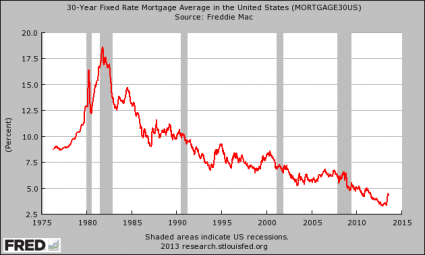
Three months ago, the average rate on a 30 year mortgage was 3.35 percent.  It has shot up more than a full point since then...
Mortgage buyer Freddie Mac said Thursday that the average on the 30-year loan rose to 4.39% from 4.31% last week. Rates are a full percentage point higher than in early May.
And as the chart below shows, mortgage rates have a lot more room to go up...


As mortgage rates go up, so do monthly payments.

And monthly payments are already beginning to soar.  Just check out this chart.
So what happens if mortgage rates eventually return to "normal" levels?

Well, it would be absolutely devastating to the housing market.  As mortgage rates rise, less people will be able to afford to buy homes at current prices.  This will force home prices down.
To a large degree, whether or not someone can afford to buy a particular home is determined by interest rates.  The following numbers come from one of my previous articles...
A year ago, the 30 year rate was sitting at 3.66 percent.  The monthly payment on a 30 year, $300,000 mortgage at that rate would be $1374.07. 
If the 30 year rate rises to 8 percent, the monthly payment on a 30 year, $300,000 mortgage at that rate would be $2201.29. 
Does 8 percent sound crazy to you? 
It shouldn't.  8 percent was considered to be normal back in the year 2000.
And we are already seeing rising rates impact the market.  The number of mortgage applications has fallen for 11 of the past 12 weeks, and this has been the biggest 3 month decline in mortgage applications that we have witnessed since 2009.

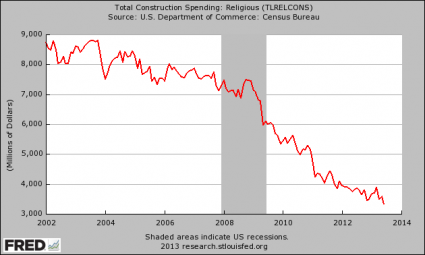
Rising interest rates will also have a dramatic impact on other areas of the real estate industry as well.  For example, public construction spending is now the lowest that it has been since 2006.
And I find the chart posted below particularly interesting.  As a Christian, I am saddened that construction spending by religious institutions has dropped to a stunningly low level...


So what does all of this mean?

Well, unless interest rates reverse course it appears that we are in the very early stages of another great real estate crash.

Only this time, it might not be so easy for the big banks to swoop in and foreclose on everyone.  Just check out the radical step that one city in California is taking to stop bank foreclosures...
Richmond is the first city in the country to take the controversial step of threatening to use eminent domain, the power to take private property for public use. But other cities have also explored the idea. 
Banks, the real estate industry and Wall Street are vehemently opposed to the idea, calling it “unconstitutional” and a violation or property rights, and something that will likely cause a flurry of lawsuits. 
Richmond has partnered with San Francisco-based Mortgage Resolution Partners on the plan. Letters have been sent to 32 servicers and trustees who hold the underwater loans. If they refuse the city’s offer, officials will condemn and seize the mortgages, then help homeowners to refinance.
If more communities around the nation start using eminent domain to stop foreclosures, that is going to change the cost of doing business for mortgage lenders and it is likely going to mean more expensive mortgages for all the rest of us.

In any event, all of this talk about a "bright future" for real estate is just a bunch of nonsense.
You can't buy a home if you don't have a good job.  And as I wrote about the other day, there are about 6 million less full-time jobs in America today than there was back in 2007.

You can't get blood out of a stone, and you can't buy a house on a part-time income.  The lack of breadwinner jobs is one of the primary reasons why the homeownership rate in the United States is now at its lowest level in nearly 18 years.

And we aren't going to produce good jobs if our economy is not growing.  And economic growth in the U.S. has been anemic at best, even if you believe the official numbers.

We were originally told that the GDP growth number for the first quarter of 2013 was 2.4 percent.  Then it was revised down to 1.8 percent.  Now it has been revised down to 1.1 percent.
So precisely what are we supposed to believe?

Overall, since Barack Obama has been president the average yearly rate of growth for the U.S. economy has been just over 1 percent.

That isn't very good at all.

But remember, the government numbers have been heavily manipulated to look good.
The reality is even worse.

According to the alternate GDP numbers compiled by John Williams of shadowstats.com, the U.S. economy has continually been in a recession since 2005.

And now interest rates are rising rapidly, and that is very bad news for the U.S. economy.
I hope that you have your seatbelts buckled up tight, because it is going to be a bumpy ride.

Source

August 1, 2013

Elliott Management: "The Entire Developed World Is On A Slippery Slope"

Elliott Management's 22-page letter to investors has something for everyone as Paul Singer ascribes his uniquely independent wisdom. From the fragility of the financial system to the hubris of academic pretenders; from inflation's various devious impacts on assets and reality to the floundering of the world's bankers; from America's "cooked data" to the pending social unrest in Europe and the perils of centralized power, Singers stresses "the temptation to debase fiat currencies... means owning claims on paper money is an act of either faith or denial." Recent market movements, Singer warns "indicate a world on life-support," and "for every day, month and year that policymakers try to substitute failed, inappropriate and risky QE policies for pro-growth policies, the debt mounts, as does resentment among middle-income families that their situation is not improving." The fact of the matter is that "no government has ever reached fiscal 'nirvana,' yet our central bank (and its peers) continues to push the envelope of risk, confidence and inflation." Despite the confident and brave words in which they are wrapped, central bank actions currently seem underscored by quiet panic.

On recent market volatility:
...the markets’ dramatic response underlines the fragility of the world’s economic and financial systems, as well as its dependence on the artificial stimulants of QE, ZIRP and extreme deficit spending, all of which are still active (or even increasing) five years after the financial crisis. The stronger growth that was supposed to be ignited by all this financial and fiscal caffeine is not present or anywhere in sight.
On the Un-Taper after any Taper:
...governments in the major developed countries are determined not to be caught by a renewed deflationary credit and banking collapse... such an event would be met by another cascade of money-printing and governmental guarantees.
On inflation:
It is more difficult to make judgments about whether and when the torrent of freshly-minted QE money will create widespread price increases that everyone would recognize as “serious inflation” (as distinguished from the “asset-price inflation” currently underway, which policymakers argue is not the same thing)...

...bond prices have dropped (depending on their duration) by anywhere from 3 to 15 points or more. It is not yet clear whether these price movements are only short-term fluctuations, or whether they are possibly the start of the painful acceptance by markets that inflation is likely to take place in the foreseeable future.
Is The Global Economy Turning Up?
Most economists seem to feel that growth in the U.S. economy will accelerate in the second half of 2013 and gather more steam in 2014, and that Europe may be close to reaching its bottom... Our guess is that a meaningful upturn of growth in the U.S. and Europe is unlikely, given the current mix of fiscal and economic policies in these regions.

...When we contemplate what it says about financial soundness when the U.S. 10-year interest rate goes from 1.60% to 2.60% in a few weeks and the world shakes, the implications are quite sobering. The market movements in June do not bespeak a robust, solid financial system capable of withstanding the normal ebbs and flows of human events. Rather, they indicate a world on life support, with policymakers experimenting, floundering and trying to create with the appropriate jaw movements what their extreme and empirically unsound policies have failed to accomplish in actual fact.

...China has had a hard time building the consumption side of its powerful economic engine to the same degree as the investment side. We agree with those who are marking down expectations for near-term growth in China. That is obviously a negative factor for the global economy

...Our views about Europe and the U.S. have evolved toward an expectation that we are not likely to see a meaningful pickup in growth for the rest of 2013, into at least 2014. If this view is indeed correct, it is anyone’s guess whether and when this reality will raise the level of citizen frustration and anger with the leaders and established mainstream political parties of these regions. It is also difficult to predict whether this frustration and anger will result in increased political radicalism.
On the "cooking" of US data and the harsh reality:
...America is undergoing a little data lift, but not as much as people think, because much of the data is “cooked.” We do not expect an acceleration of growth in the U.S., and there very well may be a fallback.

Five years after the crash, the labor recovery is still extraordinarily weak. The absolute level of nonfarm payrolls today is basically the same as it was in 2005. Furthermore, a significant percentage of recently created jobs are low-wage and/or part-time...

...the problem of distorted and false government statistics, and in this installment we are going to connect some dots.

...At present, most people assume that the economy is expanding at roughly a 2% annual “real” growth rate. However, the underlying presumption of that arithmetic is that the government’s inflation statistics are accurate, because real growth is measured by subtracting inflation from nominal GDP growth. But it is quite clear that the government uses various means to keep the inflation number artificially low, including its focus on “core” inflation, which removes energy and food prices from the equation. The resulting overestimation of real growth has a much greater impact during times of anemic growth than when unemployment is at normal, non-recessionary levels.

...the “core” concept is bunk: Inflation is in fact higher than officially reported, which means growth is actually lower than the government says it is. And this does not even include other gimmicks (such as hedonic adjustments) that increase the understatement of inflation (and overstatement of growth) in government statistics
On America's culture of dependence:
In December 1968, roughly 65.6 million American workers held full-time jobs, according to the Bureau of Labor Statistics, while nearly 1.3 million people collected disability – a ratio of over 50:1. In May 2013, with 116.1 million full-time workers and a record 8.9 million collecting disability, that ratio has dropped to 13:1. We reject the notion that our workforce has become that much feebler, especially as our workplaces have become dramatically safer.

Rather, we think this alarming and significant increase in the number of people receiving disability payments, in many cases transitioning directly from unemployment benefits to disability benefits, denotes an increased culture of dependence, which bodes poorly for the prospects of a strong economic rebound.
On why policy matters:
The dividing lines between success and failure in achieving the goals of strong growth and high-quality job creation are easy to see. A stable, predictable and relatively low-tax regime is an attractive feature for potential job-providers, whereas high and rising taxes combined with class-warfare messages are detriments. Policies that reduce the power of special-interest groups to set wages at uncompetitive levels and/or dictate corporate or governmental staffing are additive to growth, compared with rigid employment rules and structures.

...what has caused America to spend the last five years mired in recession? Bad policies are to blame. The Administration’s rationale is that things would be much worse in the absence of such policies.

...Bad choices were made, and they are still in effect today. The ultimate consequences may prove to be disastrous.

...Perhaps the best approach would be for the government to just get out of the way.
On the 'obvious' failure of central planning:
Over a long period of time, a mechanistic and technocratic mentality has taken hold, spread by people who believe in all-encompassing central control over people’s lives, and embraced by elites who have come to believe that policies have precise and definable effects. In “normal” times, perhaps the lack of a precise connection between cause and effect gets lost in the sauce, largely ignored by the public and policymakers alike. But in a low-growth environment like the present, deficiencies in the causal relationship are more discernable.

First of all, life is less predictable than the relationship presumes. Furthermore, there are second-order, delayed, interactivity and reflexivity effects, any or all of which can be every bit as important, or even more important, than the immediate and “obvious” firstorder effects. Monetary policy is a great example. Print trillions of dollars, markets go up, financing conditions become easier and banks can make money with carry trades. But what about the potential attendant effects of this monetary experimentation, such as: distortions, resentments, the inability of the middle class to participate, the risk of future inflation and so on? And when those things occur, at some “unpredictable” time in the future, will policymakers raise their hands and admit responsibility?
On political promises:
In most realms of endeavor, the more centralized the power, the greater the chances of inefficiency, corruption, inflexibility and waste. As businesspeople, we all know that.

But many politicians think they always have to do something. And many citizens let them, especially when the politicians promise to take money from someone else and give it to them if they vote “correctly.”
On overconfidence:
It is remarkable that global central bankers are so confident in their simultaneous QE policies. The prevailing wisdom seems to be that the developed world simply needs to place its faith in the central banks to hold the world together with just enough growth and job creation to ward off revolutions.

Apparently the combination of a rising stock market, falling gold prices and low reported CPI has lulled policymakers into ignoring the dangers of their policies.
And the consequences of their hubris:
Today, there is a serious structural growth problem, not to mention a deep long-term insolvency, in the “legacy” countries, so called because they are steeped in the legacy of unrepayable debt and long-term entitlement obligations. Can anyone pretend that governmental policies in the U.S., Japan, the U.K and continental Europe are effectively addressing such problems? Of course not.

So how does this global money-printing, bondbuying, ZIRP, QE, whatever you want to call it, actually end? The overwhelming majority of professional money managers (including us) will admit to having no clue, yet the central bankers think they have all the answers. The consequences for the world if they are wrong are very serious.
On 'Fiat currencies':
It is very hard for policymakers to avoid the temptation to debase fiat currencies. To maintain confidence in paper money, policymakers need to adopt strict discipline and a tone of sobriety and respect for their moral commitment to maintain the real value of this infinitely creatable and ethereal “standard” and “store of value.” Since the globe’s major central banks, starting with our own, have long since abandoned such discipline and sobriety, there is actually no solid justification for investors and citizens to have confidence that paper money or claims on paper money (bonds) will actually maintain their value.

Thus, owning claims on paper money is an act of either faith or denial.
On Inflation and QE:
QE has not solved the world’s economic problems, and it has had massive second-order effects, but QE has neither been abandoned nor replaced by smart policies designed to stimulate real growth. Central banks seem to be fanatically determined to generate inflation, since somehow inflation is thought to be a proxy for growth.

In fact, inflation is an arbitrary wealth redistribution and confiscation mechanism that sometimes (but not always) accompanies growth and boosts asset prices. But inflation, in a nutshell, is the developed world’s pro-growth policy at present.
On 'fiscal nirvana':
No government has ever achieved those goals and reached fiscal “nirvana,” yet our central bank (and its peers) continues to push the envelope of risk, confidence and inflation.
On 'faith':
The monetary policies of the legacy countries may or may not be a house of cards, but they certainly seem dangerous. So much belief and reliance is being placed on a small group of policymakers who personally had very little understanding of the financial system in advance of the last crisis.

Their lack of humility has created a distorted and inequitable “recovery.” Some social theorists rail against “trickle-down economics,” but is there any clearer and more patently unfair example of this concept than QE?

The rich get richer, and the government takes credit for doling out handouts to those who have not benefited from asset-price inflation.
On unintended consequences:
Policymakers who engage in QE other than at times of dire emergency are assuming they understand the precise linkages between output gaps, asset-price movements and consumer demand. In our opinion, that assumption is presumptuous in the extreme, whether for the most seasoned financial industry veteran or a government bureaucrat. It is foolish of the Fed and its peers to think they can figure out and finely-tune the expectations of markets.

In a large monetary debasement, there usually comes a time when central bankers start to realize that they have set society on the road to ruin, but they are reluctant to stop printing money because it would cause immediate pain. Few have the courage to swallow this medicine, so they persist or double down. Maybe at some point they understand that there is no way out and that they are just digging a deeper hole, or perhaps they think that printing another slug will buy them enough time for some deus ex machina to enter the equation and fix things.

However, the fact remains that policymakers, devoid of vision or humility, have far less insight into the medium- and long-term consequences of their policies than they publically purport to possess.
On the opacity of financial institutions:
To our knowledge, no policymaking individual or body is actually working on addressing the opacity of financial institutions, so goodness knows how modern, large financial institutions with tens of trillions of dollars (notional amount) of derivatives on their books can ever be understood or trusted by traders and governments in the absence of explicit or implicit government guarantees. At the risk of sounding like a broken record, this problem needs to be studied and fixed.
On the ignorance of the Fed:
It is extraordinary to us that the world’s most powerful central banker, in the midst of a gigantic and powerful monetary policy experiment consisting of zero percent interest rates and trillions of dollars of money-printing, expresses puzzlement that markets act how they want to act rather than pursue the script set out for them by the Ph.D-approved models of the exquisitely educated and experienced Fed.

Sadly, 2008 demonstrated conclusively that the major central banks, most energetically the Fed, possess only the most rudimentary understanding of the modern financial system.
On how it came to this?
The truth, of course, is that stock prices are at these levels only because the government printed trillions of dollars to bid them up. The economy is not performing well, and when inflation kicks in, everyone will realize that they have been hoodwinked by the oldest trick in the book: debase the currency and fool the people into thinking that they have more than they actually do, that they owe less than they promised to pay, and that everything from savings to work is based on shifting ground, rather than any stable or enduring standards of value.

How did it come to this? The answer is simple: arrogance, hubris and academics masquerading as leaders and experts.
On Ponzi-merica:
Today, suffice it to say that credit is deeply embedded as a substitute for income, in many instances completely replacing equity in purchases of homes and other large consumer goods. Tens of millions of Americans (the “thought leaders” on this road to perdition) are now completely in the grip of their own personal “Ponzi finance.” The same can be said about the U.S. government...
On getting off the slippery slope:
The entire developed world, not just the U.S., has been on a slippery slope, with policy actions that gave the impression of adding to growth without increasing risk.

...The most effective way to escape a slippery slope is to dig in and step off, deliberately and thoughtfully, as quickly as possible, accepting some current pain for the greater long-term good. In the context of repairing the U.S. economy and improving the outlook for future prosperity, this process includes reforming unpayable entitlements, deleveraging financial institutions, requiring homebuyers to make substantial down payments, ending the interest-expense tax deduction and, most of all, growing the economy faster using sustainable methods of generating growth, not just by giving people credit for which they do not qualify.

All of this progress can be made, but it takes leadership and determination.
Where are we now?
Typically, periods prior to crashes and financial crises are times of complacency, characterized by extreme pricing of financial assets that removes future reward and increases future risk. Another common feature of such periods, some of which can be quite lengthy, is a mentality of denial and inadequate focus on risk among investors and policymakers, increasingly leading to the building of very large positions that are untenable if the environment changes. It is always the case that traders with large leveraged books are vulnerable to sudden shifts in the trading landscape, and that when such traders are forced to unwind, markets are roiled. But the advent of derivatives in modern markets has allowed the creation (with relative ease and limited capital requirements) of unimaginably massive, highly-leveraged positions, in turn increasing the number of vulnerable traders.

Moreover, in a modern twist with roots in the financial crisis, central banks have leaped to the top of the heap, becoming some of the largest leveraged and exposed traders in the world. Multi-trillion-dollar positions in bonds and even some stocks have left these institutions with “nowhere to go.” They have driven up the prices of most asset classes, and markets hang on their every word, discussing the third derivatives of their intentions. (“We may start to think about deciding when to reduce the pace of our buying as a prelude to actually selling the paper we own or letting it mature, but don’t be scared! Everything’s gonna be okay! We know what we are doing!”) Central bankers must arise every morning and pray that the world’s major economies surge into growth and full employment so that the $14 trillion (and counting) of assets already on their balance sheets can somehow quietly disappear into the large flows of global markets.
It would appear that being 'smart money' is really just a matter of telling it like it is - as opposed to herding sheep-like in behind the rest of your apparent peers - a topic we are well aware of.

Source