November 11, 2014

Petrodollar Panic? China Signs Currency Swap Deal With Qatar & Canada

The march of global de-dollarization continues. In the last few days, China has signed direct currency agreements with Canada becoming North America's first offshore RMB hub, which CBC reports analysts suggest "could double maybe even triple the level of Canadian trade between Canada and China," impacting the need for Dollars.But that is not the week's biggest Petrodollar precariousness news, as The Examiner reports, a new chink in the petrodollar system was forged as China signed an agreement with Qatar to begin direct currency swaps between the two nations using the Yuan, and establishing the foundation for new direct trade with the OPEC nation in the very heart of the petrodollar system. As Simon Black warns, "It’s happening... with increasing speed and frequency."

Authorized by China's central bank, the deal will allow direct business between the Canadian dollar and the Chinese yuan, cutting out the middle man — in most cases, the U.S. dollar.

Canadian exporters forced to use the American currency to do business in China are faced with higher currency exchange costs and longer waits to close deals.

"It's something the prime minister has been talking about. He wants Canadian companies, particularly small- and medium-sized businesses, doing more and more work in China, selling goods and services there," said CBC's Catherine Cullen, reporting from Beijing.
It’s happening. With increasing speed and frequency.

The People’s Bank of China and the Canadian Prime Minister’s office issued a statement on Saturday stating that Canada will establish North America’s first offshore renminbi trading center in Toronto.

China and Canada agreed on a number of measures to increase the use of renminbi in trade, business, and investment. And they further signed a 200-billion renminbi bilateral currency swap agreement.

Moreover, just today, hot off the presses, the central banks of China and Malaysia announced the establishment of renminbi clearing arrangements in Kuala Lumpur, which will further increase the use of renminbi in South-East Asia.

This comes just two weeks after Asia’s leading financial center, Singapore, became a major renminbi hub, with direct convertibility established between the Singapore dollar and the renminbi.
And as Black notes, everyone is in on the trend. All across the world, the renminbi is quickly becoming THE currency for trade, investment, and even savings.
Renminbi deposits in South Korea, for example, surged 55-times in one single year. It’s stunning.

The government of UK just issued a renminbi bond, becoming the first foreign government to issue debt in renminbi.

Even the European Central bank is debating to include renminbi in its official reserves, while politicians the world over are sounding not-so-subtle warnings that a new non-dollar monetary system is needed.

Nothing goes up or down in a straight line. And given how volatile Europe and the global economy continue to be, the dollar may certainly be in for its surges and bumps in the coming months.

But over the long-term it’s glaringly obvious where this trend is going: the rest of the world no longer wants to rely on the US dollar, and they’re making it a reality whether the US likes it or not.
And now, no lesser oil-producing state than controversial Qatar has signed an agreement too.. seemingly opening up the door to Petrodollar panic... (as The Examiner reports)
The petro-dollar system is the heart and soul of America's domination over the global reserve currency, and their right to make all nations have to purchase U.S. dollars to be able to buy oil in the open market. Bound through an agreement with Saudi Arabia and OPEC in 1973, this de facto standard has lasted for over 41 years and has been the driving force behind America's economic, political, and military power.

But on Nov. 3 a new chink in the petro-dollar system was forged as China signed an agreement with Qatar to begin direct currency swaps between the two nations using the Yuan, and establishing the foundation for new direct trade with the OPEC nation in the very heart of the petro-dollar system.

While this new agreement between China and Qatar is only for the equivalent of $5.7 billion over the next three years, Qatar becomes the 24th nation to open its Forex market to the Chinese currency, and solidifies acceptance of the Yuan as a viable option for the future in the Middle East.

China's central bank announced Monday that it has signed a currency swap deal worth 35 billion yuan (about 5.7 billion US dollars) with the central bank of Qatar.

The three-year deal could be extended upon agreement by the two sides,said a statement on the website of the People's Bank of China (PBOC).

Also on Monday, the two sides signed a memorandum of understanding on Renminbi clearing settlement in Doha. China agreed to extend the RMB Qualified Foreign Institutional Investor scheme to Qatar, with an initial quota of 30 billion yuan.

The deal marked a new step forward in financial cooperation between the two countries, and will facilitate bilateral trade and investment to help maintain regional financial stability, the statement said. - China Daily

It is perhaps no coincidence that the term for the new agreement is set for three years, and is within the exact time frame being predicted by the director of the Finance Institute under the Development Research Center of the State Council, Zhang Chenghui for the Renminbi to become fully convertible in the global financial system.

The need for new markets and a more stable trade currency in Qatar could be tied to a new report issued last week by French bank BNP Paribas which showed that petro-dollar recycling has fallen to its lowest levels in 18 years, signifying that even oil producing nations in the Middle East are finding it difficult to trust the U.S. dollar, and facilitate its use in trade due to its depreciation since the advent of the Federal Reserve's massive QE programs.

Nearly every week now, China, Russia, or one of the BRICS nations are finalizing agreements that supersede the old system of dollar trade and reliance on the petro-dollar system. And as many countries begin to reject the dollar due to the exported inflation that is growing in nations that are relegated to having to hold them for global oil purchases, alternatives such as the Chinese Yuan will become a more viable option, especially now that the Asian power has taken over the top spot as the world's biggest economy.
Source 

November 10, 2014

The System Is Terminally Broken

The Fed has formally “ended” QE, but it hasn’t really.  The Fed will continue reinvesting interest on its portfolio in more bonds and it will rollover maturities.  We saw what happens to the stock market a few weeks ago when Fed official James Bullard asserted that the Fed needs to start raising rates:   the S&P 500 quickly dropped 8%.  Right at the bottom of the drop, the very same Bullard issued a statement suggesting that QE should be extended.  This triggered an insanely abrupt “V” move back up to a new record high for the S&P 500.  Bullard either did this intentionally or is a complete idiot.

The stock market can’t function without Federal Reserve intervention.  The stock market lost 8% quickly on just the thought that the Fed might start raising rates.  Imagine what would happen if the Fed decided to “experiment” by shutting down its market intervention operations – both verbal and physical – for a month…

As for QE, if the Fed has achieved its objective of stimulating the economy, why doesn’t it start removing the $2.6 trillion of liquidity that it has injected into its member banks (LINK)?  This was money that was supposed to be directed at the economy.  How come it’s sitting on bank balance sheets earning .25% interest?  That’s $6.5 billion in free interest the Fed continues to inject into the Too Big To Fail banks.  But why?  What would happen if the Fed decided to “experiment” by removing this massive dead-pool of money from the banks?  The money isn’t really “dead,” it’s keeping the banks from collapsing.

I’m interested to watch the Government Treasury bond auctions now that the Fed is not there to soak up anywhere from 50-100% of each issue.  I wonder if the banks will be moving their $2.6 trillion in Excess Reserves into new Treasury issuance.  Obama is going around broadcasting the lie that the Government’s spending deficit in FY 2014 was something like $600 billion.  Yet, the amount of new Treasury bonds issued increased by $1  trillion over the same period.  Either Obama is lying or the accountants at the Treasury committed a big typo.  Either the Fed has found a way to continue opaquely monetizing new Government debt issuance, or the market is soon going to force U.S. interest rates up much higher.

By continuously intervening in all of the markets, the Fed has destroyed the information transmission system that is built into freely trading markets.  If the Fed left the gold market alone – instead of hammering away with the naked shorting of Comex paper gold – the price of gold would be significantly higher than where it is now.  This would be the market’s signal that our system is indeed terminally broken.

Instead, the Fed keeps interest rates artificially low in hopes of stimulating a recovery in consumption and housing. But if this is working, how come the country’s two largest retailers have begun Black Friday shopping discounts on November 3rd (LINK)?  And the Fed keeps pushing stocks higher to  new record highs in order to “stimulate” confidence and faith in the system.  The fact that the stock market craps its pants when the Fed steps away for a split-second tells us just how broken this transmission mechanism is.  That 8% drop 4 weeks ago is the real signal that our system is terminally broken.

And now it’s emerging that the Q3 GDP report was greatly inflated by a statistical error which erroneously boosted the Government spending component.  It was this component that juiced the GDP report because residential investment (housing) and personal expenditures (consumption) both tanked.    Imagine that – a statistical error artificially boosted the GDP report right before a national election…

A colleague of mine has concluded that the QE infinity policy implemented Friday in Japan is the market’s signal that the entire western fiat system is getting close to imploding.  I’m inclined to agree with him.  Wall Street, the financial media and politicians are pointing at Europe and Japan as the source of the problems.   But the heart and nerve center of the western fiat currency/debt Ponzi scheme is right under our nose in this country.   The U.S. financial system is in worse shape than both Japan and Europe.  The only difference is that the U.S. officials do a much better job hiding these problems.

Time is starting to run out for ability of the U.S. to keep kicking the can of collapse down the road.  I really believe that the full-on intensity of the recent intervention in the precious metals market is the most obvious signal of time expiring.  China has been accumulating physical gold at a stunning rate and now some research indicates that China’s Central Bank may have accumulated significantly more gold than anyone previously thought (LINK).   China has most likely maneuvered itself into owning the world’s largest stock of gold, which is where the U.S. had positioned itself after WW2.   China has done this to a large degree by buying massive quantities of western Central Bank gold.

We’ve come full circle, only with China in the Midas throne this time around.  Eventually the world is going to revert back to a gold-backed currency system.  When this happens, the U.S. will be required to demonstrate that it possesses the amount of gold that it reports to own. The only caveat here is that I believe that the U.S. will start WW3 before it’s forced to reveal the truth about its empty gold vault. That’s how broken our system really is…

November 7, 2014

Ritual Incantation - The Economic Gibberish Of The Keynesian Apparatchiks

If you want an illustration of the utter intellectual bankruptcy of our Keynesian policy overlords just review the attached Wall Street Journal piece on yet another downgrade by the EC of its official economic growth forecast. What’s illuminating is not that the savants of Brussels were wrong by a country-mile yet again, but that they persist in a mechanistic numbers game that resembles nothing so much as ritual incantation.

Yep, the Keynesian priesthood is operating from sacred texts and magic numbers. One of these revelations says that 2% inflation was decreed by the great god of GDP and that any shortfall will precipitate his wrathful extractions from growth and jobs. But there is not a shed of empirical evidence for 2% versus 1% or 3% annual change in consumer inflation—–even if it were honestly measured. Its just revealed word as transmitted by the Keynesian priesthood.

Another sacred tenent avers that in handing down the laws of proper economic life, the Keynesian creator ordained that governments everywhere and always must strive to bring GDP growth to its full employment “potential” rate.  No exceptions. World without end.

While the texts are not clear on the precise numeric value of this divinely ordained rate of potential GDP growth, today’s congregants claim that it’s about 3%, reflecting the historic trend growth of the labor supply plus productivity gains. In fact, however, we have achieved only about half of that—about 1.8% per annum—-in the US during the last 14 years, and even a lesser fraction in Europe.

Accordingly, this imaginary trend line of “potential GDP” is now far above actual output levels. This yawning gap between the real economy and its revealed potential, in turn, enables the Keynesian priesthood to demand an endless crusade by the fiscal and central banking agencies of the state to close it.

This essentially means that the state’s economic apparatus is now all about stimulus, all of the time. In fact, the state’s central banking branch has gotten so deep into ritualized Keynesian governance that it’s essentially attempting to micro-manage vast accumulations of GDP—-about $17 trillion each in the US and Europe—-on a monthly basis.That’s entirely what the meeting statements and post-meeting press conferences are all about.

Yet this is absurd. The information flow in a $17 trillion economy is far too vast to be digested and assessed by the 12 mortal members of the FOMC, and their policy control instrument—-the bludgeon of interest rate manipulations—- could not  possibly shape its short-run course in any event. That’s especially true since the macro-economy is not a closed system, but one open to every manner of complicating and countervailing influence from trade, capital flows and financial impulses in a $80 trillion global economy.

Still, the Keynesian policy apparatchiks have not even an inkling that they are attempting the impossible or that their patter about objectives, forecasts and policy actions have gotten downright moronic. And here’s where the EC’s latest retreat on its official forecast is so ludicrously illustrative.

Given the massive complexity of the global economy—plus the tidal forces being unleashed by Japan’s yen destruction campaign, the cooling of China’s monumental construction binge, the dead-in-the-water bankruptcy of most of Europe and the massive shift of income and wealth to the top 1% in America— no one in their right mind should attempt to predict GDP growth to the exact decimal point three years into the future or even one year for that matter. There are imponderables, uncertainties and aberrations everywhere, and none of them are in the Keynesians’ primitive DSGE models.

Yet like the Keynesian apparatus everywhere in the modern world, the EC bureaucrats are pleased to try, and feel compelled to make hairline adjustments twice a year—-mainly to cover their chronic back-pedaling on the near-term picture which, in any event, reveals itself soon enough.

Thus, not too long ago the EC projected that real output gains averaged across 18 hugely divergent eurozone economies would average 2.5% during 2015. By the time of this year’s spring forecast revision, the projection was down to 1.7%; and now its fall update downgrades it further to 1.1%. Yes, and while they were splitting economic hairs, the EC prognosticators decided to embrace nine months of “disappointing” reality that has already occurred and lower the 2014 forecast to 0.8% from the spring level of 1.2%.

While it was at it, the EC also resurrected its 1.7% GDP forecast—-which was projected for 2014 awhile back before it was lowered in semi-annual nicks to its current 0.8% level. It seems that this magical 1.7% growth number for the third year forward is never really abandoned; its just rolled forward year after year. Indeed, it had  earlier been shuffled forward to 2015, but since that now seems out of reach, the Brussels prognosticators had no trouble seeing it coming clearly into view for 2016.

This paint-by-the-numbers ritual is ridiculous because it makes not a wit of difference whether the outlook for GDP three years into the future is 0.8%, 1.2%, 1.7% or any other number in that range. Its just noise and foolishness.

Why then do they persist in this pointless forecast ritual?  Well, because it is written in the sacred texts that policy action to close the GDP gap is imperative, and that the size of the gap and the requisite policy interventions depend upon a macro forecast. The latter is, in effect, their policy intervention map.

However, now that the output gap has become massive and the central bankers believe that there is vast “slack” in the labor force—- which is partly reflected in Europe’s official unemployment rates and largely obfuscated by the BLS’ dummied up U-3 numbers here—the Keynesian project faces a rude reality. Namely, that it is virtually impossible to believe that the “gap” and the “slack” are due to cyclical factors.

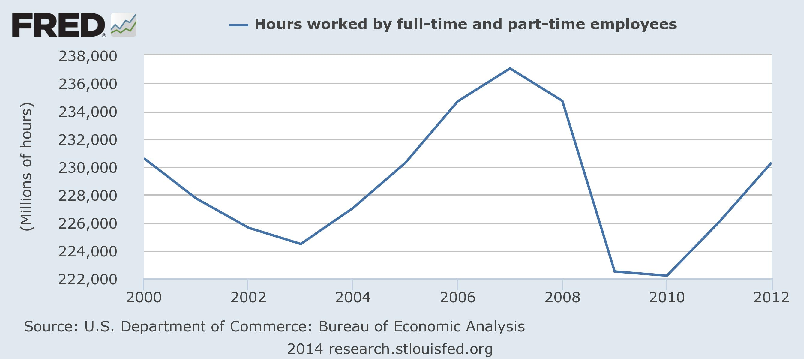
Two simple time series prove the case. First, there has been virtually no increase in non-farm labor hours actually consumed by the US economy over the past 15 years.  That’s not cyclical—–its a disastrous fundamental condition or trend.

Untitled

Secondly, real median household incomes have been trending down for the past 15 years, as well. That too is not about temporary “cyclical” slack; it is a measure of a failing, decaying national economy.


So today’s perpetual stimulus policy is utterly unsuited to the real problems at hand because these deep challenges dwell on the supply side of the economy. The latter has become freighted down with debt, taxes, regulatory barriers, crony capitalist inefficiencies and welfare state inducements to dependency. They have nothing to do with “aggregate demand”, and couldn’t be solved with even more household and business borrowing on top of the mountains of debt already on their balance sheets. The Fed’s lunatic ZIRP policy has already proven that it can’t actually stimulate credit fueled spending for consumer and capital goods owing to the roadblock of “peak debt”.

Yet the Keynesian apparatchiks continue to demand counter-cyclical “stimulus” because they are intoxicated in ritual incantation based on an earlier, more primitive Keynesian catechism. Those original texts called for episodic action at the bottom of the business cycle to prime the pump and overcome recessions. Stimulus was the exceptional condition, not the norm; it embodied the notion that after the state’s kick start——market capitalism could largely take care of itself. The corollary was that fiscal and monetary policy would rapidly normalize once the recovery commenced.

Indeed, the  “business Keynesians” of the early 1960’s promised that there would be an off-setting fiscal surplus during the top half of the cycle. Therefore “counter-cyclical deficits” were not a form of monetization of the state’s debts because the borrowing involved was held to be only temporary (i.e. would be repaid from recovery period surpluses). And central bankers like the great William McChesney Martin, who was no Keynesian at all, actually did endeavor to “lean against the wind” during the up-cycle and even take away the punch bowel just when the party got started.

But somewhere during the last two decades the Keynesian stimulus project migrated from the fiscal authorities to the central banks. This had far-reaching consequences because it shifted the locus of policy making from the unruly, paralysis prone machinery of legislative budgets and taxes to unelected bureaucrats and academics endowed with virtually plenary powers and 13 year terms.

What is worse, it put them in the full-time business of fiddling with the money and capital markets in the false belief that they could control the evolution of the macro-economy through its financial nerve center and deftly guide GDP back to the ordained path of full employment.

Consequently, all hell has broken loss. These interventions have not levitated the real economy, nor have they closed the imaginary output gap. Instead, massive central bank stimulus has destroyed honest capital markets and enabled a giant casino of speculators to feast on the free money and market props, puts and bailouts offered by the central banks.

Yet the true danger is not simply that the Keynesians are caught in a time warp. That is, that the fiscal Keynesianism taught by James Tobin in the 1960’s was OK because it was counter-cyclical help from the state to the private economy, but the 24/7 central banker Keynesianism practiced by his PhD student, Janet Yellen, has gone too far and is now obsolete.

No, Keynesianism was always wrong. It is predicated on the alleged inherent cyclical instability of market capitalism, and a purported tendency to chronically tumble into recession, depression and an economic black hole absent the ministrations of the state.

But the evidence for that is the founding event of the Keynesian gospel—–the Great Depression of the 1930s. Yet tragic as it was for mankind everywhere, the disaster of the 1930’s was not due to the inherent instabilities of capitalism or an unregulated free market.

Instead, the Great Depression was born in the financial mayhem of World War I, which destroyed the monetary system and engulfed the world in debt and inflation; and in the 1920s manipulations of the Fed, Bank of England and other central banks as they attempted to restore the pre-1914 status quo ante without the fiscal and financial discipline that was part and parcel of the prosperity and stability that flowed from the liberal international order based on the gold standard and free trade in goods, capital and labor.

All the milder business cycles since then have been generated by the state. These include the excesses of war finance and an overheated economy, as in the case the Korean and Vietnam wars; and the peacetime spells of excessive credit creation enabled by central banks, which had to then correct their own excesses through monetary stringency and recession.

In open economies and a global trading system the only thing which counts is prices, not aggregates.  America’s problem is that its production costs and labor prices are too high and its subsidies for inefficient production and non-production are too great. That is the reason why there is so much labor “slack” and why the growth of output and wealth has been so tepid since the late 1990s when the “china price” became the driving force in the global economy.

Stated differently, the Keynesian notions of “potential GDP” and “aggregate demand” have no basis in the real world. They are revealed doctrine. They are the religion of the state’s economic policy apparatus.

Its bad enough that this destructive economic religion leads to the farcical forecasting games evident in the EC’s chronic updates and slow-walks of the GDP numbers down. The evil, however, is that the Keynesian apparatchiks will not desist in their destructive money printing and borrowing until they have suffocated free market capitalism entirely, and have monetized so much public debt that the financial system simply implodes.

By Gabriele Steinhauser at The Wall Street Journal

The European Commission on Tuesday cut its growth forecasts for the eurozone and the European Union, citing the tensions in Ukraine and the Middle East along with a lack of investment.

The EU’s executive arm now also expects inflation in the eurozone to remain below the close-to 2% targeted by the European Central Bank until at least 2016. That is likely to boost expectations of stronger measures by the ECB such as large-scale purchases of government bonds and other assets.

The commission said it now expects gross domestic product in the 18-country eurozone to grow 0.8% this year, down from 1.2% growth it forecast this spring. In 2015, the eurozone economy will likely grow 1.1%, also less than the 1.7% growth seen in the spring. In 2016, growth in the currency union will rise to 1.7%, the commission said.

The forecasts for the eurozone were dragged down by lower than-expected growth in big countries, including Germany, France and Italy, the latter of which expected to fall back into recession this year.

The picture looks only mildly better for the broader EU. The 28 EU countries are now expected to grow on average 1.3% this year, down from 1.6% growth seen in the spring. Next year, EU GDP is expected to rise 1.5%, also below the 2% previously forecast. In 2016, growth is seen reaching 2%.

“The economic and employment situation is not improving fast enough,” said Jyrki Katainen, the European Commission’s vice-president for jobs and growth. “The European Commission is committed to use all available tools and resources to deliver more jobs and growth in Europe.”

Significantly for investors, the commission said eurozone inflation is likely to be 0.5% this year and 0.8% in 2015. Even in 2016, inflation in the currency union is forecast at just 1.5%, still below the close-to-2% targeted by the ECB, the commission said. Those 2014 and 2015 forecasts undershoot the ECB’s own inflation expectations released in September. At the time, the ECB said it expected eurozone inflation to be 0.6% this year and 1.1% in 2015.

Low growth and low inflation will make it much harder for the eurozone to recover from its debt crisis, causing big problems for high-debt countries such as Greece, Italy and Spain, among others.

Although most analysts don’t expect the ECB to announce new measures to stimulate inflation at its meeting on Thursday, Tuesday’s forecasts are likely to raise expectations of future action, including larger-scale asset purchases as were previously done by the U.S. Federal Reserve and the Bank of England.

Tuesday’s forecasts also form the basis for the commission’s assessment of national governments’ 2015 budgets. While the lower-than-expected growth could mean some countries get extra time to bring their deficits below the 3% of GDP allowed under EU law, they are also likely to underpin demands for new cuts in some countries, including France and Italy. According to the forecasts, both Paris and Rome will fail to cut their 2014 deficits by as much as previously promised, even when the effects of the weak economy are stripped out.

November 6, 2014

Debt on Wheels

Soaring auto sales are not so much a sign of a strong economy as they are an indication of financial hanky-panky. We saw this same type of fakery play out in housing between 2004 – 2006, when prices went through the roof due to a mortgage-lending scam (“subprime”) that crashed the stock market and sent the economy reeling. Now the bigtime money guys are at it again, writing up auto loans for anyone who can sit upright in a chair and scribble an “X” on the dotted line. As a result, car sales have surged to over 16 million for the last 6 months. (A full 7 million more than the low point in January, 2009.)   And it’s not hard to see why either. The finance gurus are packaging these sketchy subprimes into bonds, offloading them on eager investors, and recycling the profits into more crappy loans. It’s a perfect circle and it won’t end until the loans start blowing up, jittery investors head for the exits,  and Uncle Sugar rides to the rescue with more bailouts.
But we’re getting ahead of ourselves.  First take a look at these charts by House of Debt which shows the disparity between auto spending and other types of spending since the end of the slump in 2009.
House of Debt:  “New auto purchases have driven the consumer spending recovery to a large degree. The chart below shows the spending recovery for new auto sales and for all other retail spending….
houseofdebtq
From 2009 to 2013, spending on new autos increased by 40% in nominal terms. All other spending increased by only 20%. Further, excluding autos, 2013 saw lower growth in nominal retail spending than 2012…..
The concern is that a lot of auto purchases are being fueled with debt, given a strong recovery in the auto loan market. Below is the net flow of auto loans from 2002 to 2013. It is a net flow because it includes pay downs in addition to new originations. As it shows, auto lending in 2012 and 2013 tops any other year during the previous expansion from 2002 to 2007 (although it is still below the amount of new auto loans in 2000 and 2001).
houseofdebt2
(“Another Debt-Fueled Spending Spree?” House of Debt) 
How about that? So there’s a bigger debt bubble in auto loans today than there was before the bust. But why? Is it because demand is strong,  jobs are plentiful, wages are rising, the economy is growing, and people are optimistic about the future?
Heck, no. It’s because rates are low, credit is easy, and dealers are ready to put anyone with a license and a heartbeat into a brand-spanking new car no questions asked.  Here are the details from an article in the New York Times titled “In a Subprime Bubble for Used Cars, Borrowers Pay Sky-High Rates” by Jessica Silver-Greenberg and Michael Corkery:

”Auto loans to people with tarnished credit have risen more than 130 percent in the five years since the immediate aftermath of the financial crisis, with roughly one in four new auto loans last year going to borrowers considered subprime — people with credit scores at or below 640.
The explosive growth is being driven by some of the same dynamics that were at work in subprime mortgages. A wave of money is pouring into subprime autos, as the high rates and steady profits of the loans attract investors. Just as Wall Street stoked the boom in mortgages, some of the nation’s biggest banks and private equity firms are feeding the growth in subprime auto loans by investing in lenders and making money available for loans.
And, like subprime mortgages before the financial crisis, many subprime auto loans are bundled into complex bonds and sold as securities by banks to insurance companies, mutual funds and public pension funds — a process that creates ever-greater demand for loans.
The New York Times examined more than 100 bankruptcy court cases, dozens of civil lawsuits against lenders and hundreds of loan documents and found that subprime auto loans can come with interest rates that can exceed 23 percent. The loans were typically at least twice the size of the value of the used cars purchased, including dozens of battered vehicles with mechanical defects hidden from borrowers. Such loans can thrust already vulnerable borrowers further into debt, even propelling some into bankruptcy, according to the court records, as well as interviews with borrowers and lawyers in 19 states.
In another echo of the mortgage boom, The Times investigation also found dozens of loans that included incorrect information about borrowers’ income and employment, leading people who had lost their jobs, were in bankruptcy or were living on Social Security to qualify for loans that they could never afford.” (“In a Subprime Bubble for Used Cars, Borrowers Pay Sky-High Rates”, New York Times)
Can you believe that this kind of chicanery is going on in broad daylight without the regulators stepping in? Think about it for a minute: If the NYT’s journalists can find “dozens of loans that included incorrect information about borrowers’ income and employment”, then why can’t the government regulators? It’s ridiculous. What we’re talking about here is a new version of “liar’s loans” where dealers are helping people who don’t have the means to repay the debt, to fudge the details on their loan application so they can drive off in a shiny new Impala.
Haven’t we seen this movie before?
Here’s more from USA Today: “In the first quarter of 2014, 24.9% of all new-car loans were 73 to 84 months long. Four years ago, less than 10% of loans were that long. In fact, such lengthy terms have pulled the average new-car loan to 66 months. That’s an all-time record.”
7 years to pay off a car?  You got to be kidding me? It’s like a second mortgage. And there’s more, too. The average monthly payment and average amount financed hit record highs in the first quarter too. This is from Auto News:
“The average monthly new-vehicle payment was $474 in the first quarter, up 3.3 percent from a year ago. The average monthly used-vehicle payment was $352, up 1.1 percent, Experian Automotive said.
Also in the first quarter, the average amount financed on a new-vehicle loan was $27,612, an increase of $964, or 3.6 percent. For used vehicles, the average amount financed was $17,927, up $395 or 2.3 percent.”
So Americans are not just loading on more debt, they’re also assuming that they’re financial situation is going to be stable enough to make these large payments well into the future.  Good luck with that.
It’s also worth noting that, in many transactions, dealers are actually lending more than the value of the vehicle. According to Reuters David Henry,
“The average loan-to-value on new cars rose to 110.6 percent… On used cars it rose to 133.2 percent…

Auto lenders often provide loans that exceed the value of cars they are financing because borrowers want cash to pay sales taxes and fees.”
Let me see if I got this straight: You walk onto a car lot without a dime in your pocket, and drive off in a brand new car with everything paid for upfront? Such a deal! Can you see why we think that the sales numbers are a big fake?  This isn’t the sign of a strong economy. It’s the sign of another gigantic credit bubble rip-off. 


But what do the dealers get out of this thing? Is it really worth their while to botch the underwriting when they know that eventually they’ll have to repossess the vehicle? 


Sure, it is, because there’s big money in stuffing people into loans they can’t afford.
Here’s how the Times explains it: 


”Auto loans to borrowers considered subprime, those with credit scores at or below 640, have spiked in the last five years. The jump has been driven in large part by the demand among investors for securities backed by the loans, which offer high returns at a time of low interest rates. Roughly 25 percent of all new auto loans made last year were subprime, and the volume of subprime auto loans reached more than $145 billion in the first three months of this year.”
Bingo. So not only do they make dough on the high interest rates they charge their subprime borrowers, (Sometimes 23 percent or more.) they also make it by selling the loan to investors who are eager to buy any manner of crappy bond provided it offers a better return than US Treasuries. This is the mess Bernanke created by fixing interest rates at zero for nearly 6 years.  Zirp (zero interest rate policy) unavoidably leads to excessive risk taking by yield-crazed speculators.    The voracious appetite for subprime securities (ABS–Asset-Backed Securities) has even surprised the bond issuers who are constantly beating the bushes looking for sketchier products.  This is from the same article by the NY Times:
“Investors, seeking a higher return when interest rates are low, recently flocked to buy a bond issue from Prestige Financial Services of Utah. Orders to invest in the $390 million debt deal were four times greater than the amount of available securities.
What is backing many of these securities? Auto loans made to people who have been in bankruptcy.
An affiliate of the Larry H. Miller Group of Companies, Prestige specializes in making the loans to people in bankruptcy, packaging them into securities and then selling them to investors.
“It’s been a hot space,” Richard L. Hyde, the firm’s chief operating officer, said during an interview in March. Investors are betting on risky borrowers. The average interest rate on loans bundled into Prestige’s latest offering, for example, is 18.6 percent, up slightly from a similar offering rolled out a year earlier…. To meet that rising demand, Wall Street snatches up more and more loans to package into the complex investments.” (NYT)
HA! Now there’s a good way to feather the old retirement fund; load up on bonds made up of loans to people who’ve gone bust.
This is the impact that zero rates have on investor behavior. The abundance of cheap and plentiful liquidity invariably leads to trouble. And there are victims in this Central Bank-authored gold rush too, namely the unsophisticated borrowers who pay prohibitively high rates on beater vehicles that are typically worth less-than-half the value of the loan. (Check the NYT article for examples.)
The Times also notes that the ratings agencies have been playing along with the finance companies just as they did during the subprime mortgage fiasco. Here’s more from the Times:
“Rating agencies, which assess the quality of the bonds, are helping fuel the boom. They are giving many of these securities top ratings, which clears the way for major investors, from pension funds to employee retirement accounts, to buy the bonds. In March, for example, Standard & Poor’s blessed most of Prestige’s bond with a triple-A rating. Slices of a similar bond that Prestige sold last year also fetched the highest rating from S.&P. A large slice of that bond is held in mutual funds managed byBlackRock, one of the world’s largest money managers.” (NYT)
Ask yourself this, dear reader: How are the ratings agencies able to give “many of these securities top ratings”, when the investigators from the Times found “dozens of loans that included incorrect information about borrowers’ income and employment, leading people who had lost their jobs, were in bankruptcy or were living on Social Security to qualify for loans that they could never afford”?
Let’s face it: The regulatory changes in Dodd-Frank haven’t done a damn thing to protect the victims of these dodgy subprime schemes. Borrowers and investors are both getting gouged by a system that only protects the interests of the perpetrators. The sad fact is that nothing has changed. The system is just as corrupt as it was when Lehman went down.
So, how long can this go on before the market implodes?
According to the Times:
“financial firms are beginning to see signs of strain. In the first three months of this year, banks had to write off as entirely uncollectable an average of $8,541 of each delinquent auto loan, up about 15 percent from a year earlier, according to Experian….
In another sign of trouble ahead, repossessions, while still relatively low, increased nearly 78 percent to an estimated 388,000 cars in the first three months of the year from the same period a year earlier, according to the latest data provided by Experian. The number of borrowers who are more than 60 days late on their car payments also jumped in 22 states during that period….” (NYT)
(According to Amber Nelson at loan.com: “In the second quarter, the value of all auto loans late by 60 days or more was more than $4 billion, up 27 percent from the prior year, according to Experian.”)
So, yeah, the trouble is mounting, but that doesn’t mean that this madness won’t continue for some time to come. It probably will. It’ll probably drag-on until the economy turns south and more borrowers start falling behind on their payments. That will lead to more defaults, heavier losses on auto bonds, and a hasty race to the exits by investors. Isn’t that how the subprime mortgage scam played out?
Indeed. But at least there are signs of hope on the regulatory front. Check out this clip from an article at CNBC:
“In August, both Santander Consumer and General Motors Financial Co. acknowledged receiving Justice Department subpoenas in connection with a probe over possible violations of civil-fraud laws. And the Consumer Financial Protection Bureau and the Securities and Exchange Commission have both stepped up their scrutiny of the auto-loan market.” (“New debt crisis fear: Subprime auto loans“, CNBC)
So the SEC, the DOJ, and the CFPB are actually investigating the underwriting practices of these behemoth finance companies to see if they violated “civil fraud laws”?
Will wonders never cease?
Just don’t hold your breath waiting for convictions.

November 5, 2014

National Economic Suicide: The U.S. Trade Deficit With China Just Hit A New Record High

Did you know that we buy nearly five times as much stuff from the Chinese as they buy from us?  According to government numbers that were just released, we imported 44.9 billion dollars worth of stuff from China in September but we only exported 9.3 billion dollars worth of stuff to them.  And this is not happening because our economy is so much larger than China's.  In fact, the IMF says that China now has the largest economy on the entire planet on a purchasing power basis.  No, the truth is that this is happening because our economy is broken.  Every month, we consume far more wealth than we produce.  Because the outflow of money is far greater than the inflow, we have to go to major exporting nations and beg them to lend our dollars back to us so that we can pay our bills.  Meanwhile, the quality of the jobs in this country continues to go down and our formerly great manufacturing cities are rotting and decaying.  We are committing national economic suicide, and most Americans don't seem to care.

Barack Obama is constantly hyping a "manufacturing resurgence" in America, but the numbers don't lie.  In September, our manufactured goods trade deficit with the rest of the world soared to a new all-time record high of 69.16 billion dollars.  For the year, we are nearly 12 percent ahead of last year's record pace.

When we buy far more things than we sell, we get poorer as a nation.

How do you think that we ever got into a position of owing China more than a trillion dollars?

We just kept buying far more from them than they bought from us, and their money just kept piling up.  Now it has gotten to the point where our politicians literally beg them to lend our money back to us.  They are the head and we are the tail.

And we did this to ourselves.

Once upon a time, the United States was the greatest manufacturing powerhouse that the world had ever seen.  But now China manufactures more stuff than us and China also accounts for more total global trade (imports plus exports) than us.

This should never have happened.  Several decades ago, the Chinese economy was a complete joke.  But decades of incredibly foolish decisions by our politicians have resulted in the loss of tens of thousands of manufacturing facilities, millions of good paying jobs and the destruction of vast stretches of our economic infrastructure.

During the same time frame, gleaming new manufacturing facilities have gone up all over China.

China is literally wiping the floor with us on the global economic stage and most Americans don't even understand what is happening.  Here is more on the trade deficit numbers that were just released from the RealityChek Blog...
The China goods deficit of $35.56 billion blew past the old mark of $30.86 billion, set in July, by 15.23 percent. The new deficit also represented a 17.77 percent increase over the August level of $30.20 billion. 
U.S. goods exports to the still strongly growing Chinese economy fell on month in September from $9.63 billion to $9.33 billion (3.12 percent). U.S. merchandise imports from China jumped by 12.70 percent over August levels, from $39.83 billion to $44.89 billion – itself an all-time high. 
The U.S. goods deficit with China this year is now so far running 5.62 percent ahead of 2014’s record pace. 
The longstanding U.S. manufacturing trade shortfall shot up from $59.10 billion in August to $69.16 billion in September. This 17.02 percent jump resulted in a beat of the old record of $67.33 billion, also set in July, by 2.72 percent.
And it isn't just cheap plastic trinkets that China is selling to us.

In fact, their number one export to us is computer equipment.

Meanwhile, one of our main exports to them is "scrap and trash".

For much more on how China is absolutely dominating us, please see my previous article entitled "Not Just The Largest Economy – Here Are 26 Other Ways China Has Surpassed America".

Sadly, there are a couple of factors that will probably make our trade deficit with the rest of the world even worse in the months ahead.

Number one, the currency war that I wrote about earlier this week will probably push the U.S. dollar even higher against the yen and the euro.

You might think that a rising dollar sounds good, but the truth is that it will make our exports less competitive in the global marketplace.

Nations such as Japan devalue their currencies so that they can sell more stuff to us.  But that hurts our own domestic industries.  And when our own domestic industries suffer, that means less jobs for American workers.

Secondly, the collapse in the price of oil could have very serious implications for the shale oil industry.

In recent years, the shale oil revolution has caused local economic booms in states such as Texas and North Dakota.  But shale oil tends to be quite expensive to extract.  As I write this, the price of U.S. oil has fallen to about 77 dollars a barrel.  If it stays at that level or keeps going down, shale oil production in the United States will slow down dramatically.

In other words, a lot of these shale oil "boom towns" could go "bust" very rapidly.

If that happens, the amount of oil that we import will rise substantially and that will add to our overall trade deficit.

But of course the biggest factor fueling our trade deficit is that the vast majority of Americans simply do not care that we are committing national economic suicide.

When we buy products made in America, we support American businesses and American workers.
When we buy products made overseas, we hurt American businesses, we kill American jobs and we make ourselves poorer as a nation.

Of course there is nothing wrong with buying a foreign-made product once in a while.  But this holiday season, most people will fill their shopping carts to the brim with foreign-made goods without even thinking twice about it.

The next time that you go into a huge retail establishment such as Wal-Mart, start picking up products and look to see where they were made.

I think that you will be shocked at how few of them are actually made inside the United States.

When are Americans going to get sick and tired of making China wealthier at our expense?

We are willing participants in the destruction of the U.S. economy, and yet only a small minority of people seem to care.

What is it going to take for people to finally wake up?

November 4, 2014

It’s Currency War! – And Japan Has Fired The First Shot

This is the big problem with fiat currency - eventually the temptation to print more of it when you are in a jam becomes too powerful to resist.  In a surprise move on Friday, the Bank of Japan dramatically increased the size of the quantitative easing program that it has been conducting.  This sent Japanese stocks soaring and the Japanese yen plunging.  The yen had already fallen by about 11 percent against the dollar over the last year before this announcement, and news of the BOJ's surprise move caused the yen to collapse to a seven year low.  Essentially what the Bank of Japan has done is declare a currency war.  And as you will see below, in every currency war there are winners and there are losers.  Let's just hope that global financial markets do not get shredded in the crossfire.

Without a doubt, the Japanese are desperate.  Their economic decline has lasted for decades, and their debt levels are off the charts.  In such a situation, printing more money seems like such an easy solution.  But as history has shown us, wild money printing always ends badly.  Just remember what happened in the Weimar Republic and in Zimbabwe.

At this point, the Bank of Japan is already behaving so recklessly that it is making the Federal Reserve look somewhat responsible in comparison.  The following is how David Stockman summarized what just happened...
This is just plain sick. Hardly a day after the greatest central bank fraudster of all time, Maestro Greenspan, confessed that QE has not helped the main street economy and jobs, the lunatics at the BOJ flat-out jumped the monetary shark. Even then, the madman Kuroda pulled off his incendiary maneuver by a bare 5-4 vote. Apparently the dissenters——Messrs. Morimoto, Ishida, Sato and Kiuchi—-are only semi-mad. 
Never mind that the BOJ will now escalate its bond purchase rate to $750 billion per year—-a figure so astonishingly large that it would amount to nearly $3 trillion per year if applied to a US scale GDP. And that comes on top of a central bank balance sheet which had previously exploded to nearly 50% of Japan’s national income or more than double the already mind-boggling US ratio of 25%.
The Japanese are absolutely destroying the credibility of their currency in a last ditch effort to boost short-term economic growth.

So why would they want to devalue their currency?

Well, there are too main reasons why nations do this.

One reason is that it makes it easier to pay off debt.  The government debt to GDP ratio in Japan is approximately 250 percent at the moment, and the total debt to GDP ratio is approximately 600 percent.  When you have lots more money floating around, servicing crippling levels of debt becomes more feasible.

Secondly, nations like to devalue their currencies because it makes their products less expensive on the world stage.

In other words, it helps them sell more stuff to other people.

But in the process, this hurts other exporters.  For example, what the Bank of Japan just did is already having serious consequences for South Korean automakers...
In Seoul, shares of auto makers Hyundai Motor and Kia Motors fell 5.9% and 5.6%, respectively, on Monday. 
South Korean and Japanese companies often compete head-to-head in the same product groups in global markets, notably cars and electronics goods. 
From the Bank of Japan’s standpoint, “you’re giving your industry a head start relative to someone else’s,” said Markus Rosgen, regional head of equity strategy at Citi in Hong Kong. “The perception in the equity market will be that they [South Korea] will have to take a hit from the lack of competitiveness versus the Japanese.”
This is why I said that there are winners and there are losers in every currency war.

If you boost your exports by devaluing your currency, you take away business from someone else.  And ultimately other nations start devaluing their currencies in an attempt to stay competitive.  That is why they call it a currency war.

For now, the Japanese are celebrating.  On Friday, Japanese stocks surged almost five percent for the day and reached a seven year high.  Investors tend to love quantitative easing, and they were very pleasantly surprised by what the Bank of Japan decided to do.

But of course rising stock prices are not always a good thing.  As Kyle Bass recently explained, wild money printing caused Zimbabwe's stock market to skyrocket to unprecedented heights as well and that turned out very, very badly...
Amid the euphoria... Kyle Bass provided a few minutes of sanity this morning in an interview with CNBC's Gary Kaminsky. Bass starts by reflecting on the ongoing (and escalating) money-printing (or balance sheet expansion as we noted here) as the driver of stock movements currently and would not be surprised to see them move higher still (given the ongoing printing expected). 
However, he caveats that nominally bullish statement with a critical point, "Zimbabwe's stock market was the best performer this decade - but your entire portfolio now buys you 3 eggs" as purchasing power is crushed. Investors, he says, are "too focused on nominal prices" as the rate of growth of the monetary base is destroying true wealth. Bass is convinced that cost-push inflation is coming (as the velocity of money will move once psychology shifts) and investors must not take their eye off the insidious nature of underlying inflation - no matter what we are told by the government (as they will always lie when its critical). Own 'productive assets', finance them at low fixed rates (thank you Ben)...
And just like we have experienced with quantitative easing in the United States, Japan's money printing has done very little to help the real economy.  Here is more from David Stockman...
Notwithstanding the massive hype of Abenomics, Japan’s real GDP is lower than it was in early 2013, while its trade accounts have continued to deteriorate and real wages have headed sharply south.
So up to this point Japan's experiment in crazy money printing has been a dismal failure.
Will printing even more money turn things around?

We shall see, but I wouldn't hold your breath.

Meanwhile, there are reports that the European Central Bank is getting ready for more quantitative easing.  Central banks all over the planet are becoming increasingly desperate for answers, and the temptation to print, print and print some more is extremely strong.
Nobody is quite sure how this currency war will play out, but I have a feeling that it isn't going to be pretty.

November 3, 2014

FBI To Probe Accounting Fraud At Multi-Billion REIT

While the Fed and the BOJ were by far the biggest news of the past week, explicitly admitting that the world simply can not exist without one central bank passing the monetization torch to someone else, a surprising, and scare for its shareholders, development took place when REIT American Realty Capital Properties, with a then-market cap of over $10 billion, announced, under the cover of the Fed ending QE3, that it had overstated its adjusted funds from operation, a cash flow key metric used by REITs, from the first- and second-quarters of 2014.As the WSJ reminds us, while the amount of money involved, some $23 million, was "relatively small", the irregularities resulted in the resignation of the company’s chief financial officer, Brian Block, and chief accounting officer, Lisa McAlister.The result: a crash in the stock that wiped out nearly 30% or nearly $4 billion in market cap.

A bigger question of course is why did a multi-billion dollar company feel compelled to lie about what on the surface is peanutes, and what other lies plague the company's cash flow and income statements, not to mention its balance sheets. That, and also because there is never just one lack of cashflow cockroach, one wonders which other REITs have been systematically overstating their financial health.

We may learn soon, because as Reuters reports the Federal Bureau of Investigation is conducting the investigation along with prosecutors from U.S. Attorney Preet Bharara's office in New York, the sources said. Further details of the probe could not be learned.
American Realty Capital Properties said on Wednesday it would have to restate earnings after it discovered employees "intentionally made" accounting mistakes that caused it to understate net losses during the first half of 2014. Its chief accounting officer and chief financial officer resigned on Tuesday.

Andy Merrill, a spokesman for American Realty Capital, had no immediate comment when contacted by Reuters.

A criminal probe raises the stakes for the company, which has seen its shares fall almost 30 percent since the disclosure of the accounting issues on Wednesday, wiping out around $4 billion of its market value. The U.S. Securities and Exchange Commission is also investigating the company, according to the Wall Street Journal.
And once the FBI is ready done with ARCP, there are a whole lot of other "successful" real estate companies that are probably comparably rife with fraud. Because what ARCP has done is precisely the same as all those other "successful" roll ups have engaged in over the past few years : American Realty Capital Properties, which went public in 2011, is one in a web of investment companies and brokerages that have been rapidly built up over the past seven years by real estate investor Nicholas Schorsch.
Schorsch served as the chief executive of the company until Oct. 1, when he was succeeded by President David Kay.

Since then, Schorsch has turned his focus to RCS Capital, an affiliated investment management firm that he founded in 2012 and where he serves as executive chairman.

Schorsch, who began building a portfolio of commercial real estate properties in the mid 1990s and is considered a pioneer in non-traded REITs, has been expanding RCS into a broad retail brokerage platform that would serve as a one-stop-shop for alternative investments. Its legion of brokers hit 9,700 just a little over a year after Schorsch began building it through a series of acquisitions.

On the same day that Schorsch stepped down as CEO, American Realty Capital Properties said it was selling its private fund management business Cole Capital to RCS Capital for $700 million.

Over the past year and a half, RCS has also bought a number of independent broker-dealers and investment advisors as well, including Cetera Financial Group, VSR Financial and J.P. Turner.
Some did raise red flags...
Schorsch's fast-paced deal making has recently drawn some criticism, however.

The hedge fund Marcato Capital Management, which at the time held 2.4 percent of American Realty Capital's outstanding shares, said in a letter in June that the company was improperly diluting its stock with new issuances and engaging in too many acquisitions in too short a time.
... which ironically is precisely the same that Bill Ackman-darling Valeant has been doing as well. One wonders when that particular house of cards will implode under its own (hollow) cash-free, non-GAAP weight? Whenever it doe, one can be sure that the FBI will be on the scene... just after the fraud is revealed for all to see.

But the biggest question is when precisely will the FBI conduct a criminal probe in an accounting scandal before it becomes public and before thousands of shareholders are wiped out? Of course, that would mean admitting that the whole premise of "earnings" and "cash flow" is as credible and realistic as the "fundamental" case for the S&P at just why of 2050, or 19x "earnings."