November 20, 2014

Exposing More Super Secret Private Equity Limited Partnership Agreements

Private equity fund managers keep insisting that private equity limited partnership agreements need to remain confidential or their businesses will suffer irreparable harm. We’ve already shown that claim to be ludicrous.

We published a dozen of these supposedly sacrosanct documents at the end of May. They had been accidentally made public by the Pennsylvania Treasury, but no one seemed to have noticed. They included funds of major industry players such as KKR, TPG, and Cerberus. Yet miraculously, they sky has not fallen in on their businesses as a result of the release of this information. We have obtained ten more limited partnership agreements from a source authorized to receive them who is not bound by a confidentiality agreement. These include limited partnership agreements from Blackstone, Oak Hill, and New Mountain, as well as smaller players. You can see all these limited partnership agreements here.

There is a vital public interest in having this information in the open. Public pension funds, which are government bodies, are the biggest single group of investors in private equity, representing roughly 25% of total industry assets. Yet private equity limited partnership agreements are the only contracts at the state and local government level that are systematically shielded from public scrutiny, through state legislation or favorable state attorney opinions.

Yet in countries less captured by rampant free market ideology and private equity political donations, a revolt is underway against this secrecy regime. As the Financial Times reported:
Anger has erupted over the practice of asset managers coercing pension funds into signing non-disclosure agreements. Pension schemes argue it is uncompetitive and prevents them from securing the best deals for their members. 
The imposition of confidentiality agreements means pension funds are not able to compare how much they are being charged by fund managers, potentially exposing them and their scheme members to unnecessarily high fees. 
The practice is of particular concern with respect to public sector pension plans, which are effectively funded by the taxpayer. 
David Blake, director of the Pensions Institute at Cass Business School in London, said: “Local authorities are not allowed to compare fee deals, and that is an outrage. It should be made illegal that fund managers demand an investment mandate is confidential.”
How do private equity kingpins justify their extreme demands for confidentiality, their assertion that limited partnership agreements in their entirety are trade secrets? Consider this “we’ll fight them on the beaches” argument from this Monday’s Private Fund Management, that if general partners, meaning the private equity funds, are forced to divulge fees, they’ll eventually have to expose more of the limited partnership agreement. And of course they claim that would do them competitive harm:
It’s impossible to have a debate about public pension plans disclosing their fee payments without first acknowledging why GPs want them kept private in the first place… 
In this context, GPs are being portrayed as secretive and heavy-handed. But so far, what hasn’t been addressed properly is why GPs are apparently so keen to prevent fee receipts from entering the public domain in the first place. 
Speaking to pfm off the record, no manager has ever told us that they consider management fees a vital trade secret. No one has defended the idea that disclosing them can make or break a firm. 
What we are hearing instead is that GPs perceive the fee debate as a proxy battle for disclosing other data that really are sensitive to the firm’s ability to do business, such as the finer points of their investment strategies, key man clauses and the like. All these things are documented in the LPA, and if the LPA can no longer be subjected to non-disclosure, then sooner or later demands will be made to publish other types of fund-specific information also.
We pointed out when we released our initial round of limited partnership agreements that in fact, when you looked at the sections the general partners again and again cited as being hugely sensitive, there’s in fact nothing deserving of special handling:
For decades, private equity (PE) firms have asserted that limited partnership agreements (LPAs), the contracts between themselves and investors, should be treated in their entirety as trade secrets, and therefore not subject to disclosure under Freedom of Information Act laws in any jurisdiction. These private equity general partners argued that the information in their contracts was so sensitive that it needed to be shielded from competitors’ eyes, otherwise their unique, critically important know-how would be appropriated and used against them. In particular, PE firms have made frequent, forceful claims that their limited partnership agreements provide valuable insight into their investment strategies. The industry took the position that these documents were as valuable to them as the formula for Coca-Cola or the schematics for Intel’s next microprocessor chip. 
Now that we can look at the actual language in limited partnership agreements, we can see what any sophisticated user of legal instruments would guess: the PE firm lawyers describe the strategy in the broadest, most general terms to give the private equity fund as much latitude as possible. For example, here is the investment strategy language from the KKR 2006 Fund:
2.1 Objectives The objective and policy of the Partnership are to invest in (i) Securities of Persons formed to effect or which are the subject of management buyouts or build-ups sponsored by the General Partner or any Affiliate thereof and (ii) Securities of Persons the investment in which the General Partner reasonably expects to generate a return on investment commensurate with the returns typically achieved in previous KKR-sponsored buyouts, build-ups and growth equity investments.
Claiming this statement is a trade secret is analogous to the U.S. Navy claiming classified status for the fact that it operates ships on oceans. 
Moreover, if you read the balance of section 2.1 (“Objectives”), you see that that most of the remainder of the paragraph deals with the goal of tax avoidance, with 195 words in the paragraph dedicated to this issue. When KKR claims the limited partnership agreement is a trade secret, it’s not hard to surmise that these tax games are a big part of what they are really trying to hide. But now that we can look across a series of limited partnership agreements, it’s clear that the tax strategies are highly parallel across funds. To the extent that there is anything distinctive, it’s in minor details relating to the implementation of the tax scheme, and not its objective or design… 
Key person terms are another provision of LPAs that PE firms have asserted rise to trade secret status. The idea behind a “key person” provision is that certain individuals are critical achieving the sought-after investment returns and the investors thus depend on their expertise and experience. The agreements provide that if any of these “key persons” depart or otherwise can no longer work for the private equity firm, the limited partners can stop contributing capital to a fund or even force its dissolution. 
Let’s look at Milestone Partners IV, where in section 3.2(h), you can see that both John P. Shoemaker and W. Scott Warren are defined as the sole “key persons”. Are we supposed to be surprised by this? Both Shoemaker and Warren are described on the firm’s website as Milestone’s sole managing partners. So there is nothing really a secret about this either, nor is it easy to see how disclosure of Shoemaker’s and Warren’s key person designation, even if it were previously a secret, would hurt Milestone upon disclosure.
We see more of the same, the absence of any specific or sensitive detail regarding investment strategies in this new round of limited partnership agreements. In fact, you’d expect, just like the “Use of Proceeds” section in a public securities offering, for the investment strategies to be described in the most vague and general terms possible so as to give the general partner maximum flexibility in executing his mandate. And that’s what you see again and again. For instance, from Oak Hill Capital Partners III:
Purpose. The Partnership is organized for the purposes described in the Confidential Private Placement Memorandum of the Partnership, including: making investments; owning, managing, supervising and disposing of such investments; sharing the profits and losses therefrom and engaging in activities incidental or ancillary thereto; and engaging in any other lawful acts or activities consistent with the foregoing for which limited partnerships may be organized under the Partnership Law. The purposes of the Partnership may be carried out through activities conducted by the Partnership or through investments in corporations or any other Person, or participation therein, organized and conducted in the United States or elsewhere.
And this is the language from Blackstone V:
Purpose. Subject to the express limitations set forth herein, the principal purpose of the Partnership is to seek out opportunities for investment utilizing the investment skills of the General Partner and the Advisor and that are generally consistent with the purposes and objectives set forth in the Offering Memorandum. 
Specific activities permitted are committing capital to acquisitions, dispositions,
restructurings, workouts, management acquisitions, private equity investments and any other situations deemed appropriate by the Advisor without restriction thereon, except as expressly set forth herein (“Investments“).
Amusingly, the definition of Investments (which is what the underline is meant to signify) refers back to the very same section, 2.4, for the meaning:
“Investment” shall have the meaning specified in paragraph 2.4, and when the
context requires, that portion thereof allocated to BCOM as provided in paragraph 3.9 or as otherwise set forth in Article Five.
Without going into mind-numbing details, Section 3.9 doesn’t give any secret sauce about how Blackstone might compete in the marketplace (as in find or do deals) but instead the financial arrangements relating the rights Blackstone has in managing this fund related to competing fund of its own, Blackstone Communications I, and other parallel investments. The section is impressively difficult to parse. Article Five is the section on rights and duties of the general partner, with a strong emphasis on rights.

Similarly, Blackstone names only Steve Schwartzman and Hamilton James as key men; it also states that if a majority of the other unnamed Senior Managing Directors as of the closing date become incapacitated or “cease to devote the time required by paragraph 5.3.1….” the limited partners must be notified of a Key Man Event. The notion that Steve Schwartzman and Hamilton James are important to Blackstone hardly constitutes a state secret, and the document avoided naming any of the other Senior Managing Directors.

In fact, as we’ve stressed, what the industry does not want to see is other critical provisions of these documents, which we and the media have only started to dig into. Those include the extensive and often impenetrable tax provisions, the egregious indemnification agreements, the waiver of fiduciary duty, weak oversight provisions for limited partners, and lack of adequate disclosure of performance and all expenses and fees paid to general partners by portfolio companies.

There’s good reason for the general partners to want to keep these contracts secret. They don’t reflect well on them or on their captured investors.

Update 9:00 AM: An alert reader e-mailed us with more confirmation of how absurd it is for private equity funds to claim that their limited partnership agreements contain competitively valuable information. This section from a 2011 paper by Peter Morris and Ludovic Philappou of Said Business School refers to another type of information that private equity firms insist much remain secret, namely portfolio company financial results. However the same logic applies to the issues we raised:
A second objection [by GPs to improved disclosure] might be competitive disadvantage. Private equity firms might suggest that this kind of disclosure would involve giving away valuable trade secrets. This is disingenuous: it misrepresents what private equity does, and the nature of the information involved. 
Success in private equity does not depend on a simple, repeatable formula, like the recipe for Coca Cola. [emphasis added] Private equity firms try to run companies better by improving their governance. Governance involves qualitative issues like organisational structure, hiring decisions, leadership and internal incentives. Historic financial reports reveal nothing significant about what those decisions were or how they were implemented; all they reveal is the financial outcome. It follows that when a private equity firm discloses historic financial results of an individual portfolio company or a fund as a whole, in the way we suggest, it runs no risk of disclosing any proprietary trade secrets. We fail to see how reporting the information we propose creates any real competitive disadvantage. Buyouts which file public quarterly reports with the SEC or elsewhere do not seem to have suffered as a result.
Source 

November 19, 2014

3 Of The 10 Largest Economies In The World Have Already Fallen Into Recession – Is The U.S. Next?

Are you waiting for the next major wave of the global economic collapse to strike?  Well, you might want to start paying attention again.  Three of the ten largest economies on the planet have already fallen into recession, and there are very serious warning signs coming from several other global economic powerhouses.  Things are already so bad that British Prime Minister David Cameron is comparing the current state of affairs to the horrific financial crisis of 2008.  In an article for the Guardian that was published on Monday, he delivered the following sobering warning: “Six years on from the financial crash that brought the world to its knees, red warning lights are once again flashing on the dashboard of the global economy.”  For the leader of the nation with the 6th largest economy in the world to make such a statement is more than a little bit concerning.

So why is Cameron freaking out?

Well, just consider what is going on in Japan.  The economy of Japan is the 3rd largest on the entire planet, and it is a total basket case at this point.  Many believe that the Japanese will be on the leading edge of the next great global economic crisis, and that is why it is so alarming that Japan has just dipped into recession again for the fourth time in six years…
Japan’s economy unexpectedly fell into recession in the third quarter, a painful slump that called into question efforts by Prime Minister Shinzo Abe to pull the country out of nearly two decades of deflation. 
The second consecutive quarterly decline in gross domestic product could upend Japan’s political landscape. Mr. Abe is considering dissolving Parliament and calling fresh elections, people close to him say, and Monday’s economic report is seen as critical to his decision, which is widely expected to come this week.
Of course Japan is far from alone.

Brazil has the 7th largest economy on the globe, and it has already been in recession for quite a few months.

And the problems that the national oil company is currently experiencing certainly are not helping matters…
In the past five days, 23 powerful Brazilians have been arrested, with even more warrants still outstanding. 
The country’s stock market has become a whipsaw, and its currency, the real, has hit a nine-year low. 
All of this is due to a far-reaching corruption scandal at one massive company, Petrobras. 
In the last month the company’s stock has fallen by 35%.
The 9th largest economy in the world, Italy, has also fallen into recession…
Italian GDP dropped another 0.1% in the third quarter, as expected. 
That’s following a 0.2% drop in Q2 and another 0.1% decline in Q1, capping nine months of recession for Europe’s third-largest economy.
Like Japan, there is no easy way out for Italy.  A rapidly aging population coupled with a debt to GDP ratio of more than 132 percent is a toxic combination.  Italy needs to find a way to be productive once again, and that does not happen overnight.

Meanwhile, much of the rest of Europe is currently mired in depression-like conditions.  The official unemployment numbers in some of the larger nations on the continent are absolutely eye-popping.  The following list of unemployment figures comes from one of my previous articles…

France: 10.2%

Poland: 11.5%

Italy: 12.6%

Portugal: 13.1%

Spain: 23.6%

Greece: 26.4%

Are you starting to get the picture?

The world is facing some real economic problems.

Another traditionally strong economic power that is suddenly dealing with adversity is Israel.
In fact, the economy of Israel is shrinking for the first time since 2009…
Israel’s economy contracted for the first time in more than five years in the third quarter, as growth was hit by the effects of a war with Islamist militants in Gaza. 
Gross domestic product fell 0.4 percent in the July-September period, the Central Bureau of Statistics said on Sunday. It was the first quarterly decline since a 0.2 percent drop in the first three months of 2009, at the outset of the global financial crisis.
And needless to say, U.S. economic sanctions have hit Russia pretty hard.

The rouble has been plummeting like a rock, and the Russian government is preparing for a “catastrophic” decline in oil prices…
President Vladimir Putin said Russia’s economy, battered by sanctions and a collapsing currency, faces a potential “catastrophic” slump in oil prices. 
Such a scenario is “entirely possible, and we admit it,” Putin told the state-run Tass news service before attending this weekend’s Group of 20 summit in Brisbane, Australia, according to a transcript e-mailed by the Kremlin today. Russia’s reserves, at more than $400 billion, would allow the country to weather such a turn of events, he said. 
Crude prices have fallen by almost a third this year, undercutting the economy in Russia, the world’s largest energy exporter.
It is being reported that Russian President Vladimir Putin has been hoarding gold in anticipation of a full-blown global economic war.

I think that will end up being a very wise decision on his part.

Despite all of this global chaos, things are still pretty stable in the United States for the moment.  The stock market keeps setting new all-time highs and much of the country is preparing for an orgy of Christmas shopping.

Unfortunately, the number of children that won’t even have a roof to sleep under this holiday season just continues to grow.

A stunning report that was just released by the National Center on Family Homelessness says that the number of homeless children in America has soared to an astounding 2.5 million.

That means that approximately one out of every 30 children in the United States is homeless.

Let that number sink in for a moment as you read more about this new report from the Washington Post…
The number of homeless children in the United States has surged in recent years to an all-time high, amounting to one child in every 30, according to a comprehensive state-by-state report that blames the nation’s high poverty rate, the lack of affordable housing and the effects of pervasive domestic violence. 
Titled “America’s Youngest Outcasts,” the report being issued Monday by the National Center on Family Homelessness calculates that nearly 2.5 million American children were homeless at some point in 2013. The number is based on the Education Department’s latest count of 1.3 million homeless children in public schools, 
supplemented by estimates of homeless preschool children not counted by the agency. 
The problem is particularly severe in California, which has about one-eighth of the U.S. population but accounts for more than one-fifth of the homeless children, totaling nearly 527,000.
This is why I get so fired up about the destruction of the middle class.  A healthy economy would mean more wealth for most people.  But instead, most Americans just continue to see a decline in the standard of living.

And remember, the next major wave of the economic collapse has not even hit us yet.  When it does, the suffering of the poor and the middle class is going to get much worse.
Unfortunately, there are already signs that the U.S. economy is starting to slow down too.  In fact, the latest manufacturing numbers were not good at all…
The Federal Reserve’s new industrial production data for October show that, on a monthly basis, real U.S. manufacturing output has fallen on net since July, marking its worst three-month production stretch since March-June, 2011. Largely responsible is the automotive sector’s sudden transformation from a manufacturing growth leader into a serious growth laggard, with combined real vehicles and parts production enduring its worst three-month stretch since late 2008 to early 2009.
A lot of very smart people are forecasting economic disaster for next year.
Hopefully they are all wrong, but I have a feeling that they are going to be right.

November 18, 2014

Private Equity Now Looking to Even Bigger Chumps, Namely 401 (k)s and Retail

One of the reasons that private equity has managed to flourish is that its biggest investor group is what is traditionally referred to as dumb money: public pension funds, which account for 25% of industry assets. Readers may recall that even CalPERS, widely considered to be the savviest public pension fund, recently had a public board meeting where the questions asked of prospective gatekeepers, the pension fund consultants, were, with one exception, softballs. And that question was the only one to address the SEC’s revelation that private equity firms have been engaging in large scale fee-skimming and other forms of grifting. And remember, the SEC also stated that the investors in these funds, known in industry nomenclature as limited partners, have done a crappy job of negotiating their agreements.

But in predictable fashion, as one group of marks, um, sales targets, starts to dry up, private equity funds, aka general partners, are hunting for new ones. And having gone very systematically after every conceivable large pot of money, the only place left for them to go is down market, in terms of size and sophistication. As private equity industry expert Eileen Appelbaum explains in The Hill, both public and private pension funds, another big money source for private equity, are shrinking as pensions generally are under attack. So the prize for private equity is to get its hands on retail investors, namely, even lower tier wealthy and 401 (k) plans.

Before we get into how this is happening, we need to step back and underscore why this is a terrible idea. Private equity returns, even for institutional investors, are exaggerated. These reported returns do not beat stocks on a risk-adjusted basis. And that’s even when you use a measure that flatters private equity, with is internal rates of return. As we’ve discussed, IRR is known by anyone with a even a smidgen of finance training to be a terrible measure. One of the big reasons why is it overstates performance relative to better metrics, such as the widely used gold standard of discounted cash flows, or one that some academics view fondly, called public market equivalent.

So understand this: private equity’s entire raison d’etre is its allegedly superior returns. If that is bunk, the rationale for investing in private equity collapses. The other justification for investing in it, that its profile of returns doesn’t covary much with other investments, is highly sus, given that private equity is essentially levered equity. Many experts believe that the supposed differentiated pattern of returns depends heavily on private equity “smoothing” as in not marking their portfolios to market at times when markets are terrible.

In fairness, there have been historical periods when buyouts, the main type of private equity deals (accounting for 85% of industry assets) produced sparkling returns for investors, such as in the 1980s, when there were lots of overdiversified large companies selling at conglomerate discounts. Making money in leveraged buyouts then was like shooting fish in a barrel, provided you could hire an investment bank to run a hostile takeover. Simply buying the company with a ton of debt (and achievable leverage levels were also higher back then, amping up returns), breaking it up and selling off the parts was an easy winner. Selling off other assets, like headquarters properties, the corporate art collection, and surplus jets, helped too, as did thinning out an often-bloated corporate center.

But looking dispassionately at the data shows that PE’s claims to better returns don’t hold up. And that’s before you get to factoring in issues that astonishingly, academics have managed to ignore despite them being blindingly obvious omissions. For instance, when an investor signs up for a private equity fund, he is contractually obligated the minute the ink is dry. Yet the general partner won’t begin making capital calls for months, sometimes starting as much as a year later. Those capital calls continue typically until year three or four after the commitment date.

The convention in the industry is to calculate returns ONLY when the money has left the investor’s pocket and gone over to the PE fund. Yet if you read limited partnership agreements, capital calls have very short notices. Five to ten days is the norm. The consequences of missing a capital call are draconian. Generally speaking, you lose the money you’ve put in. And even if you simply miss your first capital call (as in you lose no actual dollars), that general partner will never invite you into a fund again. If you are a typical limited partner that thinks getting into funds, particularly the illusory “better” funds, is important, that alone is a terrible sanction.

So that means the investors need to make sure they have enough dough on hand to meet capital calls. That means they need to be in liquid, hence generally lower-return investments. The cost of being in lower-term investments early in the life of private equity investments to accommodate general partner capital calls, which is inherent to investing in private equity, is not factored into return calculations. Low returns in the early years of any investment severely dampen total returns.

We anticipate being able to perform some analyses of this issue. In the meantime, a paper by Oxford professor Ludovic Phalippou is coming out shortly that looks at this issue on a theoretical level (as in not working from a specific data set). He told us that his conclusion is that the cost of being in lower-return investments is roughly 300 basis points a year.* Note that 300 basis points is conventional wisdom as to how much PE outperforms public stocks using its current dubious metrics (and that is before risk adjusting it for its illiquidity, which is also conventionally depicted as 300 to 400 basis points**).

So the reason to allow smaller investors to get into private equity at all looks spurious on its face, particularly since private equity returns have been declining in recent years. And remember, the return picture will look even worse for small investors than for the big boys because they will pay more in fees, more in expenses (pretty much inherent to smaller investments) and are also just about certain to be steered to at least some less than stellar funds. A New York Times article last month flagged some of these issues (emphasis ours):
Carlyle’s new vehicle, called Carlyle Private Equity Access 2014, whose existence has not previously been disclosed, is just one of several efforts by the industry to attract checks in the tens of thousands of dollars rather than in the hundreds of millions. In addition to annual fees paid to their wealth manager, investors pay Carlyle 1 to 2 percent of their capital plus 20 percent of any profits, in line with the industry standard…. 
Morgan Stanley, for example, was recently gathering capital from wealthy clients for a new Blackstone energy fund that is expected to exceed its $4 billion target when it finishes raising capital this year. It took the bank a single day to raise its entire $500 million feeder fund, which was about four times oversubscribed, people briefed on the matter said…. 
Traditional feeder funds can also allow investors to commit as little as $250,000, but the new Carlyle product is intended to provide a more diversified investment, including private equity funds focused on Japan, Asia and Europe, as well as an international energy fund… 
Other firms, acting as middlemen, are allowing the private equity giants to attract a lower stratum of wealth. One firm, the Central Park Group, gives investors indirect access to Carlyle funds. It caters to so-called accredited investors, who have at least $1 million in assets not including their primary home. Because it is an intermediary, the firm charges a fee as high as 1.8 percent and an additional 0.55 percent for expenses, on top of the 1.3 percent of assets charged by the Carlyle funds in which it invests, according to marketing materials and a person briefed on the matter. Still, it has raised more than $500 million since its debut last year, this person said.
We’ll discuss in a later post why these hot energy funds look to be a particularly successful version of private equity picking investors’ pockets.

If you look at how the Carlyle funds that CalPERS has invested in have performed (and remember that CalPERS in theory can do a better job of fund-picking and can negotiate lower fees), you will see that on the whole, the foreign funds have performed less well than the flagship domestic funds. So “more diversified investment” appears to be seller talk for “putting you in funds with lower odds of payoff because we have less of an information advantage.”

Appelbaum explains why this downmarket trend is particularly troubling:
While private equity hasn’t tapped workers 401(k)s yet, Carlyle and other PE firms are currently developing new financial products that will let individual investors write small checks to PE funds. 
This new focus on individual investors is facilitated by the Jumpstart Our Business Startups Act (JOBS Act) that went into effect in the fall of 2013…The rules that implement the JOBS Act do not incorporate basic investor protections…It is, however, still the case that individuals that participate in a PE fund must be “accredited investors.” 
To be an accredited investor, an individual must have a net worth — alone or with a spouse — greater than $1 million, not including the value of his or her home. 
Alternatively, the individual can be an accredited investor if they have an annual income of $200,000 or more (or $300,000 with a spouse). These income thresholds were set in 1982 when $200,000 meant you were a lot richer. If these wealth and income thresholds had been adjusted for inflation, an accredited investor would have to have a net worth of $2.5 million or an annual income of $493,000 (or $740,000 with a spouse). 
Granted, very few of us will ever qualify as an accredited investor. Still, about 8.5 million people meet the current criteria. And that includes many professionals, especially in two-earner households, who may head toward retirement with a million dollars in their 401(k)s. To put that in perspective, a million dollars in a retirement savings account comes to $40,000 to $50,000 a year in pre-tax income during retirement.
The kicker here is that the $1 million in net worth can include investment in retirement accounts. And as Appelbaum stresses, having a decent personal balance sheet or income does not mean someone is financially savvy.

What goes unstated is why the mythology of these superior returns goes unchallenged, when that legitimates the rush to syphon funds out of retail chumps. The fact is that private equity has effectively bought off, co-opted or cowed the very people who ought to be minding the store.

As we indicated with Harvard, which is also considered to be a sophisticated investor, its law firm, which is one of its most important resources in cutting deals with private equity firms, is more loyal to private equity kingpin Bain. This pattern is repeated across the industry, where private equity limited partners simply don’t pay remotely enough in fees compared to private equity firms to get the best legal talent on their side. This pattern is most obvious with attorneys, but it applies to all the other supposed gatekeepers who are afraid to rock the boat with PE firms because they’ll simply refuse to deal with them (remember, the gatekeepers, such as the supposedly independent consulting firms, need to get information from the private equity firms to do their job. And the consultants no doubt correctly fear that they would be frozen out of limited partner engagements if PE firms reported that they were difficult or implies that their information demands reflected a lack of sophistication, as opposed to well-warranted skepticism).

This situation is even worse as far as the mythology of superior returns is concerned. Key employees at private equity limited partners benefit directly from PE funds reporting exaggerated returns. Even at CalPERS, cetain members of the investment office get bonuses based on performance relative to benchmarks. At CalPERS and public pension funds, these bonuses are so small as to arguably not be terribly motivating, but at other opinion leaders, such as universities like Yale and Harvard, the performance bonuses are significant. And they are also much more meaningful at private pension funds and insurers, both large investors in private equity.

We’ve noted how the use of IRR exaggerates the return side of the performance equation. The benchmarking is often flawed too. For instance, Thompson Reuters is one of the most popular services for private equity benchmarking. It also happens to show the lowest returns. An industry insider tells us that Thompson Reuters is in the process of exiting this business, forcing limited partners who used Thompson to find new benchmarks. The replacement services, such as Cambridge Associates, use benchmarks that show returns that are sufficiently greater than the one Thompson showed as to call into question whether bonuses paid to investment staffers in prior years were deserved. One doubts that any fiduciary will have the nerve to try to claw back payments, or reduce going forward bonuses in light of what now looks like excessive prior payouts, but the differences are great enough in some cases as to be giving boards and trustee fits.

And to complete this sorry picture, last week, Private Equity Manager reported that the investors’ association, the ILPA, had stated in effect that limited partners were circling the wagons, and wanted only more transparency between themselves and the general partners. So to the extent any reforms take place (and don’t hold your breath), small fry players won’t benefit. That, as we often say here, is a feature, not a bug.

* Looking at illustrative or better yet actual capital calls will allow for much more granular analysis, as well as looking at the impact over the lives of various funds, which is the most important measure. Moreover, we are not sure a one-size-fits-all story on managing pre-capital call liquidity is the best way to look at this. Wealthy individuals and smaller investors like universities and foundations would need to keep most or all of their committed money in low-risk investments like cash equivalents or short-term, low-risk bonds to avoid missing a capital call. Note that in the dot-bomb era, when wealthy investor lost boatloads on their stock portfolios, defaults on private equity capital calls were widespread. Similarly, in the crisis, Duke famously missed private equity capital calls. Similarly, CalPERS was widely criticized for dumping stocks during the crisis. It is widely rumored that the reason was not panic but needing to meet private equity capital calls. However, a CalPERS nevertheless has much more money flowing in and out on a routine basis, and thus larger investors such as the bigger pension fund and endowments could be assumed to do somewhat better, in return terms, in managing their fund so as to accommodate private equity capital calls.

** We are not certain the 300 to 400 basis point illiquidity discount is the right way to look at this issue. Private equity investors face a high degree of uncertainty as to when they get their money back. They have effectively given the general partners that option. Long-dated options are extremely valuable. We suspect this option is worth more than 300 to 400 basis points.

November 17, 2014

Obamacare = A Death Panel For The U.S. Economy

Did you know that some Americans are being hit with health insurance rate increases of more than 500 percent?  Taking advantage of "the stupidity of the American voter", the Democrats succeeded in ramming through one of the worst pieces of legislation that has ever come before Congress.  The full implementation of Obamacare has been repeatedly delayed, but now we are finally starting to see the true horror of this terrible law.  Thanks to Obamacare, millions of American families are losing health plans that they were very happy with, health insurance rates are skyrocketing, millions of workers are having their full-time hours cut back to part-time hours, rural hospitals all over the country are dying, and thousands of doctors are being driven out of the industry thus intensifying the greatest doctor shortage in U.S. history.  Obamacare is a slow-motion train wreck of epic proportions, and the full effect of this law is only beginning to be felt.  In the end, the economic impact of this law will likely be measured in the trillions of dollars.

One of the primary reasons why Democrats experienced so much pain during the recent elections was because millions of Americans are receiving some very disturbing letters from their health insurance providers.  At a time when U.S. incomes are stagnating, health insurance rates are rising to absolutely ridiculous levels.

As the New York Times recently reported, even the Obama administration is admitting that "substantial price increases" are on the way...
The Obama administration on Friday unveiled data showing that many Americans with health insurance bought under the Affordable Care Act could face substantial price increases next year — in some cases as much as 20 percent — unless they switch plans.
The data became available just hours before the health insurance marketplace was to open to buyers seeking insurance for 2015. 
An analysis of the data by The New York Times suggests that although consumers will often be able to find new health plans with prices comparable to those they now pay, the situation varies greatly from state to state and even among counties in the same state.
Originally, Barack Obama promised that if we liked our current health plans that we could keep them.  Well, it turns out that was not true at all.  Instead, the vast majority of us will eventually have to move to new plans if we have not done so already.  This is particularly true for those that purchase health insurance individually.  The following is an excerpt from an NBC News investigation...
Four sources deeply involved in the Affordable Care Act tell NBC News that 50 to 75 percent of the 14 million consumers who buy their insurance individually can expect to receive a “cancellation” letter or the equivalent over the next year because their existing policies don’t meet the standards mandated by the new health care law. One expert predicts that number could reach as high as 80 percent. And all say that many of those forced to buy pricier new policies will experience “sticker shock.”
This is something that actually happened to me.  I received a letter in the mail informing me that my new health insurance policy which meets the requirements of Obamacare will cost me nearly twice as much as my old one.

Needless to say, I was not too thrilled about that.

Other Americans are being hit even harder.  For instance, one family down in Texas got hammered with a 539 percent rate increase...
Obamacare is named the "Affordable Care Act," after all, and the President promised the rates would be "as low as a phone bill." But I just received a confirmed letter from a friend in Texas showing a 539% rate increase on an existing policy that's been in good standing for years. 
As the letter reveals (see below), the cost for this couple's policy under Humana is increasing from $212.10 per month to $1,356.60 per month. This is for a couple in good health whose combined income is less than $70K -- a middle-class family, in other words.
These rate increases are coming at a time when the middle class in the U.S. is already steadily shrinking.  A lot of families that are already stretched to the breaking point are making the very painful decision to give up health insurance entirely.  At this point, there are millions of families that simply cannot afford it.

But Obama is not about to let those people off the hook.  In fact, huge tax penalties are on the way for those that do not participate in the new system...
Penalties for failing to secure a health-insurance plan will rise steeply next year, which could take a big bite out of some families’ pocketbooks. 
“The penalty is meant to incentivize people to get coverage,” said senior analyst Laura Adams of InsuranceQuotes.com. “This year, I think a lot of people are going to be in for a shock.” 
In 2014, Obamacare’s first year, individuals are facing a penalty of $95 per person, or 1 percent of their income, depending on which is higher. If an American failed to get coverage this year, that penalty will be taken out of their tax refund in early 2015, Adams noted. 
While that might be painful to some uninsured Americans who are counting on their tax refunds in early 2015, the penalty for going uninsured next year is even harsher. The financial penalty for skipping out on health coverage will more than triple to $325 per person in 2015, or 2 percent of income, depending on whichever is higher.
Children will be fined at half the adult rate, or $162.50 for those under 18 years old.
No wonder so many people are so angry with the Democrats.

And as Massachusetts Institute of Technology professor Jonathan Gruber has so infamously observed, Obamacare never would have become law if the American people had been told the truth about what it would do to them.

It has been documented that Gruber has visited the White House about a dozen times since 2009, and he has been one of the leading intellectual proponents of Obamacare.  A video in which he states that "the stupidity of the American voter" was "really critical" to the passage of Obamacare has gone viral over the past week.  I have posted a copy of this video below...


What he is essentially saying is that the Democrats purposely deceived the American people because it was the only way that Obamacare was going to become law.
And this is a man that has become very wealthy advising government on healthcare matters.  According to an article in the Washington Post, he has made millions of dollars from "consulting" in recent years...
Not all of the contracts could be found on public Web sites, but here is a sampling. In some cases, Gruber worked with other consultants, so the fees were shared. These figures also might not represent the final payout, and of course these are gross figures, before expenses. But it’s safe to say that about $400,000 appears to be the standard rate for gaining access to the Gruber Microsimulation Model. 
Michigan: $481,050 
Minnesota: $329,000 
Vermont: $400,000 
Wisconsin: $400,000 
Gruber has also earned more than $2 million over the last seven years for an ongoing contract with HHS to assess choices made by the elderly in Medicare’s prescription-drug plan.
If you are Gruber, life is quite good.

But for most of the rest of America, the economic pain continues.

For example, one recent study found that almost half of all Floridians cannot even afford "to pay for basic necessities"...
Nearly half of Florida households do not earn enough to pay for basic necessities, according to a report released Tuesday by the United Way that seeks to cast a light on the large group of state residents who struggle financially but do not meet the official criteria for being in poverty.
While 15 percent of Florida households are below the poverty level, another 30 percent are financially insecure — a figure that also applies to Sarasota and Manatee counties — based on a new measurement developed by the United Way.
If all those people cannot even afford the basics, how are they going to pay for Obamacare?
This law is going to financially cripple millions of American families.  It truly is a death panel for the U.S. economy.  And because Barack Obama can veto anything that the Republicans in Congress do, we are stuck with it for at least another two years (and probably longer).
So what about you?

Have your health insurance premiums gone up yet?

Please feel free to add to the discussion by posting a comment below...

November 14, 2014

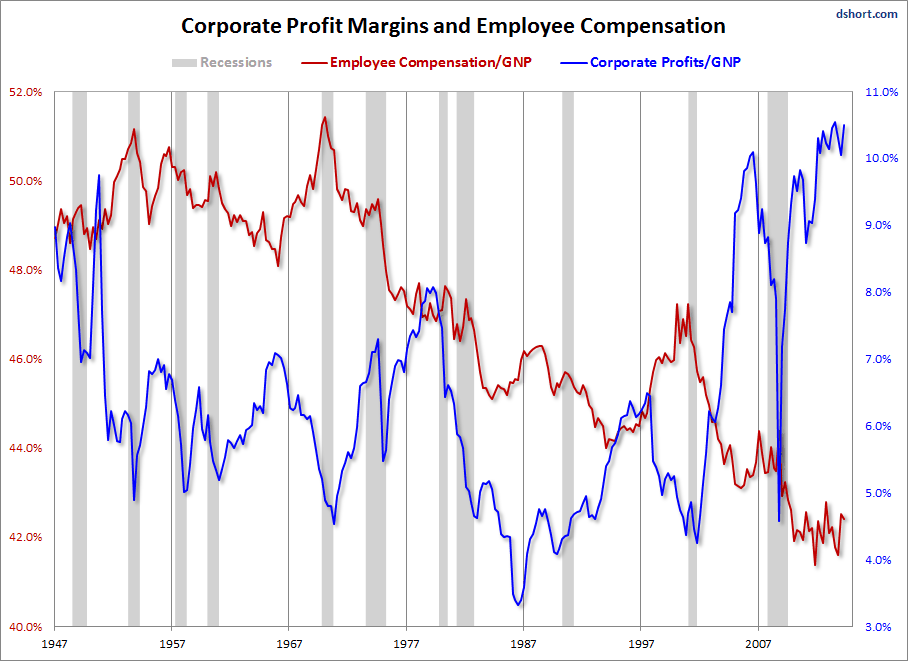
Corporate Profit Margins vs. Wages in One Disturbing Chart

This brief post by Doug Short is even more important than it appears to be. We had an outburst of neoliberal orthodoxy in comments yesterday on a post that discussed how wealth of most households had fallen since 1987. Some readers assigned blame for stagnant average worker wages (which was a big contributor to the lack of growth in household wealth) to immigrants, particularly Mexicans and H1-B visa workers.

While immigration was no doubt an element, to give it the leading role is counterfactual. The argument made, explicitly, is “more workers leads to lower wages”. Ahem, there a a lot more variables than just the labor supply side. But even if you take a simple-minded point of view, women’s rising participation in the workforce, particularly given that women even now make 77% of what men make, would be a vastly bigger wage-rate depressor than Mexican workers. The number of working women rose by nearly 30 million between 1970 and 2010, vastly larger than any estimate of immigrant influx.

The Doug Short chart below looks at corporate profit share versus labor share. This pinpoints the degree to which wage stagnation is the result of corporate managers and executives succeeding in cutting the pie to favor themselves (executive pay has become increasingly linked to stock prices, and relentless focus on short-term earnings, as well as stock buybacks, do wonders for earnings per share).

Short omits some key elements from his discussion. One is that until recently, a profit share of GDP of 6% was perceived to be a cyclical peak; no less than Warren Buffet deemed a higher level to be unsustainable. And in fact, we see an explosion of profit share from 6% to 10% of GDP in the runup to the crisis, roughly from 2003 to 2007. The “rescue the banks and financial markets” measures succeeded in bringing the profit share back to its pre-crisis levels, at the expense of workers.

Notice the inflection point in profit share is 1987, when Greenspan became Fed chairman. Correlation may not be causation, but the timing is almost exact.

But what about the years prior to 1987? We see falling labor share and rising profit share from the 1973 recession through 1979, then labor share and profit share falling through 1987. What is that about?

Interestingly, the chart shows that corporations did well in profit terms in the mid-1970s stagflation at the expense of workers. But they were perceived (correctly) as having their lunches increasingly eaten by Japanese and German manufacturers. Inflation kept rising, which hurt investment in plant and equipment (high interest rates make any long-term commitment look lousy). High inflation killed stock market valuations, which allowed corporate leaders to press an agenda of deregulation with the Carter Administration, which was desperate for any ideas to increase flagging growth levels.

In 1979, Volcker started pushing interest rates sky high. Banks and other financial players were hemorrhaging losses. Volcker was explicit privately that he wanted to break the bargaining power of labor. In Secrets of the Temple, William Greider reported that Volcker kept a notecard which tracked average pay in the construction industry. He wanted to see that fall before he was willing to let interest rates ease. The economy went into a sharp, nasty contraction, hence the reason for both falling profits and falling labor share.

But why did corporate profits continue to fall after the 1979-1982 recession was over? I’d hazard a big contributor was the rapid rise of the US dollar, which not only killed US exports, but also enabled foreign manufacturers to gain even more ground. If you look at auto imports to the US, the Japanese made tremendous headway after the dollar spike of the early 1980s.

By Doug Short, Advisor Perspectives. Cross posted from Wolf Street

Yesterday’s collection of Advisor Perspectives articles particularly caught my attention: Why Jeremy Grantham is Right about Corporate Profit Margins by Baijnath Ramraika and Prashant Trivedi. The article includes a number of fascinating graphs, the first of which is a snapshot of US Corporate Margins since 1947 calculated by dividing Corporate Profits after Tax by Gross National Product.

The article inspired me to produce a chart of the Profit-to-GNP ratio, but with an added and rather sobering overlay: Employee Compensation (wages and salaries), which I’ve likewise divided by GNP. Here it is.


If indeed corporate profits are mean reverting, a view supported by the authors of the Advisor Perspectives article, we see that this metric can spend many years at wide variance from the trend. Employee Compensation, however, has had a distinctly downward trend since its peak in 1970. The only conspicuous exception to the trend was the bubble period of “Irrational Exuberance,” as then Fed Chairman Alan Greenspan famously called it, that began in the mid-1990s.

And when it comes to wages, there are “Lies, Damn Lies, and Statistics.” Read… How to Obscure one of the Biggest Economic Problems in the US

November 13, 2014

Obama’s Secret Treaty Would Be The Most Important Step Toward A One World Economic System

Barack Obama is secretly negotiating the largest international trade agreement in history, and the mainstream media in the United States is almost completely ignoring it.  If this treaty is adopted, it will be the most important step toward a one world economic system that we have ever seen.  The name of this treaty is "the Trans-Pacific Partnership", and the text of the treaty is so closely guarded that not even members of Congress know what is in it.  Right now, there are 12 countries that are part of the negotiations: the United States, Canada, Australia, Brunei, Chile, Japan, Malaysia, Mexico, New Zealand, Peru, Singapore and Vietnam.  These nations have a combined population of 792 million people and account for an astounding 40 percent of the global economy.  And it is hoped that the EU, China and India will eventually join as well.  This is potentially the most dangerous economic treaty of our lifetimes, and yet there is very little political debate about it in this country.
Even though Congress is not being allowed to see what is in the treaty, Barack Obama wants Congress to give him fast track negotiating authority.  What that means is that Congress would essentially trust Obama to negotiate a good treaty for us.  Congress could vote the treaty up or down, but would not be able to amend or filibuster it.

Of course now the Republicans control both houses of Congress.  If they are foolish enough to blindly give Barack Obama so much power, they should all immediately resign.

And it is critical that people understand that this is not just an economic treaty.  It is basically a gigantic end run around Congress.  Thanks to leaks, we have learned that so many of the things that Obama has deeply wanted for years are in this treaty.  If adopted, this treaty will fundamentally change our laws regarding Internet freedom, healthcare, copyright and patent protection, food safety, environmental standards, civil liberties and so much more.  This treaty includes many of the rules that alarmed Internet activists so much when SOPA was being debated, it would essentially ban all "Buy American" laws, it would give Wall Street banks much more freedom to trade risky derivatives and it would force even more domestic manufacturing offshore.

In other words, it is the treaty from hell.

In addition to imposing Obama's vision for the world on 40 percent of the global population, it is also being described as a "Christmas wish-list for major corporations".  Of the 29 chapters in the treaty, only five of them actually deal with economic issues.  The rest of the treaty deals with a whole host of other issues of great importance to the global elite.

The following list of issues addressed by this treaty is from a Malaysian news source...
• domestic court decisions and international legal standards (e.g., overriding domestic laws on both trade and nontrade matters, foreign investors’ right to sue governments in international tribunals that would overrule the national sovereignty)
• environmental regulations (e.g., nuclear energy, pollution, sustainability)
• financial deregulation (e.g., more power and privileges to the bankers and financiers)
• food safety (e.g., lowering food self-sufficiency, prohibition of mandatory labeling of genetically modified products, or bovine spongiform encephalopathy (BSE) or mad cow disease)
• Government procurement (e.g., no more buy locally produced/grown)
• Internet freedom (e.g., monitoring and policing user activity)
• labour (e.g., welfare regulation, workplace safety, relocating domestic jobs abroad)
• patent protection, copyrights (e.g., decrease access to affordable medicine)
• public access to essential services may be restricted due to investment rules (e.g., water, electricity, and gas)
Why can't we get this type of reporting in the United States?

And if this treaty is ultimately approved by Congress, we will essentially be stuck with it forever.

This treaty is written in such a way that the United States will be permanently bound by all of the provisions and will never be able to alter them unless all of the other countries agree.

Are you starting to understand why this treaty is so dangerous?

This treaty is the key to Obama's "legacy".  He wants to impose his will upon 40 percent of the global population in a way that will never be able to be overturned.

Of course Obama is touting this treaty as the path to economic recovery.  He promises that it will greatly increase global trade, decrease tariffs and create more jobs for American workers.

But instead, it would be a major step toward destroying what is left of the U.S. economy.

Over the past several decades, every time a major trade agreement has been signed we have seen even more good jobs leave the United States.

And it doesn't take a genius to figure out why this is happening.  If corporations can move jobs to the other side of the planet to nations where it is legal to pay slave labor wages, they will make larger profits.

Just think about it.  If you were running a corporation and you had the choice of paying workers ten dollars an hour or one dollar an hour, which would you choose?

Plus there are so many other costs, taxes and paperwork hassles when you deal with American workers.  For example, big corporations will not have to provide Obamacare for their foreign workers.  That alone will represent a huge savings.

Any basic course in economics will teach you that labor flows from markets where labor costs are high to markets where labor costs are lower.  And at this point it costs less to make almost everything overseas.  As a result, we have already lost millions upon millions of good jobs, and countless small and mid-size U.S. companies have been forced to shut down because they cannot compete with foreign manufacturers.

Later this month, consumers will flock to retail stores for "Black Friday" deals.  But if you look carefully at those products, you will find that almost all of them are made overseas.  We buy far, far more from the rest of the world than they buy from us, and that is a recipe for national economic suicide.

We consume far more wealth that we produce, and anyone with half a brain can see that is not sustainable in the long run.  The only way that we have been able to maintain our high standard of living is by going into insane amounts of debt.  We are currently living in the largest debt bubble in the history of the planet, and at some point the party is going to end.

Please share this article with as many people as you can.  We need to inform people about what Obama is trying to do.

If Obama is successful in ramming this secret treaty through, it is going to do incalculable damage to what is left of the once great U.S. economy.

November 12, 2014

Russia to Launch New Payments System to Circumvent SWIFT Network

Many observers have become unduly excited about what they depict as efforts to break the dollar hegeomony, such as the joint effort by the so-called BRCS nations to form a development bank. While having a suite of internationals funding entities, particularly ones focused on activities that in theory increase the collective benefits of relying on a reserve currency, are seen to be important, it does not follow that launching useful new funding institutions will break dollar dominance. As much as US abuse of its position as issuer of the reserve currency is correctly resented, there isn’t a competitor waiting in the wings. The Eurozone has blown it with its failure to clean up even sicker banks than the US has, and by compounding a bad situation with its adherence to destructive austerity policies. China clearly has the potential to displace the US longer-term, but it is unwilling to run the requisite trade deficits, since that means exporting demand and hence jobs. And no country had made the transition from being a major exporter to being consumer-driven smoothly; a crisis or protracted malaise would also delay China displacing the US as currency top dog.

But not being able to get rid of the dollar any time soon does not mean that countries that the US is trying to punish by using its influence over international payments system won’t find nearer-term escape routes. Russia, which has become America’s enemy number one apparently for its sins of interceding in Syria, (when Congress was firmly opposed to military action), successfully standing up against a US-backed coup in Ukraine, of collaborating with Iran, and harboring Edward Snowden, has become the target of increasingly stringent economic sanctions. The ones that really bite are those aimed at Russian banks, which have foreign currency exposures, and have used foreign capital markets to issue debt and equity.

Russia today announced that it plans to launch a new payments system so that it will no longer need to use the payments system SWIFT. From RT:
Russia intends to have its own international inter-bank system up and running by May 2015. The Central of Russia says it needs to speed up preparations for its version of SWIFT in case of possible ”challenges” from the West. 
“Given the challenges, Bank of Russia is creating its own system for transmitting financial messaging… It’s time to hurry up, so in the next few months we will have certain work done. The entire project for transmitting financial messages will be completed in May 2015,” said Ramilya Kanafina, deputy head of the national payment system department at the Central Bank of Russia (CBR). 
Calls not to use the SWIFT (Society for Worldwide Interbank Financial 
Telecommunication) system in Russian banks began to grow as relations between Russia and the West deteriorated over sanctions. So far, SWIFT says despite pressure from some Western countries to join the anti-Russian sanctions, it has no intention of doing so… 
SWIFT, is currently one of Russia’s main connections to the international banking system, and if turned off, could hurt the Russian economy, in the short-term. Globally it transmits orders for transactions worth more than $6 trillion, and involves more than 10,000 financial institutions in 210 countries. According to SWIFT’s statute, the system has national groups of members and users in each country. In Russia it’s ROSSWIFT – the second biggest worldwide SWIFT association after the US.
I welcome reader comment, but I believe there are two issues here. First is that even though SWIFT is still open for business with Russia, it could be cut off at a future date. It can’t have escaped Moscow’s attention that Iran’s central bank and most other major banks were barred from SWIFT in 2012. From the Wall Street Journal:
The European Union said it was banning any kind of financial transactions with blacklisted Iranian financial firms, but U.S. policy makers made it clear they would keep up pressure for wider action. 
The Belgium-based Society for Worldwide Interbank Financial Telecommunication, or Swift, a financial communication and clearing system used by most of the world’s major banks, said it would comply with the EU order. 
The ban applies only to Iran banks that the EU has placed on a sanctions blacklist. They include Iran’s central bank and more than a dozen other firms. 
The U.S. Congress, meanwhile, is asking transactions with all Iranian banks to be ended, and is threatening penalties against Swift’s board and directors if they don’t cut all ties with Iran’s financial sector. U.S. lawmakers argue that Iran is shifting funding for its nuclear program out of the sanctioned banks into other firms.
Second is that setting up a payments channel outside SWIFT can enable Russia to establish a financial system for those who don’t want to be subject to US dictates. Banks that did business with Iran, both before and after the SWIFT sanctions, were hit with money-laundering sanctions. The payments were dollar payments and were cleared thought the banks’ New York branches, making them subject to US law. All dollar transactions between banks are settled at the end of the business day in New York; interbank payment systems ultimately depend on a central bank backstop, and many large payments run over the Fed’s interbank system, Fedwire. So there’s no way of engineering around this issue, at least as of now. Benjamin Lawsky, New York’s superintendent of financial services, threatened to yank the license for the New York branch of the first miscreant he dealt with, Standard Chartered.

Federal and British regulators were outraged over his move, but Federal regulators swiftly recognized that Lawsky had done them a huge favor. They vastly upped the ante when they went after other foreign banks that were defying the US by doing business through US payment systems with blacklisted foreign countries. Lawsky fined Standard Chartered for $340 million in 2012 and the Federal fines were an additional $327 million. As staggering as that was deemed to be at the time, it paled next to the $8.9 billion in fines plus criminal charges against BNP Paribas earlier this year. (Lawsky also hit Standard Chartered with a $300 million fine in August for continuing compliance failures.)

But many foreign banks, and even foreign regulators, were incensed by the magnitude of fines the US imposed for money laundering (as in using the US payments system to conduct transactions with verboten parties). French newspapers and politicians howled over the $8.9 billion fine against BNP Paribas. If the Russian payment system works (as in is NSA-proof, you can bet the US will set its best hacking talent against it), it would allow banks like BNP Paribas and Standard Chartered to deal with Iran. It would likely please them no end to get a bit of revenge on the US that way.

In addition, there are likely businesses in Europe that are not keen about how complying with the EU sanctions against Russia is hurting their business. It isn’t clear how many would be willing to walk on the wild side and defy sanctions, but processing transactions through a Russian-controlled payment system would be far less susceptible to detection than through SWIFT.

In other words, this measure is intended to reduce the effectiveness of using the dollar dominance in payments as a weapon. Whether the Russians can launch a robust enough system quickly is an open question, but this is a sensible defensive and potentially offensive measure. It may have longer-term ramifications if other countries that are not happy with the US decide to employ it for practical or political reasons. Stay tuned.