Ambrose Evans-Pritchard: Why Paul Krugman is wrong ... Central banks can always create inflation if they try hard enough ... He is wrong that you cannot create inflation when interest rates are at the zero bound, says Ambrose Evans-Pritchard ... Professor Paul Krugman is the world's most influential commentator on economic issues by a wide margin. – UK Telegraph
Dominant Social Theme: Deflation is coming and it's going to be terrible.
Free-Market Analysis: A recent article of ours made the point that deflation and disinflation are unstable monetary states in an era of central banking.
While we didn't draw precise definitional lines between various kinds of deflation, our point was clear enough: Deflation and disinflation in a monetarist world are a product of asset expansion.
We explained that Eurocrat cries of alarm over EU price deflation were insincere and merely meant to provide justifications for central bank actions that Brussels was not allowed to take. We explained that there were both monetary and price inflation in Europe and that Europe was more likely affected by "stagflation" than disinflation or deflation.
EU Deflation: Real Problem or Eurocrat Exaggeration?
The recent argument between Ambrose Evans-Pritchard and Paul Krugman gives us an opportunity to revisit the issue and expand on why, in a central banking world, disinflation and outright deflation from a monetary and price standpoint are fairly rare events that take place mostly as asset bubbles collapse.
Krugman first. The New York Times columnist recently argued once again that monetary inflation is vastly overrated in terms of its impact. Why is this important? Because Krugman, as a good socialist, wants government to be as proactive as possible.
Money printing as a central economic cure is not enough for him. He wants FDR's New Deal programs re-initiated on an even more expansive basis.
But there is another reason that Krugman downplays money printing and that has to do with the impact of central banks generally. You see ... if it doesn't matter how much money a central bank prints, then central banking itself is a fairly unimportant matter. And those who stand behind central banking, control central banking and reap its impossible rewards would like to encourage this concept of Krugman's.
We don't believe this, of course. Those who coordinate central banks around the world and run the Bank for International Settlements are surely among the most powerful people in the world. About 100 years ago there were perhaps five central banks. Now there are around 150, many directly involved in a BIS pan-global structure.
The hundreds and hundreds of trillions printed via BIS-operated central banks have created a situation unheard of in the world. This money has apparently been used to buy control of universities, think tanks, media properties, politicians, governments and military men and armies. The same money is likely to control – secretly – most of the major corporations in the world.
The control is staggering and it's been used to further centralize and internationalize the West's sociopolitical and economic system. So Krugman is arguing a very important point when he says that printing money is at least somewhat irrelevant some of the time. By proxy, he is saying that central banking is not nearly so important as it's made out to be.
And since there doesn't seem either monetary inflation or price inflation after seven years of crisis-response money printing, Krugman is beginning to write columns emphasizing his point of view.
It is one of these comments that Evans-Pritchard is responding to. Here's more from Evans-Pritchard:
He is brilliant, wide-ranging, readable, and the point of his rapier is very sharp. He correctly predicted and described the Long Slump; though whether he did so entirely for the right reasons is an interesting question.
[Krugman] demolished claims by hard-money totemists that zero rates and quantitative easing would lead to spiraling inflation in a global liquidity trap, as he calls it – or in a China-led world of excess supply and deficient demand, as others would put it.
He correctly scolded those who claimed that rich developed countries with their own sovereign currencies are at risk of a bond market crisis unless they retrench into the downturn, or might go the way of Greece.
... The dispute is over whether central banks can generate inflation even when interest rates are zero. He says they cannot do so, and that it is jejune to float such an outlandish idea. Monetary policies are to all intents and purposes impotent at that point. He goes on to suggest that the historical and global evidence has demonstrated this beyond any possible doubt, and here he ventures into flinty terrain.
... He rebukes me for quoting Tim Congdon from International Monetary Research, specifically for invoking traditional monetary theory to suggest that QE can work even when bond yields are hyper-compressed. The precise quote: "The interest rate is totally irrelevant. What matters is the quantity of money. Large scale money creation is a very powerful weapon and can always create inflation."
Mr Congdon's claim is a self-evident truism. Central banks can always create inflation if they try hard enough. As Milton Friedman said, they can print bundles of notes and drop from them helicopters. The modern variant might be a $100,000 electronic transfer into the bank account of every citizen. That would most assuredly create inflation.
... It is becoming ever clearer that the US and UK recoveries are a serious challenge to the Krugman opus and what I would loosely call (though I have much sympathy for New Keynesian arguments) the doctrine of fiscal primacy. These recoveries should not really be as strong as they are, especially in a depressed world of flat global trade. America has carried out the most drastic fiscal squeeze since demobilization after the Korean War without falling into recession. The economy is growing briskly. The jobless rate is plummeting.
The last paragraph illustrates the sterility of this debate. Despite denials, Evans-Pritchard more and more has adopted a neo-Keynesian point of view in his columns, arguing that monetary stimulation is necessary to keep the world afloat until such time as the "recovery" takes hold more fully.
But there is no "recovery" in the classical sense of the word, nor can there be in a world filled with central banks. If the money were private, if the volume of money were not produced via force, if interest rates were not set metaphorically at the point of a gun, then perhaps one could speak of a recovery. But instead, in this modern world, we can have nothing but varying degrees of asset bubbles.
At the beginning of the business cycle the asset bubbles have been deflated or at least are subject to disinflation, monetarily and even pricewise. But as more money is force-fed into the economy, these bubbles begin to swell again.
The faster they swell, the more commentators and professors begin to speak of a recovery. It is not a recovery. The bubbles are simply advancing.
First bank coffers swell and then the money leaks into multinational pockets and into stock markets, mostly. Marts travel up, and the wealthy and upper middle classes begin to leverage the wealth effect. High-end homes, yachts, expensive cars and the like begin to sell more quickly. The "recovery" is underway.
Eventually the recovery reaches the middle classes. Factories gear up, wages rise, the "recovery" is proclaimed a success. But actually, such a recovery is merely a way-station to a further disaster because the asset bubbles will continue to swell until they burst. At which point we will once again, as before, have a conversation about deflation and disinflation.
We should try to be fair, of course. Evans-Pritchard is in a sense correct about deflation. As we wrote before it is very hard to have real, long-lasting deflation in a modern, central bank economy where the printing presses are always churning out currency.
What SEEMS like deflation or disinflation is mostly the collapse of bubbles that were stuffed by previously printed currency.
Krugman is wrong. When you have central banks you almost always have unrestrained money printing. Central banks cannot know how much money is enough because there are no forward looking indices, as Alan Greenspan himself admitted during his tenure.
And so central bankers print too much. If economies subside catastrophically, it is not because of deflation or disinflation but because of monetary INFLATION to begin with.
Deflation is NOT the main problem by any means. Central banks are the problem. People like Krugman want to draw our attention away from the real issue. In this case, Evans-Pritchard has done us a favor by drawing our attention back to it.
The trouble with Evans-Pritchard is that he then goes on to make the argument that central bank inflating is a kind of Keynesian good. But monopoly money printing is not good, either. And there you have it – a modern debate in which both sides are wrong because they are arguing effectively a false premise.
Krugman wants to focus on the lack of monetary policy. Evans-Pritchard argues for continued inflation.
We'll take the side of the argument that is NOT represented – which is that money ought to be privatized and that central banks ought to lose their monopoly money printing privileges.
Conclusion When we begin to see that argument made in the mainstream press, we'll call it what it is ... Progress.
Source

DAILY BUSINESS REPORT - Financial Updates, International Markets and Business News
December 16, 2014


December 15, 2014
We Just Witnessed The Worst Week For Global Financial Markets In 3 Years
Is this the start of the next major financial crisis? The nightmarish collapse of the price of oil is creating panic in financial markets all over the planet. On June 16th, U.S. oil was trading at a price of $107.52. Since then, it has fallen by almost 50 dollars in less than 6 months. This has only happened one other time in our history. In the summer of 2008, the price of oil utterly collapsed and we all remember what happened after that. Well, the same patterns that we witnessed back in 2008 are happening again. As the price of oil crashed in 2008, so did prices for a whole host of other commodities. That is happening again. Once commodities started crashing, the market for junk bonds started to implode. That is also happening again. Finally, toward the end of 2008, we witnessed a horrifying stock market crash. Could we be on the verge of another major one? Last week was the worst week for the Dow in more than three years, and stock markets all over the world are crashing right now. Bad financial news continues to roll in from the four corners of the globe on an almost hourly basis. Have we finally reached the “tipping point” that so many have been warning about?
What we witnessed last week is being described as “a bloodbath” that was truly global in scope. The following is how Zero Hedge summarized the carnage…
And it isn’t just Greece. Financial markets all over Europe are in turmoil right now. In addition to crashing oil prices, there is also renewed concern about the fundamental stability of the eurozone. Many believe that it is inevitable that it is headed for a break up. As a result of all of this fear, European stocks also had their worst week in over three years…
Just check out what happened on the other side of the planet on Sunday…
Like I said, this is turning out to be a truly global financial panic.
Another region to keep an eye on is South America. Argentina is a financial basket case, the Brazilian stock market is tanking big time, and the implied probability of default on Venezuelan debt is now up to 93 percent…
Are we experiencing a repeat of 2008?
Could what is ahead be even worse than that?
Or could this just be a temporary setback?
Recently, Howard Hill shared a few things that he looks for to determine whether a major financial crisis is upon us or not…
In particular, I think that watching how junk bonds perform over the next few weeks will be extremely telling.
Last week was truly a bloodbath for high yield debt.
But perhaps things will stabilize this week.
Let’s hope so, because this is the closest that we have been to another major financial crisis since 2008.
Source
What we witnessed last week is being described as “a bloodbath” that was truly global in scope. The following is how Zero Hedge summarized the carnage…
- WTI’s 2nd worst week in over 3 years (down 10 of last 11 weeks)
- Dow’s worst worst week in 3 years
- Financials worst week in 2 months
- Materials worst week since Sept 2011
- VIX’s Biggest week since Sept 2011
- Gold’s best week in 6 months
- Silver’s last 2 weeks are best in 6 months
- HY Credit’s worst 2 weeks since May 2012
- IG Credit’s worst week in 2 months
- 10Y Yield’s best week since June 2012
- US Oil Rig Count worst week in 2 years
- The USDollar’s worst week since July 2013
- USDJPY’s worst week since June 2013
- Portugal Bonds worst week since July 2011
- Greek stocks worst week since 1987
And it isn’t just Greece. Financial markets all over Europe are in turmoil right now. In addition to crashing oil prices, there is also renewed concern about the fundamental stability of the eurozone. Many believe that it is inevitable that it is headed for a break up. As a result of all of this fear, European stocks also had their worst week in over three years…
European stock markets closed sharply lower on Friday, posting their biggest weekly loss since August 2011, as commodity prices continued to fall and and shares in oil-related firms came under renewed pressure from the weak price for crude.
The pan-European FTSEurofirst 300 unofficially ended 2.6 percent lower, down 5.9 percent on the week as the energy sector once again weighed heavily on wider benchmarks, falling over 3 percent.But despite all of the carnage that we witnessed in the U.S. and in Europe last week, things are actually far worse for financial markets in the Middle East.
Just check out what happened on the other side of the planet on Sunday…
Stock markets in the Persian Gulf got drilled Sunday as worries about further price declines grew. The Dubai stock index fell 7.6% Sunday, the equivalent of a 1,313-point plunge in the Dow Jones industrial average. The Saudi Arabian market fell 3.3%.Overall, Dubai stocks are down a whopping 23 percent over the last two weeks, and full-blown stock market crashes are happening in Qatar and Kuwait too.
Like I said, this is turning out to be a truly global financial panic.
Another region to keep an eye on is South America. Argentina is a financial basket case, the Brazilian stock market is tanking big time, and the implied probability of default on Venezuelan debt is now up to 93 percent…
Swaps traders are almost certain that Venezuela will default as the rout in oil prices pressures government finances and sends bond prices to a 16-year low.
Benchmark notes due 2027 dropped to 43.75 cents on the dollar as of 11:35 a.m. in New York, the lowest since September 1998, as crude extended a bear market decline. The upfront cost of contracts to insure Venezuelan debt against non-payment for five years is at 59 percent, bringing the implied probability of default to 93 percent, the highest in the world.So what does all of this mean for the future?
Are we experiencing a repeat of 2008?
Could what is ahead be even worse than that?
Or could this just be a temporary setback?
Recently, Howard Hill shared a few things that he looks for to determine whether a major financial crisis is upon us or not…
The first condition is a serious market sector correction.
According to some participants in the market for energy company bonds and loans, such a correction is already underway and heading toward a meltdown (the second condition). Others are more sanguine, and expect a recovery soon.
That smaller energy companies have issued more junk-rated debt than their relative size in the economy isn’t under debate. Of a total junk bond market estimated around $1.2 trillion, about 18% ($216 billion, according to a Bloomberg estimate) has been issued by energy-related companies. Yet those companies represent a far smaller share of the economy or stock market capitalization among the universe of junk-rated companies.
If the beaten-down prices for junk energy bonds don’t stabilize or recover a bit, we might see the second condition: a spiral of distressed sales of bonds and loans. This could happen if junk bond mutual funds or other large holders sell into an unfriendly market at low prices, and then other holders of those bonds succumb to the pressure of fund redemptions or margin calls and sell at even lower prices.
The third condition, which we can’t determine directly, would be pressure on Credit Default Swap dealers or hedge funds to make deposits as the prices of the CDS move against them. AIG was taken down when collateral demands were made to support existing CDS agreements, and nobody knew it until they were going under. There simply isn’t a way to know whether banks or dealers are struggling until the effect is already metastasizing.I think that he makes some really good points.
In particular, I think that watching how junk bonds perform over the next few weeks will be extremely telling.
Last week was truly a bloodbath for high yield debt.
But perhaps things will stabilize this week.
Let’s hope so, because this is the closest that we have been to another major financial crisis since 2008.
Source
December 12, 2014
Will the Oil Collapse Kill Energy Junk Bonds?
Some ahead-of-the-curve analysts have warned of the magnitude of energy debt, mainly junk bonds issued to fund shale gas projects, that are now at risk thanks to plunging oil prices whacking the entire energy complex.
We’ve heard over the last few weeks sunny proclamations of how many shale players have lower cost structure than commonly thought and could ride out weak prices. The supposedly super bearish Bank of America report published earlier in the week called for oil prices to drop to a scary-sounding $50 a barrel. But the document sees that aa a short-term phenomenon. As supply and demand equilibrates (shorthand for “of course some people will drive more, and a lot of wells will get shut down”), it anticipates that oil prices will rebound to $80 to $90 a barrel in the second half of 2015.
The problem with conventional wisdom, even pessimistic-looking conventional wisdom, is that the noose of a lot of borrowings is likely to change the decision-making process of those producers. As the Financial Times’ John Dizard pointed out, companies with a lot of debt are likely to keep pumping, profits be damned, until the money guys choke them off. Banks are already signaling that they will be lenient, but that’s not the same as extending new loans. Nevertheless, the perverse incentive for producers with high debt levels is to keep pumping, even at a loss, in order to generate enough cash flow to keep servicing the debt. That means that wells won’t be shut off as soon as a P&L calculus would indicate, which in turn means the energy oversupply is likely to continue longer than many experts anticipate. Whether that is a mere couple of months or a more dislocating six months plus remains to be seen.
The reason that longer is worse is twofold. First, it means that more players that are seeing if they can hold in the face losses until prices rebound will hit the wall, so that in turn means more banks and junk bond investors will suffer. Second, a longer period of oversupply may lengthen the eventual adjustment period. Bank of America now sees it at six months. If we have an additional six months of not-factored-in overproduction, it could mean even higher inventories before the readjustment begins. That in turn means even lower prices before the turnaround.
And this chart (hat tip Ed Harrison) gives an idea how much a difference the drop from $70 a barrel to yesterday’s below $60 price means (click to enlarge):
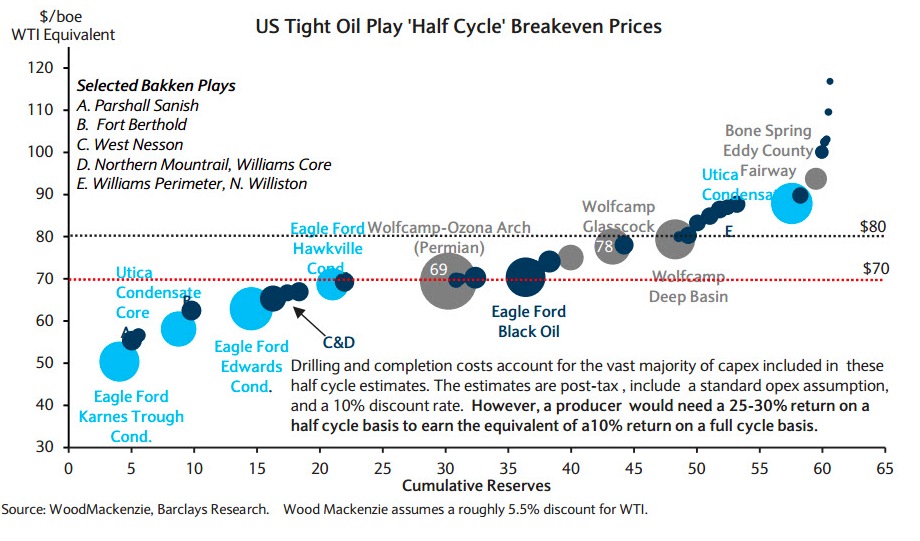
And notice that the “half cycle return” is a dubious metric and greatly understates the requirements for meeting long-term profit targets.
By Raúl Ilargi Meijer, editor-in-chief of The Automatic Earth. Originally published at Automatic Earth
Oil producer Russia hikes rates to 10.5% as the ruble continues to plunge, while fellow producer Norway does the opposite, and cuts its rates, but also sees its currency plummet. As Greek stocks lose another 7.35% after Tuesday’s 13% loss on rumors about what the left leaning Syriza party will or will not do if it wins upcoming elections, and virtually anonymous Dubai drops 7.42%. We all know the story of the chain and its weakest link, and beware, these really still ARE global markets.
Meanwhile someone somewhere saved WTO oil from falling through the big, BIG, $60 limit for most of the day Thursday, and then it went south anyway. And that brings to mind the warnings about what would, make that will, happen to high yield energy junk bonds. Of which there’s a lot out there, but not much is being added anymore, that market has been largely shut to companies, especially in the shale patch. So how are they going to finance their fracking wagers? Hard to see.
And something tells me this Bloomberg piece is still lowballing the debt issue, though I commend them for making the link between shale and Fed ‘stimulus’ policies, something all too rare in what passes for press in the US these days.
>Fed Bubble Bursts in $550 Billion of Energy Debt
The danger of stimulus-induced bubbles is starting to play out in the market for energy-company debt. Since early 2010, energy producers have raised $550 billion of new bonds and loans as the Federal Reserve held borrowing costs near zero, according to Deutsche Bank. With oil prices plunging, investors are questioning the ability of some issuers to meet their debt obligations. Research firm CreditSights predicts the default rate for energy junk bonds will double to 8% next year. “Anything that becomes a mania – it ends badly,” said Tim Gramatovich, chief investment officer of Peritus Asset Management. “And this is a mania.”
I think it’s obvious that the default rate could be much higher than 8%.
But this is by no means all of the news, it’s not even the worst. To get back to oil, there are some very revealing numbers in the following from CNBC, which call out to us that we haven’t seen nothing yet.
Oil Pressure Could Sock It To Stocks
That is today’s reality. And while there are many different estimates around about breakeven prices for US shale plays, if we go with the ones from WoodMacKenzie, we get at least some idea of how bad the industry is hurting with prices below $60 (click to enlarge):
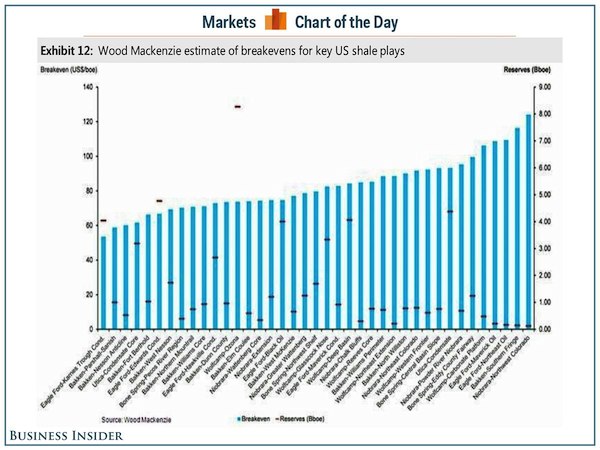
If prices fall any further (and what’s going to stop them?), it would seem that most of the entire shale edifice must of necessity crumble to the ground. And that will cause an absolute earthquake in the financial world, because someone supplied the loans the whole thing leans on. An enormous amount of investors have been chasing high yield, including many institutional investors, and they’re about to get burned something bad.
What it amounts to is that the falling oil price will chase a lot of zombie money out of the markets, the stuff created through a combination of QE-related ultra low interest rates and money printing, plus the demise of accounting standards that allowed companies to abandon mark-to-market practices. This has led to the record stock market valuation that we see today, and that could vanish in the wink of an eye once even just one asset, one commodity, starts being marked to market in defiance of the distortion official policies have imposed upon the global marketplace.
We might well be looking at the development of a story much bigger than just oil. I said earlier this week that it would be hard to find a way to bail out the US oil industry, but that’s merely one aspect here. Because if oil keeps going the way it has lately, the Fed may instead have to think about bailing out the big Wall Street banks once again.
Source
We’ve heard over the last few weeks sunny proclamations of how many shale players have lower cost structure than commonly thought and could ride out weak prices. The supposedly super bearish Bank of America report published earlier in the week called for oil prices to drop to a scary-sounding $50 a barrel. But the document sees that aa a short-term phenomenon. As supply and demand equilibrates (shorthand for “of course some people will drive more, and a lot of wells will get shut down”), it anticipates that oil prices will rebound to $80 to $90 a barrel in the second half of 2015.
The problem with conventional wisdom, even pessimistic-looking conventional wisdom, is that the noose of a lot of borrowings is likely to change the decision-making process of those producers. As the Financial Times’ John Dizard pointed out, companies with a lot of debt are likely to keep pumping, profits be damned, until the money guys choke them off. Banks are already signaling that they will be lenient, but that’s not the same as extending new loans. Nevertheless, the perverse incentive for producers with high debt levels is to keep pumping, even at a loss, in order to generate enough cash flow to keep servicing the debt. That means that wells won’t be shut off as soon as a P&L calculus would indicate, which in turn means the energy oversupply is likely to continue longer than many experts anticipate. Whether that is a mere couple of months or a more dislocating six months plus remains to be seen.
The reason that longer is worse is twofold. First, it means that more players that are seeing if they can hold in the face losses until prices rebound will hit the wall, so that in turn means more banks and junk bond investors will suffer. Second, a longer period of oversupply may lengthen the eventual adjustment period. Bank of America now sees it at six months. If we have an additional six months of not-factored-in overproduction, it could mean even higher inventories before the readjustment begins. That in turn means even lower prices before the turnaround.
And this chart (hat tip Ed Harrison) gives an idea how much a difference the drop from $70 a barrel to yesterday’s below $60 price means (click to enlarge):
And notice that the “half cycle return” is a dubious metric and greatly understates the requirements for meeting long-term profit targets.
By Raúl Ilargi Meijer, editor-in-chief of The Automatic Earth. Originally published at Automatic Earth
Oil producer Russia hikes rates to 10.5% as the ruble continues to plunge, while fellow producer Norway does the opposite, and cuts its rates, but also sees its currency plummet. As Greek stocks lose another 7.35% after Tuesday’s 13% loss on rumors about what the left leaning Syriza party will or will not do if it wins upcoming elections, and virtually anonymous Dubai drops 7.42%. We all know the story of the chain and its weakest link, and beware, these really still ARE global markets.
Meanwhile someone somewhere saved WTO oil from falling through the big, BIG, $60 limit for most of the day Thursday, and then it went south anyway. And that brings to mind the warnings about what would, make that will, happen to high yield energy junk bonds. Of which there’s a lot out there, but not much is being added anymore, that market has been largely shut to companies, especially in the shale patch. So how are they going to finance their fracking wagers? Hard to see.
And something tells me this Bloomberg piece is still lowballing the debt issue, though I commend them for making the link between shale and Fed ‘stimulus’ policies, something all too rare in what passes for press in the US these days.
>Fed Bubble Bursts in $550 Billion of Energy Debt
The danger of stimulus-induced bubbles is starting to play out in the market for energy-company debt. Since early 2010, energy producers have raised $550 billion of new bonds and loans as the Federal Reserve held borrowing costs near zero, according to Deutsche Bank. With oil prices plunging, investors are questioning the ability of some issuers to meet their debt obligations. Research firm CreditSights predicts the default rate for energy junk bonds will double to 8% next year. “Anything that becomes a mania – it ends badly,” said Tim Gramatovich, chief investment officer of Peritus Asset Management. “And this is a mania.”
I think it’s obvious that the default rate could be much higher than 8%.
The Fed’s decision to keep benchmark interest rates at record lows for six years has encouraged investors to funnel cash into speculative-grade securities to generate returns, raising concern that risks were being overlooked. A report from Moody’s this week found that investor protections in corporate debt are at an all-time low, while average yields on junk bonds were recently lower than what investment-grade companies were paying before the credit crisis. Borrowing costs for energy companies have skyrocketed in the past six months as West Texas Intermediate crude, the U.S. benchmark, has dropped 44% to $60.46 a barrel since reaching this year’s peak of $107.26 in June.
Yields on junk-rated energy bonds climbed to a more-than-five-year high of 9.5% this week from 5.7% in June, according to Bank of America Merrill Lynch index data. At least three energy-related borrowers, including C&J Energy Services, postponed financings this month as sentiment soured. “It’s been super cheap” for energy companies to obtain financing over the past five years, said Brian Gibbons, a senior analyst for oil and gas at CreditSights in New York. Now, companies with ratings of B or below are “virtually shut out of the market” and will have to “rely on a combination of asset sales” and their credit lines, he said.When you’re as addicted to debt as the shale industry has been – and still would be if they could still get their fix -, then seeing prices for your products drop over 40% and the yields on your bonds just about double (just for starters), then you have not a problem, but a disaster. And one that’s going to reverberate through all asset markets. It’s already by no means just oil that’s plunging, – industrial – commodities (iron ore, nickel, copper etc.) as a whole are way down from just a few months ago. I read a nice expression somewhere: “the economy is topped with a copper roof”, which supposedly means to say that where copper goes, the economy will follow.
But this is by no means all of the news, it’s not even the worst. To get back to oil, there are some very revealing numbers in the following from CNBC, which call out to us that we haven’t seen nothing yet.
Oil Pressure Could Sock It To Stocks
With crude sliding through the key $60 level, oil pressure could stay on stocks Friday. West Texas Intermediate futures for January closed at $59.95 per barrel, the first sub-$60 settle since July 2009. The $60 level, however, opens the door to the much bigger, $50-per-barrel level. Besides oil, traders will be watching the producer price index Friday morning, and it’s expected to be off 0.1% with the fall in energy. Consumer sentiment is also expected at 10 a.m. EST.
Consumers stepped up and spent in November, as evidenced in the 0.7% gain in that month’s retail sales Thursday. That better mood should show up in consumer sentiment. Stocks on Thursday gave up sizeable gains after oil reversed course and fell through $60.
“Oil has pretty much spooked people,” said Daniel Greenhaus, chief global strategist at BTIG. “There just isn’t a bid. With everything in energy and the oil price collapsing as it is, who is going to step in and be a buyer now? The answer is nobody.” Oil continued to slide in after-hours trading. “The selling appears to have accelerated a little bit after the close with really no bullish news in sight,” said Andrew Lipow, president of Lipow Associates. WTI futures temporarily fell below $59 in late trading.
“The big level is going to be $50 now in terms of psychological support. Much as $100 is on the upside,” said John Kilduff of Again Capital. Oil stands a good chance of getting there too. Tom Kloza, founder and analyst at Oil Price Information Service, said the market could bottom for the winter in about 30 days, but then it will be up to whatever OPEC does.That was just the intro. Now, wait for it, check this out:
“It’s (oil) actually much weaker than the futures markets indicate. This is true for crude oil, and it’s true for gasoline. There’s a little bit of a desperation in the crude market,” said Kloza.”The Canadian crude, if you go into the oil sands, is in the $30s, and you talk about Western Canadian Select heavy crude upgrade that comes out of Canada, it’s at $41/$42 a barrel.”
“Bakken is probably about $54.” Kloza said there’s some talk that Venezuelan heavy crude is seeing prices $20 to $22 less than Brent, the international benchmark. Brent futures were at $63.20 per barrel late Thursday.
“In the actual physical market, it’s fallen by even more than the futures market. That’s a telling sign, and it’s telling me that this isn’t over yet. This isn’t the bottoming process. The physical market turns before the futures,” he said.I see very little reason to doubt that what’s happening is that the media are way behind the curve in their reporting of what’s really going on. WTI and Brent are standards, and standards are one thing, but what oil actually sells for is quite another matter. Many companies – and many oil-producing countries too – must sell at whatever price they can get just to survive. And there is no stronger force in the world to drive prices down.
That is today’s reality. And while there are many different estimates around about breakeven prices for US shale plays, if we go with the ones from WoodMacKenzie, we get at least some idea of how bad the industry is hurting with prices below $60 (click to enlarge):
If prices fall any further (and what’s going to stop them?), it would seem that most of the entire shale edifice must of necessity crumble to the ground. And that will cause an absolute earthquake in the financial world, because someone supplied the loans the whole thing leans on. An enormous amount of investors have been chasing high yield, including many institutional investors, and they’re about to get burned something bad.
What it amounts to is that the falling oil price will chase a lot of zombie money out of the markets, the stuff created through a combination of QE-related ultra low interest rates and money printing, plus the demise of accounting standards that allowed companies to abandon mark-to-market practices. This has led to the record stock market valuation that we see today, and that could vanish in the wink of an eye once even just one asset, one commodity, starts being marked to market in defiance of the distortion official policies have imposed upon the global marketplace.
We might well be looking at the development of a story much bigger than just oil. I said earlier this week that it would be hard to find a way to bail out the US oil industry, but that’s merely one aspect here. Because if oil keeps going the way it has lately, the Fed may instead have to think about bailing out the big Wall Street banks once again.
Source
December 11, 2014
For Anyone That Still Believes Collapsing Oil Prices Are Good For The Economy
Are much lower oil prices good news for the U.S. economy? Only if you like collapsing capital expenditures, rising unemployment and a potential financial implosion on Wall Street. Yes, lower gasoline prices are good news for the middle class. I certainly would rather pay two dollars for a gallon of gas than four dollars. But in order to have money to fill up your vehicle you have got to have an income first. And since the last recession, the energy sector has been the number one creator of good jobs in the U.S. economy by far. Barack Obama loves to stand up and take credit for the fact that the employment picture in this country has been improving slightly, but without the energy industry boom, unemployment would be through the roof. And now that the “energy boom” is rapidly becoming an “energy bust”, what will happen to the struggling U.S. economy as we head into 2015?
At the start of this article I mentioned that much lower oil prices would result in “collapsing capital expenditures”.
If you do not know what a “capital expenditure” is, the following is a definition that comes from Investopedia…
In recent years, energy companies have been pouring massive amounts of money into capital expenditures. In fact, the energy sector currently accounts for about a third of all capital expenditures in the United States according to Deutsche Bank…
Unfortunately, when the price of oil crashes those investments become unprofitable and capital expenditures start getting slashed almost immediately.
For example, the budget for 2015 at ConocoPhillips has already been reduced by 20 percent…
Meanwhile, the flow of good jobs that this industry has been producing is also likely to start drying up.
According to the Perryman Group, the energy sector currently supports 9.3 million permanent jobs in this country…
In recent years, there has been a noticeable economic difference between areas of the country where energy is being produced and where energy is not being produced.
Since December 2007, a total of 1.36 million jobs have been gained in shale oil states.
Meanwhile, a total of 424,000 jobs have been lost in non-shale oil states.
So what happens now that the shale oil boom is turning into a bust?
That is a very good question.
Even more ominous is what an oil price collapse could mean for our financial system.
The last time the price of oil declined by more than 40 dollars in less than six months, there was a financial meltdown on Wall Street and we experienced the deepest recession that we have seen since the days of the Great Depression.
And now many fear that this collapse in the price of oil could trigger another financial panic.
According to Citigroup, the energy sector now accounts for 17 percent of the high yield bond market.
J.P. Morgan says that it is actually 18 percent.
In any event, the reality of the matter is that the health of these “junk bonds” is absolutely critical to our financial system. And according to Deutsche Bank, if these bonds start defaulting it could “trigger a broader high-yield market default cycle”…
In fact, one Motley Fool article recently stated that one industry analyst believes that up to 40 percent of all energy junk bonds could eventually go into default…
And of course bond defaults would only be part of the equation. As I wrote about the other day, a crash in junk bonds is almost always followed by a significant stock market correction.
In addition, plunging oil prices could end up absolutely destroying the banks that are holding enormous amounts of energy derivatives. This is something that I recently covered in this article and this article.
As you read this, there are five “too big to fail” banks that each have more than 40 trillion dollars in exposure to derivatives. Of course only a small fraction of that total exposure is made up of energy derivatives, but a small fraction of 40 trillion dollars is still a massive amount of money.
These derivatives trades are largely unregulated, and even Forbes admits that they are likely to be at the heart of the coming financial collapse…
Yes, if oil prices start going back up, much of what you just read about can be averted.
Unfortunately, that does not seem likely any time soon. Even though U.S. energy companies are cutting back on capital expenditures, most of them are still actually projecting an increase in production for 2015. Here is one example from Bloomberg…
At this point, Morgan Stanley is saying that the price of oil could plummet as low as $43 a barrel next year.
If that happens, it would be absolutely catastrophic to the most important industry in the United States.
In turn, that would be absolutely catastrophic for the economy as a whole.
So don’t let anyone tell you that much lower oil prices are “good” for the economy.
That is just a bunch of nonsense.
Source
At the start of this article I mentioned that much lower oil prices would result in “collapsing capital expenditures”.
If you do not know what a “capital expenditure” is, the following is a definition that comes from Investopedia…
Needless to say, this kind of spending is very good for an economy. It builds infrastructure, it creates jobs and it is an investment in the future.“Funds used by a company to acquire or upgrade physical assets such as property, industrial buildings or equipment. This type of outlay is made by companies to maintain or increase the scope of their operations. These expenditures can include everything from repairing a roof to building a brand new factory.”
In recent years, energy companies have been pouring massive amounts of money into capital expenditures. In fact, the energy sector currently accounts for about a third of all capital expenditures in the United States according to Deutsche Bank…
These companies make these investments because they believe that there are big profits to be made.US private investment spending is usually ~15% of US GDP or $2.8trn now. This investment consists of $1.6trn spent annually on equipment and software, $700bn on non-residential construction and a bit over $500bn on residential. Equipment and software is 35% technology and communications, 25-30% is industrial equipment for energy, utilities and agriculture, 15% is transportation equipment, with remaining 20-25% related to other industries or intangibles. Non-residential construction is 20% oil and gas producing structures and 30% is energy related in total. We estimate global investment spending is 20% of S&P EPS or 12% from US. The Energy sector is responsible for a third of S&P 500 capex.
Unfortunately, when the price of oil crashes those investments become unprofitable and capital expenditures start getting slashed almost immediately.
For example, the budget for 2015 at ConocoPhillips has already been reduced by 20 percent…
And Reuters is reporting that the number of new well permits for the industry as a whole plunged by an astounding 40 percent during the month of November…ConocoPhillips is one of the bigger shale players. And its decision to slash its budget for next year by 20% is raising eyebrows. The company said the new target reflects lower spending on major projects as well as “unconventional plays.” Despite the expectation that others will follow, it doesn’t mean U.S. shale oil production is dead. Just don’t expect a surge in spending like in recent years.
If the price of oil stays this low or continues dropping, this is just the beginning.Plunging oil prices sparked a drop of almost 40 percent in new well permits issued across the United States in November, in a sudden pause in the growth of the U.S. shale oil and gas boom that started around 2007.
Data provided exclusively to Reuters on Tuesday by industry data firm Drilling Info Inc showed 4,520 new well permits were approved last month, down from 7,227 in October.
Meanwhile, the flow of good jobs that this industry has been producing is also likely to start drying up.
According to the Perryman Group, the energy sector currently supports 9.3 million permanent jobs in this country…
And these are good paying jobs. They aren’t eight dollar part-time jobs down at your local big box retailer. These are jobs that comfortably support middle class families. These are precisely the kinds of jobs that we cannot afford to lose.According to a new study, investments in oil and gas exploration and production generate substantial economic gains, as well as other benefits such as increased energy independence. The Perryman Group estimates that the industry as a whole generates an economic stimulus of almost $1.2 trillion in gross product each year, as well as more than 9.3 million permanent jobs across the nation.
The ripple effects are everywhere. If you think about the role of oil in your life, it is not only the primary source of many of our fuels, but is also critical to our lubricants, chemicals, synthetic fibers, pharmaceuticals, plastics, and many other items we come into contact with every day. The industry supports almost 1.3 million jobs in manufacturing alone and is responsible for almost $1.2 trillion in annual gross domestic product. If you think about the law, accounting, and engineering firms that serve the industry, the pipe, drilling equipment, and other manufactured goods that it requires, and the large payrolls and their effects on consumer spending, you will begin to get a picture of the enormity of the industry.
In recent years, there has been a noticeable economic difference between areas of the country where energy is being produced and where energy is not being produced.
Since December 2007, a total of 1.36 million jobs have been gained in shale oil states.
Meanwhile, a total of 424,000 jobs have been lost in non-shale oil states.
So what happens now that the shale oil boom is turning into a bust?
That is a very good question.
Even more ominous is what an oil price collapse could mean for our financial system.
The last time the price of oil declined by more than 40 dollars in less than six months, there was a financial meltdown on Wall Street and we experienced the deepest recession that we have seen since the days of the Great Depression.
And now many fear that this collapse in the price of oil could trigger another financial panic.
According to Citigroup, the energy sector now accounts for 17 percent of the high yield bond market.
J.P. Morgan says that it is actually 18 percent.
In any event, the reality of the matter is that the health of these “junk bonds” is absolutely critical to our financial system. And according to Deutsche Bank, if these bonds start defaulting it could “trigger a broader high-yield market default cycle”…
If the price of oil stays at this level or continues to go down, it is inevitable that we will start to see some of these junk bonds go bad.Based on recent stress tests of subprime borrowers in the energy sector in the US produced by Deutsche Bank, should the price of US crude fall by a further 20pc to $60 per barrel, it could result in up to a 30pc default rate among B and CCC rated high-yield US borrowers in the industry. West Texas Intermediate crude is currently trading at multi-year lows of around $75 per barrel, down from $107 per barrel in June.
“A shock of that magnitude could be sufficient to trigger a broader high-yield market default cycle, if materialized,” warn Deutsche strategists Oleg Melentyev and Daniel Sorid in their report.
In fact, one Motley Fool article recently stated that one industry analyst believes that up to 40 percent of all energy junk bonds could eventually go into default…
That would be a total nightmare for Wall Street.The junk bonds, or noninvestment-rated bonds, of energy companies are also beginning to see heavy selling as investors start to worry that drillers could one day default on these bonds. Those defaults could get so bad, according to one analyst, that up to 40% of all energy junk bonds go into default over the next few years if oil prices don’t recover.
And of course bond defaults would only be part of the equation. As I wrote about the other day, a crash in junk bonds is almost always followed by a significant stock market correction.
In addition, plunging oil prices could end up absolutely destroying the banks that are holding enormous amounts of energy derivatives. This is something that I recently covered in this article and this article.
As you read this, there are five “too big to fail” banks that each have more than 40 trillion dollars in exposure to derivatives. Of course only a small fraction of that total exposure is made up of energy derivatives, but a small fraction of 40 trillion dollars is still a massive amount of money.
These derivatives trades are largely unregulated, and even Forbes admits that they are likely to be at the heart of the coming financial collapse…
No one understands the derivative risk positions of the Too Big To Fail Banks, JP Morgan Chase, Citigroup, Bank of America, Goldman Sachs or Morgan Stanley. There is presently no way to measure the risks involved in the leverage, quantity of collateral, or stability of counter-parties for these major institutions.
To me personally they are big black holes capable of potential wrack and ruin. Without access to confidential internal data about these risky derivative positions the regulators cannot react in a timely and measured fashion to block the threat to financial stability, according to a National Bureau of Economic Research study.So do we have any hope?
Yes, if oil prices start going back up, much of what you just read about can be averted.
Unfortunately, that does not seem likely any time soon. Even though U.S. energy companies are cutting back on capital expenditures, most of them are still actually projecting an increase in production for 2015. Here is one example from Bloomberg…
Higher levels of production will just drive the price of oil even lower.Continental, the biggest holder of drilling rights in the Bakken, last month said 2015 output will grow between 23 percent and 29 percent even after shelving plans to allocate more money to exploration.
At this point, Morgan Stanley is saying that the price of oil could plummet as low as $43 a barrel next year.
If that happens, it would be absolutely catastrophic to the most important industry in the United States.
In turn, that would be absolutely catastrophic for the economy as a whole.
So don’t let anyone tell you that much lower oil prices are “good” for the economy.
That is just a bunch of nonsense.
Source
December 10, 2014
Not Just Oil: Guess What Happened The Last Time Commodity Prices Crashed Like This?…
It isn’t just the price of oil that is collapsing. The last time commodity prices were this low was during the immediate aftermath of the last financial crisis. The Bloomberg Commodity Index fell to 110.4571 on Monday – the lowest that it has been since April 2009. Just like junk bonds, industrial commodities are a very reliable leading indicator. In other words, prices for industrial commodities usually start to move in a particular direction before the overall economy does. We witnessed this in the summer of 2008 when a crash in commodity prices preceded the financial crisis in the fall by a couple of months. And right now, we are witnessing what may be another major collapse in commodity prices. In recent weeks, the price of copper has declined substantially. So has the price of iron ore. So has the price of nickel. So has the price of aluminum. You get the idea. So this isn’t just about oil. This is a broad-based commodity decline, and if it continues it is really bad news for the U.S. economy.
Of course most Americans would much rather read news stories about Kim Kardashian, but what is happening to the prices of these industrial metals at the moment is actually far more important to their daily lives. For example, when the price of iron ore goes down that is a strong indication that economic activity is slowing down. And that is why it is so troubling that the price of iron ore has almost sunk to a five year low. The following comes from an Australian news source…
Could 2015 be a very rough year economically?
According to Insana, the signs are all around us…
It is commonly said that those that do not learn from history are doomed to repeat it.
So many of the exact same patterns that we witnessed leading up to the financial crash of 2008 are happening again.
Unfortunately, very few people saw the last crash coming, and this next crash will take most Americans by surprise as well.
I have written more than 1,200 articles about the economy on my website since 2009, and right now our financial system is more primed for a crash than at any other time since I started The Economic Collapse Blog.
Hopefully we have at least a couple more months of relative stability, but without a doubt 2015 is shaping up to be the most “interesting” year that we have seen in the financial world in a very long time.
All of the signs are there. But most people choose to believe that everything is going to be okay somehow. When the next crash comes, those people are going to be absolutely blindsided by it.
When you see storm clouds on the horizon, the logical thing to do is to prepare. And the number one thing that most people should be working on is an emergency fund. So don’t be frittering your money away on frivolous things. In the early stages of this next crisis, you are going to need money to pay the mortgage, to put food on the table and to take care of your family.
Just remember what happened back in 2008. A lot of middle class families were living on the financial edge every month, and because they didn’t have any cushion to fall back on, millions of those families ended up losing their homes when their jobs disappeared.
You need to have an emergency fund that can cover at least six months of expenses. You don’t want a job loss or a major emergency to put you into a situation where your family could be put out into the street.
And for those that still have lots of money invested in the stock market – I really hope that you know what you are doing.
The market giveth, and the market taketh away.
And when the market taketh away, the consequences can often be exceedingly cruel.
Source
Of course most Americans would much rather read news stories about Kim Kardashian, but what is happening to the prices of these industrial metals at the moment is actually far more important to their daily lives. For example, when the price of iron ore goes down that is a strong indication that economic activity is slowing down. And that is why it is so troubling that the price of iron ore has almost sunk to a five year low. The following comes from an Australian news source…
The price of iron ore has held below $US70 a tonne in overnight trade, leaving its five-year low within reach.
At the end of the latest offshore session, benchmark iron ore for immediate delivery to the port of Tianjin in China was trading at $US69.40 a tonne, down 0.4 per cent from its previous close of $US69.70 a tonne and only 2 per cent above the five-year low of $US68 reached a fortnight ago.
This week’s dip back under $US70 a tonne has followed revised forecasts from JPMorgan that suggest the commodity will average just $US67 a tonne next year, about $US20 below the investment bank’s previous expectation.Copper is probably an even better economic indicator than iron ore is. Economists commonly refer to it as “Dr. Copper”, and there is a really good reason for that. Looking back over history, the price of copper often makes a significant move in one direction or the other before the economy does. And now that the price of copper just hit the lowest level that we have seen since the last financial crash, alarm bells are going off. The following comes from an article by CNBC contributor Ron Insana…
Copper prices are now below $3 a pound and there’s an expression that “the economy is topped with a copper roof.” More simply put, copper tends to top out in price, before it becomes obvious that, in this case, the global economy is about to weaken.So is the global economy heading for rough waters?
Could 2015 be a very rough year economically?
According to Insana, the signs are all around us…
We already have evidence that the commodity crash has ominous portents for the rest of the world:
* Japan’s recession is deeper than previously thought.
* China’s demand for basic materials, amid a glut of uneconomic construction projects, appears to be plummeting.
* Russia’s ruble has collapsed and the country is on the brink, if not already in, a recession.
* India’s economic recovery is beginning to look shaky.
* Europe’s growth rate and inflation rate, for the next two years, were just revised downward by the European Central Bank, suggesting that Europe’s economic crisis is far from over. In fact, at least one former European leader with whom I recently spoke, believes the crisis in Europe may just be in its early stages.
* Brazil and other emerging market nations are struggling with a variety of issues, from recessions at home, to the rising value of the dollar, which is complicating how emerging markets conduct economic policies at home, given how closely their currencies are tied to the greenback.In addition, the Baltic Dry Index is now at the lowest point that we have seen at this time of the year since 2008…
Simply put, with collapsing commodity prices (iron ore for instance) and massive fleets of credit-driven mal-investment-based vessels, it should surprise no one that the shipping index just plunged back below 1000, now at its lowest for this time of year since 2008. Furthermore, the seasonal bounce always seen in Q3 was among the weakest ever.What does all of this mean?
It is commonly said that those that do not learn from history are doomed to repeat it.
So many of the exact same patterns that we witnessed leading up to the financial crash of 2008 are happening again.
Unfortunately, very few people saw the last crash coming, and this next crash will take most Americans by surprise as well.
I have written more than 1,200 articles about the economy on my website since 2009, and right now our financial system is more primed for a crash than at any other time since I started The Economic Collapse Blog.
Hopefully we have at least a couple more months of relative stability, but without a doubt 2015 is shaping up to be the most “interesting” year that we have seen in the financial world in a very long time.
All of the signs are there. But most people choose to believe that everything is going to be okay somehow. When the next crash comes, those people are going to be absolutely blindsided by it.
When you see storm clouds on the horizon, the logical thing to do is to prepare. And the number one thing that most people should be working on is an emergency fund. So don’t be frittering your money away on frivolous things. In the early stages of this next crisis, you are going to need money to pay the mortgage, to put food on the table and to take care of your family.
Just remember what happened back in 2008. A lot of middle class families were living on the financial edge every month, and because they didn’t have any cushion to fall back on, millions of those families ended up losing their homes when their jobs disappeared.
You need to have an emergency fund that can cover at least six months of expenses. You don’t want a job loss or a major emergency to put you into a situation where your family could be put out into the street.
And for those that still have lots of money invested in the stock market – I really hope that you know what you are doing.
The market giveth, and the market taketh away.
And when the market taketh away, the consequences can often be exceedingly cruel.
Source
December 9, 2014
NIRP Arrives In The US: TBTF Banks Tell Customers To Move Their Cash Or Be Charged Fees
Back in June, the world was speechless when Goldman's head of the ECB, Mario Draghi, stunned the world when he took Bernanke's ZIRP and raised him one better by announcing the ECB would send deposit rates into negative territory, in the process launching the Neutron bomb known as N(egative)IRP and pushing European monetary policy into the "twilight zone", forcing savers to pay (!) for the privilege of keeping the product of their labor in the form of fiat currency instead of invested in a global ponzi scheme built on capital market so broken even the BIS can no longer contain its shocked amazement.
Well, the US economy may be "decoupling" (just as it did right before Lehman) and one pundit after another are once again (incorrectly) predicting that the Fed may raise rates, but when it comes to the true "value" of money, US banks have just shown that when it comes to spread between reality and the economic outlook, the schism has never been deeper.
Enter US NIRP.
As the WSJ reports, far from paying for the privilege of holding other people's cash (and why would they with nearly $3 trillion in positive carry excess reserves sloshing around) US banks - primarily of the TBTF variety - "are urging some of their largest customers in the U.S. to take their cash elsewhere or be slapped with fees, citing new regulations that make it onerous for them to hold certain deposits."
What is the official explanation for this dramatic monetary escalation that has so far glided under everyone's radar?
Well, the US economy may be "decoupling" (just as it did right before Lehman) and one pundit after another are once again (incorrectly) predicting that the Fed may raise rates, but when it comes to the true "value" of money, US banks have just shown that when it comes to spread between reality and the economic outlook, the schism has never been deeper.
Enter US NIRP.
As the WSJ reports, far from paying for the privilege of holding other people's cash (and why would they with nearly $3 trillion in positive carry excess reserves sloshing around) US banks - primarily of the TBTF variety - "are urging some of their largest customers in the U.S. to take their cash elsewhere or be slapped with fees, citing new regulations that make it onerous for them to hold certain deposits."
One bank that is aggresively turning money away is the same bank for whom criminality is now an ordinary course of business, and has spent over $30 billion in recent years on legal charges and settlements: JPM.The banks, including J.P. Morgan Chase & Co., Citigroup Inc., HSBC Holdings PLC, Deutsche Bank AG and Bank of America Corp. , have spoken privately with clients in recent months to tell them that the new regulations are making some deposits less profitable, according to people familiar with the conversations.
In some cases, the banks have told clients, which range from large companies to hedge funds, insurers and smaller banks, that they will begin charging fees on accounts that have been free for big customers, the people said. Bank officials are also working with these firms to find alternatives for some of their deposits, they said.
The change upends one of the cornerstones of banking, in which deposits have been seen as one of the industry’s most attractive forms of funding, said more than a dozen corporate officials, consultants and bank executives interviewed by The Wall Street Journal.
While ZH readers (and especially Cyprus residents) are quite familiar with the logic behind bank deposits, especially in a fractional-reserve banking system, some WSJ readers may not quite understand why this move is so profound:J.P. Morgan told some clients of its commercial bank recently that it would begin charging monthly fees on deposit accounts from which clients can withdraw money at any time. The new charges will start Jan. 1 for U.S. accounts, according to an Oct. 21 memo reviewed by the Journal, and later for international accounts.
“New liquidity and capital requirements have changed the operating environment and increased the cost of doing business with financial institutions,” the memo read.
Dear Sal, if you want to complain to someone, complain to the Fed, whose trillions in bank excess reserves pumped in the system have made America's deposit base completely irrelevant on the margin, and thus give banks full liberty to do with the trillions in excess cash they have on their books as they will, even if it means chasing it out.Deposits have traditionally been a crucial growth engine for banks. Banks generally pay depositors one interest rate and then make loans with higher rates, often collecting fees in the process. But deposits also can be withdrawn at any time, potentially leaving a bank short of cash if too much money is removed at once.
The new rule driving the action is part of a broader effort by U.S. regulators and policy makers to make the financial system safer. But the move may inconvenience corporations that now have to pay new fees or look for alternatives to their bank.
Sal Sammartino, vice president of banking at Stewart Title, a unit of Stewart Information Services Corp. , a global title insurance company based in Houston, said he has had sleepless nights in recent weeks as he has negotiated with large banks to try to keep the firm’s deposits there. He declined to name the banks.
“Ultimately my balances aren’t as profitable for the banks, and that’s going to impact my business,” he said.
What is the official explanation for this dramatic monetary escalation that has so far glided under everyone's radar?
U.S. banking rules set to go into effect Jan. 1 compound the issue, especially for deposits that are viewed as less likely to stay at the bank through difficult times.
The new U.S. rules, designed to make bank balance sheets more resistant to the types of shocks that contributed to the 2008 financial crisis, will likely have little effect on retail deposits, insured up to $250,000 by federal deposit insurance. But the rules do affect larger deposits that often come from big corporations, smaller banks and big financial firms such as hedge funds. Hundreds of companies and other bank customers with deposits that exceed the insurance limits could be affected by the banks’ actions.
Overall, about $4 trillion in deposits at banks in the U.S. were uninsured, covering more than 3.5 million accounts, according to Federal Deposit Insurance Corp. data.Source
December 8, 2014
New Law Would Make Taxpayers Potentially Liable For TRILLIONS In Derivatives Losses
If the quadrillion dollar derivatives bubble implodes, who should be stuck with the bill? Well, if the “too big to fail” banks have their way it will be you and I. Right now, lobbyists for the big Wall Street banks are pushing really hard to include an extremely insidious provision in a bill that would keep the federal government funded past the upcoming December 11th deadline. This provision would allow these big banks to trade derivatives through subsidiaries that are federally insured by the FDIC. What this would mean is that the big banks would be able to continue their incredibly reckless derivatives trading without having to worry about the downside. If they win on their bets, the big banks would keep all of the profits. If they lose on their bets, the federal government would come in and bail them out using taxpayer money. In other words, it would essentially be a “heads I win, tails you lose” proposition.
Just imagine the following scenario. I go to Las Vegas and I place a million dollar bet on who will win the Super Bowl this year. If I am correct, I keep all of the winnings. If I lose, federal law requires you to bail me out and give me the million dollars that I just lost.
Does that sound fair?
Of course not! In fact, it is utter insanity. But through their influence in Congress, this is exactly what the big Wall Street banks are attempting to pull off. And according to the Huffington Post, there is a very good chance that this provision will be in the final bill that will soon be voted on…
But the truth is that people should be marching in the streets over this. If this provision becomes law, the American people could potentially be on the hook for absolutely massive losses…
But that is the thing with bank lobbyists. They are like Terminators – they never, ever, ever give up.
And they now have more of a sense of urgency then ever, because we are moving into a period of time when the big banks may begin losing tremendous amounts of money on derivatives contracts.
For example, the rapidly plunging price of oil could potentially mean gigantic losses for the big banks. Many large shale oil producers locked in their profits for 2015 and 2016 through derivatives contracts when the price of oil was above $100 a barrel. As I write this, the price of oil is down to $65 a barrel, and many analysts expect it to go much lower.
So guess who is on the other end of many of those trades?
The big banks.
Their computer models never anticipated that the price of oil would fall by more than 40 dollars in less than six months. A loss of 40, 50 or even 60 dollars per barrel would be catastrophic.
No wonder they want legislation that will protect them.
And commodity derivatives are just part of the story. Over the past couple of decades, Wall Street has been transformed into the largest casino in the history of the world. At this point, the amounts of money that these “too big to fail” banks are potentially on the hook for are absolutely mind blowing.
As you read this, there are five Wall Street banks that each have more than 40 trillion dollars in exposure to derivatives. The following numbers come from the OCC’s most recent quarterly report (see Table 2)…
JPMorgan Chase
Total Assets: $2,520,336,000,000 (about 2.5 trillion dollars)
Total Exposure To Derivatives: $68,326,075,000,000 (more than 68 trillion dollars)
Citibank
Total Assets: $1,909,715,000,000 (slightly more than 1.9 trillion dollars)
Total Exposure To Derivatives: $61,753,462,000,000 (more than 61 trillion dollars)
Goldman Sachs
Total Assets: $860,008,000,000 (less than a trillion dollars)
Total Exposure To Derivatives: $57,695,156,000,000 (more than 57 trillion dollars)
Bank Of America
Total Assets: $2,172,001,000,000 (a bit more than 2.1 trillion dollars)
Total Exposure To Derivatives: $55,472,434,000,000 (more than 55 trillion dollars)
Morgan Stanley
Total Assets: $826,568,000,000 (less than a trillion dollars)
Total Exposure To Derivatives: $44,134,518,000,000 (more than 44 trillion dollars)
Those that follow my website regularly will note that the derivatives exposure for the top four banks has gone up significantly since I last wrote about this just a few months ago.
Do you want to be on the hook for all of that?
Keep in mind that the U.S. national debt is only about 18 trillion dollars at this point.
So why in the world would we want to guarantee losses that could potentially be far greater than our entire national debt?
Only a complete and utter fool would financially guarantee these incredibly reckless bets.
Please contact your representatives in Congress and tell them that you do not want to be on the hook for the derivatives losses of the big Wall Street banks.
When this derivatives bubble finally implodes and these big banks go down (and they inevitably will), we do not want them to take down the rest of us with them.
Source
Just imagine the following scenario. I go to Las Vegas and I place a million dollar bet on who will win the Super Bowl this year. If I am correct, I keep all of the winnings. If I lose, federal law requires you to bail me out and give me the million dollars that I just lost.
Does that sound fair?
Of course not! In fact, it is utter insanity. But through their influence in Congress, this is exactly what the big Wall Street banks are attempting to pull off. And according to the Huffington Post, there is a very good chance that this provision will be in the final bill that will soon be voted on…
According to multiple Democratic sources, banks are pushing hard to include the controversial provision in funding legislation that would keep the government operating after Dec. 11. Top negotiators in the House are taking the derivatives provision seriously, and may include it in the final bill, the sources said.Sadly, most Americans don’t understand how derivatives work and so there is very little public outrage.
But the truth is that people should be marching in the streets over this. If this provision becomes law, the American people could potentially be on the hook for absolutely massive losses…
The bank perks are not a traditional budget item. They would allow financial institutions to trade certain financial derivatives from subsidiaries that are insured by the Federal Deposit Insurance Corp. — potentially putting taxpayers on the hook for losses caused by the risky contracts.This is not the first time these banks have tried to pull off such a coup. As Michael Krieger of Liberty Blitzkrieg has detailed, bank lobbyists tried to do a similar thing last year…
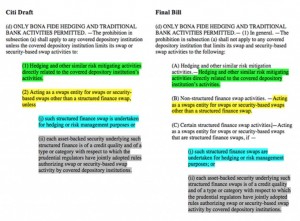
Five years after the Wall Street coup of 2008, it appears the U.S. House of Representatives is as bought and paid for as ever. We heard about the Citigroup crafted legislation currently being pushed through Congress back in May when Mother Jones reported on it. Fortunately, they included the following image in their article:Fortunately, it was stopped in the Senate at that time.
Unsurprisingly, the main backer of the bill is notorious Wall Street lackey Jim Himes (D-Conn.), a former Goldman Sachs employee who has discovered lobbyist payoffs can be just as lucrative as a career in financial services. The last time Mr. Himes made an appearance on these pages was in March 2013 in my piece: Congress Moves to DEREGULATE Wall Street.
But that is the thing with bank lobbyists. They are like Terminators – they never, ever, ever give up.
And they now have more of a sense of urgency then ever, because we are moving into a period of time when the big banks may begin losing tremendous amounts of money on derivatives contracts.
For example, the rapidly plunging price of oil could potentially mean gigantic losses for the big banks. Many large shale oil producers locked in their profits for 2015 and 2016 through derivatives contracts when the price of oil was above $100 a barrel. As I write this, the price of oil is down to $65 a barrel, and many analysts expect it to go much lower.
So guess who is on the other end of many of those trades?
The big banks.
Their computer models never anticipated that the price of oil would fall by more than 40 dollars in less than six months. A loss of 40, 50 or even 60 dollars per barrel would be catastrophic.
No wonder they want legislation that will protect them.
And commodity derivatives are just part of the story. Over the past couple of decades, Wall Street has been transformed into the largest casino in the history of the world. At this point, the amounts of money that these “too big to fail” banks are potentially on the hook for are absolutely mind blowing.
As you read this, there are five Wall Street banks that each have more than 40 trillion dollars in exposure to derivatives. The following numbers come from the OCC’s most recent quarterly report (see Table 2)…
JPMorgan Chase
Total Assets: $2,520,336,000,000 (about 2.5 trillion dollars)
Total Exposure To Derivatives: $68,326,075,000,000 (more than 68 trillion dollars)
Citibank
Total Assets: $1,909,715,000,000 (slightly more than 1.9 trillion dollars)
Total Exposure To Derivatives: $61,753,462,000,000 (more than 61 trillion dollars)
Goldman Sachs
Total Assets: $860,008,000,000 (less than a trillion dollars)
Total Exposure To Derivatives: $57,695,156,000,000 (more than 57 trillion dollars)
Bank Of America
Total Assets: $2,172,001,000,000 (a bit more than 2.1 trillion dollars)
Total Exposure To Derivatives: $55,472,434,000,000 (more than 55 trillion dollars)
Morgan Stanley
Total Assets: $826,568,000,000 (less than a trillion dollars)
Total Exposure To Derivatives: $44,134,518,000,000 (more than 44 trillion dollars)
Those that follow my website regularly will note that the derivatives exposure for the top four banks has gone up significantly since I last wrote about this just a few months ago.
Do you want to be on the hook for all of that?
Keep in mind that the U.S. national debt is only about 18 trillion dollars at this point.
So why in the world would we want to guarantee losses that could potentially be far greater than our entire national debt?
Only a complete and utter fool would financially guarantee these incredibly reckless bets.
Please contact your representatives in Congress and tell them that you do not want to be on the hook for the derivatives losses of the big Wall Street banks.
When this derivatives bubble finally implodes and these big banks go down (and they inevitably will), we do not want them to take down the rest of us with them.
Source
December 5, 2014
Could Falling Oil Prices Spark A Financial Crisis?
The oil and gas boom in the United States was made possible by the extensive credit afforded to drillers. Not only has financing come from company shareholders and traditional banks, but hundreds of billions of dollars have also come from junk-bond investors looking for high returns.
Junk-bond debt in energy has reached $210 billion, which is about 16 percent of the $1.3 trillion junk-bond market. That is a dramatic rise from just 4 percent that energy debt represented 10 years ago.
As is the nature of the junk-bond market, lots of money flowed to companies with much riskier drilling prospects than, say, the oil majors. Maybe drillers were venturing into an uncertain shale play; maybe they didn’t have a lot of cash on hand or were a small startup. Whatever the case may be, there is a reason that they couldn’t offer “investment grade” bonds. In order to tap the bond market, these companies had to pay a hefty interest rate.
For investors, this offers the opportunity for high yield, which is why hundreds of billions of dollars helped finance companies in disparate parts of the country looking to drill in shale. When oil prices were high and production was relentlessly climbing, energy related junk bonds looked highly profitable.
But junk bonds pay high yields because they are high risk, and with oil prices dipping below $70 per barrel, companies that offered junk bonds may not have the revenue to pay back bond holders, potentially leading to steep losses in the coming weeks and months.
The situation will compound itself if oil prices stay low. The junk bond market may begin to shun risky drilling companies, cutting off access to capital. Without the ability to finance drilling, smaller or more indebted oil companies may not have a future. The Wall Street Journal profiled a few fund managers who are beginning to steer clear of smaller oil companies. Moody’s Investors Service downgraded the oil and gas sector on November 25 to a “negative” outlook because of falling oil prices.
If oil prices stay at $65 per barrel for three years, 40 percent of all energy junk bonds could be looking at default, according to a recent JP Morgan estimate. While that is a long-term and uncertain scenario, the pain is being felt today. The FT reported that a third of energy debt issued in the junk-bond market is currently in “distressed” territory.
That begs the question; could a shakeout of the oil industry spark a broader financial crisis? Banks and other financial institutions could be overly exposed to energy debt. The Telegraph paints a dire scenario in which the debt bubble bursts because of low oil prices, leading to a cascading 2008-style financial collapse, at least in the junk bond market.
Such a scenario may be a bit overblown. Persistently low interest rates keep demand for junk bonds high, meaning oil companies will probably be able to restructure their debt and continue to access capital. Also, drillers will not immediately face an existential crisis because many have hedged themselves, locking in prices for a certain amount of production.
But a junk bond crisis could become more likely if oil prices stay low for an extended period of time. Once a few companies begin to default, the problem could quickly spread. Another variable is how quickly the U.S. Federal Reserve will raise interest rates, which could significantly affect the attractiveness of the junk bond market.
Local and regional banks could be highly exposed as well, especially if energy loans make up a large share of their lending portfolio. The Wall Street Journal pointed out that banks like Oklahoma-based BOK Financial – with 19 percent of its loan portfolio made up of energy loans – could be the most vulnerable. Moreover, an economic downturn in regions that depend heavily on energy, such as Texas or North Dakota, could see a broader decline in demand for loans of all kinds. That could add to the pain for local banks.
Low oil prices are not just a problem for oil companies. Investment funds, hungry for yield in a low interest rate environment, have poured money into oil and gas. To be sure, we are far from a crisis at this point, but if oil prices don’t rebound, a lot of people are going to lose a lot of money.
Source
Junk-bond debt in energy has reached $210 billion, which is about 16 percent of the $1.3 trillion junk-bond market. That is a dramatic rise from just 4 percent that energy debt represented 10 years ago.
As is the nature of the junk-bond market, lots of money flowed to companies with much riskier drilling prospects than, say, the oil majors. Maybe drillers were venturing into an uncertain shale play; maybe they didn’t have a lot of cash on hand or were a small startup. Whatever the case may be, there is a reason that they couldn’t offer “investment grade” bonds. In order to tap the bond market, these companies had to pay a hefty interest rate.
For investors, this offers the opportunity for high yield, which is why hundreds of billions of dollars helped finance companies in disparate parts of the country looking to drill in shale. When oil prices were high and production was relentlessly climbing, energy related junk bonds looked highly profitable.
But junk bonds pay high yields because they are high risk, and with oil prices dipping below $70 per barrel, companies that offered junk bonds may not have the revenue to pay back bond holders, potentially leading to steep losses in the coming weeks and months.
The situation will compound itself if oil prices stay low. The junk bond market may begin to shun risky drilling companies, cutting off access to capital. Without the ability to finance drilling, smaller or more indebted oil companies may not have a future. The Wall Street Journal profiled a few fund managers who are beginning to steer clear of smaller oil companies. Moody’s Investors Service downgraded the oil and gas sector on November 25 to a “negative” outlook because of falling oil prices.
If oil prices stay at $65 per barrel for three years, 40 percent of all energy junk bonds could be looking at default, according to a recent JP Morgan estimate. While that is a long-term and uncertain scenario, the pain is being felt today. The FT reported that a third of energy debt issued in the junk-bond market is currently in “distressed” territory.
That begs the question; could a shakeout of the oil industry spark a broader financial crisis? Banks and other financial institutions could be overly exposed to energy debt. The Telegraph paints a dire scenario in which the debt bubble bursts because of low oil prices, leading to a cascading 2008-style financial collapse, at least in the junk bond market.
Such a scenario may be a bit overblown. Persistently low interest rates keep demand for junk bonds high, meaning oil companies will probably be able to restructure their debt and continue to access capital. Also, drillers will not immediately face an existential crisis because many have hedged themselves, locking in prices for a certain amount of production.
But a junk bond crisis could become more likely if oil prices stay low for an extended period of time. Once a few companies begin to default, the problem could quickly spread. Another variable is how quickly the U.S. Federal Reserve will raise interest rates, which could significantly affect the attractiveness of the junk bond market.
Local and regional banks could be highly exposed as well, especially if energy loans make up a large share of their lending portfolio. The Wall Street Journal pointed out that banks like Oklahoma-based BOK Financial – with 19 percent of its loan portfolio made up of energy loans – could be the most vulnerable. Moreover, an economic downturn in regions that depend heavily on energy, such as Texas or North Dakota, could see a broader decline in demand for loans of all kinds. That could add to the pain for local banks.
Low oil prices are not just a problem for oil companies. Investment funds, hungry for yield in a low interest rate environment, have poured money into oil and gas. To be sure, we are far from a crisis at this point, but if oil prices don’t rebound, a lot of people are going to lose a lot of money.
Source
Subscribe to:
Posts (Atom)