February 12, 2015

The Problem Of Debt As We Reach Oil Limits

(This is Part 3 of my series – A New Theory of Energy and the Economy. These are links to Part 1 and Part 2.)

Many readers have asked me to explain debt. They also wonder, “Why can’t we just cancel debt and start over?” if we are reaching oil limits, and these limits threaten to destabilize the system. To answer these questions, I need to talk about the subject of promises in general, not just what we would call debt.

In some sense, debt and other promises are what hold together our networked economy. Debt and other promises allow division of labor, because each person can “pay” the others in the group for their labor with a promise of some sort, rather than with an immediate payment in goods. The existence of debt allows us to have many convenient forms of payment, such as dollar bills, credit cards, and checks. Indirectly, the many convenient forms of payment allow trade and even international trade.


Figure 1. Dome constructed using Leonardo Sticks

Figure 1. Dome constructed using Leonardo Sticks

Each debt, and in fact each promise of any sort, involves two parties. From the point of view of one party, the commitment is to pay a certain amount (or certain amount plus interest). From the point of view of the other party, it is a future benefit–an amount available in a bank account, or a paycheck, or a commitment from a government to pay unemployment benefits. The two parties are in a sense bound together by these commitments, in a way similar to the way atoms are bound together into molecules. We can’t get rid of debt without getting rid of the benefits that debt provides–something that is a huge problem.

There has been much written about past debt bubbles and collapses. The situation we are facing today is different. In the past, the world economy was growing, even if a particular area was reaching limits, such as too much population relative to agricultural land. Even if a local area collapsed, the rest of the world could go on without them. Now, the world economy is much more networked, so a collapse in one area affects other areas as well. There is much more danger of a widespread collapse.
Our economy is built on economic growth. If the amount of goods and services produced each year starts falling, then we have a huge problem. Repaying loans becomes much more difficult.
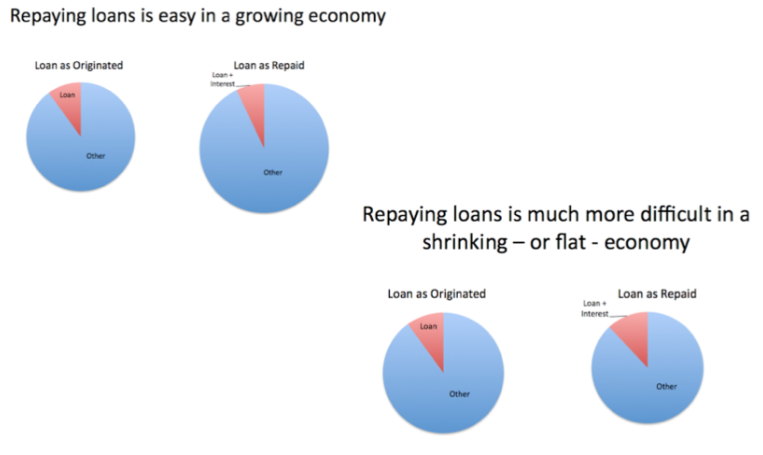
Figure 2. Repaying loans is easy in a growing economy, but much more difficult in a shrinking economy.

In fact, in an economic contraction, promises that aren’t debt, such as promises to pay pensions and medical costs of the elderly as part of our taxes, become harder to pay as well. The amount we have left over for discretionary expenditures becomes much less. These pressures tend to push an economy further toward contraction, and make new promises even harder to repay.

The Nature of Debt

In a broad sense, debt is a promise of something of value in the future. With this broad definition, it is clear that a $10 bill is a form of debt, because it is a promise that at some point in the future you, or the person you pass the $10 bill on to, will be able to exchange the $10 bill for something of value. In a sense, even gold coins are a promise of value in the future. This is not necessarily a promise we can count on though. At times in the past, gold coins have been confiscated. Derivatives and other financial products have characteristics of debt as well.

To understand how important debt is, we need to think about an economy without debt. Such an economy might have a central market where everyone brings goods to exchange. But even in such an economy, there will be a problem if there is not a precise matching of needs. If I bring apples and you bring potatoes, we could exchange with each other (“barter”). But what if I don’t have a need for potatoes? Then we might need to bring a third person into the ring, so each of us can receive what we want. Because barter is so cumbersome, barter was never widely used for everyday transactions within communities.

An approach that seemed to work better is one mentioned in David Graeber’s book, Debt: The First 5,000 Years. With this system, a temple would operate a market. The operator of the market would provide a “price” for each object, in terms of a common unit, such as “bushels of wheat.” Each person could bring goods to the market (and perhaps even services–I will work for a day in your vineyard), and have them exchanged with others based on value. No “money” was really needed because the operator would take a clay tablet and on it make a calculation of the value in “bushels of wheat” of what a person brought in goods, The operator would also calculate the value in “bushels of wheat” that the same person was receiving in return, and make certain that the two matched.
Of course, as soon as we start allowing “a day’s worth of labor ” to be exchanged in this way, we get back to the problem of future promises, and making certain that they really happen. Also, if we allow a person to carry over a balance from one day to another–for example, bringing in a large quantity of goods that cannot be sold in one day–then we get into the area of future promises. Or if we allow a farmer to buy seed on credit, with a promise to pay it back when harvest comes in a few months, we again get into the area of future promises. So even in this simple situation, we need to be able to handle the issue of future promises.

Future Promises Even Before Debt

Whenever there is division of labor, there needs to be some agreement as to how that division will take place–what are the responsibilities of each participant. In the simplest case, we have hunters and gatherers. If there is a decision that the men will do the hunting and the women will do the gathering and care for children, then there needs to be an agreement as to how the arrangement will work. The usual approach seems to have been some sort of “gift economy.” In such an economy, everyone would share whatever they were able to obtain with others, and would gain status by the amount they could offer to share.

Instead of a formal debt being involved, there was an understanding that if people were to participate in the group, they had to follow the rules that the particular culture dictated, including, very often, sharing everything. People who didn’t follow the rules would be thrown out. Because of the difficulty in living in such an environment alone, such people would likely die. Thus, participants were in some sense bound together by the customs that underlay gift economies.

At some point, as more of an economy was built up, there would be a need for one or more leaders, as well as some way of financially supporting those leaders. Thus, there would need to be some sort of taxation. While taxation to support the leader would not be considered debt, it has many of the same characteristics as debt. It is an ongoing payment obligation. The leader and the other members of the group plan their lives as if this situation is going to continue. In a way, the governmental services and the resulting taxation help bind the economy together.

Benefits of Debt

The benefits of debt are truly great, including the following:
  1. Debt allows transactions to take place that are not precisely at the same time and place. I can order goods and have them delivered to my home. An employer can pay me for a month’s work with a check, rather than needing to give me food or some other barter item corresponding to each hour I work. There is no need to have billions of gold coins (or other agreed up metal currency) to facilitate each and every transaction, and to transport around. We can each have bank accounts. From the bank’s perspective, the amount in a bank account is a liability (debt) owed to the depositor.
  2. Additional debt gives additional purchasing power to individuals, governments or businesses. The additional funds available can be spent immediately. Very often, repayment (with interest) is spread over several years, making goods that would not be affordable, affordable. Thus debt raises “demand” for goods and also for the commodities used to create these goods.
  3. Because debt makes goods more affordable, additional debt tends to “pump up” the price of commodities. These higher prices make it worthwhile for businesses to extract more minerals (including fossil fuels) from the earth, and make it worthwhile to plant more acres of food. Debt, particularly cheap debt, makes building new factories and opening new mines more affordable for businesses.
  4. Debt allows a steep step-up in standard of living, such as that obtained by adding coal or oil to an economy. Debt allows goods to be purchased that will substantially change a person’s future, such as transit to a new country, or purchase of a college education, or purchase of a delivery vehicle that can be used to start a business. Without debt, it is unlikely that fossil fuels could ever have been extracted; consumers would never have been able to afford the goods provided by fossil fuels, and businesses would have had difficulty financing the many new factories required to make goods using these fuels. See my post, Why Malthus Got His Forecast Wrong.
  5. Adding debt is self-reinforcing. Suppose a considerable amount of debt is added for what is deemed a good purpose, such as extracting oil in North Dakota. Oil companies will use the debt they receive for many different purposes–including paying employees, paying royalties to land owners, and paying taxes to the state. Employees will buy new houses and cars, taking out loans in the process. North Dakota residents who receive royalty payments may decide to take out home improvement loans to fix up their homes, expecting that the royalties will continue. The state may fix its roads with its revenue, giving additional income (which may lead to more debt) to road workers. A grocery chain may decide to build a new store (borrowing money to do so), further pushing the chain along. What happens is that indirectly, the new oil company debt makes a lot of people at least temporarily wealthier. These temporarily wealthier individuals can then “qualify” for more in loans than would otherwise be the case, giving them more to spend, and allowing yet others to qualify for loans.
  6. Arrangements that are not debt, but more of the nature of contingent debt, make people feel more confident of the current system. There are insurance programs for pension programs and for bank accounts, up to a selected balance per account. These insurance programs generally don’t have very much money in them, relative to what they are insuring. But they make people feel good, especially if there is a government that might come in and take over, beyond the actual funding of the insurance program.
What Goes Wrong with Debt and Other Financial Promises

1. As mentioned at the beginning of the post, debt works very badly if the economy is contracting.

It becomes impossible to repay debt with interest, without reducing discretionary income. Government programs, such as health care for the elderly, become more expensive relative to current incomes as well.

2. Interest payments on debt tend to transfer wealth from the poorer members of society to the richer members of society.

Economists have tended to ignore debt, because it represents a more or less balanced transaction between two individuals. The fact remains, though, that the poorer members of society find themselves especially in need of debt, and many pay very high interest rates. The ones lending money tend to be richer. Because of this arrangement, over time, interest payments tend to increase wealth disparities.

3. All too often, the payment stream upon which debt depends proves unsustainable.

In the example given above, everyone thinks the North Dakota oil will continue for a while, so takes out loans as if this is the case. If it doesn’t, then this is an “Oops” situation.
In the case of US student loans, many students are never able to get jobs with high enough wages to pay back the loans they were given.

4. Governments tend to put programs into place that are more expensive than they really can afford, for the long term.

As an economy gets wealthier (because of more fossil fuel use), there is a tendency to add more programs. Representative government is used instead of a monarch. Medical care and pensions for the elderly are added, as are unemployment benefits, and more advanced levels of schools.

Unfortunately, it is hard to properly estimate what long-run cost of these programs will be. Also, even if the programs were affordable with a high level of fossil fuels, they almost certainly will not be affordable if energy availability declines. It is virtually impossible to roll programs back, even if they are not guaranteed, once people plan their lives on the new programs.

Figure 3 shows a graph of US government spending (all levels) compared to wages (including amounts paid to proprietors, including farmers). I use this base, rather than GDP, because wages have not been keeping up with GDP in recent years. The amounts shown include programs such as Social Security and Medicare for the elderly, in addition to spending on things such as schools, roads, and unemployment insurance.
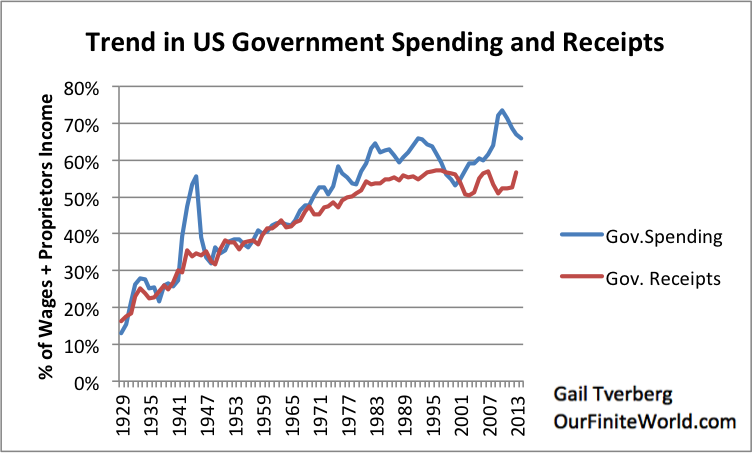

Figure 3. Comparison of US Government spending and receipts (all levels combined) based on US Bureau of Economic Research Data.

Figure 3. Comparison of US Government spending and receipts (all levels combined) based on US Bureau of Economic Research Data.

Clearly, government spending has been rising much faster than wages. I would expect this to be true in many countries.

5. There is no real tie between amounts of debt issued and what will actually be produced in the future. 

We are told that money is a store of value, and that it transfers purchasing power from the present to the future. In other words, we can count on balances in our bank accounts, and in fact, in all of the paper securities that are outstanding.

This story is only true if the economy can continue to create an increasing amount of goods and services forever. If, in fact, the production of goods and services drops off dramatically (most likely because prices cannot rise high enough to encourage enough extraction of commodities), then we have a major problem.

In any year, all we have available is the actual amount of resources that can be pulled out of the ground, plus the actual amount of food that can be grown. Together, these amounts determine how many goods and services are available. Money acts to distribute the goods that are available. Presumably, the people who work at extraction and production of these goods and services need to be paid first, or the whole process will stop. This basically leaves the “leftovers” to be shared among those who are now being supported by tax revenue and by those who hold paper securities of some sort or other. It is hard to see that anyone other than the workers producing the goods and services will get very much, if we lose the use of fossil fuels. Workers will become less efficient, and production will drop by too much.

6. Derivatives and other financial products expose the financial system to significant risks.

Certain large banks have found that they can earn considerable revenue by selling derivatives and other financial products, allowing people or businesses to essentially gamble on certain outcomes–such as the price of oil falling below a certain price, or interest rates rising very rapidly, or a certain company failing. As long as everything goes well, there is not a huge problem. The concern now is that with rapidly changing commodity prices, and rapidly changing levels of currencies, companies may fail and there may be major payouts triggered.

In theory, some of these payments may be offsetting–money owed by one client may offset money owed to another client. But even if this is the case, these defaults can sometimes take years to settle. There may also be issues with one of the parties’ ability to pay.

One particular problem with many of the products is the use of the Black-Scholes Pricing Model. This model is applicable when events are independent and normally distributed. This is not the case, when we are approaching oil limits and other limits of a finite world.

 7. Governments tend to be badly affected by a shrinking economy, so may be of little assistance when we need them most.

As noted previously, payments to governments act very much like debt. As an economy shrinks, programs that seemed affordable in the past become less affordable and badly need to be cut. Thus, governments tend to have problems at the exactly same time that banks and other lenders do.

Governments of “advanced” countries now have debt levels that are high by historical standards. If there is another major financial crisis, the plan seems to be to use Cyprus-like bail-ins of banks, instead of bailing out banks using government debt. In a bail-in, bank deposits are exchanged for equity in the failing bank. For example, in Cyprus, 37.5% of deposits in excess of 100,000 euros were converted to Class A shares in the bank.

This approach has a lot of difficulties. Businesses have a need for their funds, for purposes such as paying employees and building new factories. If their funds are taken in a bail-in, the ability of the business to continue may be damaged. Individual consumers depend on their bank balances as well. As noted above, deposit insurance is theoretically available, but the actual amount of funds for this purpose is very low relative to the amount potentially at risk. So we get back to the issue of whether governments can and will be able to bail out banks and other failing financial institutions.

8. More debt is needed to hide the lack of economic growth in an ailing world economy. This debt becomes increasingly difficult to obtain, as wages stagnate because of diminishing returns.

If wages are rising fast enough, wages by themselves might be used to pump demand for commodities, and thus raise their prices. Our wages are close to flat–median wages have been falling in the US. If wages aren’t rising sufficiently, increasing debt must be used to raise demand. Debt is growing slowly in the household sector, according to figures compiled by McKinsey Global Institute. Household debt has grown by only 2.8% per year between Q4 2007 and Q4 2014, compared to 8.5% per year in the period between Q4 2000 and Q4 2007.

Even with business demand included, debt isn’t rising rapidly enough to keep commodity prices up. This lack of sufficient growth in debt (and lack of growth in demand apart from growing debt) seems to be a major reason for the drop in prices since 2011 in many commodity prices.

9. Differing policies with respect to interest rates and quantitative easing seem to have the possibility of tearing the world financial system apart.

In a networked economy, not moving too far from the status quo is a definite advantage. If the US’s policies have the effect of raising the value of the dollar, and the policies of other countries have the tendency to lower their currencies, the net effect is to make debt held in other countries but denominated in US dollars unpayable. It also makes goods sold by American companies unaffordable.

The economy, as it exists today, has been made possible by countries working together. With sanctions against Iran and Russia, we are already moving away from this situation. Low oil prices are now putting the economies of oil exporters at risk. As countries try different approaches on interest rates, this adds yet another force, pulling economies apart.

10. The economy begins to act very strangely when too much of current income is locked up in debt and debt-like instruments.

Economic models suggest that if oil prices drop, demand for oil will grow robustly and supply will drop off quickly. If oil producers are protected by futures contracts that lock in a high price, they may not respond in the manner expected. In fact, if they are obligated to make debt payments, they may continue drilling even when it may not otherwise make financial sense to do so.

Likewise, consumers are also affected by prior commitments. If much of consumers’  income is tied up with condominium payments, auto payments, and payment of taxes, they may not have much ability to respond to lower oil prices. Instead of increasing discretionary spending, consumers may pay off some of their debt with their newfound income.

Conclusion

If the current economic system crashes and it becomes necessary to create a new one, the new system will have to deal with having an ever-smaller amount of goods and services available for a fairly long transition time. Because of this, the new system will have to be very different from the current one. Most promises will need to be of short duration.  Transfers among people living in a particular area might still be facilitated by a financial system, but it would be hard to have long-term or long-distance contracts. As a result, the new economy will likely need to be much simpler than our current economy. It is doubtful it could include fossil fuels.

Many people ask why we can’t just cancel all debt, and start over again. To do so would probably mean canceling all bank accounts as well. Most of our current jobs would probably disappear. We would probably be without grid electricity and without oil for cars. It would be very difficult to start over from such a situation. We would truly have to start over from scratch.

I have not talked about a distinction between “borrowed funds” and “accumulated equity”. Such a distinction is important in terms of the rate of return investors expect, but it is not as important in a crash situation. Similarly, the difference between stocks, bonds, pension plans, and insurance contracts becomes less important as well. If there are real problems, anything that is not physical ends up in the general category of “paper wealth”.

We cannot count on paper wealth (or for that matter, any wealth) for the long term. Each year, the amount of goods and services the economy can produce is limited by how the economy is performing, given limits we are reaching. If the quantity of these goods and services starts falling rapidly, governments may fail in addition to our problems with debts defaulting. Those holding paper wealth can’t count on getting very much. Workers producing whatever goods and services are actually being produced will likely need to be paid first.

Source

February 11, 2015

As TPP Sails Forth, It Drags the West Into Uncharted Waters

'Free trade' isn't what Trans-Pacific Partnership would deliver ... Think the Trans-Pacific Partnership is a free trade agreement? Think again. In principle, almost everyone's in favor of free trade. It promotes international harmony, raises wages, helps economies grow. It's an article of historical faith that the enactment of harsh protective U.S. tariffs in 1930 contributed to the Great Depression. And who wants that? – LA Times

Dominant Social Theme: Some sort of free trade pact is necessary.

Free-Market Analysis: There are two free trade pacts being negotiated currently, one in the "Pacific" and the other in the "Atlantic." The Pacific one seems to get most of the attention and there is good news for those who want the treaty cancelled or radically reconfigured.

The good news is that the US Congress is increasingly at odds with the way the Trans-Pacific Partnership is being handled. The fast track authority being demanded by Barack Obama is running into increased resistance because the treaty itself is a fairly radical – authoritarian – document.

What has brought the issue to the front again is twofold: One, comments from negotiators indicate the treaty may be finalized in a few weeks. Two, recent trade data seemed showed a widening trade gap.

Benzinga.com recently reported on the trade statistics, commenting, "The Commerce Department report ... [showed] that the U.S. trade deficit widened to $505.05 billion in 2014—the nation's largest gap since 2008."

US demand for foreign goods and services is going up according to this report, in part because of the strong US dollar – strong relative to other currencies anyway. Those against the treaty believe that language should be strengthened that forbids certain kinds of foreign currency manipulation.

But concerns may run deeper than language. According to the LA Times article, "The pact — which has been under negotiation virtually since the turn of the century — is in trouble on Capitol Hill, where its enemies include conservatives and liberals."

The Times article tells us that TPP has "become a symbol of everything that's wrong with free trade agreements today." Here's more:

But "free trade" has little to do with the trade deal that President Obama hopes will be a high-water mark for his administration's foreign policy: the Trans-Pacific Partnership talks, which now involve the U.S. and 11 Pacific Rim countries — Australia, Brunei, Canada, Chile, Japan, Malaysia, Mexico, New Zealand, Peru, Singapore and Vietnam.

The pact is being negotiated in secret, although U.S. trade negotiators have given big industries nice long looks behind the curtain. The White House is demanding "fast-track" approval from Congress, which limits the say lawmakers will have and requires them to ratify in haste. And public interest advocates say it could undermine rules and regulations governing the environment, health, intellectual property and financial markets (to name only a few topics).

The article offers three major doubts regarding TPP:

• Overreach. It's a big mercantilist mess, basically. Some pharmaceutical companies are directly shielded from competition by treaty language, while it also deals specifically with "food safety, product safety and access to drugs." Issues, in other words, that are only tangentially related to "free trade."

Even worse, corporations can seek rulings from international "arbitration courts" regarding sovereign laws and regulations. This is already taking place in areas regarding workplace regs and environmental issues. Sovereignty is eroded by such treaties, which take the power of law away from the nation-state and provide it instead to a new class of global judges.

• Secrecy. Like too many other modern-day negotiations, the TPP is being conducted in secret. U.S. Trade Representative Michael Froman has tried to maintain tight control over the language and who sees it. But there are countercurrents. In 2012, Sen. Ron Wyden (D-Ore.) introduced a bill requiring "that all lawmakers with oversight on trade policy be given access to key documents."

• "Fast-tracking." The White House wants the treaty signed under fast-tracking provisions that mandate lawmakers vote up or down on the treaty – as is – within 90 days. No filibusters allowed.

The article concludes that "opposition is growing from conservative Republicans and progressive Democrats alike." It calls the combination of secrecy and fast-tracking "overreach" and claims this sort of combination is increasingly seen as dangerous.

That sentiment is probably widespread. About a year ago, Canadians.org published an article entitled, "Demand the Harper government publish the Trans-Pacific Partnership."

Across Canada and around the world, people are speaking out about the Trans-Pacific Partnership trade agreement (TPP). They are rallying against the secrecy of the 12-country negotiations and the corporate agenda behind the deal.

On February 12, legislators in seven of the 12 TPP countries issued the following joint statement about the negotiations:

We, the undersigned legislators from countries involved in the negotiation of the Trans-Pacific Partnership Agreement, call on the Parties to the negotiation to publish the draft text of the Agreement before any final agreement is signed with sufficient time to enable effective legislative scrutiny and public debate

We can see from this that opposition to the treaty is both consistent and expanding. It is important to note that in the 20th century there would have been little or no way to oppose a treaty like this. One could write a letter or lobby in person but organizing a significant popular opposition was almost impossible.

But the Internet has changed more than a few legislative interactions. The opposition of so many people in Canada, the US and elsewhere seems to be having an impact. And even if the treaty does go through, it will have generated significant opposition. This is, in fact, what makes the current era both dangerous and promising.

The promise is that the Internet Reformation is making all sorts of globalist promotions increasingly irrelevant. The danger is that these promotions are insisted on anyway and that as a result government loses more and more legitimacy. Polls bear this out.

Conclusion: 
The end result is social chaos. As we often – clearly and strong suggest – protect yourself and your family as best you can. The West (the world) is moving into uncharted waters.

Source

February 10, 2015

If You Listen Carefully, The Bankers Are Actually Telling Us What Is Going To Happen Next

Are we on the verge of a major worldwide economic downturn?  Well, if recent warnings from prominent bankers all over the world are to be believed, that may be precisely what we are facing in the months ahead.  As you will read about below, the big banks are warning that the price of oil could soon drop as low as 20 dollars a barrel, that a Greek exit from the eurozone could push the EUR/USD down to 0.90, and that the global economy could shrink by more than 2 trillion dollars in 2015.  Most of the time, very few people ever actually read the things that the big banks write for their clients.  But in recent months, a lot of these bankers are issuing such ominous warnings that you would think that they have started to write for The Economic Collapse Blog.  Of course we have seen this happen before.  Just before the financial crisis of 2008, a lot of people at the big banks started to get spooked, and now we are beginning to see an atmosphere of fear spread on Wall Street once again.  Nobody is quite sure what is going to happen next, but an increasing number of experts are starting to agree that it won’t be good.

Let’s start with oil.  Over the past couple of weeks, we have seen a nice rally for the price of oil.  It has bounced back into the low 50s, which is still a catastrophically low level, but it has many hoping for a rebound to a range that will be healthy for the global economy.

Unfortunately, many of the experts at the big banks are now anticipating that the exact opposite will happen instead.  For example, Citibank says that we could see the price of oil go as low as 20 dollars this year…
The recent rally in crude prices looks more like a head-fake than a sustainable turning point — The drop in US rig count, continuing cuts in upstream capex, the reading of technical charts, and investor short position-covering sustained the end-January 8.1% jump in Brent and 5.8% jump in WTI into the first week of February. 
Short-term market factors are more bearish, pointing to more price pressure for the next couple of months and beyond — Not only is the market oversupplied, but the consequent inventory build looks likely to continue toward storage tank tops. As on-land storage fills and covers the carry of the monthly spreads at ~$0.75/bbl, the forward curve has to steepen to accommodate a monthly carry closer to $1.20, putting downward pressure on prompt prices. As floating storage reaches its limits, there should be downward price pressure to shut in production. 
The oil market should bottom sometime between the end of Q1 and beginning of Q2 at a significantly lower price level in the $40 range — after which markets should start to balance, first with an end to inventory builds and later on with a period of sustained inventory draws. It’s impossible to call a bottom point, which could, as a result of oversupply and the economics of storage, fall well below $40 a barrel for WTI, perhaps as low as the $20 range for a while.
Even though rigs are shutting down at a pace that we have not seen since the last recession, overall global supply still significantly exceeds overall global demand.  Barclays analyst Michael Cohen recently told CNBC that at this point the total amount of excess supply is still in the neighborhood of a million barrels per day…
“What we saw in the last couple weeks is rig count falling pretty precipitously by about 80 or 90 rigs per week, but we think there are more important things to be focused on and that rig count doesn’t tell the whole story.” 
He expects to see some weakness going into the shoulder season for demand. In addition, there is an excess supply of about a million barrels of oil a day, he said.
And the truth is that many firms simply cannot afford to shut down their rigs.  Many are leveraged to the hilt and are really struggling just to service their debt payments.  They have to keep pumping so that they can have revenue to meet their financial obligations.  The following comes directly from the Bank for International Settlements…
“Against this background of high debt, a fall in the price of oil weakens the balance sheets of producers and tightens credit conditions, potentially exacerbating the price drop as a result of sales of oil assets, for example, more production is sold forward,” BIS said. 
“Second, in flow terms, a lower price of oil reduces cash flows and increases the risk of liquidity shortfalls in which firms are unable to meet interest payments. Debt service requirements may induce continued physical production of oil to maintain cash flows, delaying the reduction in supply in the market.”
In the end, a lot of these energy companies are going to go belly up if the price of oil does not rise significantly this year.  And any financial institutions that are exposed to the debt of these companies or to energy derivatives will likely be in a great deal of distress as well.

Meanwhile, the overall global economy continues to slow down.

On Monday, we learned that the Baltic Dry Index has dropped to the lowest level ever.  Not even during the darkest depths of the last recession did it drop this low.

And there are some at the big banks that are warning that this might just be the beginning.  For instance, David Kostin of Goldman Sachs is projecting that sales growth for S&P 500 companies will be zero percent for all of 2015…
“Consensus now forecasts 0% S&P 500 sales growth in 2015 following a 5% cut in revenue forecasts since October. Low oil prices along with FX headwinds and pension charges have weighed on 4Q EPS results and expectations for 2015.”
Others are even more pessimistic than that.  According to Bank of America, the global economy will actually shrink by 2.3 trillion dollars in 2015.

One thing that could greatly accelerate our economic problems is the crisis in Greece.  If there is no compromise and a new Greek debt deal is not reached, there is a very real possibility that Greece could leave the eurozone.

If Greece does leave the eurozone, the continued existence of the monetary union will be thrown into doubt and the euro will utterly collapse.

Of course I am not the only one saying these things.  Analysts at Morgan Stanley are even projecting that the EUR/USD could plummet to 0.90 if there is a “Grexit”…
The Greek Prime Minister has reaffirmed his government’s rejection of the country’s international bailout programme two days before an emergency meeting with the euro area’s finance ministers on Wednesday. His declaration suggested increasing minimum wages, restoring the income tax-free threshold and halting infrastructure privatisations. Should Greece stay firm on its current anti-bailout course and with the ECB not accepting Greek T-bills as collateral, the position of ex-Fed Chairman Greenspan will gain increasing credibility. He forecast the eurozone to break as private investors will withdraw from providing short-term funding to Greece. Greece leaving the currency union would convert the union into a club of fixed exchange rates, a type of ERM III, leading to further fragmentation. Greek Fin Min Varoufakis said the euro will collapse if Greece exits, calling Italian debt unsustainable. Markets may gain the impression that Greece may not opt for a compromise, instead opting for an all or nothing approach when negotiating on Wednesday. It seems the risk premium of Greece leaving EMU is rising. Our scenario analysis suggests a Greek exit taking EURUSD down to 0.90.
If that happens, we could see a massive implosion of the 26 trillion dollars in derivatives that are directly tied to the value of the euro.

We are moving into a time of great peril for global financial markets, and there are a whole host of signs that we are slowly heading into another major global economic crisis.

So don’t be fooled by all of the happy talk in the mainstream media.  They did not see the last crisis coming either.

Source

February 9, 2015

A Day Of Reckoning For The Euro Has Arrived – 26 TRILLION In Currency Derivatives At Risk

This is the month when the future of the eurozone will be decided.  This week, Greek leaders will meet with European officials to discuss what comes next for Greece.  The new prime minister of Greece, Alexis Tsipras, has already stated that he will not accept an extension of the current bailout.  Officials from other eurozone countries have already said that they expect Greece to fully honor the terms of the current agreement.  So basically we are watching a giant game of financial “chicken” play out over in Europe, and a showdown is looming.  Adding to the drama is the fact that the Greek government is rapidly running out of money.  According to the Wall Street Journal, Greece is “on course to run out of money within weeks if it doesn’t gain access to additional funds, effectively daring Germany and its other European creditors to let it fail and stumble out of the euro.”  We have witnessed other moments of crisis for Greece before, but things are very different this time because the new Greek government is being run by radical leftists that based their entire campaign on ending the austerity that has been imposed on Greece by the rest of Europe.  If they buckle under the demands of the European financial lords, their credibility will be gone and Syriza will essentially be finished in Greek politics.  But if they don’t compromise, Greece could be forced to leave the eurozone and we could potentially be facing the equivalent of “financial armageddon” in Europe.  If nobody flinches, the eurozone will fall to pieces, the euro will collapse and trillions upon trillions of dollars in derivatives will be in jeopardy.

According to the Bank for International Settlements, 26.45 trillion dollars in currency derivatives are directly tied to the value of the euro.

Let that number sink in for a moment.

To give you some perspective, keep in mind that the U.S. government spends a total of less than 4 trillion dollars a year.

The entire U.S. national debt is just a bit above 18 trillion dollars.

So 26 trillion dollars is an amount of money that is almost unimaginable.  And of course those are just the derivatives that are directly tied to the euro.  Overall, the total global derivatives bubble is more than 700 trillion dollars in size.

Over the past couple of decades, the global financial system has been transformed into the biggest casino in the history of the planet.  And when things are stable, the computer algorithms used by the big banks work quite well and they make enormous amounts of money.  But when unexpected things happen and markets go haywire, the financial institutions that gamble on derivatives can lose massive quantities of money very rapidly.  We saw this in 2008, and we could be on the verge of seeing this happen again.

If no agreement can be reached and Greece does leave the eurozone, the euro is going to fall off a cliff.

When that happens, someone out there is going to lose an extraordinary amount of money.

And just like in 2008, when the big financial institutions start to fail that will plunge the entire planet into another major financial crisis.

So at the moment, it is absolutely imperative that Greece and the rest of the eurozone find some common ground.

Unfortunately, that may not happen.  The new prime minister of Greece certainly does not sound like he is in a compromising mood…
Greece’s new leftist prime minister, Alexis Tsipras, said on Sunday he would not accept an extension to Greece’s current bailout, setting up a clash with EU leaders – who want him to do just that – at a summit on Thursday. 
Tsipras also pledged his government would heal the “wounds” of austerity, sticking to campaign pledges of giving free food and electricity to those who had suffered, and reinstating civil servants who had been fired as part of bailout austerity conditions.
Prior to the summit on Thursday, eurozone finance ministers are going to get together on Wednesday to discuss what they should do.  If these two meetings don’t go well this week, we could be looking at big trouble right around the corner.  In fact, Greece is being warned that they only have until February 16th to apply for an extension of the current bailout…
Euro zone finance ministers will discuss how to proceed with financial support for Athens at a special session next Wednesday ahead of the first summit of EU leaders with the new Greek prime minister, Alexis Tsipras, the following day. 
However, the chairman of the finance ministers said the following meeting of the Eurogroup on Feb. 16 would be Greece’s last chance to apply for a bailout extension because some euro zone countries would need to consult their parliaments. 
“Time will become very short if they (Greece) don’t ask for an extension (by then),” said Jeroen Dijsselbloem. 
The current bailout for Greece expires on Feb 28. Without it the country will not get financing or debt relief from its lenders and has little hope of financing itself in the markets.
And as I mentioned above, the Greek government is quickly running out of money.

Most analysts believe that because of the enormous stakes that one side or the other will give in at some point.

But what if that does not happen?

Personally, I believe that the eurozone is doomed in the configuration that we see it today, and that it is just a matter of time before it breaks up.

And I am far from alone.  For example, just check out what former Fed chairman Alan Greenspan is saying…
Mr Greenspan, chairman of the Federal Reserve from 1987 to 2006, said: “I believe [Greece] will eventually leave. I don’t think it helps them or the rest of the eurozone – it is just a matter of time before everyone recognizes that parting is the best strategy. 
“The problem is that there there is no way that I can conceive of the euro of continuing, unless and until all of the members of eurozone become politically integrated – actually even just fiscally integrated won’t do it.”
The Greeks are using all of this to their advantage.  They know that if they leave it could break apart the entire monetary union.  So this gives them a tremendous amount of leverage.  Greek Finance Minister Yanis Varoufakis has even gone so far as to compare the eurozone to a house of cards…
“The euro is fragile, it’s like building a castle of cards, if you take out the Greek card the others will collapse.” Varoufakis said according to an Italian transcript of the interview released by RAI ahead of broadcast. 
The euro zone faces a risk of fragmentation and “de-construction” unless it faces up to the fact that Greece, and not only Greece, is unable to pay back its debt under the current terms, Varoufakis said. 
“I would warn anyone who is considering strategically amputating Greece from Europe because this is very dangerous,” he said. “Who will be next after us? Portugal? What will happen when Italy discovers it is impossible to remain inside the straitjacket of austerity?”
After all this time and after so many bailouts, we have finally reached a day of reckoning.
There is a very real possibility that Greece could leave the eurozone in just a matter of months, and the elite know this.

That is why they are getting prepared for that eventuality.  The following is from a recent Wall Street Journal report…
The U.K. government is stepping up contingency planning to prepare for a possible Greek exit from the eurozone and the market instability such a move would create, U.K. Treasury chief George Osborne said on Sunday. 
A spokeswoman for the Treasury declined comment on the details of the contingency planning. 
The U.K. government has said the standoff between Greece’s new anti-austerity government and the eurozone is increasing the risks to the global and U.K. economy. 
“That’s why I’m going tomorrow to the G-20 [Group of 20] to encourage our partners to resolve this crisis. It’s why we’re stepping up the contingency planning here at home,” Mr. Osborne told the BBC in an interview. “We have got to make sure we don’t, at this critical time when Britain is also facing a critical choice, add to the instability abroad with instability at home.”
And if Greece does leave, it will cause panic throughout global financial markets as everyone wonders who is next.

Italy, Spain and Portugal are all in a similar position.  Every one of them could rapidly become “the next Greece”.

But of even greater concern is what a “Grexit” would do to the euro.  If the euro falls below parity with the U.S. dollar, the derivatives losses are going to be absolutely mind blowing.  And coupled with the collapse of the price of oil, we could be looking at some extreme financial instability in the not too distant future.

When big banks collapse, they don’t do it overnight.  But we often learn about it in a single moment.

Just remember Lehman Brothers.  Their problems developed over an extended period of time, but we only learned the full extent of their difficulties on one very disturbing day in 2008, and that day changed the world.

As you read this, big financial troubles are brewing in the background.  At some point, they are going to come to the surface.  When they do, the entire planet is going to be shocked.

Source

February 6, 2015

Only 44 Percent Of U.S. Adults Are Employed For 30 Or More Hours Per Week

Jim Clifton, the Chairman and CEO of Gallup, says that the percentage of Americans that are employed full-time has been hovering near record lows since the end of the last recession.  But most Americans don’t realize this because the official unemployment numbers are extremely misleading.  In fact, Clifton says that the official 5.6 percent unemployment rate is a “big lie”.  Gallup regularly tracks the percentage of U.S. adults that are employed for 30 or more hours per week, and it is currently at 44.2 percent.  It has been hovering between 42 percent and 45 percent since the end of 2009.  This is extremely low.  As I discussed the other day, there are 8.69 million Americans that are considered to be “officially unemployed” at this point.  But there are another 92.90 million Americans that are considered to be “not in the labor force”.  Millions upon millions of those Americans would work if they could.  Overall, there are 101 million U.S. adults that do not have a job right now.  But you won’t hear that number being discussed by the mainstream media, because it would make Barack Obama look really bad.

Most Americans just assume that the economic numbers that we are being given accurately reflect reality.  That is why it is so refreshing to have men like Jim Clifton step forward and tell the truth.  His recent article entitled “The Big Lie: 5.6% Unemployment” is making headlines all over America.  The following is an extended excerpt from that article…
There’s another reason why the official rate is misleading. Say you’re an out-of-work engineer or healthcare worker or construction worker or retail manager: If you perform a minimum of one hour of work in a week and are paid at least $20 — maybe someone pays you to mow their lawn — you’re not officially counted as unemployed in the much-reported 5.6%. Few Americans know this. 
Yet another figure of importance that doesn’t get much press: those working part time but wanting full-time work. If you have a degree in chemistry or math and are working 10 hours part time because it is all you can find — in other words, you are severely underemployed — the government doesn’t count you in the 5.6%. Few Americans know this. 
There’s no other way to say this. The official unemployment rate, which cruelly overlooks the suffering of the long-term and often permanently unemployed as well as the depressingly underemployed, amounts to a Big Lie. 
And it’s a lie that has consequences, because the great American dream is to have a good job, and in recent years, America has failed to deliver that dream more than it has at any time in recent memory. A good job is an individual’s primary identity, their very self-worth, their dignity — it establishes the relationship they have with their friends, community and country. When we fail to deliver a good job that fits a citizen’s talents, training and experience, we are failing the great American dream. 
Gallup defines a good job as 30+ hours per week for an organization that provides a regular paycheck. Right now, the U.S. is delivering at a staggeringly low rate of 44%, which is the number of full-time jobs as a percent of the adult population, 18 years and older.
And Gallup is being extremely generous.

I certainly would not define a 30 hour a week job at minimum wage as a “good job”, but Gallup does.
So the truth is that the percentage of U.S. adults that do have “good jobs” is actually far lower than 44 percent.

In the video that I have posted below, there is much more from Clifton about our current employment crisis…


Pretty strong stuff.


But Clifton also understands that there is danger in speaking out like this.
For example, just check out what he told CNBC during one recent interview…
“I think that the number that comes out of BLS [Bureau of Labor Statistics] and the Department of Labor is very, very accurate. I need to make that very, very clear so that I don’t suddenly disappear. I need to make it home tonight.”
So why are there so few good jobs for Americans?

Well, for one thing, our control freak politicians have absolutely murdered job creation in the United States.

Traditionally, small businesses have been the primary engine of job growth for the U.S. economy.  But for each of the past six years, the number of new businesses being created has been lower than the number of businesses that have died.

Prior to 2008, we had never seen this happen before in all of U.S. history.
Thanks Obama.

Meanwhile, we continue to ship millions of good jobs out of the country, and millions of good jobs are being replaced by technology.

A confluence of factors are coming together to create a perfect storm that is going to be extremely bitter for American workers.

Spending our wealth is not a path to prosperity.  We have got to create wealth in order to be a prosperous nation.

But instead, we continue to buy far, far more from the rest of the world than they buy from us.  We just learned that the trade deficit increased to 46.6 billion dollars in December, and the total trade deficit for the year was more than half a trillion dollars.

This is complete and utter insanity, but at this point the trade deficit is not even a political issue for either major political party anymore.

And the really bad news is that this is about as good as things are going to get for the U.S. economy.  The next major economic downturn is right around the corner, and our employment crisis is going to get much, much worse once that strikes.

Already, layoffs in January were 17.6 percent higher than they were in January a year ago and businesses all over the country are shutting down following a very disappointing holiday season.

In addition, the Baltic Dry Index has dropped to stunningly low levels.  In fact, it is already lower than it was at any point during the last recession.  The following is an excerpt from a recent article by Mac Slavo…
The Baltic Dry Index (BDI) is used by economists and stock traders alike as a leading economic indicator because it predicts future economic activity. The index tracks in US dollars and measures global supply and demand for commodity shipments among bulk carriers including raw materials like lumber, coal, metallic ores, and grains. What makes this particular measurement so distinct from others, according to economic Howard Simmons, is that the BDI “is totally devoid of speculative content” because “people don’t book freighters unless they have cargo to move.”
On Thursday, the Baltic Dry Index was sitting at 564, That is not too far above the record low level of 554 that was established in July 1986.

So don’t be fooled by all the happy talk from the mainstream media and from politicians like Barack Obama.

They are lying to you, and their lies will soon be evident for all the world to see.

Source

February 5, 2015

Goldman Busts The Narrative: The New Oil Order Is "Blessing In Disguise" For Russia

With S&P facing billion-dollar fines for defying the narrative, Goldman Sachs just dared to go even further against the US government by suggesting that the new oil order may be a blessing in disguise for Russia's oil industry. Simply put, the impact of the lower oil price and sanctions on the Russian economy increase the importance of oil industry tax reform, which could provide stimulus for upstream investments and commercialisation of the country’s vast oil reserves. An acceleration of upstream/downstream tax rebalancing could incentivise the development of substantial new basins in Russia, leading to a production capacity increase and a reduction in refining volumes to levels necessary to supply the domestic market. As a result, in Goldman's view, Russian crude exports would increase, improving the country’s current account, government revenues would grow, and upstream would attract material incremental investments.

Via Goldman Sachs,
The new oil price environment, the impact of sanctions on upstream developments, and the emergence of the Eurasian Economic Union (Kazakhstan, Belarus and Russia) are likely to lead to a major tax reshuffle in the Russian oil industry, in our view. Russia’s dependence on the oil market makes the country’s economy highly vulnerable to the new oil price reality. Consequently, we believe Russia might need to create a stimulus for new upstream developments to go ahead, otherwise it could see falling oil revenues and further deterioration in the economy. In addition to this, the formation of the Eurasian Economic Union requires the gradual unification of export duties. All these suggest a tax overhaul in the Russian oil industry might not be far off.

In this note, we outline what shape we think potential tax reform might take and what would be the implications on the Russian oil industry, Russia in general and Russian oil equities.

Why we think change is needed?

The current tax regime indirectly subsidises both the Russian refining industry and Russian consumers, via low fuel prices, while the tax burden on Russian upstream is one of the highest in the world. Effectively, refining and consumers are subsidised by upstream. Removal of this subsidy and the simultaneous reduction of the upstream tax burden could boost upstream profitability, while keeping the government’s take from the industry unchanged; consumers and refining, not the government, would therefore fund the expected increase in upstream profitability. A lower upstream tax burden would make currently-stranded reserves commercially recoverable, which would boost production and export volumes, helping the country to sell more oil on international markets and offset the negative impact of price decline.


What we think needs to change?

The tax changes, introduced on January 1, 2015, and known as the “tax manoeuvre”, indicate some minor upstream/downstream re-balancing. However, we believe the pace of the tax adjustments introduced with the tax manoeuvre is too slow to incentivise material upstream developments. We think that, with the current macro/political realities, the pace could accelerate and could lead to faster and sharper improvement in upstream profitability. Based on the direction of tax reforms over the last 3-4 years (60/66 tax reform, the tax manoeuvre) and the formation of the Eurasian Economic Union, we infer that the end point of tax reform could be the full cancellation of export duties and excise taxes, and an increase in MET. However, we expect the magnitude of any MET increase would be lower than the reduction of export duties.

What would be the outcome of potential tax reform?

We estimate such reform could lead to the following: (a) upstream profitability would substantially increase, driving up the earnings of Russian oil companies; (b) Russia would produce more oil – its vast onshore and offshore oil resources would become commercial to develop, giving a boost to accelerated production growth; (c) export refining would become loss-making and hence refining volumes would decline. Total refining throughput could decline to as much as needed to supply products to the domestic market. Under the current regime, we estimate that potential oil products export could decline up to c.50% from 2014 to 2020 (from c.3 mnbpd to c.1.5); (d) domestic oil product prices could rise by 30%, on average, from current levels, as indirect subsidy through export duties would be eliminated; (e) unconventional and offshore exploration would pick up, as profitability would improve substantially, making those areas particularly interesting for investment.
What would be the stock impact?

We believe Russian oil companies could experience an increase in earnings, but the magnitude of impact would be differentiated. Higher upstream exposure, production growth and better access to unconventional and offshore deposits would be the key for success. Companies that adjusted their strategies to increase upstream exposure would be in a more beneficial position than those investing in downstream. For portfolio managers, stock picking in the Russian oil industry would be based on the following metrics, in our view: (a) upstream vs. refining, measured by refining cover, i.e. lower is better; (b) production growth becomes important, as profitability would improve; (c) exposure to unconventional and offshore. Within the Russian oils space, we see Novatek and Lukoil as winners on a 5-7 year view, under both the current, and a reformed, tax regime.


Tax reform machine turned on; upstream to benefit
We think that the tax manoeuvre sets the foundation for upstream/downstream tax rebalancing. In its current form, we believe it implies some upstream/downstream rebalancing, but not enough to create material incentives for upstream developments; it maintains the Russian refining sector tax incentives and indirect consumer subsidies, by effectively keeping the domestic oil products price at a discount to the international price, through the use of export duties. However, we think that the new oil order and current macro/political realities could drive a redesign of the tax system to make it more favourable to upstream. We think this could be achieved by an acceleration of the tax manoeuvre, which would imply a reduction in export duties and a MET increase. We think the end point of the tax reform would be full cancellation of export duties, a MET increase and cancellation of excise taxes.


2014 and onwards: The trend is set - volume vs. price, upstream vs. downstream

After years of tweaks to the tax regime, it looks like the trend has now been set; refining taxes are going up, upstream taxes are going down. Yet we are a long way from broad tax reform; it seems the trend could be followed, not via overall reform, but rather through a continuous chain of tweaks, such as the tax manoeuvre and special tax breaks for greenfields. The chain of recently announced tax breaks for new developments, implemented over the course of 2013/2014, has also set another interesting trend, i.e. going for volume growth in production and expanding capacity in order to maintain, or even increase, market share in the global oil market; we think Russia would have benefited from pursuing this trend a long time ago. For now, it seems the government prefers to support new developments in the industry. However, with time, we are likely to see broader support for upstream, especially as budget revenues from the refining sector increase.


Conclusion: Tax manoeuvre is the beginning of a wider reform

The Russian government’s tax manoeuvre reduces export duties for both crude oil and light products, while MET (which originates at the point of production) increases. However, the profitability of light products sales remains high and the tax differential between crude and products looks set to stay in place. In our opinion, these tax regime changes are not final, and we think there could be more adjustments to follow. We believe the government is trying to maintain its subsidy to the refining industry, but we see several factors that could lead to the gradual cancellation of the refining tax subsidy and the elimination of export duties as a fiscal tool: (a) integration of the Eurasian Economic Union of Belarus, Kazakhstan and Russia; (b) the need to increase budget revenues; and (c) the need to provide more economic incentives for new upstream developments. Yet, it does not appear that the government is ready to introduce radical changes, as it appears to be proactively trying to maintain the refining industry tax subsidy. However, we think the government might gradually approach the point where reform could be economically necessary. That could be years from now and, until that time, Russian oil industry taxation is set to remain a topic of continued debate within the government, the Kremlin and company managements. Hence, we expect the Russian oil industry tax regime to continue to be subject to regular adjustments to the tax law. This would not be positive for Russian oil equities, as it would introduce a high level of uncertainty into future projections.

Source

February 4, 2015

What Corporate CEOs Are Saying About The Soaring Dollar

On the one hand there is the (self-admitted) persistently over-optimistic Fed saying it's not a big deal:
  • BULLARD SAYS DOLLAR NOT A HUGE FACTOR FOR U.S. ECONOMY
And on the other hand, this is what actual CEOs are saying...
PPG 1/15 - "The company expects that year-overyear currency translation will unfavorably impact sales"

United Continental  1/22 - "While a strong dollar is good for our fuel purchasing, it reduces the revenue received from international ticket sales."

JNJ 1/20 - "...If currency exchange rates were to remain where they were as of last week for the balance of the year then our sales growth rate would decrease by nearly 5.5%"

American Express 1/21 - "We, like many other global companies, had a significant negative impact on our growth rates this quarter from the strengthening U.S. dollar."

United Rentals 1/22 - "The Canadian dollar has been weakening pretty consistently...  that would be another 6% or so year-over-year headwind from the currency going down. So that’s a non-trivial amount of revenue that could erode."

Kansas City Southern 1/23 - "If the peso continues to deteriorate... we will see additional headwinds"

MMM 1/27 - "in tough environments and fighting through tough headwinds... That includes a stronger U.S. dollar, which reduced fourth quarter sales by more than 4%"

DuPont 1/27 - "macroeconomic and market headwinds including a weaker ag economy, stronger dollar...  the dollar continued to strengthen against most currencies, impacting segment results"

Danaher 1/27 - "The strengthening of the U.S. dollar since our December investor meeting is expected to reduce 2015 earnings by approximately $0.10 per share."
Source 

February 3, 2015

When It Comes to the Bull Market, Keep Your Eye on the Money Printing, Not the Regulation

Republicans gutting Dodd-Frank as Wall St. goes subprime again ... It is not mortgages but subprime car loans that U.S. banks are repackaging now for foreign investors ... Teams of bank lobbyists [are] rewriting laws up on Capitol Hill these days ... Little by little, these influence-buyers are gutting and filleting the Dodd-Frank Act, the package of bank regulations that was among the few big accomplishments of the Obama administration during the two years when Democrats controlled Congress. These lobbyists represent some of the same corporate villains whose greedy, in some cases criminal, machinations just about demolished the economy in 2008, tossing millions out of their jobs and impoverishing even thrifty and financially prudent citizens. – CBC

Dominant Social Theme: Regulations are necessary, especially when they last a long time.

Free-Market Analysis: This article is in line with what we've forecast in the past regarding regulation and asset expansions.

When markets crash, it is easy to create regulations to "address" the perceived problem. In fact, legislators often don't know or understand the problem, but they are willing to act to palliate the public perception that "something needs to be done."

However, when markets go back up and the regulations are getting in the way of potential profits, suddenly those recently passed regs don't look so good.

This is why it is likely not possible to reduce or eliminate market risk using regulations. Of course, regulations usually don't help address the perceived problem anyway. But the more markets improve, the less newly codified regulations may be seen as necessary.

Battalions of lawyers and lobbyists may be unleashed to reduce or remove the most significant regs, and thus even if the reg is by some chance addressing the intended issue, it may soon be whittled into insignificance.

Here's more:

Just seven years after so many people nearly lost everything, conservative lawmakers are hard at work dismantling those damned bothersome restrictions placed on banks to prevent a repeat of the great meltdown.

Late last year, Republicans refused to pass a larger spending bill unless the White House agreed to undo a section of Dodd-Frank that forced banks to move their risky derivative trades to units that don't enjoy taxpayer backing.

Then, when Congress reconvened this year under full Republican control, the very first order of business was once again the banks. This time, the aim is to let the big, federally insured banks increase their risk profiles. Super idea, that one.

The idea, clearly, is to get rid of all this Dodd-Frank stuff entirely, particularly the so-called Volcker rule, the law's centerpiece. It basically forbids banks to play risky games with their own cash reserves, which the banks are required to maintain in case things go sideways again.
Car loans at 35%

Think they won't? Well, Wall Street has already dived back into the stinking ooze of subprime lending, the financial weapon of mass destruction that blew up in 2008.

The article goes on to report that what has replaced repackaged loans of low-income housing are car loans.

The cycle is the same as in the early 2000s according to the article. Auto lenders find consumers with poor credit ratings and offer high-interest car loans. Various lending institutions package the loans (form them into securitized debt), manipulating the most risky of them by blending them with less risky loans. This securitized debt is then provided to investors around the world and proves attractive because of the high return.

This is similar to the subprime repackaging that was commonly held to have destabilized markets in the mid-2000s.

The article also points out that Fannie Mae and Freddie Mac are once again "approving down payments as low as three per cent." It concludes, sarcastically, "Consumers don't need protection, you see. The market provides that already. Really. It does."

We can see clearly that the debate over market risk has been confined mainly to regulation in this article. The sarcasm at the end emphasizes this point. No matter that endless commentary in the alternative media has focused on central bank money printing and excessively low short-term rates, we are supposed to believe that market crashes are a regulatory phenomenon.

Whether regulations are gutted or not is probably beside the point. Vast waves of money sloshing over financial facilities create the conditions for a market meltdown. As asset bubbles expand into the larger economy, the possibility of a market event becomes increasingly probable.

Regulation is not at fault, nor is it a panacea. Regulations that are passed after market events are often undone. And even if they are not undone, monetary stimulation will create conditions for market instability.

Over US$50 trillion has been poured into markets following the 2008-2009 market crash. And now, as we've reported recently, there are signs that further monetary coordination will expand current asset bubbles.

Regulation is a red herring. Keep your eye on monetary stimulation. The vast amounts of money being poured into the world's economy will likely have an increasingly significant effect. First will come a considerable – additional – boom. And then a bust.

If you are appropriately hedged and diversified you may be able to make money going up and coming down. Some people always do. But don't be fooled about the market mechanism.

Conclusion: 
If a global Wall Street Party is to take place, it will be built on the shaky foundation of money printing. And sooner or later it will collapse.

Source

February 2, 2015

Nomi Prins: The Sinister Evolution Of Our Modern Banking System

I quit Wall Street and decided that it was time to talk more about what was going on inside it, as it had changed. It had become far more sinister and far more dangerous.
     ~ Nomi Prins

Today, the 'revolving door' connecting our political and financial systems is evident to anyone with eyes. But this entwined relationship between Washington DC and Wall Street is nothing new, predating even the formation of the Federal Reserve.

To chronicle the evolution to where we find ourselves today, we welcome Nomi Prins, Wall Street veteran turned financial industry reformist, and author of the excellent expose All The Presidents Bankers.

In this well-detailed interview, Nomi goes into depth of the rationale and process behind the creation of the Federal Reserve, and more important, how its mandate -- and the behavior of the banking system overall -- metastasized into the every-banker-for-himself regime of sanctioned theft we now live with.
Chris Martenson:   To me, it couldn’t have been more obviously obscene then in 2010, and I believe maybe 2009, right after the big banks had been handed just vast, huge, very favorable handouts and bailouts during the Great Recession -- and then they handed themselves record bonuses. I thought optically that was just horrible. As somebody who was inside the banking system: Are they that tone deaf? What’s behind that sort of behavior?

Nomi Prins:   Indeed, they have become very isolated.

It began with the period before the 1970s when different people were rising to leadership in banks, and worsened in the 80s when we started seeing people who had more sociopathic tendencies or less ability to appreciate the idea of the public's economic stability being beneficial to growing their institutions. They no longer viewed it as necessary.

And with the advent of the larger futures market, the options market, the derivatives market, and all the off-shore elements of banking that were able to be developed, so much capital was now available and off of the books that the idea of maintaining some sort of a connection to stability policy -- or even to whatever the Presidency might want -- dissolved. At the same time, all the Presidents that were involved in running the country around that time didn’t ask or require accountability towards financial stability from them.

So there was a bunch of things that were happening at the same time, and that’s why the media does a poor job of critiquing this because they’re not looking at all the strands. None of this is simple. A lot of things happened at the same time to create these kinds of shifts. On the one hand, you have no restraint: you don’t have the Gold Standard anymore, so you have less of a strain on having something physical be reserved against your leverage. You now have this ability of petrodollars being recycled. You have the ability to leverage more debt. You have less humility. You have a more technologically-advanced, less transparent global financial system, so you can make and hide money easier. And then you have ascendancies of leadership in banks and in the government that are OK with all this, and allow it to fester.

It's all defended as some sort of example of a free market and competition -- "the best gets the best", and so forth -- when the reality is it just destabilizes the entire system and creates an artificiality. We see central banks supporting all of this mess, as opposed to figuring out what the exit policy is -- which none of them have a clue about. That’s really where we’ve evolved to.
Click the play button below to listen to Chris' interview with Nomi Prins (52m:45s)

Source