February 25, 2015

Janet Yellen Is Freaking Out About ‘Audit The Fed’ – Here Are 100 Reasons Why She Should Be

Janet Yellen is very alarmed that some members of Congress want to conduct a comprehensive audit of the Federal Reserve for the first time since it was created.  If the Fed is doing everything correctly, why should Yellen be alarmed?  What does she have to hide?  During testimony before Congress on Tuesday, she made “central bank independence” sound like it was the holy grail.  Even though every other government function is debated politically in this country, Yellen insists that what the Federal Reserve does is “too important” to be influenced by the American people.  Does any other government agency ever dare to make that claim?  But of course the Federal Reserve is not a government agency.  It is a private banking cartel that has far more power over our money and our economy than anyone else does.  And later on in this article I am going to share with you dozens of reasons why Congress should shut it down.

The immense power wielded by the Federal Reserve is clearly demonstrated whenever Janet Yellen speaks publicly.  On Tuesday, her comments about interest rates sent stocks to brand new record highs…
Yellen, in her semi-annual testimony before the Senate banking committee, used a word familiar to investors when she reiterated that the central bank will be “patient” on raising interest rates for the first time since the 2008 financial crisis. Traders took that as a sign that interest rates would remain unchanged until autumn. 
The Dow Jones Industrial Average rose 92.35 points (0.5%) to 18,209.19, while the Standard & Poors 500 gained 5.82 points (0.3%) to 2,115.48, both eclipsing Friday’s record closes.
But Yellen was also unusually defensive on Tuesday.  The “Audit the Fed” bill that is being sponsored by Rand Paul (among others) has her really freaked out.  The following comes from the Hill…
Appearing before the Senate Banking Committee, Yellen was on the defensive, as Republicans questioned how the Fed conducts monetary policy and Democrats put forward ideas for getting tougher on Wall Street. 
In the midst of all of it, Yellen generally argued the Fed was designed as an independent entity for a reason — and it would be best not to change it. 
“Central bank independence in conducting monetary policy is considered a best practice for central banks around the world,” she said. “Academic studies, I think, establish beyond the shadow of a doubt that independent central banks perform better.”
In fact, she went so far as to mention the “Audit the Fed” bill by name…
A GOP-controlled Congress has given the bill its best chances yet of passage, and that renewed interest led Yellen to deliver her most spirited opposition yet. 
“I want to be completely clear,” she said. “I strongly oppose Audit the Fed.”
Yellen argued the audit measure would allow politicians to second-guess the Fed’s decisions, which, in turn, would weaken the central bank. And the ultimate victim of that process, she said, would be the U.S. economy.
So what is she so concerned about?

We are all accountable to someone.

What is so wrong about the Federal Reserve being accountable to Congress?

Why can’t we find out what is really going on inside the Fed?

And of course it isn’t just Yellen that is freaking out.  Just consider these comments from Richard Fisher, the president of the Federal Reserve Bank of Dallas…
“It is always politically convenient to make something sound mysterious, if not malevolent, by claiming it is opaque,” Fisher said in a speech to the Economic Club of New York that is part of an effort by Fed officials to fight the legislation. 
“My suspicion is that many of those in Congress calling for ‘auditing’ the Fed are really sheep in wolves’ clothing,” he said. “Having proven themselves unable to cobble together with colleagues a working fiscal policy or to construct a regulatory regime that incentivizes rather than discourages investment and job creation — in other words, failed at their own job — they simply find it convenient to create a bogeyman out of an entity that does its job efficiently.”
Obviously this is a very, very touchy subject over at the Fed.

It is quite clear that they do not want the rest of us to be able to see what they are really up to.
And the truth is that if the American people really did know how the Federal Reserve works and what it has been doing behind closed doors, most Americans would want it shut down tomorrow.

At the end of the day, the reality of the matter is that we don’t even need a Federal Reserve.  I really like how David Stockman made this point the other day…
At the end of the day, American capitalism does not need recycled political hacks like Jerome H. Powell or clueless school marms like Janet Yellen to thrive. If we need a Fed at all, it is the one designed by Carter Glass 100 years ago. That is, a “bankers bank” that was intended to provide standby liquidity at a penalty spread above the free market interest rate in consideration for good collateral originating from inventory and receivables in the real economy. 
Under that arrangement, there would be no monetary central planning or pointless attempts to manage the level of GDP, the number of new jobs, the rate of housing starts, the fluctuations of the CPI or the amplitudes of the business cycle. There would also be no pegging of the money market rate, no helping hand for Wall Street gamblers, no cheap debt to enable profligate politicians to kick-the-can down the road indefinitely. 
In short, what the nation really needs is not an “independent” Fed, but one that is shackled to a narrow and market-driven liquidity function. The rest of its current remit is nothing more than the self-serving aggrandizement of the apparatchiks who run it; and who have now managed to turn the nation’s vital money and capital markets into dangerous, unstable casinos, and the nations savers into indentured servants of a bloated and wasteful banking system.
The Federal Reserve has been around for just over a hundred years, and it has done an absolutely abysmal job for the American people.

I want to share with you some facts and figures that I have shared before, but they bear repeating.  Please share this list of 100 reasons why the Federal Reserve should be shut down with everyone that you know…

#1 We like to think that we have a government “of the people, by the people, for the people”, but the truth is that an unelected, unaccountable group of central planners has far more power over our economy than anyone else in our society does.
#2 The Federal Reserve is actually “independent” of the government.  In fact, the Federal Reserve has argued vehemently in federal court that it is “not an agency” of the federal government and therefore not subject to the Freedom of Information Act.
#3 The Federal Reserve openly admits that the 12 regional Federal Reserve banks are organized “much like private corporations“.
#4 The regional Federal Reserve banks issue shares of stock to the “member banks” that own them.
#5 100% of the shareholders of the Federal Reserve are private banks.  The U.S. government owns zero shares.
#6 The Federal Reserve is not an agency of the federal government, but it has been given power to regulate our banks and financial institutions.  This should not be happening.
#7 According to Article I, Section 8 of the U.S. Constitution, the U.S. Congress is the one that is supposed to have the authority to “coin Money, regulate the Value thereof, and of foreign Coin, and fix the Standard of Weights and Measures”.  So why is the Federal Reserve doing it?
#8 If you look at a “U.S. dollar”, it actually says “Federal Reserve note” at the top.  In the financial world, a “note” is an instrument of debt.
#9 In 1963, President John F. Kennedy issued Executive Order 11110 which authorized the U.S. Treasury to issue “United States notes” which were created by the U.S. government directly and not by the Federal Reserve.  He was assassinated shortly thereafter.
#10 Many of the debt-free United States notes issued under President Kennedy are still in circulation today.
#11 The Federal Reserve determines what levels some of the most important interest rates in our system are going to be set at.  In a free market system, the free market would determine those interest rates.
#12 The Federal Reserve has become so powerful that it is now known as “the fourth branch of government“.
#13 The greatest period of economic growth in U.S. history was when there was no central bank.
#14 The Federal Reserve was designed to be a perpetual debt machine.  The bankers that designed it intended to trap the U.S. government in a perpetual debt spiral from which it could never possibly escape.  Since the Federal Reserve was established 100 years ago, the U.S. national debt has gotten more than 5000 times larger.
#15 A permanent federal income tax was established the exact same year that the Federal Reserve was created.  This was not a coincidence.  In order to pay for all of the government debt that the Federal Reserve would create, a federal income tax was necessary.  The whole idea was to transfer wealth from our pockets to the federal government and from the federal government to the bankers.
#16 The period prior to 1913 (when there was no income tax) was the greatest period of economic growth in U.S. history.
#17 Today, the U.S. tax code is about 13 miles long.
#18 From the time that the Federal Reserve was created until now, the U.S. dollar has lost 98 percent of its value.
#19 From the time that President Nixon took us off the gold standard until now, the U.S. dollar has lost 83 percent of its value.
#20 During the 100 years before the Federal Reserve was created, the U.S. economy rarely had any problems with inflation.  But since the Federal Reserve was established, the U.S. economy has experienced constant and never ending inflation.
#21 In the century before the Federal Reserve was created, the average annual rate of inflation was about half a percent.  In the century since the Federal Reserve was created, the average annual rate of inflation has been about 3.5 percent.
#22 The Federal Reserve has stripped the middle class of trillions of dollars of wealth through the hidden tax of inflation.
#23 The size of M1 has nearly doubled since 2008 thanks to the reckless money printing that the Federal Reserve has been doing.
#24 The Federal Reserve has been starting to behave like the Weimar Republic, and we all remember how that ended.
#25 The Federal Reserve has been consistently lying to us about the level of inflation in our economy.  If the inflation rate was still calculated the same way that it was back when Jimmy Carter was president, the official rate of inflation would be somewhere between 8 and 10 percent today.
#26 Since the Federal Reserve was created, there have been 18 distinct recessions or depressions: 1918, 1920, 1923, 1926, 1929, 1937, 1945, 1949, 1953, 1958, 1960, 1969, 1973, 1980, 1981, 1990, 2001, 2008.
#27 Within 20 years of the creation of the Federal Reserve, the U.S. economy was plunged into the Great Depression.
#28 The Federal Reserve created the conditions that caused the stock market crash of 1929, and even Ben Bernanke admits that the response by the Fed to that crisis made the Great Depression even worse than it should have been.
#29 The “easy money” policies of former Fed Chairman Alan Greenspan set the stage for the great financial crisis of 2008.
#30 Without the Federal Reserve, the “subprime mortgage meltdown” would probably never have happened.
#31 If you can believe it, there have been 10 different economic recessions since 1950.  The Federal Reserve created the “dotcom bubble”, the Federal Reserve created the “housing bubble” and now it has created the largest bond bubble in the history of the planet.
#32 According to an official government report, the Federal Reserve made 16.1 trillion dollars in secret loans to the big banks during the last financial crisis.  The following is a list of loan recipients that was taken directly from page 131 of the report…

Citigroup – $2.513 trillion
Morgan Stanley – $2.041 trillion
Merrill Lynch – $1.949 trillion
Bank of America – $1.344 trillion
Barclays PLC – $868 billion
Bear Sterns – $853 billion
Goldman Sachs – $814 billion
Royal Bank of Scotland – $541 billion
JP Morgan Chase – $391 billion
Deutsche Bank – $354 billion
UBS – $287 billion
Credit Suisse – $262 billion
Lehman Brothers – $183 billion
Bank of Scotland – $181 billion
BNP Paribas – $175 billion
Wells Fargo – $159 billion
Dexia – $159 billion
Wachovia – $142 billion
Dresdner Bank – $135 billion
Societe Generale – $124 billion
“All Other Borrowers” – $2.639 trillion

#33 The Federal Reserve also paid those big banks $659.4 million in “fees” to help “administer” those secret loans.
#34 During the last financial crisis, big European banks were allowed to borrow an “unlimited” amount of money from the Federal Reserve at ultra-low interest rates.
#35 The “easy money” policies of Federal Reserve Chairman Ben Bernanke have created the largest financial bubble this nation has ever seen, and this has set the stage for the great financial crisis that we are rapidly approaching.
#36 Since late 2008, the size of the Federal Reserve balance sheet has grown from less than a trillion dollars to more than 4 trillion dollars.  This is complete and utter insanity.
#37 During the quantitative easing era, the value of the financial securities that the Fed has accumulated is greater than the total amount of publicly held debt that the U.S. government accumulated from the presidency of George Washington through the end of the presidency of Bill Clinton.
#38 Overall, the Federal Reserve now holds more than 32 percent of all 10 year equivalents.
#39 Quantitative easing creates financial bubbles, and when quantitative easing ends those bubbles tend to deflate rapidly.
#40 Most of the new money created by quantitative easing has ended up in the hands of the very wealthy.
#41 According to a prominent Federal Reserve insider, quantitative easing has been one giant “subsidy” for Wall Street banks.
#42 As one CNBC article stated, we are seeing absolutely rampant inflation in “stocks and bonds and art and Ferraris“.
#43 Donald Trump once made the following statement about quantitative easing: “People like me will benefit from this.”
#44 Most people have never heard about this, but a very interesting study conducted for the Bank of England shows that quantitative easing actually increases the gap between the wealthy and the poor.
#45 The gap between the top one percent and the rest of the country is now the greatest that it has been since the 1920s.
#46 The mainstream media has sold quantitative easing to the American public as an “economic stimulus program”, but the truth is that the percentage of Americans that have a job has actually gone down since quantitative easing first began.
#47 The Federal Reserve is supposed to be able to guide the nation toward “full employment”, but the reality of the matter is that an all-time record 102 million working age Americans do not have a job right now.  That number has risen by about 27 million since the year 2000.
#48 For years, the projections of economic growth by the Federal Reserve have consistently overstated the strength of the U.S. economy.  But every single time, the mainstream media continues to report that these numbers are “reliable” even though all they actually represent is wishful thinking.
#49 The Federal Reserve system fuels the growth of government, and the growth of government fuels the growth of the Federal Reserve system.  Since 1970, federal spending has grown nearly 12 times as rapidly as median household income has.
#50 The Federal Reserve is supposed to look out for the health of all U.S. banks, but the truth is that they only seem to be concerned about the big ones.  In 1985, there were more than 18,000 banks in the United States.  Today, there are only 6,891 left.
#51 The six largest banks in the United States (JPMorgan Chase, Bank of America, Citigroup, Wells Fargo, Goldman Sachs and Morgan Stanley) have collectively gotten 37 percent larger over the past five years.
#52 The U.S. banking system has 14.4 trillion dollars in total assets.  The six largest banks now account for 67 percent of those assets and all of the other banks account for only 33 percent of those assets.
#53 The five largest banks now account for 42 percent of all loans in the United States.
#54 We were told that the purpose of quantitative easing is to help “stimulate the economy”, but today the Federal Reserve is actually paying the big banks not to lend out 1.8 trillion dollars in “excess reserves” that they have parked at the Fed.
#55 The Federal Reserve has allowed an absolutely gigantic derivatives bubble to inflate which could destroy our financial system at any moment.  Right now, four of the “too big to fail” banks each have total exposure to derivatives that is well in excess of 40 trillion dollars.
#56 The total exposure that Goldman Sachs has to derivatives contracts is more than 381 times greater than their total assets.
#57 Federal Reserve Chairman Ben Bernanke has a track record of failure that would make the Chicago Cubs look good.
#58 The secret November 1910 gathering at Jekyll Island, Georgia during which the plan for the Federal Reserve was hatched was attended by U.S. Senator Nelson W. Aldrich, Assistant Secretary of the Treasury Department A.P. Andrews and a whole host of representatives from the upper crust of the Wall Street banking establishment.
#59 The Federal Reserve was created by the big Wall Street banks and for the benefit of the big Wall Street banks.
#60 In 1913, Congress was promised that if the Federal Reserve Act was passed that it would eliminate the business cycle.
#61 There has never been a true comprehensive audit of the Federal Reserve since it was created back in 1913.
#62 The Federal Reserve system has been described as “the biggest Ponzi scheme in the history of the world“.
#63 The following comes directly from the Fed’s official mission statement: “To provide the nation with a safer, more flexible, and more stable monetary and financial system.”  Without a doubt, the Federal Reserve has failed in those tasks dramatically.
#64 The Fed decides what the target rate of inflation should be, what the target rate of unemployment should be and what the size of the money supply is going to be.  This is quite similar to the “central planning” that goes on in communist nations, but very few people in our government seem upset by this.
#65 A couple of years ago, Federal Reserve officials walked into one bank in Oklahoma and demanded that they take down all the Bible verses and all the Christmas buttons that the bank had been displaying.
#66 The Federal Reserve has taken some other very frightening steps in recent years.  For example, back in 2011 the Federal Reserve announced plans to identify “key bloggers” and to monitor “billions of conversations” about the Fed on Facebook, Twitter, forums and blogs.  Someone at the Fed will almost certainly end up reading this article.
#67 Thanks to this endless debt spiral that we are trapped in, a massive amount of money is transferred out of our pockets and into the pockets of the ultra-wealthy each year.  Incredibly, the U.S. government spent more than 415 billion dollars just on interest on the national debt in 2013.
#68 In January 2000, the average rate of interest on the government’s marketable debt was 6.620 percent.  If we got back to that level today, we would be paying more than a trillion dollars a year just in interest on the national debt and it would collapse our entire financial system.
#69 The American people are being killed by compound interest but most of them don’t even understand what it is.  Albert Einstein once made the following statement about compound interest…
“Compound interest is the eighth wonder of the world. He who understands it, earns it … he who doesn’t … pays it.”
#70 Most Americans have absolutely no idea where money comes from.  The truth is that the Federal Reserve just creates it out of thin air.  The following is how I have previously described how money is normally created by the Fed in our system…
When the U.S. government decides that it wants to spend another billion dollars that it does not have, it does not print up a billion dollars. 
Rather, the U.S. government creates a bunch of U.S. Treasury bonds (debt) and takes them over to the Federal Reserve. 
The Federal Reserve creates a billion dollars out of thin air and exchanges them for the U.S. Treasury bonds.
#71 What does the Federal Reserve do with those U.S. Treasury bonds?  They end up getting auctioned off to the highest bidder.  But this entire process actually creates more debt than it does money…
The U.S. Treasury bonds that the Federal Reserve receives in exchange for the money it has created out of nothing are auctioned off through the Federal Reserve system.
But wait. 
There is a problem. 
Because the U.S. government must pay interest on the Treasury bonds, the amount of debt that has been created by this transaction is greater than the amount of money that has been created. 
So where will the U.S. government get the money to pay that debt? 
Well, the theory is that we can get money to circulate through the economy really, really fast and tax it at a high enough rate that the government will be able to collect enough taxes to pay the debt. 
But that never actually happens, does it? 
And the creators of the Federal Reserve understood this as well.  They understood that the U.S. government would not have enough money to both run the government and service the national debt.  They knew that the U.S. government would have to keep borrowing even more money in an attempt to keep up with the game.
#72 Of course the U.S. government could actually create money and spend it directly into the economy without the Federal Reserve being involved at all.  But then we wouldn’t be 17 trillion dollars in debt and that wouldn’t serve the interests of the bankers at all.
#73 The following is what Thomas Edison once had to say about our absolutely insane debt-based financial system…
That is to say, under the old way any time we wish to add to the national wealth we are compelled to add to the national debt. 
Now, that is what Henry Ford wants to prevent. He thinks it is stupid, and so do I, that for the loan of $30,000,000 of their own money the people of the United States should be compelled to pay $66,000,000 — that is what it amounts to, with interest. People who will not turn a shovelful of dirt nor contribute a pound of material will collect more money from the United States than will the people who supply the material and do the work. That is the terrible thing about interest. In all our great bond issues the interest is always greater than the principal. All of the great public works cost more than twice the actual cost, on that account. Under the present system of doing business we simply add 120 to 150 per cent, to the stated cost. 
But here is the point: If our nation can issue a dollar bond, it can issue a dollar bill. The element that makes the bond good makes the bill good.
#74 The United States now has the largest national debt in the history of the world, and we are stealing roughly 100 million dollars from our children and our grandchildren every single hour of every single day in a desperate attempt to keep the debt spiral going.
#75 Thomas Jefferson once stated that if he could add just one more amendment to the U.S. Constitution it would be a ban on all government borrowing…
I wish it were possible to obtain a single amendment to our Constitution. I would be willing to depend on that alone for the reduction of the administration of our government to the genuine principles of its Constitution; I mean an additional article, taking from the federal government the power of borrowing.
#76 At this moment, the U.S. national debt is sitting at $18,141,409,083,212.36.  If we had followed the advice of Thomas Jefferson, it would be sitting at zero.
#77 When the Federal Reserve was first established, the U.S. national debt was sitting at about 2.9 billion dollars.  On average, we have been adding more than that to the national debt every single day since Obama has been in the White House.
#78 We are on pace to accumulate more new debt under the 8 years of the Obama administration than we did under all of the other presidents in all of U.S. history combined.
#79 If all of the new debt that has been accumulated since John Boehner became Speaker of the House had been given directly to the American people instead, every household in America would have been able to buy a new truck.
#80 Between 2008 and 2012, U.S. government debt grew by 60.7 percent, but U.S. GDP only grew by a total of about 8.5 percent during that entire time period.
#81 Since 2007, the U.S. debt to GDP ratio has increased from 66.6 percent to 101.6 percent.
#82 According to the U.S. Treasury, foreigners hold approximately 5.6 trillion dollars of our debt.
#83 The amount of U.S. government debt held by foreigners is about 5 times larger than it was just a decade ago.
#84 As I have written about previously, if the U.S. national debt was reduced to a stack of one dollar bills it would circle the earth at the equator 45 times.
#85 If Bill Gates gave every single penny of his entire fortune to the U.S. government, it would only cover the U.S. budget deficit for 15 days.
#86 Sometimes we forget just how much money a trillion dollars is.  If you were alive when Jesus Christ was born and you spent one million dollars every single day since that point, you still would not have spent one trillion dollars by now.
#87 If right this moment you went out and started spending one dollar every single second, it would take you more than 31,000 years to spend one trillion dollars.
#88 In addition to all of our debt, the U.S. government has also accumulated more than 200 trillion dollars in unfunded liabilities.  So where in the world will all of that money come from?
#89 The greatest damage that quantitative easing has been causing to our economy is the fact that it is destroying worldwide faith in the U.S. dollar and in U.S. debt.  If the rest of the world stops using our dollars and stops buying our debt, we are going to be in a massive amount of trouble.
#90 Over the past several years, the Federal Reserve has been monetizing a staggering amount of U.S. government debt even though Ben Bernanke once promised that he would never do this.
#91 China recently announced that they are going to quit stockpiling more U.S. dollars.  If the Federal Reserve was not recklessly printing money, this would probably not have happened.
#92 Most Americans have no idea that one of our most famous presidents was absolutely obsessed with getting rid of central banking in the United States.  The following is a February 1834 quote by President Andrew Jackson about the evils of central banking…
I too have been a close observer of the doings of the Bank of the United States. I have had men watching you for a long time, and am convinced that you have used the funds of the bank to speculate in the breadstuffs of the country. When you won, you divided the profits amongst you, and when you lost, you charged it to the Bank. You tell me that if I take the deposits from the Bank and annul its charter I shall ruin ten thousand families. That may be true, gentlemen, but that is your sin! Should I let you go on, you will ruin fifty thousand families, and that would be my sin! You are a den of vipers and thieves. I have determined to rout you out and, by the Eternal, (bringing his fist down on the table) I will rout you out.
#93 There are plenty of possible alternative financial systems, but at this point all 187 nations that belong to the IMF have a central bank.  Are we supposed to believe that this is just some sort of a bizarre coincidence?
#94 The capstone of the global central banking system is an organization known as the Bank for International Settlements.  The following is how I described this organization in a previous article…
An immensely powerful international organization that most people have never even heard of secretly controls the money supply of the entire globe.  It is called the Bank for International Settlements, and it is the central bank of central banks.  It is located in Basel, Switzerland, but it also has branches in Hong Kong and Mexico City.  It is essentially an unelected, unaccountable central bank of the world that has complete immunity from taxation and from national laws.  Even Wikipedia admits that “it is not accountable to any single national government.”  The Bank for International Settlements was used to launder money for the Nazis during World War II, but these days the main purpose of the BIS is to guide and direct the centrally-planned global financial system.  Today, 58 global central banks belong to the BIS, and it has far more power over how the U.S. economy (or any other economy for that matter) will perform over the course of the next year than any politician does.  Every two months, the central bankers of the world gather in Basel for another “Global Economy Meeting”.  During those meetings, decisions are made which affect every man, woman and child on the planet, and yet none of us have any say in what goes on.  The Bank for International Settlements is an organization that was founded by the global elite and it operates for the benefit of the global elite, and it is intended to be one of the key cornerstones of the emerging one world economic system.
#95 The borrower is the servant of the lender, and the Federal Reserve has turned all of us into debt slaves.
#96 Debt is a form of social control, and the global elite use all of this debt to dominate all the rest of us.  40 years ago, the total amount of debt in our system (all government debt, all business debt, all consumer debt, etc.) was sitting at about 2 trillion dollars.  Today, the grand total exceeds 56 trillion dollars.
#97 Unless something dramatic is done, our children and our grandchildren will be debt slaves for their entire lives as they service our debts and pay for our mistakes.
#98 Now that you know this information, you are responsible for doing something about it.
#99 Congress has the power to shut down the Federal Reserve any time that it would like.  But right now most of our politicians fully endorse the current system, and nothing is ever going to happen until the American people start demanding change.
#100 The design of the Federal Reserve system was flawed from the very beginning.  If something is not done very rapidly, it is inevitable that our entire financial system is going to suffer an absolutely nightmarish collapse.

Source

February 24, 2015

Ten Banks, Including JPM, Goldman, Deutsche, Barclays, SocGen And UBS, Probed For Gold Rigging

No matter how many times the big banks are caught red-handed manipulating precious metals, some failed former Deutsche Bank prop-trader (you know who you are) will take a vociferous stand based on ad hominem attacks and zero facts that no, what you see in front of you is not precious metal rigging at all but a one-off event that has nothing to do with a criminal banking syndicate hell bent on taking advantage of anyone who is naive and dumb enough to still believe in fair and efficient markets.

The last time this happened was in November when we learned that "UBS Settles Over Gold Rigging, Many More Banks To Follow", and sure enough many more banks did follow, because in Europe, where the stench of gold market manipulation stretches far beyond merely commercial banks, and rises through the central banks, namely the BOE and ECB, culminating with the Head of Foreign Exchange & Gold at the BIS itself, all such allegations have to be promptly settled or else the discovery that the manipulation cartel in Europe involves absolutely everybody will shock and stun the world, which heretofore was led to believe that such things as gold market (not to be confused with Libor or FX) manipulation only exist in the paranoid delusions of a few tinfoil fringe-blogging lunatics.

However, as usually happens, someone always fails to read the memo that when it comes to gold-market manipulation one must i) find nothing at all incriminating if one is a paid spokesman for the entities doing the manipulation such as former CFTC-sellout Bart Chilton or ii) if one can't cover it, then one must settle immediately or else the chain of revelations will implication everyone.

This time, that someone is the US Department of Justice, which as the WSJ just reported, is investigating at least 10 major banks for possible rigging of precious-metals markets. The DOJ is shockingly doing so "even though European regulators dropped a similar probe after finding no evidence of wrongdoing, according to people close to the inquiries." Of course, the reason why said probe was dropped in Europe is because it would have implicated virtually the entire trading desk at the biggest and most important European bank: Deustche Bank, as well as the biggest bank in Switzerland, UBS and UK's own Barclays, reveal a manipulation cartel rivaling even that of Libor. And once traders at the commercial banks turned sides and squealed for the prosection, well then it would be the central banks' turn next. Which is why it was imperative to bring this investigation to a quiet end.

But not in the US.

According to the WSJ, "prosecutors in the Justice Department’s antitrust division are scrutinizing the price-setting process for gold, silver, platinum and palladium in London, while the Commodity Futures Trading Commission has opened a civil investigation, these people said. The agencies have made initial requests for information, including a subpoena from the CFTC to HSBC Holdings PLC related to precious-metals trading, the bank said in its annual report Monday.

HSBC also said the Justice Department sought documents related to the antitrust investigation in November. The two probes “are at an early stage,” the bank added, saying it is cooperating with U.S. regulators.

Who is involved in this latest gold-rigging scandal? Why everyone! ... which makes it immediately obvious why the European regulator had to promptly cover up the whole affair. Under scrutiny are Bank of Nova Scotia , Barclays PLC, Credit Suisse Group AG , Deutsche Bank AG , Goldman Sachs Group Inc., J.P. Morgan Chase & Co., Société Générale SA, Standard Bank Group Ltd. and UBS AG , according to one of the people close to the investigation.
Robert Hockett, a law professor at Cornell University, said it is “not particularly surprising” that the Justice Department is plowing ahead despite the decision by European regulators. Recent scrutiny of big banks’ operations in the physical commodities markets and criticism of the Justice Department’s financial-crisis track record make it “quite understandable” that the agency would investigate allegations of precious metals price-rigging.

Last year, the FCA fined Barclays £26 million ($40.2 million) for lax controls after one of its traders allegedly manipulated the gold fix at the expense of a client.

Swiss regulator Finma settled last year allegations of foreign-currency manipulation with UBS. The regulator said it found “serious misconduct” among precious-metals traders at UBS, including “front running,” or trading ahead of, the silver-fix orders of one client. A spokeswoman for UBS, which said at the time that it “instituted significant cultural and compliance changes,” declined further comment.
You mean to say that the banks that were for decades rigging Libor... and FX... and bonds... and stocks... oh, and gold, were let go with a slap on the wrist and a promise to "change their ways" and not to do it again?  Yup, that's exactly right.

So what happens next? Well, we finally will find just how much of a banker-controlled muppet the so-called US attorney general truly is. Recall that a week ago he gave his subordinates 90 days to being cases against individuals for their role in the financial crisis.

Well here is the perfect opportunity.  Should Holder let this latest mass criminal ring go without any incarecration, one can officially stick a fork in the US justice system, which is meant for everyone, but the rule-flouting bankers who can clearly get away with absolutely anything.

As for the rigging in the gold market, rigging which begins with the lowliest prop-traders at Deutsche Bank and involves every single central bank and High Frequency trading outfit and is now a proven fact, we have explained over the years and thousands of times just how to end it all, so instead of wasting readers' time on this topic yet again, here are just two very simple solutions how to fix this one particular market:

all trading in "paper" gold should cease immediately and all contracts be settled in physical for true price discovery

February 23, 2015

Alan Greenspan Warns: There Will Be a “Significant Market Event... Something Big Is Going To Happen”

With the Federal Reserve printing trillions upon trillions of dollars to keep the economic system afloat, many investors and financial pundits have surmised that the fundamental economic problems facing the United States during the crash of 2008 have been resolved. Stocks are, after all, at historic highs.

But the insiders know different. And if there’s any single person out there who understands U.S. monetary policy and its long-term effects on domestic and global affairs it’s former Federal Reserve chairman Alan Greenspan. As the head of the world’s most powerful central bank for nearly two decades he’s privy to the insider conversations and government machinations that have brought us to where we are today.

Greenspan recently joined veteran resource analyst Brien Lundin at the New Orleans Investment Conference to share some of his thoughts. According to Lundin, the former Fed chairman made it clear that the central bank is facing a serious problem and one that will have significant ramifications in the future.
We asked him where he thought the gold price will be in five years and he said “measurably higher.”

In private conversation I asked him about the outstanding debts… and that the debt load in the U.S. had gotten so great that there has to be some monetary depreciation. Specially he said that the era of quantitative easing and zero-interest rate policies by the Fed… we really cannot exit this without some significant market event… By that I interpret it being either a stock market crash or a prolonged recession, which would then engender another round of monetary reflation by the Fed.

He thinks something big is going to happen that we can’t get out of this era of money printing without some repercussions – and pretty severe ones – that gold will benefit from.
Watch the full interview:


If we are in fact staring a major market event in the face as Alan Greenspan proposes then wealth preservation should be a key tenet of any preparedness strategy going forward. Greenspan himself, somewhat ironically, was a gold bug and proponent of sound money prior to his appointment as the chairman of the Fed. And though he didn’t discuss it much during his tenure, he is now actively saying that we can expect to see gold markedly higher within the next five years.

His assessment is likely based on concerns over the U.S. dollar which will, as Lundin notes, more than likely suffer a currency devaluation at some point in the future.
The end has to come at some point...  If you look at a chart of the U.S. dollar index it has gone nearly parabolic in the last few months… In any market that is so one sided, that is accelerating so rapidly, that trend will end… it will most likely end in a fairly violent fashion.
And if gold rises as a result, so too will other resource assets in the energy and mining sectors. What it boils down to is that the assets that are necessary to keep our system operating will always have value, and that is especially true in a situation where the U.S. dollar happens to be crashing. Uranium , for example, powers one in five American homes, which means that it will always be a necessary resource, regardless of what the dollar does or doesn’t do. Lundin’s assessment is echoed by Uranium Energy Corp CEO Amir Adnani, who recently said we may well see a “resurgence” in the price of this and natural resources like gold.

The same can be said for oil and agriculture resources.

They will always have value, regardless of whether the dollar is strong or violently collapses under its own weight.

Thus, when we consider ways to preserve wealth and insulate ourselves from the coming destruction of our currency one must consider holding physical assets. For some that means stockpiling food and other supplies in anticipation of Greenspan’s market event that could adversely affect credit flows and delivery of essential goods. For others who may currently hold stocks, U.S. Treasurys, or cash, diversifying your portfolio with well managed resource-based companies will not only preserve wealth during currency volatility, but build it as the value of real, physical assets rises.

The man who is essentially the architect responsible for domestic monetary policy under four U.S. Presidents has now said that a significant market event will take place when the Fed is eventually forced to exit their monetary easing and zero-interest rate policies.

Are you prepared for that day?

Source

February 20, 2015

It’s Germany vs. Greece, And The Very Survival Of The Eurozone Is At Stake

Is this the beginning of the end for the eurozone?  On Thursday, Germany rejected a Greek request for a six-month loan extension.  The Germans insisted that the Greek proposal did not require the Greeks to adhere to the austerity restrictions which previous agreements had forced upon them.  But Greek voters have already very clearly rejected the status quo, and the new Greek government has stated unequivocally that it will not be bound by the current bailout arrangement.  So can Germany and Greece find some sort of compromise that will be acceptable to both of them?  It certainly does not help that some Greek politicians have been comparing the current German government to the Nazis, and the Germans have fired back with some very nasty comments about the Greeks.  

Unfortunately for both of them, time is running out.  The Greek government will run out of money in just a couple of weeks, and without a deal there is a very good chance that Greece will be forced to leave the euro.  In fact, this week Commerzbank AG increased the probability of a “Grexit” to 50 percent.  And if Greece does leave the eurozone, it could spark a full blown European financial crisis which would be absolutely catastrophic.

What the Greeks want right now is a six month loan extension which would give them much more economic flexibility than under the current agreement.  Unfortunately for the Greeks, Germany has rejected this proposal…
Germany rejected a Greek proposal for a six-month extension to its euro zone loan agreement on Thursday, saying it was “not a substantial solution” because it did not commit Athens to stick to the conditions of its international bailout. 
Berlin’s stance set the scene for tough talks at a crucial meeting of euro zone finance ministers on Friday when Greece’s new leftist-led government, racing to avoid running out of money within weeks, will face pressure to make further concessions. 
As the biggest creditor and EU paymaster, Germany has the clout to block a deal and cast Greece adrift without a financial lifeline, potentially pushing it toward the euro zone exit.
Even though Germany is already saying no to this deal, Greece is still hoping that the Eurogroup will accept the deal that it has proposed…
“The Greek government submitted a letter to the Eurogroup asking for a six-month extension of the loan agreement. Tomorrow’s Eurogroup has only two options: either to accept or reject the Greek request,” a government  official said. “It will then be clear who wants to find a solution and who doesn’t.” Earlier on Thursday, the German finance ministry rejected Athens’ request for an extension by saying it fell short of the conditions set out earlier this week by the euro zone.
At this point, the odds of a deal going through don’t look good.

But there is always next week.  It is possible that something could still happen.

However, if there is no deal and Greece is forced out of the euro, the consequences for Greece and for the rest of the eurozone could be quite dramatic.

The following is how the Independent summarized what could happen to Greece…
An immediate financial crisis and a new, deep, recession. Without external financial support the country would have to default on its debts and, probably, start printing its own currency again in order to pay civil servants. Its banks would also lose access to funding from the European Central Bank. 
To prevent these institutions collapsing Athens would have impose controls on the movement of money out of the country. The international value of the new Greek currency would inevitably be much lower than the euro. That would mean an instant drop in living standards for Greeks as import prices spike. And if Greeks have foreign debts which they have to pay back in euros they will also be instantly worse off. There could be a cascade of defaults.
That doesn’t sound pretty at all.

The most frightening part for those that have money in Greek banks would be the capital controls that would be imposed.  People would have to deal with strict restrictions on how much money they could take out of their accounts and on how much money they could take out of the country.

In anticipation of this happening, people are already pulling money out of Greek banks at a staggering pace…
In the midst of the dramatic showdown in Brussels between the new Greek government and its European creditors, many Greek depositors—spooked by the prospect of a Greek default or, worse, an exit from the euro zone and a possible return to the drachma—have been pulling euros out of the nation’s banks in record amounts over the last few days. 
The Bank of Greece and the European Central Bank won’t report official cash outflows for January until the end of the month. But sources in the Greek banking sector have told Greek newspapers that as much as 25 billion euros (US $28.4 billion) have left Greek banks since the end of December. According to the same sources, an estimated 900 million euros flowed out of Greek banks on Tuesday alone, the day after the talks broke up in Brussels, sparking fears that measures will be taken to stem the outflow. On Thursday, by mid-afternoon, deposits had shrunk by about 680 million euros (US $77.3 million). 
“If outflows reach 1 billion euros, capital controls might need to be imposed,” said Thanasis Koukakis, a financial editor for Estia a conservative daily, and To Vima, an influential Sunday newspaper.
And if we do indeed witness a “Grexit”, the rest of Europe would be deeply affected as well.
The following is how the Independent summarized what could happen to the rest of the continent…
There would probably be some financial contagion as financial investors wake up to the fact that euro membership is not irreversible. There could a “flight to safety” as depositors pull euros out of other potentially vulnerable eurozone members such as Portugal, Spain or Italy to avoid taking a hit. European company share prices could also fall sharply if investors panic and divert their cash into the government bonds of states such as Germany and Finland. 
The question is how severe this contagion would be. The continent’s politicians and regulators seem to think the impact would be relatively small, saying that Europe’s banks have reduced their cross-border exposure to Greece and that general confidence in the future of the eurozone is much stronger than it was a few years ago. But others think this is too complacent. The truth is that no one knows for sure.
To be honest, I think that the rest of the eurozone is being far too complacent about what Greece leaving would mean.

There are all kinds of implications that most people are not even discussing yet.

For example, just consider what a “Grexit” would mean for the European interbank payment system known as Target2.  The following comes from an article by Ambrose Evans-Pritchard…
In normal times, Target2 adjustments are routine and self-correcting. They occur automatically as money is shifted around the currency bloc. The US Federal Reserve has a similar internal system to square books across regions. They turn nuclear if monetary union breaks up. 
The Target2 “debts” owed by Greece’s central bank to the ECB jumped to €49bn in December as capital flight accelerated on fears of a Syriza victory. They may have reached €65bn or €70bn by now. 
A Greek default – unavoidable in a Grexit scenario – would crystallize these losses. The German people would discover instantly that a large sum of money committed without their knowledge and without a vote in the Bundestag had vanished.
Ouch.

And in a previous article, I discussed some of the other things that are at stake…
If there is no deal, we could see a Greek debt default, Greece could be forced to leave the eurozone and go back to the drachma, the euro could collapse to all time lows, all the banks all over Europe that are exposed to Greek government debt could be faced with absolutely massive losses, and the 26 trillion dollars in derivatives that are directly tied to the value of the euro could start to unravel.  In essence, if things go badly this could be enough to push us into a global financial crisis.
At the end of the day, there are essentially only two choices for Europe…

#1) Find a way to make a deal, which would maybe keep the current financial house of cards together for another six months.

#2) A horrifying European financial crisis starting almost immediately.

In the long-term, nothing is going to stop the economic horror which is coming to Europe, and once it starts it is going to drag down the entire planet.

Source

February 19, 2015

De-Dollarization Accelerates: Russia Launches SWIFT-Alternative Linking 91 Entities

Back in 2013, The NSA was first exposed for secretly 'monitoring' the SWIFT payments flows. This appears to have been among the last straws for Russia (and others) as far as both NSA spying and dollar domination.

Last year, following threats to remove Russia from SWIFT by the UK, (which SWIFT rapidly distanced its 'independent-self' from), Russia (and China) announced plans to create its own de-dollarized version. In November, Russia detailed the SWIFT-alternative's launch date around May 2015, and just last month, Medvedev warned of "unlimited reaction" if Russia was cut off from the SWIFT payments system.

So the news this week that Russia has launched its own 'SWIFT'-alternative, linking 91 credit institutions initially, suggests de-dollarization is considerably further along than many expected (especially as Russia dumps US Treasuries at a record pace).

As Sputnik News reports,
Almost 91 domestic credit institutions have been incorporated into the new Russian financial system, the analogous of SWIFT, an international banking network.

The new service, will allow Russian banks to communicate seamlessly through the Central Bank of Russia.

It should be noted that Russia's Central Bank initiated the development of the country's own messaging system in response to repeated threats voiced by Moscow's Western partners to disconnect Russia from SWIFT.

...

Joining the global interbank system in 1989, Russia has become one of the most active users of SWIFT globally, sending hundreds of thousands of messages per day. In general, SWIFT provides a secure communication network for more than ten thousands of financial institutions around the world, approving transactions of trillions of US dollars.

Earlier this month Russian Deputy Prime Minister Igor Shuvalov expressed confidence that Russia would not be disconnected from SWIFT. In her turn, Russian Central Bank First Deputy Chair Ksenia Yudaeva called upon Russian civilians and financial institutions not to dramatize the current situation.

Russian experts point to the fact that Western businesses would face severe losses if they expelled Russia from the international SWIFT system. On the other hand, the alternative system launched by Russia might reduce the negative impacts caused by measures imposed by the West, including possible disconnection from SWIFT, and diminish Western financial dominance over Russia.
*  *  *
SWIFT (The Society for Worldwide Interbank Financial Telecommunication) is a Belgium-based international organization that provides services and a standardized environment for global banking communicating that allows financial institutions to send and receive messages about their transactions.
The core of SWIFT's work is a secure financial messaging service that communicates payment orders to be settled at correspondent accounts — accounts that one financial institution holds with another financial institution.

The network has become key to the functioning of Russia's financial system since the first bank began to use the service in 1989.

About 360,000 such messages are sent daily, making Russia the second most prolific user of SWIFT in the world, the head of SWIFT in Russia, Roman Chernov, told a conference last year, according to RIA Novosti. Over 600 Russian financial institutions use SWIFT, which saw a 40 percent growth in its traffic in 2014, he said.
Source

February 18, 2015

Are You Ready For Total Currency War?

On February 18, 1943, German Propaganda Minister Joseph Goebbels delivered a rousing speech at the Berlin Sportpalast, asking the German people, "Sind Sie bereit für totalen Krieg?" or "Are you ready for total War?" Germany had planned for Blitzkrieg and a short war and was unprepared for a world war as the combined military forces of the United States, England and the Soviet Union crushed the Reich relentlessly and systematically. Although the people and economy rallied in defense of Germany, total war only prolonged the horrors of war and delayed their inevitable defeat. 

Today, 72 years later, another quasi-fascist empire formerly at the pinnacle of world economic power is being taken over, this time on the economic front, by China and the BRICs. Yet it retains the ability to project military power on every continent, with troops deployed in over 150 countries, and is involved simultaneously in regions ranging from Europe and the Ukraine, across the Middle East and Africa to the nations in Asia surrounding China. 

The leadership of most foreign vassal states are threatened, bought off or blackmailed into doing the empire's bidding lest they be overthrown and replaced through covert black-ops that often masquerade as homegrown domestic uprisings like the Arab Spring or the Ukraine coup in 2014. 

Non-cooperating foreign nations, central banks, domestic nationalists and powerful centers of influence are threatened with state trade sanctions, individual sanctions and blacklisting, banking prohibitions and bond-rating downgrades in addition to other economic and outright military threats. The empire's powerful propaganda machine based in New York and London that, when needed, can within only weeks turn former allies into evil despots without cause, reason or evidence. 

An unforgiveable crime is to threaten the mountains of government debt and endless trillions in derivatives issued by vassal state governments led by controlled foreign political leaders where old bond offerings are simply rolled over, along with interest owed, into new obligations. This further burdens citizens and taxpayers just so favored global investment banking interests in the US, UK, Germany and others can continue their fee and commission gravy train. 

Greece is the Achilles Heel of the European Union 

But the cardinal sin for a politician or political leader is to threaten the ruling entity, as Greece is now doing with the European Union. The EU has a ruling junta of unelected politicians and banking bond-holding interests hiding behind political leaders like Merkel in Germany. This modern-day creation of a permanent union built upon the fatal flaw of the American union, where formerly sovereign states are free to join but can never leave, is a recipe for disaster. 

This was the case with the Civil War in the United States or today in Greece, with the total economic destruction and destitution of both the state and the people to foreign banking interests and debt slavery. This permanent debtor status to German and other banking interests appears to even preclude Greece getting financial help from Russia or China. 

Make no mistake; tiny Greece does threaten the survival of the EU monstrosity. Should Greece prevail in its efforts to separate from the EU, Italy, Spain, Portugal and other nations will surely follow its bold path back to prosperity, independence and sovereignty, not possible without a dramatically weakened euro. 

The Establishment Media Insures the Currency War Is a Secret War 

"The first casualty when war comes is truth." - Hiram Johnson a Republican politician from California who served in the United States Senate for nearly 30 years. 

Thanks to the establishment propaganda media outlets – all major cable news channels including the neocon Fox News – relatively few Americans are able to see the ongoing global dollar and economic wars raging from Yemen, Syria, Iraq and Iran to Greece and the Ukraine. Most assume the EU banking assault on Greece in response to its threats to leave the European Union and its bond debts to German banks is a separate economic issue from US and EU financial sanctions against Russia. Likewise, there is little discussion and even less understanding by Americans about how the ISIS movement, originally created by the US as a moderate faction against the Syrian government, suddenly morphed into the Sunni Caliphate movement now controlling the majority of Syria and Iraq. 

The real question is whether this economic and financial war being waged between Washington and vassal states including the supra-national European Union versus the Russia/China alliance will remain an economic and currency war or go hot over ISIS and nationalistic resistance. The ultimate goal of the empire is to maintain the survival of the petrodollar energy market priced in dollars – and that is the reason behind the ultimate US goal, which is to wrest control of oil and gas pipelines through Iraq, Syria and the Ukraine from opposition regimes. 

As an American, I'm writing here about a coverup of an ongoing war between Washington, London and the EU versus Russia and China. The EU, historically a vassal state controlled by Washington, is now being pushed into a military conflict over Ukraine. Today there is a policy rift taking place between Germany's Merkel, joined by other major European countries, and the formerly dominant US/UK leadership as to whether military weapons should be provided to the American-installed government in Kiev. 

Europeans Remember the Horrors of World War Two 

What most Americans do not realize is that during World War Two, every European nation had at least a contingent of troops fighting on the side of Germany against the Russians – and Russians are tough fighters. Putin's 80% approval rate in Russia dwarfs the popularity of every Western politician and political party. It is difficult to imagine German or French troops fighting and dying for Merkel or Hollande on the plains of the Ukraine, formerly part of Russia, where millions of Soviet troops died during the Second World War. 

While the usual neocon spokesmen like John McCain and Lindsey Graham might want the US involved in a military conflict with Russia in the Ukraine, and uneducated Americans might even go along with them, Europeans know their history and are rightly horrified at the prospect. 

Remember, the old Soviet Union during the World War was a hated communist government led by a tyrannical dictator. Active military conflicts are tough for politicians to justify unless there is a cultural, religious, patriotic or ethnic aspect to the military action. Joseph Stalin, one of the world's greatest tyrants, was able to get the Russian people behind his war with Hitler only because to the public, defeat meant either lifetime serfdom or death under the foreign Nazi regime. The cruelty of the German and SS armies ultimately guaranteed their defeat; although in many areas they were initially welcomed as liberators, eventually military occupation by the Nazis became equal to or worse than the terrors of Stalin and the Soviet Union. 

Today the Internet Limits the Effectiveness of Government Propaganda Efforts 

Governments and politicians now have to deal with the Internet Reformation where alternative media outlets often present an entirely different view of war and financial market manipulation than does the establishment media with their sanitized video footage supported by "patriotic" propagandistic editorials and financial news comments. 

While historically the Washington Empire was somewhat benign and even helpful to former adversaries following World War Two, US incursions over the last two decades have been more of a horror story of nation destruction than liberation and prosperity – witness Iraq, Afghanistan, Syria, Libya and Yemen just to name a few. Of course, all nations and empires compete and none of our competitors from Russia, China or Iran etc. are ruled by saints or without their own atrocities but retribution does happen and the chickens do come home to roost when nations or empires lose in military, economic or currency wars. Sadly, the innocence of civilians is no protection when the surging tides of empire turn. 

Innocence Does Not Offer Protection 

Ask the hundreds of thousands of Germans who were drafted into the Volkssturm in the last year of World War Two, given a Panzerfaust and marched to the front to attack Soviet tanks and defend the Nazi leadership in Berlin. Or consider the innocent civilians in a firebombed Dresden where tens of thousands were roasted alive or suffocated by the allied terror bombing at the end of the war, not to mention the hundreds of thousands in Japan who were victims of fire-bombing and atomic bomb attack. 

Personally I don't plan on defending American politicians in Washington from foreign or domestic assault or the central banking cartel and Wall Street investment bankers who ultimately will destroy the world in a sea of debt. But emergency presidential executive orders guarantee we will not be able to protect our retirement funds, savings and investment portfolios from confiscation when the chickens come home to roost on the Washington Empire. 

If we have some wealth or property left when the dollar fails, we cannot stop the future "means testing" of our Social Security and Medicare benefits. Much of our domestic real estate holdings may well be stolen by favored groups and individuals when we can't pay the exorbitant annual property taxes just like much property in the defeated South was taken by northeastern "carpet baggers" after the War Between the States – or lost during the Great Depression, which is a more likely scenario for comparison of what all productive Americans will face in the future. 

Right now there is a world war taking place right in front of us but all we see on cable news are the nightly military skirmishes on the periphery of the conflict. The real war is economic, financial and currency related and the empire is already over-extended in debt, military operations and financial manipulation. Surely the near-term dollar strength is evidence that while defeat is not imminent and that all markets can be manipulated for a season, ultimately real global market forces will prevail. 

Don't Wait Until It's Too Late 

Americans should take advantage of recent dollar strength to diversify into gold, investments, real estate and safe haven locations outside the US dollar and the United States. Better to be early than too late because eventually the consequences of aggressive military actions, central banking manipulation and uncontrolled government debt and unfunded liabilities will come home to the American people. Neither the guilt of our political and banking leadership nor the innocence of our citizenry will protect you, your assets or your family. (Ron will be speaking more on this topic at the May 13-17 High Alert Investment Conference.) 

Don't wait for a Greek withdrawal from the EU, a run on euro debt, a third US invasion of Iraq, war against ISIL or an escalation in Syria or the Ukraine in an attempt to secure oil and gas pipelines to act. Just remember that all empires eventually become over-extended financially, economically or militarily and the consequences of retribution and blowback are real and deadly to innocent populations. 

Source

February 17, 2015

How Third Way Trade Agreements Study Distorts Via Omission to Pave Way for TTP and TTIP

Third Way (h/t TPM), a Democratic pro-trade think tank, has released a new study, “Are Modern Trade Deals Working?” It examines the various “free trade” deals the U.S. has signed since 2000 to conclude that 13 of 17 have led to an improvement in our goods (not including services; see more below) trade balance with the countries involved, giving a net improvement over the 17 agreements studied of $30.2 billion per year.

I did a similar analysis of this very question (though in less detail than the Third Way study) in 2012. Unlike the Third Way report, my post included all U.S. free trade agreements (rather than starting in 2001 like Third Way) as well as the effect of the 2000 agreement for Permanent Normalized Trade Relations (PNTR) with China. So, compared to the Third Way study, my post includes the FTAs with Israel, Canada, and Mexico, but did not consider the Panama FTA, which had not yet come into effect when I posted. My conclusion was essentially the same as Third Way’s, that the effects of the agreements on our trade in goods were usually positive, but of small size (the effect of the Israel FTA was also small). Because the Third Way study begins in 2001, however, it omits the impacts of NAFTA and PNTR with China. However, as my post showed, they are the most important by far.
This fact is not lost on opponents of the Trans Pacific Partnership (TPP) and the Transatlantic Trade and Investment Partnership (TTIP). Lori Wallach of Public Citizen Global Trade Watch told the Associated Press that “studies such as Third Way’s make a big deal out of modest trade improvements with countries like Panama, and gloss over huge trade deficits with major trading partners such as South Korea, Mexico and Canada.” She’s right.

In 1993, the year before NAFTA went into effect, the United States had a surplus with Mexico on trade in goods of $1.7 billion. In 1995, it went to a deficit of $15.8 billion, and in 2014 the goods trade deficit was $53.8 billion, down from 2007′s peak of $74.8 billion. This was in sharp contrast with the analysis of Gary Hufbauer and Jeffrey Schott, who predicted trade surpluses on the order of $9-12 billion through the 2000s, even as they admitted that the peso was overvalued (it collapsed in value in the December 1994 “Tequila crisis”).

Meanwhile, the balance of trade in goods with Canada went from a deficit of $10.8 billion in 1993 to $34.0 billion in 2014. Note that the U.S. had a peak deficit of $78.3 billion in 2008, which collapsed to  $21.6 billion in 2009.

In 2000, the year PNTR was adopted, the United States had an $83.9 billion goods trade deficit with China. In May of that year, the International Trade Commission (h/t David Cay Johnston) released a report estimating that the trade balance would worsen by a further $4.3 billion. According to the article, the U.S. Trade Representative and the White House both criticized this study strongly. And in fact, the 2001 deficit fell to $83.1 billion. However, in 2002 it was $103.1 billion, an increase more than four times the ITC prediction, and by 2014 it had grown to $342.6 billion.

By including trade in goods but not trade in services, Third Way is admirably the stacking the deck against its own position. It points out that the U.S. has a global surplus in trade in services of $232 billion in 2014, including a $45 billion surplus with Canada and Mexico. However, it doesn’t mention that the U.S. goods trade deficit was $737 billion in 2014, or that the country’s overall 2014 trade deficit was $505 billion, up from $477 billion in 2013.

The ultimate question is whether TPP and TTIP are going to be more like the U.S.-Australia Free Trade Agreement, or more like NAFTA and PNTR. Considering that the TPP includes all the NAFTA countries, Australia, Chile, Japan, and six others, comprising “nearly 40 percent of global GDP,” I think it’s safe to assume that it will have a much bigger impact than the FTAs with Australia or Chile, for instance. Similarly, since the European Union has an economy about the same size as the U.S. economy, I believe the TTIP will also have big consequences.

Moreover, we have to remember that these are much more than trade agreements. Both of them have increased protections for investors, patents, trademarks, and other intellectual property, and in both of them the U.S. is advocating the inclusion of investor-state dispute settlement so companies can sue governments through arbitration rather than courts, something that has proven more favorable for companies vis-a-vis both governments and consumers. So, in addition to the negative effects on U.S. workers that we would expect on the basis of the Stolper-Samuelson Theorem, all signatory countries are likely to suffer from higher prices for medicine and assaults on their regulations through investor-state dispute settlement.

Thus, while the Third Way study is right as far as it goes, what it leaves out is far more significant and worrisome.

Source

February 16, 2015

Why The Price Of Oil Is More Likely To Fall To 20 Rather Than Rise To 80

This is just the beginning of the oil crisis.  Over the past couple of weeks, the price of U.S. oil has rallied back above 50 dollars a barrel.  In fact, as I write this, it is sitting at $52.93.  But this rally will not last.  In fact, analysts at the big banks are warning that we could soon see U.S. oil hit the $20 mark.  The reason for this is that the production of oil globally is still way above the current level of demand.  Things have gotten so bad that millions of barrels of oil are being stored at sea as companies wait for the price of oil to go back up.  But the price is not going to go back up any time soon.  Even though rigs are being shut down in the United States at the fastest pace since the last financial crisis, oil production continues to go up.  In fact, last week more oil was produced in the U.S. than at any time since the 1970s.  This is really bad news for the economy, because the price of oil is already at a catastrophically low level for the global financial system.  If the price of oil stays at this level for the rest of the year, we are going to see a whole bunch of energy companies fail, billions of dollars of debt issued by energy companies could go bad, and trillions of dollars of derivatives related to the energy industry could implode.  In other words, this is a recipe for a financial meltdown, and the longer the price of oil stays at this level (or lower), the more damage it is going to do.

The way things stand, there is simply just way too much oil sitting out there.  And anyone that has taken Economics 101 knows that when supply far exceeds demand, prices go down…
Oil prices have gotten crushed for the last six months. The extent to which that was caused by an excess of supply or by a slowdown in demand has big implications for where prices will head next. People wishing for a big rebound may not want to read farther. 
Goldman Sachs released an intriguing analysis on Wednesday that shows what many already suspected: The big culprit in the oil crash has been an abundance of oil flooding the market. A massive supply shock in the second half of last year accounted for most of the decline. In December and January, slowing demand contributed to the continued sell-off.
At this point so much oil has already been stored up that companies are running out of places to put in all.  Just consider the words of Goldman Sachs executive Gary Cohn…
“I think the oil market is trying to figure out an equilibrium price. The danger here, as we try and find an equilibrium price, at some point we may end up in a situation where storage capacity gets very, very limited. We may have too much physical oil for the available storage in certain locations. And it may be a locational issue.” 
“And you may just see lots of oil in certain locations around the world where oil will have to price to such a cheap discount vis-a-vis the forward price that you make second tier, and third tier and fourth tier storage available.” 
[…] “You could see the price fall relatively quickly to make that storage work in the market.”
The market for oil has fundamentally changed, and that means that the price of oil is not going to go back to where it used to be.  In fact, Goldman Sachs economist Sven Jari Stehn says that we are probably heading for permanently lower prices…
The big take-away: “[T]he decline in oil has been driven by an oversupplied global oil market,” wrote Goldman economist Sven Jari Stehn. As a result, “the new equilibrium price of oil will likely be much lower than over the past decade.”
So how low could prices ultimately go?

As I mentioned above, some analysts are throwing around $20 as a target number…
The recent surge in oil prices is just a “head-fake,” and oil as cheap as $20 a barrel may soon be on the way, Citigroup said in a report on Monday as it lowered its forecast for crude. 
Despite global declines in spending that have driven up oil prices in recent weeks, oil production in the U.S. is still rising, wrote Edward Morse, Citigroup’s global head of commodity research. Brazil and Russia are pumping oil at record levels, and Saudi Arabia, Iraq and Iran have been fighting to maintain their market share by cutting prices to Asia. The market is oversupplied, and storage tanks are topping out. 
A pullback in production isn’t likely until the third quarter, Morse said. In the meantime, West Texas Intermediate Crude, which currently trades at around $52 a barrel, could fall to the $20 range “for a while,” according to the report.
Keep in mind that the price of oil is already low enough to be a total nightmare for the global financial system if it stays here for the rest of 2015.

If we go down to $20 and stay there, a global financial meltdown is virtually guaranteed.
Meanwhile, the “fracking boom” in the United States that generated so many jobs, so much investment and so much economic activity is now turning into a “fracking bust”…
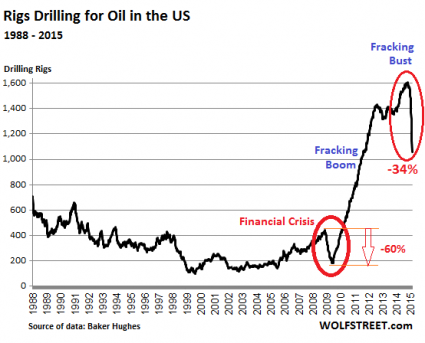
The fracking-for-oil boom started in 2005, collapsed by 60% during the Financial Crisis when money ran out, but got going in earnest after the Fed had begun spreading its newly created money around the land. From the trough in May 2009 to its peak in October 2014, rigs drilling for oil soared from 180 to 1,609: multiplied by a factor of 9 in five years! And oil production soared, to reach 9.2 million barrels a day in January.
It was a great run, but now it is over.

In the months ahead, the trickle of good paying oil industry jobs that are being lost right now is going to turn into a flood.

And this boom was funded with lots and lots of really cheap money from Wall Street.  I like how Wolf Richter described this in a recent article…
That’s what real booms look like. They’re fed by limitless low-cost money – exuberant investors that buy the riskiest IPOs, junk bonds, leveraged loans, and CLOs usually indirectly without knowing it via their bond funds, stock funds, leveraged-loan funds, by being part of a public pension system that invests in private equity firms that invest in the boom…. You get the idea.
As all of this bad paper unwinds, a lot of people are going to lose an extraordinary amount of money.

Don’t get caught with your pants down.  You will want your money to be well away from the energy industry long before this thing collapses.

And of course in so many ways what we are facing right now if very reminiscent of 2008.  So many of the same patterns that have played out just prior to previous financial crashes are happening once again.  Right now, oil rigs are shutting down at a pace that is almost unprecedented.  The only time in recent memory that we have seen anything like this was just before the financial crisis in the fall of 2008.  Here is more from Wolf Richter…
In the latest reporting week, drillers idled another 84 rigs, the second biggest weekly cut ever, after idling 83 and 94 rigs in the two prior weeks. Only 1056 rigs are still drilling for oil, down 443 for the seven reporting weeks so far this year and down 553 – or 34%! – from the peak in October. 
Never before has the rig count plunged this fast this far: 
Fracking Bust
What if the fracking bust, on a percentage basis, does what it did during the Financial Crisis when the oil rig count collapsed by 60% from peak to trough? It would take the rig count down to 642!
But even though rigs are shutting down like crazy, U.S. production of oil has continued to rise…
Rig counts have long been used to help predict future oil and gas production. In the past week drillers idled 98 rigs, marking the 10th consecutive decline. The total U.S. rig count is down 30 percent since October, an unprecedented retreat. The theory goes that when oil rigs decline, fewer wells are drilled, less new oil is discovered, and oil production slows. 
But production isn’t slowing yet. In fact, last week the U.S. pumped more crude than at any time since the 1970s. “The headline U.S. oil rig count offers little insight into the outlook for U.S. oil production growth,” Goldman Sachs analyst Damien Courvalin wrote in a Feb. 10 report.
Look, it should be obvious to anyone with even a basic knowledge of economics that the stage is being set for a massive financial meltdown.

This is just the kind of thing that can plunge us into a deflationary depression.  And when you combine this with the ongoing problems in Europe and in Asia, it is easy to see that a “perfect storm” is brewing on the horizon.

Sadly, a lot of people out there will choose not to believe until the day the crisis arrives.
By then, it will be too late to do anything about it.

Source

February 13, 2015

Goldman and JPMorgan sit safely behind the walls of Dodd-Frank

Big government may be the best thing to happen to the big banks — and they know it. Do the big-government Democrats in Washington know it, too?

“More intense regulatory and technology requirements have raised the barriers to entry higher than at any other time in modern history,” Goldman Sachs CEO Lloyd Blankfein said this week, according to the Wall Street Journal. “This is an expensive business to be in, if you don’t have the market share in scale. Consider the numerous business exits that have been announced by our peers as they reassessed their competitive positioning and relative returns.”

This was an ode to Dodd-Frank, the Wall Street Journal editorial page concluded. “Lloyd Blankfein and Elizabeth Warren find common ground,” the editorial’s online edition proclaimed.

Blankfein’s comments were probably one part spin (wooing investors), but they were also a candid admission of how the big guys benefit when government gets bigger.

Blankfein has been talking this way for a while. “We will be among the biggest beneficiaries of reform,” the CEO said on a May 2010 conference call as Dodd-Frank made its way through Congress. In the firm’s 2009 annual report, Blankfein and Goldman President Gary Cohn cheered some of Dodd-Frank’s provisions, writing: “we support measures that would require higher capital and liquidity levels, as well as the use of clearinghouses for standardized derivative transactions.”

JPMorgan CEO Jamie Dimon explained in 2013 that Dodd-Frank helped create a “bigger moat” around the megabanks. The Business Insider reported that Dimon “pointed out that while margins may come down, market share may increase due to a ‘bigger moat’” created by regulations. “In Dimon’s eyes, higher capital rules, Volcker, and [over-the-counter] derivative reforms longer-term make it more expensive and tend to make it tougher for smaller players to enter the market, effectively widening JPM’s ‘moat’.”

Dodd-Frank is indeed killing community banks, a recent study from Harvard’s Kennedy School of Government suggests. Marshall Lux of the Kennedy School found that just before and during the financial crisis, these small banks lost market share — about 6 percent total from mid-2006 through mid-2010. Then, it seems, the real threat to community banks’ emerged: Dodd-Frank. Since mid-2010, community banks have lost 12 percent of market share.

The bitter irony is that the very thing that makes community banks still valuable in an age of megabanks is the thing that makes them so vulnerable to regulation. “Community banks generally are relationship banks,” Lux writes in his study. “Their competitive advantage is a knowledge and history of their customers and a willingness to be flexible. (This is sometimes a problem, particularly in a regulatory system that reflects big bank processes, which are transactional, quantitative and dependent on standardization and mark-to-market accounting practices.)"

Regulation not only squeezes small banks, but it also heightens those “barriers to entry,” for which Blankfein is so grateful. About 100 new banks entered the economy every year between 1990 and the financial crisis in 2008, according to a December study by two members of the Federal Reserve Board. From 2009 through 2013, only about seven new banks have been formed — total.

This stagnation has persisted even as the financial sector has rebounded beautifully from the recession it caused. Banks’ shares are up 60.4 percent in the past two years, as measured by the KBW bank index — that’s 10 percent more growth than the S&P 500, which is up 53.9 percent in the same period.

The Fed members who wrote the study attribute most of the decline to market forces, not regulatory forces. But even they find that there would have been dozens of new banks every year — more than 100 in aggregate — if not for regulations keeping them out.

“There are economies of scale when dealing with regulation,” said Lux’s co-author Robert Greene.

Beyond barriers to entry, new regulation protects the giants because politics and lobbying are home games for the big guys. Goldman is famously close with Washington, and the revolving door between Goldman and its regulators is well-trafficked. More regulation typically increases the value of lobbyists and lawyers, particularly the lobbyists and lawyers who used to be lawmakers and regulators. Wauwatosa Community Bank can’t afford to hire many former members of the House Financial Services Committee.

Goldman and JPMorgan have complained about many aspects of Dodd-Frank and worked to weaken many provisions. But they realize that the policies that cramp their profits also kill their competitors. That's a win-lose for the big guys. It's a lose-lose for the economy.

Source