Richard Duncan, author of The Dollar Crisis and The New Depression: The Breakdown Of The Paper Money Economy, isn't mincing words about the risks he sees ahead for the world economy.
Essentially, he sees the past 50 years of economic prosperity fueled by globalization and easy credit in serious danger of being unwound, as the doomed monetary policies currently being pursued by the word's central banks result in a massive multi-decade depression that spans the globe.
The first version of The Dollar Crisis, the hardback, came out in 2003, so I wrote it in 2002. And at that time, the dollar against gold was $300. So the dollar has lost more than 75% of its value since The Dollar Crisis was written, and I don’t think it’s going to stop here. I expect it to continue to lose value over the years and decades ahead.
But what we’re seeing is that the real theme of The Dollar Crisis was that the post-Bretton Woods international monetary system was fundamentally flawed because it couldn’t prevent trade imbalances between countries. And the US had developed an enormous trade deficit with the rest of the world and this blew the trade surplus countries like Japan and China into bubbles. And then, the dollars boomeranged back into the United States and blew it into a bubble, as well. I didn’t know when the housing bubble was going to pop in the US but I knew it would. And I wrote in The Dollar Crisis that when it did, we would have a severe global economic recession/depression that would involve a systemic banking sector crisis in the United States and necessitate trillion-dollar budget deficits and unorthodox monetary policy to prevent a Great Depression from occurring.
Read the entire article

DAILY BUSINESS REPORT - Financial Updates, International Markets and Business News


April 3, 2015
Warren Buffett is Everything That’s Wrong With America
I think I’ve never understood the American – and international – fascination with money, with gathering wealth as the no. 1 priority in one’s life. What looks even stranger to me is the idolization of people who have a lot of money. Like these people are per definition smarter or better than others. It seems obvious that most of them are probably just more ruthless, that they have less scruples, and that their conscience is less likely to get in the way of their money and power goals.
America may idolize no-one more than Warren Buffett, the man who has propelled his fund, Berkshire Hathaway, into riches once deemed unimaginable. For most people, Buffett symbolizes what is great about American society and its economic system. For me, he’s the symbol of everything that’s going wrong.
Last week, Buffett announced a plan to merge a number of ‘food’ companies in a deal he set up with Brazilian 3G Capital. For some reason, they all have German names (I’m not sure why that is or what it means, if anything): Heinz, Kraft, Oscar Mayer. Reuters last week summed up a few of the ‘foods’ involved:
Read the entire article
America may idolize no-one more than Warren Buffett, the man who has propelled his fund, Berkshire Hathaway, into riches once deemed unimaginable. For most people, Buffett symbolizes what is great about American society and its economic system. For me, he’s the symbol of everything that’s going wrong.
Last week, Buffett announced a plan to merge a number of ‘food’ companies in a deal he set up with Brazilian 3G Capital. For some reason, they all have German names (I’m not sure why that is or what it means, if anything): Heinz, Kraft, Oscar Mayer. Reuters last week summed up a few of the ‘foods’ involved:
His move on Wednesday to inject Velveeta cheese, Jell-O, Lunchables, Oscar Mayer wieners, and Kool-Aid into his portfolio, stuffs an already amply supplied larder. The additions came from the acquisition of Kraft Foods Group Inc by H.J. Heinz Co, which is controlled by 3G Capital and Buffett’s Berkshire Hathaway. His larder already included everything from Burger King’s Triple Whopper burgers, Coca-Cola soft drinks and Tim Horton donuts to See’s Candies and Dairy Queen ice cream Blizzards, as well as such Heinz brands as Tomato Ketchup, Ore-Ida fries, bagel bites and T.G.I. Friday’s mozzarella sticks.Isn’t it curious to see that once people have more than enough to eat, they sort of make up for that by drastically lowering the quality of their food, like there’s some sort of balance that needs to be found? Give them more than plenty, and they’ll start using it to poison themselves.
Read the entire article
April 2, 2015
What Happens After A Mega Corporation Raises Its Workers' Wages
Earlier today, McDonalds announced that it would become the latest company to raise hourly pay for 90,000 workers by more than 10% and add benefits such as paid vacation for its restaurant workers. Specifically, starting in July, MCD will pay at least $1 per hour more than the local legal minimum wage for employees at the roughly 1,500 restaurants it owns in the U.S. The increase will lift the average hourly rate for its U.S. restaurant employees to $9.90 on July 1 and more than $10 by the end of 2016, from $9.01 currently. Finally, McDonald’s also will enable workers after a year of employment to accrue up to five days of paid time-off annually.
With this announcement, McDonalds joins the following companies which have likewise raised minimum wages in recent months:
As the following WSJ story released overnight, here is what happens when mega-corporations such as WalMart and McDonalds, whose specialty are commoditized products and services and have razor thin margins, yet which try to give an appearance of doing the right thing, raise minimum wages. They start flexing their muscles, and in the process trample all over the companies that comprise their own cost overhead: their suppliers and vendors.
Take the case of WalMart: the world's biggest retailer "is increasing the pressure on suppliers to cut the cost of their products, in an effort to regain the mantle of low-price leader and turn around its sluggish U.S. sales."
Read the entire article
With this announcement, McDonalds joins the following companies which have likewise raised minimum wages in recent months:
- WalMart
- Aetna
- Gap
- Ikea
- Target
- TJ Maxx
As the following WSJ story released overnight, here is what happens when mega-corporations such as WalMart and McDonalds, whose specialty are commoditized products and services and have razor thin margins, yet which try to give an appearance of doing the right thing, raise minimum wages. They start flexing their muscles, and in the process trample all over the companies that comprise their own cost overhead: their suppliers and vendors.
Take the case of WalMart: the world's biggest retailer "is increasing the pressure on suppliers to cut the cost of their products, in an effort to regain the mantle of low-price leader and turn around its sluggish U.S. sales."
Read the entire article
April 1, 2015
The Stock Market In 2015 Is Starting To Look Remarkably Similar To The Stock Market In 2008
Are we watching a replay of the last financial crisis? Over the past six months, the price of oil has collapsed, the U.S. dollar has soared, and a whole bunch of other patterns that we witnessed just before the stock market crash of 2008 are repeating once again. But what we have not seen yet is the actual stock market crash. So will there be one this year? In this article, I am going to compare the performance of the Dow Jones Industrial Average during the first three months of 2008 to the performance of the Dow Jones Industrial Average during the first three months of 2015. As you will see, there are some striking similarities. And without a doubt, we are overdue for a major market downturn. The S&P 500 has risen for six years in a row, but it has never had seven up years consecutively. In addition, there has not even been a 10 percent stock market “correction” is almost three and a half years. So will stocks be able to continue to defy both gravity and the forces of economic reality? Only time will tell.
Below is a chart that shows how the Dow Jones Industrial Average performed during the first three months of 2008. It was a time of increased volatility, but the market pretty much went nowhere. This is typical of what we see in the months leading up to a market crash. The markets start getting really choppy with large ups and large downs…
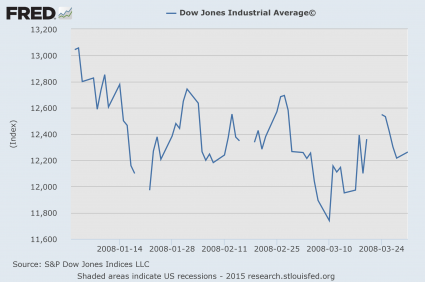
Below is a chart that shows how the Dow Jones Industrial Average performed during the first three months of 2008. It was a time of increased volatility, but the market pretty much went nowhere. This is typical of what we see in the months leading up to a market crash. The markets start getting really choppy with large ups and large downs…
March 31, 2015
Japan "Wakes Up," Joins China-led Development Bank (And Then Backs Out)
It’s official: the US is on its own when it comes to opposing the China-led Asian Infrastructure Investment Bank (see here for full summary of AIIB developments). We suppose it was only a matter of time, but news that Japan will seek membership in a matter of months will likely still come as somewhat of a surprise to Washington, given the otherwise tenuous relationship between the two countries and considering Japan’s leadership role in the ADB. Nevertheless, the Japanese have apparently come to the same conclusion as Australia and South Korea: not joining simply isn’t an option no matter how loudly the US protests. Here’s more from FT:
Read the entire articleJapan is likely to join the Asian Infrastructure Investment Bank within a few months, according to the country’s ambassador to Beijing, a move that would see Tokyo break ranks with Washington and leave the US as the only big holdout.
Masato Kitera told the Financial Times he agreed with Japanese business leaders’ belief that the country would sign up to the China-led development bank by June.
“The business community woke up late, but now they have mounted a big campaign for the AIIB which appears to be very effective,” Mr Kitera said…
A Japanese move to join the bank would be a reversal of rhetoric and, for China, the biggest coup yet given the fractious relationship between the two Asian powers.
Japan also has strong links to the rival Asian Development Bank, the head of which it traditionally appoints, and has in the past questioned the need for a new bank...
No country was seen to be as supportive of the US position as Japan — in part because many officials in both countries saw the AIIB as a direct challenge to the Japanese-controlled Asian Development Bank.
But Japanese executives look on China’s ambitious plans to help build infrastructure in the region as a huge business opportunity, as well as a chance to help repair frayed relations.
March 30, 2015
Central Banks Warn: Investors May Get Crushed When They All Run for the Exits
Companies are selling bonds like madmen. This year through Tuesday, investment-grade and junk-rated companies have sold $438 billion in new bonds, up 14% from the prior record for this time of the year, set in 2013, according to Dealogic. This quarter is already in second place, nudging up against the all-time quarterly record of $455 billion of Q2 2014.
About $87 billion of these bonds funded takeovers, a record for this time of the year, the Wall Street Journal reported. The four biggest bond sales in that batch were for healthcare takeovers, including the Actavis deal whose $21 billion bond sale was the second largest in history, behind Verizon’s $49 billion bond sale in 2013.
Actavis had received orders for more than four times the bonds available, according to CFO Tessa Hilado. “You don’t really know what the demand is until people start placing their orders,” she said. “I would say we were pleasantly surprised.”
Brandon Swensen, co-head of U.S. fixed income at RBC Global Asset Management, couldn’t “see anything on the radar that’s going to slow things down materially,” he told the Wall Street Journal. His firm expects rates to “remain low.”
All of the investors chasing after these bonds expect rates to remain low. Or else they wouldn’t chase after these bonds. If rates rise, as the Fed is promising in its convoluted cacophonous manner, these bonds that asset managers are devouring at super-high prices and minuscule yields are going to be bad deals. And their bond funds are going to take a bath.
Read the entire article
March 27, 2015
Matt Taibbi Takes Up SEC’s Andrew Bowden Regulatory Capture Scandal
Matt Taibbi has written a characteristically informative, incisive piece about the embarrassing spectacle of the SEC’s Director of Compliance Inspections and Examinations, Andrew Bowden, making sycophantic remarks about the private equity industry at a recent conference, a story we broke early last week. It’s bad enough to see a regulator so besotted by firms he oversees; it’s even worse in light of statements Bowden made less than a year ago the widespread fraud and misconduct he said his examiners were finding. As we wrote in our original post:
Bowden stated that the SEC had found “violations of law or material compliance failures” in more than half the firms examined. Let’s not put too fine a point on this: the SEC said that most firms were stealing from investors, either by accident or design. Bowden confirmed that view, later telling the New York Times’ Gretchen Morgenson that “investors’ pockets are being picked.”In case you have yet to see it, contrast that view of the industry with Bowden’s take a mere ten months later:
March 26, 2015
How Wall Street Used Swaps to Get Rich at the Expense of Cities
A recent report by Saqib Bhatti of the Roosevelt Institute describes a number of financial deals between Wall Street and municipalities as predatory. Bhatti asserts that these dirty transactions have forced cities and states to cut essential services to pay off the financial sector. On Tuesday, Bhatti’s ReFund America project issued a new report specifically directed at the financial problems of Chicago and calling on the city to fight back in the courts and elsewhere against these deals.
One of the main problems arises from the use of interest rate swaps to create synthetic fixed rate municipal bonds. You’ll get great rates, cities were told, and these interest rate swaps will protect you against interest rate hikes. Risks were downplayed, if they were mentioned at all. The chief of these is the risk of downgrades in credit rating. In those cases, the swap could be cancelled, inflicting massive termination penalties on the city. Other risks include the inability to refinance into a lower interest rate, because the swap runs for a very long term, and payments would eat up any gains. Bhatti says the City of Oakland refinanced one of its bonds, and continues to pay for the swap; he says it’s “like paying for insurance on a car that was sold years ago”.
Another trap was the pension obligation bond. The idea is to borrow the money needed to make up a shortfall in pension payments, with the idea that the pension plan would invest the funds at a higher rate of return than the bond after expenses.
A third trap was Auction Rate Securities. These are short-term securities that have to roll over every month or two. If an investor in ARS wants out, but the city can’t roll the ARS over, the city is stuck with huge interest rate bills. This happened to the Port Authority of New York and New Jersey, which saw interest rates jump from 4.3% to 20% in one week.
Read the entire article
March 25, 2015
ABCs of the Coming Credit Crunch?
Dominant Social Theme: Markets go up and down. Not to worry.
Free-Market Analysis: This is a good analysis of what could go wrong with world markets (especially Western and US ones) and why ... It touches on a number of memes: Sort through them to better understand what's taking place, or what could take place – and could not.
More:
Maybe it's too quiet. Last week, Ray Dalio, the founder of the $165bn (£110bn) hedge fund Bridgewater Associates, wrote a widely-circulated note warning his clients that the US Federal Reserve risked setting off a 1937-style crash when it starts raising interest rates again.
Dalio provides us with a grim forecast here, and also offers us a question. Can even a modest rate increase destabilize markets worldwide? Are they that fragile? And what about vaunted central bank interference in the marketplace, not to mention the "plunge protection team"?
With all the buying power at its disposal, does not the Fed along with other central banks have the wherewithal to conquer any sudden downturn at least in the short term?
Read the entire article
March 24, 2015
They Are Slowly Making Cash Illegal
The move to a cashless society won’t happen overnight. Instead, it is being implemented very slowly and systematically in a series of incremental steps. All over the planet, governments are starting to place restrictions on the use of cash for security reasons. As citizens, we are being told that this is being done to thwart criminals, terrorists, drug runners, money launderers and tax evaders. Other forms of payment are much easier for governments to track, and so they very much prefer them. But we are rapidly getting to the point where the use of cash is considered to be a “suspicious activity” all by itself. These days, if you pay a hotel bill with cash or if you pay for several hundred dollars worth of goods at a store with cash you are probably going to get looked at funny. You see, the truth is that we have already been trained to regard the use of large amounts of cash to be unusual. The next step will be to formally ban large cash transactions like France and other countries in Europe are already doing.
Starting in September, cash transactions of more than 1,000 euros will be banned in France. The following comes from a recent Zero Hedge article which detailed what these new restrictions will do…
Read the entire article
Starting in September, cash transactions of more than 1,000 euros will be banned in France. The following comes from a recent Zero Hedge article which detailed what these new restrictions will do…
Read the entire article
March 23, 2015
Washington Blinks: Will Seek Partnership With China-Led Development Bank
Don’t look now, but Washington just blinked. As we’ve documented exhaustively over the past week, pressure has been building steadily for the US to strike some manner of conciliatory tone towards China with regard to the Asian Infrastructure Investment Bank, a China-led institution aimed at rivaling the US/Japan-backed ADB. Britain’s decision to join China in its new endeavor has prompted a number of Western nations to throw their support behind the bank ahead of the March 31 deadline for membership application. Because the AIIB effectively represents the beginning of the end for US hegemony, the White House has demeaned the effort from its inception questioning the ability of non-G-7 nations to create an institution that can be trusted to operation in accordance with the proper “standards.” Now, with 35 nations set to join as founders, it appears Washington may be set to concede defeat. Here’s more, via WSJ:
Read the entire articleThe Obama administration, facing defiance by allies that have signed up to support a new Chinese-led infrastructure fund, is proposing the bank work in a partnership with Washington-backed development institutions such as the World Bank.
The collaborative approach is designed to steer the new bank toward economic aims of the world’s leading economies and away from becoming an instrument of Beijing’s foreign policy. The bank’s potential to promote new alliances and sidestep existing institutions has been one of the Obama administration’s chief concerns as key allies including the U.K., Germany and France lined up in recent days to become founding members of the new Asian Infrastructure Investment Bank.
The Obama administration wants to use existing development banks to co-finance projects with Beijing’s new organization. Indirect support would help the U.S. address another long-standing goal: ensuring the new institution’s standards are designed to prevent unhealthy debt buildups, human-rights abuses and environmental risks. U.S. support could also pave the way for American companies to bid on the new bank’s projects.
“The U.S. would welcome new multilateral institutions that strengthen the international financial architecture,” said Nathan Sheets, U.S. Treasury Under Secretary for International Affairs. “Co-financing projects with existing institutions like the World Bank or the Asian Development Bank will help ensure that high quality, time-tested standards are maintained.”
March 20, 2015
Investors Crushed as US Natural Gas Drillers Blow Up
The Fed speaks, the dollar crashes. The dollar was ripe. The entire world had been bullish on it. Down nearly 3% against the euro, before recovering some. The biggest drop since March 2009. Everything else jumped. Stocks, Treasuries, gold, even oil.
West Texas Intermediate had been experiencing its biggest weekly plunge since January, trading at just above $42 a barrel, a new low in the current oil bust. When the Fed released its magic words, WTI soared to $45.34 a barrel before re-sagging some. Even natural gas rose 1.8%. Energy related bonds had been drowning in red ink; they too rose when oil roared higher. It was one heck of a party.
But it was too late for some players mired in the oil and gas bust where the series of Chapter 11 bankruptcy filings continues. Next in line was Quicksilver Resources.
It had focused on producing natural gas. Natural gas was where the fracking boom got started. Fracking has a special characteristic. After a well is fracked, it produces a terrific surge of hydrocarbons during first few months, and particularly on the first day. Many drillers used the first-day production numbers, which some of them enhanced in various ways, in their investor materials. Investors drooled and threw more money at these companies that then drilled this money into the ground.
But the impressive initial production soon declines sharply. Two years later, only a fraction is coming out of the ground. So these companies had to drill more just to cover up the decline rates, and in order to drill more, they needed to borrow more money, and it triggered a junk-rated energy boom on Wall Street.
At the time, the price of natural gas was soaring. It hit $13 per million Btu at the Henry Hub in June 2008. About 1,600 rigs were drilling for gas. It was the game in town. And Wall Street firms were greasing it with other people’s money. Production soared. And the US became the largest gas producer in the world.
But then the price began to plunge. It recovered a little after the Financial Crisis but re-plunged during the gas “glut.” By April 2012, natural gas had crashed 85% from June 2008, to $1.92/mmBtu. With the exception of a few short periods, it has remained below $4/mmBtu – trading at $2.91/mmBtu today.
Throughout, gas drillers had to go back to Wall Street to borrow more money to feed the fracking orgy. They were cash-flow negative. They lost money on wells that produced mostly dry gas. Yet they kept up the charade. They aced investor presentations with fancy charts. They raved about new technologies that were performing miracles and bringing down costs. The theme was that they would make their investors rich at these gas prices.
Read the entire article
March 19, 2015
Real Reason for the Asian Investment Bank – and Western Participation
Dominant Social Theme: Asia will show the West how to run an investment bank.
Free-Market Analysis: High finance and international politics are subtle affairs.
On its surface, the effort to create an Asian-oriented "world bank" is straightforward. But beneath the surface, currents swirl. The putative reason for such a bank is that the current World Bank is often exploitative and takes advantage of countries in trouble. A second reason is that the advantages of a World Bank will now accrue to Asian members. Their influence and monetary power will expand accordingly.
But the third reason is the most interesting of all. A little more from the article, first:
The concerted move to participate in Beijing's flagship economic outreach project was a diplomatic blow to the United States, reflecting European eagerness to partner with China's fast-growing economy, the world's second largest.
It comes amid prickly trade negotiations between Brussels and Washington, and at a time when EU and Asian governments are frustrated that the U.S. Congress has held up a reform of voting rights in the International Monetary Fund due to give China and other emerging powers more say in global economic governance.
German Finance Minister Wolfgang Schaeuble made the announcement at a joint news conference with visiting Chinese Vice Premier Ma Kai, at which no questions were allowed. He said Germany, Europe's biggest economy and a major trade partner of Beijing, would be a founding member of the Asian Infrastructure Investment Bank.
Read the entire article
March 18, 2015
Nomi Prins: The Volatility/Quantitative Easing Dance of Doom
The battle between the ‘haves’ and ‘have-nots’ of global financial policy is escalating to the point where the ‘haves’ might start to sweat – a tiny little. This phase of heightened volatility in the markets is a harbinger of the inevitable meltdown that will follow the grand plastering-over of a systemically fraudulent global financial system. It’s like a sputtering gas tank signaling an approach to ‘empty’.
Obscene amounts of central bank liquidity applauded by government leaders that have protected the political-financial establishment with failed oversight and lack of foresight, have coalesced to form one of the most unequal, unstable economic environments in modern history. The ongoing availability of cheap capital for big bank solvency, growth and leverage purposes, as well as stock and bond market propulsion has fostered a false sense of economic security that bares little resemblance to most personal realities.
We are entering the seventh year of US initiated zero-interest-rate policy. Biblically, Joseph only gathered wheat for seven years before seven years of famine. Quantitative easing, or central bank bond buying from banks and the governments that sustain them, has enjoyed its longest period of existence ever. If these policies were about fortifying economic conditions from the ground up, fostering equality as a force for future stability, they would have worked by now. We would have moved on from them sooner.
But they aren’t. Never were. Never will be. They were designed to aid big banks and capital markets, to provide cover to feeble leadership. They are policies of capital creation, dispersion and global reallocation. The markets have acted accordingly.
What began with the US Federal Reserve became a global phenomenon of subsidizing the financial system and its largest players. Most real people – that don’t run hedge funds or big banks or leverage other peoples’ money in esoteric derivatives trades – have their own meager fortunes at risk. They don’t have the power of ECB head, Mario Draghi to issue the ‘buy’ order from atop the ECB mountain. Nor do they reap the benefits.
Retail sales are down because people have no extra money and can’t take on excess debt through credit cards forever. They aren’t governments or central banks that can print when they want to, or big private banks that can summon such assistance at will.
March 16, 2015
The US Oil Bust Just Got Worse
The price of oil did today what it has been doing for a while: it waits for a trigger and plunges. As I’m writing this, West Texas Intermediate is down 4.4%, trading at $44.99 a barrel, less than a measly buck away from this oil bust’s January low. It’s down over 20% from the peak of the most recent sucker rally.
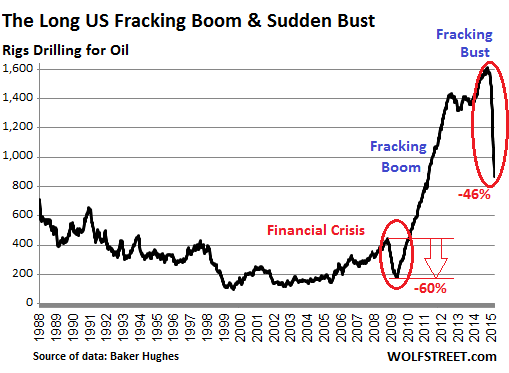
US oil drillers have been responding by slashing capital expenditures, including drilling, in a deceptively brutal manner. In the latest week, drillers idled 56 rigs that were classified as drilling for oil, according to Baker Hughes. Only 866 rigs were still active, down 46.2% from October, when they’d peaked at 1,609. In the 22 weeks since, drillers have taken out 743 rigs, the most dizzying cliff dive in the data series, and probably in history:
Read the entire article
Subscribe to:
Posts (Atom)