The TPP covers a bewildering range of topics. In addition to conventional trade issues like tariff rates, it includes language on labor rights, environmental laws, copyright and patent protections, e-commerce, state-owned enterprises, corruption, and government procurement.
Trade deals like the TPP have grown so complex because the global trade community has figured out how to solve a problem that has bedeviled philosophers and political leaders for centuries: how to craft international agreements with teeth. The WTO's dispute-settlement process, which serves as a model for the TPP, puts pressure on countries to actually keep the promises they make in trade deals. That's why everyone with an agenda — wealthy investors, drug companies, labor unions, environmental groups, and so on — is scrambling to get on the bandwagon.
But the complex, secretive, and anti-democratic way the TPP is being crafted rubs a lot of people the wrong way. The agreement will have profound and long-lasting effects on countries that sign on, yet voters in those countries won't even be allowed to see the text until negotiations are over and it's too late to make changes. No wonder so many groups — the AFL-CIO, civil liberties groups like the Electronic Frontier Foundation, and even the free traders at the Cato Institute — have been raising concerns about it. – Vox.com, April 17, 2015
Read the entire article

DAILY BUSINESS REPORT - Financial Updates, International Markets and Business News
April 21, 2015


April 20, 2015
How the Federal Reserve Is Destroying Your Economic Future
When it comes to what goes on in the marble corridors of the Federal Reserve, Americans tend to be suspicious. For different reasons, both the right and the left have challenged Fed policies aimed at bolstering the economy in the wake of the Great Recession. In two papers for the Institute of New Economic Thinking’s Working Group on the Political Economy of Distribution, “Have Large Scale Asset Purchases Increased Bank Profits?” and the forthcoming “The Impact of ‘Quantitative Easing’ on Expected Profits: Explaining the Rise and Fall of the Fed’s QE Policy,” economist Gerald Epstein and his colleague Juan Antonio Montecino sought to find out who in the economy tends to benefit from the Fed’s actions. They conclude that Wall Street and wealthy Americans are the big winners from policies like quantitative easing, while the rest see little improvement in their economic lives. End result? Inequality is getting worse.
Lynn Parramore: Complaining about the Fed is something of a national pastime. What is it about this institution that attracts so much criticism?
Gerald Epstein: People in America get really angry at the Federal Reserve and at the “money system” in general during economic crises. The Fed draws hostility because of its power, its insulation from democratic accountability, its lack of transparency, and because of its historical and structural connections to finance. It has a lot of power in the economy because it has a big impact on the supply and cost of credit, that is, interest rates. It also plays a key role in supervising banks and historically has seemed to take it easy on the banks when it shouldn’t have, such as in the lead up to the financial crisis. Bankers themselves govern the Fed to some extent, and then there’s the classic revolving door where Fed officials come from and then go back to the financial sector. Fed officials tend to believe that the institution should have a large measure of independence from democratic control, even though in law it is under the ostensible control of Congress.
So critics, often for good reason, are concerned that the Fed is wielding its vast powers in the interests of the banks and not in the interests of the people. After the financial crisis, Americans have perceived that the banks have been bailed out, but a significant proportion of the population is still in serious economic trouble.
LP: Many libertarians want to audit the Fed or just plain end it, while conservatives like Rick Perry label the Fed’s actions treasonous. On the other side of the political spectrum, members of the Occupy Movement and progressives like Bernie Sanders and Elizabeth Warren challenge the Fed’s ties to Wall Street. How do people with such vastly different ideologies end up distrusting the Fed?
Read the entire article
Lynn Parramore: Complaining about the Fed is something of a national pastime. What is it about this institution that attracts so much criticism?
Gerald Epstein: People in America get really angry at the Federal Reserve and at the “money system” in general during economic crises. The Fed draws hostility because of its power, its insulation from democratic accountability, its lack of transparency, and because of its historical and structural connections to finance. It has a lot of power in the economy because it has a big impact on the supply and cost of credit, that is, interest rates. It also plays a key role in supervising banks and historically has seemed to take it easy on the banks when it shouldn’t have, such as in the lead up to the financial crisis. Bankers themselves govern the Fed to some extent, and then there’s the classic revolving door where Fed officials come from and then go back to the financial sector. Fed officials tend to believe that the institution should have a large measure of independence from democratic control, even though in law it is under the ostensible control of Congress.
So critics, often for good reason, are concerned that the Fed is wielding its vast powers in the interests of the banks and not in the interests of the people. After the financial crisis, Americans have perceived that the banks have been bailed out, but a significant proportion of the population is still in serious economic trouble.
LP: Many libertarians want to audit the Fed or just plain end it, while conservatives like Rick Perry label the Fed’s actions treasonous. On the other side of the political spectrum, members of the Occupy Movement and progressives like Bernie Sanders and Elizabeth Warren challenge the Fed’s ties to Wall Street. How do people with such vastly different ideologies end up distrusting the Fed?
Read the entire article
April 17, 2015
How Pending “Trade” Deals Would Undermine Zoning and Local Land Use Rules
A key principle of land use in the United States is that homeowners can often veto new buildings on nearby land that other people own. A trade agreement that’s currently in the works could have a huge impact on that long-established system of local control.
The Trans Pacific Partnership (TPP) is a trade pact that would change the rules for investments and trade among its signers. It’s currently in behind-closed-doors negotiation among 12 countries, including the United States, Australia, Canada, Japan, Mexico, and Singapore. Other countries could join later.
A recently leaked draft of the TPP gives investors from member nations the right to sue when a decision by a local government “interferes with distinct, reasonable investment-backed expectations.”
Panels of private lawyers chosen by the investors and the federal government will meet to decide the suits. If the investors win, the federal government must reimburse them for the loss of future profits.
Critics of the TPP argue that it could gut environmental and health regulation. They point to the past history of trade agreements to back up that concern. The TPP’s backers, on the other hand, assert that the treaty only bans arbitrary or discriminatory actions.
No matter who turns out to be right about that, the pact is likely to undermine local oversight of land use.
The TPP Goes Against the Spirit of American Land Use Law
Read the entire article
The Trans Pacific Partnership (TPP) is a trade pact that would change the rules for investments and trade among its signers. It’s currently in behind-closed-doors negotiation among 12 countries, including the United States, Australia, Canada, Japan, Mexico, and Singapore. Other countries could join later.
A recently leaked draft of the TPP gives investors from member nations the right to sue when a decision by a local government “interferes with distinct, reasonable investment-backed expectations.”
Panels of private lawyers chosen by the investors and the federal government will meet to decide the suits. If the investors win, the federal government must reimburse them for the loss of future profits.
Critics of the TPP argue that it could gut environmental and health regulation. They point to the past history of trade agreements to back up that concern. The TPP’s backers, on the other hand, assert that the treaty only bans arbitrary or discriminatory actions.
No matter who turns out to be right about that, the pact is likely to undermine local oversight of land use.
The TPP Goes Against the Spirit of American Land Use Law
Read the entire article
April 16, 2015
The Collapse Of The Petrodollar: Oil Exporters Are Dumping US Assets At A Record Pace
Back in November we chronicled the (quiet) death of the Petrodollar, the system that has buttressed USD hegemony for decades by ensuring that oil producers recycled their dollar proceeds into still more USD assets creating a very convenient (if your printing press mints dollars) self-fulfilling prophecy that has effectively underwritten the dollar’s reserve status in the post WWII era. Here’s what we said last year:

Two years ago, in hushed tones at first, then ever louder, the financial world began discussing that which shall never be discussed in polite company - the end of the system that according to many has framed and facilitated the US Dollar's reserve currency status: the Petrodollar, or the world in which oil export countries would recycle the dollars they received in exchange for their oil exports, by purchasing more USD-denominated assets, boosting the financial strength of the reserve currency, leading to even higher asset prices and even more USD-denominated purchases, and so forth, in a virtuous (especially if one held US-denominated assets and printed US currency) loop...
Few would have believed that the Petrodollar did indeed quietly die, although ironically, without much input from either Russia or China, and paradoxically, mostly as a result of the actions of none other than the Fed itself, with its strong dollar policy, and to a lesser extent Saudi Arabia too, which by glutting the world with crude, first intended to crush Putin, and subsequently, to take out the US crude cost-curve, may have Plaxico'ed both itself, and its closest Petrodollar trading partner, the US of A.
As Reuters reports, for the first time in almost two decades, energy-exporting countries are set to pull their "petrodollars" out of world markets this year.
April 15, 2015
OPEC Going Broke, Dumping Dollars. Is That Good Or Bad?
When oil prices fell out of bed last winter there was much hand-wringing over the fate of the former beneficiaries of high-priced crude. Trillions of dollars of junk bonds issued by frackers, for instance, might default, oil field services companies could fail, and layoffs in the oil patch might swamp the nascent employment recovery.
Some of this has happened, though not on the apocalyptic scale the worst-case scenarios suggested. More might be coming, but right now it’s not headline news in North America.
For OPEC, however, the sudden 50% diminution in export revenue is a clear and present danger, and the response is noteworthy:
Oil-Rich Nations Are Selling Off Their Petrodollar Assets at Record Pace
Now that oil prices have dropped by half to $50 a barrel, Saudi Arabia and other commodity-rich nations are fast drawing down those “petrodollar” reserves.
In the heady days of the commodity boom, oil-rich nations accumulated billions of dollars in reserves they invested in U.S. debt and other securities. They also occasionally bought trophy assets, such as Manhattan skyscrapers, luxury homes in London or Paris Saint-Germain Football Club.
Now that oil prices have dropped by half to $50 a barrel, Saudi Arabia and other commodity-rich nations are fast drawing down those “petrodollar” reserves. Some nations, such as Angola, are burning through their savings at a record pace, removing a source of liquidity from global markets.
Read the entire article
Some of this has happened, though not on the apocalyptic scale the worst-case scenarios suggested. More might be coming, but right now it’s not headline news in North America.
For OPEC, however, the sudden 50% diminution in export revenue is a clear and present danger, and the response is noteworthy:
Oil-Rich Nations Are Selling Off Their Petrodollar Assets at Record Pace
Now that oil prices have dropped by half to $50 a barrel, Saudi Arabia and other commodity-rich nations are fast drawing down those “petrodollar” reserves.
Now that oil prices have dropped by half to $50 a barrel, Saudi Arabia and other commodity-rich nations are fast drawing down those “petrodollar” reserves. Some nations, such as Angola, are burning through their savings at a record pace, removing a source of liquidity from global markets.
Read the entire article
April 14, 2015
The Six Too Big To Fail Banks In The U.S. Have 278 TRILLION Dollars Of Exposure To Derivatives
The very same people that caused the last economic crisis have created a 278 TRILLION dollar derivatives time bomb that could go off at any moment. When this absolutely colossal bubble does implode, we are going to be faced with the worst economic crash in the history of the United States. During the last financial crisis, our politicians promised us that they would make sure that “too big to fail” would never be a problem again. Instead, as you will see below, those banks have actually gotten far larger since then. So now we really can’t afford for them to fail. The six banks that I am talking about are JPMorgan Chase, Citibank, Goldman Sachs, Bank of America, Morgan Stanley and Wells Fargo. When you add up all of their exposure to derivatives, it comes to a grand total of more than 278 trillion dollars. But when you add up all of the assets of all six banks combined, it only comes to a grand total of about 9.8 trillion dollars. In other words, these “too big to fail” banks have exposure to derivatives that is more than 28 times greater than their total assets. This is complete and utter insanity, and yet nobody seems too alarmed about it. For the moment, those banks are still making lots of money and funding the campaigns of our most prominent politicians. Right now there is no incentive for them to stop their incredibly reckless gambling so they are just going to keep on doing it.
So precisely what are “derivatives”? Well, they can be immensely complicated, but I like to simplify things. On a very basic level, a “derivative” is not an investment in anything. When you buy a stock, you are purchasing an ownership interest in a company. When you buy a bond, you are purchasing the debt of a company. But a derivative is quite different. In essence, most derivatives are simply bets about what will or will not happen in the future. The big banks have transformed Wall Street into the biggest casino in the history of the planet, and when things are running smoothly they usually make a whole lot of money.
But there is a fundamental flaw in the system, and I described this in a previous article…
Read the entire article
So precisely what are “derivatives”? Well, they can be immensely complicated, but I like to simplify things. On a very basic level, a “derivative” is not an investment in anything. When you buy a stock, you are purchasing an ownership interest in a company. When you buy a bond, you are purchasing the debt of a company. But a derivative is quite different. In essence, most derivatives are simply bets about what will or will not happen in the future. The big banks have transformed Wall Street into the biggest casino in the history of the planet, and when things are running smoothly they usually make a whole lot of money.
But there is a fundamental flaw in the system, and I described this in a previous article…
Read the entire article
April 13, 2015
California Urban Water Use Restricted While Regulators Give Oil Industry Two More Years To Operate Injection Wells In Protected Groundwater Aquifers
With snowpack levels at just 6% of their long-term average, the lowest they’ve ever been in recorded history, California Governor Jerry Brown has announced new regulations to cut urban water use 25%, the first ever mandatory water restrictions in the state.
California is in the fifth year of its historic, climate-exacerbated drought and, per a recent analysis by a senior water scientist at NASA, has only one year of water left in its reservoirs, while groundwater levels are at an all-time low.
The Golden State’s towns and cities only account for about 20% of all water used for human purposes, however (including residential, institutional, industrial and commercial uses). Agriculture uses the other 80%.
Half of the produce grown in America comes from California, yet 2015 is likely to be the second year in a row that California’s farmers get no water allocation from state reservoirs. In some parts of the state, agricultural operations have pumped so much groundwater that the land is starting to sink.
Governor Brown’s executive order has been criticized for not including restrictions on groundwater pumping by agricultural operations, but Brown defended the decision, saying that hundreds of thousands of acres of land were already lying fallow because of the state’s water crisis.
There’s another industry conspicuously exempt from California’s new water restrictions, though. “Fracking and toxic injection wells may not be the largest uses of water in California, but they are undoubtedly some of the stupidest,” Zack Malitz of the environmental group Credo says, according to Reuters.
Read the entire article
California is in the fifth year of its historic, climate-exacerbated drought and, per a recent analysis by a senior water scientist at NASA, has only one year of water left in its reservoirs, while groundwater levels are at an all-time low.
The Golden State’s towns and cities only account for about 20% of all water used for human purposes, however (including residential, institutional, industrial and commercial uses). Agriculture uses the other 80%.
Half of the produce grown in America comes from California, yet 2015 is likely to be the second year in a row that California’s farmers get no water allocation from state reservoirs. In some parts of the state, agricultural operations have pumped so much groundwater that the land is starting to sink.
Governor Brown’s executive order has been criticized for not including restrictions on groundwater pumping by agricultural operations, but Brown defended the decision, saying that hundreds of thousands of acres of land were already lying fallow because of the state’s water crisis.
There’s another industry conspicuously exempt from California’s new water restrictions, though. “Fracking and toxic injection wells may not be the largest uses of water in California, but they are undoubtedly some of the stupidest,” Zack Malitz of the environmental group Credo says, according to Reuters.
Read the entire article
April 10, 2015
Why The BRICs Are Less Worried About The Next Crash
When even Jamie Dimon warns that "another crisis is coming", and points to the utter lack of market liquidity and the likelihood of another flash crash, it probably means that not only has he been reading this website, but that JPM's chief prop trading group, the Chief Investment Office, infamously long three years ago is already short and just waiting for the bottom to fall out of the market. One group, however, that is not be too worried about the next global financial crash - at least superficially - are the BRICs, because according to the Russian Prime Minister Dmitry Medvedev, "the creation of the BRICS reserve currencies pool worth $100 billion will allow member states to depend less on negative processes in the world economy and bypass market volatility."
"Along with the launch of the New Development Bank, it is one of the most important initiatives for countries entering into this association. The agreement establishing a pool of reserve currencies was signed last summer," said Medvedev at a government meeting Thursday.
"Each of the BRICS members may apply to any party to the treaty for loan,” Medvedev said, adding that key decisions will be taken by the Governing Council, which consists of either finance ministers or central bank governors. Russia will be represented by the head of the Central Bank of Russia Elvira Nabiullina.
"I hope [the agreement on establishing the pool] will not only strengthen our economic cooperation, but also provide the participants of the ‘five’ more independence from the current international financial situation and the problems existing in the international financial institutions," he said adding that it’s one of the most significant practical initiatives of BRICS.
Of course, stating that $100 billion (not USD denominated of course) in equity is a buffer against market or economic shocks in a world in which there is $600 trillion in notional derivatives, and which are one failed counterparty away from confirming (again, the first time being Lehman's bankruptcy) that net is indeed gross in a collateral chain that is only as strong as its weakest link, is supremely naive especially since the BRICs themselves are loaded to the gills with trillions in USD-denominated debt.
Unless, of course, what the Russian PM is suggesting is that the currency pool will provide the "fresh start" equity in a new, post-dollar world, in which any debt denominated in dollars is nullified once the crisis strikes. Of course, for that to happen, it would mean that the USD is no longer the world's reserve currency. Which is, of course, the unspoken message here (and one which would promptly explain China's ravenous gold buying in recent years).
On Wednesday the Government Commission on legislative activities approved the bill on the ratification of the agreement to establish the BRICS reserve currencies pool. The ratification of this agreement will help Russia advance its monetary cooperation strategy, particularly in the development of privileged relations with its partners from BRICS, said the Russian government.
Source
"Along with the launch of the New Development Bank, it is one of the most important initiatives for countries entering into this association. The agreement establishing a pool of reserve currencies was signed last summer," said Medvedev at a government meeting Thursday.
"Each of the BRICS members may apply to any party to the treaty for loan,” Medvedev said, adding that key decisions will be taken by the Governing Council, which consists of either finance ministers or central bank governors. Russia will be represented by the head of the Central Bank of Russia Elvira Nabiullina.
"I hope [the agreement on establishing the pool] will not only strengthen our economic cooperation, but also provide the participants of the ‘five’ more independence from the current international financial situation and the problems existing in the international financial institutions," he said adding that it’s one of the most significant practical initiatives of BRICS.
Of course, stating that $100 billion (not USD denominated of course) in equity is a buffer against market or economic shocks in a world in which there is $600 trillion in notional derivatives, and which are one failed counterparty away from confirming (again, the first time being Lehman's bankruptcy) that net is indeed gross in a collateral chain that is only as strong as its weakest link, is supremely naive especially since the BRICs themselves are loaded to the gills with trillions in USD-denominated debt.
Unless, of course, what the Russian PM is suggesting is that the currency pool will provide the "fresh start" equity in a new, post-dollar world, in which any debt denominated in dollars is nullified once the crisis strikes. Of course, for that to happen, it would mean that the USD is no longer the world's reserve currency. Which is, of course, the unspoken message here (and one which would promptly explain China's ravenous gold buying in recent years).
On Wednesday the Government Commission on legislative activities approved the bill on the ratification of the agreement to establish the BRICS reserve currencies pool. The ratification of this agreement will help Russia advance its monetary cooperation strategy, particularly in the development of privileged relations with its partners from BRICS, said the Russian government.
Source
April 9, 2015
19 Signs That American Families Are Being Economically Destroyed
The systematic destruction of the American way of life is happening all around us, and yet most people have no idea what is happening. Once upon a time in America, if you were responsible and hard working you could get a good paying job that could support a middle class lifestyle for an entire family even if you only had a high school education. Things weren’t perfect, but generally almost everyone in the entire country was able to take care of themselves without government assistance. We worked hard, we played hard, and our seemingly boundless prosperity was the envy of the entire planet. But over the past several decades things have completely changed. We consumed far more wealth than we produced, we shipped millions of good paying jobs overseas, we piled up the biggest mountain of debt in the history of the world, and we kept electing politicians that had absolutely no concern for the long-term future of this nation whatsoever. So now good jobs are in very short supply, we are drowning in an ocean of red ink, the middle class is rapidly shrinking and dependence on the government is at an all-time high. Even as we stand at the precipice of the next great economic crisis, we continue to make the same mistakes. In the end, all of us are going to pay a very great price for decades of incredibly foolish decisions. Of course a tremendous amount of damage has already been done. The numbers that I am about to share with you are staggering. The following are 19 signs that American families are being economically destroyed…
Read the entire list
Read the entire list
April 8, 2015
Iceland Considers Stripping Power to Create Currency From Banks
Still reeling from the economic catastrophe that struck in 2008, Iceland and its Parliament are debating a plan that would dramatically restructure the tiny nation’s monetary system by stripping commercial banks of the legal ability to create currency out of thin air — and handing that power exclusively to politicians and central bankers under what is being labelled a “sovereign money” system. The proposal to quash private bankers’ fractional-reserve system, where banks literally bring new currency into existence with government permission and then charge interest on it, is already making major waves. It is being described by analysts as everything from “radical” and “revolutionary” to a prescription for “an almost Soviet-style banking system.” Either way, the implications of the debate are enormous.
In a parliamentary report released on March 31, commissioned by the prime minister about the monetary idea, Chairman Frosti Sigurjónsson on Parliament’s Committee for Economic Affairs and Trade suggested that a “fundamental reform” of Iceland’s monetary system was needed. “Iceland, being a sovereign state with an independent currency, is free to abandon the present unstable fractional reserves system and implement a better monetary system,” explained MP Frosti, who authored the report. “Such an initiative must however rest on further study of the alternatives and a widespread consensus on the urgency for reform.”
The explosive 110-page report, entitled “Monetary Reform: A Better Monetary System for Iceland,” offers a great deal of educational material on the inherent flaws of the current fractional-reserve banking system. In essence, with full government backing, the existing monetary system literally allows commercial banks to create fiat currency out of nothing, based on the amount of deposits held by the commercial bank. The banks then charge customers interest payments on the currency that they created out of nothing. Countless analysts have blasted the existing system as a scam and a fraud that serves mostly to loot the public.
Of course, The New American magazine has been attempting to raise awareness of this system for decades — along with the inherent instability it produces, as well as how it allows government-backed bankers to get rich at public expense. The Icelandic report, if nothing else, should serve as a valuable educational tool to create more widespread public understanding of the systemically flawed system now in place across virtually the entire globe. The parliamentary document itself acknowledges that education on the existing system is necessary if it is ever going to be seriously reformed.
April 7, 2015
Time US leadership woke up to new economic era
This past month may be remembered as the moment the United States lost its role as the underwriter of the global economic system. True, there have been any number of periods of frustration for the US before, and times when American behaviour was hardly multilateralist, such as the 1971 Nixon shock, ending the convertibility of the dollar into gold. But I can think of no event since Bretton Woods comparable to the combination of China’s effort to establish a major new institution and the failure of the US to persuade dozens of its traditional allies, starting with Britain, to stay out of it.
This failure of strategy and tactics was a long time coming, and it should lead to a comprehensive review of the US approach to global economics. With China’s economic size rivalling America’s and emerging markets accounting for at least half of world output, the global economic architecture needs substantial adjustment. Political pressures from all sides in the US have rendered it increasingly dysfunctional.
Largely because of resistance from the right, the US stands alone in the world in failing to approve the International Monetary Fund governance reforms that Washington itself pushed for in 2009. By supplementing IMF resources, this change would have bolstered confidence in the global economy. More important, it would come closer to giving countries such as China and India a share of IMF votes commensurate with their new economic heft.
Meanwhile, pressures from the left have led to pervasive restrictions on infrastructure projects financed through existing development banks, which consequently have receded as funders, even as many developing countries now see infrastructure finance as their principle external funding need.
April 6, 2015
The Real Risk Of A Coming Multi-Decade Global Depression
Richard Duncan, author of The Dollar Crisis and The New Depression: The Breakdown Of The Paper Money Economy, isn't mincing words about the risks he sees ahead for the world economy.
Essentially, he sees the past 50 years of economic prosperity fueled by globalization and easy credit in serious danger of being unwound, as the doomed monetary policies currently being pursued by the word's central banks result in a massive multi-decade depression that spans the globe.
The first version of The Dollar Crisis, the hardback, came out in 2003, so I wrote it in 2002. And at that time, the dollar against gold was $300. So the dollar has lost more than 75% of its value since The Dollar Crisis was written, and I don’t think it’s going to stop here. I expect it to continue to lose value over the years and decades ahead.
But what we’re seeing is that the real theme of The Dollar Crisis was that the post-Bretton Woods international monetary system was fundamentally flawed because it couldn’t prevent trade imbalances between countries. And the US had developed an enormous trade deficit with the rest of the world and this blew the trade surplus countries like Japan and China into bubbles. And then, the dollars boomeranged back into the United States and blew it into a bubble, as well. I didn’t know when the housing bubble was going to pop in the US but I knew it would. And I wrote in The Dollar Crisis that when it did, we would have a severe global economic recession/depression that would involve a systemic banking sector crisis in the United States and necessitate trillion-dollar budget deficits and unorthodox monetary policy to prevent a Great Depression from occurring.
Read the entire article
Essentially, he sees the past 50 years of economic prosperity fueled by globalization and easy credit in serious danger of being unwound, as the doomed monetary policies currently being pursued by the word's central banks result in a massive multi-decade depression that spans the globe.
The first version of The Dollar Crisis, the hardback, came out in 2003, so I wrote it in 2002. And at that time, the dollar against gold was $300. So the dollar has lost more than 75% of its value since The Dollar Crisis was written, and I don’t think it’s going to stop here. I expect it to continue to lose value over the years and decades ahead.
But what we’re seeing is that the real theme of The Dollar Crisis was that the post-Bretton Woods international monetary system was fundamentally flawed because it couldn’t prevent trade imbalances between countries. And the US had developed an enormous trade deficit with the rest of the world and this blew the trade surplus countries like Japan and China into bubbles. And then, the dollars boomeranged back into the United States and blew it into a bubble, as well. I didn’t know when the housing bubble was going to pop in the US but I knew it would. And I wrote in The Dollar Crisis that when it did, we would have a severe global economic recession/depression that would involve a systemic banking sector crisis in the United States and necessitate trillion-dollar budget deficits and unorthodox monetary policy to prevent a Great Depression from occurring.
Read the entire article
April 3, 2015
Warren Buffett is Everything That’s Wrong With America
I think I’ve never understood the American – and international – fascination with money, with gathering wealth as the no. 1 priority in one’s life. What looks even stranger to me is the idolization of people who have a lot of money. Like these people are per definition smarter or better than others. It seems obvious that most of them are probably just more ruthless, that they have less scruples, and that their conscience is less likely to get in the way of their money and power goals.
America may idolize no-one more than Warren Buffett, the man who has propelled his fund, Berkshire Hathaway, into riches once deemed unimaginable. For most people, Buffett symbolizes what is great about American society and its economic system. For me, he’s the symbol of everything that’s going wrong.
Last week, Buffett announced a plan to merge a number of ‘food’ companies in a deal he set up with Brazilian 3G Capital. For some reason, they all have German names (I’m not sure why that is or what it means, if anything): Heinz, Kraft, Oscar Mayer. Reuters last week summed up a few of the ‘foods’ involved:
Read the entire article
America may idolize no-one more than Warren Buffett, the man who has propelled his fund, Berkshire Hathaway, into riches once deemed unimaginable. For most people, Buffett symbolizes what is great about American society and its economic system. For me, he’s the symbol of everything that’s going wrong.
Last week, Buffett announced a plan to merge a number of ‘food’ companies in a deal he set up with Brazilian 3G Capital. For some reason, they all have German names (I’m not sure why that is or what it means, if anything): Heinz, Kraft, Oscar Mayer. Reuters last week summed up a few of the ‘foods’ involved:
His move on Wednesday to inject Velveeta cheese, Jell-O, Lunchables, Oscar Mayer wieners, and Kool-Aid into his portfolio, stuffs an already amply supplied larder. The additions came from the acquisition of Kraft Foods Group Inc by H.J. Heinz Co, which is controlled by 3G Capital and Buffett’s Berkshire Hathaway. His larder already included everything from Burger King’s Triple Whopper burgers, Coca-Cola soft drinks and Tim Horton donuts to See’s Candies and Dairy Queen ice cream Blizzards, as well as such Heinz brands as Tomato Ketchup, Ore-Ida fries, bagel bites and T.G.I. Friday’s mozzarella sticks.Isn’t it curious to see that once people have more than enough to eat, they sort of make up for that by drastically lowering the quality of their food, like there’s some sort of balance that needs to be found? Give them more than plenty, and they’ll start using it to poison themselves.
Read the entire article
April 2, 2015
What Happens After A Mega Corporation Raises Its Workers' Wages
Earlier today, McDonalds announced that it would become the latest company to raise hourly pay for 90,000 workers by more than 10% and add benefits such as paid vacation for its restaurant workers. Specifically, starting in July, MCD will pay at least $1 per hour more than the local legal minimum wage for employees at the roughly 1,500 restaurants it owns in the U.S. The increase will lift the average hourly rate for its U.S. restaurant employees to $9.90 on July 1 and more than $10 by the end of 2016, from $9.01 currently. Finally, McDonald’s also will enable workers after a year of employment to accrue up to five days of paid time-off annually.
With this announcement, McDonalds joins the following companies which have likewise raised minimum wages in recent months:
As the following WSJ story released overnight, here is what happens when mega-corporations such as WalMart and McDonalds, whose specialty are commoditized products and services and have razor thin margins, yet which try to give an appearance of doing the right thing, raise minimum wages. They start flexing their muscles, and in the process trample all over the companies that comprise their own cost overhead: their suppliers and vendors.
Take the case of WalMart: the world's biggest retailer "is increasing the pressure on suppliers to cut the cost of their products, in an effort to regain the mantle of low-price leader and turn around its sluggish U.S. sales."
Read the entire article
With this announcement, McDonalds joins the following companies which have likewise raised minimum wages in recent months:
- WalMart
- Aetna
- Gap
- Ikea
- Target
- TJ Maxx
As the following WSJ story released overnight, here is what happens when mega-corporations such as WalMart and McDonalds, whose specialty are commoditized products and services and have razor thin margins, yet which try to give an appearance of doing the right thing, raise minimum wages. They start flexing their muscles, and in the process trample all over the companies that comprise their own cost overhead: their suppliers and vendors.
Take the case of WalMart: the world's biggest retailer "is increasing the pressure on suppliers to cut the cost of their products, in an effort to regain the mantle of low-price leader and turn around its sluggish U.S. sales."
Read the entire article
April 1, 2015
The Stock Market In 2015 Is Starting To Look Remarkably Similar To The Stock Market In 2008
Are we watching a replay of the last financial crisis? Over the past six months, the price of oil has collapsed, the U.S. dollar has soared, and a whole bunch of other patterns that we witnessed just before the stock market crash of 2008 are repeating once again. But what we have not seen yet is the actual stock market crash. So will there be one this year? In this article, I am going to compare the performance of the Dow Jones Industrial Average during the first three months of 2008 to the performance of the Dow Jones Industrial Average during the first three months of 2015. As you will see, there are some striking similarities. And without a doubt, we are overdue for a major market downturn. The S&P 500 has risen for six years in a row, but it has never had seven up years consecutively. In addition, there has not even been a 10 percent stock market “correction” is almost three and a half years. So will stocks be able to continue to defy both gravity and the forces of economic reality? Only time will tell.
Below is a chart that shows how the Dow Jones Industrial Average performed during the first three months of 2008. It was a time of increased volatility, but the market pretty much went nowhere. This is typical of what we see in the months leading up to a market crash. The markets start getting really choppy with large ups and large downs…
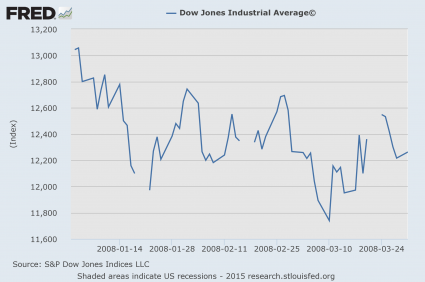
Below is a chart that shows how the Dow Jones Industrial Average performed during the first three months of 2008. It was a time of increased volatility, but the market pretty much went nowhere. This is typical of what we see in the months leading up to a market crash. The markets start getting really choppy with large ups and large downs…
Subscribe to:
Posts (Atom)