September 17, 2013

Treasury Department’s Disingenuous Answers to Elizabeth Warren on Dodd Frank, Too Big to Fail

One of the aggravating facts of life in bureaucracies is having to contend regularly with misrepresentation. And I don’t mean faux friendly corporate bromides like “We’re here to help,” but weasely, technically accurate but substantively misleading statements. A Treasury reply to some questions from Elizabeth Warren is a classic in this genre.

The written responses to Warren’s queries came back last week (see the full text at the end of this post). Warren criticized Treasury’s failure to do its own homework on the whether large banks can borrow money more cheaply by virtue of being perceived as being too big to fail. As Bloomberg noted:
U.S. Senator Elizabeth Warren criticized the Treasury Department for not conducting a formal study to determine if some banks receive a funding subsidy for being perceived to be too big to fail. 
“The best way to make an objective determination of whether too-big-to-fail continues to exist over time is by measuring the subsidy, and Treasury should develop its own metrics for doing so through the Office of Financial Research,” Warren, a Massachusetts Democrat, said today in an e-mailed statement.
This question matters not just because it’s precisely the sort of thing the Office of Financial Research ought to be doing, but also because Treasury has the leading role on the Financial Stability Oversight Council. But peculiarly, Treasury takes the position that it can rely on third-party research. Given the banks’ role in supporting various think tanks and funding finance programs at business schools, one would have to assume that Treasury knows full well that a lot of that “research” is lobbying using charts and data as decoration. By contrast, in the UK, the Bank of England not only prepares an impressively detailed Financial Stability Report twice a year, but when Andrew Haldane was its executive director of financial stability, he gave detailed estimates of the funding cost advantage of the big UK and global banks. So if England thinks preparing this sort of analysis is part of the “financial stability overseer” job description, it’s telling that Treasury has chosen to shirk it.

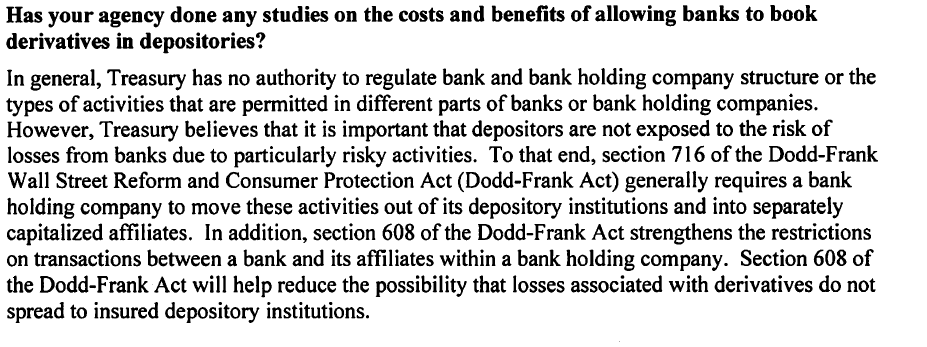
But if I were Warren, I’d be at least as unhappy about Treasury’s misdirections. For instance, get a load of this (click to enlarge):
Screen shot 2013-09-17 at 1.07.52 AM
Translation: We’re sympathetic, but not our job.

But that’s not the whole story.

There was a big brouhaha in 2011 when Bank of America moved $75 trillion (yes, trillion) of derivatives from its holding company to its retail bank to avoid having to post $3.3 billion of extra collateral after a downgrade. The FDIC was opposed to the move. The Fed supported it. And the Treasury? Nowhere to be found, at least from what I can recall at the time plus some searching this evening.

Yet the Treasury had a dog in this fight, both via its role on FSOC and as potential funder of Bank of America. As Jonathan Weil pointed out in 2011:
Dodd-Frank lets the FDIC borrow money from the Treasury to finance a seized company’s operations for as long as five years. While the law says the FDIC is supposed to tap the banking industry to pay for any eventual losses, it’s hard to imagine the agency could ever charge enough to cover the costs from a failure at a company with $2.2 trillion of assets, or any other giant financial institution, for that matter. Plus, there’s always the chance Congress will change the law again.
But at this juncture (before the various get out of jail free cards known as mortgage settlements had come to pass), Treasury’s priority was to help shore up the wobbly Charlotte bank. Remaining silent in the Fed/FDIC argument over the Bank of America derivatives assured the Fed as more senior regulator would win.

So the Treasury has a history on this topic, and it’s the opposite of the posturing about being concerned about depositor risk exposures.* And notice how talking about depositor risk sidesteps the big issue about booking derivatives in depositaries: the whole point is, as the Bank of America example shows, to lower funding costs, meaning to have deposit insurance and the taxpayer backstop subsidize the derivatives casino. Warren’s next question hones in on that issue, as to whether Treasury has looked into what OTC derivatives are really used for and how much of it is socially productive. Again, Treasury answers a different question and makes motherhood and apple pie statements about how Dodd Frank reduces opacity in the OTC derivatives markets.
Similarly, in response to question 4 on borrowing costs, Treasury says in passing:
The emergency resolution authority created under Title II [of Dodd Frank] explicitly forbids any bailout by taxpayers.
That’s a minority view. First, William Dudley of the New York Fed said late last year that Title II resolutions won’t work with the firms everyone is most worried about, globe-sprawling behemoths. As we wrote then:

The New York Fed’s William Dudley gave a surprisingly candid, meaning not positive, assessment of the state of the Too Big to Fail problem in a speech yesterday at the Clearing House’s Second Annual Business Meeting and Conference. From the text of his speech(emphasis ours)….:
In my view, this initial exercise has confirmed that we are a long way from the desired situation in which large complex firms could be allowed to go bankrupt without major disruptions to the financial system and large costs to society. Significant changes in structure and organization will ultimately be required for this to be achieved. However, the “living will” exercise is an iterative process, and we have only taken the first step in a long journey. 
The second way to potentially minimize the negative externalities from a firm’s failure would be to avoid a bankruptcy proceeding altogether and instead resolve the firm under the Dodd-Frank Act’s Title II orderly liquidation 7 authority.8 
The “single point of entry” model has much promise, but much remains to be done before it could be implemented with confidence for a globally active firm. Title II authority is U.S. law. Subsidiaries and affiliates chartered in other countries could be wound down under the bankruptcy laws of those countries, if authorities there did not have full confidence that local interests would be protected. Certain Title II measures including the one-day stay provision with respect to OTC derivatives and other qualified financial contracts may not apply through the force of law outside the United States, making orderly resolution difficult.
Second, and more important, Spencer Bachus, Chairman of the House Financial Services Committee, pointed out in a paper published a month before the Dudley speech that despite the claims of Dodd Frank fans that it barred bailouts, it leaves plenty of room for rescues:
Among other things, the “resolution authority” gives the FDIC the power to lend to a fail- ing firm; purchase its assets; guarantee its obligations; and — most important — pay off its creditors. The “resolution authority” also gives the FDIC the authority to borrow money from the Treasury. Lots of it. How much? The FDIC can borrow up to 10% of the book value of the failed firm’s total consolidated assets in the 30 days immediately following its appointment as receiver. After those 30 days, the FDIC can borrow up to 90% of the fair value of the failed firm’s total consolidated assets.
Tellingly, the Bloomberg story on the Warren letter has no less than Jacob Lew undercutting its claims about Dodd Frank resolutions:
Treasury Secretary Jacob J. Lew in July said that if too big to fail is not solved by the end of this year “we’re going to have to look at other options.” He didn’t elaborate on what alternatives President Barack Obama’s administration might consider.
So Treasury can’t even keep its stories straight. Let’s hope Warren is keeping score and has a bit of sport the next time its officials make an appearance before the Senate Banking Committee. If she can’t get them to change behavior, she can at least make clear that no one is buying their excuses.

Source

September 16, 2013

NOW THAT SUMMERS IS OUT: Here Are The 4 People Who Could Get The Nod To Replace Bernanke

Bombshell weekend news: Larry Summers has withdrawn from consideration to be the next Fed Chair, citing a difficult Senate confirmation process.

So who could get it?

The favorite for sure is Janet Yellen. She's the current Fed vice chairwoman, and a clear continuation of the current regime. She's a brilliant economist, who is supported by the vast majority of academic economists. Over 400 top-names signed a letter on her behalf last week. She's generally regarded as being "dovish" meaning more willing to tolerate inflation risk if it means getting unemployment back to normal, though throughout her career she's been flexible and adaptive. If nominated, she would be the first woman to lead the Federal Reserve.

The other possibility that Obama has publicly floated, in addition to Yellen and Summers, is Donald Kohn. He was also a Fed vice chairman (through 2010) and would also likely be seen as a continuation of Bernanke. According to Charlie Gasparino, Kohn has received support from Tim Geithner, who has advised Obama during this process.

Speaking of Tim Geithner, Obama apparently wanted him, according to reports. The fact that Obama was so into Larry Summers, despite the opposition, is a strong sign that for the position the president was eager to have a trusted loyalist, and not bring in an outsider around whom he had less familiarity. Geithner fits the bill, but according to reports, he has resisted any overtures, and is happy in the private sector. Still, anything's possible.

Another name that was discussed a lot early on was Roger Ferguson. Ferguson was previously chairman of TIAA-CREF and was the on the Fed from 1997-2006, service as vice chairman before Donald Kohn. As Matt O'Brien at The Atlantic has explained, he is highly qualified and would likely cut a Bernanke-esque policy path.

ULTRA WILD CARD: Former Bank of Israel chief Stanley Fischer. This is the monetary policy wonk's dream because he's basically been the professor to everyone these days who matters. Probably no chance it will happen.


Source

September 13, 2013

They Denied That We Were In A Depression In 1933 And They Are Doing It Again In 2013

The more things change, the more things stay the same.  The Great Depression actually started in 1929, but as you will see below, as late as 1933 the Associated Press was still pumping out lots of news stories with optimistic economic headlines and many Americans still did not believe that we were actually in a depression.  And of course we are experiencing a very similar thing today.  The United States is in the worst financial shape that it has ever been in, our economic infrastructure is being systematically gutted, and poverty is absolutely exploding.  Since the stock market crash of 2008, the Federal Reserve has been wildly printing money and the federal government has been running trillion dollar deficits in a desperate attempt to stabilize things, but in the process they have made our long-term economic problems far worse.  It would be hard to overstate how dire our situation is, and yet the mainstream media continues to assure us that everything is just fine and that happy days are here again.

As I have already noted, the mainstream media was doing the exact same thing back during the days of the Great Depression.  The following are actual Associated Press headlines from 1933...

"Decisive Break from Panic Shown in Business Figures"

"Markets Spurt To New Highs"

"New Farm Bill to End Depression"

And the following is a headline discovery from 1933 that was made by Linda Goin...
I was browsing through old newspapers the other day and discovered a page filled with news about the stock market and banks in the Daily Capital News from Jefferson City, Missouri. The date was March 15, 1933, well into the Great Depression, and the news was cautiously celebratory as a headline read, “Era of Fear is Declared at End Now.”
The Depression-era classic song entitled "Happy Days Are Here Again" was played at the Democratic National Convention in 1932 and it went on to be featured by the Democrats for many years after that.  The following is an excerpt from a Wikipedia article about that song...
Today, the song is probably best remembered as the campaign song for Franklin Delano Roosevelt's successful 1932 presidential campaign. According to TIME magazine, it gained prominence after a spontaneous decision by Roosevelt's advisers to play it at the 1932 Democratic National Convention, and went on to become the Democratic Party's "unofficial theme song for years to come".
There is only one huge problem.

The election of Roosevelt didn't end the depression.  Years of bitter economic suffering and dust bowl conditions were still ahead.  The Great Depression continued all the way up to the start of World War II, and the war years were certainly no picnic for average folks either.

But at least cheery headlines can make people feel better, right?

That is what some believe.

Others believe that giving people false hope is very cruel and that it sets up people for failure.

The following are some actual headlines that were found on mainstream news sites today...

CNBC: "Recession risk gone in all US states but 1: Moody's Analytics"

CNN: "Foreclosure crisis is drawing to a close"

NBC News: "Stocks close near highs; S&P logs 7-day rally"

Wow, those headlines sound great!

So are happy days here again?

Not quite.

In fact, things continue to get even worse in a whole host of ways.  Just consider the following statistics...

-According to a brand new Gallup poll that was just released, 20.0% of all Americans did not have enough money to buy food that they or their families needed at some point over the past year.  That is just under the record of 20.4% that was set back in November 2008.

-Gallup also found that the ability of American families to meet some of their other most basic needs is near an all-time low...
The Basic Access Index, which includes 13 questions about topics including Americans' ability to afford food, housing, and healthcare, was 81.4 in August, on par with the all-time low of 81.2 recorded in October 2011.
-More than 90 million working age Americans are considered to be "not in the labor force".

-The labor force participation rate is the lowest that it has been in 35 years.

-516,000 Americans "left the labor force" last month.  That was a brand new all-time record high.

-The number of private sector jobs dropped by 278,000 last month.

-77 percent of the jobs that have been "created" so far this year have been part-time jobs.

-Approximately one out of every four part-time workers in America is living below the poverty line.

-Right now, 40 percent of all U.S. workers are making less than what a full-time minimum wage worker made back in 1968.

-The U.S. trade deficit with China has hit a brand new record high.

-The U.S. trade deficit with the EU has hit a brand new record high.

-The number of U.S. households on food stamps is at a brand new record high.

-One of the largest furniture manufacturers in America was just forced into bankruptcy...
The maker of furniture brands such as Thomasville, Broyhill, Lane and Drexel Heritage said Monday that it has filed for Chapter 11 bankruptcy protection.
-Total mortgage activity has dropped to the lowest level that we have seen since October 2008.
Yes, those in the top 1 percent are doing very well for the moment thanks to the reckless money printing that the Federal Reserve has been doing.

But for most Americans, the last several years have been a continual struggle.  The following is a list that comes from one of my previous articles entitled "44 Facts About The Death Of The Middle Class That Every American Should Know"...

1. According to one recent survey, "four out of five U.S. adults struggle with joblessness, near poverty or reliance on welfare for at least parts of their lives".

2. The growth rate of real disposable personal income is the lowest that it has been in decades.

3. Median household income (adjusted for inflation) has fallen by 7.8 percent since the year 2000.

4. According to the U.S. Census Bureau, the middle class is taking home a smaller share of the overall income pie than has ever been recorded before.

5. The home ownership rate in the United States is the lowest that it has been in 18 years.

6. It is more expensive to rent a home in America than ever before.  In fact, median asking rent for vacant rental units just hit a brand new all-time record high.

7. According to one recent survey, 76 percent of all Americans are living paycheck to paycheck.

8. The U.S. economy actually lost 240,000 full-time jobs last month, and the number of full-time workers in the United States is now about 6 million below the old record that was set back in 2007.

9. The largest employer in the United States right now is Wal-Mart.  The second largest employer in the United States right now is a temp agency (Kelly Services).

10. One out of every ten jobs in the United States is now filled through a temp agency.

11. According to the Social Security Administration, 40 percent of all workers in the United States make less than $20,000 a year.

12. The ratio of wages and salaries to GDP is near an all-time record low.

13. The U.S. economy continues to trade good paying jobs for low paying jobs.  60 percent of the jobs lost during the last recession were mid-wage jobs, but 58 percent of the jobs created since then have been low wage jobs.

14. Back in 1980, less than 30% of all jobs in the United States were low income jobs.  Today, more than 40% of all jobs in the United States are low income jobs.

15. At this point, one out of every four American workers has a job that pays $10 an hour or less.

16. According to one study, between 1969 and 2009 the median wages earned by American men between the ages of 30 and 50 declined by 27 percent after you account for inflation.

17. In the year 2000, about 17 million Americans were employed in manufacturing.  Today, only about 12 million Americans are employed in manufacturing.

18. The United States has lost more than 56,000 manufacturing facilities since 2001.

19. The average number of hours worked per employed person per year has fallen by about 100 since the year 2000.

20. Back in the year 2000, more than 64 percent of all working age Americans had a job.  Today, only 58.7 percent of all working age Americans have a job.

21. When you total up all working age Americans that do not have a job, it comes to more than 100 million.

22. The average duration of unemployment in the United States is nearly three times as long as it was back in the year 2000.

23. The percentage of Americans that are self-employed has steadily declined over the past decade and is now at an all-time low.

24. Right now there are 20.2 million Americans that spend more than half of their incomes on housing.  That represents a 46 percent increase from 2001.

25. In 1989, the debt to income ratio of the average American family was about 58 percent.  Today it is up to 154 percent.

26. Total U.S. household debt grew from just 1.4 trillion dollars in 1980 to a whopping 13.7 trillion dollars in 2007.  This played a huge role in the financial crisis of 2008, and the problem still has not been solved.

27. The total amount of student loan debt in the United States recently surpassed the one trillion dollar mark.

28. Total home mortgage debt in the United States is now about 5 times larger than it was just 20 years ago.

29. Back in the year 2000, the mortgage delinquency rate was about 2 percent.  Today, it is nearly 10 percent.

30. Consumer debt in the United States has risen by a whopping 1700% since 1971, and 46% of all Americans carry a credit card balance from month to month.

31. In 1999, 64.1 percent of all Americans were covered by employment-based health insurance.  Today, only 55.1 percent are covered by employment-based health insurance.

32. One study discovered that approximately 41 percent of all working age Americans either have medical bill problems or are currently paying off medical debt, and according to a report published in The American Journal of Medicine medical bills are a major factor in more than 60 percent of all personal bankruptcies in the United States.

33. Each year, the average American must work 107 days just to make enough money to pay local, state and federal taxes.

34. Today, approximately 46.2 million Americans are living in poverty.

35. The number of Americans living in poverty has increased by more than 15 million since the year 2000.

36. Families that have a head of household under the age of 30 have a poverty rate of 37 percent.

37. At this point, approximately 25 million American adults are living with their parents.

38. In the year 2000, there were only 17 million Americans on food stamps.  Today, there are more than 47 million Americans on food stamps.

39. Back in the 1970s, about one out of every 50 Americans was on food stamps.  Today, about one out of every 6.5 Americans is on food stamps.

40. Right now, the number of Americans on food stamps exceeds the entire population of the nation of Spain.

41. According to one calculation, the number of Americans on food stamps now exceeds the combined populations of “Alaska, Arkansas, Connecticut, Delaware, District of Columbia, Hawaii, Idaho, Iowa, Kansas, Maine, Mississippi, Montana, Nebraska, Nevada, New Hampshire, New Mexico, North Dakota, Oklahoma, Oregon, Rhode Island, South Dakota, Utah, Vermont, West Virginia, and Wyoming.”

42. At this point, more than a million public school students in the United States are homeless.  This is the first time that has ever happened in our history.  That number has risen by 57 percent since the 2006-2007 school year.

43. According to U.S. Census data, 57 percent of all American children live in a home that is either considered to be "poor" or "low income".

44. In the year 2000, the ratio of social welfare benefits to salaries and wages was approximately 21 percent.  Today, the ratio of social welfare benefits to salaries and wages is approximately 35 percent.

But there is no way that we are actually in another economic depression, right?

If that was the case, the mainstream media certainly would have told us, right?

According to John Williams of Shadow Government Statistics, if the U.S. government actually used honest numbers, they would show that the U.S. economy has actually been contracting continually since 2005.
In other words, if the numbers were not being manipulated they would show that we have had negative GDP growth every single year since 2005.

I don't know about you, but that sure sounds like a depression to me.

What do you think?

Source

September 12, 2013

Eminent Domain Mortgage-Seizure "Approved" For CA City

Despite PIMCO, DoubleLine, and pretty much every other major mortgage bondholder in the world litigating the actions, Richmond, California's leaders approved this morning a plan for the city to become the first in the nation to acquire mortgages with negative equity in a bid to keep local residents in their homes.

Richmond's city council voted 4 to 3 to use the power of 'eminent domain' (as we discussed here most recently) if trusts for more than 620 delinquent and performing "underwater" mortgages reject offers made by the city to buy the loans at deep discount pegged to their properties' current appraised prices to refinance them and reduce their principal.

City council members opposed to the plan countered that using eminent domain would put Richmond at risk of expensive lawsuits that could destroy the city's finances; and sure enough, Richmond had no takers last month when the successor to its redevelopment agency put $34 million of bonds up for sale to refinance previous debt. As Reuters reports, investors holding the mortgages targeted by Richmond dispute altruism motivates the plan and are set to meet in court for the first time tomorrow.

Via Reuters,
Richmond, California's leaders approved on Wednesday morning a plan for the city to become the first in the nation to acquire mortgages with negative equity in a bid to keep local residents in their homes.
The power of 'eminent domain' allows governments to seize private property for a public purpose. Critics say the plan threatens the market for private-label mortgage-backed securities.

Richmond's city council voted 4 to 3 for Mayor Gayle McLaughlin's proposal for city staff to work more closely with Mortgage Resolution Partners to put the plan crafted by the investor group for the city to work.

Richmond can now invoke eminent domain if trusts for more than 620 delinquent and performing "underwater" mortgages reject offers made by the city to buy the loans at deep discount pegged to their properties' current appraised prices to refinance them and reduce their principal.

City council members opposed to the plan countered that using eminent domain would put Richmond at risk of expensive lawsuits that could destroy the city's finances.

Other council members warned of a backlash from financial institutions, noting Richmond had no takers last month when the successor to its redevelopment agency put $34 million of bonds up for sale to refinance previous debt. The eminent domain plan had been disclosed to the U.S. municipal bond market.

realtor Jeffrey Wright warned that going through with eminent domain could prompt a clampdown in mortgage lending in Richmond or push up mortgage interest rates in the city of about 104,000 residents.

The investors have sued through trustees Wells Fargo & Co and Deutsche Bank AG in U.S. District Court to block the plan, which they say relies on them swallowing losses. The two sides square off in court in person for the first time on Thursday.
Source

September 11, 2013

How Big Banks Can Steal Your Home From You Even If Your Mortgage Is Totally Paid Off

Did you know that the big banks have a way to legally steal your house from you even if you don't owe a single penny on your mortgage?  Big banks and hedge funds are buying billions of dollars worth of tax liens from local governments all over the nation, and they are ruthlessly foreclosing on homeowners when they can't pay the absolutely ridiculous penalties and legal fees that are tacked on to the original tax bill.  As you will see below, one 76-year-old man lost his $197,000 home that he fully owned over a $134 tax bill.  A 95-year-old woman lost her $300,000 home over a $44.79 tax bill.  This is a very, very dirty way to make money, and the predatory financial institutions that are involved in this business definitely do not want to talk about it.

Of course much of the blame should also be shouldered by the local governments that are coldly selling these tax liens to these ruthless predators.  If local governments want to collect their tax bills, they should do it themselves.  They should not be auctioning off their tax liens to cold-hearted financial institutions that are very eager to commit a legal version of highway robbery.

A few days ago, the Washington Post reported on the tragic story of a 76-year-old former Marine named Bennie Coleman.  Coleman had originally purchased his home with cash, but that didn't stop tax lien predators from stealing his home over an unpaid $134 property tax bill...
On the day Bennie Coleman lost his house, the day armed U.S. marshals came to his door and ordered him off the property, he slumped in a folding chair across the street and watched the vestiges of his 76 years hauled to the curb. 
Movers carted out his easy chair, his clothes, his television. Next came the things that were closest to his heart: his Marine Corps medals and photographs of his dead wife, Martha. The duplex in Northeast Washington that Coleman bought with cash two decades earlier was emptied and shuttered. By sundown, he had nowhere to go.
All because he didn’t pay a $134 property tax bill.
So why couldn't he pay such a small bill?

Well, as the Post explained, these big banks and hedge funds keep tacking on interest, penalties and legal fees until the tax bills are many times the size that they originally were.  When the distressed homeowners can't come up with thousands of dollars to pay off the debts, the big banks and the hedge funds move in for the kill...
For decades, the District placed liens on properties when homeowners failed to pay their bills, then sold those liens at public auctions to mom-and-pop investors who drew a profit by charging owners interest on top of the tax debt until the money was repaid.
But under the watch of local leaders, the program has morphed into a predatory system of debt collection for well-financed, out-of-town companies that turned $500 delinquencies into $5,000 debts — then foreclosed on homes when families couldn’t pay, a Washington Post investigation found.
In particular, hedge funds have discovered that this is a great way to make huge piles of money.  The following is a short excerpt from a CNN article that was published back in May...
With buyers identified only by numbers or unrelated names, the fragmented, unregulated industry is opaque. Even the market's size is debated -- $15 billion a year, according to Howard Liggett, the chief executive of Distressed Real Estate Consulting Services, or $5 billion a year, according to the National Tax Lien Association, a trade group. While returns are a closely kept secret, investors typically make between 2.5% and 10% a year, or in the low teens for larger buys. 
"The hedge funds are chasing yield in this business" says Albert Friedman, a principal at Alterna Capital, an alternative investment firm in Boca Raton that buys tax liens. 
Insiders estimate hedge funds now control 40% of the tax-lien market, from under 5% five years ago, with regional banks, obscure partnerships sporting names like God's ATM LLC, and mom-and-pop investors making up the rest.
And a number of "too big to fail" banks are involved in this business as well.

In a previous article, I described exactly how this works...
1) The big Wall Street banks set up or invest in shell companies that will disguise who they really are.
2) These shell companies run around and buy up all of the tax liens that they can get their hands on.
3) Predatory levels of interest (in some states as high as 18 percent), fees and penalties rapidly pile up on these unpaid tax liens.  The affected homeowners quickly end up owing much, much more than what the original tax bills were for.
4) If the collecting firm has to hire a lawyer, then that gets charged to the homeowner as well.  The bloated legal fees for some of these lawyers can end up being the biggest expense of all.
5) If the tax liens do not get paid, the collecting firms move in to foreclose as quickly as legally possible. 
According to the Huffington Post, Wall Street banks such as Bank of America and JPMorgan Chase have been gobbling up several hundred thousand tax liens from local governments.  It appears that "distressed housing markets" are being particularly targeted. 
Many of these tax liens are sold in online auctions, so it is unclear if many local government officials even realize who the big money behind many of these shell companies is.
These big financial institutions may consider this to be "good business", but the truth is that they are absolutely shattering lives in the process.  This is particularly true when it comes to older people that do not fully understand what is happening to them.  Just consider the following examples from a recent Washington Post article...
A 48-year-old math teacher paid his taxes in 2007, but the tax office took his $1,400 payment and applied it to the wrong house, crediting an entirely different taxpayer.
A 58-year-old bank employee almost lost her house in 2010 because the tax office mistakenly sent bills and notices to a wooded lot across from a strip shopping center in Virginia — 12 times. 
A 69-year-old hat designer was given the wrong payoff amount and ended up in court to save her property, owned by her family since 1943. 
Those homeowners found out about the mistakes in time to fight. Ninety-five-year-old Daisy Dolsey, living in a nursing home and struggling with Alzheimer’s, wasn’t so lucky: She lost her $300,000 house over a $44.79 tax debt even after she paid her taxes.
Doesn't that just sicken you?

And then the big banks and the hedge funds have the gall to wonder why people dislike them so much.

In this day and age, large financial institutions have become more cold-hearted than ever before.
Always make sure that your property taxes are fully paid, and always keep a paper record of all financial transactions involving your home.

If you do slip up and make a mistake at some point, there is a very good chance that a ruthless financial institution will try to swoop in and steal your home right out from under your nose.

Source

September 10, 2013

John B. Taylor: The Weak Recovery Explains Rising Inequality, Not Vice Versa

Last year at this time a debate raged about whether economic growth and job creation has been abnormally slow compared with previous recoveries from recessions in the United States. Now that the growth rate has declined to 1.6% over the past year from 2.8%, the debate is no longer about whether. It's about why.

The poor economic policies of the past few years is a reasonable explanation for today's weak economy. Fiscal policy has at best provided temporary stimulus before fading away with no sustainable impact on growth. More costly and confusing regulations—including the many mandates in the Affordable Care Act and the Dodd-Frank Act—have reduced the willingness of firms to invest and hire. The Federal Reserve has employed a variety of unconventional and unpredictable monetary policies with not very successful results.

The administration and its supporters are not about to blame the slow recovery on its own policies, or those of the Fed. Instead, President Obama and his supporters have been talking about "an economy that grows from the middle out," as he put it in Galesburg, Ill., in July. The fashionable middle-out view blames today's troubles on policies that took root in Ronald Reagan's administration.
 
The 1980s and '90s experienced a declining trend in unemployment rates, milder and less frequent recessions, and a lower inflation rate—all of which disproportionately benefited people with middle and lower incomes, especially compared with the 1970s. These decades were also characterized by widening inequality. The reason? "Washington," as Mr. Obama asserted in Galesburg, "doled out bigger tax cuts to the very wealthy and smaller minimum wage increases for the working poor."
 
Weak economic growth today, according to the middle-out view, is the consequence of a wider distribution, or dispersion, of income (more at the upper end). This growth in inequality, the argument goes, is the consequence of tax cuts since the 1980s, a trend toward deregulation (that actually began under the Carter administration), and fewer targeted federal programs.
 
The key causal factor of the middle-out view is that a wider income distribution slows economic growth by lowering consumption demand. Saving rates rise and consumption falls if the share of income shifts toward the top, according to middle-out reasoning, because people with higher incomes tend to save more than those with lower incomes.
 
The data for the recovery since mid-2009 do not support this view. The 5.4% overall savings rate during this recovery is not high compared with the 8.4% average since 1960. It is relatively low compared to past recoveries, such as the 9.3% savings rate during a comparable period during the recovery in the early 1980s.
 
Moreover, data do not support the view that tax cuts in the past 30 years are responsible for the widening income distribution. According to the Congressional Budget Office, the distribution of market income before taxes widened in the 1980s and '90s by about as much as the distribution of income after taxes.
 
The middle-out view fails to explain the weak economy and high unemployment today. It also fails to explain the strong economy and low unemployment in the 1980s and '90s.
 
Widening income distribution can be a concern, however, especially if it signals reduced income mobility and a growing inequality of opportunity. Consider data collected by Berkeley economist Emmanuel Saez for the upper 10% and the lower 90% of the income scale. From the end of World War II until the mid-1960s, real income growth was strong for both groups and there was relatively little change in the distribution of income.
 
In the late 1960s and 1970s the growth of real income slowed dramatically for both groups, coinciding with the terrible economic policy of that period. Income growth sped up in the 1980s and '90s but was faster in the upper-income group than in the lower-income group. This is the period of the widening of the distribution. According to the latest data collected by Mr. Saez, real income of both groups has recently stagnated.
 
What caused the differential income growth in the 1980s and 1990s? Research shows that the returns to education started increasing in the 1980s. For example, the wage premium for going to college compared to high school increased. But the supply of educated students did not respond to the increase in returns. High-school graduation rates were declining in the 1980s and '90s and have moved very little since then. Test scores of American students fell in international rankings. With little supply response, the returns to those with the education rose more quickly, causing the income distribution to widen.
 
Greater economic freedom, the key policy trend of the 1980s and 1990s, did not spread to large parts of the education system. That remains true today, although increased accountability and freedom to choose schools in some states such as Florida and Texas shows what can and should be done.
 
The policies favored by those with a middle-out view—higher tax rates, more intrusive regulations, more targeted fiscal policies—will not revive the economy. More likely they will perpetuate the weak economy we have and cause real incomes—including for those in the middle—to continue to stagnate.
 

September 9, 2013

The Number Of Private Sector Jobs Fell By 278,000 Last Month But The Economy Is Getting Better?

Have you heard about the "wonderful" employment numbers that were just released?  Last month, the unemployment rate declined to 7.3 percent.  Somehow this happened even though the percentage of working age Americans with a job actually declined and the number of private sector workers fell by 278,000.  So how did the federal government magically produce a drop in the unemployment rate even though less people have jobs?  Well, they did it by pretending that more than half a million Americans "dropped out of the labor force" last month.  If the government is to be believed, the number of Americans that want to work dropped by an astounding 516,000 in a single month even though the population of our country is constantly increasing.  The federal government continues to feed us absolutely absurd numbers month after month, and at this point "the official unemployment rate" is essentially meaningless.

But that doesn't mean that Barack Obama is about to drop the charade.  In fact, he continues to insist that the economy is getting better.  The following is an excerpt from one of Obama's recent weekly radio addresses...
Over the past four and a half years, we’ve fought our way back from the worst recession of our lifetimes. And thanks to the grit and resilience of the American people, we’ve begun to lay a foundation for stronger, more durable economic growth.
Oh really?

Does he actually believe that anyone is still buying what he is saying?

The cold, hard truth is that the U.S. economy has not recovered while Obama has been in the White House.  If you doubt this, please see my previous article entitled "33 Shocking Facts Which Show How Badly The Economy Has Tanked Since Obama Became President".

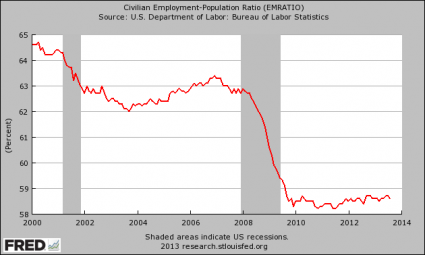
Since World War II, the percentage of working age Americans that is employed had always bounced back dramatically after a recession ended.

Unfortunately, that has not happened this time.

As you can see from the chart posted below, the percentage of working age Americans with a job has stayed below 59 percent since late 2009.  This chart reflects the most recent employment numbers...


So where is the recovery Obama?

Can he possibly put a positive spin on the chart above?

Of course not.

The truth is that the official unemployment rate should still be up around 10 percent like it was a few years ago.

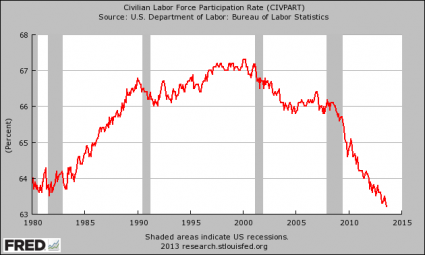
But that wouldn't make Obama look very good, would it?  So the U.S. government has been pretending that millions upon millions of Americans have been "leaving the labor force".  This has pushed the labor force participation rate to a 35-year-low...


At this point, we have more than 90 million Americans that are considered to be "not in the labor force"...
On Friday, the BLS reported that the 90,473,000 Americans not currently in the labor force marked the first time the figure exceeded the 90 million threshold.
In January 2009, when President Obama first took office, there were 80.5 million Americans 16 years and older not in the labor force, meaning the number of Americans not in the labor force has increased 10 million during his presidency.
For men, the BLS reported the labor force participation rate, the percentage of the population working or considered looking for work, was 63.2 percent in August, basically unchanged from 63.5 percent in July. It’s also a record low.
How low can that number possibly go?

Meanwhile, the quality of our jobs continues to decline rapidly as well.  If you can believe it, at this point more than 40 percent of all U.S. workers actually make less than what a full-time minimum wage worker made back in 1968.

As a result, the U.S. middle class is steadily dying.  The following is from a recent Yahoo article...
It’s the elephant in the room no one wants to talk about… 
The middle class in the U.S. economy is on the verge of collapse. Yes, I said collapse. That social class that once helped the U.S. economy grow and prosper is coming apart. Will the U.S. economy ever be the same without it or is this the new norm?
For much more on this, please see my previous article entitled "44 Facts About The Death Of The Middle Class That Every American Should Know".

And unfortunately, things look like they may start getting a lot worse for ordinary Americans.
There are a couple of major events which could potentially cause our economic decline to accelerate greatly in September...

#1 Fed Tapering

Right now, there is not much demand for U.S. Treasury bonds.  Foreigners have become net sellers of U.S. Treasuries and domestic demand has become quite weak.  Without the Federal Reserve buying up tens of billions of dollars worth of U.S. Treasuries each month, where will the demand come from?

That is a very good question.  If the Fed starts to taper quantitative easing in September, that is almost certainly going to send bond yields soaring.  Already, bond yields have been rising steadily, and if they get too high it is going to be absolutely disastrous for the U.S. economy.

#2 War With Syria

If the U.S. attacks Syria, it will likely cause financial markets all over the planet to descend into chaos and send the price of oil skyrocketing.

And that assumes that the conflict is limited to only the United States and Syria.  If Syria decides to retaliate by launching missiles at Israeli cities, that will set off a major regional war in the Middle East and the consequences for the global economy will be off the charts.

So as bad as the U.S. economy is right now, the truth is that things could easily get much, much worse.

Let us hope for the best, but let us also prepare for the worst.

Source

September 6, 2013

Plan at G-20 Is to Tighten Global Rules on Taxes

Many of the leaders of the world’s richest economies are convening at the eighth Group of 20 summit meeting in St. Petersburg, Russia, with the economic winds at their back, ready to sign on to a sweeping new set of tax rules for multinational corporations.

They are expected on Friday to agree to enact new tax laws that would limit the ability of multinational corporations like Apple and Starbucks to legally avoid paying taxes by operating subsidiaries in certain countries.
      
The practice came to the fore during the global recession as national coffers were strained and leaders looked for new sources of revenue. The recent positive economic news has not damped that desire or relieved the pressure to crack down.
      
In the United States, economic news has pointed to continued growth. On Friday, the Labor Department is expected to issue a healthy jobs report with 180,000 jobs created in August. It is the last set of economic data the government will release before the Federal Reserve meets to consider tightening monetary policy and raising interest rates in the United States.
      
On Thursday, the Institute for Supply Management issued its closely watched report, which said service companies were hiring more, and fewer people are applying for unemployment benefits. Auto sales are up sharply.
      
Recent economic reports from Britain, France, Germany and other countries in Europe’s northern tier have also been optimistic, although central bankers there remain cautious.
      
If the United States government reports that even more jobs were created, analysts expect that the 10-year Treasury note, which rose to 3 percent on Thursday, will rise further.
      
Currencies in many of the developing economies that benefited from the expansionist policies of the Federal Reserve have recently been falling sharply against the dollar as the Fed signaled its plans to tighten, and as money flows have reversed. Growth in many of the so-called BRICS economies — Brazil, Russia, India, China and South Africa — that had buoyed global growth have slowed as momentum shifts to the United States, Japan and northern Europe.
      
The heads of state have two days of meetings and will issue a communiqué on Friday that is expected to address the tax overhaul and other questions of economic policy.
      
Though the meeting is overshadowed by the crisis in Syria, and deep divisions between nations over possible American military action there, the heads of state are still expected to collectively endorse an economic policy statement that will encourage the continuing fiscal stimulus, or government spending, to help the recovery.
      
Germany, in the driver’s seat of European economic policy, had objected but appeared ready to acquiesce to a statement endorsing fiscal stimulus at a ministerial-level meeting in July in Moscow.
That meeting also encouraged governments to carefully coordinate tapering off monetary stimulus programs like the Federal Reserve’s so-called quantitative easing. The end of cheap credit has curbed growth in emerging markets as investors bring money back to the United States to take advantage of rising interest rates.
      
On Thursday, Russia’s deputy minister of finance, Sergei A. Storchak, said the leaders were set to endorse a similarly worded statement on Friday.
      
“It’s not going to be more than the agreements that were reached in Moscow,” Mr. Storchak told Reuters at the summit meeting, being held in the restored Czarist-era Catherine Palace in St. Petersburg.
      
In a reflection of the depth of concern about currency outflows caused by rising interest rates in the United States — meaning investors can obtain similar returns in emerging markets at far lower risk — the BRICS nations announced an intention to create a collective fund of $100 billion to defend their weakening local currencies. It was unclear when it would be operating and able to intervene in currency trading.
      
The effort at tax reform, if enacted widely, would squeeze more money from multinational corporations and shift a portion of the global tax burden from individuals and small businesses to large corporations. The proposal is for countries to better coordinate tax treaties to close loopholes that multinational corporations exploit by registering in tax havens like Delaware or the Cayman Islands. Another tactic of concern is shifting profits to low-tax jurisdictions and costs to high-tax ones.
      
In one widely cited example, Starbucks last year paid no corporate tax in Britain despite generating sales of nearly $630 million from more than 700 stores in that country. The company volunteered to pay more in coming years. Apple, despite being the most profitable American technology company, avoided billions in taxes in the United States and around the world through a web of complex subsidiaries.
      
Even with the high-level agreement, it will take years to put in place, and companies that benefit and have structured their business to comply with the laws in place today are all but certain to lobby to retain these advantages. The G-20 governments endorsed a draft of the tax agreement in Moscow in July.
      
The reform would encourage nations to adopt new standardized tax treaties, to replace the web of thousands of such agreements that exists now.
      
Russia is hosting the G-20 for the first time since the group was formed in 1999 and began discussing strategies for priming the global economy.
      
Mr. Storchak, the deputy finance minister in Russia, said in an interview before the opening meeting on Thursday that Russia had asked all governments to explain their spending plans for the years ahead, and that most had complied and agreed to release the results of this survey during the forum.
 

September 5, 2013

David Dayen: Jack Lew Shows His True Colors By Forcing Deregulation of Derivatives on the CFTC

I don’t know of any clear-eyed analyst who held out much hope that the handover of the Treasury Department from Tim Geithner to Jack Lew would herald a new era of stringent financial regulatory reform. Lew, outside of a stint at Citi, didn’t have much expertise with the matter; he’s more of a budget wonk. And when, at his confirmation hearing, he pronounced that Dodd-Frank solved the Too Big to Fail problem, he told you exactly who would have his ear at Treasury. This was further confirmed when Mary Miller, the undersecretary for domestic finance, denied the existence of TBTF in a speech to the Minsky conference in April.

But the most obvious reminder of the Geithner-Lew continuity was the recent upending of what would have been Gary Gensler’s final and most triumphant act at the Commodity Futures Trading Commission. Gensler was trying to finish off the cross-border derivatives rule from Dodd-Frank, which would have given CFTC oversight of any affiliates which execute more than $8 billion in trades, no matter where the location of the entity. This would have arrested a race to the bottom, where the mega-banks that control 95% of all trades fan out overseas to park their trading desks away from CFTC oversight.

Gensler was putting the screws to his commission and demanding a clean vote, intimating that he would allow a temporary exemptive order to expire July 12, putting the plain language from the Dodd-Frank statute (which clearly permitted cross-border regulation) into effect. This was some real hardball designed to get Mark Wetjen, a bank-friendly Democratic commissioner, to play ball.
Enter Jack Lew. We knew the hints of his intervention previously (I wrote about it in July), but Silla Brush and Robert Schmidt have done a deep dive into the matter for Bloomberg. The details on the July 3 meeting with Lew, Gensler and the SEC’s Mary Jo White are fascinating.
Banks and lawmakers, as well as financial regulators from around the world, had besieged Lew with complaints about Gensler’s campaign to impose U.S. rules overseas. 
The July 3 meeting in Lew’s conference room with a view of the White House grew tense, according to three people briefed on it. Gensler argued his plan was vital if the U.S. hoped to seize meaningful authority over financial instruments that helped push the global economy to the brink in 2008, taking down American International Group Inc. (AIG) and Lehman Brothers Holdings Inc. and igniting the worst recession since the 1930s. 
Lew insisted that Gensler coordinate better with the Securities and Exchange Commission, whose new chairman, Mary Jo White, was also present. Gensler, who was deep into negotiations with his European counterparts, was surprised by Lew’s demand. He’d been hearing the same request from lobbyists seeking to slow the process, and he told the Treasury chief it felt like his adversary bankers were in the room, the people said. 
Gensler subsequently apologized to Lew for the outburst. He also softened his demands, cutting a deal with the European Union a week later. Gensler, chairman of a historically obscure agency called the Commodity Futures Trading Commission, had again pushed an idea to the brink until forced to settle.
What we got was the concept of “substitute compliance,” meaning that any overseas regulator deemed comparable to US rules would oversee derivatives trades made in their own countries. In actuality, that drives a stake through the heart of the regulation; the rule starts from the presumption that foreign rules are equivalent.

This was a pure power play. The CFTC budget is a scant $200 million. By contrast, the IT budget for a major global bank is about $1.3 billion. Giving this relative backwater agency control over the multi-trillion-dollar derivatives market is something of a designed failure. And that’s particularly true when a political actor like Jack Lew basically calls the chairman of the agency on the carpet for daring to want to regulate. This is Robert Rubin and Brooksley Born all over again.

Brush and Schmidt estimate that the final rule will cover less than 20% of the entire derivatives market, a far cry from the initial goal. If you remember, the long-departed Blanche Lincoln, then-chairwoman of the Senate Agriculture Committee, faced a challenge from the left in a primary, and subsequently surprised everyone by writing a fairly strong derivatives rule for Dodd-Frank. That got whittled down in the conference committee, cut back to a nub in what got signed into law (the article plays it with Gensler giddy about the law’s language, but it definitely changed from the Lincoln draft to the final version), and further dulled by the rule-writing process, including one of Geithner’s final acts, exempting foreign exchange swaps. Banks have also taken to calling their swaps “futures” to get around the regulations.

Gensler tried to make the best of a bad situation and he had some victories along the way, but the deck was so stacked against him (particularly with the bank shill in his midst, Mark Wetjen) that any rule he successfully navigated through the process could only be described as “the best he could do under the circumstances.” The cross-border rule mattered more than all of them, because if mega-banks could just pass off derivatives trading to one of their thousands of affiliates overseas to evade scrutiny, you can bet they’ll do it. Gensler said that a bad cross-border rule would mean “we will have repealed derivatives reform altogether.” Well, we got a bad one.

Some will blame “lobbyists,” in this case from Wall Street banks to multinationals that do a lot of hedging, for this outcome. The article does this in part. Bull-pucky. Lobbyists don’t win unless sympathetic regulators in a position of power allow it. Gensler, a Goldman alum who preferred deregulation during a previous stint at Treasury, but got religion after seeing derivatives play a starring role in the financial crisis, wouldn’t budge. Wetjen, and ultimately Jack Lew, would. And they held enough power to take whatever teeth remained out of the rules. Meanwhile, Gensler, for daring to try to do his job, ruined his career:
In the end, Gensler also sacrificed his ambition, creating so many political enemies in Congress and the industry that his chances for a second term as chairman are dim.
“He burned a lot of bridges getting it all done, within the commission and internationally,” said David Hirschmann, president of the Center for Capital Markets Competitiveness at the U.S. Chamber of Commerce.
I’ve heard the Administration wouldn’t offer him anything above an ambassadorship.
The story is really good. It goes into detail about Wetjen’s betrayal of the swap execution facility rules (particularly on the number of bids sellers would have to solicit before making a trade, which got whittled down to two, the least possible improvement from a fully private system). It highlights the changes to the definition of a “swaps dealer,” allowing major traders like BP, Shell and Koch Industries to get out from under the CFTC’s watch. It calls out Chuck Schumer for flacking for the banks in a letter to the CFTC urging them to stop the cross-border regulations, essentially arguing in favor of outsourcing from New York City and moving derivatives desks overseas.

The big story here, however, is Lew. In the end, even Geithner, who at least paid lip service to the importance of cross-border regulation in 2011, comes out looking better. Lew asking that Gensler “better share information with his European counterparts and the SEC” is tantamount to telling him to back off. The Euro regulators didn’t want the CFTC overseeing European banks (who represent a large percentage of registered swap dealers). Sarah Bloom Raskin, the Fed Governor with a consumer protection profile, is headed over to Treasury to become Lew’s #2, and an important counsel on financial reform matters. The derivatives debacle shows the Raskin appointment to be window dressing, and probably more of a way to get a liberalish voice out of Larry Summers’ Fed while “proving” that the Administration can promote women. In reality, Lew will follow the bankers’ dictates.

Gensler puts a brave face on this in the article, claiming the system is safer. In reality, Treasury ensured that the banks will still get to gamble virtually at will, without any pesky regulator monitoring their risk. This quote says it all:
“The banks are going to be fine,” said Sunil Hirani, chief executive officer of trueEX Group LLC, who helped pioneer electronic trading of derivatives. “They are going to make a ton of money.”
Indeed.

Source

September 4, 2013

3 Charts That Show How American Households Have Totally Changed Over The Last 40 years

A fascinating report from the Census (via Heidi Moore and Marketing Charts) takes a look at how the structure and habitation of U.S. households has changed dramatically since 1970.
The report is titled "America’s Families and Living Arrangements: 2012" and its findings include the following bullets.
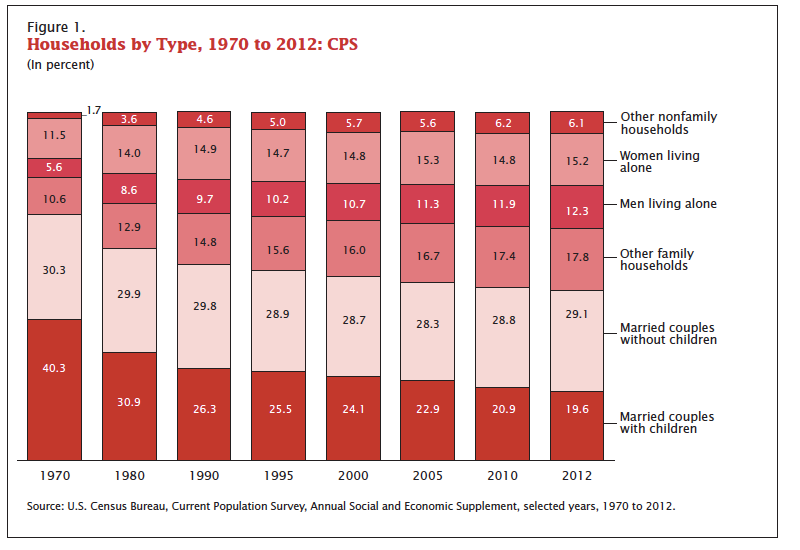
• Sixty-six percent of households in 2012 were family households, down from 81 percent in 1970. 
• Between 1970 and 2012, the share of households that were married couples with children under 18 halved from 40 percent to 20 percent. 
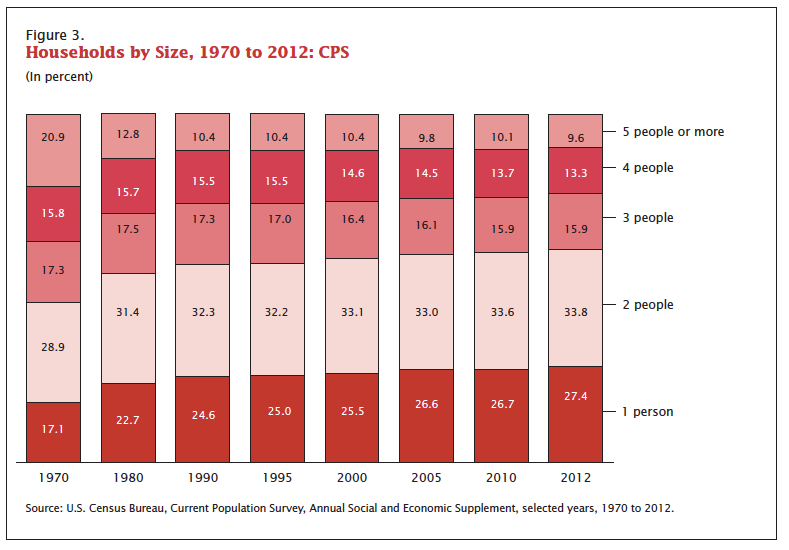
• The proportion of one-person households increased by 10 percentage points between 1970 and 2012, from 17 percent to 27 percent. 
• Between 1970 and 2012, the average number of people per household declined from 3.1 to 2.6.
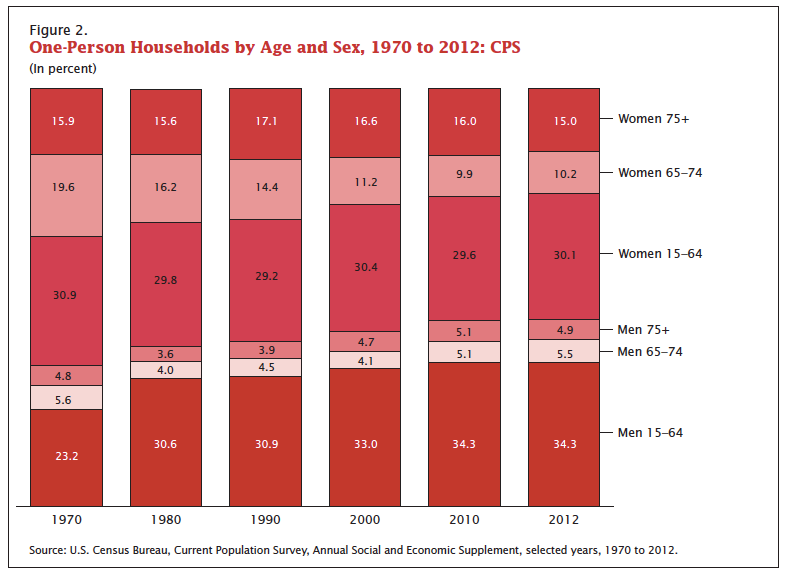
The following charts really drive home the way things have changed.

First, you can see that the percent of households that have two parents and children is down to 20 percent from 40.3 percent in 1970.

 
The number of households that are single men has surged, while the percent of households that are single older women has dropped considerably.
 And overall, the number of households with just one person in them has surged, while the percentage of households with five people or more has fallen from over 20 percent to less than 10 percent of households.

September 3, 2013

Is The Economist left or right-wing?

Editor’s note: This week, to mark the 170th anniversary of the appearance of the first issue of The Economist on September 2nd 1843, this blog will answer some of the more frequently asked questions about The Economist itself.

SOME readers, particularly those used to the left-right split in most democratic legislatures, are bamboozled by The Economist’s political stance. We like free enterprise and tend to favour deregulation and privatisation. But we also like gay marriage, want to legalise drugs and disapprove of monarchy. So is the newspaper right-wing or left-wing?

Neither, is the answer. The Economist was founded in 1843 by James Wilson, a British businessman who objected to heavy import duties on foreign corn. Mr Wilson and his friends in the Anti-Corn Law League were classical liberals in the tradition of Adam Smith and, later, the likes of John Stuart Mill and William Ewart Gladstone. This intellectual ancestry has guided the newspaper's instincts ever since: it opposes all undue curtailment of an individual’s economic or personal freedom. But like its founders, it is not dogmatic. Where there is a liberal case for government to do something, The Economist will air it. Early in its life, its writers were keen supporters of the income tax, for example. Since then it has backed causes like universal health care and gun control. But its starting point is that government should only remove power and wealth from individuals when it has an excellent reason to do so.

The concepts of right- and left-wing predate The Economist's foundation by half a century. They first referred to seating arrangements in the National Assembly in Paris during the French Revolution. Monarchists sat on the right, revolutionaries on the left. To this day, the phrases distinguish conservatives from egalitarians. But they do a poor job of explaining The Economist’s liberalism, which reconciles the left’s impatience at an unsatisfactory status quo with the right’s scepticism about grandiose redistributive schemes. So although its credo and its history are as rich as that of any reactionary or revolutionary, The Economist has no permanent address on the left-right scale. In most countries, the political divide is conservative-egalitarian, not liberal-illiberal. So it has no party allegiance, either. When it covers elections, it gives its endorsement to the candidate or party most likely to pursue classically liberal policies. It has thrown its weight behind politicians on the right, like Margaret Thatcher, and on the left, like Barack Obama. It is often drawn to centrist politicians and parties who appear to combine the best of both sides, such as Tony Blair, whose combination of social and economic liberalism persuaded it to endorse him at the 2001 and the 2005 elections (though it criticised his government’s infringements of civil liberties).

When The Economist opines on new ideas and policies, it does so on the basis of their merits, not of who supports or opposes them. Last October, for example, it outlined a programme of reforms to combat inequality. Some, like attacking monopolies and targeting public spending on the poor and the young, had a leftish hue. Others, like raising retirement ages and introducing more choice in education, were more rightish. The result, "True Progressivism", was a blend of the two: neither right nor left, but all the better for it, and coming instead from what we like to call the radical centre.

Source