October 22, 2014

19 Very Surprising Facts About The Messed Up State Of The U.S. Economy

Barack Obama and the Federal Reserve are lying to you.  The "economic recovery" that we all keep hearing about is mostly just a mirage.  The percentage of Americans that are employed has barely budged since the depths of the last recession, the labor force participation rate is at a 36 year low, the overall rate of homeownership is the lowest that it has been in nearly 20 years and approximately 49 percent of all Americans are financially dependent on the government at this point.  In a recent article, I shared 12 charts that clearly demonstrate the permanent damage that has been done to our economy over the last decade.  The response to that article was very strong.  Many people were quite upset to learn that they were not being told the truth by our politicians and by the mainstream media.  Sadly, the vast majority of Americans still have absolutely no idea what is being done to our economy.  For those out there that still believe that we are doing "just fine", here are 19 more facts about the messed up state of the U.S. economy...

#1 After accounting for inflation, median household income in the United States is 8 percent lower than it was when the last recession started in 2007.

#2 The number of part-time workers in America has increased by 54 percent since the last recession began in December 2007.  Meanwhile, the number of full-time jobs has dropped by more than a million over that same time period.
#3 More than 7 million Americans that are currently working part-time jobs would actually like to have full-time jobs.

#4 The jobs gained during this "recovery" pay an average of 23 percent less than the jobs that were lost during the last recession.

#5 The number of unemployed workers that have completely given up looking for work is twice as high now as it was when the last recession began in December 2007.

#6 When the last recession began, about 17 percent of all unemployed workers had been out of work for six months or longer.  Today, that number sits at just above 34 percent.

#7 Due to a lack of decent jobs, half of all college graduates are still relying on their parents financially when they are two years out of school.

#8 According to a new method of calculating poverty devised by the U.S. Census Bureau, the state of California currently has a poverty rate of 23.4 percent.

#9 According to the New York Times, the "typical American household" is now worth 36 percent less than it was worth a decade ago.

#10 In 2007, the average household in the top 5 percent had 16.5 times as much wealth as the average household overall.  But now the average household in the top 5 percent has 24 times as much wealth as the average household overall.

#11 In an absolutely stunning development, the rate of small business ownership in the United States has plunged to an all-time low.

#12 Subprime loans now make up 31 percent of all auto loans in America.  Didn't that end up really badly when the housing industry tried the same thing?

#13 The average cost of producing a barrel of shale oil in the United States is approximately 85 dollars.  Now that the price of oil is starting to slip under that number, the "shale boom" in America could turn into a bust very rapidly.

#14 On a purchasing power basis, China now actually has a larger economy than the United States does.

#15 It is hard to believe, but there are 49 million people that are dealing with food insecurity in America today.

#16 There are six banks in the United States that pretty much everyone agrees fit into the "too big to fail" category.  Five of them have more than 40 trillion dollars of exposure to derivatives.

#17 The 113 top earning employees at the Federal Reserve headquarters in Washington D.C. make an average of $246,506 a year.  It turns out that ruining the U.S. economy is a very lucrative profession.

#18 We are told that the federal deficit is under control, but the truth is that the U.S. national debt increased by more than a trillion dollars during fiscal year 2014.

#19 An astounding 40 million dollars has been spent just on vacations for Barack Obama and his family.  Perhaps he figures that if we are going down as a nation anyway, he might as well enjoy the ride.

If our economy truly was "recovering", there would be lots of good paying middle class jobs available.

But that is not the case at all.

I know so many people in their prime working years that spend day after day searching for a job.  Most of them never seem to get anywhere.  It isn't because they don't have anything to offer.  It is just that the labor market is absolutely saturated with qualified job seekers.

For example, USA Today recently shared the story of 42-year-old Alex Gomez...
"I've had to seriously downgrade my living situation," said Alex Gomez, a 42-year-old with a master's degree in entrepreneurship. Gomez lost his last full-time job in 2009 and has been looking for work since a short-term contract position ended in 2012. 
Gomez's home was foreclosed on, so the Tampa resident lives with three roommates in a college neighborhood. He drained his 401(k) trying to save his house, and he has around $150,000 in student loans. His mother is tapping her 401(k) to pay his rent. Gomez subsists on that and about $200 a month in food stamps. 
"I have been applying and looking for pretty much anything at this stage," he said. Although he's looking for work in engineering or data management, "I applied to a supermarket as a deli clerk because I used to be a deli clerk as a teenager," he said. He was told he was overqualified and turned down.
Does Alex Gomez have gifts and abilities to share with our society?
Of course he does.

So why can't he find a job?

It is because we have a broken economy.

We are in the midst of a long-term economic decline and the system simply does not work properly anymore.

And thanks to decades of very foolish decisions, this is only the start of our problems.
Things are only going to get worse from here.

October 21, 2014

Goldman Makes It Official That the Stock Market is Manipulated, Buybacks Drive Valuations

It’s remarkable that this Goldman report, and its writeup on Business Insider, is being treated with a straight face. The short version is current stock price levels are dependent on continued stock buybacks. Key sections of the story:
Goldman Sachs’ David Kostin believes a temporary pullback may explain why the S&P 500 has tumbled from its all-time high of 2,019 on Sept. 19. 
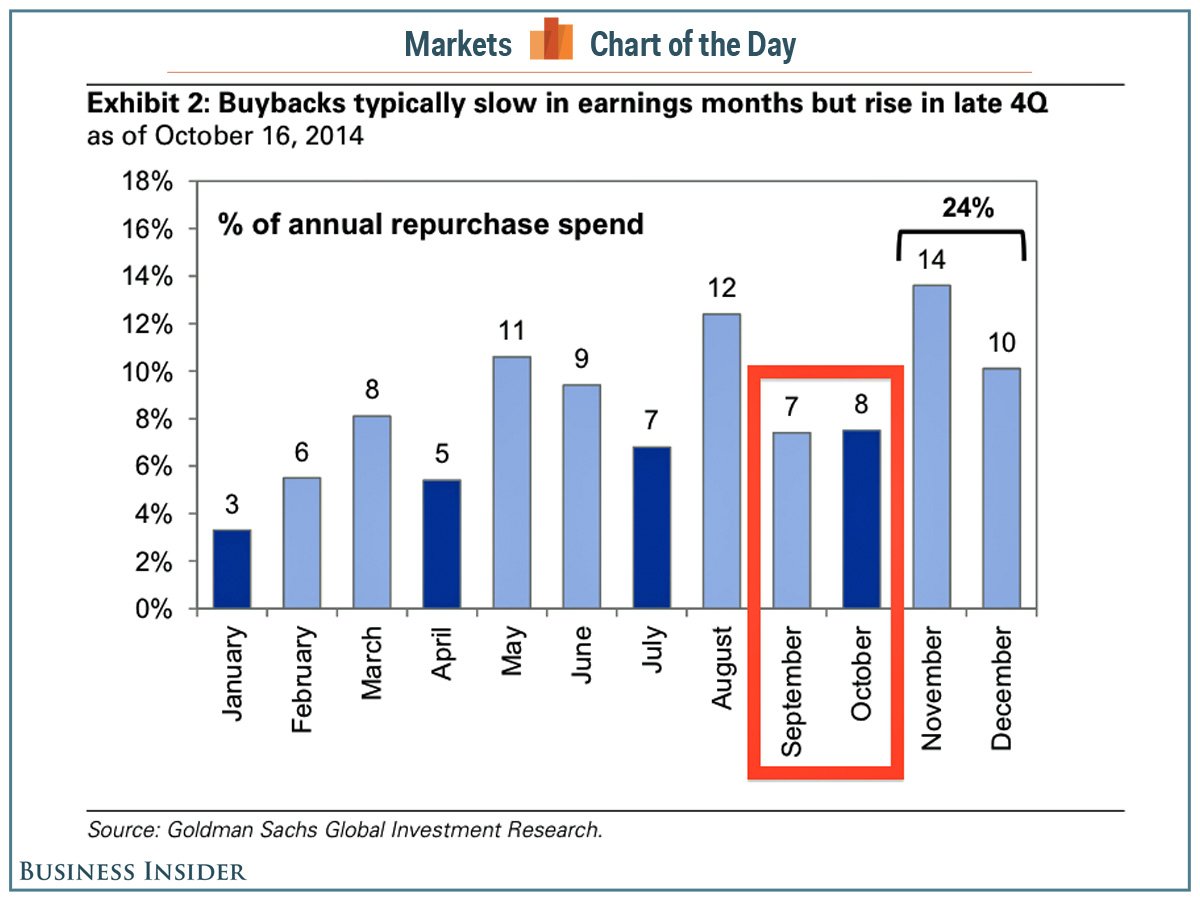
“Most companies are precluded from engaging in open-market stock repurchases during the five weeks before releasing earnings,” Kostin notes. “For many firms, the beginning of the blackout period coincided with the S&P 500 peak on September 18. So the sell-off occurred during a time when the single largest source of equity demand was absent. Buybacks dip during earnings reporting months, which have seen 1.2 points higher realized volatility than in other months during the past 25 years.”… 
“We expect companies will actively repurchase shares in November and December,” he writes. “Since 2007, an average of 25% of annual buybacks has occurred during the last two months of the year.”

 Notice how the bulk of buybacks are concentrated in the fourth quarter, with the obvious intent of goosing prices at year end so as to lead to higher executive pay for “increasing shareholder value”? In fact, these companies are being gradually liquidated. Issuing debt, which public companies have done in copious volumes since the crash, and using it to buy shares is dissipating corporate assets. They are over time shrinking their businesses. That is also reflected in aggressive headcount cuts and cost-saving measures. Even though analysts like to tout the cash that companies have sitting on their balance sheets as a source of potential investment, as we’ve discussed in previous posts, public companies are so terrified of even a quarterly blip in earnings due to incurring expenses relating to long-term investments that they’d rather do nothing, or go the inertial path of cutting costs to show higher profits.

But with borrowing the big source of this corporate munificence to the share-owning classes, this is a self-limiting game. But the end game could be a long time in coming. First, you have economists who believe that the stock market directly drives consumer spending, echoing the Fed’s confidence in the wealth effect. For instance, see this argument from Roger Farmer (hat tip Bruegel blog):
There is a close relationship between changes in the value of the stock market and changes in the unemployment rate one quarter later. My research here, and here shows that a persistent 10% drop in the real value of the stock market is followed by a persistent 3% increase in the unemployment rate. The important word here is persistent. If the market drops 10% on Tuesday and recovers again a week later, (not an unusual movement in a volatile market), there will be no impact on the real economy. For a market panic to have real effects on Main Street it must be sustained for at least three months.
Yves here. The problem is that correlation is not causation. Significant and sustained stock market declines are almost always the result of Fed tightening. The usual lag between an interest rate cycle turn and a stock market peak historically was roughly four months, but in our new normal of seemingly permanent heavy-duty central bank meddling, old rules of thumb are to be used with great caution. Nevertheless, Greenspan was obsessed with what drove stock prices, and the Fed is unduly solicitous of asset price levels, no doubt because people like Janet Yellen have to leave their DC bubble in order to meet actual unemployed people.

Mike Whitney reminds those who manage to miss it that the Fed is so concerned about the actual and psychological impact of stock market prices that it immediately talked investors into getting back into the pool when the market started misbehaving badly last week. From Counterpunch:
For those readers who still think that the Fed doesn’t meddle in the markets: Think again. Friday’s stock surge had nothing to do with productivity, price, earnings, growth or any of the other so called fundamentals. It was all about manipulation; telling people what they want to hear, so they do exactly what you want them to do. The pundits calls this jawboning, and the Fed has turned it into an art-form. All [St. Louis Fed President James] Bullard did was assure investors that the Fed “has their back”, and , sure enough, another wild spending spree ensued. One can only imagine the backslapping and high-fives that broke out at the Central Bank following this latest flimflam…. 
It’s too bad the Fed can’t put in a good word for the real economy while they’re at it. But, oh, I forgot that the real economy is stuffed with working stiffs who don’t warrant the same kind of treatment as the esteemed supermen who trade stocks for a living. Besides, the Fed doesn’t give a rip about the real economy. If it did, it would have loaded up on infrastructure bonds instead of funky mortgage backed securities (MBS). The difference between the two is pretty stark: Infrastructure bonds put people to work, circulate money, boost economic activity, and strengthen growth. In contrast, MBS purchases help to fatten the bank accounts of the fraudsters who created the financial crisis while doing bupkis for the economy. Guess who the Fed chose to help out? 
Do you really want to know why the Fed isn’t going to end QE? Here’s how Nomura’s chief economist Bob Janjuah summed it up: 
“I want to remind readers of a message that may be buried in the past: When QE1 ended, the S&P 500 fell just under 20% in a roughly three-month period before the QE2 recovery. 
When the QE2 ended, the S&P 500 fell about 20% in a three-month period before the next Fed-inspired bounce (aided by the ECB). QE3 is ending this month…” 
Is that why the Fed started jawboning QE4, to avoid the inevitable 20 percent correction?
Whitney continues with one of our favorite tropes: that all QE has done is elevate asset prices. That has not led to a recovery in anything much beyond the balance sheets of the top cohorts and the income of the top 1%. Even worse, it has provide cover for the Administration falling in with investor-favoring austerity, in the form of reducing deficit spending when it ought to be increasing it to take up the considerable and costly slack in the economy.

It’s not surprising to see the Fed double down on a failed strategy. The central bank had apparently finally recognized in 2013 that QE was not helping the real economy, and they needed to exit the policy to reduce the resulting economic distortions. But they lost their nerve during last summer’s taper tantrum, and turned cowardly again in response to a mere stock market hissy fit.

The Fed believes that what is good for the wealthy is good for the US, and that when they are in danger of suffering financially, the central bank should break glass and administer monetary relief. Even though the Fed may think it is serious about ending QE and eventually raising rates, as they say in Venezuela, “They have changed their minds, but they have not changed their hearts.”

October 20, 2014

Updated Secret Trans-Pacific Partnership Agreement (TPP)

WikiLeaks has released a second updated version of the Trans-Pacific Partnership (TPP) Intellectual Property Rights Chapter. The TPP is the world's largest economic trade agreement that will, if it comes into force, encompass more than 40 per cent of the world's GDP. The IP Chapter covers topics from pharmaceuticals, patent registrations and copyright issues to digital rights. Experts say it will affect freedom of information, civil liberties and access to medicines globally. The WikiLeaks release comes ahead of a Chief Negotiators' meeting in Canberra on 19 October 2014, which is followed by what is meant to be a decisive Ministerial meeting in Sydney on 25–27 October.

Despite the wide-ranging effects on the global population, the TPP is currently being negotiated in total secrecy by 12 countries. Few people, even within the negotiating countries' governments, have access to the full text of the draft agreement and the public, who it will affect most, none at all. Large corporations, however, are able to see portions of the text, generating a powerful lobby to effect changes on behalf of these groups and bringing developing country members reduced force, while the public at large gets no say.


Julian Assange, WikiLeaks' Editor-in-Chief, said:
The selective secrecy surrounding the TPP negotiations, which has let in a few cashed-up megacorps but excluded everyone else, reveals a telling fear of public scrutiny. By publishing this text we allow the public to engage in issues that will have such a fundamental impact on their lives.
The 77-page, 30,000-word document is a working document from the negotiations in Ho Chi Minh City, Vietnam, dated 16 May 2014, and includes negotiator's notes and all country positions from that period in bracketed text. Although there have been a couple of additional rounds of talks since this text, little has changed in them and it is clear that the negotiations are stalling and that the issues raised in this document will be very much on the table in Australia this month.

The last time the public got access to the TPP IP Chapter draft text was in November 2013 when WikiLeaks published the 30 August 2013 bracketed text. Since that point, some controversial and damaging areas have had little change; issues surrounding digital rights have moved little. However, there are significant industry-favoring additions within the areas of pharmaceuticals and patents. These additions are likely to affect access to important medicines such as cancer drugs and will also weaken the requirements needed to patent genes in plants, which will impact small farmers and boost the dominance of large agricultural corporations like Monsanto.


Nevertheless, some areas that were highlighted after WikiLeaks' last IP Chapter release have seen alterations that reflect the controversy; surgical method patents have been removed from the text. Doctors' groups said this was vitally important for allowing doctors to engage in medical procedures without fear of a lawsuit for providing the best care for their patients. Opposition is increasing to remove the provision proposed by the US and Japan that would require granting of patents for new drugs that are slightly altered from a previous patented one (evergreening), a technique by the pharmaceutical industry to prolong market monopoly.

The new WikiLeaks release of the May 2014 TPP IP text also has previously unseen addendums, including a new proposal for different treatment for developing countries, with varying transition periods for the text to take force. Whilst this can be viewed as an attempt to ease the onus of this harsh treaty on these countries, our diplomatic sources say it is a stalling tactic. The negative proposals within the agreement would still have to come into force in those countries, while the governments that brought them in would have changed.

Despite the United States wanting to push to a resolution within the TPP last year, this bracketed text shows there is still huge opposition and disagreement throughout the text. At this critical moment the negotiations have now stalled, and developing countries are giving greater resistance. Despite the huge lobbying efforts, and many favorable proposals for big pharmaceutical companies, they are not getting entirely what they wish for either. Julian Assange said:

The lack of movement within the TPP IP Chapter shows that this only stands to harm people, and no one is satisfied. This clearly demonstrates that such an all-encompassing and divisive trade agreement is too damaging to be brought into force. The TPP should stop now.
Current TPP negotiation member states are the United States, Japan, Mexico, Canada, Australia, Malaysia, Chile, Singapore, Peru, Vietnam, New Zealand and Brunei.
Source

October 17, 2014

Impact of FATCA – and the Case for Physical and Regional Diversification

The height of idiocy: US Government hijacks the whole Swiss banking system ... True story ... One of our SMC members just received a package from HSBC giving him and his wife a deadline to comply with FATCA—US' global tax law ... Suddenly they had just four weeks to prove that they were not US taxpayers, all because at one point they had purchased a service that gave them a US phone number. And now they, as Canadian citizens and residents, have to submit a fully completed W8BEN IRS form, along with a government issued photo ID and a detailed letter of explanation to make it very clear that they were not in fact Americans. – Sovereign Man 

Dominant Social Theme: There's no problem with FATCA – and there are reasons these rules have been put in place.

Free-Market Analysis: This article is a strongly worded warning about negative ramifications regarding FATCA.

As such, it's a bracing affirmation of the kind of sensible reporting that circulates on the Internet beyond the filters of mainstream media. It also provides us with yet more reasons to consider prudent diversification – physically and regionally as well as from an asset class standpoint. More on that below.

Certainly, it is unfortunate that FATCA is not a continued subject of discussion by the mainstream Western media given the impact that it will likely have on banks around the world as well as US expats and others who wish to hold overseas assets. GATCA, upcoming, holds the prospect of even more harm, but we'll leave that for another day.

Mainstream reporting regarding FATCA was wretched at the outset and has not improved with age. In fact, many Western outlets tend to ignore the subject entirely, which is odd given FATCA's worldwide impact.

Here's an excerpt from a FATCA supplement posted earlier this year at the Washington Post. It is written from the point of view apparently of Chinese government officials and is entitled, "China, US pact to curb offshore tax evasion."

The agreement between China and the United States for US financial accounts registered at banks in China to send their tax reports to the US Internal Revenue Service (IRS) to curb offshore tax evasion will have positive effects for China, experts said.

The agreement will also enable Beijing to obtain information on mainland taxpayers in the US to help fight against tax evasion and corruption. 

"No doubt, the news is positive and will aide China's anti-corruption efforts in its financial institutions," said Zeng Zhaoning, an economist at Xi'an Shiyou University, in a June 29 report by Huashang Daily, which is based in Shaanxi province. "The wealthy in China are obtaining foreign nationalities for their children and spouses to illicitly transfer income to foreign financial institutions in an attempt to escape tax reviews by the Chinese government." 

Beijing Economic Research Institute Chairman Gong Chengyu said that overall, Chinese citizens in the United States have more accounts than US citizens in China, "so in the long run, it is more beneficial for China". 

Under the agreement announced on June 26 by the US Treasury, US financial accounts will report their taxes directly to the Chinese government, which will then file them to the IRS. In the past, the accounts were only required to be reported to the foreign country's government. 

The two countries agreed on the terms, but are reviewing before officially signing it. The new agreement will remove the threat of blacklisting or penalties that have been hanging over Chinese financial institutions, including institutions in Hong Kong, the US and other subsidiaries in the Chinese mainland. 

The US government's implementation of the 2010 Foreign Account Tax Compliance Act (FATCA) is to curb offshore taxes that were previously not reported. Around 80,000 banks and other financial institutions have agreed to start reporting to the IRS on US-owned foreign accounts by July 1. 

While this was announced as a paid supplement, it has the hallmarks of much mainstream reporting regarding FATCA. It emphasizes the determination to catch tax evaders and positions FATCA as a necessary attempt to do so. The larger ramifications are downplayed or not brought up at all.

Yet, as the recent post at the international 'Net publication Sovereign Man (excerpted above) shows clearly, the ramifications of this invasive and comprehensive law have yet to be fully explored.

Here's more:

It used to be that foreigners were vying to become US citizens, but today they're begging not to be confused as one. In aiming to make itself the warden of the world, the US government has become very comfortable with reaching beyond its borders. 

Historically, the pursuit of global dominance involved taking over others' territories with guns blazing. Today, there's more finesse, but the intentions are the same. FATCA, the new Manifest Destiny, is probably the most arrogant piece of legislation ever enacted, at least in modern times. 

Assuming that the entire world should be subject to its own arcane and excessive tax legislation, FATCA requires foreign banks to sabotage their relationships with their clients and breach their own privacy standards to comply with the US government's will. 

This overreaching piece of legislation demands that they reveal the information of US citizens with accounts over $50,000. Otherwise the banks will be frozen out of the US banking system and slapped with a 30% withholding tax—effectively killing their business. Those that resist can even face criminal charges. ... 

This is the economic equivalent of a military occupation. Between compliance documentation, and facing massive fines and potential criminal charges, it's no mystery as to why foreign financial institutions are going out of their way to avoid US customers. 

And increasingly they're looking for alternatives to the whole system as well. If you're a foreign bank that gets reminded constantly of the potential penalties, breaches and charges that you could face simply for doing business, it's only prudent that you hedge your bets and look to minimize your exposure to the US dollar and the US banking system. 

The US thus just continues to shoot itself in the foot. 

We beg to differ only with this last point. From the creation of the BRICS (by Goldman Sachs) to the explosion of fracking technology to expansive African and Middle East warring and Keynesian monetary stimulation (that benefits mostly investors rather than workers), we're fairly convinced that there are other agendas at work.

We've expressed this in the past. It seems to us that the Anglosphere itself is being hollowed out; many productive businesses, for instance, have already moved to Asia and China. In fact, Asia is being touted as the next industrial breadbasket of the world.

A coincidence? FATCA is not surely not "just" bad or invasive legislation. It has the additional impact of making US institutions and even the US dollar itself objects of intense concern on a global scale.

It all may add up to a kind of campaign against US interest and the dollar – a campaign that will result in the creation of a more international monetary system including a global regulator, global taxes and global trading marts.

One could even speculate that the sudden enthusiasm for cannabis legalization is in part intended to provide international agencies with more credible taxing authority. In any event, Sovereign Man is correct: Diversification these days involves more than asset classes. It also involves physical regions.

The Daily Bell has posted several reports and editorials about this recently – with a special focus on Colombia. As it so happens, an airline travel magazine – American Way – recently published an extraordinary article on Colombia as an "inviting tourist destination." You can read the whole article here.

Here's an excerpt.

Colombia has become an inviting tourist destination and the toast of South America ... If you were prone to understatement, you might say that Colombia has had something of an image problem for most of the last 50 years. With the country variously divided by political strife, torn apart by guerrilla warfare and terrorized by drug traffickers, it seemed until recently that Colombia's biggest export was the steady stream of dark headlines it supplied to the global press. What a difference a decade makes. 

Since former President Álvaro Uribe ­disarmed paramilitary forces, cracked down on the drug trade and pushed leftist ­guerrilla groups to the far corners of the country, ­Colombia has been radically transformed. Today, the economy is the only thing that is going boom, as it outpaces that of the United States. Foreign investment last year was up twelvefold from a decade ago, to $12 billion, and the number of international tourists has more than tripled in the last decade. Not surprisingly, the outlook of Colombians has risen right along with their fortunes; they were ranked as the happiest people on the planet in 2012 and 2013 in polls conducted by the WIN Gallup International Association. 

Evidence of this new feel-good era is on display most anywhere you look in Bogotá, but I see it first at my hotel — the achingly trendy new Click Clack, a 60-room haven of hip in the city's affluent northern reaches that has become a beacon to the city's smart set. Here, on any night of the week, you can find a parade of chic, young and young-at-heart Bogotanos exiting their shiny new ­Rovers and BMWs to descend the sleek lobby staircase to the buzzy restaurant downstairs or to catch the elevator up 10 stories to the Apache Rooftop Bar, the rollicking nightclub where they stand packed shoulder-to-shoulder sipping cocktails to a pulsing backbeat spun out by a disc jockey into the early-morning hours. 

"I'm very proud of my country, because after 45 years of violence, everybody is pushing hard to show the better side of ­Colombia — who we really are," says Juan Felipe Cruz, the hotel's 31-year-old co-owner, over a sublime plate of cured salmon with crème fraîche and under a matte-black chandelier of an inverted coffee cup the size of a VW Beetle. "In 2001, my father told me there was no future for me here and sent me to Switzerland," Cruz says. "He'd been kidnapped by guerrillas and had suffered a lot. Now, he says he lives in a country he's never seen. It's true: Colombia today is another country."

... In the early 1990s, medellín was a city terrorized by drug traffickers and had the highest homicide rate in the world. But in the 21 years since police shot cocaine kingpin Pablo Escobar dead on the roof of his ­Medellín hideout, violent crime has ­plummeted and the city has transformed itself into a ­marvel of modernity. It has a spotless public-transportation system of cable cars and trains that run with Swiss efficiency, ­world-class museums, restaurants and shopping, and last year it beat out New York and Tel Aviv, Israel for the "City of the Year" title bestowed by the Urban Land ­Institute, ­Citigroup and The Wall Street Journal. Throw in an average annual temperature of 72 ­degrees and a stunning setting on the verdant slopes of the central Andes and you can see why the locals, who have a deserved reputation for their fierce civic pride, crow that there's no place on Earth they'd rather be. 

... On my last night in Colombia, I return to Bogotá and am invited to the opening of ­Cacio & Pepe, a new Italian restaurant where young professionals fill the red ­banquettes and crowd the parquet floors. I remark to designer Laura Urrutia and her husband, Felipe Boshell, my hosts, that I've rarely encountered a people as welcoming as Colombians. "We have a happy culture and an innocent culture in spite of our problems," Felipe says. "We give visitors a warm welcome because we were isolated from the world for so long. Colombia is such a well-kept secret that we're just really glad they're here!" 

Conclusion In this era when geopolitics is increasingly confusing and dangerous, regional – physical diversification – is surely as important as asset diversification. Please conduct your own due diligence, of course. You may wish to consider Colombia as you do.

October 16, 2014

For Bank Of America, Crime Is Now An Ordinary Course Of Business

Once upon a time banks made money in one of two ways: either by borrowing short and lending long, a/k/a the conventional banking way, or through investment banking, which includes advisory, underwriting and trading with the backstop of billions in deposits, aka the proto-hedge fund way.
Then things changed.

For a profoundly philosophical, if comically metaphysical essay, that uses several thousand excess words and footnotes to come to the miraculous conclusion that bank accounting is, get this, fickle, the following Bloomberg take should be an amusing way to kill a few extra hours. Philosophical ramblings aside, it is, of course, very easy to determine if a bank made or lost money, and that does not even involve looking at the cash flow statement. One looks at the Non-GAAP bottom line and excludes the "excluded", or added back items.

As a reminder, the reason non-GAAP exists in the first place, is to goalseek an already meaningless number to just a cent or two above Wall Street consensus, so as to kickstart the buying of the stock by headline scanning algos. Because EPS may be meaningless but stock-tied compensation/incentive awards are quite meaningful, and lucrative, to executives.

Still, even when it comes to the wizardry of non-GAAP, for a number to be somewhat credible, it has to follow a few basic guidelines, namely that in order for an expense or charge to be "excluded" from the bottom line, it has to fall within the "one-time", "non-recurring" category. Add it back too many times and the magic falls apart as even the mutually-accepted fabulation by circle-jerking ostriches that is non-GAAP. promptly evaporates.

Which is why we ask: why do Wall Street "analysts" continue to add back Bank of America's legal and litigation charges and settlements from its bottom line when calculating its non-GAAP EPS?

As the chart below clearly show, any myth that Bank of America's legal fees are "one-time" or "non-recurring" is by now long dead and buried. In fact, in 2014 they have never been greater!


How does this nearly $30 billion in legal "addbacks" over the past three years compared to the so-called Net Income Bank of America generated over the same time period? Here is the answer:


In short: between Q4 2011 and Q3 2014 Bank of America produced "Net Income" of $15.9 billion. However, the amount of added back "one-time, non-recurring" legal expenses is a stunning $28.9 billion: two of every three dollars, non-GAAP as they may be, comes from Bank of America engaging in criminal activity... and that's just the stuff it got caught for.

So perhaps an even more relevant question than how long will the EPS "addback" bullshit continue, is how long will the regulators and enforcers allow Bank of America to exist as an organization for which two-thirds of its "ordinary course business" is, for lack of a better word, crime?

October 15, 2014

9 Ominous Signals Coming From The Financial Markets That We Have Not Seen In Years

Is the stock market about to crash?  Hopefully not, and there definitely have been quite a few "false alarms" over the past few years.  But without a doubt we have been living through one of the greatest financial bubbles in U.S. history, and the markets are absolutely primed for a full-blown crash.  That doesn't mean that one will happen now, but we are starting to see some ominous things happen in the financial world that we have not seen happen in a very long time.  So many of the same patterns that we witnessed just prior to the bursting of the dotcom bubble and just prior to the 2008 financial crisis are repeating themselves again.  Hopefully we still have at least a little bit more time before stocks completely crash, because when this market does implode it is going to be a doozy.

The following are 9 ominous signals coming from the financial markets that we have not seen in years...

#1 By the time the markets closed on Monday, we had witnessed the biggest three day decline for U.S. stocks since 2011.

#2 On Monday, the S&P 500 moved below its 200 day moving average for the first time in about two years.  The last time this happened after such an extended streak of success, the S&P 500 ended up declining by a total of 22 percent.

#3 This week the put-call ratio actually moved higher than it was at any point during the collapse of Lehman Brothers in 2008.  This is an indication that there is a tremendous amount of fear on Wall Street right now.

#4 Everybody is watching the VIX at the moment.  According to the Economic Policy Journal, the VIX has now risen to the highest level that it has been since the heart of the European debt crisis.  This is another indicator that there is extraordinary fear on Wall Street...
US stock market volatility has jumped to the highest since the eurozone debt crisis, according to a closely watched index, the the CBOE Vix index of implied US share price volatility. 
It jumped to 24.6 late on Monday and is up again this morning. On Thursday, it was as low as 15. 
That's a very strong move, but things have been much worse. At height of the recent financial crisis – the Vix index peaked at 80.1 in November 2008.
Could we get there again? Yeah.
#5 The price of oil is crashing.  This also happened in 2008 just before the financial crisis erupted.  At this point, the price of oil is now the lowest that it has been in more than two years.

#6 As Chris Kimble has pointed out, the chart for the Dow has formed a "Doji Star topping pattern".  We also saw this happen in 2007.  Could this be an indication that we are on the verge of another stock market crash similar to what happened in 2008?

#7 Canadian stocks are actually doing even worse than U.S. stocks.  At this point, Canadian stocks have already dropped more than 10 percent from the peak of the market.

#8 European stocks have also had a very rough month.  For example, German stocks have already dropped about 10 percent since July, and there are growing concerns about the overall health of the German economy.

#9 The wealthy are hoarding cash and precious metals right now.  In fact, one British news report stated that sales of gold bars to wealthy customers are up 243 percent so far this year.

So what comes next?

Some experts are saying that this is the perfect time to buy stocks at value prices.  For example, USA Today published a story with the following headline on Tuesday: "Time to 'buy' the fear? One Wall Street pro says yes".

Other experts, however, believe that this could represent a major turning point for the financial markets.

Just consider what Abigail Doolittle recently told CNBC...
Technical strategist Abigail Doolittle is holding tight to her prediction of market doom ahead, asserting that a recent move in Wall Street's fear gauge is signaling the way. 
Doolittle, founder of Peak Theories Research, has made headlines lately suggesting a market correction worse than anyone thinks is ahead. The long-term possibility, she has said, is a 60 percent collapse for the S&P 500. 
In early August, Doolittle was warning both of a looming "super spike" in the CBOE Volatility Index as well as a "death cross" in the 10-year Treasury note. The former referenced a sharp move higher in the "VIX," while the latter used Wall Street lingo for an event that already occurred in which the fixed income benchmark saw its 50-day moving average cross below its 200-day trend line. 
Both, she said, served as indicators for trouble ahead.
So what do you think?

Are we about to witness a stock market crash and another major financial crisis?

Or is this just another "false alarm" that will soon fade?

Please feel free to share what you think by posting a comment below...

October 14, 2014

How To Blow Up OPEC In Three Easy Steps

It’s easily been longer than I care to remember that I first wrote it was only a matter of time before individual OPEC members would throw out the cartel’s agreements on prices and production, and just produce at full force and capacity, and then some. We may have seen that time arrive.

The underlying reason I first talked about it was two-fold. First: the economic crisis, which could lead to one thing only: less global demand. And second: the fast increasing wealth and population numbers in oil-producing nations which, as initially defined by Jeffrey Brown and Sam Foucher in the Export Land Model, has proven to be a much bigger factor in OPEC economies than people realized.

Hardly anyone, still to this day, talks about the Export Land Model, but birth rates in Arab oil producing nations have been sky-high for many years, and the fact that in a country like Saudi Arabia some 50% of the population is younger than 20 years old, has enormous consequences domestically. Certainly with the King and the rest of the reigning class seriously getting on in age.

A generational clash can be avoided only by pampering the young, and that comes with a big surge in domestic demand for oil. And since for many young people there are no jobs, Saudi Arabia has no industries to speak of, there are many who follow the example of Saudi’s like Osama Bin Laden into extremism.

Wait, first let me point to a nice piece of Fed ‘communication’. There’s been an entire parade of Fed heads paraded in the media lately, and one of the major issued addressed is that the global slowdown, which finally looks to have sunk in all over the place, would cause Yellen et al to be careful with, and postpone if needed, its interest rate hikes. Analysts and ‘experts’ also look to be wholly convinced of this. But then comes vice head Stanley Fisher and says a rate hike wouldn’t hurt anyone anyway:

The Federal Reserve’s eventual rate increase, the first since 2006, will not damage the global economy, Federal Reserve Vice Chairman Stanley Fischer said on Saturday. While there could be “trigger further bouts of volatility” in international markets when the Fed first hikes, “the normalization of our policy should prove manageable for the emerging market economies,” Fischer said in a speech at the IMF’s annual meeting.

[..] Since last year, Fischer said, the Fed has “done everything we can, within limits of forecast uncertainty, to prepare market participants for what lies ahead.” The Fed has been as clear as it can be about the future course of its policy course, and markets understand, Fischer said. “We think, looking at market interest rates, that their understanding of what we intend to do is roughly correct … ”
Any emerging market governments paying attention should feel a shiver of cold air when reading that. Fisher provides the Fed with an alibi here: if, make that when, rate hikes start makes victims, Fisher and Yellen can say they had no idea, that their models clearly stated that would not happen. Don’t count on them waiting.

Then back to OPEC. Like the EU, 54-year old OPEC has lived past its best before date. Predictably, individual members’ interests have started to diverge too much for it to remain a coherent entity. And the divergence widens fast these days.

I’ve hinted before at the long-standing cooperation between the US and Saudi Arabia, and there’s little doubt in my mind that the two are up to something. Washington has it in for Putin, first and foremost. The ‘Ukraine project’ has not brought what was intended.

Russia also still stands behind its only Middle East sphere of influence, Syria, something the Saudis like as little as America (but which Moscow won’t give up and and end up with zero say in the region) . And there’s always Venezuela, OPEC member and very vulnerable to power oil prices. Then there are a dozen other possible ‘targets’ among oil producers that the Saudi/US partnership may want to weaken. Who likes Iran, for one thing?

We’ve known for a while that the Saudis were lowering their prices. Which is something other OPEC members will be plenty upset about. But now we find out they’re also increasing production, and trying to catch EUropean and Asian customers before other fellow members can. That adds a whole extra dimension to the story:

Days after slashing prices in Asia, Saudi Arabia is now making an aggressive push in the European oil market, traders say. The kingdom is taking the unusual step of asking buyers to commit to maximum shipments if they want to get its crude. “The Saudi push is not just in Asia. It’s a global phenomenon,” one oil trader said. “They are using very aggressive tactics” in Europe too, the trader added.

This month, state-owned Saudi Aramco stunned the rest of OPEC by slashing its November prices to defend its market share in Asia’s growing market. The move, setting a price war in the oil-production group, was combined with a boost in the kingdom’s output in September.

But Riyadh is also moving to protect its sales to Europe, a declining market where it is facing rivalry from returning Libyan production. After cutting its November prices there, Saudi Aramco is also asking refiners to commit to full, fixed deliveries in talks to renew contracts for next year, the traders say. [..] “They are threatening buyers” to discontinue sales if they don’t agree with the fixed deliveries, another trader said.
What follows from that is that Saudi Arabia more or less unilaterally decides where oil prices are going. Iran and Iraq have already announced price cuts, and the rest has no choice but to follow, no matter how badly they need higher prices. It’s a kind of musical chairs, and quite a few nations will fall be the wayside. Though not necessarily Russia.

Algeria and Kuwait, for whatever reasons, seem to be lined up with the Saud family against the rest of OPEC:

Oil ministers from Kuwait and Algeria dismissed possible production cuts as crude’s slump to a four-year low prompted Venezuela to call for an emergency meeting of OPEC. [..] Bear markets for Brent and U.S. crude are putting pressure on OPEC’s consensus on output ahead of the group’s scheduled Nov. 27 meeting in Vienna …

OPEC supplies 40% of the world’s oil, and its largest Persian Gulf producers, including Saudi Arabia, Iraq and Iran, are offering deeper discounts to buyers in Asia to maintain market share amid a global glut. “If we had a way to preserve the stability of prices or something that would bring it back to previous levels, we would not hesitate in that,” Kuwait’sAl-Omair said in remarks reported by KUNA yesterday. “There is no room for countries to reduce their production,” he said, without giving details.

Ample supply, helped by surging U.S. and Russian output, pushed Brent crude into a bear market last week. The European benchmark slumped more than 20% from its peak for the year on June 19, meeting a common definition of a bear market. Brent fell on Oct. 10 to its lowest since December 2010.

“This is going to increase pressure for Saudi Arabia to cut output to raise prices …” “They are increasingly giving signs they won’t do it on their own. Saudi Arabia doesn’t want to lose market share in Asia … ”.

OPEC is boosting production as its members fight for market share and seek to meet rising domestic demand. [..] Saudi Arabia, Iran and most recently Iraq all widened the discounts they’ll offer on their main grades sold to Asia next month to the most since at least 2009.

Venezuelan President Nicolas Maduro gave instructions to ask for an extraordinary OPEC meeting, the country’s foreign ministry said in a post on its Twitter account on Oct. 10. “The price of oil is important for our country, and we’ll start actions to stop its fall,” the ministry cited former oil minister Rafael Ramirez as saying.

Crude prices have fallen because of several factors, including U.S. shale production, geopolitics and speculation, Algeria’s Yousfi said yesterday at a news conference in the city of Oran. “We follow with great attention the level of oil prices, but we are very tranquil,” he said. Crude probably won’t fall below $76 to $77 a barrel because that price level represents the highest cost of production in the U.S. and Russia, Al-Omair of Kuwait said. Both countries have abundant supply and are outside the group..
‘There is no room for countries to reduce their production’, says Kuwait. In other words, it’s everybody for themselves. Because supply and demand numbers seem to indicate there’s lots of room to cut production. So that can’t be it. Still, production rises in Saudi Arabia, US, Russia and undoubtedly many other producing nations. What else can they do when prices fall, but try and sell higher volumes to the highest bidder, as demand wanes in a shrinking global economy that’s done blowing bubbles? There’s nothing left but to pump all out and hope for the best.

A rift between OPEC members deepened over the weekend, as producers in the cartel moved in different directions amid falling oil prices. Venezuela, which has been one of the most outspoken proponents of a production cut by the Organization of the Petroleum Exporting Countries, called over the weekend for an emergency meeting of the group to respond to falling prices. But Kuwait said Sunday that OPEC was unlikely to act to rein in output.

Also on Sunday, Iraq’s State Oil Marketing Company cut the price of Basrah Light crude in November for Asian and European buyers by 65 cents to a discount of $3.15 a barrel below the Oman/Dubai benchmark for Asian customers and $5.40 below the Brent benchmark for European customers…

The moves and countermoves are the latest in a time of particular discord in OPEC. The organization was founded to leverage members collective output to help influence global prices. In recent periods of low prices, Saudi Arabia, OPEC’s top producer and de facto leader has managed to cobble together some level of consensus.

But even modest cooperation between many members has broken down, and Saudi Arabia, in particular, has moved to act on its own. While it cut output earlier this summer, other members didn’t go along. Since then, it has dropped its prices.

Each member has a different tolerance for lower prices. Kuwait, the United Arab Emirates and Saudi Arabia generally don’t need prices quite as high as Iran and Venezuela to keep their budgets in the black.
The 3 easy steps to blow up OPEC are easy indeed. The question may be why now, and why the way it happens. But that it’s happening is clear.
  • Step 1: raise output
  • Step 2: lower prices
  • Step 3: watch member nations’ governments go down like cats in a sack, trying to keep control of their societies.
  • Step 3a: yank up the US dollar
This is not a purely economic issue, it’s political. The US has a large voice in it in the director’s role, and the House of Saud plays the part of the protagonist. This is a major development in world politics, it’s not just some financial market-driven move.

World power relations are being hugely changed on the fly as we’re all watching and trying to figure what to make of all this. One thing’s for sure: the world will never be the same.

Why it happens now is a great question, which is impossible to answer. And that’s fine: it’s enough to try and understand exactly what is going on, let alone why.

But I bet you it has to do with the US and Europe realizing they can no longer keep pretending their economies are growing or recovering or doing fine.

We’ve landed in the next phase of what arguably started in 2007, but what you could place back many years before that, an economic system based on the fantasy that is debt driven growth, inflated by a factor of a trillion, give or take a few zeros.

That system is in the process of dying. And the people who have tried to make you believe, and succeeded, that it would all be fine in the end, are now jockeying for position in the aftermath of the demise of a world built on debt.

And they are the same people who built that world, profited from it to an insane degree, and want to use those profits to hang on to power in a world that will be dramatically different from the one they called the shots in. And that doesn’t bode well; it tells us violent clashes will be on the horizon.

October 13, 2014

Dropping Oil Prices Send Shockwaves Through Energy Sector

Energy stocks have taken a beating so far in October as commodity prices continue to deteriorate.

A wave of bad news has hit the commodities sector. A weakening global economy, a surplus in oil supplies and a strengthening U.S. dollar have combined to send oil prices lower in recent weeks.

On Oct. 9, the slide continued when Brent crude dropped below $90 per barrel for the first time in more than two years.

Poor economic data from Germany raised fears that a renewed European recession could be on the horizon. The S&P 500 lost 2 percent on Oct. 9, and the markets have experienced some of the worst volatility so far this year. The International Monetary Fund (IMF) also revised downwards its projection for global economic growth in 2014 and 2015, warning that “global growth is still mediocre.”

China’s oil demand remains weaker than it has been in years. To a certain extent, China’s oil imports have been artificially elevated as it has diverted oil into its strategic stockpile. Oil imports could soften as stockpiles fill up. China even posted a decline in oil imports for the month of July.

Elsewhere in Asia, demand is also tepid. Driven by a desire to boost budgets by cutting spending, countries like Indonesia, Vietnam, Thailand, India and Malaysia are all trimming fuel subsidies, according to The Wall Street Journal. That has sent fuel prices up 10 percent in Malaysia and 23 percent in Indonesia, for example. India’s decision to reduce subsidies has pushed demand growth for diesel to near zero for the year, after annual growth rates of 6 to 11 percent in the past.

Meanwhile, oil supplies continue to rise. OPEC production for September hit its highest level in almost two years. Libya has lifted its oil production to 900,000 barrels per day, up from just 200,000 barrels per day in June. And Saudi Arabia has yet to significantly cut production.

Separately, the U.S. Energy Information Administration (EIA) reported higher than expected crude oil in inventories as refineries cut purchases and close for maintenance. Higher global supplies are pushing down prices.

The U.S. dollar also continues to strengthen, with the currency recently hitting a two-year high with the euro. A stronger dollar tends to weaken oil prices.

With oil prices hitting multi-year lows, the markets wiped out energy stocks. On Oct. 9, ExxonMobil lost 2.95 percent; Chevron lost 2.92 percent; BP was down 2.69 percent, and ConocoPhillips was off 3.20 percent.

But it wasn’t just oil companies. The markets continue to wallop the coal sector. Arch Coal lost 7.23 percent of its value; Alpha Natural Resources lost 11.11 percent, and Peabody lost 9.22 percent. In addition to the broader economic malaise, the coal sector got an extra bit of bad news on Oct. 9 when China declared that it would reinstate tariffs on certain types of imported coal that were scrapped a decade ago. The tariffs threaten to slash coal imports and boost China’s domestic coal industry.

The one-day sell off was the stock market’s worst performance of 2014. It is unclear where the markets will go from here as there are no signs that the supply and demand picture will change significantly anytime soon.

But if oil prices drop any further, the bite will really set in. Although specifics differ across companies and regions, some oil companies could begin to trim spending on exploration if oil prices drop below $85 per barrel. That would eventually lead to lower oil production and bring prices back up to some equilibrium.

Alternatively, prices may soon drop lower than Saudi Arabia is willing to tolerate. In such a scenario, the world’s only real swing producer would accept lower output in order to see prices increase to its desired range – somewhere between $95 and $110 per barrel.
However, Riyadh has remained silent thus far on its next steps.

October 10, 2014

Asian De-Dollarization Explodes: South Korean Renminbi Deposits Surge 55-Fold In A Year

The Bank of Korea — South Korea’s central bank — released data that says South Korean domestic deposits have reached 16.19 billion Chinese renminbi in July this year, which is a 55-fold increase from the same period last year when renminbi deposits accounted for only 290 million.

According to data from South Korean banks, the proportion of foreign currency deposits held in renminbi was 0.4% at the end of 2012. That number reached 13.7% at the end of last year, while at the end of July this year the renminbi accounted for 25.9% of all foreign currency deposits in South Korea.

That’s an incredible, exponential increase.

Since Korean interest rates continue to be low and follow closely those of most Western countries, Koreans realize that if they continue to hold their money in bank accounts denominated in won, their savings are steadily and surreptitiously being diminished by inflation that’s higher then their paltry returns.

With a lack of good investment opportunities in a zero-interest rate environment and with frothy equity markets, Koreans are at least diversifying their currency exposure, with domestic capital rapidly flowing into renminbi deposits that yield much higher at around 3.25% per year.

Coupled with the continued strength of the renminbi, the attractiveness of diversifying their capital in foreign currencies, and the renminbi in particular, is clearly a firm trend among Koreans.

This is a well known scenario. Just as Europeans from countries with weaker currencies and economic prospects used to safeguard their savings by holding them in Deutschmarks and Swiss franks, we see the same trend happening today.

Individuals, companies and even governments are diversifying their currency exposure — mostly on the account of the US dollar. Renminbi denominated bonds are now being issued by businesses all over the world– heck, even McDonald’s issued a renminbi bond.

And now the UK will become the first country in the world other than China to issue renminbi denominated government debt. In fact, just this morning the UK Treasury announced that it hired Bank of China, HSBC and Standard Chartered to arrange the sale, with the bond issuance likely happening next Monday.

This follows last week’s announcement from the People’s Bank of China that renminbi and euro are now directly tradable, without the need to use the US dollar as a conduit.

The signs are clearly all there. Everyone realizes that the present system is on its way out and are taking appropriate measures. The Germans, the French, the Brits, the Canadians, the Koreans…

Don’t you think it’s time to step up and do something about it too?

The situation today looks a lot like one big game of musical chairs. Investors and “hot money” desperately looking for yield in a zero interest rate environment are pushing prices of practically all assets sky high and diversifying into markets and currencies with brighter prospects.

Make sure that you’re not the one left stranded when the music stops.


If you liked this post, please click here to Download our Free 17 page Report The 6 Pillars of Self Reliance.