While it has yet to be officially confirmed by the Trump transition team, moments ago the NYT reported that - in what had previously been leaked on several occasions on various other outlets most notably the WSJ - former Goldman banker and Soros employee, Steven Mnuchin "a financier with deep roots on Wall Street and in Hollywood but no government experience" is expected to be named Donald J. Trump’s Treasury secretary as soon as Wednesday.
The WSJ has confirmed as much, reporting that "President-elect Donald Trump will name longtime banker and former Goldman Sachs executive Steven Mnuchin as Treasury secretary, turning to a campaign loyalist and fundraiser for the incoming administration’s top economic cabinet post, a transition official said Tuesday."
As the WSJ adds, "Mr. Mnuchin’s Wall Street pedigree presents a contrast with the populist themes Mr. Trump struck in his campaign, railing against big banks and vowing to close tax loopholes that benefit hedge funds. Mr. Trump also repeatedly attacked his rivals in the primary and general elections for their Wall Street ties, especially those connected to Goldman Sachs."
If confirmed by the Senate as Treasury secretary, Mr. Mnuchin will join a list of prominent bankers who made similar moves from Wall Street to Washington, including two of his former bosses at Goldman, Henry Paulson and Robert Rubin, who were both top Goldman executives before running Treasury.
Read the entire article

DAILY BUSINESS REPORT - Financial Updates, International Markets and Business News
November 30, 2016


November 29, 2016
"Europe Will Devalue Or Dissolve..."
No rest for the wicked. With the shockwaves from Brexit and President Trump still reverberating around the world, the established order is bracing for more bad news. Next up is a December 4 Italian constitutional referendum that might end the reign of centrist prime minister Matteo Renzi and replace him with a bunch of anti-euro iconoclasts from the Brexit/Trump part of the spectrum. Here’s an excerpt from a much longer, deep-context Guardian UK article:
As the air of insurgency becomes unmistakable, the technical debate over reforming a 70-year-old constitution is in danger of becoming a sideshow. Perhaps the most disturbing poll for Renzi found last week that only 40% of Italians say they will vote on the reform package; 56% consider their vote to be more a verdict on the prime minister, his government and, by implication, the state of the nation.
If that bigger picture still dominates come polling day, it is hard to see anything but defeat for a man once billed as Italy’s Tony Blair. After 13 years of a flatlining economy, Italians are battered, bruised and looking for somebody to blame. Unemployment is running at 11%, but is close to 40% among the young, who made up the bulk of the 107,000 who left the country last year to seek work abroad. The aftermath of the financial crash is estimated to have wiped out about a quarter of Italian industry. The average family income is less now than it was in 2007.
Traditionally among the most enthusiastic proponents of European integration, ordinary Italians are furious at the EU’s failure to share the burden of the huge migration surge to their southern shores. Lectures from Brussels on the need to cut public spending and balance budgets, given the desperately straitened times, have added insult to injury. It is no coincidence that a current bookshop bestseller – 1960: The Best Year of Our Lives – is a nostalgic evocation of the Italian postwar economic miracle, when the country’s growth was judged to outstrip Germany’s.
Read the entire article
As the air of insurgency becomes unmistakable, the technical debate over reforming a 70-year-old constitution is in danger of becoming a sideshow. Perhaps the most disturbing poll for Renzi found last week that only 40% of Italians say they will vote on the reform package; 56% consider their vote to be more a verdict on the prime minister, his government and, by implication, the state of the nation.
If that bigger picture still dominates come polling day, it is hard to see anything but defeat for a man once billed as Italy’s Tony Blair. After 13 years of a flatlining economy, Italians are battered, bruised and looking for somebody to blame. Unemployment is running at 11%, but is close to 40% among the young, who made up the bulk of the 107,000 who left the country last year to seek work abroad. The aftermath of the financial crash is estimated to have wiped out about a quarter of Italian industry. The average family income is less now than it was in 2007.
Traditionally among the most enthusiastic proponents of European integration, ordinary Italians are furious at the EU’s failure to share the burden of the huge migration surge to their southern shores. Lectures from Brussels on the need to cut public spending and balance budgets, given the desperately straitened times, have added insult to injury. It is no coincidence that a current bookshop bestseller – 1960: The Best Year of Our Lives – is a nostalgic evocation of the Italian postwar economic miracle, when the country’s growth was judged to outstrip Germany’s.
Read the entire article
November 28, 2016
Black Friday Sales Slump As Retail Tracker Admits Holiday Season "Off To A Slow Start", Blames Warm Weather
Sales and traffic at U.S. brick-and-mortar stores on Thanksgiving Day and Black Friday declined from last year, as Reuters reports that stores offered discounts well beyond the weekend and more customers shopped online.
The National Retail Federation reports that spending per person over Thanksgiving Weekend this year was $289.19, down 3.4% from $299.60 in the same period last year.
Internet sales rose in the double digits on both days, surpassing $3 billion for the first time on Black Friday, according to data released on Saturday.
Data from analytics firm RetailNext showed net sales at brick-and-mortar stores fell 5.0% over the two days, while the number of transactions fell 7.9%.
Reuters report that ShopperTrak data highlights the waning importance of Black Friday, which until a few years ago kicked off the holiday shopping season, as more retailers start discounting earlier in the month and opened their doors on Thanksgiving Day.
Read the entire article
The National Retail Federation reports that spending per person over Thanksgiving Weekend this year was $289.19, down 3.4% from $299.60 in the same period last year.
Internet sales rose in the double digits on both days, surpassing $3 billion for the first time on Black Friday, according to data released on Saturday.
Data from analytics firm RetailNext showed net sales at brick-and-mortar stores fell 5.0% over the two days, while the number of transactions fell 7.9%.
Reuters report that ShopperTrak data highlights the waning importance of Black Friday, which until a few years ago kicked off the holiday shopping season, as more retailers start discounting earlier in the month and opened their doors on Thanksgiving Day.
Read the entire article
November 25, 2016
October Was The Worst Month For Hedge Funds Yet This Year
Another month, and the pain for the hedge fund industry just keeps getting more intense.
According to the latest Evestment report, investors redeemed an estimated net $14.2 billion from hedge funds in October. Year-to-date, there has been a net $77.0 billion removed from the industry. October’s outflow was the fourth month of redemptions in the last five and seventh in 2016. Due to the breadth of products experiencing outflows, and the persistence of redemptions outweighing new allocations, it is clear the industry is experiencing a crisis -like wave of negative investor sentiment.
One almost wonders how much higher the market can keep rising with redemption requests flooding countless back offices. We hope to find out soon.
Here are the rest of the details on the latest, ongoing, troubles facing the hedge fund industry which, unless something drastically changes soon may end up being a "zero hedge" industry:
The breadth of redemption pressure in October was the industry’s largest in 2016 with 61% of reporting funds estimated to have net outflow during the month. The last five months have accounted for the majority of the industry’s redemptions in 2016, a time frame which aligns with investors’ processes for analyzing 2015 results, and taking actions on those decisions.
Read the entire article
According to the latest Evestment report, investors redeemed an estimated net $14.2 billion from hedge funds in October. Year-to-date, there has been a net $77.0 billion removed from the industry. October’s outflow was the fourth month of redemptions in the last five and seventh in 2016. Due to the breadth of products experiencing outflows, and the persistence of redemptions outweighing new allocations, it is clear the industry is experiencing a crisis -like wave of negative investor sentiment.
One almost wonders how much higher the market can keep rising with redemption requests flooding countless back offices. We hope to find out soon.
Here are the rest of the details on the latest, ongoing, troubles facing the hedge fund industry which, unless something drastically changes soon may end up being a "zero hedge" industry:
The breadth of redemption pressure in October was the industry’s largest in 2016 with 61% of reporting funds estimated to have net outflow during the month. The last five months have accounted for the majority of the industry’s redemptions in 2016, a time frame which aligns with investors’ processes for analyzing 2015 results, and taking actions on those decisions.
Read the entire article
November 24, 2016
Relentless Dollar Surge Continues: Asian Currencies Plunge To 7 Year Lows, Hitting Emerging Markets
While most global equity markets were subdued due to the US Thanksgiving holiday, the FX world was very busy overnight, marked by the relentless dollar surge on expectations of a rate hike not only in December but further in 2017, sending Asian currencies to the weakest level in 7 years: the Bloomberg-JPMorgan Asia Dollar Index reached 103.32, the lowest level since March 2009.
The regional FX plunge will likely deter regional central banks from easing monetary policies as the prospects of higher U.S. rates spurred capital outflows according to Toru Nishihama, an emerging-market economist at Dai-ichi Life Research Institute who added that depreciating currencies are making it very hard for central banks to ease on concerns about inflationary pressure and acceleration of fund outflows.
The dollar also pushed its way past more of last year's peaks against the euro to hit $1.0550 in early European action, with only the March 2015 high of $1.0457 standing in the way of a drive toward parity, likewise the yen skidded to an eight-month low and China's yuan to an 8-1/2 year low, while the highly sensitive Turkish lira and Indian rupee hit new historic troughs, although the USD has since given up some of the gains.
"There doesn't seem to be anything stopping U.S. yields going higher in the near-term so I think people are going to stay on the dollar trend," said Michael Metcalfe, head of global macro strategy at State Street Global Markets.
"The only risk to this are that the dislocations in markets outside of the U.S., particularly in emerging markets, get to a point where they start to feed back into concerns (for the Federal Reserve as it looks to raise interest rates)," he said.
Read the entire article
The regional FX plunge will likely deter regional central banks from easing monetary policies as the prospects of higher U.S. rates spurred capital outflows according to Toru Nishihama, an emerging-market economist at Dai-ichi Life Research Institute who added that depreciating currencies are making it very hard for central banks to ease on concerns about inflationary pressure and acceleration of fund outflows.
The dollar also pushed its way past more of last year's peaks against the euro to hit $1.0550 in early European action, with only the March 2015 high of $1.0457 standing in the way of a drive toward parity, likewise the yen skidded to an eight-month low and China's yuan to an 8-1/2 year low, while the highly sensitive Turkish lira and Indian rupee hit new historic troughs, although the USD has since given up some of the gains.
"There doesn't seem to be anything stopping U.S. yields going higher in the near-term so I think people are going to stay on the dollar trend," said Michael Metcalfe, head of global macro strategy at State Street Global Markets.
"The only risk to this are that the dislocations in markets outside of the U.S., particularly in emerging markets, get to a point where they start to feed back into concerns (for the Federal Reserve as it looks to raise interest rates)," he said.
Read the entire article
November 23, 2016
Forget Deutsche Bank, These 2 American Banks Are Now "The Most Systemically Dangerous In The World"
Back in the summer we wrote about an IMF report that flagged Deutsche Bank as the "most important net contributor to systemic risks" (see "'Deutsche Bank Poses The Greatest Risk To The Global Financial System': IMF"). Those who read our site frequently were likely not terribly surprised by the IMF's conclusion.
Among the G-SIBs, Deutsche Bank appears to be the most important net contributor to systemic risks, followed by HSBC and Credit Suisse. In turn, Commerzbank, while an important player in Germany, does not appear to be a contributor to systemic risks globally. In general, Commerzbank tends to be the recipient of inward spillover from U.S. and European G-SIBs. The relative importance of Deutsche Bank underscores the importance of risk management, intense supervision of G-SIBs and the close monitoring of their cross-border exposures, as well as rapidly completing capacity to implement the new resolution regime.
That said, we suspect the latest ranking of global systemically important banks (G-SIBs) by the Financial Stability Board may be a bit more surprising to our readers, among others, as it features two of America's largest banks right at the very top.
Read the entire article
Among the G-SIBs, Deutsche Bank appears to be the most important net contributor to systemic risks, followed by HSBC and Credit Suisse. In turn, Commerzbank, while an important player in Germany, does not appear to be a contributor to systemic risks globally. In general, Commerzbank tends to be the recipient of inward spillover from U.S. and European G-SIBs. The relative importance of Deutsche Bank underscores the importance of risk management, intense supervision of G-SIBs and the close monitoring of their cross-border exposures, as well as rapidly completing capacity to implement the new resolution regime.
That said, we suspect the latest ranking of global systemically important banks (G-SIBs) by the Financial Stability Board may be a bit more surprising to our readers, among others, as it features two of America's largest banks right at the very top.
Read the entire article
November 22, 2016
S&P Set To Open At All Time High, Boosted By Rising Crude On More "OPEC Deal Optimism"
European and Asian stocks rose after the early scare from the latest Fukushima quake dissipated when all Tsunami warnings were cancelled. The global risk on mood was spurred by another jump in crude, which was up 1% in early trading, with the commodity complex now enjoying its biggest three-day rally since May, after Nigeria signaled optimism that OPEC will agree a supply-cut deal next week in Vienna. S&P futures are up 0.3%, with the cash index set to open at new record highs.
With OPEC jawboning having become a daily fixture ahead of the cartel's now almost monthly summits, today was no exception, and earlier in the session, a Nigerian OPEC delegate said he expects details of the Vienna accord to be finalized Tuesday (and if they are not, this will just serve as a basis for a similar headline tomorrow, and then day after, and so on).
“Everyone is on board,” delegate Ibrahim Waya said in Vienna, where OPEC members are meeting to discuss output quotas ahead of the November 30 summit. Brent and WTI both extended gains following the headlines, pushing index futures higher with them.
The commodity story - on hopes of a global fiscal stimulus push - dominated as miners led the MSCI All-Country World Index higher while S&P500 futures on the S&P 500 Index advanced 0.3 percent. On Monday, the American gauge reached a record for the first time since Aug. 15, just as the Dow Jones Industrial Average, Russell 2000 Index and Nasdaq Composite Index hit fresh all-time highs.
Oil reached the strongest level in more than three weeks. Copper headed for its highest close since July 2015. Euro-area bonds rose on optimism the region’s central bank will extend stimulus.
Read the entire article
With OPEC jawboning having become a daily fixture ahead of the cartel's now almost monthly summits, today was no exception, and earlier in the session, a Nigerian OPEC delegate said he expects details of the Vienna accord to be finalized Tuesday (and if they are not, this will just serve as a basis for a similar headline tomorrow, and then day after, and so on).
“Everyone is on board,” delegate Ibrahim Waya said in Vienna, where OPEC members are meeting to discuss output quotas ahead of the November 30 summit. Brent and WTI both extended gains following the headlines, pushing index futures higher with them.
The commodity story - on hopes of a global fiscal stimulus push - dominated as miners led the MSCI All-Country World Index higher while S&P500 futures on the S&P 500 Index advanced 0.3 percent. On Monday, the American gauge reached a record for the first time since Aug. 15, just as the Dow Jones Industrial Average, Russell 2000 Index and Nasdaq Composite Index hit fresh all-time highs.
Oil reached the strongest level in more than three weeks. Copper headed for its highest close since July 2015. Euro-area bonds rose on optimism the region’s central bank will extend stimulus.
Read the entire article
November 21, 2016
We Are Being Set Up For Higher Interest Rates, A Major Recession And A Giant Stock Market Crash
Since Donald Trump’s victory on election night we have seen the worst bond crash in 15 years. Global bond investors have seen trillions of dollars of wealth wiped out since November 8th, and analysts are warning of another tough week ahead. The general consensus in the investing community is that a Trump administration will mean much higher inflation, and as a result investors are already starting to demand higher interest rates. Unfortunately for all of us, history has shown that higher interest rates always cause an economic slowdown. And this makes perfect sense, because economic activity naturally slows down when it becomes more expensive to borrow money. The Obama administration had already set up the next president for a major recession anyway, but now this bond crash threatens to bring it on sooner rather than later.
For those that are not familiar with the bond market, when yields go up bond prices go down. And when bond prices go down, that is bad news for economic growth.
So we generally don’t want yields to go up.
Unfortunately, yields have been absolutely soaring over the past couple of weeks, and the yield on 10 year Treasury notes has now jumped “one full percentage point since July”…
The 10-year Treasury yield jumped to 2.36% in late trading on Friday, the highest since December 2015, up 66 basis point since the election, and up one full percentage point since July!
The 10-year yield is at a critical juncture. In terms of reality, the first thing that might happen is a rate increase by the Fed in December, after a year of flip-flopping. A slew of post-election pronouncements by Fed heads – including Yellen’s “relatively soon” – have pushed the odds of a rate hike to 98%.
Read the entire article
For those that are not familiar with the bond market, when yields go up bond prices go down. And when bond prices go down, that is bad news for economic growth.
So we generally don’t want yields to go up.
Unfortunately, yields have been absolutely soaring over the past couple of weeks, and the yield on 10 year Treasury notes has now jumped “one full percentage point since July”…
The 10-year Treasury yield jumped to 2.36% in late trading on Friday, the highest since December 2015, up 66 basis point since the election, and up one full percentage point since July!
The 10-year yield is at a critical juncture. In terms of reality, the first thing that might happen is a rate increase by the Fed in December, after a year of flip-flopping. A slew of post-election pronouncements by Fed heads – including Yellen’s “relatively soon” – have pushed the odds of a rate hike to 98%.
Read the entire article
November 18, 2016
Ford CEO Folds? Trump Confirms Carmaker Won't Move Production To Mexico
Just hours after Ford CEO complained of the "huge impact" of Donald Trump's proposed trade plans, following the company's plan to move a substantial portion of its passenger-car production to Mexico from a factory in Michigan, Donald Trump tweeted “Just got a call from my friend Bill Ford, Chairman of Ford, who advised me that he will be keeping the Lincoln plant in Kentucky -- no Mexico," seemingly winning his first 'america-first' victory.
As WSJ reported yesterday, Ford Motor Co. Chief Executive Mark Fields issued a warning about President-elect Donald Trump’s proposed trade policies, saying high tariffs on automobiles and other products coming into the U.S. would be a blow to the auto industry and broader U.S. economy.
Mr. Fields, speaking with reporters on the sidelines of the Los Angeles Auto Show on Tuesday, said Ford has talked to Mr. Trump’s transition team and believes the company can work with the new administration. During a separate interview, he said, “We all share the same objective; we want a vibrant and healthy U.S. economy.”
The two sides, however, appear to be at odds on how to achieve that goal.
Ford’s plan to move a substantial portion of its passenger-car production to Mexico from a factory in Michigan was heavily criticized by Mr. Trump on the campaign trail. Like many of its rivals, Ford is building more-profitable light trucks in the U.S. while investing in new capacity in Mexico to produce lower-margin small cars.
And then hours later, Donald Trump tweeted...
Read the entire article
As WSJ reported yesterday, Ford Motor Co. Chief Executive Mark Fields issued a warning about President-elect Donald Trump’s proposed trade policies, saying high tariffs on automobiles and other products coming into the U.S. would be a blow to the auto industry and broader U.S. economy.
Mr. Fields, speaking with reporters on the sidelines of the Los Angeles Auto Show on Tuesday, said Ford has talked to Mr. Trump’s transition team and believes the company can work with the new administration. During a separate interview, he said, “We all share the same objective; we want a vibrant and healthy U.S. economy.”
The two sides, however, appear to be at odds on how to achieve that goal.
Ford’s plan to move a substantial portion of its passenger-car production to Mexico from a factory in Michigan was heavily criticized by Mr. Trump on the campaign trail. Like many of its rivals, Ford is building more-profitable light trucks in the U.S. while investing in new capacity in Mexico to produce lower-margin small cars.
And then hours later, Donald Trump tweeted...
Read the entire article
November 17, 2016
War On Cash Intensifies: Citibank To Stop Accepting Cash At Some Branches
Less than a week after India’s surprise move to scrap its highest denomination cash notes, another front in the War on Cash has intensified down under in Australia.
Yesterday, banking giant UBS proposed that eliminating Australia’s $100 and $50 bills would be “good for the economy and good for the banks.”
(How convenient that a bank would propose something that’s good for banks!)
This isn’t the first time that the financial establishment has pushed for a cashless society in Australia (or anywhere else).
In September 2015, Australian bank Westpac published its “Cash Free Report”, suggesting that the country would become cashless by 2022.
In July 2016, Australian payments firm Tyro published an enormously self-serving blog post touting the benefits of a cashless society and saying, “it’s only a matter of time.”
Most notably, two days ago, Citibank (yes, THAT Citibank) announced that it was going cashless at some of its Australian branches.
Read the entire article
Yesterday, banking giant UBS proposed that eliminating Australia’s $100 and $50 bills would be “good for the economy and good for the banks.”
(How convenient that a bank would propose something that’s good for banks!)
This isn’t the first time that the financial establishment has pushed for a cashless society in Australia (or anywhere else).
In September 2015, Australian bank Westpac published its “Cash Free Report”, suggesting that the country would become cashless by 2022.
In July 2016, Australian payments firm Tyro published an enormously self-serving blog post touting the benefits of a cashless society and saying, “it’s only a matter of time.”
Most notably, two days ago, Citibank (yes, THAT Citibank) announced that it was going cashless at some of its Australian branches.
Read the entire article
November 16, 2016
Global Bonds Plunge As "Trumpflation" Rally Returns, Dollar Jumps
After taking a one day breather, the "Trumpflation" Rally returned with a vengeance as global government bonds tumbled and the dollar rose on renewed speculation the economic outlook is strong enough to allow the Federal Reserve to hike in December (odds are now 94%). Asian shares rose, industrial metals and crude oil fell, European shares and US equity futures were pressured.
As reported last night, the latest bond selloff started in Japan where JGB futures slid after a BOJ buying operation was poorly received, and yields on both the 2Y and 5Y rose to or above the BOJ's -0.1% interest rate. 10 year Japanese yields have edged back above zero intra-day for the first time since September 21st and the market will at some stage focus on whether the BoJ will defend the zero level, especially if the global yield sell-off gathers pace over the coming weeks and months. It would be a strange decision to abandon the new policy so soon after announcing it so assuming global yields remain elevated they may be forced to buy more JGBs than they thought when the new scheme was announced.
As DB's Jim Reid observes, if the BoJ sticks to defending zero in a world where the US is likely to increase fiscal spending then you could make an argument that there is full blown helicopter money except that the BoJ is flying the copter over the US and may be about to become the new US government’s best friend. Without them, and without the ECB, it might be that Trump would be less able to spend freely on the fiscal side as yields would be less supported globally. Certainly one way to think of in our opinion.
Read the entire article
As reported last night, the latest bond selloff started in Japan where JGB futures slid after a BOJ buying operation was poorly received, and yields on both the 2Y and 5Y rose to or above the BOJ's -0.1% interest rate. 10 year Japanese yields have edged back above zero intra-day for the first time since September 21st and the market will at some stage focus on whether the BoJ will defend the zero level, especially if the global yield sell-off gathers pace over the coming weeks and months. It would be a strange decision to abandon the new policy so soon after announcing it so assuming global yields remain elevated they may be forced to buy more JGBs than they thought when the new scheme was announced.
As DB's Jim Reid observes, if the BoJ sticks to defending zero in a world where the US is likely to increase fiscal spending then you could make an argument that there is full blown helicopter money except that the BoJ is flying the copter over the US and may be about to become the new US government’s best friend. Without them, and without the ECB, it might be that Trump would be less able to spend freely on the fiscal side as yields would be less supported globally. Certainly one way to think of in our opinion.
Read the entire article
November 15, 2016
The Election Of Donald Trump Is Already Having An Enormous Impact On The Economy
The election of Donald Trump has sent shockwaves through the U.S. economy and the U.S. financial system. Since November 8th, the Dow has hit a brand new all-time record high, the U.S. dollar has strengthened greatly, and bank stocks are way up. But not all of the economic news is good news. Unlike stocks, bonds have reacted very negatively to Trump’s election victory. The past week has been an absolute bloodbath for bond traders, and as you will see below this is going to have dramatic implications for all U.S. consumers moving forward.
Over just a two day period, more than a trillion dollars was wiped out as bond yields spiked all over the globe. As CNN has noted, this type of “violent reaction” in the bond market has only happened three other times within the past ten years…
The rate on 10-year Treasury notes has surged to 2.3%, from 1.77% before the election. Last week’s spike in Treasury rates was so big, that it had only happened three times before in the last decade.
BlackRock’s Russ Koesterich called it a “violent reaction.”
The move stands to have broad repercussions for all Americans. Not only will the U.S. government have to pay more to borrow money, but mortgage rates and car loan costs should also rise. That’s because Treasuries are used as the benchmark for many other forms of credit.
Read the entire article
Over just a two day period, more than a trillion dollars was wiped out as bond yields spiked all over the globe. As CNN has noted, this type of “violent reaction” in the bond market has only happened three other times within the past ten years…
The rate on 10-year Treasury notes has surged to 2.3%, from 1.77% before the election. Last week’s spike in Treasury rates was so big, that it had only happened three times before in the last decade.
BlackRock’s Russ Koesterich called it a “violent reaction.”
The move stands to have broad repercussions for all Americans. Not only will the U.S. government have to pay more to borrow money, but mortgage rates and car loan costs should also rise. That’s because Treasuries are used as the benchmark for many other forms of credit.
Read the entire article
November 14, 2016
What Happens When 2-Term Presidencies End?
Four words - nothing good for stocks.
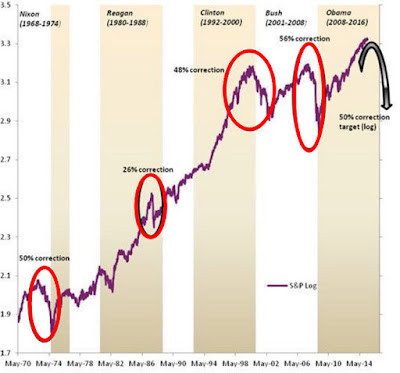
With the election decided, the burning question now is, “What next?” And, as Axioma details in their latest report, as “unprecedented” as the 2016 US Presidential election may have been, there are at least some precedents to which we can point for insights into what may now lie ahead.
Granted, the economic impact of policies introduced by Donald Trump will not be seen for many months or years. Nevertheless, we can look to other market events to get an idea of what we might expect in equity and currency markets over the near term, while the markets are still absorbing the news.
Admittedly, two examples of vote-related surprises (2000 uncertainty post-election, and Brexit) and associated market movements and volatilities, along with the example of how the market may view one of Trump’s signature issues (NAFTA agreement in Jan 1994), are hardly comprehensive indicators of what we might see in markets over the next few months; and of course, the economic impact of trade and other policies may not be known for months or years. But we believe the uncertainty and associated market volatility we have seen in the past may well come to pass again, and market volatility may become the order of the day, as the US transitions to a substantially different style of administration from the past eight years and new policies are put into place.
Read the entire article

With the election decided, the burning question now is, “What next?” And, as Axioma details in their latest report, as “unprecedented” as the 2016 US Presidential election may have been, there are at least some precedents to which we can point for insights into what may now lie ahead.
Granted, the economic impact of policies introduced by Donald Trump will not be seen for many months or years. Nevertheless, we can look to other market events to get an idea of what we might expect in equity and currency markets over the near term, while the markets are still absorbing the news.
Admittedly, two examples of vote-related surprises (2000 uncertainty post-election, and Brexit) and associated market movements and volatilities, along with the example of how the market may view one of Trump’s signature issues (NAFTA agreement in Jan 1994), are hardly comprehensive indicators of what we might see in markets over the next few months; and of course, the economic impact of trade and other policies may not be known for months or years. But we believe the uncertainty and associated market volatility we have seen in the past may well come to pass again, and market volatility may become the order of the day, as the US transitions to a substantially different style of administration from the past eight years and new policies are put into place.
Read the entire article
November 11, 2016
Making Yields Great Again: Trump Unleashes A "Bigly Rates Repricing"
The details which explain why DB, which until recently was very bullish on fixed income, is now bearish on fixed income and thinks that "Trump’s victory cements the shift in the policy mix", are as follows:
Trump’s victory is fundamentally bearish fixed income from a pure economics perspective. The key risk to the view comes from increased geopolitical uncertainty.
If Trump’s economic program is taken at face value, it would imply (1) increased fiscal spending, (2) reduced regulation, (3) a change of Fed leadership and (4) increased protectionism. Each one of these factors is bearish rates.
First, as we highlighted last week, Trump’s plan is consistent with more than 2.5% of GDP of annual fiscal stimulus over the next ten years (see table below). Of course, the extent to which the plan will be implemented is unclear. However, Trump is arguably in a strong position relative to the Republican Party and the latter controls both the House and the Senate. This should give Trump leverage to implement his fiscal plan, at least initially. Also, one of the clear statements made by Trump in his acceptance speech was that he intends to significantly increase infrastructure spending. It is worth noting that the Fed in principle welcomes more fiscal support as it sees the US economy as being constrained by a lack of demand. Given that the fiscal stimulus will occur as the US economy is close to full employment, it should have a faster spillover on monetary policy, notwithstanding the desire from the current Fed leadership to run the economy hot. Increased fiscal spending should be supportive of higher yields from a macro perspective (supports domestic demand and inflation) and from a flow perspective (reduces the supply/demand imbalance).
Read the entire article
Trump’s victory is fundamentally bearish fixed income from a pure economics perspective. The key risk to the view comes from increased geopolitical uncertainty.
If Trump’s economic program is taken at face value, it would imply (1) increased fiscal spending, (2) reduced regulation, (3) a change of Fed leadership and (4) increased protectionism. Each one of these factors is bearish rates.
First, as we highlighted last week, Trump’s plan is consistent with more than 2.5% of GDP of annual fiscal stimulus over the next ten years (see table below). Of course, the extent to which the plan will be implemented is unclear. However, Trump is arguably in a strong position relative to the Republican Party and the latter controls both the House and the Senate. This should give Trump leverage to implement his fiscal plan, at least initially. Also, one of the clear statements made by Trump in his acceptance speech was that he intends to significantly increase infrastructure spending. It is worth noting that the Fed in principle welcomes more fiscal support as it sees the US economy as being constrained by a lack of demand. Given that the fiscal stimulus will occur as the US economy is close to full employment, it should have a faster spillover on monetary policy, notwithstanding the desire from the current Fed leadership to run the economy hot. Increased fiscal spending should be supportive of higher yields from a macro perspective (supports domestic demand and inflation) and from a flow perspective (reduces the supply/demand imbalance).
Read the entire article
November 10, 2016
Everything Is Soaring As Trump Makes Buying Stuff Great Again
Who would have thought - as recently as two days ago - that a Trump presidency is the best thing for global risk? Certainly not Wall Street experts, all of whom warned of drops as big as 5% should Trump be elected.
And yet, the global repricing of inflation expectations continues at a feverish pace in the aftermath of the Trump victory, leading to another surge in US equity futures, up 15 points or 0.7% to 2175 at last check, with Asian and European stock market all jumping (Nikkei was up a whopping 6.7% after losing 4.6% the day before) after the initial shock of Donald Trump’s election victory gave way to optimism that his plans for fiscal stimulus will provide a boost to the global economy. Commodity metals soared with copper surging 4.5% to $5,658.50 a metric ton, the biggest gain since May 2013, while zinc advanced 2.1% and nickel added 2%. Gold climbed on speculation whether the Federal Reserve will raise interest rates in December.
The euphoria is largely due to the market's hopes of a burst in fiscal stimulus, aka much more debt, which while self-defeating in the long run, is providing a major boost to risk assets for the short-run, as it puts QE potentially back in the picture: after all someone will be needed to monetize the US budget deficit which is expected to once again soar under president Trump.
As Citi strategists note today, "The outcome of the U.S. election leaves the policy and macroeconomic outlook in the U.S. and globally with major uncertainties. Acknowledging these major uncertainties, we expect the new administration to pursue some deregulation, fiscal expansion, and reassess the costs and benefits of free trade. The combination of policies could be inflationary, quicken the path of Fed hikes and strengthen the dollar."
Read the entire article
And yet, the global repricing of inflation expectations continues at a feverish pace in the aftermath of the Trump victory, leading to another surge in US equity futures, up 15 points or 0.7% to 2175 at last check, with Asian and European stock market all jumping (Nikkei was up a whopping 6.7% after losing 4.6% the day before) after the initial shock of Donald Trump’s election victory gave way to optimism that his plans for fiscal stimulus will provide a boost to the global economy. Commodity metals soared with copper surging 4.5% to $5,658.50 a metric ton, the biggest gain since May 2013, while zinc advanced 2.1% and nickel added 2%. Gold climbed on speculation whether the Federal Reserve will raise interest rates in December.
The euphoria is largely due to the market's hopes of a burst in fiscal stimulus, aka much more debt, which while self-defeating in the long run, is providing a major boost to risk assets for the short-run, as it puts QE potentially back in the picture: after all someone will be needed to monetize the US budget deficit which is expected to once again soar under president Trump.
As Citi strategists note today, "The outcome of the U.S. election leaves the policy and macroeconomic outlook in the U.S. and globally with major uncertainties. Acknowledging these major uncertainties, we expect the new administration to pursue some deregulation, fiscal expansion, and reassess the costs and benefits of free trade. The combination of policies could be inflationary, quicken the path of Fed hikes and strengthen the dollar."
Read the entire article
Subscribe to:
Posts (Atom)