Since Donald Trump’s victory on election night we have seen the worst bond crash in 15 years. Global bond investors have seen trillions of dollars of wealth wiped out since November 8th, and analysts are warning of another tough week ahead. The general consensus in the investing community is that a Trump administration will mean much higher inflation, and as a result investors are already starting to demand higher interest rates. Unfortunately for all of us, history has shown that higher interest rates always cause an economic slowdown. And this makes perfect sense, because economic activity naturally slows down when it becomes more expensive to borrow money. The Obama administration had already set up the next president for a major recession anyway, but now this bond crash threatens to bring it on sooner rather than later.
For those that are not familiar with the bond market, when yields go up bond prices go down. And when bond prices go down, that is bad news for economic growth.
So we generally don’t want yields to go up.
Unfortunately, yields have been absolutely soaring over the past couple of weeks, and the yield on 10 year Treasury notes has now jumped “one full percentage point since July”…
The 10-year Treasury yield jumped to 2.36% in late trading on Friday, the highest since December 2015, up 66 basis point since the election, and up one full percentage point since July!
The 10-year yield is at a critical juncture. In terms of reality, the first thing that might happen is a rate increase by the Fed in December, after a year of flip-flopping. A slew of post-election pronouncements by Fed heads – including Yellen’s “relatively soon” – have pushed the odds of a rate hike to 98%.
Read the entire article

DAILY BUSINESS REPORT - Financial Updates, International Markets and Business News
November 21, 2016


November 18, 2016
Ford CEO Folds? Trump Confirms Carmaker Won't Move Production To Mexico
Just hours after Ford CEO complained of the "huge impact" of Donald Trump's proposed trade plans, following the company's plan to move a substantial portion of its passenger-car production to Mexico from a factory in Michigan, Donald Trump tweeted “Just got a call from my friend Bill Ford, Chairman of Ford, who advised me that he will be keeping the Lincoln plant in Kentucky -- no Mexico," seemingly winning his first 'america-first' victory.
As WSJ reported yesterday, Ford Motor Co. Chief Executive Mark Fields issued a warning about President-elect Donald Trump’s proposed trade policies, saying high tariffs on automobiles and other products coming into the U.S. would be a blow to the auto industry and broader U.S. economy.
Mr. Fields, speaking with reporters on the sidelines of the Los Angeles Auto Show on Tuesday, said Ford has talked to Mr. Trump’s transition team and believes the company can work with the new administration. During a separate interview, he said, “We all share the same objective; we want a vibrant and healthy U.S. economy.”
The two sides, however, appear to be at odds on how to achieve that goal.
Ford’s plan to move a substantial portion of its passenger-car production to Mexico from a factory in Michigan was heavily criticized by Mr. Trump on the campaign trail. Like many of its rivals, Ford is building more-profitable light trucks in the U.S. while investing in new capacity in Mexico to produce lower-margin small cars.
And then hours later, Donald Trump tweeted...
Read the entire article
As WSJ reported yesterday, Ford Motor Co. Chief Executive Mark Fields issued a warning about President-elect Donald Trump’s proposed trade policies, saying high tariffs on automobiles and other products coming into the U.S. would be a blow to the auto industry and broader U.S. economy.
Mr. Fields, speaking with reporters on the sidelines of the Los Angeles Auto Show on Tuesday, said Ford has talked to Mr. Trump’s transition team and believes the company can work with the new administration. During a separate interview, he said, “We all share the same objective; we want a vibrant and healthy U.S. economy.”
The two sides, however, appear to be at odds on how to achieve that goal.
Ford’s plan to move a substantial portion of its passenger-car production to Mexico from a factory in Michigan was heavily criticized by Mr. Trump on the campaign trail. Like many of its rivals, Ford is building more-profitable light trucks in the U.S. while investing in new capacity in Mexico to produce lower-margin small cars.
And then hours later, Donald Trump tweeted...
Read the entire article
November 17, 2016
War On Cash Intensifies: Citibank To Stop Accepting Cash At Some Branches
Less than a week after India’s surprise move to scrap its highest denomination cash notes, another front in the War on Cash has intensified down under in Australia.
Yesterday, banking giant UBS proposed that eliminating Australia’s $100 and $50 bills would be “good for the economy and good for the banks.”
(How convenient that a bank would propose something that’s good for banks!)
This isn’t the first time that the financial establishment has pushed for a cashless society in Australia (or anywhere else).
In September 2015, Australian bank Westpac published its “Cash Free Report”, suggesting that the country would become cashless by 2022.
In July 2016, Australian payments firm Tyro published an enormously self-serving blog post touting the benefits of a cashless society and saying, “it’s only a matter of time.”
Most notably, two days ago, Citibank (yes, THAT Citibank) announced that it was going cashless at some of its Australian branches.
Read the entire article
Yesterday, banking giant UBS proposed that eliminating Australia’s $100 and $50 bills would be “good for the economy and good for the banks.”
(How convenient that a bank would propose something that’s good for banks!)
This isn’t the first time that the financial establishment has pushed for a cashless society in Australia (or anywhere else).
In September 2015, Australian bank Westpac published its “Cash Free Report”, suggesting that the country would become cashless by 2022.
In July 2016, Australian payments firm Tyro published an enormously self-serving blog post touting the benefits of a cashless society and saying, “it’s only a matter of time.”
Most notably, two days ago, Citibank (yes, THAT Citibank) announced that it was going cashless at some of its Australian branches.
Read the entire article
November 16, 2016
Global Bonds Plunge As "Trumpflation" Rally Returns, Dollar Jumps
After taking a one day breather, the "Trumpflation" Rally returned with a vengeance as global government bonds tumbled and the dollar rose on renewed speculation the economic outlook is strong enough to allow the Federal Reserve to hike in December (odds are now 94%). Asian shares rose, industrial metals and crude oil fell, European shares and US equity futures were pressured.
As reported last night, the latest bond selloff started in Japan where JGB futures slid after a BOJ buying operation was poorly received, and yields on both the 2Y and 5Y rose to or above the BOJ's -0.1% interest rate. 10 year Japanese yields have edged back above zero intra-day for the first time since September 21st and the market will at some stage focus on whether the BoJ will defend the zero level, especially if the global yield sell-off gathers pace over the coming weeks and months. It would be a strange decision to abandon the new policy so soon after announcing it so assuming global yields remain elevated they may be forced to buy more JGBs than they thought when the new scheme was announced.
As DB's Jim Reid observes, if the BoJ sticks to defending zero in a world where the US is likely to increase fiscal spending then you could make an argument that there is full blown helicopter money except that the BoJ is flying the copter over the US and may be about to become the new US government’s best friend. Without them, and without the ECB, it might be that Trump would be less able to spend freely on the fiscal side as yields would be less supported globally. Certainly one way to think of in our opinion.
Read the entire article
As reported last night, the latest bond selloff started in Japan where JGB futures slid after a BOJ buying operation was poorly received, and yields on both the 2Y and 5Y rose to or above the BOJ's -0.1% interest rate. 10 year Japanese yields have edged back above zero intra-day for the first time since September 21st and the market will at some stage focus on whether the BoJ will defend the zero level, especially if the global yield sell-off gathers pace over the coming weeks and months. It would be a strange decision to abandon the new policy so soon after announcing it so assuming global yields remain elevated they may be forced to buy more JGBs than they thought when the new scheme was announced.
As DB's Jim Reid observes, if the BoJ sticks to defending zero in a world where the US is likely to increase fiscal spending then you could make an argument that there is full blown helicopter money except that the BoJ is flying the copter over the US and may be about to become the new US government’s best friend. Without them, and without the ECB, it might be that Trump would be less able to spend freely on the fiscal side as yields would be less supported globally. Certainly one way to think of in our opinion.
Read the entire article
November 15, 2016
The Election Of Donald Trump Is Already Having An Enormous Impact On The Economy
The election of Donald Trump has sent shockwaves through the U.S. economy and the U.S. financial system. Since November 8th, the Dow has hit a brand new all-time record high, the U.S. dollar has strengthened greatly, and bank stocks are way up. But not all of the economic news is good news. Unlike stocks, bonds have reacted very negatively to Trump’s election victory. The past week has been an absolute bloodbath for bond traders, and as you will see below this is going to have dramatic implications for all U.S. consumers moving forward.
Over just a two day period, more than a trillion dollars was wiped out as bond yields spiked all over the globe. As CNN has noted, this type of “violent reaction” in the bond market has only happened three other times within the past ten years…
The rate on 10-year Treasury notes has surged to 2.3%, from 1.77% before the election. Last week’s spike in Treasury rates was so big, that it had only happened three times before in the last decade.
BlackRock’s Russ Koesterich called it a “violent reaction.”
The move stands to have broad repercussions for all Americans. Not only will the U.S. government have to pay more to borrow money, but mortgage rates and car loan costs should also rise. That’s because Treasuries are used as the benchmark for many other forms of credit.
Read the entire article
Over just a two day period, more than a trillion dollars was wiped out as bond yields spiked all over the globe. As CNN has noted, this type of “violent reaction” in the bond market has only happened three other times within the past ten years…
The rate on 10-year Treasury notes has surged to 2.3%, from 1.77% before the election. Last week’s spike in Treasury rates was so big, that it had only happened three times before in the last decade.
BlackRock’s Russ Koesterich called it a “violent reaction.”
The move stands to have broad repercussions for all Americans. Not only will the U.S. government have to pay more to borrow money, but mortgage rates and car loan costs should also rise. That’s because Treasuries are used as the benchmark for many other forms of credit.
Read the entire article
November 14, 2016
What Happens When 2-Term Presidencies End?
Four words - nothing good for stocks.
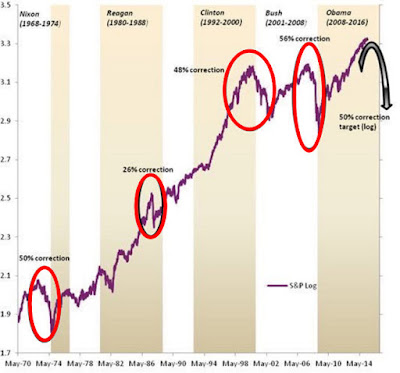
With the election decided, the burning question now is, “What next?” And, as Axioma details in their latest report, as “unprecedented” as the 2016 US Presidential election may have been, there are at least some precedents to which we can point for insights into what may now lie ahead.
Granted, the economic impact of policies introduced by Donald Trump will not be seen for many months or years. Nevertheless, we can look to other market events to get an idea of what we might expect in equity and currency markets over the near term, while the markets are still absorbing the news.
Admittedly, two examples of vote-related surprises (2000 uncertainty post-election, and Brexit) and associated market movements and volatilities, along with the example of how the market may view one of Trump’s signature issues (NAFTA agreement in Jan 1994), are hardly comprehensive indicators of what we might see in markets over the next few months; and of course, the economic impact of trade and other policies may not be known for months or years. But we believe the uncertainty and associated market volatility we have seen in the past may well come to pass again, and market volatility may become the order of the day, as the US transitions to a substantially different style of administration from the past eight years and new policies are put into place.
Read the entire article

With the election decided, the burning question now is, “What next?” And, as Axioma details in their latest report, as “unprecedented” as the 2016 US Presidential election may have been, there are at least some precedents to which we can point for insights into what may now lie ahead.
Granted, the economic impact of policies introduced by Donald Trump will not be seen for many months or years. Nevertheless, we can look to other market events to get an idea of what we might expect in equity and currency markets over the near term, while the markets are still absorbing the news.
Admittedly, two examples of vote-related surprises (2000 uncertainty post-election, and Brexit) and associated market movements and volatilities, along with the example of how the market may view one of Trump’s signature issues (NAFTA agreement in Jan 1994), are hardly comprehensive indicators of what we might see in markets over the next few months; and of course, the economic impact of trade and other policies may not be known for months or years. But we believe the uncertainty and associated market volatility we have seen in the past may well come to pass again, and market volatility may become the order of the day, as the US transitions to a substantially different style of administration from the past eight years and new policies are put into place.
Read the entire article
November 11, 2016
Making Yields Great Again: Trump Unleashes A "Bigly Rates Repricing"
The details which explain why DB, which until recently was very bullish on fixed income, is now bearish on fixed income and thinks that "Trump’s victory cements the shift in the policy mix", are as follows:
Trump’s victory is fundamentally bearish fixed income from a pure economics perspective. The key risk to the view comes from increased geopolitical uncertainty.
If Trump’s economic program is taken at face value, it would imply (1) increased fiscal spending, (2) reduced regulation, (3) a change of Fed leadership and (4) increased protectionism. Each one of these factors is bearish rates.
First, as we highlighted last week, Trump’s plan is consistent with more than 2.5% of GDP of annual fiscal stimulus over the next ten years (see table below). Of course, the extent to which the plan will be implemented is unclear. However, Trump is arguably in a strong position relative to the Republican Party and the latter controls both the House and the Senate. This should give Trump leverage to implement his fiscal plan, at least initially. Also, one of the clear statements made by Trump in his acceptance speech was that he intends to significantly increase infrastructure spending. It is worth noting that the Fed in principle welcomes more fiscal support as it sees the US economy as being constrained by a lack of demand. Given that the fiscal stimulus will occur as the US economy is close to full employment, it should have a faster spillover on monetary policy, notwithstanding the desire from the current Fed leadership to run the economy hot. Increased fiscal spending should be supportive of higher yields from a macro perspective (supports domestic demand and inflation) and from a flow perspective (reduces the supply/demand imbalance).
Read the entire article
Trump’s victory is fundamentally bearish fixed income from a pure economics perspective. The key risk to the view comes from increased geopolitical uncertainty.
If Trump’s economic program is taken at face value, it would imply (1) increased fiscal spending, (2) reduced regulation, (3) a change of Fed leadership and (4) increased protectionism. Each one of these factors is bearish rates.
First, as we highlighted last week, Trump’s plan is consistent with more than 2.5% of GDP of annual fiscal stimulus over the next ten years (see table below). Of course, the extent to which the plan will be implemented is unclear. However, Trump is arguably in a strong position relative to the Republican Party and the latter controls both the House and the Senate. This should give Trump leverage to implement his fiscal plan, at least initially. Also, one of the clear statements made by Trump in his acceptance speech was that he intends to significantly increase infrastructure spending. It is worth noting that the Fed in principle welcomes more fiscal support as it sees the US economy as being constrained by a lack of demand. Given that the fiscal stimulus will occur as the US economy is close to full employment, it should have a faster spillover on monetary policy, notwithstanding the desire from the current Fed leadership to run the economy hot. Increased fiscal spending should be supportive of higher yields from a macro perspective (supports domestic demand and inflation) and from a flow perspective (reduces the supply/demand imbalance).
Read the entire article
November 10, 2016
Everything Is Soaring As Trump Makes Buying Stuff Great Again
Who would have thought - as recently as two days ago - that a Trump presidency is the best thing for global risk? Certainly not Wall Street experts, all of whom warned of drops as big as 5% should Trump be elected.
And yet, the global repricing of inflation expectations continues at a feverish pace in the aftermath of the Trump victory, leading to another surge in US equity futures, up 15 points or 0.7% to 2175 at last check, with Asian and European stock market all jumping (Nikkei was up a whopping 6.7% after losing 4.6% the day before) after the initial shock of Donald Trump’s election victory gave way to optimism that his plans for fiscal stimulus will provide a boost to the global economy. Commodity metals soared with copper surging 4.5% to $5,658.50 a metric ton, the biggest gain since May 2013, while zinc advanced 2.1% and nickel added 2%. Gold climbed on speculation whether the Federal Reserve will raise interest rates in December.
The euphoria is largely due to the market's hopes of a burst in fiscal stimulus, aka much more debt, which while self-defeating in the long run, is providing a major boost to risk assets for the short-run, as it puts QE potentially back in the picture: after all someone will be needed to monetize the US budget deficit which is expected to once again soar under president Trump.
As Citi strategists note today, "The outcome of the U.S. election leaves the policy and macroeconomic outlook in the U.S. and globally with major uncertainties. Acknowledging these major uncertainties, we expect the new administration to pursue some deregulation, fiscal expansion, and reassess the costs and benefits of free trade. The combination of policies could be inflationary, quicken the path of Fed hikes and strengthen the dollar."
Read the entire article
And yet, the global repricing of inflation expectations continues at a feverish pace in the aftermath of the Trump victory, leading to another surge in US equity futures, up 15 points or 0.7% to 2175 at last check, with Asian and European stock market all jumping (Nikkei was up a whopping 6.7% after losing 4.6% the day before) after the initial shock of Donald Trump’s election victory gave way to optimism that his plans for fiscal stimulus will provide a boost to the global economy. Commodity metals soared with copper surging 4.5% to $5,658.50 a metric ton, the biggest gain since May 2013, while zinc advanced 2.1% and nickel added 2%. Gold climbed on speculation whether the Federal Reserve will raise interest rates in December.
The euphoria is largely due to the market's hopes of a burst in fiscal stimulus, aka much more debt, which while self-defeating in the long run, is providing a major boost to risk assets for the short-run, as it puts QE potentially back in the picture: after all someone will be needed to monetize the US budget deficit which is expected to once again soar under president Trump.
As Citi strategists note today, "The outcome of the U.S. election leaves the policy and macroeconomic outlook in the U.S. and globally with major uncertainties. Acknowledging these major uncertainties, we expect the new administration to pursue some deregulation, fiscal expansion, and reassess the costs and benefits of free trade. The combination of policies could be inflationary, quicken the path of Fed hikes and strengthen the dollar."
Read the entire article
November 9, 2016
TPP Is a Monopoly Protection Scheme, the Exact Opposite of a “Free Trade” Deal
Normally when we think of “free trade,” us lay people, we think of removing barriers to the exchange of goods and services. Removing barriers is the “free” part of “free trade.” Of course, there really is no such thing as a “no barriers” market, since even the simplest of markets always has rules, and those who write the rules are “picking winners and losers” by definition.
Consider, for example, a flea market held in the parking lot of a local fairground on a Saturday. To participate, you have to register for a space with the organizers (the parking lot isn’t infinitely long or wide), set up an approved tent or table, and usually, if your goods are sold by weight or volume, have your weights and measuring devices certified by the organizers as honest.
All of the restrictions above place limits on the “market” — put it under control of the organizers — but consider for a minute just the last one, certified weights and measures. How is that not “picking winners and losers”? Winners — Vendors with honest scales. Losers — Vendors who cheat their customers.
Or consider a flea market without that requirement. Winners — Vendors who cheat their customers. Losers — Vendors with honest scales.
A lot has been written, in fact, about the non-existence, by definition, of anything resembling a “free market,” including much by the writer Masaccio (main site here).
Read the entire article
Consider, for example, a flea market held in the parking lot of a local fairground on a Saturday. To participate, you have to register for a space with the organizers (the parking lot isn’t infinitely long or wide), set up an approved tent or table, and usually, if your goods are sold by weight or volume, have your weights and measuring devices certified by the organizers as honest.
All of the restrictions above place limits on the “market” — put it under control of the organizers — but consider for a minute just the last one, certified weights and measures. How is that not “picking winners and losers”? Winners — Vendors with honest scales. Losers — Vendors who cheat their customers.
Or consider a flea market without that requirement. Winners — Vendors who cheat their customers. Losers — Vendors with honest scales.
A lot has been written, in fact, about the non-existence, by definition, of anything resembling a “free market,” including much by the writer Masaccio (main site here).
Read the entire article
November 8, 2016
"I Just Lost All Faith In Our Deeply Corrupt Legal System And In The Rule Of Law In The US"
The FBI just gave Hillary Clinton the biggest gift in the history of presidential politics. Two days before the election the FBI has announced that they are ending their investigation into Hillary Clinton’s mishandling of classified information. After reviewing the emails that were found on electronic devices owned by Huma Abedin and Anthony Weiner, FBI Director James Comey sent a letter to Congress telling them that “we have not changed our conclusions that we expressed in July with respect to Secretary Clinton.” That means that there will be no indictment, and the path is now clear for Hillary Clinton to become the next president of the United States on Tuesday unless an election miracle happens.
These days it is unusual for a news story to hit me on a deeply emotional level, but this one sure did. When the FBI originally announced that they were renewing this investigation, it gave me a glimmer of hope that there may be a little bit of integrity left in our legal system.
But after yesterday’s announcement I have lost all faith in our deeply corrupt system of justice. America has become a lawless nation, and the rule of law is completely dead in this country.
Yes, it is true that those of us in the general public do not know what was contained in those emails, and Director Comey says that nothing significant was found in them…
In a letter to lawmakers, Comey said the FBI is standing by its original findings, made in July, that Clinton should not be prosecuted for her handling of classified information over email as secretary of State.
“The FBI investigative team has been working around the clock to process and review a large volume of emails from a device obtained in connection with an unrelated criminal investigation,” Comey said in the letter. “During that process we reviewed all of the communications that were to or from Hillary Clinton while she was secretary of State,” Comey wrote. “Based on our review, we have not changed our conclusions that we expressed in July with respect to Secretary Clinton.”
Read the entire article
These days it is unusual for a news story to hit me on a deeply emotional level, but this one sure did. When the FBI originally announced that they were renewing this investigation, it gave me a glimmer of hope that there may be a little bit of integrity left in our legal system.
But after yesterday’s announcement I have lost all faith in our deeply corrupt system of justice. America has become a lawless nation, and the rule of law is completely dead in this country.
Yes, it is true that those of us in the general public do not know what was contained in those emails, and Director Comey says that nothing significant was found in them…
In a letter to lawmakers, Comey said the FBI is standing by its original findings, made in July, that Clinton should not be prosecuted for her handling of classified information over email as secretary of State.
“The FBI investigative team has been working around the clock to process and review a large volume of emails from a device obtained in connection with an unrelated criminal investigation,” Comey said in the letter. “During that process we reviewed all of the communications that were to or from Hillary Clinton while she was secretary of State,” Comey wrote. “Based on our review, we have not changed our conclusions that we expressed in July with respect to Secretary Clinton.”
Read the entire article
November 7, 2016
Private Equity Energy Funds Did So Badly They Might Have to Do the Unthinkable – Pay Clawbacks
The law firm Akin Gump issued a warning that might chill the bones of some private equity general partners: clawbacks may be a-comin’. From the firm’s website:
In recent months, managers of private equity funds in the energy sector have been facing a scenario they likely never imagined: having to return millions of dollars of their “carried interest” earnings back to investors.
For newbies to this private equity practice, private equity funds typically pay the profit share, prototypically 20% once a target rate of return has been met. What creates the possibility of a clawback is the fact that for most US funds, the profit computation and any payouts are made every time a portfolio company is sold. By contrast, in “European” deals, the carry fees are paid only at the end of the fund’s life.
The conventional US approach, combined with strong general partner incentives to realize profits on at least some promising deals early in the fund’s life, means that the general partners can pay themselves carry fees that are more than they deserved once the impact of doggy companies, which are sold late in the fund’s life, are factored in. Hence the limited partnership agreements provide for “clawbacks,” as in the recovery of overpayments of carry fees.
Yet as we’ve written, clawbacks are almost never paid in practice. Why? First, the clawback provisions have tax language that is very favorable to the general partners, and has the economic effect that they can hang on what are excessive carry fees based on raw cash flows. Second, possession is 9/10ths of the law. In those instances where the general partner owes limited partner clawbacks, the general partner usually goes to the limited partners and offers them a special deal (details often unspecified!) on their next fund. Needless to say, this approach has the desirable effect of pre-committing those limited partners.
Read the entire article
In recent months, managers of private equity funds in the energy sector have been facing a scenario they likely never imagined: having to return millions of dollars of their “carried interest” earnings back to investors.
For newbies to this private equity practice, private equity funds typically pay the profit share, prototypically 20% once a target rate of return has been met. What creates the possibility of a clawback is the fact that for most US funds, the profit computation and any payouts are made every time a portfolio company is sold. By contrast, in “European” deals, the carry fees are paid only at the end of the fund’s life.
The conventional US approach, combined with strong general partner incentives to realize profits on at least some promising deals early in the fund’s life, means that the general partners can pay themselves carry fees that are more than they deserved once the impact of doggy companies, which are sold late in the fund’s life, are factored in. Hence the limited partnership agreements provide for “clawbacks,” as in the recovery of overpayments of carry fees.
Yet as we’ve written, clawbacks are almost never paid in practice. Why? First, the clawback provisions have tax language that is very favorable to the general partners, and has the economic effect that they can hang on what are excessive carry fees based on raw cash flows. Second, possession is 9/10ths of the law. In those instances where the general partner owes limited partner clawbacks, the general partner usually goes to the limited partners and offers them a special deal (details often unspecified!) on their next fund. Needless to say, this approach has the desirable effect of pre-committing those limited partners.
Read the entire article
November 4, 2016
"Internal Crossing" - The Unintended Consequence Of Dodd-Frank That Is Crushing Bond Liquidity And Transparency
A couple of weeks ago we wrote about the curious case of the 34-year old Goldman Sachs high-yield trader, Tom Malafronte, who has managed to make $100mm "trading" with Goldman clients so far in 2016 while somehow also complying with Dodd-Frank regulations that prevent proprietary trading. Here is what we wrote:
Back in 2010, Congress passed the Dodd-Frank Wall Street Reform and Consumer Protection Act which was intended to shut down proprietary trading desks at the big wall street banks while allowing them to hold just enough inventory to satisfy market making requirements. Which is why many are now questioning how a 34-year-old Goldman Sach high-yield trader, Tom Malafronte, managed to make $100mm while maintaining compliance with federal banking regulations. As a senior trader of Skyland Capital told the Wall Street Journal, “It goes against everything we’ve been seeing the last three years."
The gains were the work of Tom Malafronte, a managing director on the bank’s high-yield-bond desk in New York. The 34-year-old trader bought billions of dollars in junk corporate debt on the cheap starting in January, then locked in profits as prices recovered, according to people familiar with the matter.
The windfall is a throwback to a previous era on Wall Street, when big banks were more eager to step in as markets turned and bond traders took bigger risks. Those bets have become less common since the crisis. Hoping to make the financial system safer, Congress passed rules that curbed banks’ ability to wager with their own money and required them to hold more capital.
Wall Street responded by shutting down its proprietary-trading desks and shrinking inventories of securities like bonds. The government allowed banks to continue trading securities in their capacity as market makers, serving as intermediaries between buyers and sellers. Regulators have said banks must show that the amount of bonds and other securities they hold on their balance sheets don’t exceed what they need to meet “reasonably expected near-term demand.”
Read the entire article
Back in 2010, Congress passed the Dodd-Frank Wall Street Reform and Consumer Protection Act which was intended to shut down proprietary trading desks at the big wall street banks while allowing them to hold just enough inventory to satisfy market making requirements. Which is why many are now questioning how a 34-year-old Goldman Sach high-yield trader, Tom Malafronte, managed to make $100mm while maintaining compliance with federal banking regulations. As a senior trader of Skyland Capital told the Wall Street Journal, “It goes against everything we’ve been seeing the last three years."
The gains were the work of Tom Malafronte, a managing director on the bank’s high-yield-bond desk in New York. The 34-year-old trader bought billions of dollars in junk corporate debt on the cheap starting in January, then locked in profits as prices recovered, according to people familiar with the matter.
The windfall is a throwback to a previous era on Wall Street, when big banks were more eager to step in as markets turned and bond traders took bigger risks. Those bets have become less common since the crisis. Hoping to make the financial system safer, Congress passed rules that curbed banks’ ability to wager with their own money and required them to hold more capital.
Wall Street responded by shutting down its proprietary-trading desks and shrinking inventories of securities like bonds. The government allowed banks to continue trading securities in their capacity as market makers, serving as intermediaries between buyers and sellers. Regulators have said banks must show that the amount of bonds and other securities they hold on their balance sheets don’t exceed what they need to meet “reasonably expected near-term demand.”
Read the entire article
November 3, 2016
Pound Surges After UK Government Loses Article 50 Lawsuit; Brexit Needs Parliamentary Approval High Court Rules
The decision means that the U.K. must hold a vote in Parliament before starting the two-year countdown to Brexit, a panel of London judges decided, setting up a constitutional confrontation at the country’s Supreme Court. London judges deliver a decision that could be a setback for Prime Minister Theresa May’s plan to unilaterally start the process by the end of March by invoking Article 50 of the Lisbon Treaty.
U.K. Trade Secretary Liam Fox said “the government is disappointed by the court’s judgement.” adding that "The country voted to leave the European Union in a referendum established by an act of Parliament." Speaking to lawmakers in the House of Commons in London, Fox also said that "It’s right we consider it carefully before deciding how to proceed."
The UK Government seeks to appeal the ruling on December 7 at the Supreme Court.
Absent an overturn on appeal, lawmakers could now influence Theresa May's approach to Brexit and if a majority is opposed it could theoretically delay or even stop the process. Mrs. May’s ruling Conservative Party is the largest party in Parliament, with a majority of 15 seats.
More details from Sky News, which explains that according to the ruling, Theresa May cannot trigger Brexit without putting it to an MPs' vote in the House of Commons, the High Court has ruled.
Read the entire article
U.K. Trade Secretary Liam Fox said “the government is disappointed by the court’s judgement.” adding that "The country voted to leave the European Union in a referendum established by an act of Parliament." Speaking to lawmakers in the House of Commons in London, Fox also said that "It’s right we consider it carefully before deciding how to proceed."
The UK Government seeks to appeal the ruling on December 7 at the Supreme Court.
Absent an overturn on appeal, lawmakers could now influence Theresa May's approach to Brexit and if a majority is opposed it could theoretically delay or even stop the process. Mrs. May’s ruling Conservative Party is the largest party in Parliament, with a majority of 15 seats.
More details from Sky News, which explains that according to the ruling, Theresa May cannot trigger Brexit without putting it to an MPs' vote in the House of Commons, the High Court has ruled.
Read the entire article
November 2, 2016
Is ECB 'Omnipotence' "Too Powerful For Any Democracy To Abide"?
The reputation of central banks has always had its ups and downs. For years, central banks’ prestige has been almost unprecedentedly high. But a correction now seems inevitable, with central-bank independence becoming a key casualty.
Central banks’ reputation reached a peak before and at the turn of the century, thanks to the so-called Great Moderation. Low and stable inflation, sustained growth, and high employment led many to view central banks as a kind of master of the universe, able – and expected – to manage the economy for the benefit of all. The depiction of US Federal Reserve Chair Alan Greenspan as “Maestro” exemplified this perception.
The 2008 global financial crisis initially bolstered central banks’ reputation further. With resolute action, monetary authorities made a major contribution to preventing a repeat of the Great Depression. They were, yet again, lauded as saviors of the world economy.
But central banks’ successes fueled excessively high expectations, which encouraged most policymakers to leave their monetary counterparts largely responsible for macroeconomic management. Such “expectational” and, in turn, “operational” overburdening has exposed monetary policy’s true limitations.
In other words, central banks’ good reputation now seems to be backfiring. And “personality overburdening” – when trust in the success of monetary policy is concentrated on the person at the helm of the institution – means that individual leaders’ reputations are likely to suffer as well.
Read the entire article
Central banks’ reputation reached a peak before and at the turn of the century, thanks to the so-called Great Moderation. Low and stable inflation, sustained growth, and high employment led many to view central banks as a kind of master of the universe, able – and expected – to manage the economy for the benefit of all. The depiction of US Federal Reserve Chair Alan Greenspan as “Maestro” exemplified this perception.
The 2008 global financial crisis initially bolstered central banks’ reputation further. With resolute action, monetary authorities made a major contribution to preventing a repeat of the Great Depression. They were, yet again, lauded as saviors of the world economy.
But central banks’ successes fueled excessively high expectations, which encouraged most policymakers to leave their monetary counterparts largely responsible for macroeconomic management. Such “expectational” and, in turn, “operational” overburdening has exposed monetary policy’s true limitations.
In other words, central banks’ good reputation now seems to be backfiring. And “personality overburdening” – when trust in the success of monetary policy is concentrated on the person at the helm of the institution – means that individual leaders’ reputations are likely to suffer as well.
Read the entire article
November 1, 2016
Over Half A Trillion In M&A: October Mergers Smash All Records With $500.1 Billion In Deals
Last week David Rosenberg pointed out that mega Merger Manias like the one we are experiencing "invariably takes place at or near cycle peaks, as companies realize that they can no longer grow their earnings organically. We have just witnessed five multi-billion dollar deals this past week alone — $207 billion globally (AT&T/Time Warner; TD Ameritrade/Scottrade) in what has been the most active announcement list since 1999 … what do you know, near the tail end of that tech bull market too."
And now that October is officially over, we can close the books on what has been an unprecedented month for M&A. According to Bloomberg, in the month when a chill was sent through the spines of corporate CFOs and their investment bankers over fears that rates are about to rise and thus make debt-funded deals more expensive, the scramble to acquire competitors went off the charts, leading to an all time high in global M&A with almost half a trillion dollars of mergers and acquisitions announced globally.
CenturyLink Inc.’s $34 billion acquisition of Level 3 Communications Inc., as well as General Electric Co.’s deal to combine its oil and gas division with Baker Hughes Inc., pushed October’s deal volumes to about $489 billion, according to data compiled by Bloomberg. That’s the highest amount for at least 12 years, topping the previous record of $471 billion in April 2007, the data show.
Read the entire article
And now that October is officially over, we can close the books on what has been an unprecedented month for M&A. According to Bloomberg, in the month when a chill was sent through the spines of corporate CFOs and their investment bankers over fears that rates are about to rise and thus make debt-funded deals more expensive, the scramble to acquire competitors went off the charts, leading to an all time high in global M&A with almost half a trillion dollars of mergers and acquisitions announced globally.
CenturyLink Inc.’s $34 billion acquisition of Level 3 Communications Inc., as well as General Electric Co.’s deal to combine its oil and gas division with Baker Hughes Inc., pushed October’s deal volumes to about $489 billion, according to data compiled by Bloomberg. That’s the highest amount for at least 12 years, topping the previous record of $471 billion in April 2007, the data show.
Read the entire article
Subscribe to:
Posts (Atom)